

One of the remarkable features of the past couple of decades or so has been the growth of sovereign wealth funds (SWFs).Footnote 1 SWFs have attracted an enormous amount of attention in the academic literature from politics and international relations right through to economics, geography, law, and political economy. This attention has focused, in part, on the geopolitics of SWF investment. With majority and minority stakes in assets located around the globe, questions have been raised regarding to what extent SWFs are the instruments of their sponsoring nation-states with the latter’s attendant strategic geopolitical goals and objectives.Footnote 2 At issue is whether SWFs operate as vehicles of geopolitics or whether these funds should be treated like any other investment fund as regards their search for superior risk-adjusted rates of return.Footnote 3
A complicating geopolitical factor considered by Clark and Monk has been the extent to which the emergence of SWFs in global finance reflects the marked global imbalances between the West (favouring consumption over savings) and other resource-rich and trade-and-exchange-rich countries (favouring saving over consumption).Footnote 4 This is not to ignore various ancillary questions which arise, including the extent to which they are representative of long-term structural imbalances, the degree to which nations that have benefited from trade have captured the generated wealth in SWF institutions, and the fact that there are significant differences between the various types of SWFs according to their sources of funds.Footnote 5
In this article, we examine the relationship between SWFs and international politics by taking a new angle on this inquiry. In particular, we examine to what extent a government may use a SWF to exercise its responsibility towards future generations. The responsibility is often referred to as the principle of intergenerational equity. With its increased reference in both international as well as domestic legal fora, some have argued that it has begun to reach customary norm status in international law.Footnote 6
To examine this issue, we first highlight the nature of intergenerational equity as a complex principle in international law. This complexity has revolved around the fact that future generations lack legal personhood, thereby making it hard to establish a clear cause of action. After suggesting one example in which this challenge has been circumvented by placing greater onus on domestic legislatures to make intergenerational equity actionable (the Oposa case), we consider whether a SWF may be used in a similar way to execute the principle of intergenerational equity.
We take as our analytical focus the AUS$65 billion SWF known as the Australian Future Fund (FF). The Future Fund is a SWF established by the Australian government in 2006 in response, partly, to the 2002 Intergenerational Report. Although different SWFs may be motivated by different objectives, the FF is a useful case-study because of two unique and interrelated commitments made by its political sponsors.Footnote 7 At one level, its long-term mandate is framed by a commitment to intergenerational equity simultaneously managing competing claims for the spending of government revenue while conceptualizing what is meant by the long term. It is argued that this “frame” sets the terms for understanding the purpose of the fund and, in so doing, takes advantage of political support for the policy while effectively neutralizing opposition within and without the governing coalition.Footnote 8 At another level, the government made a commitment to international best practices in the governance of the institution, thereby leading other similar institutions around the world and reinforcing its commitment to the overriding purpose of the fund. These moves are argued to have been strategic in that they represent choices made with respect to competing political claims, but are underpinned by a principled approach to the inevitable claims and counter-claims for short-term political advantage.
By conducting an in-depth analysis on the governance, board structure, and long-term investment mandate of the FF, we argue that the formulation of the FF represented an active choice by its political sponsors to achieve intergenerational objectives. For example, the FF is conceived to be a long-term investor. Unlike some funds that are silent or ambivalent about their time horizons, the enabling legislation set 2020 and 2040 as reference points for realizing its goals and objectives. In addition, we show that the formal constitution of the fund reflects a series of choices made about the responsibility and accountability of board members that went beyond conventional expectations derived from trust law and pension plan governance. Recognizing that no parliament can tie the hands of future parliaments, the status and significance accorded to board members suggests that they represent a claim by future generations on current public policy. The sponsor of the FF hoped that board members would act as a more effective bulwark against short-term expediency than is often the case for pension fund trustees.Footnote 9 These arguments are illustrated in a number of ways, and refer to the choices made about the nature of investment and the exclusion of certain modes of investment that could confer significant political powers on board members.
This article draws upon a long-term research programme on the governance of financial institutions, especially pension systems. This research has focused upon the political dimensions of fund governance, the various models available that seek to reconcile expertise with representation, best-practice institutional investment decision-making, and the scope of institutional innovation in a highly uncertain world.Footnote 10 Our research is largely case-study based, utilizing the skills of field analysis, close-dialogue, and comparative institutional analysis across related jurisdictions. Inevitably, we rely upon exemplars to make our arguments; in this case, the Australian Future Fund is used to illustrate a series of general arguments about the legitimacy of public institutions that have, or seek to sustain, long-term investment mandates.Footnote 11
Two caveats ought to be acknowledged from the outset. The first concerns the account of the motives underlying the conception of the Future Fund. There are, no doubt, other ways of writing the story that dispute the significance, for example, of intergenerational equity. Likewise, whereas our story tends to treat the government of the day as a “responsible” custodian of the future, it is conceivable that the government was simply lucky rather than deliberately forward-thinking in its economic policy. Second, this article is about the principles of institutional design in relation to long-term investment. There remain, nevertheless, significant issues to be resolved if the value of the FF is to be realized over the long term. The article is less about performance before and after the global financial crisis than it is about the preconditions for effective long-term performance in the face of the apparent temptations to serve domestic interests (whether in the public or private domain).Footnote 12
I. Principle of intergenerational equity in international law
The principle of intergenerational equity has emerged over the past two decades as an increasingly important tool in contemporary international law, especially in the context of environmental protection, human rights, and economic development. The theoretical literature on intergenerational equity draws on Brown Weiss’s seminal work In Fairness to Future Generations, which articulated the principle in terms of three distinct responsibilities.Footnote 13 These are clearly set out in a later paper as follows:
I have proposed three basic principles of intergenerational equity. First, each generation should be required to conserve the diversity of the natural and cultural resource base so that it does not unduly restrict the options available to future generations in solving their problems and satisfying their own values. This principle is called “conservation of options”. Second, each generation should be required to maintain the quality of the planet so that it is passed on in no worse condition than that in which it was received, and should also be entitled to planetary quality comparable to that enjoyed by previous generations. This principle is called “conservation of quality”. Third, each generation should provide its members with equitable rights of access to the legacy of past generations and should conserve this access for future generations. This principle is called “conservation of access”.Footnote 14
Brown Weiss here identifies the principle of intergenerational equity as a geographically nuanced one. That is, the principle extends across time and space. It is inter-temporal because it is fundamentally premised on equity between past, present, and future generations. No generation should benefit at the cost of another generation. And it is spatially sensitive because it applies to communities across natural and cultural borders. In other words, it is relevant at both the “local” as well as the “global” level, hence her concept of “planetary rights and obligations”.Footnote 15
The principle has grown in relevance within international law as it has been incorporated into the text of international law instruments. However, in all cases it has been reflected in the preamble and guiding objectives of international treaties rather than in the substantive provisions of the text.Footnote 16 The Preamble to the Universal Declaration of Human Rights, for example, has recognized that “the inherent dignity and … the equitable and inalienable rights of all members of the human family is the foundation of freedom and justice and peace in the world”.Footnote 17 In this context, “all members of the human family” has been interpreted to include a temporal dimension in which intergenerational association is recognized. The Convention on Biological Diversity also makes reference in its preamble to “the benefit of present and future generations”.Footnote 18 This is extended to Article 1, which codifies as the objective of the treaty “fair and equitable sharing of the benefits” of the substantive provisions of the treaty.Footnote 19 More recently, the International Union for Conservation of Nature (IUCN) Draft International Covenant on Environment and Development explicitly sets out intergenerational equity as a fundamental guiding principle in Article 5.Footnote 20
Notwithstanding the fact that intergenerational equity has been used as an overarching principle in these instruments rather than as a substantive provision, a few commentators have suggested that intergenerational equity is beginning to be recognized as a customary norm in international law.Footnote 21 From the case-law, evidence for this view might be found in the opinions of Judge Weeramantry of the International Court of Justice. In the case of the Maritime Delimitation in the Area between Greenland and Jan Mayen (Denmark v. Norway), Judge Weeramantry referred to the principle in the context of the environment as the concept that:
[E]ach generation is a trustee or steward of the natural environment for the benefit of generations yet unborn, and … the fact that intergenerational fairness can be addressed under principles of equity in accordance with a long tradition in international law of using equitable principles to achieve a just result.Footnote 22
Reliance on this principle, however, was not decisive in this case and should be relied on with caution. A more extensive comment on the emergence of intergenerational equity was made by Judge Weeramantry in his dissenting opinion in the Nuclear Tests Case (New Zealand v. France) of 1995. In that opinion he stated:
The case before the court raises, as no case before the court has done, the principle of intergenerational equity—an important and rapidly developing principle of contemporary environmental law … The court has not thus far had occasion to make any pronouncement on this rapidly developing field … [The case] raises in pointed form the possibility of damage to generations yet unborn.Footnote 23
Judge Weeramantry’s dissenting opinion here is interesting because it acknowledges a tension within the development of the principle of intergenerational equity. Although it has been recognized as an area of important and rapid development, the application of this principle to substantive outcomes has been limited. One possible reason for this might be the difficulty in establishing a cause of action given that the legal personhood of future generations is indeterminate and that by extension it may be difficult to calculate the direct damages they have suffered. This point has been hinted at by jurisprudence theorist John Austin. Distinguishing between the notion of absolute duties from legal rights, Austin made the following comment:
If the obligated behaviour of one individual does not refer to a specifically designated other individual … but refers only to the legal community as such, then … one is satisfied … to assume a legal obligation without a corresponding reflex right.Footnote 24
Future generations arguably fall into a legal community rather than a set of specifically designated individuals. Although advocates of intergenerational rights would argue that this too heavily discounts the moral commitment owed to them by present generations, it may in part explain the difficulty courts and treaty-makers have had in stipulating defined legal rights and entitlements to the future.
The difficulty in enforcing substantive outcomes for intergenerational equity through international law instruments as discussed above suggests that more fruitful legal instruments can be found elsewhere. More specifically, domestic law may be a useful domain in which to consider the application of intergenerational equity. A precedent for this can be found in the 1993 Philippine Supreme Court case, Minors Oposa v. Secretary of the Department of Environment and Natural Resources (Oposa v. DENR).Footnote 25 Here, the Philippine Supreme Court permitted a class action brought by Filipino children on behalf of themselves and future generations to stop logging approvals granted by the Secretary of the DENR. The court decided in favour of the plaintiffs and required the Secretary of the DENR to cancel existing Timber Licence Agreements and restrict any new applications. The significance of this finding has been in dispute. Although some have argued that the case recognized the standing of future generations to sue, Gatmaytan has argued that this statement was in fact obiter dictum and is therefore not a legally binding precedent.Footnote 26 He argues that the cause of action was founded on domestic legislative instruments which were not properly executed: Article 2, section 16 of the Constitution, Executive Order No. 192 of 1987 (creating the DENR) and the Administrative Code of 1987. In particular, the Constitution stated that “the State shall protect and advance the right of the people to a balanced and healthful ecology in accord with the rhythm and harmony of nature”.Footnote 27 In its decision, the majority concluded that issuance of logging permits by the Secretary of the DENR was in breach of this duty and thereby gave rise to a cause of action against the defendants.
The Oposa case has significant implications for intergenerational equity, but arguably for different reasons than initially reported. Rather than standing for the circumvention of the legal difficulties in intergenerational rights, the case suggests that intergenerational obligations can be defended through the use of domestic law instruments. As Gatmaytan argues, “the Constitution [was] no longer merely a policy declaration but an actionable right”.Footnote 28 Indeed, by realizing the principle of intergenerational equity through duties imposed upon a statutory organization, Oposa affirms the role of the legislature as the defender of intergenerational equity. This outcome is, in fact, not too dissimilar from what Brown Weiss appears to be advocating in the following passage:
Virtually every policy decision of government and business affects the composition of future generations, whether or not they are taken to ensure their rights under the guidelines enunciated above. Decisions regarding … economic policy, the relative prosperity of different regions and social groups, transportation, health, education—all influence the demographics and composition of future generations.Footnote 29
These comments are important because they suggest a novel way in which the emerging customary norm of intergenerational equity can be “actionable”: through the domestic legislature. Through the actions of the legislature, it can be argued that the international policy objections of intergenerational equity which are widely recognized can have substantive impact whilst avoiding the technical difficulties of establishing a cause of action in alternative legal fora.Footnote 30
These rights, it could be argued, do not merely extend to environmental and human rights actions. Certainly, in the context of international treaties, references to intergenerational equity have been most explicit in the context of the environment and human rights as signalled above. Furthermore, within Australia, the principle of ecological sustainable development, which has gained strength as a common law principle as well as in environmental and planning regulation, gives support to the notion of intergenerational equity.Footnote 31 However, the articulation of the intergenerational principle as stated by Brown Weiss and others above gives licence to a broader view of society’s obligations to the future. These might include aged health, pension fund liabilities, and climate change responsibility, amongst others, which add to the richness and complexity of intergenerational equity as a customary norm in international law.Footnote 32
Having set out how the emerging norm of intergenerational equity might be actionable through domestic law instruments, the remainder of this article focuses on the particular application of this principle within the instrument of the Australia SWF. In the next section, we focus on the political, economic, and governance context which created the preconditions for a SWF in Australia as well as a number of other resource-based economies over the last two decades of economic boom. We examine the choices faced by the political class during this period and highlight the extent to which the investment of these commodity-linked revenue streams demanded a judgement on the timeframe for the public (and private) return on investment. This in turn reflects the application of the principle of intergenerational equity in the context of national law-making. As we will argue in the subsequent sections of this article, this is not only novel in a legal sense but also from a financial funds management perspective.
II. Temptation, principles, and practice
The Future Fund was conceived in Australia in a climate where short-term returns on investment arguably earned a premium over long-term benefits. This is as much an economic comment reflecting the booming commodities and resource base of the Australian economy as it is a political comment on the myopic concerns of the political class and voting public. It represented a time when the growth of China, India, and the oil-rich countries of the Middle East were fuelled by economies which exported natural resources to these economies.
The policy-makers in these latter countries faced a dilemma: they could treat their foreign earnings as recurrent revenue but suffer the political consequences should (when) the bubble burst or they could “park” the assets in special-purpose long-term investment vehicles but suffer the short-term political costs of ignoring the claims of entitlement by organized domestic interests. In modern democracies, subject to the ups and downs of electoral cycles, the short-term political advantages of spending windfall earnings are readily apparent; it is also apparent that the beneficiaries of long-term investment are often not represented in the political process. Put more formally, the democratic political process heavily discounts the future—the discount rate being the product of the length of the political cycle, the degree to which sectional interests underwrite the power of governing parties, and the synchronization of the political cycle with the economic cycle.Footnote 33 Managing temptation against long-term commitment is one of the staples of political theory and philosophy and was discussed by the ancient Greeks as the tension between passion and reason.Footnote 34
It is also apparent that conventional economic theory also discounts the future, denying the relevance of sunk costs and thereby reinforcing the predilections of politicians in favour of short-termism. In part, the choice of a high discount rate reflects rather simple-minded assumptions about how people properly behave—generalizing from everyday behaviour to issues large and small that can be shown to have, nonetheless, long-term consequences for their children and grandchildren. Equally, some analysts have argued that a commitment to the future is too vague and implies a historical contingency to behaviour that runs against the grain of current methods of economic optimization (as evident in the economic debate over pricing climate change and the proper weight attributed to the future).Footnote 35 Laslett captured this sentiment in the following statement: “time present is always sovereign, in respect to what is gone by, and of what is still to come”.Footnote 36
The degree to which the costs of short-termism loom large depends, in part, on the degree to which political elites expect to be directly accountable when these costs come due. In effect, they must find robust and convincing ways of separating the short term from the long term such that the latter does not, under pressure, always collapse into the former. At one level, this problem can be seen as an issue of rhetoric—that is, an issue of convincing political constituencies that the favoured solution is plausible and beneficial to future generations as suggested by Wolfe.Footnote 37 For some analysts, rhetoric is naturally associated with hypocrisy in that any such solution involves some form or another of duplicity or worse. At another level, though, scepticism is the natural antidote to political hypocrisy—politicians must mobilize constituents’ interests in ways that evidently govern their self-interests while holding out a solution to acknowledged temptation on both sides of the equation.Footnote 38
Noting temptation, Robert Nozick pointed to the advantages of a principled approach to political decision-making: “principles constitute a form of binding” ourselves to the future and are especially effective when chosen principles are characterized by “generality, no proper names, and no positional predicates”. A freely chosen principle which transcends the specific claims of an individual or a group as well as the exigencies of the moment will have the legitimacy to “constrain the influence of undesired or irrelevant factors” in favour of a commonly accepted goal or objective.Footnote 39 If long-term investment is legitimated with reference to a principle or overriding goal that transcends the claims of special interests, such a principle may effectively “constrain” the temptation of giving in to claims for current consumption. For Nozick, this logic was not only a normative proposition about the proper role of institutions, it also reflected the customary practice of many people being self-conscious about the (self-defeating) costs of temptation.Footnote 40
Of course, a principled approach to governing temptation can be accused of being overly abstract and effectively “empty” when faced with the real world of reciprocal relationships.Footnote 41 Nozick observed that a principled approach to governing temptation depends upon four strategies or practices. In the first instance, the choice of an overarching principle must be justifiable. That is, it must be explained and debated so that whatever residual disagreement remains is effectively neutralized (if not denied) when implemented. In the second instance, the chosen overarching principle must be recognized as such, becoming a reference point for public discourse and thereby being accepted as a reason to “trump” the claims of special interests. Third, policy-makers must be shown to have made a commitment to the principle, thereby translating often distrusted political rhetoric into accepted policy practice. And fourth, there should be clear instances of adherence to the principle such that the public comes to expect it to govern behaviour (their own included) when dealing with the relevant issues.Footnote 42
In what follows, it is suggested that the political sponsors of the Future Fund invoked a principle-based approach to the establishment of the fund. They did so cognizant of latent political support amongst core supporters of the then governing Liberal Party for managing the looming costs of an ageing society while recognizing the pressures within the governing coalition and the incentives faced by the Labor opposition to distribute the windfalls due to trade and privatization for short-term political gain. The government did so in a strategic manner.
But, by adopting a principle-based approach, it gave life to Thomas Scanlon’s argument to the effect that the “social contract” that binds people together now and in the future is based on “principles which no one could reasonably reject”.Footnote 43 This strategy was conceived in the context of pressing macroeconomic issues and was implemented through a fund governance regime that promises to hold the government of the day accountable to the principled approach to policy-making.
In the next section we examine the specific context which the political sponsors of the Future Fund in Australia faced. We argue that the fund’s formation brought to life a principle-based approach to intergenerational equity in the context of public pension fund liabilities. In this way it represented an example of using domestic legislation to codify the hard-to-apply principle of intergenerational equity and as such has helped to enlarge its significance.
III. The context of the Australian future fund
Notwithstanding the importance of macroeconomic reforms made to the Australian economy under the Hawke and Keating Labor governments between 1983 and 1996, the Australian economy has benefited over the last two decades from a significant growth in the demand for non-renewable resources by the world’s emerging economies. This resource boom helped repair what Peter Costello, the Treasurer of the Commonwealth of Australia over the period 1996 to 2007, has described as the parlous budgetary position of the government when he assumed office. Costello has argued that the Australian economy in 1996 faced a shrinking tax base against planned expenditures and steep political difficulties in carrying through the management of the economy in the face of global economic and financial instability.Footnote 44
Notwithstanding these circumstances, the Australian government managed to return seven budget surpluses through to 2004. Whereas austerity was Costello’s initial budget strategy, by 2001 tax revenue had begun to grow faster than expected on the back of the export of raw commodities such as coal and iron ore to North-east Asia. So significant was the inflow of tax revenue that the Australian government was able to retire most of its inherited debt by 2004. In fact, the government decided not to retire all its debt only because of concerns over the consequences of such a move for the efficient pricing of domestic financial securities. Instead of paying down all debt, the government decided to collect its growing receipts into an arm’s-length investment fund—the Future Fund—for the stated purpose of funding the costs of unfunded defined benefit pension liabilities associated with federal government civil servants. Even with the closure of the scheme to new participants in 2006, it was estimated that the costs of such pensions would reach AUS$140 billion by 2040.Footnote 45
The governing Liberal Party was dependent upon on a coalition with a small party based upon rural interests for its majority in the House of Representatives and the passage of legislation through the Senate. Also, because of competition between the Treasurer and the Prime Minister for power within the governing coalition, and deepening poverty in certain pockets of major cities, “responsible” national financial management was contested at each phase in the transition from budget “crisis” to establishing the Future Fund. Notwithstanding the windfall in tax revenue, the government was constrained in spending its “surplus” revenue for two reasons. When elected, the Liberal government devolved responsibility for interest-rate setting to the Reserve Bank of Australia (anticipating the UK Labour government’s 1997 action). The Reserve Bank proved to be a strong player in macroeconomic policy, willing to increase and decrease interest rates at any stage in the electoral cycle. This “external” discipline empowered the Treasurer in dealing with colleagues’ claims for increased government spending given the ever-present threat of inflation (see Figure 1).
CPI and Housing Investment (Australia, 1990–2007).Footnote 46

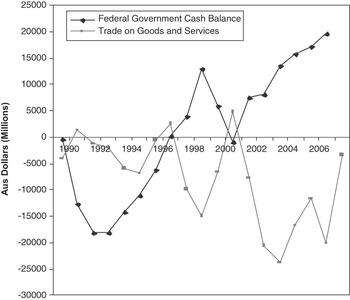
Also important was the fact that the Australian economy was rather small relative to the growth in export revenue; this is not an argument about economic immaturity but one about the inability of the economy to absorb the volume of exogenously generated wealth. As unemployment dipped to historical lows, as real income began to grow, and as property prices took on expectations of growth well beyond acknowledged shortfalls in supply in regional markets, government saving through budget surplus and the paydown of debt were the obvious options for reining in burgeoning domestic demand (see Figure 2). The increasing value of the Australian dollar against the US dollar and, to some extent, European currencies, did little to dampen domestic demand. In this sense, the creation of a SWF to store “excess” national wealth may have become government policy for macroeconomic reasons rather than for achieving the stated purpose of funding long-term pension liabilities.
Australian Trade and Government Accounts (1990–2007).Footnote 47

Here, though, a further issue loomed large. Whereas many countries that created SWFs over the past twenty years did so in the hope that such an institution would also stimulate the development of their financial systems, Australia has a highly developed financial market with large financial institutions and deep liquidity provided, in part, by the compulsory second-pillar defined contribution pension system. From a modest beginning in the mid-1980s, the growth in superannuation contributions, the returns generated by improving markets over the late 1990s through to the global credit crisis, and the concentration of assets in a relatively small number of large cost-conscious providers, saw financial assets grow from 30 percent of GDP in 1980 to approximately 130 percent of GDP in 2007. Further, anticipating developments in other Western countries, reforms to federal financial regulation through the 1990s combined with a robust national competition regime were conceived so as to encourage innovation across the financial sector while protecting against market volatility.Footnote 48 The FF was not, however, designed to be a lender of last resort should the national financial system be adversely affected by global financial events.
In fact, the Future Fund was formed in the context of a sophisticated and growing domestic financial system with unrestricted access to global financial markets (as evident in the growth of global infrastructure investment groups). With an initial endowment provided by the government, combining tax receipts with its share of the outstanding stock of the privatized telco (Telstra), it could claim the interest of leading investment houses without dominating the domestic financial system. Further, as noted below, its long-term mandate provided a rationale for investment management rather different from that apparent in the hurly-burly of the short-term competition for assets amongst the large pension providers. With his decision to locate the fund in Melbourne rather than Sydney (the largest Australian city and most significant financial centre), the Treasurer exercised his residual power over his Sydney-based rival—the Prime Minister—to reinforce the place of his “home” city in the global economy.
By this account, the Future Fund was the product of national macroeconomic management, fortuitous global circumstances, and the strategic management of political interests that would have otherwise spent the largesse of economic growth in the highly contested short-term Australian political cycle. As such, the notional object of the Future Fund—federal government unfunded defined benefit pension liabilities—was a debt of convenience rather than the rationale for establishing the fund. In less fortuitous macroeconomic circumstances, it is doubtful whether the government would have been willing or able to sequester such financial resources. As the gathering global financial crisis has come to dominate the Australian economy and government finances, the Future Fund has also become the object of claims made on behalf of current taxpayers to discount the costs of the recession.
It is arguable that the legitimacy of the Future Fund was underwritten by a more substantial claim than macroeconomic imperatives and expediency. In an interview, the previous Treasurer Peter Costello made an explicit link between the Liberal government’s early commitment to intergenerational accounting and the full funding of long-term federal superannuation obligations, arguing that the expected value of those obligations was such that they would be an unjustified burden on the welfare of future generations. In the first Intergenerational Report of 2002, produced as a Budget Paper for 2002–03 and presented in Parliament by the Treasurer, the government emphasized the long-term prospects for Australia in the context of an ageing society, declining fertility, and the sensitivity of immigration to economic conditions.Footnote 49 In doing so, the government matched concerns expressed by the World Bank and amplified by other multilateral institutions over the 1990s that the then current government spending and the expected value of future entitlements may not be economically sustainable.Footnote 50
The implications of this proposition for government finances have been used to scrutinize the current funding and long-term sustainability of countries’ social security and health-care systems.Footnote 51 It became an essential reference point for the reform of many countries’ pensions systems, and was especially important in continental Europe.Footnote 52 In Australia’s case, however, pension reform had taken place in the 1980s with the adoption of a compulsory second-pillar pension system and a compulsory national health care insurance scheme. Nonetheless, three related implications for government finances were drawn from the 2002 Intergenerational Report. First, the management and paying-down of current debt was an essential ingredient in planning for the future; second, Australia’s international competitiveness depended on maintaining its reputation as a “lower taxing and spending country”; and third, promoting long-term economic growth was crucial if the expected costs associated with an ageing population were to be met without impoverishing future generations.
The logic of intergenerational accounting is explained in Auerbach, Kotlikoff, and Leibfritz,Footnote 53 in their early work, separately and together,Footnote 54 and is applied to Australia by Ablett.Footnote 55 In summary terms, intergenerational accounting applied to government expenditure can be imagined as based upon four principles: transparency, comprehensiveness, discipline, and a distinction between current spending and investment. Transparency refers to itemizing and accounting for the cost of current and future commitments; comprehensiveness refers to a full accounting of all obligations whether “on-the-books” or not; discipline refers to the political temptations of engaging in spending policies that carry moral hazard; and, the distinction between spending and investment refers to allocating the burden of paying for different types of public goods where the costs and benefits of investment may be distributed far into the future. In their international comparison of generational balances, Kotlikoff and Leibfritz concluded that Australia, like a number of other countries, faced a “substantial imbalance” favouring current generations over future generations.Footnote 56
Foreshadowing the legislation establishing the Future Fund, the Treasurer, in an answer to a question in Parliament, observed that the Future Fund was “designed to fund Australia to meet the costs of the ageing of the population” and “in particular, unfunded superannuation liabilities”. In doing so, Costello invoked a principled approach to policy-making augmented by his hard-earned reputation for fiscal responsibility over the past decade. Though silent on the specific constituency to which his argument was addressed, it appears he appealed to core supporters of the Liberal Party, specifically the retired and the baby-boom generation who were the beneficiaries of the previous decade of rising incomes and house prices. Although the Labor opposition noted that this initiative was accompanied elsewhere in the budget with superannuation reforms and tax concessions aimed at those constituents, they focused on the logic of the initiative rather than antagonizing voters who it would have to win over at the pending election.
To emphasize the significance of the initiative, Costello contended that the “Commonwealth’s unfunded superannuation liabilities (were) at the moment AUS$90 billion” and were “expected to grow by 2020 to AUS$140 billion”.Footnote 57 These figures were disputed in both the House of Representatives and the Senate. Tanner, the Labor Party spokesman on finance, argued in the House that the percentage share of government outlays due to superannuation was just a “couple of points” and would not likely grow to more than 3.5 percent.Footnote 58 In the Senate, it was claimed, in fact, that by 2041 these liabilities would halve in value against expected GDP.Footnote 59 For Tanner, unfunded obligations could be paid for out of future economic growth encouraged by a Future Fund focused upon “investment in infrastructure”.Footnote 60
At issue for Tanner and the Labor opposition (which won the late 2007 federal election) was whether the establishment of an investment fund would be an effective way of realizing the future value of what they deemed to be windfall gains from the “spectacular boost in commodity prices driven by demand in China”.Footnote 61 There were other options, including passing on the initial allocation of AUS$18 billion to a combined federal government employees’ pension fund, thereby using the administrative and investment resources of the existing defined contribution scheme to manage the defined benefit liability. The government, however, sought to distinguish between individual account-based pension fund investment and the liabilities associated with defined benefit schemes, arguing that the governance of these schemes was not compatible.Footnote 62 It was also contended that the Future Fund would not perform any better than the long-term government bond rate, in which case it would be better to use the assets to sustain the infrastructure necessary to realize a higher overall rate of economic growth. The government suggested that the Labor Party’s claim for infrastructure was “code” for pork-barrel politics.
The possibility that Future Fund assets could be subverted by special interests was raised on both sides of the House. For this reason, the government’s enabling legislation excluded the fund from directly owning real assets like property and infrastructure. Nonetheless, the Labor opposition thought that even this provision could be “very easily circumvented” using “modern financial instruments” and suggested that the coalition partners, the National Party, would find ways to raid the fund “for political purposes”.Footnote 63 Both sides of the House agreed that the governance of the fund was to be a crucial bulwark against political temptation and the means by which the fund’s assets would be properly managed on behalf of future generations of Australians. Time and again, the principle was invoked to frame the terms of the political debate.
IV. Best-practice governance
Throughout the passage of the Future Fund legislation, consideration was given to the proper governance of the fund.Footnote 64 The government referred to expert advice on this matter received from a number of sources including the international investment and pension fund consulting firm Towers Watson. This company had led industry consulting on the issue, with recent published research on best-practice investment management.Footnote 65 Our research has established a 12-point criterion for evaluating standards of fund governance, including a set of three issues sensitive to both the size of funds (asset value) and the goals and objectives of the sponsoring institutions. It should be noted, moreover, that while these standards were framed with reference to pension funds, endowments, and related beneficial institutions, the criteria established were intended to apply to a wide variety of investment institutions, including SWFs.
The design of an institution for a new function is a rare event. More often than not, institutions, once created, claim new responsibilities carrying with them the compromises and conditions at the time of establishment, amplified or dampened by experience.Footnote 66 In this case, the government took the opportunity to follow industry best practice without an obligation to match or copy established pension funds. The resulting governance framework and management structure has been assessed and scored by a number of commentators. For example, Truman gave the fund a score of 26.5 out of a possible 33, suggesting that its governance regime was, perhaps, less effective than a number of other similar institutions (such as the Canadian CPPib and CalPERS) but far more effective than other non-pension related SWFs (especially those from Asia and the Middle East).Footnote 67 Notwithstanding the recent establishment of the fund, Truman indicated that there were some shortfalls in governance in the reporting of investment activities.Footnote 68
Scoring is a useful means of institutional comparison. But to the extent that scoring seeks to be all-encompassing in terms of the criteria used to judge form and functions, scoring tends to weigh equally both more and less important criteria. Also, in using a common format for scoring each criterion, the distinctive characteristics of different funds may be ignored, notwithstanding the apparent commonalities shared by institutions. More problematic, however, is the assumption that scoring is meaningful without a deep understanding of each and every fund. Using the best-practice framework developed in Clark and Urwin as a reference point, we also scored the FF and gave it a score of 12.9 out of 15, a score that placed it amongst the very best institutions that we know and have evaluated.Footnote 69 Using this framework, we emphasize certain aspects of the Future Fund that are innovative with reference to comparator institutions.
In the best-practice framework, elements of “good” governance were arranged under three headings: institutional coherence, referring to the framing of investment decision-making; people, referring to those responsible and involved in decision-making; and process, referring to the mechanisms by which investment is managed and implemented. Elsewhere, this framework is developed by focusing upon the resources of governance and the role of leadership in rationalizing the management of investment under risk and uncertainty.Footnote 70 For present purposes, we emphasize certain aspects of the three elements of good governance, especially the clarity of the fund’s mission statement (institutional coherence), the size and composition of the fund board (people), the role of board members in relation to the real-time execution of investment management, and the choice made to manage investment through a network of external providers rather than manage assets internally or through a mix of internal and external management (process).
The mandate of the fund was set in the legislation (February 2006) and is found in detail in the first Ministerial investment mandate or directions issued in May 2006. As set out in Section 15 of the Act, the “main” objective of the fund is to “enhance the ability of the Commonwealth to discharge unfunded superannuation liabilities” subject to Section 18 wherein (1) “the responsible Ministers may give the Board written directions about the performance of its [the fund’s] investment functions”, and (2) in doing so, “responsible Ministers must have regard to: (a) maximising the return earned on the Fund over the long term, consistent with international best practice for institutional investment; and (b) such other matters as the responsible Ministers consider relevant”. In the Investment Mandate, the benchmark rate of return was set at CPI plus 4.5 to 5.5 percent subject to a long-term asset allocation strategy and an acceptable level of risk “measured in terms such as the probability of losses in a particular year”. A series of conditions were set, including ensuring that the fund did not adversely affect the efficient functioning of Australian financial markets.
In these ways, the mandate of the fund was set in principle and in practice. The objective was unequivocal and the investment process was given a behavioural logic (maximizing returns), a strategic template (long-term asset allocation and risk management), and a return target (range of returns). As such, the investment mandate matched similar frameworks found in other countries amongst pension-related investment institutions (see, for example, CPPib and MassPRIM).Footnote 71 The mandate also gave clear guidance as regards avoiding, as much as possible, adverse outcomes that may have political costs for the government sponsor. For example, the Board was required to limit yearly reported losses, minimize the effects of its actions on Australian stock markets, restrict holdings of domestic companies’ stock such that it does not trigger Australian takeover rules and regulations while also limiting its holding of foreign-listed firms’ common stock to no more than 20 percent.
The enabling legislation also established the Future Fund Management Agency, an entity operating within the ambit of the federal government and “responsible for assisting and advising the Board”. This Agency is, effectively, the operational arm of the Board subject to the direction of the Chair of the Board as Head of the Agency. The enabling legislation simply set out the functions of the Agency such that Section 75 detailed seven such functions while allowing for other functions incidental to the performance of those enumerated functions.
In terms of its operational role, the Board published in November 2008 its first statement of objectives as regards the investment approach of the Future Fund Management Agency.Footnote 72 Here, five points were made. First, that the Agency would emphasize long-term, total portfolio risks rather than asset-specific risks (assuming the long term is ten years). Second, the Agency acknowledged the limits of relying upon historical data on risk and return, especially over the long term. Third, given the long term, the Agency would ensure portfolio diversification in relation to key macroeconomic indicators such as inflation, growth, and market liquidity. Fourth, rather than rely upon asset classes, the Agency would use strategies such that asset classes would be the components of long-term investment. And fifth, the fund would take advantage of its long-term time horizon in being the “investor of choice” for third parties. To realize these objectives, the Board decided not to become an institution with its own investment capacity (unlike the CPPib) but rely upon the market for investment management.
V. Board structure and responsibility
Perhaps the most important innovation in the governance of the Future Fund came with the size and composition of the Board and the government’s conceptualization of its responsibilities: Board members were deemed “guardians” rather than trustees. In countries with a strong English common law heritage, members of pension fund boards are trustees in that they act as fiduciaries with respect to the interests of beneficiaries. In many jurisdictions, pension fund boards combine representation with expertise—board members are selected on the basis of the stakeholder group they represent and the expertise they may bring to board deliberations.Footnote 73 In defined benefit plans, this dual role or function can produce quite large boards with rather heterogeneous skills and expertise. In some jurisdictions, the premium on representation in multi-employer public sector plans can result in boards with as many as fifteen to twenty-one appointed members. Not surprisingly, there can be significant co-ordination problems with such boards, especially where large numbers encourage the shirking of responsibilities and grandstanding in deliberations.Footnote 74
In theory, at least, the optimal number of members of boards that rely upon collegial or collective decision-making is in the order of five to seven, with an independent chair.Footnote 75 As for the Future Fund, the Board has six members with an independent chair appointed by the government rather than elected from within the Board. The chair was appointed in the first instance for five years, while three Board members were selected for an initial three-year term and the other three for an initial five-year term. It is anticipated that, if desired by the Board members, the group of three appointed for three years will be reappointed. Ideally, the term of appointment will be five years with renewal on the basis of a performance review.
Research on the competence and consistency of pension fund decision-making suggests that effective investment decision-making under risk and uncertainty depends on board members’ skills and education.Footnote 76 It would appear that experience without formal training, and general knowledge of the field without task-specific experience, means that many boards are unable to deal with the contingency of financial markets.Footnote 77 By statute, to be eligible for appointment as a Future Fund Board member, such persons must have “(a) substantial experience or expertise; and (b) professional credibility and significant standing in at least one of the following fields: (c) investing in financial assets; (d) the management of investment in financial assets; (e) corporate governance”.Footnote 78 In many jurisdictions, there are no such “qualifications” to be a trustee. Instead, trustees are simply required to act in a prudent manner consistent with common sense.Footnote 79
In an interview, Peter Costello observed that, all things being equal, Board members could come from a variety of states and meet community expectations as regards diversity. Crucial, though, was the expectation that Board members would have the presence of mind and independence of thought to stand against the government of the day to protect the integrity of the Future Fund. As acknowledged on both sides of the debate in parliament, governments will be tempted to influence investment decision-making and siphon off assets for their immediate political advantage. Being appointed a “guardian” is to stand guard against short-term political interests, a mandate for behaviour that references community norms and expectations and that goes well beyond the requirements of simply being a “professional”.Footnote 80
In a number of ways, the government sought to protect Board members from immediate political affect, and sustain their legitimacy. So, for example, the term of appointment of five years with the prospect of renewal was expected to sever the link with the short-term political cycle. The required expertise of Board members and the presumption in favour of their independence from political commitment was deemed to match the successful “reform” of the Reserve Bank of Australia initiated by Peter Costello in his first year of appointment as federal Treasurer (emulated by the UK Labour government with respect to the independence of the Bank of England). The small size of the Board, the premium on expertise and experience, and the personal accountability of Board members for investment strategy may enable the development of a collective sense of guardianship oftentimes missing in large pension fund boards wherein the competing claims of various represented interests can lead to consensual decision-making such that dissent is registered by silence or the search for the lowest common denominator.Footnote 81
Crucially, the Future Fund is not a pension fund in two respects. If nominally established to meet the long-term superannuation liabilities of the closed Commonwealth defined benefit plan, participants in the plan have no claim on the assets of the Future Fund. Their pension entitlements remain a claim on the plan sponsor (the Commonwealth government) and its future tax receipts. The plan is “unfunded” and is administered as a pay-as-you-go system with the prospect of “funding” from 2020. As such, the pension entitlements of participants are not reliant upon the performance of the Future Fund. One implication of this arrangement is that risk management is not a function of short-term and long-term asset-liability matching. Risk management is important, but not in the same sense as existing pension plans.Footnote 82 In this respect, the Future Fund is an investment platform much like the Canadian CPPib, shorn of responsibility for administering the underlying pension fund and focused exclusively on maximizing the rate of return subject to an appropriate level of risk. It has certain advantages over the CPPib, including its explicit long-term mandate.
Also important is the fact that the Future Fund exists, and will continue to exist, at the will of the government of the day and ultimately parliament. Time and again in debate it was observed that “a parliament can not commit a future parliament legislatively”.Footnote 83 In essence, other than the contractual commitments made by the fund to investment providers, a future parliament could alter the form and functions of the fund and indeed close the fund and claim the assets. By this logic, the responsibility of the guardians is a responsibility to future generations of taxpayers to ensure that the best intentions of the government in establishing the fund are honoured notwithstanding the legitimacy of future claims that might be made on those assets for other reasons and other uses. Guardians may act like trustees in that they act as fiduciaries. Nonetheless, their commitment is to the future welfare of Australians, not the entitlements of plan participants.
VI. Long-term investment
Given the significance of intergenerational equity for the establishment of the Future Fund, it is clear that the fund will be held to account for its contribution to the welfare of future generations of Australians. This is a rather abstract time horizon although the period through to 2040 (the date when the payment of superannuation benefits will likely conclude) could be thought to encompass two or perhaps three future generations: those born but not yet taxpayers, those to be born through to 2030, and those to be born after 2030. To the extent that the Future Fund enables future governments to release scarce resources for investment in the development of Australia, thereby doing more than simply paying the retirement benefits of retirees, it is also arguable that investment in the fabric of economic development will benefit generations born beyond 2030.
More specifically, the long term was formally identified in the government’s commentary on the enabling legislation as 2020 (the likely date when the balance of income and benefit payments is likely to switch to net outflow) and 2040. The latter date has a degree of certainty because the plan is closed to new members; while benefits may accrue, mortality tables can give reasonable though not entirely dependable estimates about the expected longevity of plan participants. While obviously important, neither the claims of future generations nor the plan “trigger” dates are operational definitions of long-term investment. In this case, the Board considered the various options and chose ten years as the effective long-term time horizon for planning investment risk-adjusted rates of return. Given the short-time horizons of Australian super funds, being largely preoccupied with quarter-to-quarter returns, it is arguable that the Future Fund has no obvious Australian peers. Its peers are large pension-related SWFs from other countries.
The Board also decided to pursue an absolute return strategy subject to an explicit risk budget rather than use industry or institutional benchmarks. This issue was debated at length by the Board—benchmarks are standard practice in the investment management industry.Footnote 84 However, it has been observed by industry commentators that benchmarking can encourage backsliding on any commitment to invest over the long term.Footnote 85 In any event, since the Future Fund relies upon the financial market for investment management, to use yearly or even tri-annual benchmarks would likely reinforce the short-termism and predilections for churning portfolios observed in the industry.Footnote 86 Here, the Future Fund’s risk budget is the governing instrument and is set in relation to long-term economic movements in the desired balance between asset classes. Note, though, that the Board is inevitably sensitive to short-term volatility in the fund’s performance because of the questions that might be prompted about its underlying competence and success.
Whether the long term is defined by reference to generations, the onset of expected liabilities, or operational targets, ten years out is a highly unusual time horizon. It is a time horizon sensitive to structural change, technological innovation, and demographic transformation. As such, the implication is plain: if acted upon, investment is about placing bets on the map of global climate change, the winners at the frontier of technology and innovation, and the place of Australia in relation to the global economy. The convergence of these themes in financial product offerings is in its nascence and entrepreneurial fund managers are only now beginning to develop investment strategies responsive to emerging trends in technology, climate change, and Australian innovation.Footnote 87 At the same time, the long term is also sensitive to the pace of global economic integration and the stability of financial markets. Whether prompted endogenously or through the process of corporate offshoring and outsourcing from advanced economies, global economic integration over the past few decades benefited Asian, Latin American, and (to an extent) African countries.Footnote 88 In this respect, a ten-year time horizon could encompass two or three economic cycles, a boom and bust, and a global crisis. A ten-year time horizon is also sensitive to the global co-ordination of economic regulation as well as the degree to which one kind of regulatory regime for a block of countries may, or may not, be a “winning” model over other kinds of regulatory regimes. La Porta et al.’s maps of finance may be a template for fund investment.Footnote 89
Whereas the implied scope of a rolling ten-year investment programme is structural and global, it is also entirely plausible that since the fund is one of just a few institutions with such scope of activity, it has, as a consequence, some responsibility for contributing to the realization of long-term economic, social, and environmental goals. More to the point, in the second Intergenerational Report of 2007, the government sought to establish a connection between the apparent goal of fiscal sustainability introduced in the first Intergenerational Report and the “wellbeing of successive generations” which “requires sustainable economic, social and environmental conditions”.Footnote 90 In doing so, the overarching principle legitimating the Future Fund was extended to include long-term social and environmental conditions—points of reference not included in the more limited initial financial conception of intergenerational equity.Footnote 91
This suggests, however, a broader set of responsibilities for the Future Fund than that set out in statute and by the initial Investment Mandate. Whereas it is clear that the long-term investment horizon of the fund will involve taking bets on the map of climate change, the second Intergenerational Report suggests that the fund has, as well, an obligation to ensure that its investments are “sustainable” in the sense that either these commitments do not harm the prospects of future generations or contribute to the cultural, social, and ecological heritage that we pass from one generation to the next.Footnote 92 If challenging in terms of its scope and implied obligations, long-term investment involves much more than exploiting the map of opportunities. Indeed, Brown Weiss has suggested that we (the current generation) are the trustees for future generations and as such “have a fiduciary obligation to conserve this heritage for future generations”.Footnote 93 Private institutional fund managers are still some distance away from recognizing that intergenerational responsibility may interact with their financial decision-making in accordance with their fiduciary duties to pension fund beneficiaries.Footnote 94 However, even amongst public institutions, the kind of mandate and obligation articulated explicitly by the Future Fund is rare.Footnote 95
It may be argued, of course, that the purpose of the fund was limited to realizing future superannuation commitments. But, as noted above, the government invoked the principle of intergenerational equity to transcend expectations that the fund was just another pension fund in disguise. In any event, recognizing the rolling ten-year investment time horizon, there can be little doubt that investing in structural change may mean, as well, investing in technological innovation conceived to “solve” or at least benefit from attempts to mitigate the effects of climate change. By this logic, such an investment strategy would be consistent with the past government’s preferred definition of intergenerational equity. But it may have significant consequences for the Future Fund’s investment strategy if the anticipated frontier of innovation results in the long-term discounting of the value of the inherited fossil fuel economy (the basis of much of Australia’s foreign earnings and the endowment of the Future Fund).
VII. Conclusions
In many respects, the Australian Future Fund is the latest institution in a line of similar institutions conceived and designed by Western governments to manage, politically and economically, the windfall benefits of commodity endowments and trade. Compared to the Alberta Heritage Fund, the Alaska Fund, and the Norwegian Petroleum Fund (renamed recently as the Pension Fund), the government sponsor of the FF tackled directly some of the political issues that have bedevilled the effective operation of other, older institutions. So, for example, using a principle-based approach enables the government to focus on the long term, holding at bay the claims of organized groups for a share in current investment earnings. Similarly, barring the direct ownership of real assets strengthens the hand of the FF’s Board and management in resisting political claims that the institution should invest in public and private projects deemed important for national development.Footnote 96 One way or another, its best-practice governance is an expression of lessons learnt from other jurisdictions.
It has been argued by some observers that the Future Fund is just a pension fund. This interpretation is encouraged by the legislative goals and objectives of the fund, namely the funding of the unfunded defined benefit pension liabilities of federal government employees. Reference to 2020 as the expected date when the payments of benefits will first outweigh the inflow of contributions and reference to 2040 as the likely date when the government’s commitments will be exhausted were clearly important for the government when setting the investment mandate for the fund. Nonetheless, the underlying principle legitimating the establishment of the fund was intergenerational equity, not the government’s obligations to its employees. It was argued here that invoking this principle served two purposes: to sustain the government’s intended meaning of the long term and, thereby, to provide a principled defence of the integrity of the fund in the face of likely political interests in suborning the fund’s asset for other purposes.
In this way, the FF represents a novel legal instrument not only in terms of domestic fiscal policy but also in terms of the broader international law dimensions that inform it. It does this in two key respects. First, it extends the concept of intergenerational equity beyond its environmental and human rights domain to the field of pension fund liabilities and employment relations. This is significant because it gives force to the broader meaning of intergenerational equity identified in early articulations of the principle.Footnote 97 Second, the direct reference to intergenerational equity used by its political sponsors is more than an oratorical device. Rather it carries substantive implications for the management and structure of the FF. In this way, it is a case-study in turning intergenerational equity into an actionable principle through law—something which has otherwise been elusive within the international law arena. By acknowledging its importance within the domestic legislature and seeking to apply it through the provisions of the FF, the Australian government contributed to the growing prominence of intergenerational equity as a customary norm within the international community.
But the application of intergenerational equity within the FF is not without its challenges. The principle of intergenerational equity arguably stands against another basic principle underpinning Westminster democracies: that parliament cannot bind the hands of future parliaments. While contracts written in the past must be honoured by present governments (or compensation paid to affected parties), parliaments have the right to rewrite and discard past legislation in favour of the policies of the day. In this respect, the Future Fund is more vulnerable than a pension fund to the political winds of change. In many jurisdictions, pension plan participants have, at least, a legal claim on the assets of their pension plan; in effect, their promised benefits or their account balances are “property” protected by statute and common law. In this case, government employees do not have a claim on the assets of the Future Fund. This fact is apparent in the choice made by the government to label board members “guardians” rather than “trustees”. By our interpretation, the government meant to invest the role of its guardians with a higher purpose than that attributed to pension fund trustees.
In these ways, the government sought to tame politics and govern temptation. It did so mindful of the short-term political benefits of spending its windfall from the remarkable burst in revenue associated with the boom in non-renewable resource exports to China. It did so with the tentative support of the opposition Labor Party, which became the governing party in 2008. Peter Costello was able to enlist their support, in part because of the appeal of the notion of intergenerational equity and in part because of their fascination with the apparent political machinations within the governing parties over the competing claims for spending the money. We argue, though, that the principle of intergenerational equity carries with it a larger scope than the funding of future pension obligations. That is, the principle can be interpreted more broadly than the simple statements of commitment made in the enabling legislation. This is apparent in the rewritten conception of intergenerational equity underpinning the 2007 report. There, fiscal sustainability is joined by social and environmental sustainability, providing a broad rationale for investment.
Whether this principled approach to the establishment of the Future Fund will be an effective governing device remains to be seen. Care must be taken not to idealize either the design of the institution or its capacity to realize its founders’ intentions. The global credit crisis which came almost immediately after the establishment of the fund and the first steps in developing its investment strategy will be a test of the current government’s commitment to the institution and the degree to which a principle adopted in certain circumstances can hold back, or should hold back, changing economic imperatives. In crisis, governments have claimed back committed public and private resources, witness the Argentine government’s expropriation of the assets of private pension plans.