Pygmy killer whales (Feresa attenuata (Gray, 1874)) are one of the least known cetacean species (Ross & Leatherwood, Reference Ross, Leatherwood, Ridgway and Harrison1994; McSweeney et al., Reference McSweeney, Baird, Mahaffy, Webster and Schorr2009). Until the 1950s, the only record of pygmy killer whales came from two skeletal specimens collected in the 1800s (Yamada, Reference Yamada1954). Sightings of this species in most areas of the world are considered too infrequent for any form of dedicated study and the species is still classified as ‘data deficient’ by the International Union for Conservation of Nature. The limited understanding of the distribution, ecology and behaviour of this species has come mostly from opportunistic sightings and stranding events. It is therefore important that opportunistic observations of this species be documented to assist in increasing the data available on the characteristics of this species.
From the limited information available on this species, it appears to occur in tropical to subtropical waters warmer than 18°C (Caldwell & Caldwell, Reference Caldwell and Caldwell1971; Ross, Reference Ross2006). The waters of the eastern tropical Pacific, Hawaii and Japan are areas where this species is seen relatively frequently, however it is still considered to be rare throughout its range (McSweeney et al., Reference McSweeney, Baird, Mahaffy, Webster and Schorr2009). In the northern hemisphere, the species has been sighted as far north as the Bay of Biscay (latitude 45.26°N) (Williams et al., Reference Williams, Williams and Brereton2002). However, the species is not believed to occur south of 35°S worldwide with it being recorded as far south as Punta Piedras in Argentina (latitude 35.50°S) (Lichter et al., Reference Lichter, Fraga and Castello1990) and Cape Town in South Africa (latitude 33.58°S) (Best, Reference Best1970).
In Australia, the first published record of this species was of a beach cast animal just south of the Queensland border on a New South Wales (NSW) beach (latitude 28.26°S) (Bryden, Reference Bryden1976). To our knowledge, this record is the only peer reviewed account of pygmy killer whales in Australian waters. The southern edge of the distribution of the species in Australia has been documented by five sightings on the continental shelf edge off Wollongong in central NSW (latitude 34.43°S) between August 2001 and February 2002 with group sizes ranging from 3 to 45 individuals (Ross, Reference Ross2006). Additionally, a single beach cast animal was found in Denial Bay in South Australia in April 2008 (latitude 32.08°S) (Kemper, Reference Kemper2008). Determining the distribution of pygmy killer whales in Australian waters was highlighted as a conservation objective in a review of the conservation status of Australia's smaller whales and dolphins (Ross, Reference Ross2006) in order to assist with a review of the potential impact of threats to the species.
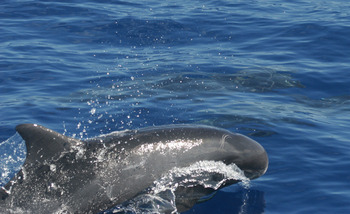
Here we present data from a number of confirmed sightings of pygmy killer whales in temperate waters off the coast of Eden, on the far south coast of NSW, Australia. To the best of our knowledge, these sightings represent the most southerly sightings of this species worldwide and extend their known range in Australian waters by approximately 300 km into temperate waters. The sightings were collected as a part of pelagic cetacean and sea bird surveys off the coast of Eden, NSW from 2004 to 2007. The area was surveyed for an average of eight days per year over the four year period. Species identification was confirmed by experienced cetacean observers and based on the key diagnostic features of the species, being the dark coloration, rounded rather than pointed melon, white lips with light pigmentation extending up the head, rounded rather than pointed tips of the pectoral fins and a shallow dipping dorsal cape (Shirihai, Reference Shirihai2006) (Figure 1).
A pygmy killer whale off Eden, New South Wales, Australia (latitude 37°S). Note the key diagnostic features including the bulbous melon and white lips with the light pigmentation extending up the head, and the clear demarcation of the dorsal cape that only dips at a shallow angle below the dorsal fin. This photograph was taken during the fourth sighting.

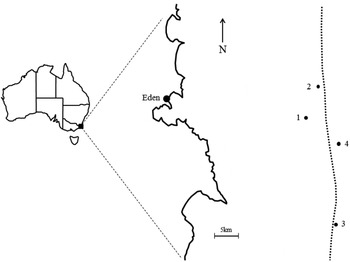
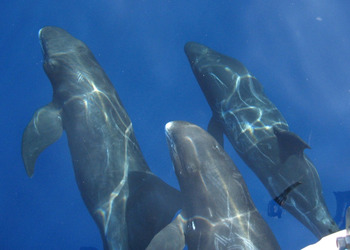
The first confirmed sighting off Eden was on the 27 February 2004. A group of 20–30 pygmy killer whales were sighted in close association with a group of 9–12 Risso's dolphins (Grampus griseus) at 37.10°S 150.28°E (Figure 2) where the water depth was 119 m. During the observations both species were seen to be bow riding (Figure 3), breaching and swimming upside down for an extended period of time around the survey vessel. All animals were noted to be travelling north. The second sighting occurred on the 21 May 2005 when a group of 25–30 pygmy killer whales were sighted at 37.04°S 150.31°E (Figure 2) in 135 m of water and similar to sighting one, all animals were travelling north. The water temperature was 21°C. Species identification for both sightings one and two was later confirmed based on photographs.
The locations of the four sightings of pygmy killer whales off Eden, New South Wales, Australia which represent the four most southerly sightings of the species worldwide. The dashed line through the sightings indicates the edge of the continental shelf.

Pygmy killer whales bow riding off Eden, New South Wales, Australia (latitude 37°S). Note the key diagnostic features including the white lips with the light pigment extending up the head, particularly in the central individual. Also note the rounded pectoral fins. This photograph was taken during the fourth sighting.

The third sighting had a similar group size to the first two sightings (20–30 individuals) and occurred on the 17 March 2007 at 37.31°S 150.35°E at 305 m depth (Figure 2). The water was particularly warm for the area with a maximum temperature recorded of 24.7°C. Species identification was based on observations of the bulbous-shaped head and white lips extending to light areas on the front of the face in the field and photographs of the lateral pigmentation of the animals. An additional odontocete species was seen breaching in the vicinity of the pygmy killer whales, although due to sea conditions there was difficulty in confirming species identification. However, given the external morphology of the animal observed from a distance, and known species in the area it was thought likely to be either a Risso's dolphin or a common bottlenose dolphin (Tursiops truncatus). As per sightings one and two all animals were travelling north.
The fourth and final sighting occurred on the 18 March 2007 at 37.15°S 150.36°E (Figure 2) in 315 m water depth. This group was larger than observed previously with 50–70 pygmy killer whales present. As in previous sightings, the group was recorded travelling north. The animals remained near the survey vessel for an extended period of time and often approached to bow ride. At one point seven of these individuals were bow-riding; many behaviours were observed within the group including travelling, mating, socializing, spy hopping, breaching, bow riding, logging and possible feeding with one individual observed with a fish in its mouth (species unknown). The water temperature was exceptionally warm for the area at 25.8°C. The species identification was confirmed by photographs (Figures 1 & 3).
The marine environment of the east coast of Australia is greatly influenced by the strength of the East Australian Current (EAC). This warm water current flows southward along the coast and brings warm water to high latitudes. When the EAC is particularly strong, warm water can infiltrate much further south than normal. Research has shown that the strength of the EAC is increasing and warm water now infiltrates 350 km further south than it did 60 years ago (Ridgway & Hill, Reference Ridgway, Hill, Poloczanska, Hobday and Richardson2009). Additionally, the waters of south-eastern and western Australia have been found to be warming faster than other parts of Australia (Lough, Reference Lough, Poloczanska, Hobday and Richardson2009). This has strong impacts on the distribution and recruitment of many marine species and taxonomic groups such as zooplankton, and tropical, temperate and pelagic fish (Booth et al., Reference Booth, Edgar, Figueira, Jenkins, Kingsford, Lenanton, Thresher, Poloczanska, Hobday and Richardson2009; Hobday et al., Reference Hobday, Griffiths, Ward, Poloczanska, Hobday and Richardson2009; Munday et al., Reference Munday, Cheal, Graham, Meekan, Pratchett, Sheaves, Sweatman, Wilson, Poloczanska, Hobday and Richardson2009; Richardson et al., Reference Richardson, McKinnon, Swadling, Poloczanska, Hobday and Richardson2009) that have been shown to have ranges that are expanding in a southerly direction in the area off south-east Australia. In particular the numbers of tropical fish in subtropical and temperate regions of east Australia have been increasing (Munday et al., Reference Munday, Cheal, Graham, Meekan, Pratchett, Sheaves, Sweatman, Wilson, Poloczanska, Hobday and Richardson2009). Given climate change scenarios it is likely that this warm water will continue to spread further south which will possibly extend the southern distributional limits of many species. All sightings of pygmy killer whales off Eden, NSW occurred at times when the water temperature exceeded 18°C, currently believed to be the lower temperature tolerance limit for this species (Ross, Reference Ross2006). Additionally, all sightings were closely aligned with the edge of the continental shelf (approximately 21 nautical miles offshore) and on a part of the coast where scientific effort is extremely low to the south of this region. It is therefore possible that this species occurs in waters further south than recorded here, especially given that the animals were travelling north in all observations and the water temperature was higher than what is believed to be the lower temperature tolerance limit of the species. It is possible that sightings of pygmy killer whales in higher latitudes may continue to increase as the EAC extends further south.
The association of pygmy killer whales with other cetacean species is not well understood. Pygmy killer whales have been documented to prey on other dolphin species escaping from tuna nets (Perryman & Foster, Reference Perryman and Foster1980). They have also been noted to occur in association with striped dolphins (Stenella coeruleoalba) and a fin whale (Balaenoptera physalus) with a calf in the Bay of Biscay (Williams et al., Reference Williams, Williams and Brereton2002), with false killer whales (Pseudorca crassidens), short-finned pilot whales (Globicephala macrorhynchus) and bottlenose dolphins (Tursiops truncatus) in Hawaii (McSweeney et al., Reference McSweeney, Baird, Mahaffy, Webster and Schorr2009) as well as Fraser's dolphins (Lagenodelphis hosei) and pygmy right whales (Caperea marginata) (Ross, Reference Ross2006). Two of the four sightings reported here noted the presence of either common bottlenose dolphins or Risso's dolphins in association with the pygmy killer whales. To our knowledge, association between pygmy killer whales and Risso's dolphins has not previously been documented. Due to the short duration of sightings we can only speculate on the nature of the associations with other cetacean species which could be driven by either aggression or potentially a similarity in habitat or prey preference. The diet of pygmy killer whales is not currently known, however the limited information available suggests that cephalopods and fish (Leatherwood & Reeves, Reference Leatherwood and Reeves1983; Ross & Leatherwood, Reference Ross, Leatherwood, Ridgway and Harrison1994) as well as other marine mammals (Perryman & Foster, Reference Perryman and Foster1980) make up their diet. Sightings of pygmy killer whales in oligotrophic waters similar to east Australia have also occurred off the coast of Brazil where it has been suggested that pygmy killer whales may visit the continental slope for feeding opportunities (Siciliano et al., Reference Siciliano, Moreno and Silva2008). Typically, group sizes for this species have been reported to be up to 50 individuals with the occasional group of up to 100 animals being observed. Group sizes off Eden, NSW were consistent with this and ranged from 20 up to 70 individuals with the most common group size being between 20 and 30 individuals.
Although the number of sightings presented here is relatively small it still represents a significant contribution to what is known about the distribution, behaviour and ecology of this species off the east coast of Australia and is the most southerly reported sighting of this species worldwide. Anecdotal reports suggest that this species is often boat shy (Carwardine, Reference Carwardine1995). This means that the species may occur more regularly than noted. Local fishermen in the Eden area often comment on the presence of a ‘small black dolphin’ on the edge of the continental shelf. At least nine live sightings of pygmy killer whales have been reported in NSW over a period of six years. This is in comparison to Hawaii (currently believed to be an area of significance for this species) where eleven sightings occurred over eight years with a much higher survey effort (McSweeney et al., Reference McSweeney, Baird, Mahaffy, Webster and Schorr2009). Given the relatively high sighting rate compared to the low and opportunistic nature of the sampling effort, it is possible that the waters of NSW represent an additional area of abundance for this rarely sighted cetacean species. The same surveys that recorded the presence of pygmy killer whales have recorded an additional 21 cetacean species in the area off Eden, NSW (David Donnelly, unpublished data). Given the commercial and military interest in this region of Australia as well as the apparent significance of the area to a high number of cetacean species, it is recommended that systematic cetacean surveys to document both the abundance and distribution of cetacean species' be initiated. These surveys may be of particular importance given this region is likely to be an area of significance for a rarely sighted and poorly understood species such as the pygmy killer whale.
ACKNOWLEDGEMENTS
These observations were collected under Commonwealth permit number 2007-0003.The authors thank all of the people involved with these surveys that assisted with observations and data collection. This research received no specific grant from any funding agency, commercial or not-for-profit sectors. We thank Jason Caruso from Nature Imprinted Photography and Phillip Tubb for providing images.
Supplementary material and methods
The supplementary material referred to in this paper can be found online at journals.cambridge.org/mbdcup.