Introduction
Sweden has long been noted for its well-developed and comprehensive system of home (or domiciliary) and community-based services that strive to provide universal and equitable access. In recent years, however, service provision has not kept pace with rising needs. Although some recent research has suggested that services still respond to local variations in needs, it is not clear whether various groups of the older population have been differentially affected (Davey et al. Reference Davey, Femia, Zarit, Shea, Sundström, Berg, Smyer and Savla2006). To address this specific issue, this paper presents an analysis of variations in the mix of formal and informal services received by older adults in 1994 and 2000 as a function of gender, advanced age and disability.
Variability across welfare states
Esping-Andersen's (Reference Esping-Andersen1990) taxonomy of welfare states focused on how the goals of the state guide and influence its social welfare policies. He distinguished the Scandinavian ‘social democratic’ regimes from those of both the ‘conservative’ regimes of continental Europe and of ‘liberal’ Anglo-Saxon governments. Social-democratic regimes tend to emphasise principles such as equality, universality and comprehensiveness, whereas liberal regimes rely to a much greater extent on targeting and residualism (that is, meeting only those needs that are not met by family and private support), with much more modest and stratified benefits and entitlements. Esping-Andersen's Reference Esping-Andersen1999 revision of his earlier work dealt more fully with the role of the family and introduced a feminist perspective on social welfare that much previous analysis had overlooked (cf. O'Connor Reference O'Connor1993; Orloff Reference Orloff1993).
More specifically, the vital role of family care in complementing state and privately-paid services was newly seen as an important component of country variations in patterns of care and support. When compared with earlier generations, women's greatly increased labour-force participation in recent decades, along with the higher rates of marital dissolution, remarriage, childless elders and never-married individuals, have drastically changed the ways in which families provide assistance to older people. Despite high levels of formal support in Sweden, the family has always been the primary source of assistance to most non-institutionalised frail older adults, and there is evidence that, as demands on public services increase, this role is again increasing (Johansson and Thorslund Reference Johansson and Thorslund1992; Johansson, Sundström and Hassing Reference Sundström, Johansson and Hassing2002; Sundström, Johansson and Hassing Reference Sundström, Johansson and Hassing2002).
Ebb and flow in Swedish home-help services
The home-help service in Sweden effectively began with the abolition in 1956 of the long established poor-relief system. Between the 1950s and 1970s, home-help services grew rapidly as more women entered the labour force, many as home-help workers. An important study by Berg et al. (Reference Berg, Branch, Doyle and Sundström1993) tracked the trends in institutional and home-based long-term care over 20 years (1965–85). Many of the changes that they observed, from the introduction of the home-help services through to their earliest retrenchment, accelerated during the 1990s economic recession (Bergmark, Parker and Thorslund Reference Bergmark, Parker and Thorslund2000). A particular manifestation was a growing shortage of home-help workers (Jeths and Thorslund Reference Jeths and Thorslund1994), while long-term care units increasingly provided short rehabilitation episodes followed by discharge back to the community, and nursing homes have increasingly been reserved for end-stage care. Our understanding of these long-term changes in Swedish home-help policies led us to predict that there has been greater targeting of services over time (Daatland Reference Daatland1997), and that the care-mix – the combination of assistance that older adults receive from formal and informal sources – varies with the scale of municipal service provision (Sundström, Malmberg and Johansson Reference Sundström, Malmberg and Johannson2006). It was also expected that by the 1990s, formal municipal services had become most important for three groups of older people: women (because they were less likely than men to have available kin support); those with greater functional impairment (whose needs are more pronounced); and for the oldest age groups (for the aforementioned reasons and for other, unmeasured, age-related reasons). A great variety of models have been suggested to account for such variations in the care-mix.
Models of formal and informal care
Despite considerable interest in the interface between formal and informal care (Patsios and Davey Reference Patsios, Davey, Johnson, Bengtson, Coleman and Kirkwood2005), there remains a ‘dearth of theoretical analysis of the relationship between informal and formal care in a welfare state of the Swedish kind’ (Sundström, Johansson and Hassing Reference Sundström, Johansson and Hassing2002: 350). Some analysts assert the substitution model, i.e. that formal care substitutes for informal care (e.g. Greene Reference Greene1983). If substitution of formal for informal support occurs, there would be a negative relationship between the levels of formal and informal support. Despite repeated attempts to substantiate this model, the consensus among researchers is that the substitution effect is small or statistically insignificant (Hanley, Wiener and Harris Reference Hanley, Wiener and Harris1991). Even longitudinal analyses that have found some evidence of substitution have not demonstrated major or persistent replacement of informal care by formal services, but rather suggested that substitution is temporary and a response to the lack of an appropriate formal carer at a particular time (Tennstedt, Harrow and Crawford Reference Tennstedt, Harrow and Crawford1996; Tennstedt et al. Reference Tennstedt, Crawford and McKinlay1993).
The task-specificity model emphasises that formal services and informal care complement each other and take on specialised and largely complementary tasks (Litwak Reference Litwak1985; Litwak and Szelyeni Reference Litwak and Szelenyi1969; Messeri et al. Reference Messeri, Silverman and Litwak1993). According to Noelker and Bass (Reference Noelker and Bass1989), this ‘dual specialisation’ should produce the optimal arrangement of care for the frail elderly person. Informal care-givers are more likely to carry out tasks that require little skill and that occur at unpredictable times, and provide emotional support, whereas formal carers are more likely to provide specialised care at fixed times. Yet there is little evidence for the task-specificity of either formal or informal care (Chappell and Blandford Reference Chappell and Blandford1991; Denton Reference Denton1997; Noelker and Bass Reference Noelker and Bass1989), and formal assistance is often provided for the tasks that informal carers undertake (Chappell Reference Chappell1992). There is a growing consensus that, to meet the care needs of frail elderly people, the relationship between formal and informal networks is closer and more intricate than was previously believed.
The supplementation model predicts that it is more common for functionally dependent or disabled elders to receive both informal care and formal services (Soldo, Agree and Wolf Reference Soldo, Agree, Wolf, Ory and Bond1989; Tennstedt et al. Reference Tennstedt, Sullivan, McKinlay and D'Agostino1990), particularly if their care needs are extensive or when the needs of the older person exceed the resources and capacity of the informal network (Edelman Reference Edelman1986; Edelman and Hughes Reference Edelman and Hughes1990; Moscovice et al. Reference Moscovice, Davidson and McCaffrey1988; Stoller and Pugliesi Reference Stoller and Pugliesi1988). The complementarity model argues that formal care is mobilised when crucial elements of the informal network are lacking or when there is substantial need or, in short, that formal services provide for those tasks which informal carers are unable to provide (Chappell and Blandford Reference Chappell and Blandford1991). Instead of informal carers providing care in isolation from formal services, the complementarity model sees a broad division of the required care tasks, i.e. the two forms of care complement one another (George Reference George, Ward and Tobin1987). There is evidence that when the informal system cannot provide the necessary care alone, both informal and formal care make contributions (Chappell and Blandford Reference Chappell and Blandford1991; Denton Reference Denton1997). Having considered how formal and informal sectors coincide, it is also important to take into account the structure of formal care itself, for previous theory and research has paid scant attention to the historical, cross-national or regional variations in either its forms or scale.
Regional variability
In any care system, regional variability conditions the level of service provision, so understanding how it operates is critical. The extent and quality of Swedish data on regional and municipal variations in care supply and receipts is unsurpassed, making it the ideal nation to study variations in care-mix. Despite a clear recognition that multiple decisions affect an individual's receipt of home-help services (e.g. Bergmark, Parker and Thorslund Reference Bergmark, Parker and Thorslund2000; Thorslund, Bergmark and Parker Reference Thorslund, Bergmark and Parker1997), relatively little work has addressed the issue of municipal variability in home-help services, and even less has linked this variability with individual needs or behaviour. Berg et al. (Reference Berg, Branch, Doyle and Sundström1993) reported that, across 282 municipalities in 1985, home-help coverage rates (i.e. the percentage of individuals aged 80 or more years who received the service) ranged from 17 to 80 per cent, with an average of 43 per cent. Considering the entire population aged 65 or more years, the proportion that received help ranged from 8 to 33 per cent, with an average of 19 per cent. There was also variability in the number of hours provided per client, with some municipalities targeting their provision on relatively few clients, and others distributing the hours among a large number. In some municipalities, for example, 10 per cent of clients accounted for 50 per cent of delivered home-help hours. Considerable variability in the municipal rate of residence in care institutions of those aged 80 or more years was also reported, with a range from 9 to 37 per cent and an average of 24 per cent.
Berg and Sundström (Reference Berg and Sundström1988) used stepwise multiple regression models to predict coverage rates from various municipal indicators, and their model predicted around 25 per cent of the variance. Using more recent data, Trydegård and Thorslund (Reference Trydegård and Thorslund2001) addressed the issue of municipal variability by examining diverse ‘demand-side’ (population and municipal structure) and ‘supply-side’ (local government economy and politics) characteristics as predictors of home-help and institutional-residence rates, i.e. the proportion of individuals in an age group receiving assistance or living in institutional settings. They found considerable variation in coverage rates and many different predictors, but only a weak association between municipal characteristics and coverage rates; the final multivariate model accounted for approximately 15 per cent of the variance in home-help provision. Nonetheless, several of their findings are of interest. In particular, the bivariate analyses indicated that disparate demographic attributes (e.g. the proportion of the population that was very old, population change, the morbidity rate, and average income) associated with home-help coverage rates in the expected direction. Moreover, several features of the local economy and the political character of the local state also predicted home-help coverage rates. Municipalities with higher tax rates, fewer privatised services, higher social-services expenditure, relatively low allocations of social-services spending on child-care, and a high proportion of left-wing elected representatives provided home help to a high proportion of older adults. While the analyses were limited because no index of need for home help was available, the findings demonstrated the value of linking individual and municipal characteristics. Such linked analyses are likely to have greater predictive power than models exclusively of either individual or municipal attributes (cf. Raudenbush and Bryk Reference Raudenbush and Bryk2002).
Shifting home-help policy and inequalities
Thorslund, Bergmark and Parker (Reference Thorslund, Bergmark and Parker1997) described four levels of decision- making in Swedish public welfare management (for the Danish equivalents see Stuart and Weinrich Reference Stuart and Weinrich2001). At the highest level are national decisions about the level and allocation of funding. Below this are the municipalities' decisions about the allocation among different welfare sectors (e.g. education and social services). Below this again are the allocations to specific services in each sector (e.g. as in social services between child-care and elder-care). Finally, the most fundamental level is that of the allocation to the individual client. Apart from the setting of national budgets, which generally affects all municipalities similarly, given the structure of the Swedish home-help system, the municipal allocations to particular services are the most critical decisions – they determine, for example, the budgets for home-help services and institutional care.Footnote 1
Taking a historical perspective, in Sweden the collective provision of poor relief and social services was a parish responsibility from medieval times, as codified in a 1577 law. It later became a municipal responsibility, but until the 20th century, the adequacy of services tended to vary with the financial strength of the municipality and exogenous factors such as crop failures. Indeed, the era of poor relief did not formally end in Sweden until 1956, and alternatives to institutional care did not become widespread until the 1960s and 1970s, following mandates from the central government. Today, the structure of the decision-making process is changing with decentralisation being implemented at various levels – which some say amounts to a diffusion of responsibility. The present restrictions and ‘redefinition of responsibility’ are creating increased inequalities in the Swedish system (cf. Davey et al. Reference Davey, Femia, Zarit, Shea, Sundström, Berg, Smyer and Savla2006; Trydegåd and Thorslund Reference Trydegård and Thorslund2001). There is a growing gap between needs and resources, which means that instead of everyone having equal access to services, with retrenchment it is increasingly those with the greatest need that are able to obtain them, raising concerns about whether the Swedish model of home-based and community based services may inadvertently be changing.
On some level, then, regional variations in service provision may well reflect more political decisions than differences in need, in which case understanding the linkages between formal and informal care systems is of increasing importance. A recent analysis of another dataset by the authors has cast doubt, however, on this hypothesis (Davey et al. Reference Davey, Femia, Zarit, Shea, Sundström, Berg, Smyer and Savla2006). The study examined whether the regional variability in home-help services was associated with inequalities in provision when individual needs were controlled. It linked municipal indicators with data for 3,267 individuals aged 65 or more years from the 2002–03 Undersökning av lenadsförhållanden [Level of Living Survey] (Statistiska Centralbyrån 2003). Contrary to Trydegård and Thorslund's (Reference Trydegård and Thorslund2001) finding from an analysis of 1997 data, no association was found in the 2002–03 data between home-help coverage rates and institutionalisation rates (R 2=0.002). Furthermore, while those living in municipalities with higher levels of home-help provision were clearly more likely to receive the service, when variations in need were taken into account, there were no significant differences in the probability of receiving home-help by the level of municipal provision. Thus, service levels vary across Sweden, but the need for care appears to vary correspondingly. The lack of main effects does not imply, however, the absence of interaction effects between individual characteristics and the attributes of the municipality of residence. The present paper extends these earlier analyses by considering interactions between individual characteristics and municipal characteristics. Specifically, we consider how the importance of municipal services might vary as a function of individual characteristics, including age, gender and level of disability.
As home-help services have decreased in both absolute and relative terms, there has been increasing emphasis on targeting those individuals with the greatest need, and a corresponding shift from providing help with instrumental tasks to providing support with the personal activities of daily living. Sundström and Malmberg (Reference Sundström and Malmberg1996) depicted an emerging gradient in the service response to need, such that for a given level of functional impairment, a person received significantly less support in 1993 than in 1987, with the greatest decrease being for those with moderate levels of impairment. Those with little impairment still received little support in 1993, and those with high levels of impairment still received high support. Their findings also suggested that women were the hardest hit by the decline in home-help services, since they were less likely than men to have informal support available to fill the support gap. In contrast to several studies that have documented differences in care processes for frail older men and women, Larsson and Thorslund (Reference Larsson and Thorslund2002) reported that most observed gender differences in the receipt of home-help and informal-care support disappeared once living arrangements were controlled. Their findings underscore the importance of including the availability of kin support in all analyses of the relationship between care needs and receipts.
Research questions
Whether the Swedish care system will be able to continue to target support effectively given its diminished resources is a critical question. The specific research question addressed in this paper was, ‘do differences in the availability of formal services, specifically in the coverage and intensity of home-help services and institutional care, differentially affect the mix of formal and informal help for older women, the oldest-old, and those with a high level of functional impairment?’
Data and methods
This study has linked publicly-available data on Swedish municipalities with data for around 1,400 older people from the Hemma På Äldre Da'r (HPÄD) [Ageing at Home] surveys in 1994 and 2000.Footnote 2 These surveys were of a nationally-representative sample of community-dwelling Swedish people aged 75 or more years and asked, among other topics, similarly worded items about various health and ageing issues. There is no indication that the non-response caused substantial bias in either survey. The extremely frail and sick may have been slightly under-represented, but the two samples include many people with cognitive dysfunction, and the fraction of frail elders is comparable to whose estimated by other Swedish national surveys. Because the 1994 HPÄD survey was not originally designed with multi-level analyses in mind, the respondent's municipality could not be precisely determined for 137 (10%) of the respondents. For the remaining 90 per cent, unique matches based on postal codes were made. For the 2000 sample, the municipality of residence was obtained for all 1,466 participants. There were very few missing data at both the municipal and individual levels. As a result, the final analysis sample comprised between 2,616 (96.6%) and 2,632 (97.2%) of the 2,708 individuals for whom there were data on the municipality of residence. At the time of the surveys, there were 289 Swedish municipalities, and the sample members lived in 212 (73.4%). Complete data (i.e. no missing values) were available for at least one respondent in 209 (72.3%) of all municipalities.
Measures
There were two kinds of measure for each respondent: individually specific attributes including the outcome measures, and municipality of residence attributes (e.g. Trydegård and Thorslund Reference Trydegård and Thorslund2001). Consistent with our previous research in this area, the outcome measure is a categorical variable for care-mix, coded ‘1’ for receipt of only informal assistance, ‘2’ for formal assistance only, ‘3’ for both formal and informal assistance, and ‘0’ for neither formal nor informal assistance (the reference category in the multinomial logistic regression models).
We considered several individual-level predictor variables in the analyses. The year was a dummy dichotomy (‘0’ for 1994, and ‘1’ for 2000). Age was coded into five-year groups (75–79 years as the reference category, with also 80–84 years and 85 years or older), and sex was another dichotomy (‘0’=man, ‘1’=woman). The survey assessed a number of functional limitations including those with instrumental tasks (IADL, including housework, meal preparation and shopping) and the physical activities of daily living (PADL, including bathing, dressing, transferring, walking and toileting). As considerable evidence has suggested that physical and instrumental limitations in the activities of daily living are hierarchically related (e.g. Lawton and Brody Reference Lawton and Brody1969; Zarit, Johansson and Berg Reference Zarit, Johansson and Berg1993; Zarit, Johansson and Malmberg Reference Zarit, Johansson and Malmberg1995), for the present analyses, a single categorical index of disability was derived, with ‘0’ for neither instrumental nor physical limitations, ‘1’ for only instrumental limitations, and ‘2’ for physical limitations regardless of instrumental limitations. The availability of kin support was coded into five mutually-exclusive categories: married with living children, the reference category; married with no living children; not married and living with children; living alone and with living children; and living alone with no living children. A small number of ‘other’ living arrangements were excluded from the analysis. We considered the potential effects of educational attainment and cognitive impairment, but they were not significant predictors of care-mix, even though the sample was diverse on both characteristics.
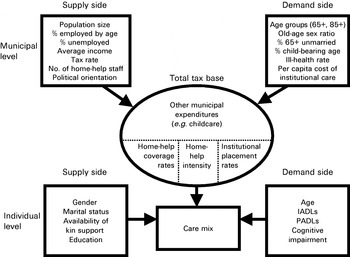
Among the most developed countries, in Sweden an exceptional range of social data are collected and in the public domain. In addition to numerous personal attributes (which can be clustered or reduced), a great variety of municipal indicators are available. Based on the conceptual framework presented in Figure 1, we focused on three that were expected to align most closely with support to older adults. To reduce multi-collinearity, we estimated the interactive effects of various municipal characteristics in separate models. The first municipal variable assessed the (logarithm of) intensity of home-help services as a function of the number of home-help recipients in the municipality (i.e. total hours provided divided by the total number of recipients). The second municipal indicator reflected the obverse of domiciliary and community-based services, viz. an indicator of the proportion of the municipal population aged 80 or more years that resided in institutions. To be consistent with some previous research on the topic, home-help coverage rates were also analysed, and the results are discussed briefly below.
The conceptual framework

Analytic approach
The analyses used multinomial logistic regression models that incorporate corrections for the nested data structure (i.e. individuals within municipalities). Separate models for the two municipal outcomes are presented, i.e. average intensity of municipal home-help provision per recipient, and the rate of institutional residence among those aged 80 or more years. Because they were so consistent across the models, we first present the results for the individual level characteristics, and afterwards examine the interactions with each of the municipal characteristics. To aid the interpretation of the findings, we use substitution and exponentiation to derive predicted probabilities based upon the results of the multinomial logistic regression models. The model chi-squared statistics are based on Wald tests with clustered data, for which the degrees of freedom are based on the number of estimated parameters.
Results
Individual characteristics
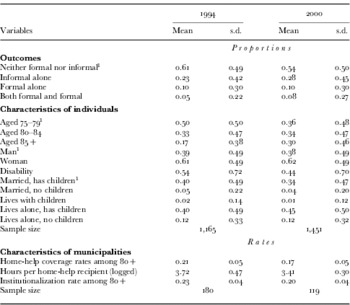
Table 1 displays the descriptive statistics for all the study variables. Controlling for differences in rates of disability (Larsson Reference Larsson2006; Sundström et al. Reference Sundström, Malmberg and Johannson2006) and for changes in the level of formal services, both of which decreased over the study period, the respondents were more likely to have been receiving informal assistance alone, formal assistance alone, and formal and informal assistance together in 2000 than in 1994. Compared to those aged 75–79 years, those aged 80 years or older were more likely to have been receiving informal assistance, with or without formal help, while those aged 85 or more years were more likely than those aged 75–79 years to have been receiving formal assistance alone. In the absence of interactions, there were no main effects of gender on care-mix. Disability was associated with a greater probability of receiving all forms of assistance. Living alone was associated with a lower likelihood of receiving informal support alone and with a higher probability of receiving formal support alone. Living with children, a rare phenomenon among older adults in Sweden, was associated with a much lower likelihood of receiving formal assistance alone.Footnote 3
Descriptive statistics for the study variables

Note. Institutionalisation rates in 1994 were based on a sample size of 179 because of incomplete data. Percentages for categorical variables may be obtained directly by multiplying by 100. 1. Reference category.
Home-help coverage rates
The coverage rate, defined as the proportion of an age group that receive services, has been used previously to indicate the extensiveness of home- and community-based services. In the models, only the rates for those aged 80 or more years produced a significant interaction – a single significant effect with a single care-mix category. Specifically, as coverage rates increased, more individuals received neither formal nor informal assistance (i.e. no support), while the rates of informal assistance alone decreased, and the rates of formal services alone increased. Furthermore, these effects were limited to the oldest age group; the altered coverage rates did not associate with changes in the care-mix for 75–79 year-olds. In consequence, the model results are neither discussed further nor presented in the tables.
Intensity of home help per recipient
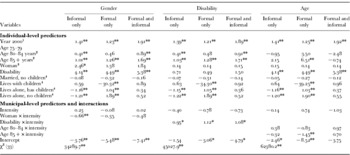
The models that tested the interactions between gender, disability and age with the intensity of municipal home-help services are presented in Table 2. There was a significant negative interaction between gender and the intensity measure; more specifically, in the municipalities with higher intensity provision, men were slightly more likely to have been receiving informal assistance alone, whereas women were somewhat less likely to have been receiving this source of care. Interestingly, the rate of formal assistance, either with or without informal assistance, did not associate with the intensity of support, and thus the overall effects were seen in the proportion of individuals that received neither form of assistance.
Multinomial logistic regression model of care-mix for average number of home-help hours per recipient, Sweden, 1994 and 2000

Notes: 1. Reference case, year 1994. 2. Reference case, aged 75–79 years. 3. Reference case, man. 4. Reference case, married and has children.
Significance levels: * p<0.05, ** p<0.01.
The level of disability interacted with the intensity of municipal services, and the coefficients with informal assistance alone, formal assistance alone, and both forms of assistance were all positive. It followed that most of these effects were also seen in the proportion of individuals that received neither form of assistance.Footnote 4 As with the gender interactions, most differences in care-mix were in rates of informal assistance. The age of the client and the intensity of municipal services also interacted with the probability of receiving formal services alone (with a negative coefficient). Among those aged 75–79 years, the probability of receiving formal services alone increased as the intensity of municipal services increased, but among those aged 80–84 years, there was a weak inverse relationship, and among the oldest age group, the negative relationship was stronger.Footnote 5
Institutionalisation rates
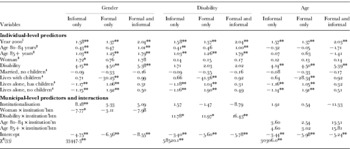
The models that tested the interactions between gender, disability and age with the proportion of municipal residents aged 80 or more years that lived in institutions are presented in Table 3. As with home-help intensity, there was a significant interaction between gender and the percentage of the oldest residents who lived in residential care institutions, and the coefficient for informal support alone (i.e. the main effect) was negative. Here, however, the gender effect was confined to men.Footnote 6 The type of disability and the municipal rates of institutional living also interacted, with positive coefficients for receipt of informal assistance alone, formal assistance alone, or both forms of assistance together. What this effect means is that disabled individuals living in municipalities with high institutionalisation rates were more likely to be receiving all forms of assistance relative to equally disabled individuals living in municipalities with low institutionalisation rates. This is precisely the opposite of what would be expected if municipalities used one form of assistance (i.e. institutionalisation) to substitute for another (i.e. home and community-based services). The predicted proportion of individuals receiving neither form of assistance decreased as disability increased, and this decrease was steeper as a function of disability in municipalities with high institutionalisation rates. The predicted rates of informal assistance alone were also high in municipalities with a high proportion of individuals aged 80 or more years living in institutions, but this form of assistance was most common among individuals with only IADLs.
The predicted probabilities of receiving informal assistance alone among those with neither IADL nor PADL limitations were 9.0, 9.6 and 10.1 per cent in municipalities with rates of institutional living that were respectively one standard deviation below the mean, at the mean, or one standard deviation above the mean. Among those with limitations only on ADLs, the corresponding predicted probabilities were 60.9, 67.8 and 73.4 per cent in municipalities with low, average and high institutionalisation rates. Finally, among those with limitations on PADLs, the corresponding predicted probabilities were 52.1, 53.7 and 55.1 per cent. Whereas less than one-in-ten respondents with neither IADL nor PADL limitations received formal and informal assistance in combination, more than one-third with PADL limitations received assistance from formal and informal sources. There were no interactions between age and the proportion of individuals living in institutional settings.
Multinomial logistic regression model of care-mix for institutionalisation rates of municipal residents aged 80 years and older, Sweden, 1994 and 2000

Notes: 1. Reference case, year 1994. 2. Reference case, aged 75–79 years. 3. Reference case, man. 4. Reference case, married and has children.
Significance levels: * p<0.05, ** p<0.01.
Discussion
Sweden has long been noted for its high levels of comprehensive home-based and community-based care services. In recent years, however, provision has not kept pace with growing demand. There is also considerable regional variability in service levels, causing some to question whether the inequalities amount to inequities of service provision. In this paper, we set out to evaluate whether the recent diminution of home and community-based services has affected differentially women, the most disabled and the oldest-old. This has been accomplished by linking individual-level needs attributes with the level of old-age care in the municipality of residence in both 1994 and 2000. During the six-year study period, there were several complex changes in both the supply of and demand for home-based and community-based services. For example, the proportion of the population aged 80 or more years that received home-help services dropped by more than one-fifth, from 21.2 to 16.8 per cent (Table 1). This trend was offset because older adults were somewhat healthier in 2000 than in 1994 (as observed in the present study sample and by others, e.g. Larsson Reference Larsson2006; Sundström et al. Reference Sundström, Malmberg and Johannson2006). Even so, home-help coverage rates in 2000 were just a fraction of the 43 per cent observed in 1985 value by Berg and colleagues (Reference Berg, Branch, Doyle and Sundström1993). Between 1994 and 2006, the intensity of home-help services reduced by more than one-quarter, from approximately 41.5 to 30.1 hours per month. Over the same period there was a 16 per cent decrease in the proportion of the population aged 80 or more years that resided in care institutions, which altered the composition of the older population living in the community. Resources are finite, and the amount that municipalities allocate to one segment of the population must of necessity affect the amount available for another. Funds spent on municipal programmes for older adults and young children correlate inversely, and the strength of the association has been growing (Pearson correlation coefficient −0.41 in 1994, and −0.56 in 2000).
A remarkable aspect of these changes is that they have had little effect on the rates of unmet need, defined as having one or more observed limitation in an activity of daily living for which no form of assistance is received. In 1994, only 4.5 per cent of individuals with an IADL or PADL limitation reported no assistance, and in 2000 the proportion had risen to only 5.5 per cent. Previous research has noted the relatively low rates of unmet need in Sweden, especially in comparison with the United States (cf. Davey et al. Reference Davey, Femia, Zarit, Shea, Sundström, Berg, Smyer and Savla2005, Reference Davey, Johansson, Malmberg and Sundström2006; Shea et al. Reference Shea, Davey, Femia, Zarit, Sundstrom, Berg and Smyer2003). The slight increase in unmet need may be attributable partly to increases in efficiency in the targeting and delivery of services. On the other hand, although there is no direct evidence, it may be that needs are less fully met than previously – it was not possible to construct a measure of the extent to which needs were under-met.
Controlling for the changes in individual and municipal characteristics, the 2000 survey respondents were more likely to be in receipt of all forms of assistance than those of 1994. This paradoxical finding appears to be driven primarily by differences in disability and the level of municipal services. Individual needs for assistance (or demand-side measures) emerged as strong and consistent predictors of all forms of assistance, particularly disability and advanced age, both of which may be considered as proxies for functional limitations and the need for assistance. Once differences in living arrangement were considered, there was little indication that formal and informal support favoured either men or women. Those who lived alone were less likely to have received support only from informal sources, and were more likely to have been receiving assistance from formal sources alone, while the availability of kin support did not affect the likelihood of receiving support from both formal and informal sources. Thus, there was no evidence that one form of support supplanted the other. One clear and interesting finding is that co-residence with an adult child was often tied to a specific care arrangement, and as a result predicted a lower probability of receiving formal assistance alone. Fully three-quarters of older adults living with their children in the absence of a spouse had at least one measured limitation on an activity of daily living.
Several questions remain about how municipal allocations of home and community-based services are determined and specifically about the decisions made about old-age care. Early researchers, e.g. Berg et al. (Reference Berg, Branch, Doyle and Sundström1993), observed considerable temporal stability in home-help services, so inertia is a possible explanation. Sundström and Berg (Reference Sundström and Berg1990) found that home-help coverage rates and rates of solitary living correlated positively (r=0.29), but that the causal direction was unclear. Further, the negative correlation between home-help coverage rates and rates of institutional living observed by Trydegård and Thorslund (Reference Trydegård and Thorslund2001) might be evidence that municipalities differed in their preference for providing old-age care in community or institutional settings, but none of these early studies were able to estimate the influence of the need for care and support on the level of municipal service provision. Davey et al. (Reference Davey, Femia, Zarit, Shea, Sundström, Berg, Smyer and Savla2006) were able to link data from individuals with their municipalities of residence, and their analysis suggested that, controlling for individual need, there were no differences in the probability of receiving home and community-based services by municipality.
Consistent with the previous research in Sweden that has linked individual and municipal attributes (Davey et al. Reference Davey, Femia, Zarit, Shea, Sundström, Berg, Smyer and Savla2006), the analysis reported here has found that, once need characteristics were considered, the municipality of residence had no significant main effect on the level of care and support service delivered to frail older people. As anticipated in the guiding theoretical construction of the roles of gender, disability and advanced age as modifiers of older people's care-mix, several important interaction effects were found. Although the level of home-help service provision has been widely seen as a key indicator of formal care coverage, the variability in this rate had a trifling presence in the explanatory models; it was limited to its interaction with age, such that rates of formal assistance for those in the oldest age groups were highest in the municipalities with higher coverage rates. Further, these findings were offset by the fact that the rates of receiving no assistance as well as informal assistance alone were lower for the oldest age groups.
The association between the intensity of home-help services provision and the rate of institutionalisation of frail older people produced more consistent results with regard to gender. One of the most striking findings is that neither the intensity of home and community-based services nor institutionalisation rate predicts the likelihood of receiving formal supports, either with or without assistance from informal sources. Rather, in municipalities with a high level of service provision, women were less likely than men to receive informal help alone, while in municipalities with high rates of institutionalisation, men were more likely to receive informal help alone. The overall conclusion is that Sweden's old-age care system achieves equitability by gender once differences in the municipal profiles by age, living arrangement and the disability of the older residents are taken into account.
With regard to the interactions between municipal characteristics and disability, the results of the analysis point to the importance of assiduous targeting on the basis of needs. The predicted probability of receiving neither form of assistance decreased forcefully as the level of disability increased, and this relationship was strongest in the municipalities that provided the most services or in which a high proportion of the oldest age-groups lived in institutional homes. It was therefore apparent that the municipalities that provided the highest levels of services also tended to direct their support on the basis of need. This finding provides the clearest evidence to date of the extent to which home-delivered and community-based services are allocated rationally. It is of great interest that this allocation extends to the informal care system. Previous research has noted an increase in the rate of informal assistance as municipal services have declined (Johansson, Sundström and Hassing Reference Johansson, Sundström and Hassing2003; Sundström, Johansson and Hassing Reference Sundström, Johansson and Hassing2002). These results are also entirely consistent with Muramatsu and Campbell's (Reference Muramatsu and Campbell2002) finding, from a United States study, that State expenditure on home-delivered and community-based services was directed towards those with the most functional limitations.
The finding of a significant interaction effect between the age of the person with care and support needs and the level of their municipality's level of service provision is consistent with the proposition that municipalities that provide more than usual services also target them effectively. To be more specific, while in all municipalities the oldest-old were the most likely to receive formal services alone, the differential was greatest, controlling for disability, in the municipalities that provided less intensive services. It is therefore possible that age alone, rather than need defined by disability, entered into their decisions about eligibility for home-help services. If so, the relationship identifies an important and rare opportunity for increasing the efficiency and effectiveness of Swedish home-help services, for otherwise the country's care system displays much evidence of complementarity between formal and informal forms of assistance.
Limitations of the analysis
The present research has several limitations that warrant discussion. One is largely empirical; because the individual-level variables were drawn from an extant survey dataset, to some extent the measures may not have fully captured the relevant constructs, particularly for the interpretation. It should also be remembered that it was not possible to identify the municipality of residence for all individuals in the 1994 sample. To follow up some of the most interesting implications of the results, more detailed information would be required on unmet or under-met needs and on older people's functional limitations. Moreover, important issues of co-ordination amongst an individual's network of formal and informal carers were beyond the scope of the present investigation. Similarly, the individual-level variables were cross-sectional and available for only two years, so it was not possible to examine the responsiveness of the care network to changes in an individual's level of need.
Another limitation is primarily theoretical. Little previous research on the support received by older adults has linked micro-data with levels of municipal service provision. The main influences on the level of home and community-based services in Sweden are not well understood, nor what determines change over time, and previous findings have disagreed about the key variables. Future research should examine more thoroughly the ways in which both supply and demand characteristics at the municipal level associate with the priority given to old-age care-services relative to other municipal responsibilities, and how this balance interacts with the precise allocations to different types of support for older adults. The present study is no more than a first step towards the fuller inquiry.
Acknowledgements
This work was partially supported by a grant from the United States National Institute on Aging (R03AG023301).