Transactional models conceptualize the emergence and maintenance of psychopathology as a complex process, involving the dynamic transactions between child, caregiver, and environmental variables (Sroufe, Egeland, Carlson, & Collins, Reference Sroufe, Egeland, Carlson and Collins2005). Attachment researchers have focused both on child factors, such as infant attachment security (see Greenberg, Reference Greenberg, Cassidy and Shaver1999; Sroufe, Reference Sroufe, Belsky and Nezworski1988), and on aspects of the caregiving environment that promote children's attachment security, such as caregiver sensitivity and caregiver state of mind in the Adult Attachment Interview (AAI; George, Kaplan, & Main, Reference George, Kaplan and Main1996). Although insecure attachment patterns have been identified as risk factors for problems in adaptation, studies of clinical and risk samples suggest that atypical attachment patterns are more frequently implicated in the development of child and adult psychopathology (Kobak, Cassidy, Lyons-Ruth, & Ziv, Reference Kobak, Cassidy, Lyons-Ruth, Ziv, Cicchetti and Cohen2006). These atypical attachment classifications include disorganized infant behavior (Main & Solomon, Reference Main, Solomon, Greenberg, Cicchetti and Cummings1990) in the Strange Situation procedure (Ainsworth, Blehar, Waters, & Wall, Reference Ainsworth, Blehar, Waters and Wall1978) and unresolved states of mind with respect to loss and trauma in the AAI (Main & Goldwyn, Reference Main and Goldwyn1998). Caregivers' unresolved states of mind have been most extensively studied using the AAI to predict infant attachment patterns (Hesse & Main, Reference Hesse and Main2006; van IJzendoorn, Reference van IJzendoorn1995). In contrast, little is known about how caregiver states of mind influence functioning in older children and adolescents. In this study, we examine how caregivers' AAI status is associated with child behavior problems from middle childhood to early adolescence in a sample of economically disadvantaged families.
States of Mind Regarding Attachment
Main and Goldwyn's (Reference Main and Goldwyn1998) classifications of states of mind are based on an analysis of a person's ability to attend to attachment-related memories and topics during the course of the AAI. Individual differences in state of mind are inferred from features of AAI transcripts that reflect different discourse strategies used in discussing these topics. Secure/autonomous adults are able to engage attachment-related topics actively and in a flexible manner, allowing them to access and reflect upon experiences from childhood. Conversely, individuals with insecure states of mind show restrictions in their capacity to deploy attention to interview topics. On the one hand, dismissing speakers show limited access to attachment information through persistent claims of lack of memory for their early relationships, presentation of an idealized portrait of their parents, or derogation in an effort to minimize the importance of attachment figures. On the other hand, preoccupied speakers show restrictions in their attention through entanglement in memories of childhood or by displaying angry or passive speech that distracts them from the interview topics.
In addition to the secure/autonomous, dismissing, and preoccupied states of mind, Main and Goldwyn (Reference Main and Goldwyn1998) identified momentary lapses in these organized strategies that can occur during discussions of loss or abuse events. These lapses in monitoring of discourse or reason indicate a lack of resolution and result in an unresolved classification with respect to either loss or abuse. For instance, individuals rated as unresolved with respect to loss display markers such as beliefs that the deceased is not dead or a marked change in speech style, whereas individuals coded for unresolved abuse might indicate a fear of being taken over by the perpetrator or exhibit visual–sensory intrusions in recounting an abuse event. In addition to unresolved with respect to loss or abuse, Main and Goldwyn (Reference Main and Goldwyn1998) added two additional atypical classifications that are characterized by pervasive disorganization that extends beyond momentary lapses during the discussion of a specific topic. Cannot classify (CC) is assigned when the speaker uses both dismissing and preoccupied strategies in different parts of the interview (Hesse, Reference Hesse1996). Preoccupied with traumatic events (E3) is assigned when discussions of trauma become a pervasive theme and the interview is marked by confusion and fearfulness (Main & Goldwyn, Reference Main and Goldwyn1998).
Unresolved status is secondary to the major organized states of mind and may co-occur with secure as well as insecure (dismissing or preoccupied) states of mind. However, few studies have considered how caregivers' unresolved loss or abuse is moderated by the major organized states of mind. Main effect models linking insecure/organized strategies to psychopathology have received only limited support in attachment research (Greenberg, Reference Greenberg, Cassidy and Shaver1999; Kobak et al., Reference Kobak, Cassidy, Lyons-Ruth, Ziv, Cicchetti and Cohen2006; Sroufe, Reference Sroufe, Belsky and Nezworski1988). Most dismissing and preoccupied individuals do not develop serious psychopathology. An alternative model of attachment and psychopathology views insecure/organized strategies as vulnerabilities to breaking down under conditions of stress. This diathesis-stress model of attachment and psychopathology has been supported by studies of both young children (Belsky & Fearon, Reference Belsky and Fearon2002) and adolescents (Marsh, McFarland, Allen, Boykin-McElhaney, & Land, Reference Marsh, McFarland, Allen, Boykin McElhaney and Land2003). When unresolved status is viewed as a continuing source of intrapersonal stress, this model suggests that individuals with both insecure states of mind and unresolved loss or abuse would be particularly vulnerable to problems in adaptation. In contrast, unresolved caregivers with secure/autonomous states of mind might be more resilient in managing the stress of unresolved loss or abuse.
The Effects of Caregiver States of Mind on Adult and Child Psychopathology
A number of studies have examined the association between unresolved, E3, or CC states of mind and symptoms of psychopathology. For example, increased rates of unresolved classifications have been reported among suicidal teens (Adams, Sheldon-Keller, & West, Reference Adams, Sheldon-Keller and West1996), adults previously hospitalized for psychiatric disorders during adolescence (Allen, Hauser, & Borman-Spurrell, Reference Allen, Hauser and Borman-Spurrell1996), and patients diagnosed with anxiety disorders (Fonagy et al., Reference Fonagy, Leigh, Steele, Steele, Kennedy and Mattoon1996). In addition, increased rates of CC and E3 classifications have been reported among those institutionalized for violent crimes (van IJzendoorn et al., Reference van IJzendoorn, Feldbrugge, Derks, de Ruiter, Verhagen and Philipse1997), men who have been violent toward their spouses (Holtzworth-Munroe, Stuart, & Hutchinson, Reference Holtzworth-Munroe, Stuart and Hutchinson1997), and subjects diagnosed with borderline personality disorder (Fonagy et al., Reference Fonagy, Leigh, Steele, Steele, Kennedy and Mattoon1996; Patrick, Hobson, Castle, Howard, & Maughan, Reference Patrick, Hobson, Castle, Howard and Maughan1994). However, although these studies suggest that these states of mind are associated with increased risk for psychiatric diagnosis, it has been difficult to determine whether the AAI classifications precede or merely coincide with psychopathology.
The intergenerational effect of caregivers' states of mind has been most extensively investigated in studies of infant attachment in the Strange Situation. A meta-analytic review indicated a substantial effect (d = 1.06) of caregiver autonomous/secure states of mind on infant attachment security (van IJzendoorn, Reference van IJzendoorn1995). In contrast, studies of caregivers' unresolved status and their infants' disorganized behavior produced moderate effect sizes (d = 0.65). The lack of correspondence between caregivers' unresolved status and infant attachment behavior may partially result from a failure to consider how unresolved status is moderated by the major organized states of mind. For example, Schuengel, Bakersman-Kranenburg, and van IJzendoorn (Reference Schuengel, Bakersman-Kranenburg and van IJzendoorn1999) discovered that secure/autonomous unresolved caregivers were less likely to have disorganized infants and more likely to display frightening behaviors directed toward their infants than nonautonomous unresolved caregivers. Another study found a similar result in that unresolved mothers displayed more frightening behaviors toward their infants than did non-unresolved mothers but unresolved secure mothers were judged as less frightening than unresolved insecure mothers (Jacobvitz, Leon, & Hazen, Reference Jacobvitz, Leon and Hazen2006). Finally, secure unresolved mothers were more successful in a home visit-based intervention targeting mothers and infants than were insecure unresolved mothers (Heinicke et al., Reference Heinicke, Goorsky, Levine, Ponce, Ruth and Silverman2006).
Although there is substantial evidence supporting the effects of caregivers' states of mind on infant attachment, much less is known about intergenerational effects of caregivers' states of mind on older children or adolescents. There is some evidence that caregiver's organized states of mind have continued effects on young children. Crowell and Feldman (Reference Crowell and Feldman1988) found that preschool aged children of secure mothers were more affectionate and had more positive affect compared to insecure children. In addition, Allen and colleagues (Reference Allen, McElhaney, Land, Kuperminc, Moore and O'Bierne-Kelly2003) reported a modest association between mother and adolescents states of mind. Bowlby's (Reference Bowlby1973) concept of developmental pathways provides guidelines for considering caregiver effects, as he viewed attachment aspects of personality as more sensitive to early experiences during infancy and childhood and as gradually becoming more resistant to change by adolescence and adulthood. The two most extensively used measures of attachment support the view that children's personality is more environmentally sensitive during early developmental periods. Whereas infant and toddler attachment security as measured by the Strange Situation is relatively unstable (Fraley & Brumbaugh, Reference Fraley, Brumbaugh, Rholes and Simpson2004; Kobak et al., Reference Kobak, Cassidy, Lyons-Ruth, Ziv, Cicchetti and Cohen2006), measures of adult attachment in the AAI tend to be very stable (Allen, McElhaney, Kuperminc, & Jodl, Reference Allen, McElhaney, Kuperminc and Jodl2004; Bakersman-Kranenburg & van IJzendoorn, Reference Bakersman-Kranenburg and van IJzendoorn1993; Crowell, Treboux, & Waters, Reference Crowell, Treboux and Waters2002; Sagi, van IJzendoorn, Scharf, Koren-Karie, Joels, & Mayseless, Reference Sagi, van IJzendoorn, Scharf, Koren-Karie, Joels and Mayseless1994). Bowlby's environmental sensitivity hypothesis suggests that older children and adolescents may be less influenced by caregivers' states of mind or that the intergenerational effects may be largely shaped during early periods of development.
Limitations of Previous Studies of Unresolved States of Mind
Previous investigations of caregivers' unresolved status with respect to loss or abuse have been limited by several conceptual and design issues. First, most studies have failed to control for exposure to abuse or loss when considering unresolved status. As a result, it is not clear whether findings linking unresolved status to psychopathology can be attributed to unresolved status or simply to exposure to these events. Exposure to abuse has been consistently associated with negative outcomes. For instance, childhood physical and sexual abuse increase risk for posttraumatic stress disorder (PTSD; Widom, Reference Widom1999), dissociative symptoms (Irwin, Reference Irwin1994), depression (Briere, Reference Briere1988), personality disorders (Johnson, Cohen, Brown, Smailes, & Bernstein, Reference Johnson, Cohen, Brown, Smailes and Bernstein1999), and substance abuse (Epstein, Saunders, Kilpatrick, & Resnick, Reference Epstein, Saunders, Kilpatrick and Resnick1998). In contrast to abuse, exposure to loss is more common and is not typically associated with long-term negative outcomes. Bowlby (Reference Bowlby1980) posited that some types of mourning may increase risk for psychopathology. For instance, approximately 18% of those who lose a spouse continue to show depressive symptoms 2 years later (Clayton, Halikas, & Maurice, Reference Clayton, Halikas and Maurice1972). In addition, certain types of traumatic loss such as homicide, suicide, or accident can result in PTSD (Kaltman & Bonnano, Reference Kaltman and Bonnano2003). Compared to abuse, exposure to loss should be less predictive of psychopathology, but moderating factors may make recovery from a loss experience more difficult. These findings indicate importance of controlling for exposure to traumatic loss and abuse when considering the effects of unresolved status.
Most prior investigations of unresolved loss and abuse have been hindered by relatively small samples or by low base rates of unresolved status in middle class samples. van IJzendoorn and Bakersman-Kranenburg's (Reference van IJzendoorn and Bakerman-Kranenburg1996) meta-analysis reported substantially elevated rates of unresolved loss in low socioeconomic status (SES) compared with higher SES samples. In addition, rates of exposure to trauma are higher among low SES families who live in high-risk neighborhoods and face more life stress and adversity (Attar, Guerra, & Tolan, Reference Attar, Guerra and Tolan1994). As a result, studies of unresolved and E3/CC classifications need to be extended to low SES samples to better understand the relationships between atypical classifications and child outcomes.
The Current Study
The current study has several aims. We examine the associations between caregiver states of mind, caregiver psychopathology, and child behavior problems at ages 6, 8, 10, and 13 in an economically disadvantaged sample. At each of these ages, we plan to test caregivers' organized state of mind (secure vs. insecure) as a moderator of unresolved status. We hypothesize that caregivers' exposure to trauma and disorganized states of mind will increase their children's risk for psychopathology. In addition, we will address several limitations of previous studies by examining caregiver psychopathology as a possible mediator of caregivers' unresolved status on child behavior problems, by controlling for caregivers' exposure to traumatic loss and abuse, and by treating unresolved loss and unresolved abuse as separate and independent predictors of child behavior problems.
Method
Participants
One hundred twenty-nine caregiver–adolescent dyads were recruited from a longitudinal study of families with children that had participated in Head Start (Ackerman, Schoff, Levinson, Youngstrom, & Izard, Reference Ackerman, Schoff, Levinson, Youngstrom and Izard1999). Because of missing data on one of our control variables (caregiver verbal IQ), 5 dyads were not included in the analyses, leaving a sample of 124. Fifty-seven percent of the families had a single caregiver, 21% included two biological parents, and 22% included a primary caregiver and a live-in partner. Primary caregivers were predominately biological mothers (87%), 7% were grandmothers, 3% were biological fathers, and 3% were aunts or foster mothers. Adolescents ranged in age from 12.38 to 13.99 years (M = 13.11, SD = 0.22). Seventy-six percent of participants were African American, 21% were European American, and 3% were Hispanic. Families had an average household income of $23,756 (SD = $24,263) and 27% of the families received welfare payments. Recruitment of a high-risk low-income sample served to increase the prevalence of both exposure to trauma and of unresolved and E3/CC classifications.
Procedure
Caregiver–adolescent dyads were assessed two times when their children were 13. Initial interviews were conducted during a home visit and followed within a 2 to 4 week period by a 3-hr laboratory visit. During the lab visit, caregivers completed the AAI (George et al., Reference George, Kaplan and Main1996). Within 6 months of the lab visit, adolescents were interviewed at their school and teacher reports of child behavior problems were collected. In addition to data collected when the child was 13, teacher reports of child behavior problems were collected at ages 6, 8, and 10, and caregiver verbal IQ was assessed when their children first entered the Head Start study at age 4.
Caregiver measures
AAI
The AAI (George et al., Reference George, Kaplan and Main1996) is a semistructured 60- to 90-min interview. It focuses on memories of childhood experiences with attachment figures and includes detailed probing of all childhood physical or sexual abuse and lifetime loss experiences. Reliability and validity of the AAI are well established (Bakersman-Kranenburg & van IJzendoorn, Reference Bakersman-Kranenburg and van IJzendoorn1993; Crowell et al., 2003). All AAIs were recorded and transcribed. Transcripts were coded using the AAI Q-sort (Kobak, Cole, Fleming, Ferenz-Gillies, & Gamble, Reference Kobak, Cole, Fleming, Ferenz-Gillies and Gamble1993) based on the Main and Goldwyn's (Reference Main and Goldwyn1998) experience and state of mind scales (see also Main, Goldwyn, & Hesse, Reference Main, Goldwyn and Hesse2003). Two blind raters sorted 100 Q-sort items to describe each transcript. If interrater reliability fell below .60 (Spearman–Brown formula), a third rater sorted the transcript and the highest two-rater correlation was used to form a composite description. A third rater was required on 26 (21%) transcripts. The average reliability for the composite Q-sorts across all transcripts was .80 (Spearman–Brown formula). Composited Q-sorts were then correlated with prototype sorts for secure, dismissing, and preoccupied derived from the Main and Goldwyn (Reference Main and Goldwyn1998) system and were converted into classifications according to cutoff scores (Kobak et al., Reference Kobak, Cole, Fleming, Ferenz-Gillies and Gamble1993). To check reliability with the Main and Goldwyn system, transcripts were assigned to one of the three major states of mind categories. Classifications of a random sample of 20 transcripts were then compared with classifications provided by a certified rater from another lab. Percentage agreement with the outside rater was 85%. At least one of the two raters coding each transcript had attended a 2-week training workshop and passed reliability testing on the Main and Goldwyn (Reference Main and Goldwyn1998) coding method.
Using cutoff scores of a zero or positive correlation with secure, dismissing, or preoccupied prototypes, 55 transcripts (44.4%) were classified as secure/autonomous, 44 (35.5%) were dismissing, and 21 (16.9%) were preoccupied. In addition, two atypical classifications were coded using Main and Goldwyn's (1998) criteria. Four transcripts (3.2%) were identified as CC and 9 transcripts (7.3%) were classified as E3 or fearfully preoccupied with trauma. Because of the small number of these transcripts, the CC and E3 classifications were combined to form a CC/E3 group. Of the 27 transcripts classified as unresolved for loss, 11 were also classified as secure/autonomous and 16 were classified as insecure (dismissing, preoccupied, or CC/E3). Conversely, none of the 11 transcripts classified as unresolved for abuse were also classified as secure/autonomous.
All discussions of loss and abuse were scored using Main and Goldwyn's (1998) 9-point unresolved scales. A score above a 5 on these scales automatically qualifies the transcript for a primary unresolved classification, whereas a score of 5 leaves classification of the transcript to the rater's discretion. Interrater reliability for the unresolved scales was .82 for loss and .83 for abuse. Agreement on unresolved classifications yielded a κ of .96. Intraclass correlation coefficients between our lab and the outside rater for the continuous unresolved loss and abuse scales were .67 and .94, respectively. One hundred seventeen caregivers (94.4%) reported a loss during the interview and 27 transcripts (21.8%) were classified as unresolved for loss. Forty-three caregivers (34.6%) reported childhood abuse during the interview and 11 transcripts (8.8%) were classified as unresolved for abuse. Four transcripts were classified as unresolved for both loss and abuse. Overall, 28.2% of the sample was given a primary classification of unresolved. For subsequent analyses, the unresolved scales were treated as continuous measures.
Trauma interview
A lifetime trauma interview was administered following the AAI. Interviewers recorded attachment-related traumas from the AAI and then probed for additional traumatic events with questions from the Traumatic Stress Schedule (Norris, Reference Norris1990). Dummy variables were created to index exposure to traumatic loss and childhood abuse. Traumatic loss events were defined as sudden, violent losses that occurred through homicide, suicide, or accident, and childhood abuse included both physical and sexual abuse but excluded emotional abuse and neglect. Thirty-seven caregivers (29.8%) reported experiencing a traumatic loss and 47 caregivers (37.9%) reported childhood physical and/or sexual abuse.
Verbal IQ
The vocabulary subtest of the Wechsler Adult Intelligence Scale—Revised (Wechsler, Reference Wechsler1981) was administered to caregivers during the first wave of data collection when their children were in Head Start. This is a widely used measure of verbal ability that has demonstrated sound psychometric properties. Scaled scores were used for all analyses.
Depression
Caregiver depression was assessed using the Beck Depression Inventory (BDI; Beck & Steer, Reference Beck and Steer1987). The BDI is a commonly used self-report instrument for assessing depression severity and demonstrates good psychometric properties. A meta-analysis of the BDI's internal consistency revealed a mean α of .81 for nonpsychiatric patients (Beck, Steer, & Garbin, Reference Beck, Steer and Garbin1988). In this study, the Cronbach α is .92.
Dissociation
The Dissociative Experiences Scale (DES; Bernstein & Putnam, Reference Bernstein and Putnam1986) is a 28-item measure of the extent to which an individual has dissociative experiences during their everyday life. The DES demonstrated good split-half and test–retest reliability as well as adequate internal consistency. For the present sample, the Cronbach α is .93.
Adolescent measures
Teacher rating forms (ages 6, 8, 10, and 13)
The Achenbach Child Behavior Checklist—Teacher's Report Form (TRF; Achenbach & Rescorla, Reference Achenbach and Rescorla2001) is a 113-item measure of children's behavioral and emotional problems at school. Achenbach and Rescorla (Reference Achenbach and Rescorla2001) report evidence for good interrater reliability, test–retest reliability, and criterion-related validity. At ages 6, 8, and 10, one elementary school teacher completed the TRF for each child. At age 13, two teachers (math and English) rated the adolescents. The ratings between the two teachers correlated between .29 and .60 across the nine symptoms clusters. In 27.6% of the sample, only one teacher's rating was available. To maintain complete data at age 13 and match the single teacher ratings from elementary school, the teacher who reported the highest level of problem behavior at age 13 was used for the analyses. The total problems composite was used at each time point. In addition, the internalizing and externalizing composites as well as the attention, thought, and social problems subscales were used for post hoc analyses.
Missing data
At ages 6, 8, 10, and 13, there were 12, 19, 36, and 6 children missing teacher data, respectively. These data were analyzed using hierarchical linear modeling (HLM; Raudenbush, Bryk, Cheon, & Congdon, Reference Raudenbush, Bryk, Cheon and Congdon2004), which allows for missing observations at Level 1 under the assumption that data are either missing completely at random (MCAR) or missing at random (MAR). To test this assumption, we examined patterns of missing data at each time point by coding “missing” (0) or “not missing” (1). The t tests with each predictor variable yielded only 2 of 27 significant tests. In addition, missing data at any time point was unrelated to scores on the TRF at other time points. As a result of the two significant t tests, data cannot be assumed to be MCAR, but may still be MAR. There are no procedures to test whether data are MAR, but based on the limited relationships between missing data and both predictor variables and other time points, the MAR assumption is not rejected.
Results
Data analytic plan
Our goal was to test the effects of caregiver AAI status on child behavior problems while controlling for caregiver psychopathology. Therefore, our data analytic plan was to examine the relationships between caregiver state of mind and psychopathology, between caregiver psychopathology and child behavior problems, and between caregiver state of mind and child behavior problems. Initially, we used correlations and regression models to explore these relationships. HLM was then used to understand the association between caregiver state of mind and child behavior problems across four time points from middle childhood to early adolescence. Post hoc analyses were conducted to explore the effects of caregiver state of mind on subscales of the TRF to determine if there was specificity in the predicted outcomes.
Descriptive analyses
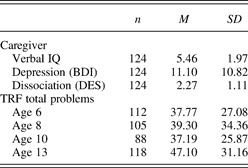
The means and standard deviations of child and caregiver adjustment measures are presented in Table 1. Comparisons of mean teacher-reported child behavior problems with normative data highlight risks often found in low-income samples. According to Achenbach and Rescorla (Reference Achenbach and Rescorla2001), 7% of children are rated at a T score of 65 or above. In our sample, 24%, 29%, 22%, and 41% of children were rated 65 or above at ages 6, 8, 10, and 13, respectively.
Means and standard deviations

Note: BDI, Beck Depression Inventory (Beck & Steer, Reference Beck and Steer1987); DES, Dissociative Experiences Scale (Bernstein & Putnam, Reference Bernstein and Putnam1986); TRF, Teacher Report Form (Achenbach & Rescorla, Reference Achenbach and Rescorla2001).
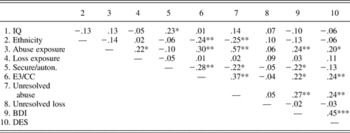
Correlations between the caregiver attachment, trauma exposure, and psychopathology variables are presented in Table 2. These correlations indicate that caregivers classified as secure/autonomous had higher verbal IQs than insecure caregivers, and that African American caregivers were less likely to be classified E3/CC or unresolved for abuse than non African Americans. However, African American caregivers did not differ from other caregivers in rates of exposure to abuse. Exposure to abuse was correlated with E3/CC status, unresolved abuse, and nonsecure/autonomous states of mind. In contrast, scores on the unresolved loss scale were independent of all other AAI and trauma exposure variables. As both caregiver IQ and ethnicity were related to constructs of interest, both variables were included as controls in subsequent analyses. In addition, correlations between teacher-reported behavior problems across time points indicated substantial stability. Correlations between time points ranged from .28 to .50.
Correlations between caregiver variables

Note: E3, preoccupied with traumatic events; CC, cannot classify; BDI, Beck Depression Inventory (Beck & Steer, Reference Beck and Steer1987); DES, Dissosiative Experiences Scale (Bernstein & Putnam, Reference Bernstein and Putnam1986).
*p < .05. **p < .01. ***p < .001.
Caregiver psychopathology and AAI status
We first examined the association between caregiver AAI status and psychopathology. Caregiver psychopathology was tested as a third variable that might account for associations between caregiver AAI status and child behavior problems. Correlations between caregiver depression and dissociation (BDI and DES) and AAI variables (secure/autonomous, unresolved loss, unresolved abuse, and E3/CC) produced five significant results (see Table 2). Caregivers' depressive symptoms were positively related to insecure status, unresolved abuse, and E3/CC status. Dissociation was positively related to unresolved abuse and E3/CC status. Unresolved loss was unrelated to psychopathology variables.
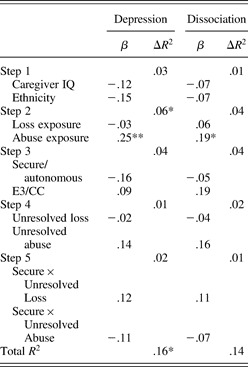
Caregiver depressive and dissociative symptoms were regressed on control and AAI variables (see Table 3). Caregivers' ethnicity, verbal IQ, and exposures to traumatic loss and childhood abuse were entered in the first two steps. Dummy codes for AAI secure/autonomous and E3/CC classifications were entered in the third step. The fourth step tested continuous scores for unresolved loss and abuse. The final step tested the interaction between caregivers' secure/autonomous state of mind and unresolved status. To reduce multicollinearity, variables were centered before creating interaction terms (Aiken & West, Reference Aiken and West1991). Caregivers' exposure to abuse accounted for significant variance in their depressive and dissociative symptoms. Caregiver AAI status failed to account for additional variance in caregiver adjustment. These findings suggest that caregiver exposure to trauma, not unresolved or E3/CC status, accounts for increased caregiver depressive and dissociative symptoms. As a result, caregiver trauma exposure is controlled in all subsequent analyses.
Regression models predicting caregiver self-reported psychopathology

Note: E3, preoccupied with traumatic events; CC, cannot classify.
*p < .05. **p < .01.
Finally, we examined the correlations between caregivers' symptoms and teacher-reported child behavior problems at ages 6, 8, 10, and 13. None of the six correlations were significant. As a result, caregiver psychopathology was excluded from subsequent analyses of child behavior problems.
Caregiver AAI status and teacher ratings of child behavior problems
Our primary aim was to examine the relation between caregiver unresolved status and teacher reports of behavior problems when children were 6, 8, 10, and 13 years of age. A two-level HLM model (Raudenbush et al., Reference Raudenbush, Bryk, Cheon and Congdon2004) was used, with repeated measures of child behavior problems as a within-subjects factor at Level 1. Caregiver AAI status, exposure to trauma, and IQ were entered as between-subjects factors at Level 2.
Caregiver effects on average total problems across time
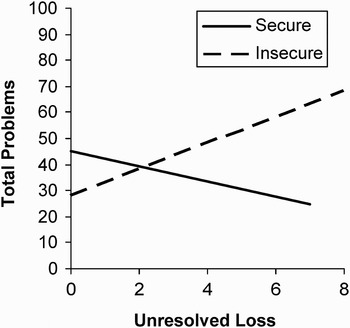
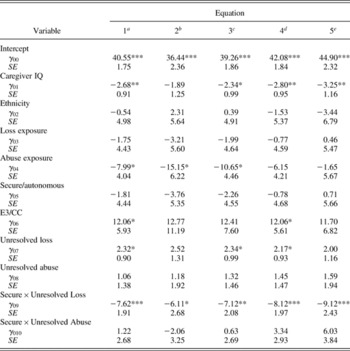
In the initial analysis, the Level 1 model estimated the mean total problems score for children across the four time points (ages 6, 8, 10, and 13) with no additional Level 1 predictors. At Level 2, caregiver variables, including ethnicity, trauma exposure, and AAI variables were entered as predictors of the total problems intercept. As shown in the first column of Table 4, there was a main effect for E3/CC status on aggregate child behavior problems, γ = 12.06, t (113) = 2.03, p < .05. Caregiver's exposure to childhood abuse had a negative effect on total problems, γ = −7.99, t (113) = −1.98, p < .05. This was an unanticipated finding. There was a main effect for unresolved loss, γ = 2.32, t (113) = 2.56, p < .05. Finally, the interaction between caregiver secure/autonomous status and unresolved loss produced a significant effect on the aggregate intercept, γ = −7.62, t (113) = −4.00, p < .001, indicating that caregiver security moderates the effect of unresolved loss for child problem behaviors by reducing the association between unresolved loss and child behavior problems (see Figure 1). The regression weights for these lines indicate the unresolved loss positively predicts child behavior problems in the insecure group (β = .42, p < .001), but not in the secure group (β = −.25, ns).
The moderating effect of caregiver secure/autonomous status on the relationship between unresolved loss and teacher-reported child behavior problems across time points.

Multilevel model coefficients predicting TRF total problems (intercepts)

Note: TRF, Teacher Report Form (Achenbach & Rescorla, 2001); E3, preoccupied with traumatic events; CC, cannot classify.
aTotal problems aggregated across time points (6, 8, 10, and 13).
bTotal problems at age 6.
cTotal problems at age 8.
dTotal problems at age 10.
eTotal problems at age 13.
*p < .05. **p < .01. ***p < .001.
Caregiver effects on total problems at ages 6, 8, 10, and 13
The next set of analyses tested whether caregiver AAI status affects child behavior problems at each of the time points (ages 6, 8, 10, and 13) individually. A time variable coded as (0, 1, 2, 3) was entered in the Level 1 model uncentered. This model, presented in the second column of Table 4, examines the relation between caregiver AAI status and behavior problems reported by teachers at age 6. In the third, fourth, and fifth columns of Table 4, the time variable was coded as (−1, 0, 1, 2), (−2, −1, 0, 1), and (−3, −2, −1, 0), respectively, to test caregiver effects on behavior problems at ages 8, 10, and 13.
At age 6 there was an interaction between caregiver secure/autonomous status and unresolved loss on the total problems intercept, γ = −6.11, t (113) = −2.28, p < .05. This interaction followed the same pattern as in the first model of aggregate child problems. At age 8, there was a main effect for unresolved loss, γ = 2.34, t (113) = 2.13, p < .05, and an interaction between secure/autonomous status and unresolved loss, γ = −7.12, t (113) = −3.12, p < .01. At age 10, there was a main effect for unresolved loss, γ = 2.17, t (113) = 2.33, p < .05, and an interaction between secure/autonomous status and unresolved loss, γ = −8.12, t (113) = −4.12, p < .001. In addition, there was a significant positive effect of caregivers' E3/CC status, γ = 12.06, t (113) = 2.15, p < .05, on child behavior problems. At age 13, the interaction between caregiver secure/autonomous status and unresolved loss had a significant effect on the total problems intercept, γ = −9.12, t (113) = −3.75, p < .001. The interactions at each of the time points followed the same pattern as in the aggregate model.
Caregiver effects on TRF subscales
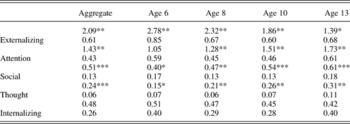
As the unresolved loss produced risk for child behavior problems among insecure caregivers, further analyses were conducted to determine whether these effects are specific to a certain type of behavior problem. Specifically, we used the internalizing and externalizing composites from the TRF as well as the attention, social, and thought problems subscales. A series of HLM models were constructed using unresolved loss as a predictor in the intercept of each of these subscales aggregated across time points, as well as for each individual time point (ages 6, 8, 10, and 13). Results are presented in Table 5. Overall, they suggest a consistent effect for unresolved loss on all symptom clusters across ages with the exception of internalizing behaviors, for which there was no effect at any time point.
Multilevel model coefficients for unresolved loss predicting TRF subscales (intercepts) among children of insecure caregivers

Note: TRF, Teacher Report Form (Achenbach & Rescorla, Reference Achenbach and Rescorla2001).
*p < .05. **p < .01. ***p < .001.
Caregiver effects on growth in child behavior problems
Next, we examined the effects of caregiver variables on growth in children's behavior problems between ages 6 and 13. Time was entered as an uncentered variable at Level 1, and caregiver variables were entered at Level 2 to test the effects of caregiver variables on children's growth trajectories. With caregiver IQ, ethnicity, and exposure to trauma controlled, caregiver AAI variables did not influence growth in behavior problems.
Discussion
The primary goal of our study was to examine the effects of caregivers' unresolved status with respect to loss or abuse on child behavior problems over a 7-year period. We found a consistent association between caregivers' unresolved loss and teacher ratings of children's behavior problems at ages 6, 8, 10, and 13, but solely among caregivers who had insecure (dismissing or preoccupied) states of mind. This association was established at the first assessment (age 6) and persisted at the ages 8, 10, and 13 assessments. Post hoc analyses showed that these effects on total problems scores resulted from teacher ratings of externalizing (rule breaking and aggressive behaviors) along with social, thought, and attention problems. Elevated levels of internalizing behaviors (withdrawn, depressed and somatic) were not evident in teacher ratings of children with insecure unresolved caregivers. Past studies with mothers and infants (Jacobvitz et al., Reference Jacobvitz, Leon and Hazen2006; Schuengel et al., Reference Schuengel, Bakersman-Kranenburg and van IJzendoorn1999) have reported a similar moderating effect in which caregivers' secure/autonomous state of mind served as a protective factor when caregivers were unresolved with respect to loss or abuse. The present study extends these findings to older children and adolescents. Although the combination of unresolved loss and insecure states of mind did not affect caregivers' reports of depressive or dissociative symptoms, it was strongly associated with child behavior problems over a 5-year period. These findings are especially impressive considering that child behavior problems were rated by teachers rather than by parents, avoiding the problem of shared method variance.
The protective effect of secure/autonomous states of mind illustrates an important point about the three organized attachment categories. Although a secure state of mind has been linked to overall resilience in the face of stressful transitions (Kobak & Sceery, Reference Kobak and Sceery1988), insecure strategies may represent potential sources of vulnerability. However, the vast majority of individuals with insecure strategies do not develop psychopathology (Greenberg, Reference Greenberg, Cassidy and Shaver1999; Sroufe, Reference Sroufe, Belsky and Nezworski1988). An alternative view is that insecure strategies create a diathesis for psychopathology that is likely to be evident under highly stressful conditions (Kobak et al., Reference Kobak, Cassidy, Lyons-Ruth, Ziv, Cicchetti and Cohen2006). In our sample, unresolved loss may represent a persistent source of stress that becomes most problematic for insecure caregivers whose strategies for regulating the attachment system, compared to those of secure caregivers, are more vulnerable to breaking down when faced with the daily demands of caring for children.
Previous AAI studies have treated individuals with unresolved loss and unresolved abuse as part of a single category. However, our results suggest that researchers should consider them as separate risk factors. In our study, caregivers' lack of resolution with respect to loss and abuse were not correlated and produced differential effects on caregiver and child outcomes. This was most evident in the case of unresolved loss, which was independent of secure/autonomous, E3/CC, and unresolved abuse as well as rates of exposure to abuse or traumatic loss. The lack of association between unresolved loss and exposure to traumatic losses was surprising, and suggests that objectively coded features of the loss do not account for lack of resolution. In contrast to unresolved loss, the effects of unresolved abuse on caregivers' depressive and dissociative symptoms were largely accounted for by exposure to abuse and not to unresolved status. These findings converge with a recent taxometric analysis of the AAI (Roisman, Fraley, & Belsky, Reference Roisman, Fraley and Belsky2007). A factor analysis of the AAI state of mind scales from over 500 transcripts indicated that unresolved loss loaded with more passive indicators of a preoccupied state of mind including passive speech and fear of loss. In contrast, unresolved abuse loaded with more active markers of preoccupied status such as angry involved speech. Both this study and our own point to differential patterns associated with abuse and loss and suggest that researchers should analyze these scales separately.
Neither caregivers' exposure to abuse nor unresolved abuse had an impact on teacher-rated child behavior problems but, at this point, we would like to be cautious about concluding that caregivers' abuse histories do not produce risk for their children. An alternative explanation for this finding must be considered, especially in light of findings that parents who were abused during childhood are likely to maltreat their own children (Egeland, Jacobvitz, & Sroufe, Reference Egeland, Jacobvitz and Sroufe1988; Lyons-Ruth & Block, Reference Lyons-Ruth and Block1996). It is possible that teacher reports of behavior problems are not sensitive to the types of internalizing behaviors that may result from abuse; that is, teachers may not be accurate reporters of the types of behavior problems typically displayed by children of abused parents. It is likely that parent and self-reports of behavior problems will provide additional information regarding maladjustment among this group.
Mediators of the relationship between caregiver unresolved loss and children's behavior problems remain to be discovered. In infancy, unresolved caregivers are more likely to display frightened or frightening behaviors, which in turn, produce higher levels of infant attachment disorganization (Hesse & Main, Reference Hesse and Main2006; Main & Hesse, Reference Main, Hesse, Greenberg, Cicchetti and Cummings1990; Scheungel et al., Reference Schuengel, Bakersman-Kranenburg and van IJzendoorn1999). Theoretically, these behaviors, which include dissociative, frightening, and frightened behaviors, put the infant in a situation of “fright without solution” as their source of safety also becomes a source of danger (Main & Hesse, Reference Main, Hesse, Greenberg, Cicchetti and Cummings1990). Infants may be especially vulnerable to these subtle parental behaviors, as they have not yet developed the self-regulatory capacities necessary to cope with these situations. However, not only may these behaviors be more difficult to observe at later developmental periods, they may also have less of a direct impact on children as they develop strategies to manage themselves and their interactions with their parents. More research is necessary to determine whether caregiver behavior during infancy can fully account for the relationship between caregiver unresolved loss and children's later behavior problems.
This study also addressed several methodological issues in studies of atypical AAI status. Previous studies have reported elevated levels of unresolved loss and abuse and E3/CC classifications in psychiatric populations (e.g., Adams et al., Reference Adams, Sheldon-Keller and West1996; Allen et al., Reference Allen, Hauser and Borman-Spurrell1996; Fonagy et al., Reference Fonagy, Leigh, Steele, Steele, Kennedy and Mattoon1996) as well as increased psychopathology among children of parents with psychiatric problems. Thus, it was important to test whether the effects of caregivers' unresolved or E3/CC status on child outcomes could be accounted for by caregiver psychopathology. Consistent with previous studies, the findings suggest that caregivers with unresolved abuse (however, not unresolved loss) and E3/CC classifications are at increased risk for depressive and dissociative symptoms. However, this association was accounted for by caregivers' reports of exposure to childhood abuse, rather than by unresolved or E3/CC status. In addition, we found no association between caregiver reports of depressive or dissociative symptoms and increased risk for child behavior problems. Thus, the effects of caregiver AAI status on child behavior problems could not be accounted for by caregiver psychopathology.
These findings are consistent with the literature on the sequelae of child abuse. Exposure to childhood abuse is a well-established predictor of adult psychopathology (e.g., Briere, Reference Briere1988; Epstein et al., Reference Epstein, Saunders, Kilpatrick and Resnick1998; Widom, Reference Widom1999). However, although exposure to child abuse was associated with concurrent psychopathology, neither caregivers' exposure to abuse nor unresolved abuse influenced teacher reports of child behavior problems. Controlling for exposure to loss produced different results. Loss of an attachment figure is a common lifetime occurrence and, although depressive symptoms are part of the normal grieving process in the year following a loss (Clayton et al., Reference Clayton, Halikas and Maurice1972), exposure to loss has not been linked to psychopathology. Whereas simple exposure to loss, even sudden, violent loss, did not increase intergenerational risk for psychopathology, markers of a lack of resolution of the loss did. In sum, our study supported the incremental validity of the unresolved scales over exposure for loss but not abuse.
Finally, the E3/CC caregiver classification predicted elevated levels of child behavior problems at age 10. As both E3 and CC classifications represent a pervasively disorganized attachment narrative, it is not surprising that they are related to intergenerational risk. However, these classifications have low base rates and, as a result, little is known about their impact on developmental outcomes. Therefore, this study provides important evidence of their incremental validity, as these effects were not accounted for by either exposure to trauma or caregiver psychopathology.
Limitations and Future Directions
It is important to note that caregiver state of mind was measured when the children were 13 and accounted for child behavior problems that were concurrent with and preceded the AAI assessment. Previous AAI studies do show substantial stability in the major classifications (Allen et al., Reference Allen, McElhaney, Kuperminc and Jodl2004; Bakersman-Kranenburg & van IJzendoorn, Reference Bakersman-Kranenburg and van IJzendoorn1993; Crowell et al., Reference Crowell, Treboux and Waters2002; Sagi, van IJzendoorn et al., Reference Sagi, van IJzendoorn, Scharf, Koren-Karie, Joels and Mayseless1994). In the Crowell et al. (Reference Crowell, Treboux and Waters2002) study, stability was 78% for organized classifications (secure/autonomous, dismissing, and preoccupied). These stability studies suggest that attachment-related aspects of caregivers' personalities are relatively resistant to change. Future research on intergenerational effects of caregivers' states of mind on child adaptation would benefit from repeated AAI assessments beginning earlier in the child's development. A second limitation was the reliance on self-reports of child abuse events both on the trauma interview and the AAI. As a result, caregiver reports of abuse were not independently validated by archival records from child protective services. A number of abuse experiences reported in the interview had not been previously reported or legally documented and, in some cases, participants had not shared these experiences with even close family members. Inability to validate these reports as well as possible underreporting of abuse are limitations inherent to child abuse research and could potentially lead to underestimation of the relationships between this both caregiver and adolescent adjustment.
Although this study highlights the intergenerational effects of caregivers' unresolved loss experiences, several issues remain to be addressed by future investigations. Unresolved loss was not associated with concurrent depressive or dissociative symptoms in our study, but the relation with other forms of adult psychopathology needs to be considered. In particular, it would be useful to explore the potential overlap between unresolved loss and the complicated grief diagnosis that is being considered for inclusion in the upcoming fifth edition of the Diagnostic and Statistical Manual of Mental Disorders (Bonnano et al., Reference Bonnano, Neria, Mancini, Coifman, Litz and Insel2007). There is also a need to consider how intergenerational transmission is influenced by children's developmental period. Although we found evidence for a consistent pattern of effects during childhood and early adolescence, later adolescence may expose offspring to a number of nonfamilial influences that may alter symptom patterns and trajectories. Finally, investigations should focus on the mechanisms of intergenerational transmission with special consideration of possible cognitive factors, such as how the frightening experiences associated with unresolved loss and abuse may affect children's working memory and associated attentional problems (Hesse & Main, Reference Hesse and Main2006) as well as genetic factors that may predispose children to adjustment problems.