Transcatheter occlusion of the atrial septal defect is a standard of care for secundum atrial septal defects with suitable anatomy and haemodynamics. Atrial septal occluder has evolved since it was first described by King and Mills in 1974.Reference King and Mills1 Since then, there have been multiple modifications to the device but none received as wide acceptance as the Amplatzer septal occluder due to its ease of use, self-centering mechanism, ability to recapture and redeploy, as well as its proven track records in safety and efficacy.Reference Jung and Choi2–Reference Kim, Jung, Chang, Jung and Choi4 It is now overwhelmingly the device of choice in many centres around the world. However, ongoing improvements in the device designs in terms of the scaffolding material and the attachment between the delivery cable and the device have given rise to a newer group of devices that are primarily based on the Amplatzer type of device concept.
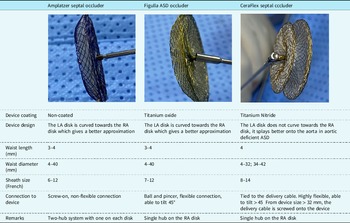
The CeraFlex septal occluder (Lifetech Scientific Co. Ltd, Shenzhen, China) and the Figulla Flex atrial septal defect occluder (Occlutech International AB, Helsingborg, Sweden) were introduced as alternatives with architecture which are largely similar in their construction and implantation process to those of the Amplatzer’s with minor modifications. Among the important structural innovations to encourage their use were the improvement in device coating to accelerate the endothelialisation of the device; a softer Nitinol architecture that allegedly reduces the risk of erosion; increased flexibility between the delivery cable and the device either via a wire or ball mechanism and the absence of the left atrial clamp to reduce risk of trauma and clot formation on the left atrial disk. The characteristics of these devices are summarised in Table 1.
Characteristics of the Amplatzer Septal Occluder, Figulla ASD Occluder and CeraFlex Septal Occluder

LA = left atrium; RA = right atrium; ASD = atrial septal defect.
We sought to investigate whether these features give these novel septal occluders the claimed advantage over the Amplatzer septal occluder by these devices. This study aimed to examine the safety and efficacies of these novel devices compared to the Amplatzer septal occluder in the early and intermediate term.
Materials and method
This was a single-centre, retrospective review of data records. Between January, 2013 and April, 2020, all consecutive patients who had undergone transcatheter secundum atrial septal defect closure were included in the study. During this period, all transcatheter atrial septal defectclosure was prospectively captured in an electronic database that documented the patients' baseline demography, indications and haemodynamics of the procedure, the device used, concerns or complications during the procedures and the immediate and intermediate outcomes. During the procedure, the choice of the device was based on the choice of the operator and not influenced by the characteristics of the defect or patient. All patients who had a follow-up duration of at least 6 months were included in the study. Patients who had incomplete outcome data or had a follow-up duration of fewer than 6 months were excluded from the study.
A device was deemed efficacious if there was no residual shunt detected via transthoracic echocardiogram at 1 year post-occlusion. In patients with more than one defects, only the treated defect was studied. Patients in whom a fenestration was created in the device to offload either the atriums post-atrial septal defect closure were not considered to have a residual shunt if the shunt came from the fenestration. They were patients with critical pulmonary stenosis or pulmonary atresia who had undergone previous right ventricular decompression, or elderly patients with restrictive left ventricular physiology. These fenestrations were created manually by the operators, using the dilator of the long delivery sheath over a guidewire which has pierced through the body of the device. As the size of the delivery sheath corresponds to the size of the device, the size of the fenestration created was relative to the size of the atrial septal occlude. The fenestration was created to transiently offload the atrium while the ventricles remodel themselves over time, except in one patient where a factory-made fenestrated device was used. Post-occlusion with the fenestrated device, no patient experienced acute pulmonary oedema. All self-made fenestration occluded spontaneously within 6 months after device implantation.Reference Leong, Kandavello, Husin, Perumal and Kaur Khelae6
In order to study the advantage of the novel devices over the Amplatzer septal occluder, we examined the softness of the device by assessing the risk of device erosion; and the pivoting mechanism via surrogate measures by comparing the procedure time, rate of early-onset device migration and the need for balloon assistance during delivery.
Early-onset complications were defined as documented complications either procedure or non-procedure related, which occurred during the first 12 hours of the patients’ stay after the procedure. These included vascular injury, cardiac injury, oesophageal injury, new onset of pericardial effusion and arrhythmias, which persisted after deployment of the device and device embolisation. Transient catheter-induced arrhythmias were not considered as device-associated complications and hence not captured. Late complications were complications that were documented after the discharge of the patient. These late complications were late-onset pericardial effusion, device embolisation, late-onset arrhythmias, device erosion, device migration and device thrombosis. Baseline characteristics were used to assess the odds of developing early and late-onset complications.
All procedures were performed under general anaesthesia under transesophageal echocardiography guidance. Details of the procedures were as previously described.Reference Alwi, Leong, Da Cruz, Ivy and Jagger7 All patients were discharged the day after the procedure, unless there was the presence of a complication, with aspirin at 5 mg/kg/day of a maximal dose of 150 mg daily for 6 months. Patients with a history of critical pulmonary stenosis or pulmonary atresia with intact ventricular septum post right ventricular decompression or patients with borderline pulmonary hypertension or with restrictive left ventricular physiology were admitted until they were deemed suitable for discharge. After discharge, these patients were followed up at 3 months and at 6–12 months thereafter with electrocardiogram and echocardiogram. Ambulatory monitors were applied when indicated.
Categorical data were described as a number with frequency and continuous data as median with interquartile range or mean with standard deviation, as appropriate. Baseline characteristics were compared using Kruskal–Wallis and Pearson’s Chi-square tests. Pearson’s Chi-square tests were used to compare the early and delayed complications between groups. Cross tabulation using Pearson’s Chi-square and Fisher’s exact tests were performed for early and late-onset complications to assess the relationship between the variables before performing logistic regression to see the magnitude of the risk factors with significant p values. A p-value of <0.05 in the context of a two-sided test was considered significant. The statistical analyses were carried out using IBM SPSS Statistics version 21 (SPSS Inc., Chicago, IL). This study was approved by the institutional review board.
Results
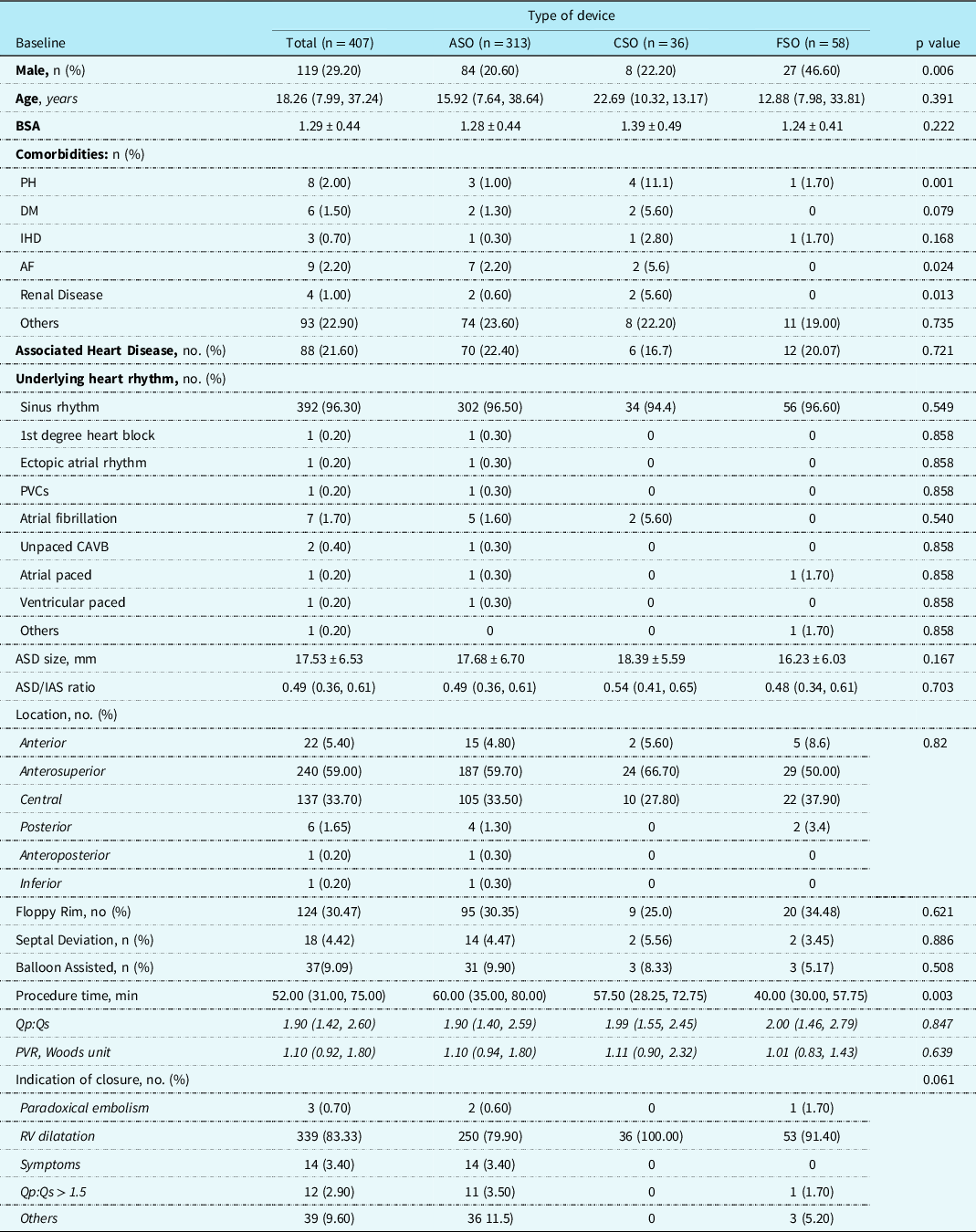
Four hundred and twelve patients, of which, 407 patients (age range: 0.17–70.72 years; Male: 29.2%) had complete follow-up data. Two hundred and sixteen (53.1%) patients were above 18 years old. None of the patients had severe pulmonary hypertension where the pulmonary to systemic vascular resistance ratio of >0.6 or a peak pulmonary artery to systemic pressure ratio of >0.5. Baseline characteristics of these patients were as summarised in Table 2. Amplazter septal occluders were the predominant occluder used as the Ceraflex septal occluder and Figulla atrial septal defect occluder were introduced into the institution in 2016. However, Amplatzer septal occluder was continued to be used. In the entire Amplatzer septal occluder cohort, as many as 181 (57.8%) patient underwent atrial septal defect occlusion in and after 2016. Some operators still preferred Amplatzer septal occluder due to their familiarity with the device. At baseline, there is no significant difference in terms of atrial septal defect size and haemodynamics. There was, however, a shorter procedure time in the Ceraflex septal occluder and Figulla atrial septal defect occluder groups which was due to the lower rate of device prolapse in the Ceraflex septal occluder and Figulla atrial septal defect occluder groups. Thirty-seven (9.1%) patients underwent balloon-assisted closure. No statistically significant difference was observed in the use of balloon-assisted device deployment among devices. Meanwhile, 28 (6.8%) patients had fenestrated device closure.
Baseline characteristics of the patient cohort and the characteristics of the atrial septal defects

BSA = Body surface area; PH = pulmonary hypertension; DM = diabetes mellitus; IHD = ischemic heart disease; AF = Atrial fibrillation; PVC = premature ventricular contraction; CAVB = complete atrio-ventricular heart block; ASD = atrial septal defect; IAS = interatrial septal length; Qp:Qs = pulmonary to systemic shunt ratio; PVR = pulmonary vascular resistance.
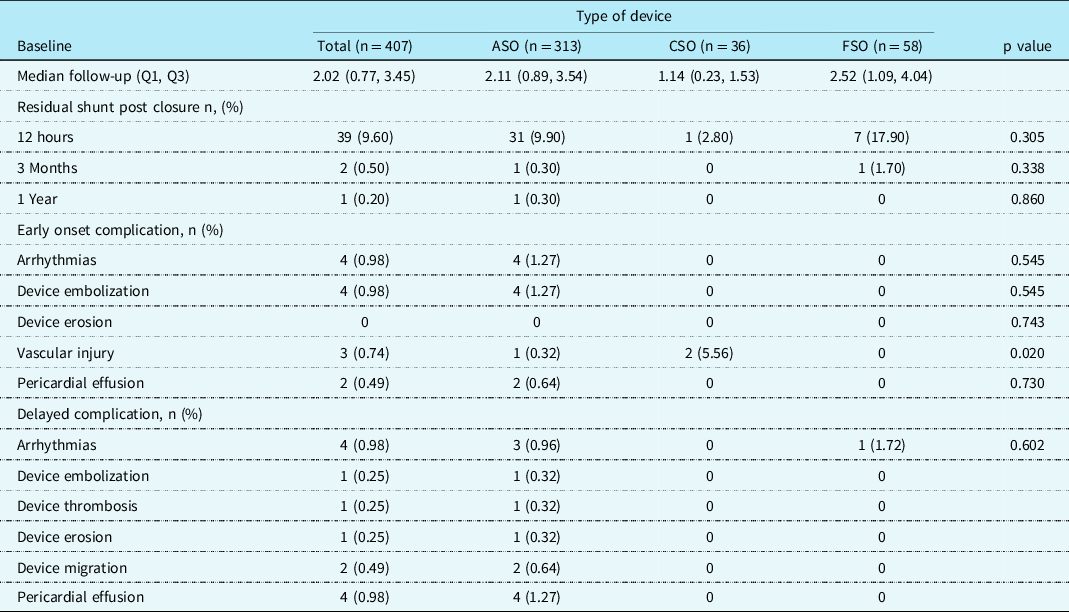
Table 3 summarises the early-onset and delayed complications of patients treated with different occluders. The rates of early-onset complications in Amplazter septal occluder, Ceraflex septal occluder and Figulla atrial septal defect occluder were 3.83%, 5.56% and 0%. There was no statistical difference in the immediate complication rates among devices. However, there was a higher rate of vessel injury in the Ceraflex septal occluder. This was presumably due to the larger delivery sheaths used for Ceraflex septal occluder compared to the other two devices. No early-onset device migration, cardiac or oesophageal injuries were noted. There were two patients with newly-onset small pericardial effusions immediately post-atrial septal occluder occlusions. The effusions occurred in 62.9 and 39.3 years old patients which were mild and non-progressive. The pericardial effusion resolved with diuretics. The patients were safely weaned off diuretics without the recurrence of pericardial effusion. Device embolisations were seen in four patients which were largely due to device mis-sizing. Three patients had transcatheter retrieval of the device followed by redo occlusion using larger occluders while another patient who had device embolisation to the ascending aorta, underwent emergency surgery for device retrieval and patch closure of the atrial septal defect.
Early and delayed-onset complications

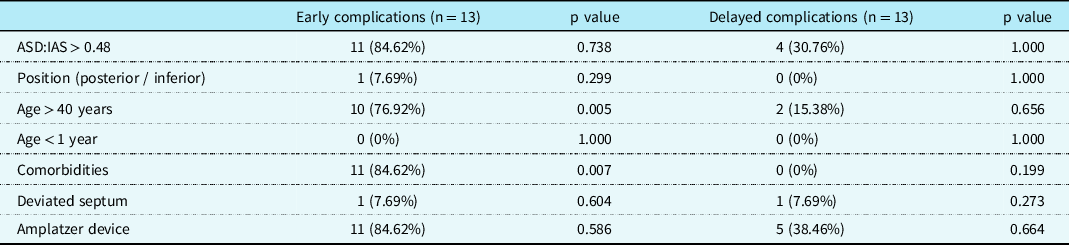
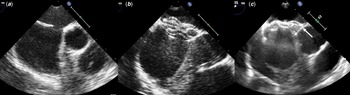
The patients were followed up for a median duration of 2.02 (IQR: 0.77, 3.45) years. Ten (2.46%) patients developed delayed complications. The rates of late complications were 2.56%, 0% and 1.72% in the Amplatzer septal occluder, Ceraflex septal occluder and Figulla atrial septal defect occluder groups. No statistical significance was noted in the delayed complication rates among the groups. No difference in the complication rate was noticed before and after 2016 when the novel occluders were introduced (5 versus 7, p = 1.00). There was one case of device erosion (Fig 1). Two patients were found to have late-onset pericardial effusion, of whom, one had device erosion while another had a small pericardial effusion which resolved over time. The latter occurred in a 4-month-old patient with Down Syndrome and chronic lung disease which underwent atrial septal defect closure using an Amplatzer septal occluder to aid weaning off oxygen. The pericardial effusion was not progressive and was presumed due to Down Syndrome rather than the procedure. Four patients had a loss of sinus rhythm. Two patients were in the Amplatzer septal occluder groups, who were >40 years old and had dilated atria. They developed atrial fibrillation 1 and 2 years after device closure, while another two patients from the Amplatzer septal occluder group developed sinus node dysfunction but with regular ectopic atrial beats. None of them required a pacemaker and were treated medically. Among the risk factors for complications, age >40 years and the presence of comorbidities were associated with early-onset complications (Table 4). In univariate analysis, these two risk factors significantly increased the patient’s odds for early-onset complications. In multivariate analysis, only age >40 years had the 2.9-fold increase risk (CI: 1.122–7.566) for early-onset complications (Table 5). The risk factors were not associated with the occurrence of delayed complications.
Cross tabulations of baseline characteristics against early and delayed-onset complications

ASD:IAS = atrial septal defect to interatrial septal length ratio.
Univariate and multivariate analyses of the risk factors for early-onset complications

Description of the patient with cardiac erosion by an Amplatzer septal occluder. This was a 14-year-old patient, weighing 43 kg with an atrial septal defect size of 11 mm. (a) There was good, solid around the atrial septal defect except for the aortic rim. The aortic rim was completely devoid of tissue. (b) A 14 mm Amplatzer septal occluder was implanted without difficulty. However, the pre-discharge echocardiogram showed the device abutting the aortic root. (c) On day 3 post-procedure, there was large hemopericardium detected on echocardiogram. The patient underwent emergency surgery to remove the septal occluder and closure of the atrial septal defect. Intraoperative, the device was seen eroding through the roof of the atrium just posterior to the aortic root.

Discussion
Complication rates
In this study, we found a high success in the occlusion rate (90.4% within 12 hours, 99.5% at 3 months and 99.8% at 1 year). Meanwhile, the overall complication rate was acceptably low at 6.39%. Although there was a higher number of complications reported in the Amplatzer septal occluder group, the denominator was significantly larger than the other two groups. The actual rate of complication was comparable among the groups. Our study showed no statistically significant difference in terms of the efficacies and the rate of complications sans the risk of vascular injuries. Previous studies demonstrated non-superiority between the Amplatzer septal occluder and Figulla atrial septal defect occluder with an occlusion rate of 90.3–100% and a complication rate of 3.9–15.2% seen in the patients treated with Figulla atrial septal defect occluder.Reference Kim, Jung, Chang, Jung and Choi4,Reference Pac, Polat, Cetin, Oflaz and Balli8,Reference Godart, Houeijeh and Recher9 Although less well studied than the other two devices, the same was seen between the Amplatzer septal occluder and Ceraflex septal occluder with an occlusion rate of 100% and the complication rate of 3.5% in the Ceraflex septal occluder group.Reference Astarcioglu, Kalcik and Sen5 The absence of a left atrial hub did not influence the rate of left-sided device thrombosis nor cardiac injury. Instead of the type of occluders, we found that the patient factor (age >40 years and the presence of preprocedural comorbidities) was associated with an increased risk for early-onset complications.
Device erosion
Though uncommon, the risk of device erosion is a much-feared complication in device atrial septal defect closure. Its occurrence is very much worrisome since it carries a risk of an out-of-hospital sudden death.Reference Taggart, Dearani and Hagler10,Reference Roberts, Parmar and Rajathurai11 Erosion occurs due to the constant impingement of the device onto the adjacent structure, causing a “circular-sawing” effect.Reference Amin, Hijazi, Bass, Cheatham, Hellenbrand and Kleinman12 This condition was implicated by oversizing the occluder, a larger device-to-patient ratio and a deficient aortic septal rim.Reference McElhinney, Quartermain, Kenny, Alboliras and Amin13,Reference Takaya, Akagi and Nakagawa14 The rate of erosion has been significantly reduced by avoiding oversizing of the device. However, aortic rim deficiency has not been made an absolute contraindication for device closure. This type of atrial septal defect constituted 59% of our patient cohort. Our isolated incident of erosion occurred in a large-size patient with a small device, underscoring the unpredictability of the risk of erosion. Importantly, device erosion often occurs late, and hence patients should be educated to be cognizant of the symptoms of erosion. Device manufacturers attempted to modify these devices to reduce their risk. Amongst others are creating a softer device scaffolding, which allegedly reduces the risk of erosion. The exact mechanism that softens the device was not clearly spelled out. The wire thickness was also not readily available. Nevertheless, given the low occurrence of device erosion in our cohort and we were not able to drive home a firm conclusion that supports the lower risk of erosion in these newer occluders. However, previous reports demonstrated that erosion was not unique to the Amplatzer septal occluder device.Reference Abe, Tsukano and Tosaka15,Reference Auriau, Bouvaist and Aaberge16 Recently, there have been efforts to occlude atrial septal defects using biodegradable occluders, which obviates the long-term exposure of the heart to a hard metallic occluder while allowing for future atrial transeptal septal puncture for left heart interventions.Reference Lu, Ouyang and Wang17–Reference Sigler, Söderberg, Schmitt, Mellmann and Bernhard19 Animal studies have been promising, but in-human studies are still underway. Until some evidence demonstrates their safety and efficacy, one would still rely on conventional metallic occluders.
Pivoting mechanism
The biggest advantage of these novel devices perhaps lies in their pivoting ability. The mechanism allows the device to pivot in line with the axis of the atrial septum, reducing the tension onto the atrial septum and allowing the operator to precisely evaluate the final position of the device before its release. Upon releasing the device from its cable, there is minimal movement seen on the device. The absence of a rigid cable-to-device connection also allows for a better assessment of the postero-inferior rim after deployment of the septal occluder, which with the rigid cable connection, crowds both the disks together, obscuring the said rim. The Ceraflex septal occluder and FSO have such advantages due to the pivoting mechanism. Procedure time, which was used as a surrogate marker of the ease of use, was shorter in the Ceraflex septal occluder and Figulla atrial septal defect occluder groups. With the main operators unchanged, the shorter procedure times were due to the ease of the device deployment and transechocardiogram assessment of the postero-inferior aspect the device after deployment. Not to be missed out, the manufacturer for Amplatzer septal occluder has come up with a new delivery cable with an ultra-flexible distal cable that allows flexibility of >90° to reduce tension and improve evaluation of the final device position.Reference Haddad, Khraiche, Bonnet, Meot and Malekzadeh-Milani20 Nevertheless, such a pivoting advantage only reveals itself on full deployment of the right atrial disk. As long as the connecting mechanism is still within the delivery sheath, the mechanism does not work. This advantage also comes with the disadvantage of the ease of the device prolapsing into the right atrium on the removal of the balloon after using the balloon to assist the delivery of the occluder. However, such a deficiency does not preclude their use as additional manoeuvers can be made to minimise the risk of device prolapse. This study did not include patients that use this novel delivery system, as it concluded before its introduction.
Limitations
The major limitation in this study was the discrepancy between the number of cases in each occluder and the timeline of its use. The Amplatzer septal occluder is overwhelmingly the commonly used device and has the longest follow-up period, which made comparison unfair. In addition, this study was limited by its retrospective nature. Data were procured from a database and hence exposed to transcription errors and issues of missing data.
Conclusion
There is no significant difference in safety and efficacies between the novel pivoting devices compared to the conventional Amplatzer Septal Occluder.
Acknowledgements
The authors would like to thank the Research Department of Institut Jantung Negara, Nurul Fakhri and Athirah Azeman for their assistance in the statistical analyses and preparation of the tables in this study.
Financial support
We thank the IJN Foundation for funding the database from which the data was extracted.
Conflicts of interest
None.
Ethical standards
The authors assert that all procedures contributing to this work comply with the ethical standards of the relevant guidelines on human experimentation and with the Helsinki Declaration of 1975, as revised in 2008, and has been approved by the institutional committees of Institut Jantung Negara.