Introduction
Birds are hosts to a broad diversity of symbiotic animals and one of the most diverse groups is mites (Arachnida: Acariformes, Parasitiformes), with at least 40 families and 3000 described species that live in close association with birds (Proctor and Owens Reference Proctor and Owens2000). The nature of the symbiotic relationship and the impacts these mites have on their hosts are variable, with some species being detrimental parasites, such as scaly-leg mites (Knemidokoptes Furstenberg, Prostigmata: Epidermoptidae), while other species are relatively benign associates such as most feather mites (Astigmata: Analgoidea, Pterolichoidea) (Proctor and Owens Reference Proctor and Owens2000).
Mites inhabit all parts of the avian integument; they can be found on and in the skin of their hosts, on and in the feathers, and even in the nasal passages, lungs, and air sacs. Dwelling in the nasal passages of birds has evolved independently in five families of parasitiform (Rhinonyssidae, Melicharidae) and acariform (Ereynetidae, Turbinoptidae, Cytoditidae) mites. Four of these families are parasites (Knee et al. Reference Knee, Proctor and Galloway2008) and the other family (Melicharidae) includes phoretic mites found in the nasal passages of hummingbirds (Colwell Reference Colwell1973). There are at least 500 described species of parasitic avian nasal mites worldwide (Fain Reference Fain1994). The Rhinonyssidae is the most diverse and frequently encountered family. Rhinonyssids are slow-moving haematophagous endoparasites. These mites occur predominately in the nasal cavity in association with the turbinates, scrolls of highly vascularised epithelial tissue, and occasionally in the tracheal tissues, lungs, and body cavity (Porter and Strandtmann Reference Porter and Strandtmann1952; Bell Reference Bell1996a). Speleognathine (Prostigmata: Ereynetidae) mites are tissue-feeding nasal parasites of birds and mammals (Akimov et al. Reference Akimov, Badanin and Zabludovskaya2003). Speleognathines are found throughout the nasal cavity, and their hydrophobic cuticle allows them to move rapidly on top of the nasal mucosa (Porter and Strandtmann Reference Porter and Strandtmann1952). The Turbinoptidae (Astigmata) are sluggish, tissue-feeding mites that dwell in the superficial cutaneous regions of the nasal cavity and feed on corneous layers of the skin (Fain Reference Fain1994). Turbinoptids are encountered infrequently, but when present, a host is often infested with large numbers (Porter and Strandtmann Reference Porter and Strandtmann1952). Cytoditidae (Astigmata) species have not been collected in Canada; this is a small family of exudate-feeding endoparasites that occur throughout the nasal cavity as well as the sinuses, lungs and air-sacs (Fain Reference Fain1994). In most cases, nasal mites are not considered to cause significant pathology to their hosts; however, the feeding activity of some rhinonyssids may cause trauma to nasal tissues (de Rojas et al. Reference de Rojas, Mora, Ubeda, Cutillas, Navajas and Guevara2002), and species that invade the lungs and air-sacs, such as Sternostoma tracheacolum Lawrence (Rhinonyssidae), can cause pneumonia and death of their hosts (Bell Reference Bell1996a).
Avian nasal mites have been surveyed in regions throughout the world, including Russia, Australia, Canada, Taiwan, and the United States of America (Maa and Kuo Reference Maa and Kuo1965; Domrow Reference Domrow1969; Pence Reference Pence1975; Butenko Reference Butenko1984; Knee et al. Reference Knee, Proctor and Galloway2008). Before Knee et al. (Reference Knee, Proctor and Galloway2008) there were only seven records for nasal mites from birds in Canada, four of which were published records (George Reference George1961; Pence Reference Pence1975; Ballard and Ring Reference Ballard and Ring1979; Hood and Welch Reference Hood and Welch1980) and three were unpublished records from mites deposited in the Canadian National Collection of Insects, Arachnids, and Nematodes in Ottawa, Ontario, Canada. Knee et al. (Reference Knee, Proctor and Galloway2008) emphasised the lack of knowledge about these peculiar mites, and indicated that there were likely still many more species of nasal mites to be recorded from birds in Canada. Following the publication of this survey, two of the authors (W.K. and T.D.G) continued to explore the diversity of nasal mites in Canada with the objectives of discovering undescribed species, as well as expanding the number of records for Manitoba and Canada. It is important to know the identity and distribution of species parasitising birds in Canada and neighbouring countries. Established host records enable researchers to detect new species invasions and to explore the role of these mites in avian disease.
Materials and methods
Most birds were casualties from 1999 to 2013 from the Wildlife Haven (Manitoba Wildlife Rehabilitation Organization) and the Prairie Wildlife Rehabilitation Centre. Small numbers of birds were submitted by the general public as a result of window strike, road kill, or cat mauling; some game birds, typically with breast meat removed, were donated by hunters. As soon as possible after death, birds were tagged with date of death and location, individually bagged and stored at −20 °C until processing in the laboratory at the University of Manitoba (Winnipeg, Manitoba, Canada). The nasal passages of thawed birds were flushed with a solution of warm water and mild soap using orthodontic syringes, a 12 mL Monojet® 412 curved tip plastic syringe for larger birds (⩾10 g) and 3 mL Monojet® syringe fitted with a 22 gauge slotted irrigation needle for smaller birds (usually <10 g), though diameter of the nostrils ultimately determined the size of syringe used. The solution was flushed through each nostril, through the opening in the palette and back out the mouth into a Petri dish. Occasionally nasal mites were collected from whole-body washing, where a thawed bird was placed in a container ranging in volume from 4−40 L, depending on the size of the bird, submerged in warm water containing a few drops of liquid dish detergent. Each bird was agitated vigorously three to 10 minutes, depending on the size of the bird. Each bird was then removed from the container and rinsed thoroughly; the washing solution was filtered through a 90-µm sieve. This process was repeated once again with warm, soapy water, and once finally with warm water. The filtrate from all three washes was preserved in 70% or 95% ethanol. Samples were examined for mites using a dissecting microscope. All nasal mites were collected and preserved in 70% or 95% ethanol for later identification; all other associated arthropods were retained by T.D.G.
Mites were removed from ethanol and cleared in 85% lactic acid, mounted in polyvinyl alcohol medium (6371A; BioQuip Products, Rancho Dominguez, California, United States of America), and cured on a slide warmer at 40 °C for three to four days. Slide-mounted specimens were examined using a Leica DM2500 compound microscope with differential interference contrast. Species level identifications were made using keys (Pence Reference Pence1975; Knee and Proctor Reference Knee and Proctor2010) and species descriptions from the primary literature. Voucher specimens (CNC535645–CNC535685; Supplementary Material Table S1) are deposited in the Canadian National Collection of Insects, Arachnids, and Nematodes (Agriculture and Agri-Food Canada, Ottawa, Ontario, Canada). Host taxonomy follows the American Ornithologists’ Union (1983) Checklist of North American birds, 7th edition, plus supplements. Infestation parameters were calculated using Quantitative Parasitology 3.0 (Rózsa et al. Reference Rózsa, Reiczigel and Majoros2000). Scientific permits were issued to T.D.G. for migratory birds by the Canadian Wildlife Service, Environment Canada, and for raptors and upland game birds by Manitoba Conservation.
Results
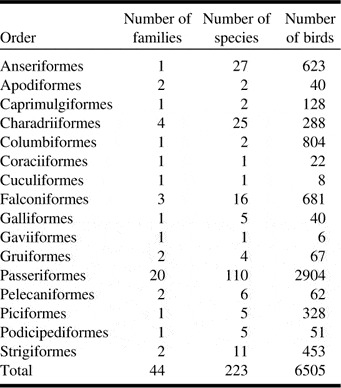
Over the period of 1999–2013, we examined a total of 6505 birds for nasal mites (which includes birds from Manitoba reported by Knee et al. (Reference Knee, Proctor and Galloway2008)), representing 223 species from 16 orders and 44 families (Table 1). The majority of these birds were from Manitoba with a small number (18) from Alberta, British Columbia, Ontario, and Saskatchewan, Canada. Approximately half of the birds and species examined were passerines (2904 birds, 110 species). The next most abundant bird orders examined were Columbiformes, Falconiformes, and Anseriformes in order of decreasing abundance. Considering the low diversity of bird taxa in the order, columbiform hosts were overrepresented with 804 individuals examined from two species, Columba livia Gmelin and Zenaida macroura (Linnaeus). Anseriform, charadriiform, and falconiform hosts were the next most diverse orders examined, in decreasing order.
Diversity and abundance of all birds examined in Manitoba, Canada for nasal mites during 1999–2013, including those reported by Knee et al. (Reference Knee, Proctor and Galloway2008).

Note: Results from 18 birds from Alberta, British Columbia, Ontario, and Saskatchewan, Canada not included in Knee et al. (2008) are also provided in the table.
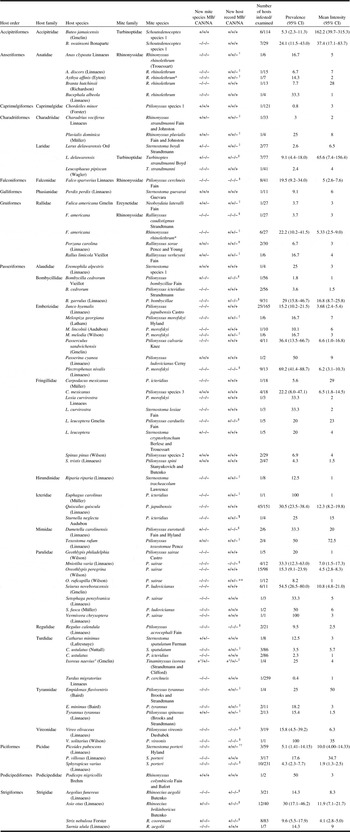
The focus of this study was to provide new host records and new nasal mite records for Manitoba, Canada, and North America; therefore, only a selection of nasal mites from selected hosts (i.e., those not reported by Knee et al. (Reference Knee, Proctor and Galloway2008)) were identified to species and are presented here. Following this targeted approach we include the host records for 92 individual birds, representing 64 species from 11 orders and 23 families (Table 2; Supplementary Material Table S1). There were 21 new locality records for rhinonyssid species, one new ereynetid, and two new turbinoptid species for Manitoba, including five undescribed species (four rhinonyssids and one turbinoptid), which will be described in a subsequent publication. For Canada, there were 16 new locality records for rhinonyssid species, one new ereynetid, and one new turbinoptid species. For North America, we found eight new locality records for rhinonyssid species and one new turbinoptid species (Table 2). Identifications were based on adult specimens, with the exception of two instances where identification was based on nymphs (Rhinonyssus rhinolethrum Berlese and Trouessart from Aythya affinis (Eyton) and Fulica americana Gmelin).
Host records for nasal mites (Rhinonyssidae, Turbinoptidae, and Ereynetidae) collected from birds in Manitoba (MB), Canada (CAN) (with one °British Columbia, Canada record), including the status of these records (+ new, − prexisting record) in North America (NA) (*identification based on nymph).
Notes: No confidence intervals (CI) are provided for prevalence or intensity where 95% CI intervals are uncertain for the given sample size.
† Mitchell and Rhodes (Reference Mitchell and Rhodes1960).
‡ Pence (Reference Pence1975).
§ Knee et al. (Reference Knee, Proctor and Galloway2008).
|| Pence and Young (Reference Pence and Young1979).
¶ Spicer (Reference Spicer1978).
** Spicer (Reference Spicer1987).
†† Hyland (Reference Hyland1962).
Of the 64 host-parasite associations reported in this study (Table 2), 58 were new host records for rhinonyssids, one was new for ereynetids, and four were new for turbinoptids in Manitoba. For Canada, the new host-mite records were 52 for rhinonyssids, one for ereynetids, and three for turbinoptids. New host mite records for North America included 30 for rhinonyssids, and three for turbinoptids. Birds were typically infested with only one species of nasal mite, with the exception of four individuals that had two species of nasal mites: Fulica americana with Rallinyssus caudistigmus Strandtmannn and Neoboydaia lateralli Fain, Bombycilla cedrorum Vieillot with Ptilonyssus bombycillae Fain and P. icteridius Strandtmann, Loxia curvirostra Linnaeus with P. morofskyi Hyland and Sternostoma loxiae Fain, and Loxia leucoptera Gmelin with P. carduelis Fain and S. cryptorhynchum Berlese and Trouessart (Table 2).
One specimen of Ptilonyssus cerchneis Fain was collected from an American robin (Turdus migratorius Linnaeus); however, this record is possibly a falconiform contaminant as P. cerchneis has only been collected from American kestrels (Falco sparverius Linnaeus) (Pence Reference Pence1975; Knee et al. Reference Knee, Proctor and Galloway2008) and may be a host specialist. The red-tailed hawk, Buteo jamaicensis (Gmelin), had both the highest mean intensity of infestation with 162 Schoutedenocoptes species, one per infested host, and the highest intensity overall, with 351 mites from one host.
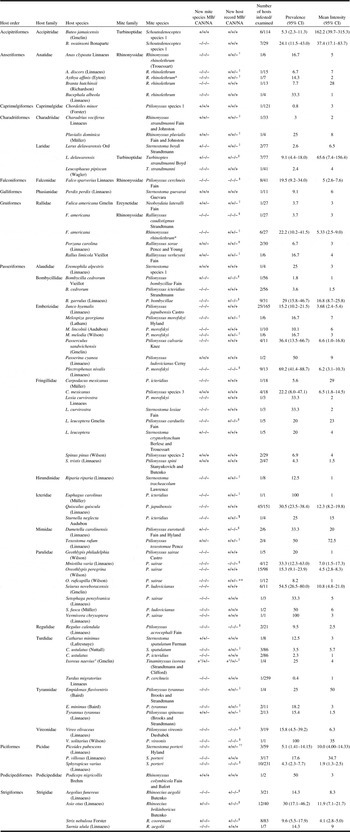
With this study and Knee et al. (Reference Knee, Proctor and Galloway2008) combined, a total of 6968 birds from 243 species have been examined for nasal mites, and no nasal mites have been collected from 127 of these species in Alberta or Manitoba (Table 3). Sample sizes among these species ranged from 1–271 with a mean of 15, most species (83%) were sampled fewer than 10 times. Of the species not found infested with nasal mites sample sizes were as follows: 41 host species n⩾10 birds, 25 species n⩾20 birds, for five species n⩾50 birds, and for four species n⩾100 (Table 3). The four largest sample sizes were for merlin (n=242) (Falco columbarius Linnaeus), American crow (n=217) (Corvus brachyrhynchos Brehm), European starling (n=153) (Sturnus vulgaris Linnaeus), and blue jay (n=131) (Cyanocitta cristata Linnaeus).
Numbers of each bird species examined from Manitoba (MB) and Alberta (AB), Canada from which no nasal mites were collected (1999–2013), including Knee et al. (Reference Knee, Proctor and Galloway2008) records.

* Species with nasal mite records in the United States of America.
Discussion
Our understanding of the rich parasitic arthropod fauna associated with birds in Canada is incomplete but progressing. With this study and including Knee et al. (Reference Knee, Proctor and Galloway2008), we have examined 243 species of birds for nasal mites, representing about 57% of Canada’s breeding avifauna (426 species) (American Ornithologists’ Union 1983). Thus, a moderate portion of Canada’s avifauna has been examined for nasal mites, but many of these include species for which sample sizes are small, and some taxonomic groups are underrepresented, such as procellariiforms, marine charadriiforms, and grassland passeriforms, as indicated in Knee et al. (Reference Knee, Proctor and Galloway2008).
Expanding upon the seven pre-existing records of nasal mites in Canada, Knee et al. (Reference Knee, Proctor and Galloway2008) reported an additional 56 species of nasal mites in the country (48 rhinonyssids, seven ereynetids, one turbinoptid), and predicted there were at least 70 species of rhinonyssids in Canada based on species accumulation curves. In the present study, we have expanded upon the known diversity of rhinonyssids (33% increase), ereynetids (14%), and turbinoptids (100%) in Canada. Overall, a total of 66 species of rhinonyssids, eight ereynetid species, and two species of turbinoptids are now known to occur in Canada. It is likely we will surpass the estimate of 70 species of rhinonyssids in Canada during future surveys.
Knee et al. (Reference Knee, Proctor and Galloway2008) added an additional 105 new host-parasite species records (96 rhinonyssid, seven ereynetid, two turbinoptid) for Canada. In this survey, we have added 56 additional host-parasite species records for birds in Canada (52 rhinonyssid, one ereynetid, three turbinoptid). There are now 155 rhinonyssid, eight ereynetid, and five turbinoptid host-parasite species records known for Canada. In this study, we also reported 33 new host-parasite records for birds in North America. Nasal mites have been surveyed relatively more intensively in the United States of America than in Canada, and as most bird species in Canada migrate annually, this makes it more challenging to observe new records at this broader geographic scale. One new record of note is an undescribed species of rhinonyssid from grey partridge in Manitoba, a bird introduced to Canada from Europe. Nasal mites had never previously been reported from galliform hosts in Canada or the United States of America.
In this survey, Sternostoma tracheacolum was collected from the bank swallow (Riparia riparia (Linnaeus)), and is now known from three species of birds in Canada (including Agelaius phoeniceus (Linnaeus), Mniotilta varia (Linnaeus)) (Knee et al. Reference Knee, Proctor and Galloway2008). This species may cause serious pathology in their hosts by entering the lungs and air sacs, which can lead to pneumonia and mortality (Bell Reference Bell1996a). This mite is a host generalist and has been collected from at least 37 species of wild and captive birds (Fain and Hyland Reference Fain and Hyland1962; Bell Reference Bell1996b). Considering the pathology and broad host range of these mites, it is important to monitor the host species range and distribution of S. tracheacolum.
As seen in other surveys, prevalence of infestation by turbinoptids was low, but when they were encountered the intensity of infestation was high. A maximum of 351 Schoutedenocoptes species, one was collected from one red-tailed hawk and 244 Turbinoptes strandtmanni Boyd from a ring-billed gull. Ereynetids were also infrequently encountered, and when they were present they occurred in low numbers.
It is rare for one host individual to harbour more than one species of nasal mite. Pence (Reference Pence1973) reported co-infestations in birds from Louisiana but did not provide any details. Spicer (Reference Spicer1987) reported one co-infested flycatcher with two species of rhinonyssids, representing 1% of 87 infested birds from Texas, United States of America. Butenko and Stanyukovich (Reference Butenko and Stanyukovich1999) reported co-infestations of rhinonyssids in 0.3% of 377 infested mallards (Anas platyrhynchos Linnaeus), 0.8% of 87 infested Eurasian teals (Anas crecca Linnaeus), and 2.3% of 84 infested garganeys (Anas querquedulae Linnaeus). In the present study, multiple species co-infestations were uncommon (4.3% of infested hosts) but higher than in previously published records.
Species of birds infested are always reported in nasal mite surveys, but rarely are species that were uninfested by nasal mites included. A substantial number of birds have been examined in Canada for nasal mites since 1999, and out of the ~7000 birds examined in this study and Knee et al. (Reference Knee, Proctor and Galloway2008), some host species have been extensively sampled and yet no mites found. The prevalence of infestation is to some extent a function of the sampling effort; if more individuals are examined the chance of finding mites increases, if a host species is infested at all. Pence (Reference Pence1973) maintained that if more than 10 birds are examined, it is significantly more likely that it will be found to harbour nasal mites. We examined ⩾10 individuals of 41 species of birds that had no nasal mites; however, nasal mites have been recorded for 13 of these species in the United States of America. We sampled ⩾50 individuals of five species of birds, and ⩾100 individuals of four species, none of which were infested with nasal mites in Canada. Two of these species (American crow, Corvus brachyrhynchos, and European starling, Sturnus vulgaris) are reported to have nasal mites in the United States of America. Four species of nasal mites are reported from American robins (Turdus migratorius) in the United States of America (Pence Reference Pence1975); we examined 271 American robins in the present study plus Knee et al. (Reference Knee, Proctor and Galloway2008) and only two of these had nasal mites; one of these records is likely a falconiform contaminant. A small number of host species have been sampled exhaustively in Canada and yet no nasal mite infestations have been found, even though they are known to be infested by nasal mites in other parts of North America. The apparent absence of nasal mites across the geographic range of their hosts warrants further investigation.
Although we continue to explore the diversity of nasal mites infesting birds in Canada, there is still considerable work to do. Our efforts have been regional, focussed mainly in Alberta and Manitoba. No doubt there is variation in infestation parameters and faunal composition commensurate with local environmental conditions and opportunities for transmission.
Acknowledgements
The authors thank the hospital staff at the Wildlife Haven (Manitoba Wildlife Rehabilitation Organization) and the Prairie Wildlife Rehabilitation Centre for their care in receiving birds, and their careful triage and processing protocols to maintain specimens in the best condition possible for this study. They also thank Dave Holder, Lisa Babey, and a small army of undergraduate research assistants for their help in sampling for nasal mites in the majority of the birds examined in this study; they gratefully acknowledge the continued support of the Department of Entomology, Faculty of Agricultural and Food Sciences at the University of Manitoba.
Financial Support
Funding was provided to T.D.G., in part, by a Discovery Grant from the Natural Sciences and Engineering Research Council of Canada.
Supplementary material
To view supplementary material for this article, please visit http://dx.doi.org/10.4039/tce.2016.47