Cardiac injury occurs commonly during hematopoietic stem cell transplantation in paediatric patients.Reference Rotz, Ryan and Jodele 1 – Reference Murdych and Weisdorf 5 Long-term survivors of paediatric hematopoietic stem cell transplantation have rates of left ventricular systolic dysfunction between 0 and 26%, with the wide range due in part to non-standardised monitoring intervals, variable methods to determine systolic function and hence definitions of left ventricular systolic dysfunction, and differing risk factors among populations studied, for example percent of patients who received pre-hematopoietic stem cell transplantation anthracyclines.Reference Rotz, Ryan, Hlavaty, George, El-Bietar and Dandoy 6 – Reference Uderzo, Pillon and Corti 10 Historically, shortening fraction and ejection fraction have been used to describe function of the left ventricle. Speckle-tracking echocardiography is a more recently developed means of measuring tissue motion and deformation that is not as angle-dependent as shortening fraction and ejection fraction, and therefore less operator- and patient-dependent. The degree of tissue deformation can then be quantified as a measure of strain in multiple planes: circumferential, longitudinal, and radial. A large systemic review of long-term cancer survivors showed that strain may be abnormal despite normal ejection shortening fraction and ejection fraction.Reference Thavendiranathan, Poulin, Lim, Plana, Woo and Marwick 11 In addition, measures of strain can predict future reductions in ejection fraction in adults with breast cancer.Reference Hare, Brown, Leano, Jenkins, Woodward and Marwick 12 , Reference Sawaya, Sebag and Plana 13 Global longitudinal strain has been used to assess changes in cardiac function over the first-year post-hematopoietic stem cell transplantation in small cohorts of hematopoietic stem cell transplantation patients,Reference Covi, Ravindranath, Farooqi, Savasan, Chu and Aggarwal 14 though no study of strain has previously been completed among long-term survivors of paediatric hematopoietic stem cell transplantation.
Echocardiography guidelines developed by the Children’s Oncology Group for screening recommend routine assessment of cardiac function, both systolic and diastolic, using two-dimensional echocardiography at intervals ranging from yearly to every 5 years, depending on patient exposure to anthracyclines and radiation, exposure dose, and age at exposure.Reference Chow, Anderson and Baker 15 However, guidelines developed by the Center for International Blood and Marrow Transplant Research and European Society for Blood and Marrow Transplantation do not specify the need for echocardiographic screening.Reference DeFilipp, Duarte and Snowden 16 Many paediatric patients transplanted for non-malignant indications, such as Shwachman–Diamond syndrome, Hurlers syndrome, sickle cell disease, and beta-thalassemia, have pre-existing cardiac abnormalities and should be screened with disease-specific modalities.Reference Rotz, Ryan, Hlavaty, George, El-Bietar and Dandoy 6 , Reference Braunlin, Stauffer and Peters 17 – Reference Toiviainen-Salo, Pitkanen and Holmstrom 22 For the remaining patients without disease-specific indications and no radiation or anthracycline exposure, strategies vary in paediatric hematopoietic stem cell transplantation centres, and many centres screen all asymptomatic individuals for an indeterminate period post-hematopoietic stem cell transplantation. We aimed to determine the rate of abnormal systolic function in survivors of paediatric hematopoietic stem cell transplantation at least 5 years post-infusion, and identify a subset of survivors who can safely avoid future echocardiographic screening.
Methods
Patients who underwent hematopoietic stem cell transplantation at Cincinnati Children’s Hospital Medical Center between 1982 and 2006, and had an echocardiogram performed at least 5 years after cell infusion were reviewed in the study, with Institutional Review Board approval. A paediatric cardiologist reviewed each patient’s most recent echocardiogram. If specific measurements were missing, a different paediatric cardiologist blinded to the patient’s history performed measurements of images that were available. In addition, if echocardiographic windows were appropriate and the images technically adequate, post hoc, offline analysis of global longitudinal strain was performed as described below (echocardiograms subsection). Linear measurements were normalised for age and patient body surface area. Clinical variables were obtained from the electronic medical record, and echocardiographic measurements were compared with clinical risk factors.
Data collection
We collected data such as diagnosis, age, date of transplant, sex, preparative regimen, including chemotherapy and total body irradiation, and previous anthracycline exposure. Indications for echocardiogram were reviewed, and those patients who had an echocardiogram performed for routine surveillance were included for further analysis.
Echocardiograms
All echocardiograms were performed using the iE33 ultrasound system (Phillips Medical Systems, Best, The Netherlands). We analysed echocardiograms for ejection fraction, left ventricular end diastolic dimension, septal thickness, posterior wall thickness, and global longitudinal strain. We converted dimensions measured to age-adjusted z-scores (SDs) using the Boston Children’s Hospital z-score system.Reference Lai, Mertens, Cohen and Geva 23 Values were considered abnormal if they fell more than two z-scores below the mean (zero). We calculated ejection fraction using Simpson’s method. If measurement of ejection fraction was not available on the original clinical report, a cardiologist blinded to the study calculated ejection fraction using 5/6 area–length method on previously captured images. We performed offline calculations of global longitudinal strain using vendor-independent clinical echocardiographic software (Image Arena, TomTec Imaging Systems, Munich, Germany). Normal values for strain have not been definitively set across the various available echocardiogram platforms and analysis software. Based on recent guideline recommendations and a meta-analysis, we choose conservative values for the present analysis that may underestimate the amount of dysfunction, and therefore we considered global longitudinal strain abnormal if values were ⩾−16.0%.Reference Levy, Machefsky and Sanchez 24 , Reference Lang, Badano and Mor-Avi 25
Statistical analysis
We exported data to Prism (GraphPad Software, La Jolla, CA, United States of America) for analysis. We tested categorical variables using a two-sided Fisher’s exact test. Positive and negative predictive values were computed for categorical variables. We used an independent two-sample t-test to calculate two-tailed p-value for continuous variables.
Results
Patients
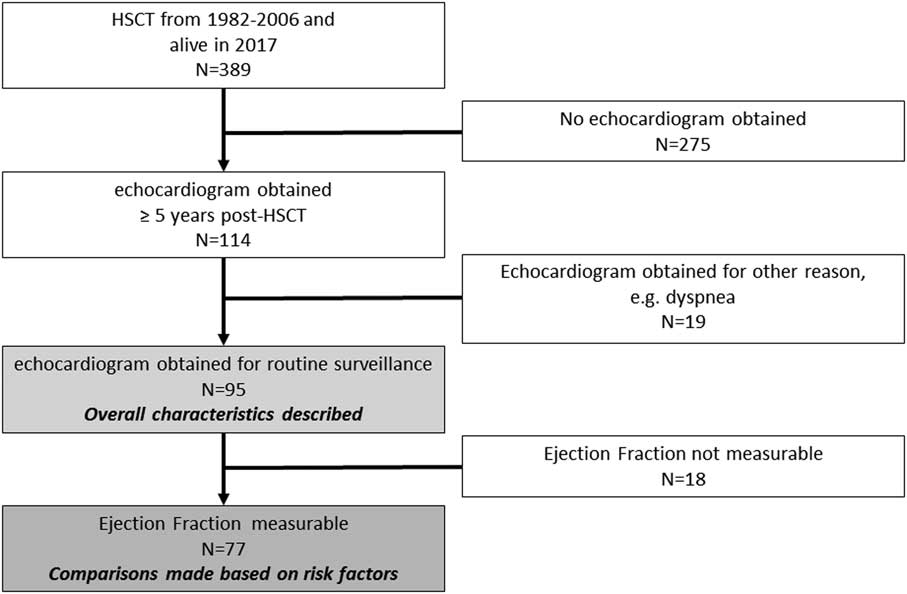
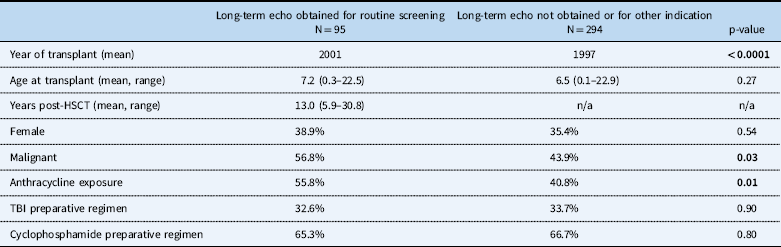
A total of 389 patients underwent hematopoietic stem cell transplantation between 1982 and 2006 and were alive in 2017, and 114 of these patients had an echocardiogram obtained at least 5 years post-infusion (Fig 1). If patients had multiple echocardiograms obtained at least five years post-infusion, the most recent examination was used. Indications for echocardiograms included cardiac symptoms (n=5, 4.4%), congenital cardiac anomalies (n=8, 7.0%), hypertension (n=2, 1.8%), known cardiac or pulmonary disease (n=2, 1.8%), routine post-hematopoietic stem cell transplantation surveillance (n=95, 83.3%), and unknown (n=2, 1.8%). We compared the 95 patients who had echocardiogram performed for routine surveillance, to the remainder of the cohort, either no echo obtained or echo was obtained for specific clinical indication (N=294) (Table 1). Those with routine surveillance echocardiogram performed were transplanted more recently (2001 versus 1997, p<0.0001). Patients were more likely to have received an echocardiogram if they underwent hematopoietic stem cell transplantation for a malignant indication or had previously received anthracyclines. However, we saw no difference between groups for age at transplant, sex, or total body irradiation or cyclophosphamide-based preparative regimen (Table 1). The mean time from hematopoietic stem cell transplantation to most recent echo in the routine surveillance group was 13.0 years with a range of 5.9–30.8 years. No patients in the routine surveillance group received pre- or post-hematopoietic stem cell transplantation thoracic radiation.
Included patients.

Characteristics of patients who had echocardiograms obtained for routine screening at least 5 years post-hematopoietic stem cell transplantation and those that did not have echocardiogram obtained or had echocardiogram obtained for other indication.

HSCT=hematopoietic stem cell transplant; TBI=total body irradiation
Bold type indicates a p-value of <0.05.
Echocardiographic measurements
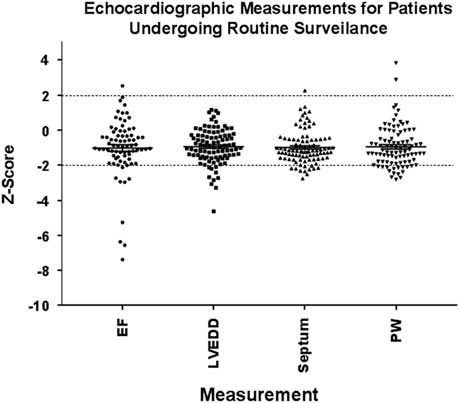
Of the 95 patients who had echocardiograms performed for routine surveillance, 77 (81.1%) had ejection fraction measured, 95 (100%) had left ventricular end diastolic dimension, 92 (96.8%) had septal thickness, and 91 (95.8%) had posterior wall thickness. The mean ejection fraction z-score was −1.01(59.3%) in the range of 35.0–73.0%. Mean z-score of left ventricular end diastolic dimension was −0.94, mean z-score of septal thickness was −0.98, and mean z-score of left ventricular posterior wall thickness was −0.95 (Fig 2). From the echocardiograms of 77 patients with the measurement of ejection fraction, 10 (13.0%) had ejection fraction z-score of ⩽−2.0, which is abnormally low. Among these 10 patients, the mean ejection fraction was 47.6%, in the range of 35.0–55.4%. In addition, 10/95 patients (10.5%) had abnormally low left ventricular end-diastolic dimension, 11/92 patients (12.0%) had abnormally low septal thickness, and 15/91 patients (16.5%) had abnormally low posterior wall thickness.
Echocardiographic z-score measurements. Included are patients with indication of routine surveillance. A z-score of ⩽2.0 is considered abnormal. Note: ejection fraction, left ventricular end-diastolic dimension, septal thickness (septum), posterior wall thickness.

Risk factors for abnormal ejection fraction
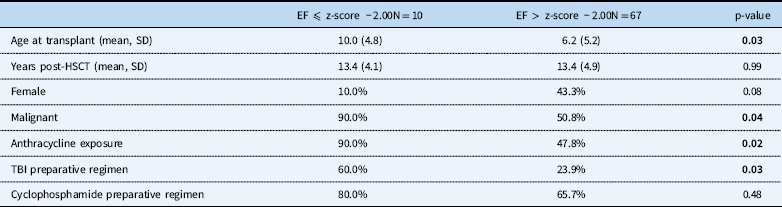
We next analysed the risk factors for abnormal ejection fraction in the 77 patients who had this measurement available (Fig 1). Patients with an abnormal ejection fraction at most recent examination were either older at the time of transplantation, had a malignant transplant indication, were exposed to anthracyclines, or had received total body irradiation-based conditioning (Table 2). Patients who received anthracycline chemotherapy had a mean z-score ejection fraction of −1.46 versus patients who did not receive anthracyclines −0.45 (p=0.008), with mean ejection fraction 57.3 versus 61.7%. Patients who received total body irradiation had a mean z-score ejection fraction of −1.79 versus patients who did not receive total body irradiation −0.68 (p=0.007), with mean ejection fraction 56.6 versus 60.5%. Notably, those who received cyclophosphamide conditioning had a mean z-score ejection fraction of −1.13 versus patients who did not receive cyclophosphamide conditioning −0.76 (p=0.38). In the population of 77 patients, the positive predictive value of having an abnormal ejection fraction given exposure to total body irradiation or anthracyclines was 19.2% at 95% confidence interval (10.4–32.5%).
Risk factors for abnormally low ejection fraction among patients who had echocardiograms obtained for routine screening at least 5 years post-HSCT.

EF=ejection fraction; HSCT=hematopoietic stem cell transplant; TBI=total body irradiation
Bold type indicates a p-value of <0.05.
Global longitudinal strain
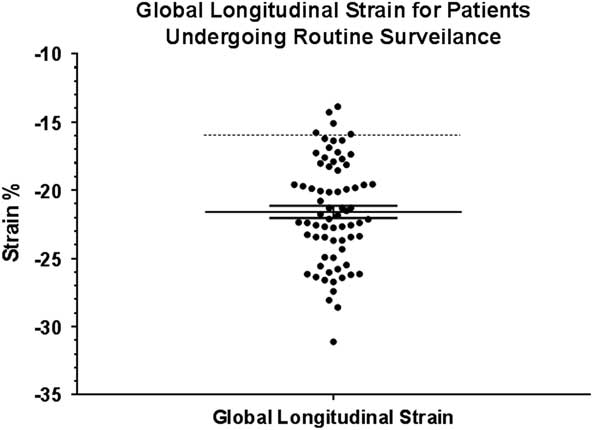
In order to determine if some patients had evidence of abnormal left ventricular systolic function in the setting of normal ejection fraction, we measured global longitudinal strain. We were able to obtain measurements of global longitudinal strain in 71 of 95 patients (74.7%) who had echo obtained for routine surveillance. Among the 71 patients, the mean global longitudinal strain was −21.96%, and five of 71(7.0%) patients had an abnormally elevated global longitudinal strain (Fig 3). Only one patient who had a normal ejection fraction with z-score −0.39 and ejection fraction 61.7% had an abnormal global longitudinal strain of −15.9% (normal ⩽−16.0%). Moreover, no difference in global longitudinal strain was noted between anthracycline, total body irradiation, or cyclophosphamide exposed and unexposed subjects.
Global longitudinal strain. Included are patients with indication of routine surveillance. A strain measurement of ⩾−16.0% (“less negative”) is considered abnormal.

Low-risk patients
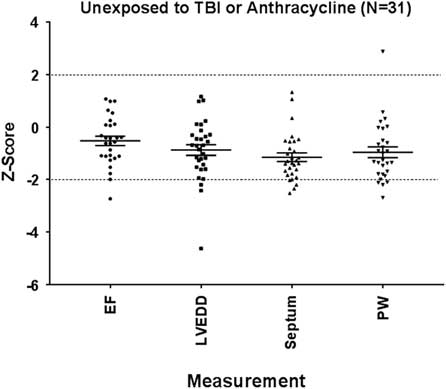
Among individuals who received neither anthracycline chemotherapy nor total body irradiation only, 1/31 (3.2%) patient was found to have an abnormal ejection fraction with z-score −2.73, ejection fraction 51.4%, or global longitudinal strain −14.28% (Fig 4). Among the population of 77 patients, the negative predictive value of having a normal ejection fraction given no exposure to total body irradiation or anthracyclines was 96.7% at 95% confidence interval (83.3–99.8%). The transplant indication for these 31 patients was hemophagocytic lymphohistiocytosis (7), Wiskott–Aldrich syndrome (4), severe aplastic anaemia (4), severe combined immunodeficiency (4), congenital amegakaryocytic thrombocytopenia (2), immunodysregulation polyendocrinopathy enteropathy X-linked syndrome (2), Fanconi anaemia (1), Hurler’s syndrome (1), Shwachman–Diamond syndrome (1), Krabbe’s disease (1), Neiman Pic (1), and medulloblastoma (1). The single patient with abnormal ejection fraction was seen by a paediatric cardiologist and was asymptomatic. On further review of this child’s echocardiogram, minor trabeculations were observed which can be seen in normal children as well as in children with cardiac non-compaction.Reference Bennett and Freudenberger 26 No medication was started and he was advised to continue routine cardiac surveillance.
Echocardiographic measurements in patients who did not receive total body irradiation or anthracyclines. Note: ejection fraction, left ventricular end-diastolic dimension, septal thickness (septum), posterior wall thickness.

Discussion
Long-term survivors of paediatric hematopoietic stem cell transplantation who are asymptomatic and did not receive radiation or anthracyclines were unlikely to demonstrate abnormal ejection fraction or global longitudinal strain in this study at a mean of 13.0 years post-hematopoietic stem cell transplantation. Recommendations for screening are available for patients who received anthracyclines or chest irradiation, but no guidelines exist for unexposed long-term survivors.Reference Chow, Anderson and Baker 15 Recently published data have called for re-evaluation of short-interval screening in paediatric cancer survivors exposed to anthracyclines and/or radiation at low risk for cardiomyopathy.Reference Ramjaun, AlDuhaiby and Ahmed 27 , Reference Spewak, Williamson, Mertens, Border, Meacham and Wasilewski-Masker 28 Similarly, data in our study demonstrate that patients unexposed to total body irradiation or anthracyclines likely do not require surveillance echocardiogram before this time point, unless otherwise indicated. Whether dysfunction will develop at a later time point is currently unknown.
Patients exposed to anthracyclines and total body irradiation appear at higher risk for the development of left ventricular systolic dysfunction and require close echocardiographic screening and clinical monitoring for the development of cardiac complications. The incidence of clinical heart failure increases based on higher anthracycline dose and longer time from treatment.Reference Mulrooney, Yeazel and Kawashima 29 The effects of chemotherapy or radiotherapy may be too modest to be detected by echocardiography in the first several years post-treatment, and only become evident once significant cardiac reserves are depleted.Reference Ewer and Ewer 30 The current Children’s Oncology Group guidelines have been shown to be cost-effective, and ongoing lifelong screening based on age, radiation exposure, and anthracycline exposure is estimated to improve life expectancy in long-term survivors.Reference Wong, Bhatia and Landier 31
This study has several notable limitations. Patients who were symptomatic or had pre-existing cardiac dysfunction were not included in the analysis, and thus our reported incidence of abnormal ejection fraction of 13.0% likely under-represents the true burden of systolic dysfunction in this patient population. Patients who had echocardiograms performed were more likely than the population as a whole to have been transplanted for malignancy or have been exposed to anthracyclines. In this report we only analysed patient’s most recent echocardiogram, however, patients may have variability in loading conditions and echocardiogram values may change between studies. Some centres recommend a repeat echocardiogram a few weeks after an abnormal finding to confirm the findings. Diastolic dysfunction was not available for the vast majority of the patients analysed as this test was not routinely performed at our institution until more recently. Moreover, this study was performed retrospectively and cardiologists reading echocardiograms for clinical indications were not blinded to patient symptoms or exposures. Furthermore, we did not use cardiac MRI as a gold standard with which to compare echocardiographic measurements of ejection fraction and global longitudinal strain. Cardiac MRI appears to detect abnormal ejection fraction even in the setting of normal echocardiogram.Reference Armstrong, Plana and Zhang 32 Cardiac MRI also has the advantage of detecting myocardial fibrosis which is not perceptible by echocardiography. It remains unknown if incorporating cardiac MRI would improve detection and result in earlier pharmacologic intervention of cardiomyopathy. Finally, although we believe this to be the largest echocardiographic study of long-term paediatric hematopoietic stem cell transplantation survivors, the number of patients included were not enough to produce a meaningful multi-variate analysis of multiple risk factors. To this end, although cyclophosphamide has been associated with cardiac injury during the time of transplantation, our analysis did not detect a relationship between cyclophosphamide conditioning and late systolic dysfunction. This study also looked at a heterogeneous group of hematopoietic stem cell transplantation survivors, so disease-specific recommendations for rare conditions known to affect the systolic dysfunction, for example Shwachman–Diamond syndrome, cannot be made. A multi-institutional trial could be performed retrospectively, among a group of institutions who routinely obtain echocardiographic screening for all survivors regardless of anthracycline or radiation exposure, to confirm these findings.
Cardiomyopathy is commonly seen in survivors of paediatric hematopoietic stem cell transplantation who were exposed to anthracyclines and total body irradiation. Screening should continue as per current Children’s Oncology Group guidelines in this high-risk population, as early intervention may reduce or prolong the progression to symptomatic heart failure.Reference Silber, Cnaan and Clark 33 – Reference Cardinale, Colombo and Lamantia 36 Long-term survivors of paediatric hematopoietic stem cell transplantation who are asymptomatic and did not receive radiation or anthracyclines were unlikely to demonstrate subclinical left ventricular systolic dysfunction in this study and further frequent surveillance after approximately 10 years post-hematopoietic stem cell transplantation is likely not indicated, unless recommended based on underlying disease process. A multi-centre retrospective study in a similar cohort of survivors should be performed to confirm these findings.
Financial support
Funding for this study was provided by a grant from the University of Cincinnati Cancer Institute Cancer Survivorship Program.
Conflicts of interest
The authors have no relationship with industry and other relevant entities – financial or otherwise – within the past 2 years that might pose a conflict of interest in connection with the submitted article.
Ethical standards
All procedures performed in studies involving human participants were in accordance with the ethical standards of the institutional and/or national research committee and with the 1964 Helsinki declaration and its later amendments or comparable ethical standards. Institutional Review Board Approval was obtained for this study. Informed consent was not obtained for patients included in this study due to the retrospective nature.