Implications
Using data collected on commercial farms, we describe outputs from a large study investigating potential associations between lamb performance and PrP genotype in three British lowland sheep breeds (Texel, Charollais and Poll Dorset). The lowland sector is the most important contributor of genes to the slaughter generation of lambs in the British sheep industry and this is the most comprehensive study of possible PrP/trait associations in these breeds, to date. Although significant associations were sometimes seen, there was little pattern across breeds. Therefore, selection on PrP genotype is unlikely to have marked impacts on lamb performance traits in these breeds.
Introduction
Following the outbreak of Bovine Spongiform Encephalopathy in the 1990s and the threat it posed to human health (Ironside et al., Reference Ironside, Sutherland, Bell, McCardle, Barrie, Estebeiro, Zeidler and Will1996; Bruce et al., Reference Bruce, Will, Ironside, McConnell, Drummond, Suttie, McCardle, Chree, Hope, Birkett, Cousens, Fraser and Bostock1997), industry-wide initiatives were put in place to control the prevalence of scrapie in sheep and goats in Great Britain. With the eventual aim of eradicating the disease from the national sheep flock, the National Scrapie Plan of Great Britain (NSP) was established in 2001. As part of the NSP, the Ram Genotyping Scheme (RGS), a selective breeding programme, was designed to take advantage of PrP allele mutations on chromosome 13. Variants from the wild-type (ARQ) at codons 136, 154 and 171 give rise to four commonly seen alleles (ARR, AHQ, ARH and VRQ) that can encode up to 15 different genotypes (Baylis and Goldmann, Reference Baylis and Goldmann2004), offering differing levels of susceptibility to classical scrapie in sheep (Hunter et al., Reference Hunter, Goldmann, Smith and Hope1994). Animals carrying the VRQ allele are the most susceptible, whilst homozygous ARR/ARR are the least susceptible.
Of concern at the commencement of the NSP were anecdotal claims from sheep breeders that animals with the ARR/ARR genotype had inferior performance to those with more susceptible genotypes. This led to the initiation of a research project in which potential associations between PrP genotype and performance and survival traits were investigated in a variety of sheep breeds from all sectors of the sheep industry in Great Britain. Results for hill breeds have now been reported (Man et al., Reference Man, Brotherstone, Merrell, Murray and Villanueva2006; Sawalha et al., Reference Sawalha, Brotherstone, Man, Conington, Bunger, Simm and Villanueva2007a; Pritchard et al., Reference Pritchard, Calahan and Ap Dewi2008; Moore et al., Reference Moore, Boulton and Bishop2009), with the general conclusion being that although significant associations between PrP genotype and lamb performance are occasionally seen, these are generally small in magnitude and not consistent across breeds. However, the majority of British slaughter lambs are sired by terminal sire (i.e. lowland) breeds (Pollott et al., Reference Pollott, Stone, Eglin, Pelaez and Cook2006), and it is in this sector that associations between PrP genotype and performance traits, if they exist, would have the largest impact. Currently, no large-scale investigations of such associations under commercial conditions in these breeds have been reported. This paper describes an analysis of lamb production traits in three lowland sheep breeds, comprising two terminal sire breeds and one self-contained breed, in which possible associations with PrP genotype were assessed.
Material and methods
Datasets and traits
Commercially reared and performance-recorded Charollais, Texel and Poll Dorset flocks were invited by the Meat and Livestock Commission (MLC) to take part in the research. A total of 50 pedigree breeders who agreed to participate provided varied sized data for the analyses. Nineteen Charollais and nine Poll Dorset flocks supplied data from 1997 to 2006, while 22 Texel flocks supplied data from 1998 to 2005. In total, this contributed 68 833 lamb records and included 29 633 lambs with PrP genotype information. The number of recorded lambs differed per breed, with the proportion of lamb records that could be unambiguously matched to PrP genotype ranging from 32% to 52% (Table 1).
The structure of the dataset

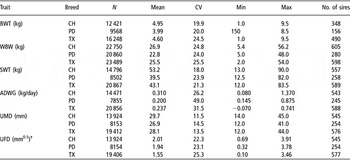
Pedigree structure and data integrity were examined prior to recoding of animal identifiers using the R’Tools suite of programmes (Pong-Wong et al., Reference Pong-Wong, George, Woolliams and Haley2001). Six traits were analysed: weights at birth, 8 and 20 weeks of age (scan weight), average daily weight gain from 8 to 20 weeks, and ultrasonic muscle and fat depths. Birth weight was recorded at or within 24 h of birth. Ultrasonic muscle and fat depths were measured at the level of the third lumbar vertebra. Fat depth data were right-skewed from the standard normal distribution curve and the analyses were performed on square-root transformed data that were closer to being normally distributed. The number of records, basic statistics and number of sires are shown by breed in Table 2. Datasets from each breed were well balanced, with similar numbers of trait observations by year, except birth weight, where data were available only from a subset of breeders.
Summary statistics for each trait and breed

BWT = birth weight; W8W = 8-week weight; SWT = scan weight; ADWG = average daily weight gain from 8 to 20 weeks; UMD = ultrasonic muscle depth; UFD = ultrasonic fat depth; CH = Charollais; PD = Poll Dorset; TX = Texel; CV = coefficient of variation (%).
†Square root transformed. Minimum, mean and maximum values on the observed scale were 0.47, 4.04 and 15.29 for CH, 0.10, 3.76 and 14.29 for PD and 0.01, 2.40 and 11.97 for TX.
PrP genotypes
The NSP Administration Centre (NSPAC) supplied PrP genotypes obtained using a variety of proprietary commercial genotyping methodologies, chiefly SNP assays. In all cases, the ovine PrP gene was genotyped at polymorphic codons 136(A/V), 154(R/H) and 171(Q/R/H) to discriminate between the five major alleles: ARR, ARQ, ARH, AHQ and VRQ. PrP genotypes were merged with performance datasets and cleaned using SAS software version 9.1 prior to analysis.
Statistical methodology
Mixed model univariate analyses were performed for all traits, using ASReml version 2.0 (Gilmour et al., Reference Gilmour, Gogel, Cullis, Welham and Thompson2002). Models included direct (animal) genetic effects and up to three maternal traits (maternal genetic, permanent environmental and temporary (litter) effect), as well as appropriate fixed effects including PrP genotype (described below) and were of the form:

where y is the vector of observations for each trait, b is the vector of fixed effects, a and m are vectors of random direct and maternal additive genetic effects, l and pe are vectors of random maternal temporary and permanent environmental effects, e is the vector of random residual effects and X, Z 1, Z 2, Z 3, Z 4 are design matrices relating fixed and random effects to observations. Fixed effects included were consistent across breeds and traits, and were flock-year, sex, maternal age, litter size or type of rearing, and all two-way interactions. Additionally, covariates of birth date and age at which measurements were obtained, i.e. age at weighing and age at scanning were also fitted. Random effects contributing significantly to the global model fit, as assessed by the likelihood ratio test, were included in the final model. In all cases the most economical (parsimonious) model was selected. This resulted in slightly random different models, sometimes being fitted for the same trait in different breeds; however, the primary aim was to define the best fitting model for the purpose of assessing PrP effects, rather than to estimate variance components. Variance components and derived genetic parameters are not discussed further, other than to note that for all breeds and traits they were in general agreement with previously published studies, giving confidence in the integrity and structure of the datasets.
Testing for associations with PrP genotype
The potential associations of PrP genotype with each trait were assessed by including the PrP genotype as a fixed effect in the linear models, described above, by one of the two following methods. First, animals were classified based on their PrP genotype; i.e. ARR/ARR, ARR/ARQ, ARR/AHQ, and so on. The number of genotypes ranged from six to nine across breeds. Secondly, in a separate set of analyses, animals were classified according to the number of copies of each of the PrP alleles carried (i.e. 0, 1 or 2), e.g. ARR/ARR, ARR/xxx and xxx/xxx, where xxx represents non-ARR alleles, etc. Each allele was examined in turn by this method. Only a proportion of the animals in each dataset was genotyped, therefore the significance of the PrP genotype or the allele effects was assessed after fitting a fixed effect of ‘genotyped or ungenotyped’. For most traits, genotyped lambs had superior trait values relative to ungenotyped lambs, possibly reflecting preferential genotyping of better performing lambs by breeders.
Exploration of PrP associations in these analyses involve a large number of independent comparisons, i.e. three breeds and several traits, hence there is an increased risk of obtaining apparently significant results by chance alone. A conservative means of adjusting for this is the Bonferroni correction in which the significance level is adjusted to [1 − (1 − a)1/n], where there are n independent comparisons (hypotheses) being made. Correcting for three independent datasets, the P-value necessary to attain 0.05 significance becomes 0.017; for three datasets and two independent traits per dataset (body size and carcass composition) the value is 0.0085; and for three datasets and three traits per dataset (body size, fat and muscle depth) the value is 0.0057.
Results
PrP allele distribution
PrP allele frequencies in each breed are shown in Figure 1. All five common PrP alleles are present in the Texel dataset; however, the Charollais and Poll Dorset dataset show less PrP allele diversity, being dominated by the ARR and ARQ alleles. The most frequent allele in all breeds was ARR, ranging in frequency from 0.56 in Texel to 0.83 in Charollais. The ARQ allele was present at a similar frequency in all breeds, ranging from 0.11 in the Texel to 0.17 in the Poll Dorset. Substantial differences between the breeds were apparent in the relative frequencies of the ARH, AHQ and VRQ alleles. Only in the Texel dataset were ARH and AHQ alleles present, with the ARH allele being the second most common allele. All three breeds had very low frequencies of the VRQ allele, ranging from 0.01 to 0.05. It was most common in the Poll Dorset dataset, this being the only dataset with homozygous VRQ genotypes present (n = 25). Allele frequencies for these three breeds are similar to previously published breed-level PrP allele frequencies obtained from NSP data (Eglin et al., Reference Eglin, Warner, Gubbins, Sivam and Dawson2005).
PrP allele frequencies for the Charollais (CH), Poll Dorset (PD) and Texel (TX) datasets.

PrP associations with performance traits
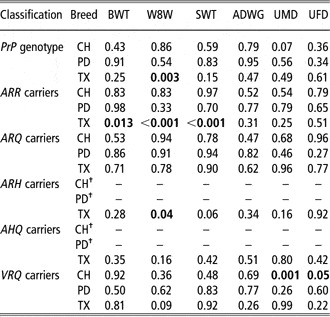
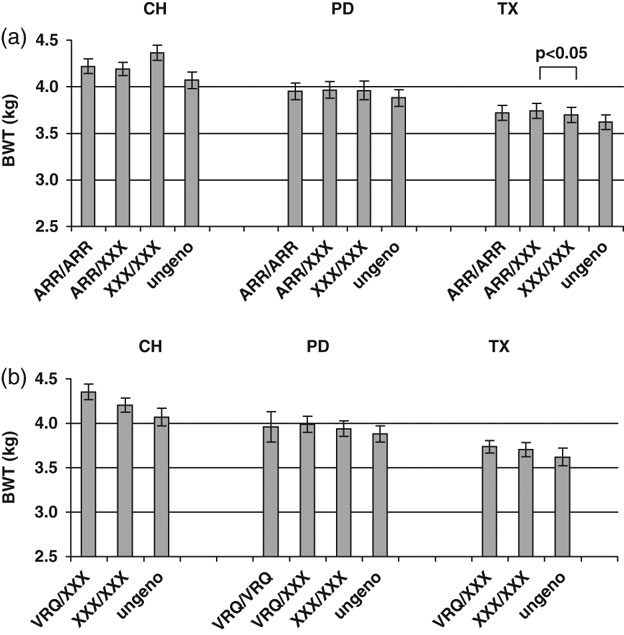
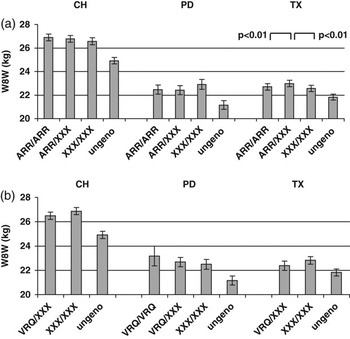
The significance of the association between performance traits and PrP genotype or the number of copies of each PrP allele, is shown in Table 3 for every trait and every breed. Results for the number of copies of each allele are presented as histograms in Figures 2 to 7, for the ARR and VRQ alleles.
Tests of significance (P valuesFootnote 1) for different traits and analyses differing in genotypic classifications for the three breeds

BWT = birth weight; W8W = 8-week weight; SWT = scan weight at ∼20 weeks; ADWG = average daily weight gain from 8 to 20 weeks; UMD = ultrasonic muscle depth; UFD = ultrasonic fat depth; CH = Charollais; PD = Poll Dorset; TX = Texel.
Values in bold represent significant results.
† Alleles are not present in this breed.
1 The P values presented in this table do not show Bonferroni corrections.
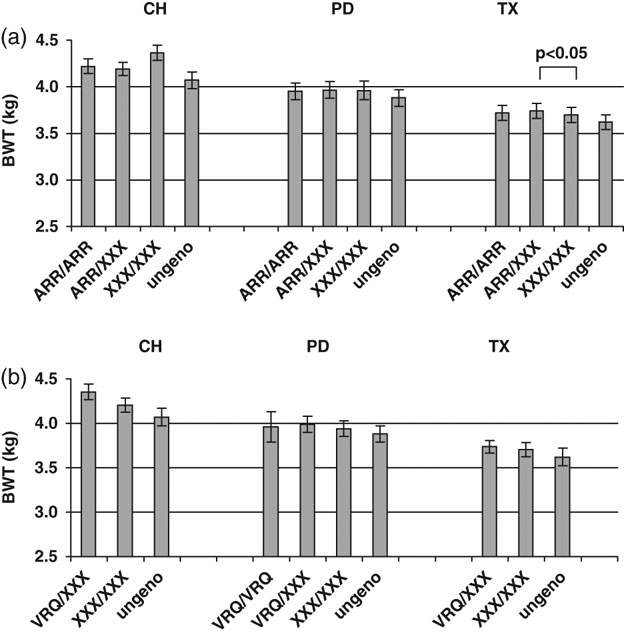
Least squares means (and standard errors) for birth weight (BWT) of animals classified by the number of copies of (a) ARR and (b) VRQ alleles for the Charollais (CH), Poll Dorset (PD) and Texel (TX) datasets. Significant genotype contrasts and their P-value are indicated in the figure.
Least squares means (and standard errors) for 8-week weight (W8W) of animals classified by the number of copies of (a) ARR and (b) VRQ alleles for the Charollais (CH), Poll Dorset (PD) and Texel (TX) datasets. Significant genotype contrasts and their P-value are indicated in the figure.

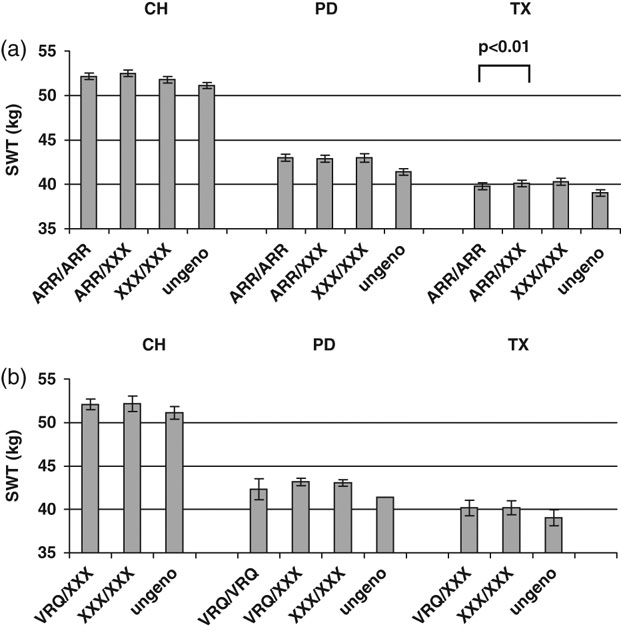
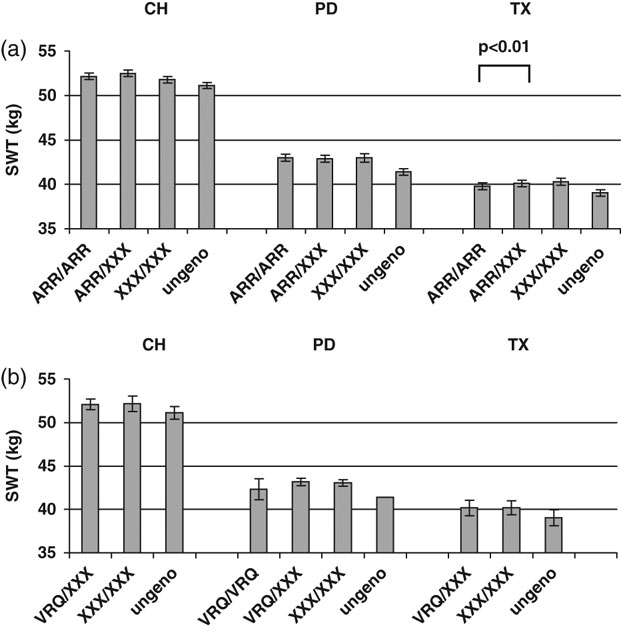
Least squares means (and standard errors) for scan weight (SWT) of animals classified by the number of copies of (a) ARR and (b) VRQ alleles for the Charollais (CH), Poll Dorset (PD) and Texel (TX) datasets. Significant genotype contrasts and their P-value are indicated in the figure.
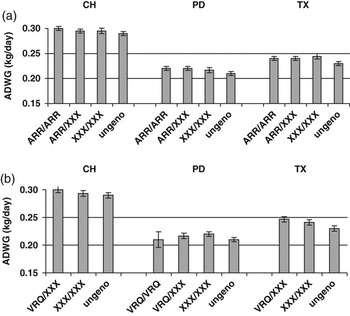
Least squares means (and standard errors) for average daily weight gain (ADWG) of animals classified by the number of copies of (a) ARR and (b) VRQ alleles for the Charollais (CH), Poll Dorset (PD) and Texel (TX) datasets. Significant genotype contrasts are indicated in the figure.

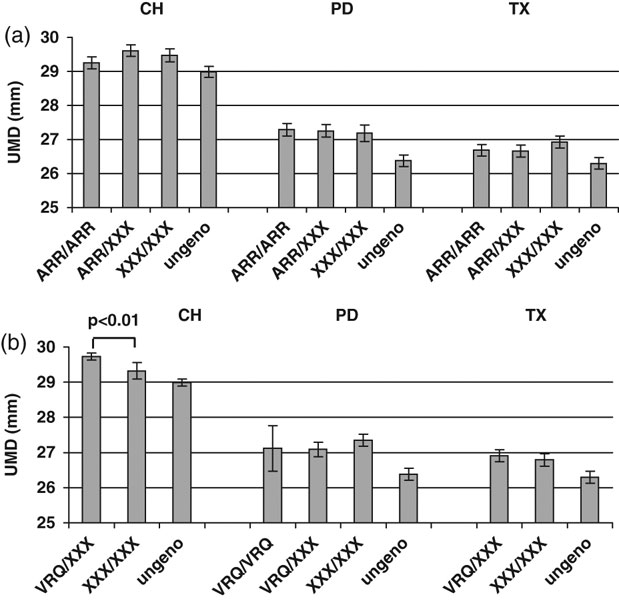
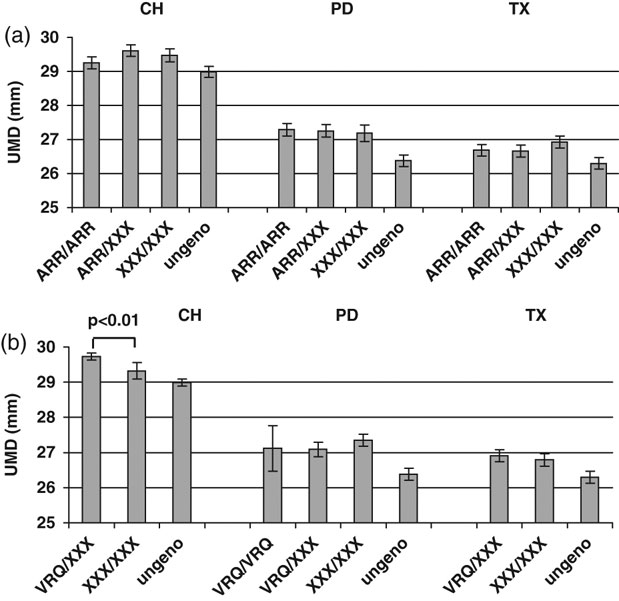
Least squares means (and standard errors) for ultrasonic muscle depth (UMD) of animals classified by the number of copies of (a) ARR and (b) VRQ alleles for the Charollais (CH), Poll Dorset (PD) and Texel (TX) datasets. Significant genotype contrasts and their P-value are indicated in the figure.
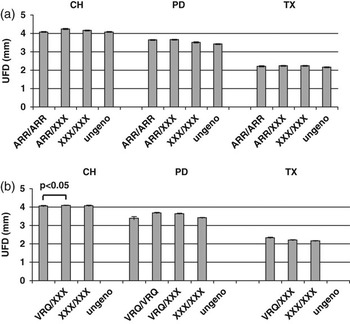
Least squares means (and standard errors) for ultrasonic fat depth (UFD) of animals classified by the number of copies of (a) ARR and (b) VRQ alleles for the Charollais (CH), Poll Dorset (PD) and Texel (TX) datasets. Significant genotype contrasts and their P-value are indicated in the figure.

Birth weight
The only significant association of PrP genotype or the number of specific PrP alleles with birth weight was seen in the Texel breed (Table 3), where lambs with one ARR allele were significantly heavier by 0.08 kg than those with no ARR alleles (P = 0.013) (Figure 2). However, after Bonferroni correction, this result is of marginal significance, depending on the stringency of the correction made.
Eight-week weight
No significant associations of PrP genotype with 8-week weight were detected in either the Charollais or Poll Dorset lambs. However, analyses of the Texel data revealed significant effects of both PrP genotype (P = 0.003) and the number of ARR alleles carried (P < 0.001) (Table 3, Figure 3). Lambs with one ARR allele had significantly higher weights than lambs with either two (0.40 kg) or zero ARR alleles (0.42 kg). A significant association was also seen in ARH-carrying lambs (P = 0.04), due to high 8-week weights in a group of 129 AHQ/ARH lambs. The ARR allele association, but not the ARH association, remained significant (P < 0.01) after Bonferroni correction for nine independent tests.
Scan weight
Scan weight results were similar to those for 8-week weight. Once again, no significant associations were detected in Charollais or Poll Dorset lambs. However, an ARR allele effect (P < 0.001) was seen in the Texel breed where lambs with one ARR allele had significantly higher scan weights (0.42 kg greater) than lambs with two copies (Table 3, Figure 4). This association remained significant (P < 0.01) after Bonferroni correction for nine independent tests.
Average daily weight gain
No significant PrP genotype effects were seen for average daily weight gain (Table 3, Figure 5). The absence of an ARR allele effect in the Texel breed is simply reflective of the fact that the association affected growth rate prior to, rather than subsequent to the 8-week weight.
Ultrasonic muscle depth
No association was detected between muscle depth and PrP genotype in Poll Dorset or Texel lambs. However, a highly significant association (P < 0.001) was found for Charollais in the analysis of number of VRQ alleles (Table 3), and this result remained significant (P < 0.01) after Bonferroni correction for nine independent tests. Lambs with one copy of the VRQ allele had 0.58 mm (approximately 2%) deeper muscle than those with zero copies (Figure 6). Correcting muscle depth for scan weight did not alter the magnitude or significance of the association (results not shown).
Ultrasonic fat depth
No significant associations were found between PrP genotype and ultrasonic fat depth in Texel or Poll Dorset lambs. However, in Charollais lambs a significant association of number of VRQ alleles (P = 0.045) and ultrasonic fat depth was observed (Table 3, Figure 7). After back-transformation to the observed scale, this equated to 0.22 mm (approximately 5%) extra fat in VRQ-carrying lambs, a result that is similar to that seen for muscle depth. However, the number of VRQ-carrying lambs was small (Figure 1), and although the magnitude of the effect was large it did not retain significance after the Bonferroni correction.
Discussion
A small number of significant associations between PrP genotype and lamb performance traits were detected in two of the three lowland breeds included in this study. The Charollais and Texel breeds revealed results that are of relevance to the sheep industry, although in reality the impacts might be slight, as discussed below. No significant associations were found with any trait in the Poll Dorset breed.
In the Charollais breed, lambs carrying one VRQ allele had significantly greater muscle and fat depths than lambs without this allele (there were no lambs present in this dataset with two VRQ alleles). Thus, in principle, decreasing the frequency of the VRQ allele could result in a reduction of muscle and fat in Charollais lambs at scanning. Whilst loss of muscle depth may be considered an adverse effect, this would be offset by the concurrent reduction in fat depth that could be seen to be advantageous as continual effort is required to keep fat depths at acceptable levels to reach industry carcass specifications. However, it must be kept in mind that the frequency of this allele is very low in our dataset (n = 168 heterozygotes, less than 2.5% of lambs). If our dataset is representative of the breed, the effects on individual flocks and therefore industry as a whole are likely to be minor.
In direct contrast to our study, Sweeney and Hanrahan (Reference Sweeney and Hanrahan2008), found that carriers of the ARR allele in the Charollais breed showed increased muscle depths relative to the ARQ allele, while the same study showed results in the opposite direction for these two alleles in the Suffolk breed. Studies on the German Black-Headed Mutton breed (de Vries et al., Reference de Vries, Borchers, Hamann, Drögemüller, Reinecke, Lüpping and Distl2004) also showed reduced muscle depths with ARR-carrying animals compared with non-carriers of this allele. A study on three UK hill breeds by Moore et al. (Reference Moore, Boulton and Bishop2009), showed that only the Welsh Mountain breed had any associations with ultrasonic traits in which the ARR and AHQ alleles were associated with lower muscle depths, while VRQ carriers were associated with more fat than other genotypes. In the same breed, Pritchard et al. (Reference Pritchard, Calahan and Ap Dewi2008) observed a contrasting result in which ARR homozygous lambs had significantly greater muscle depth than ARR heterozygous lambs. Extensive studies failed to show any significance of PrP genotype in determining the depth of muscle or fat in many other European sheep breeds (Roden and Haresign, Reference Roden and Haresign2001; Prokopova et al., Reference Prokopova, Lewis, Dingwall and Simm2002; de Vries et al., Reference de Vries, Borchers, Hamann, Drögemüller, Reinecke, Lüpping and Distl2004; Vitezica et al., Reference Vitezica, Moreno, Bouix, Barillet, Perret and Elsen2005; Isler et al., Reference Isler, Freking, Thallman, Heaton and Leymaster2006; Man et al., Reference Man, Brotherstone, Merrell, Murray and Villanueva2006; Sawalha et al., Reference Sawalha, Brotherstone, Man, Conington, Bunger, Simm and Villanueva2007a; Sweeney and Hanrahan, Reference Sweeney and Hanrahan2008). Thus, there is no clear pattern of association emerging between ultrasonic muscle depth and PrP genotype, and there are no other reports of fat depth associations of this type.
Significant associations with weight traits at all ages and number of copies of the ARR allele carried were found in the Texel breed in our study. Lambs with one ARR allele had consistently higher birth, 8-week and scan weights than lambs with two or zero alleles. The body size effect was largely present by 8 weeks of age, as no significant associations were seen with 8- to 20-week average daily weight gain. The observation that the body size advantage is associated with ARR heterozygous lambs, rather than ARR homozygous lambs, means that the benefits of increasing ARR allele frequency will depend on the actual allele frequency. As the allele frequency increases beyond the approximate value, 0.5, observed in this dataset, the live weight advantage associated with ARR heterozygous lambs will decline. As well as the direct benefits of lambs being heavier, birth weight is also an important factor in lamb survival, although an intermediate optimum birth weight is often seen (Sawalha et al., Reference Sawalha, Conington, Brotherstone and Villanueva2007b; Gubbins et al., Reference Gubbins, Cook, Hyder, Boulton, Davis, Thomas, Haresign, Bishop, Villanueva and Eglin2009). Therefore, bearing in mind the small absolute effect of PrP genotype on birth weight and the complex relationship with ARR allele frequency, expected impacts on lamb survival are likely to be trivial. As the Texel breed is one of the few major breeds in which substantial numbers of ARH alleles are present, the beneficial association with 8-week weight observed in the Texel breed may help to explain its continuing presence in this breed.
Several other studies have been carried out on the Texel breed and associations with weight traits and the PrP gene (Brandsma et al., Reference Brandsma, Janss and Visscher2004; de Vries et al., Reference de Vries, Borchers, Hamann, Drögemüller, Reinecke, Lüpping and Distl2004; Brandsma et al., Reference Brandsma, Janss and Visscher2005; Sweeney and Hanrahan, Reference Sweeney and Hanrahan2008); however, only that of Brandsma et al. (Reference Brandsma, Janss and Visscher2004) showed any significant findings. Again, these were in direct contrast with our study, showing that VRQ carriers were approximately 1 kg heavier than ARQ homozygotes at 135 days of age (equivalent to scan weight in this study), based on the reported differences in estimated breeding value.
For weight traits, associations with the number of specific PrP alleles have been seen in other studies, although not in the consistent manner of the ARR-carrying lambs in the Texel breed. For example, a significant positive association was seen between birth weight and AHQ/AHQ in North Country Cheviot (Hill) lambs; however, this association became negative in the same lambs at 8 weeks (Moore et al., Reference Moore, Boulton and Bishop2009). In the same study, the VRQ allele was associated with higher 8-week weights while the ARR allele was associated with significantly lower predictions for 8-week weight, scan weight and average daily weight gain in the Welsh Mountain breed. In the Swaledale breed (Man et al., Reference Man, Brotherstone, Merrell, Murray and Villanueva2006), significant associations were found with the number of ARR alleles carried, with ARR heterozygotes outweighing non-carriers by 0.44 kg at weaning. In the Scottish Blackface breed (Sawalha et al., Reference Sawalha, Brotherstone, Man, Conington, Bunger, Simm and Villanueva2007a), the number of copies of AHQ and ARQ alleles carried give rise to significant associations with slaughter weight, where AHQ heterozygotes were 0.5 kg heavier than non-AHQ carriers and ARQ homozygotes were 0.4 kg lighter than either ARQ heterozygotes or non-carriers. The same study found that the number of copies of the ARQ allele carried were important, with heterozygous ARQ lambs being significantly heavier at birth by 0.04 kg than homozygous ARQ lambs.
Also in direct comparison with our study, Tongue et al. (Reference Tongue, Pfeiffer, Heasman, Simmons and Ryder2006) reported positive associations with birth weight and PrP genotype in the Dorset breed, where VRQ carriers had a disadvantage of 0.6 kg at this age over ARQ heterozygotes.
Other studies on important European sheep breeds have failed to show positive associations between lamb weight and growth traits and PrP genotype (Roden and Haresign, Reference Roden and Haresign2001; Prokopova et al., Reference Prokopova, Lewis, Dingwall and Simm2002; de Vries et al., Reference de Vries, Borchers, Hamann, Drögemüller, Reinecke, Lüpping and Distl2004; Alexander et al., Reference Alexander, Stobart, Russell, O’Rourke, Lewis, Logan, Duncan and Moss2005; Moussaoui et al., Reference Moussaoui, Caja, Casellas, Such and Francino2005; Vitezica et al., Reference Vitezica, Moreno, Bouix, Barillet, Perret and Elsen2005; Isler et al., Reference Isler, Freking, Thallman, Heaton and Leymaster2006; Tongue et al., Reference Tongue, Pfeiffer, Heasman, Simmons and Ryder2006; Casellas et al., Reference Casellas, Caja, Bach, Francino and Piedrafita2007; Sweeney and Hanrahan, Reference Sweeney and Hanrahan2008), thus leading Sweeney and Hanrahan (Reference Sweeney and Hanrahan2008) to conclude that there is no compelling evidence to reject the null hypothesis that there is no association between PrP genotype and lamb growth traits.
Despite the lack of consistent associations across breeds, it is difficult to ignore the observation that the PrP-trait significant associations seen in the Charollais and Texel breeds were highly significant in this study. It is possible that these are false positive results arising from insufficient stringency in the significance testing or factors in the datasets that we have not accounted for adequately.
In summary, there is little evidence of consistent relationships between PrP genotype and lamb performance traits across sectors or even between breeds within the same sector. The conclusion of Sweeney and Hanrahan (Reference Sweeney and Hanrahan2008) that there is little evidence to support the anecdotal evidence from breeders that superior PrP genotypes had inferior phenotypes also applies to this study. Although this study revealed some apparently relevant associations of PrP genotype with performance traits, in reality their practical impact will be slight.
Acknowledgements
This work was part of project SE0236, funded by Defra (Department of Environment, Food and Rural Affairs). The authors would like to thank Beatriz Villanueva and Bill Hill for comments on the manuscript.