Between a.d. 500 and 1000 in the lower Ulua valley of Caribbean coastal Honduras, objects made of fired clay were deeply embedded in the texture of daily life through their participation in both ritualized and quotidian practices. These objects, including pottery vessels, musical instruments, ornaments, and figural sculptures, were produced in house compounds, the settings of everyday life and face-to-face social engagement. We draw on two recent contributions to Mesoamerican analysis of production, the concepts of craft and multicrafting, and another concept less familiar in Mesoamerican studies, communities of practice, to explore how working with clay in house compounds produced and reproduced identities, histories, and connections between social groups, and with places on the landscape. Transforming how we think about apparently simple and ubiquitous craft practices, like working with clay, allows us to begin to see more social complexity among households often treated as interchangeable parts of a single social stratum. This re-emphasizes what household archaeologists working in Mesoamerica have long proposed: households are sites where social, economic, and political complexity was shaped, not just objects of processes located outside “domestic” spaces.
We begin with a necessarily brief discussion of the setting of the excavations that provide the data for our analysis: household sites located along the lower course of the Ulua River in Caribbean coastal Honduras, occupied between a.d. 500 and 1000. The key sites are introduced: Cerro Palenque, Travesía, Campo Pineda (CR 103), and Campo Dos (CR 132), each producing evidence of ceramic production in excavations conducted by one or more of the authors. Spanning a wide range of site sizes, from small villages to larger sites with leading families who lived in close proximity to community facilities, notably ballcourts, each site shows evidence of a similar range of house-based activities, include crafting.
We then proceed with a discussion of the theoretical concept of a craft—a concept that is quite different from the well understood models of craft production that are widespread in Mesoamerican archaeology. Craft, as a theoretical concept, relies on establishing what Charles Keller (Reference Keller and Schiffer2001) described as a “practitioner's perspective,” distinct from the attention given in studies of craft production to consumers and producers as economic actors. We examine the evidence for the tools, techniques, and social relations that supported the development of a practitioner's perspective in the lower Ulua valley.
Drawing on the concept of “multicrafting” introduced by Kenneth Hirth (Reference Hirth and Hirth2009), we argue that households with evidence of working with clay also supported a range of other crafts on which production of ceramic objects depended. This leads to a discussion of how crafters learn and practice their craft socially, in the kind of “communities of practice” that Jean Lave and Etienne Wenger have proposed as a theoretical model (Lave and Wenger Reference Lave and Wenger1991; Wenger Reference Wenger1998). We end by considering the work that clay crafting in the Ulua valley accomplished in building enduring social relations, through the creation of communities of practice that bound together multicrafting households not only within the valley, but between settlements in northern Honduras and those in other areas.
ULUA VALLEY HOUSEHOLD ARCHAEOLOGY
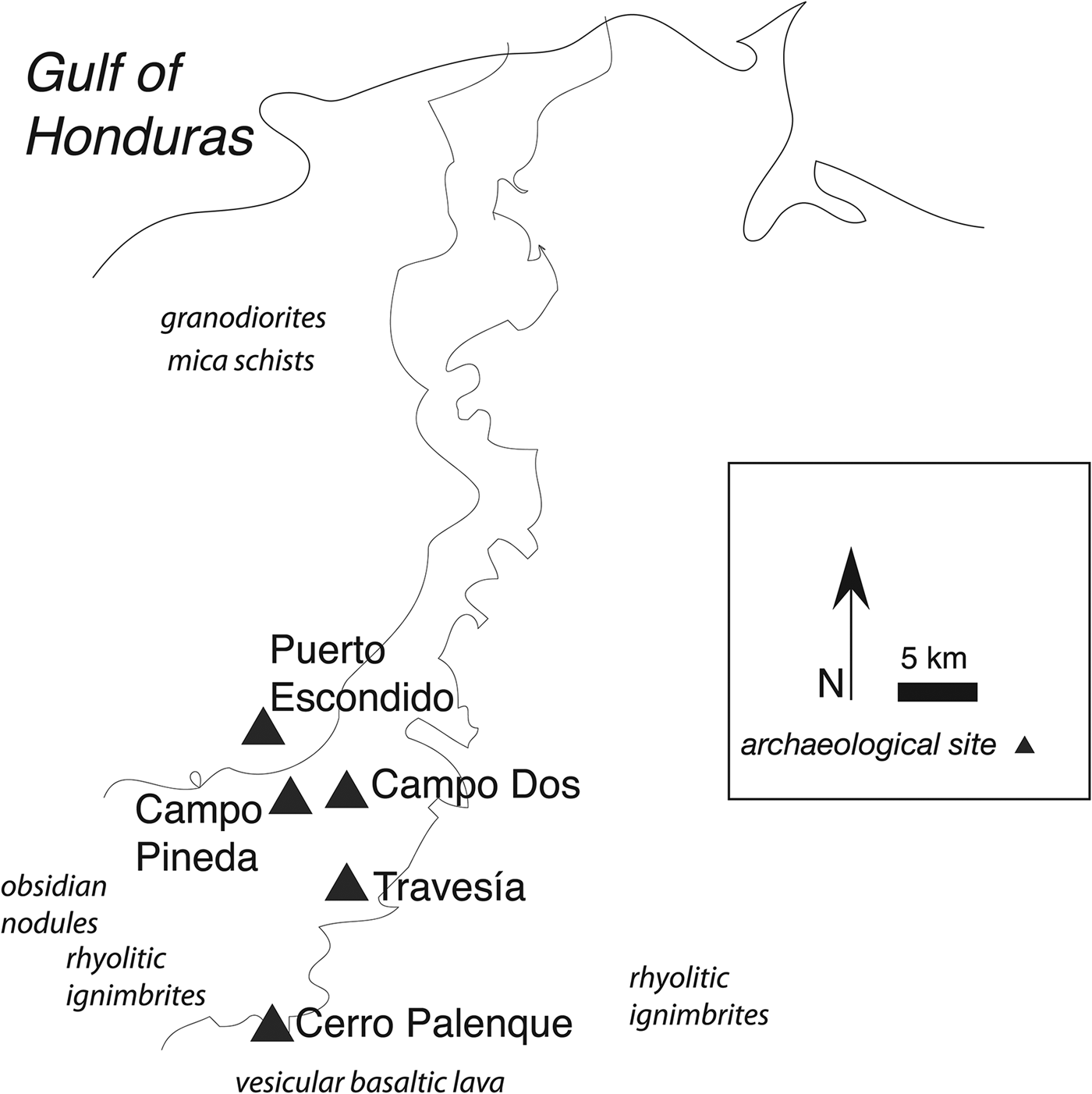
The lower Ulua valley (Figure 1) is made up of the floodplain of the Ulua river and its major tributaries, the Comayagua and the Chamelecon, after they leave narrow canyons and reach absolute elevations below 100 m asl. Defined in this fashion, the valley covers approximately 2400 km2. It was the focus of successive multi-year projects designed to systematically survey, locate, map, and date archaeological sites, using test excavations where necessary, in the service of cultural resources management in the face of development of the region (Beaudry-Corbett et al. Reference Beaudry-Corbett, Caputi, Henderson, Joyce, Robinson, Wonderley, Henderson and Beaudry-Corbett1993; Henderson Reference Henderson, Danien and Sharer1992; Joyce Reference Joyce1985; Pope Reference Pope1985; Robinson Reference Robinson1989). These projects identified over 500 archaeological sites, many with surface visible architecture dating to between a.d. 500 and 1000. A small number of sites have been subject to more extensive investigation, including household archaeology, involving broad area excavations designed to identify contemporaneous features resulting from daily life (Hasemann et al. Reference Hasemann, van Gerpen and Velíz1977; Hendon Reference Hendon2010a; Joyce Reference Joyce1985, Reference Joyce1991; Lopiparo Reference Lopiparo1994, Reference Lopiparo2003).
Map showing sites discussed in text and main geological sources of clays. Illustration by Rosemary A. Joyce.

Along the edges of the valley, where mountains gave way to floodplains, and in zones where hills up to 300 m asl interrupt the floodplain, settlements from this period are represented by surface visible mounds, platforms made primarily of cobbles that once supported perishable structures, organized in groups around exterior workspaces that were often paved with cobblestones. The most intensively investigated of these sites with stone mounds is Cerro Palenque (Hendon Reference Hendon2010a; Joyce Reference Joyce1985, Reference Joyce1991). A second site, Travesía, subject of excavations starting in the late nineteenth century, is similar to Cerro Palenque in size and complexity, but is located in an area on the floodplain where many houses were built directly on ground surface, with limited use of stone in construction (Hendon et al. Reference Hendon, Joyce and Lopiparo2014:99–136; Joyce Reference Joyce and Robinson1987; Lincoln Reference Lincoln1979; Robinson, Hasemann and Veliz Reference Robinson, Hasemann and Velíz1979; Sheehy Reference Sheehy1978, Reference Sheehy1982; Sheehy and Veliz Reference Sheehy and Velíz1977; Stone Reference Stone1941:58–86).
More common in the central floodplains are settlements that employed clay as the primary construction material, some intensively excavated in advance of site destruction and demonstrating sequences of residential construction over periods from roughly 1600 b.c. to at least a.d. 1000. In this area, Lopiparo (Reference Lopiparo1994, Reference Lopiparo2003) investigated the integration of ceramic production in daily life in four sites: Campo Dos (CR 132), Campo Pineda (CR 103), CR 80, and CR 381.
Cerro Palenque is the largest documented settlement known for the period between a.d. 500 and 1000, with over 500 buildings organized in approximately 100 residential compounds (Joyce Reference Joyce1991). Stone platforms making up residential compounds both at Cerro Palenque and in other sites averaged 5 × 7 m, with smaller platforms (average 2 × 2 m) occupying special locations such as the centers of patios. Hearths were rarely identified in or around these cobble constructions. In several groups at Cerro Palenque, stone benches made of cobbles were built into at least one building (Joyce Reference Joyce1985, Reference Joyce1991). Refuse from daily activities was present in localized piles behind platforms, and included chert and obsidian flakes and blades, chert cores, macrobotanical and zooarchaeological materials, and ceramics from vessels with forms that could have been used for storage, cooking, and serving of food and drink. While every excavated group at Cerro Palenque had evidence for this range of daily provisioning activities, some produced material from more unusual activities: figurines, figural whistles and flutes, and large modeled ceramic censers indicating ritual practices (Joyce Reference Joyce1991). Other rare items such as ground stone celts and barkbeaters suggest localized craft production (Hendon Reference Hendon2010a).
While excavations at Travesía were more limited in scope, Joyce (Reference Joyce and Robinson1987) noted evidence in one household for extensive obsidian blade production. In earlier dwellings at the same location, a range of everyday provisioning activities was suggested by the presence of animal bone, chipped stone, and ceramics appropriate for storing, cooking, and serving food, as well as figural ceramic flutes and fragments of figurines indicating ritual practice at the household level. While hearths and benches were not identified here, traces of walls resting on a foundation of cobbles, and thick interior plaster floors, distinguished the houses in this outlying area of the site. Stone (Reference Stone1941) previously reported excavations of buildings of the main quadrangle at Travesia, now understood to be the residence of the leading family of the settlement, that were built of cut stone and cobbles covered in thick plaster stucco.
In the central floodplains, most settlements are composed of substantially larger earthen platforms than the cobble and cut stone platforms of sites like Cerro Palenque and Travesía. Excavations demonstrate that these larger platforms, up to 100 m on a side, supported multistructure house compounds or clusters of compounds, raised above the floodplain, whose constituent buildings fall into the same size range as indicated by the plan of buildings on stone platforms in other sites in the valley. Whether in the form of surface-visible cobble mounds located on earthen platforms, or as traces of perishable structures buried in them during remodeling events, these groups of buildings occupied similar spatial footprints suggesting a degree of regularity in organized domestic space. Exterior spaces around which groups of buildings clustered averaged 12 m in width, and the total size of compounds was on average 20 × 20 m, comparable to cobble platform compounds in other areas of the valley. Because of the differential preservation afforded by the burial of clay house features in this zone, in many sites hearths have been identified, both inside and outside buildings. Some examples of clay benches inside houses of this kind have been documented. Exterior subterranean “bell-shaped” pits, probably originally for storage, have been identified on the periphery of central floodplains house compounds. These were sometimes reused for burial or for refuse disposal. Animal bone and plant remains recovered from these sites show use of a wide range of domesticated and gathered plants, and exploitation of large and small land mammals and riverine fauna (Henderson and Joyce Reference Henderson, Joyce and Emery2004; Morell-Hart Reference Morell-Hart2011). Burials dating between a.d. 500 and 1000 were located under house floors and patios in residential settlements of both kinds, although preservation was better in the earthen platforms of the central floodplain. In this area, burials were the focus of ritual practices employing ceramic artifacts, oriented to a shared set of geographical reference points with cosmological significance (Joyce Reference Joyce, Adams and King2011; Lopiparo Reference Lopiparo, Ardren and Hutson2006, Reference Lopiparo and Beck2007).
Overall, while most residential sites have similar ranges of everyday activities related to provisioning the residents, there are few standardized ways space was used that are evident in our excavations. Most buildings have few built-in features that would limit their use for multiple purposes. A few contained benches, implying not just use for sitting, but perhaps the expression of some degree of authority for those who occupied or used these spaces. Evidence for ritual practices in household settings is ubiquitous, with a few compounds at larger towns like Travesía and Cerro Palenque containing central low platforms that were foci of ritual practices. Yet there seems to be no predictable segregation of activities related to household ritual to any one area in residential compounds, nor are the kinds of ritual actions evident in different sites precisely the same.
When we turn to craft working, there is also notable variability from site to site, and from house compound to house compound within sites. Crafting that took place in or around house compounds included knapping of chert and obsidian, textile and bark cloth production, and, the focus of this article, ceramic production. Excavations at Cerro Palenque, Travesía, Campo Pineda (CR 103), and Campo Dos (CR 132) produced assemblages of artifacts, features, and byproducts of production that serve as the basis for our discussion (Hendon Reference Hendon2010a; Hendon and Lopiparo Reference Hendon, Lopiparo and Rubén Ávalos2004; Joyce Reference Joyce and Robinson1987; Lopiparo Reference Lopiparo1994, Reference Lopiparo2003, Reference Lopiparo and Rubén Ávalos2004, Reference Lopiparo, Ardren and Hutson2006; Lopiparo and Hendon Reference Lopiparo, Hendon, Halperin, Faust, Taube and Giguet2009; Lopiparo et al. Reference Lopiparo, Joyce, Hendon, López Varela and Foias2005). Trash deposits immediately adjacent to house compounds in these sites yielded fragments of molds for figurines, small vessels, and other objects, suggestive of the practice of clay working within domestic spaces. In some cases, shallow basins and traces of fine clay were deposited on the surface of buried house yards. Also in direct proximity to house structures were a variety of facilities that we identify as used for firing ceramics.
We now turn to a discussion of clay working in these Ulua valley sites. We start by reviewing what a practitioner's perspective entails. We then trace a practitioner's perspective by examining how clays might have been obtained, and their properties understood; how they were shaped, and what the techniques of shaping can tell us about crafting as forming identities; and the ways that shaped clay objects were finally fired to fix them as products, using a variety of approaches.
CLAY AS CRAFT
Focusing on the craft and beginning with the crafter allow us to bring out the ways that different materials and technologies required their own bodies of knowledge and skills. Keller (Reference Keller and Schiffer2001; Keller and Keller Reference Keller and Keller1996) argues that crafting requires both a plan and the ability to adjust as the process plays out. He notes that trying to take the practitioner's perspective helps one appreciate the degree of skill and knowledge involved to become proficient in a particular craft. The practitioner's perspective thus provides a powerful complement to the more externally imposed analyses of production processes, including the chaîne opératoire and operational sequences approaches, in which a technological process is broken down into its component parts by the analyst (Dobres Reference Dobres, Dobres and Hoffman1999; Lemonnier Reference Lemonnier1992; Miller Reference Miller2007).
Drawing on Keller's concept of the practitioner's perspective, Hendon (Reference Hendon2006, Reference Hendon, Hruby and Flad2007, Reference Hendon2010a, Reference Hendon2012) has suggested that archaeologists begin analysis of skilled production with the craft worker, rather than only studying the integration of craft production into economic structures or relations. For this purpose, craft can be defined as “a productive process that involves skill, flexibility, creativity, choice, and knowledge accumulated over time, often through non-verbal experiential and observational learning, and embedded in a social context” (Hendon Reference Hendon2006:355). Crafting is intimately tied up in the specificity of the materials used, the technologies of production chosen, and the body techniques employed by crafters as they move through the production process.
Starting with the crafters and the particulars of their craft also allows us to avoid the entrenched archaeological distinctions between “luxury” (or “elite”) and “utilitarian” objects that have tended to privilege the former as providing more insight into economic relations and social complexity. Our perspective allows us to explore a craft in terms of the knowledge required, and the skills that need to be developed, to acceptably craft goods, as well as the choices made and the meaning ascribed to these processes by the crafter and others. In the case of fired clay, success in making even the “simplest” or “least costly” of the kinds of objects that form the focus of our analysis, unslipped jars, required expertise and knowledge that was not necessarily easily acquired or general in the population. Such objects of everyday use in a household context, like the mundane objects discussed by Lemonnier (Reference Lemonnier2012), can prove to be rich sources of information about experience and internal complexity of social groups, critical to better understanding how households worked as webs of social relations.
Rye (Reference Rye1981) provides our beginning point for considering the steps that potters in the lower Ulua valley would have had to take to carry out the production processes for which we have evidence in household settings. He provides a step by step outline of procedures for making traditional pottery that takes the crafter's perspective. Rye (Reference Rye1981:v) writes that his “personal experience with archaeologists left [him] with the impression that many are not familiar with the principles of pottery making.” It is consequently pertinent to note that one of us (Joyce) is an experienced, if not skilled, potter, and brings to this study that experiential perspective. In the pages that follow, we walk through the processes an Ulua valley clay crafter would have had to master to gain competency, from locating clay to firing finished products. Our guiding questions throughout are, “What knowledge would a crafter have needed?” and “How might a crafter have gained the knowledge necessary?” As we will show, this allows us to understand aspects of working with clay that might otherwise be difficult to trace through more standard analyses not centered on the experience of the craft worker.
Ulua Valley pottery crafting
Clays that were potentially workable could be found in many areas of the lower Ulua valley (Figure 1). At least four distinct kinds of rock formations surround the valley. Vesicular lava flows extend over wide areas at the south end of the valley (Williams and McBirney Reference Williams and McBirney1969:21–27, 63–64, 70–72), while ignimbrites, or rhyolite tuff, form the southeast and southwest edges of the valley (Williams and McBirney Reference Williams and McBirney1969:31–45). The hills found throughout the floodplains expose formations of alternating limestone and cobble conglomerate layers, including cobbles of quartzites and cherts (Williams and McBirney Reference Williams and McBirney1969:14–17). Much older granites, diorites, and metamorphosed sedimentary rocks (including marble) are found on the northwest valley edge (Williams and McBirney Reference Williams and McBirney1969:5). The gneiss and schist in these formations were high in mica, making clays of the northern valley mica-rich. As a consequence of this geologic complexity, potters in this area had a diversity of available materials.
The analysis of ceramics made between a.d. 500 and 1000 in the lower Ulua valley demonstrates a wide range of textures, colors, and degrees of particle size sorting that likely resulted from exploiting multiple potential clay sources. Dozens of distinct types and varieties dating to this period have been defined, some with limited distribution within the Ulua valley, and others found outside the region as well (Beaudry-Corbett et al. Reference Beaudry-Corbett, Caputi, Henderson, Joyce, Robinson, Wonderley, Henderson and Beaudry-Corbett1993). This work, primarily based on macroscopic observations, has not been complemented by compositional analysis of geological resources. While small numbers of sherds from Ulua valley museum collections have been included in studies of specific wares from Honduras, to date the only systematic analysis of chemical composition of an assemblage from the Ulua valley has been work by Lopiparo using petrographic analysis and instrumental neutron activation analysis (INAA) of samples from four sites she excavated, including Campo Dos and Campo Pineda, along with a comparative group of samples of the same pottery groups from four other sites including Cerro Palenque and Travesía (Lopiparo Reference Lopiparo and Beck2007; Speakman and Glascock Reference Speakman and Glascock2003).
Lopiparo (Reference Lopiparo2003, Reference Lopiparo and Rubén Ávalos2004, Reference Lopiparo and Beck2007) demonstrated that sites in the central floodplain were likely obtaining abundant clay suited to their purposes from the immediate region, where a number of streams produced well sorted clays derived from the weathering of a combination of metamorphic and igneous rocks in the surrounding mountains. In addition to such secondary clay deposits, primary clays derived from different igneous and volcanic rocks that would have been available at higher elevations in the mountains likely were used for selected wares. While primary clays would not have benefitted from the sorting of particle sizes that was accomplished by water transport, they offered uniformity in color and texture, and the possibility of emphasizing specific desirable characteristics stemming from geological resources of limited distribution, such as concentrations of mica in clays weathering from micaceous schist deposits located on the northwest edge of the valley.
Knowledge of clays, and expertise in working with them, would have to have been developed through practical experience. Here, we would suggest that Vitelli's (Reference Vitelli, Skibo and Feinman1998) caution not to use arguments based on outcomes of historical processes is pertinent. We cannot act as if people went out in deliberate search of the varied clays in use in the valley. We have to at least attempt to construct a model of how they might have encountered clays of such variety and experimented with them.
We suggest this took place during the course of other everyday activities that brought people into contact with clay. The more distant clays, removed from settlements, could have been encountered by people gathering obsidian nodules from rhyolitic ignimbrites available southwest of the valley in the mountains, or seeking micaceous schist as a facing stone for buildings, both resources whose use is documented in excavated sites. The properties of clays that would have formed in primary beds near such distinct geologic resources would have been quite different, and the people collecting clays from these locations would have had to develop distinct expertise to employ these primary clays.
While geologic prospecting for stone provides an obvious context for clay crafters to develop knowledge of primary deposits, sources of river-laden clays that were located closer to settlements also would have had to be identified, and their properties recognized, tested, and finally, exploited, by people going about their everyday routines. Here, we would point to the use of clay as an architectural material as setting the stage for crafters understanding the workability and potential of these clays (Joyce Reference Joyce and Beck2007). Used for finished floors, rammed earth wall footings, and clay plasters on pole frameworks (wattle-and-daub construction, locally called bajareque), such architectural uses provided a context within which clay crafters might have identified clay deposits of particular potential for different uses.
These two different routes to identifying clays to shape into fired clay artifacts should be viewed as potentially giving rise to very different craft knowledge. Primary clays encountered in the context of geologic prospecting might have been thought of as another kind of mineral resource, like the obsidian, schist, and other stones that led people to travel to the mountains. Exploring these clays could have built on existing approaches to working with other mineral resources, where uniformity in texture is important, such as obsidian and chert used for chipped stone artifacts, or marble used locally for distinctive carved marble vases.
Gathering clay as a step in the construction of architecture would have led to a somewhat different experience of the material. First, river-lain clay deposits would have been wetter and more plastic than primary clays in upland settings. Collected as part of a range of architectural materials, they would have lent themselves to use in diluted forms as thin coats, including the clay plasters whose traces we detect on cobble walls, benches, and floors. This is, of course, the familiar way that clay is made into slips and slip paints: by settling, draining off a thin suspension of clay and water from above heavier particles, and application as a surface layer (Rye Reference Rye1981:37). Shallow basin-like features that Lopiparo (Reference Lopiparo1994, Reference Lopiparo2003) documented in her research at Campo Dos and Campo Pineda (and similar features Joyce had earlier excavated at Campo Pineda), both in immediate proximity to residential buildings, could have been used for this step in clay processing. The fine texture of the body of Baracoa Group Fine Paste bowls, cups, and vases that developed after a.d. 800 also reflects the existence of such processes in the workshops where these vessels were made at sites like Cerro Palenque (Lopiparo et al. Reference Lopiparo, Joyce, Hendon, López Varela and Foias2005). With no added nonplastic particles, the walls of these vessels are extremely thin, with bodies showing evidence of lamination, likely made by depositing relatively wet clay in thin layers in a mold.
Mold technology for working with clay was a key form of technical expertise in the clay crafting that developed in the Ulua valley between a.d. 500 and 1000. Fired clay molds and products of molds are found in very high numbers and at many sites. Both vessels and other objects were made with molds. Imagery on the most detailed mold-made figurines contains so much fine detail that it makes it clear that the prototypes from which molds were made were themselves products of skilled crafting, possibly of a completely different material: modeled from wax or resin, or carved from wood (Hendon et al. Reference Hendon, Joyce and Lopiparo2014).
The use of molds in working clay consequently implies the integration of clay crafting with other crafts, likely in the same residential settings. This is an example of what Hirth (Reference Hirth and Hirth2009) has labeled multicrafting. He (Hirth Reference Hirth and Hirth2009:17) argues against the “traditional view of the household as a passive and inefficient unit of production.” In particular, he critiques the idea that the intermittent and part time nature of crafting in households was typical of poorly developed economies, and that crafting arises as a response to economic stress. Hirth (Reference Hirth and Hirth2009:18) calls for recognition of the “entrepreneurial initiative” of crafting, and notes that the “incentives for crafting are multiple and may just as often originate in the household as in external conditions.”
Hirth explores the advantages of engaging in a variety of craft activities for the economic success of households. We would add that household multicrafting required the development of a wider range of skills, expertise, and knowledge among practitioners. It would have allowed for assertion of difference in knowledge and status based on expertise within multicrafting households (Hendon Reference Hendon, Meskell and Preucel2004, Reference Hendon, Hruby and Flad2007). In the Ulua valley example, the skills required to carve or model the prototype figurine were fundamentally different from those needed to successfully fire a clay impression of such a prototype.
Nor was the expertise required to create prototypes the same as the skill set needed to make clay objects using molds. Lopiparo (Reference Lopiparo, Ardren and Hutson2006) has argued that fired clay molds served in the lower Ulua valley to ensure that less skilled crafters were able to produce objects whose imagery was “legible” to others in the community (see Bowser [Reference Bowser2000] for the idea of “legibility”). In the lower Ulua valley, we have few objects that precisely match molds. This argues against the common suggestion that molds are adopted to increase efficiency, since they were not used for multiple copies. Many molds and objects of different sizes and slightly different details incorporate the same imagery at varying scales, suggesting that molds were important in producing uniform appearances of objects made at multiple places by different crafters.
Based on the review of thousands of fragments of figurines and figurine molds, we conclude that most molds used in the lower Ulua valley probably were produced to make few, perhaps even one, impression (Hendon et al. Reference Hendon, Joyce and Lopiparo2014). This implies that the crafters making the prototypes were, in effect, masters within a network through which less experienced crafters obtained knowledge and consolidated the skills needed to competently execute the task of making mold-made ceramic objects. Tracing the chain of knowledge, skill, and experience required to produce even the least impressive of the classic Ulua figurines reveals the complexity of social acquisition of skill and its practice. Making a good mold-made figurine would actually be quite difficult. Within the crafting households where novices learned to do this, a great deal of effort went into making it possible for new crafters to learn the procedures and be successful in implementing them, with more skilled crafters producing prototype images that served as templates for molds. Molds were then used by less skilled crafters to produce figurines with legible imagery. Careful examination of many figurines has shown that details were added after molding by applying modeled pieces, incising details, and painting, work which also may have been done by more experienced crafters.
Our focus on craft allows us to examine how such a “community of practice” developed through participation in shared craft practices. Anthropologist Lave, with sociologist Wenger, defined communities of practice in their study of “situated learning” (Lave and Wenger Reference Lave and Wenger1991; Wenger Reference Wenger1998). They found that more successful learning was promoted in apprenticeships when beginning practitioners were given tasks that were not artificial or make-work, a condition they defined as legitimacy, but that could also be completed successfully by novices. Beginning practitioners could share in the legitimate task of pressing clay into molds without having developed the greater skill needed to make the clay mixture, oversee the firing, or produce the highly detailed prototype images. When beginning practitioners undertake legitimate tasks that they can actually accomplish, they risk less than if they had attempted tasks they were unprepared to accomplish, but their work still situates them within the community of practice (Joyce Reference Joyce, Cordell and Habicht-Mauche2012). Where crafting was a shared concern of a household, the creation of shared practical expertise was simultaneously the forging of social relations.
Crafting clay required knowledge of clay resources; understanding of the behavior of clay when mixed with water—a capacity to adapt clay-water mixtures through the addition of nonplastics in the correct proportions, so that objects did not shrink too much, or fail to maintain cohesion. Crafting clay also required an understanding of the behavior of a clay-water-nonplastic mixture when exposed to heat. One of the striking things about clay crafting on the household scale in northern Honduras is the variety of firing facilities that were employed, the final part of the process of crafting clay, to which we now turn.
Firing worked clay
The first identification of probable kilns in Honduras was made at the site of La Sierra in the Naco Valley (Urban et al. Reference Urban, Wells, Ausec and Rice1997; Wells Reference Wells and Ávalos2004). Research in the lower Ulua valley since then has identified at least three different kinds of apparent ceramic firing facilities, none with the suite of features found at La Sierra. Two patterns of firing facilities in the lower Ulua valley are, like those reported at La Sierra, above ground; one other is below ground.
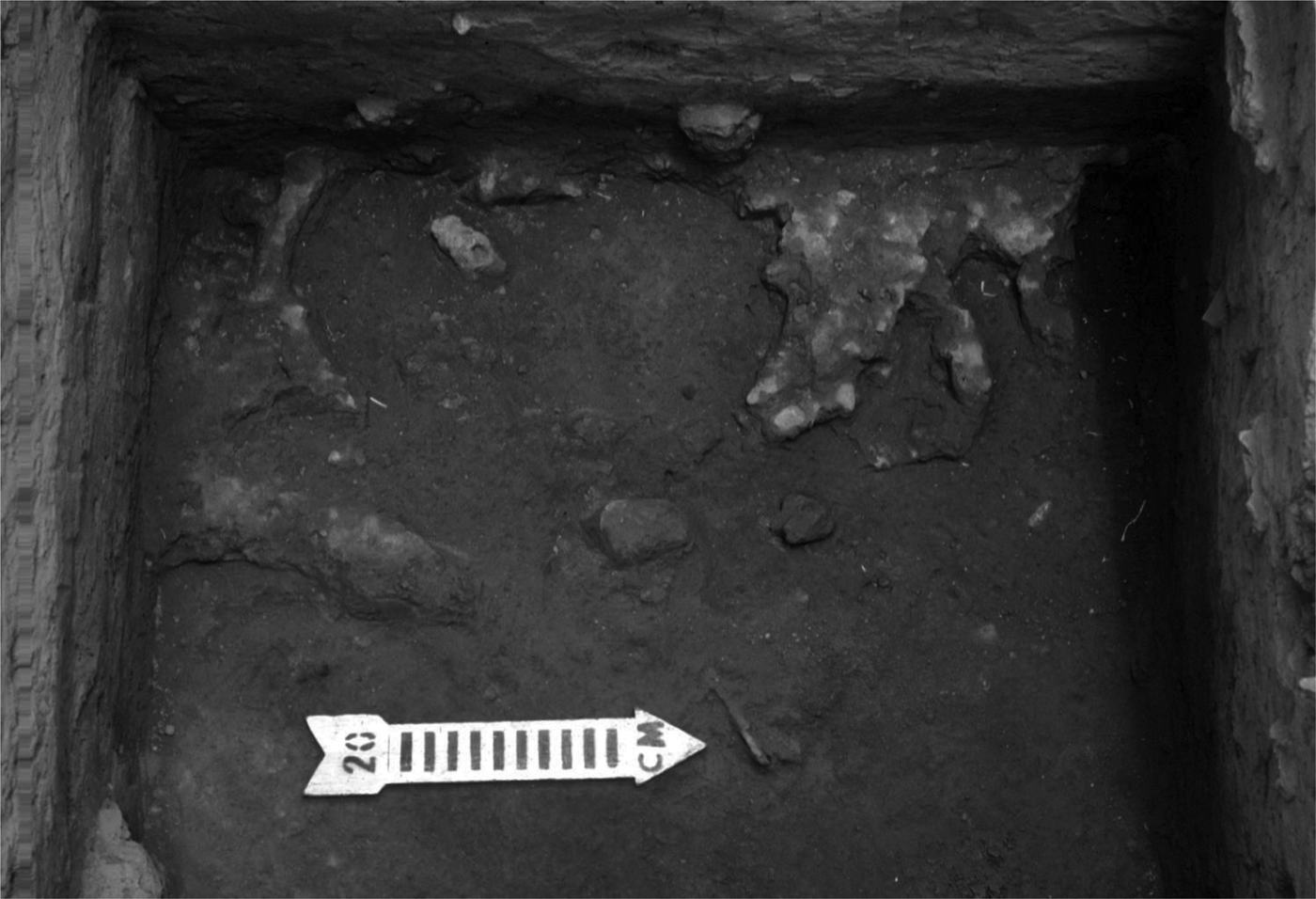
The most common firing facility is also the oldest form recognized: a round, above-ground fired clay chamber, somewhat less than a meter in diameter, with vertical walls and an open top, provided with a fired clay vent on one side (Figure 2). Multiple examples were documented at Puerto Escondido (Joyce and Henderson Reference Joyce, Henderson, Laporte, Arroyo, Escobedo and Mejía2003). At the time these firing facilities were in use, between 1150 and 1000 b.c., clay crafters at this site began a long history of experimenting with control of the atmosphere of firing, producing distinct blackened and fully oxidized beige or buff vessels, as well as others with contrasting zones in black and beige.
Firing facility excavated at Puerto Escondido. Photo courtesy of Rosemary A. Joyce.
The same basic form of firing facility was excavated at Travesía, in deposits dating to around a.d. 400–650 (Joyce Reference Joyce and Robinson1987). Joyce recovered sherds fired harder than normal, with colors shifted from the norm for vessels with the same shape and surface patterns in association with this oven. Among them were examples of the first Ulua Polychrome ceramics, produced by using different densities of iron pigments to make very dark red and black motifs. While innovations in painting slips have been emphasized in the definition of these new polychromes, it is also notable that these early polychrome ceramics demonstrate evidence of different firing than the ceramics that precede them, which they otherwise closely resemble in size and shape. Where the paste color of earlier painted finewares is normally somewhat red brown, with a dark black core, Ulua Polychromes show a clearer yellowish body on either side of a more variable grey to black core. Also found near the Travesía oven were sherds identifiable as Sulaco Polychrome, similarly fired to unusual colors. Sulaco Polychrome as a whole is even more distinctive in paste, when compared with earlier pottery, with a fully oxidized orange body, or at most a very faint light grey core. Thus, the badly fired sherds found near the Travesía kiln may be understood as failures produced in the course of crafting new ceramic bodies to carry new polychrome painted designs.
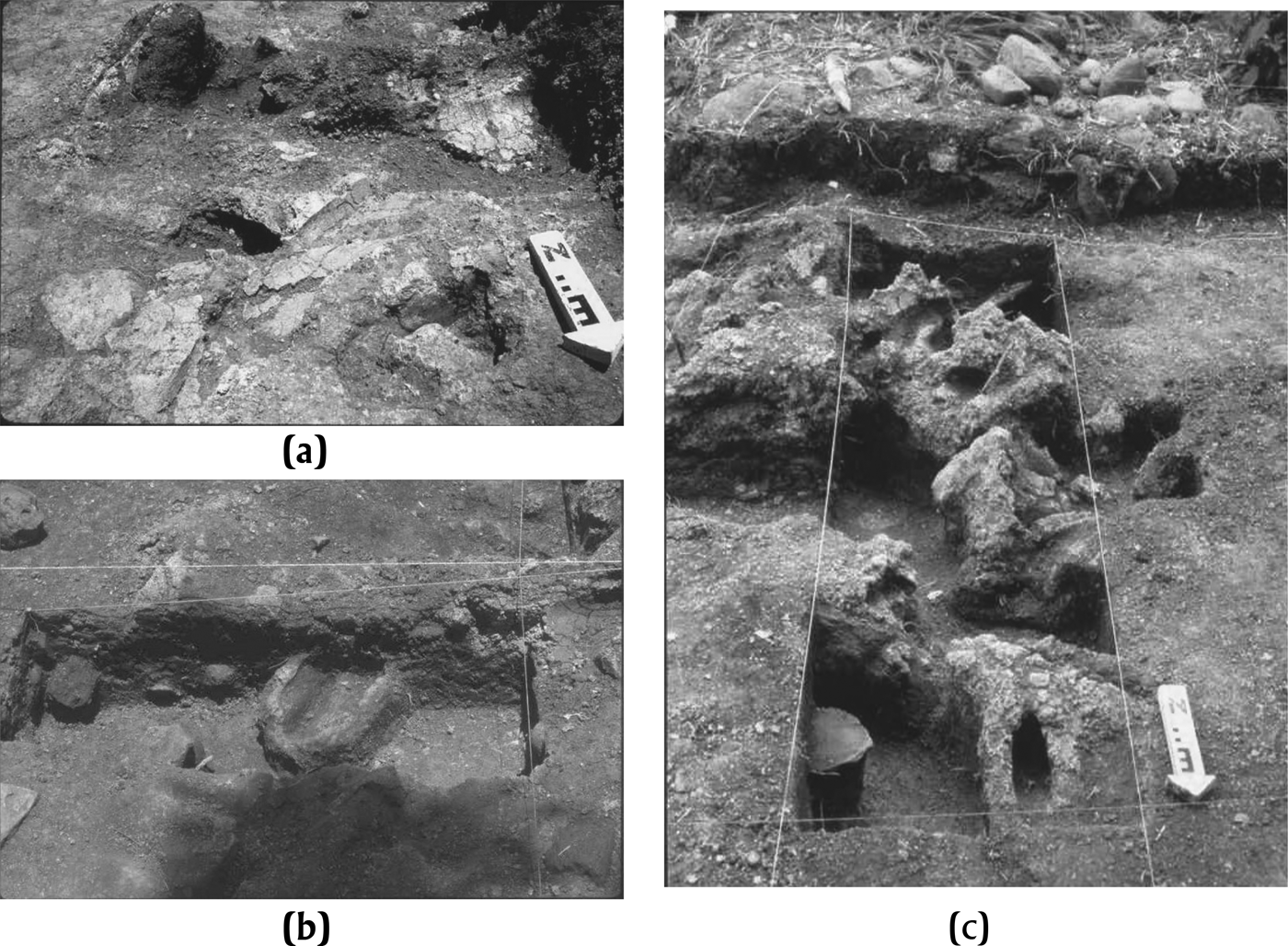
The kind of firing facility seen at Puerto Escondido, and centuries later in use at Travesía, was small in size, but built to allow control of the atmosphere surrounding a small number of vessels being fired. The second kind of above-ground firing facility identified in the lower Ulua valley does not seem to have as small a capacity, and may be closer in conception to the kilns of La Sierra in the Naco Valley. Examples from Cerro Palenque (Figure 3) have a stone pavement (a detail also found at La Sierra) and fired fragments of burned clay covering poles (bajareque) forming curving walls, also like the reported kilns from La Sierra (Urban et al. Reference Urban, Wells, Ausec and Rice1997). The Cerro Palenque firing facilities are located next to a pit containing broken vessels and molds, suggesting a dump of products of the firing (Hendon Reference Hendon2010a; Hendon and Lopiparo Reference Hendon, Lopiparo and Rubén Ávalos2004; Lopiparo et al. Reference Lopiparo, Joyce, Hendon, López Varela and Foias2005). The molds recovered all are for small open vessels, bowls or cups. The most common vessel form was a distinctive open bowl with a glossy red-orange interior slip and an unslipped or poorly slipped exterior. Originally defined as the type Lasani Orange based on a small sample from outlying houses in the Cerro Palenque settlement (Lopiparo et al. Reference Lopiparo, Joyce, Hendon, López Varela and Foias2005), these bowls share a uniform paste that is completely oxidized, yellow in color, and somewhat soft and easily eroded. The ware implies the use of a facility allowing control of the firing atmosphere, the introduction of abundant oxygen, but protection from fire clouds, yet perhaps not a high or long sustained maximum temperature. These are very different characteristics than the harder, but incompletely oxidized products of the thick-walled round firing facility at Travesía.
Remains of above ground firing facility at Cerro Palenque. Photo by Julia Hendon.
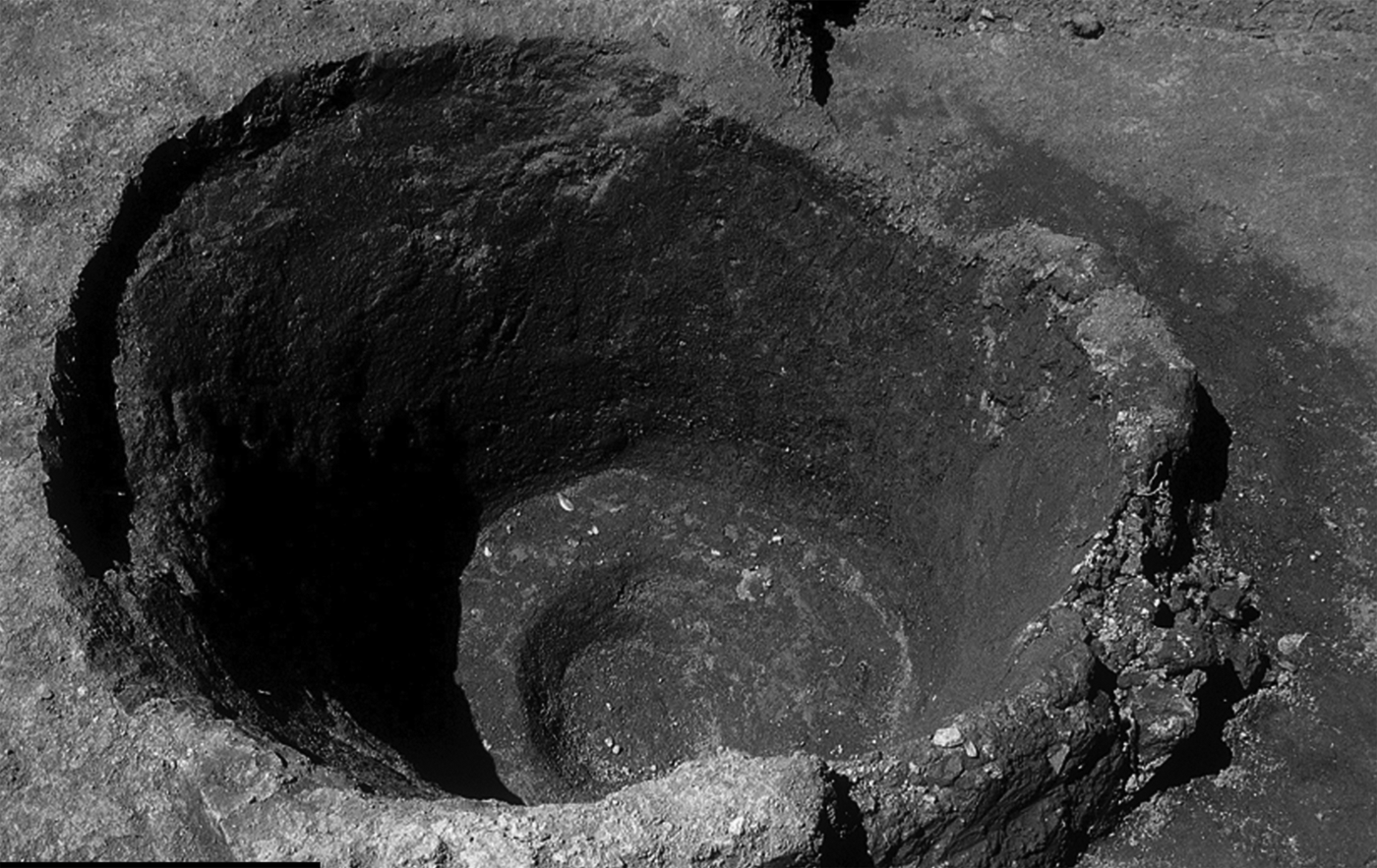
The third type of formal firing facility identified in the lower Ulua valley is below ground pits of varied shapes and sizes. These can be compared to firing facilities that Rye (Reference Rye1981:98) describes as “an intermediate stage between open firing and true kilns.” An example documented ethnographically in Pakistan shows raised areas in the bottom of the firing facility, allowing circulation of oxygen around fuel and unfired ware (Rye Reference Rye1981:Figure. 87). An excavated example of a below ground pit from Campo Pineda (Figure 4) is similar in concept, with a raised ring of fired clay in the base allowing air to circulate somewhat freely around the ware being fired, including the bottom of the clay objects at the base, elevated on the raised ring (Lopiparo Reference Lopiparo2003). Yet there is no single standardized version of this kind of firing facility. At Campo Dos, potters apparently used simple subterranean pits to finish Baracoa Group fine paste vessels (Lopiparo Reference Lopiparo1994; Lopiparo et al. Reference Lopiparo, Joyce, Hendon, López Varela and Foias2005).
Below ground firing facility from Campo Pineda. Photo by Jeanne Lopiparo.
Lopiparo (Reference Lopiparo2003) found abundant evidence in the vicinity of this Campo Pineda subterranean firing facility for use of molds to produce mold-made figurines. If these were typical products of this firing facility, then the volume of the pit suggests that a single firing could have produced a large number of objects. Both figurine molds and mold-made figurines recovered here and at other Ulua valley sites were constructed of a clay body that fired brown to orange. In most instances, there is no firing core on the relatively thin figurines, but their texture is soft, suggesting relatively short firing or low firing temperature. The exterior surface on many of these objects is somewhat darker than the paste in section, suggesting that carbon circulated in the atmosphere around the objects during firing, and was deposited and not burned off.
We have taken the time to point out the distinctions between the firing facilities at Travesía, Cerro Palenque, Campo Dos, and Campo Pineda, and between their likely products, to underline the point we are making: ceramic production in the lower Ulua valley between a.d. 500 and 1000 required the development of varied knowledge and skill. As household craft production, we can be tempted to view clay crafting as relatively uniform, even unskilled work. This would be a mistake. As the abundance of fired clay forms of great diversity in lower Ulua valley houses would suggest, clay crafting was central to the work of creating social relations in everyday practices. In the final section of this paper, we explore how the concept of communities of practice helps us understand the household scale social relations that crafting helped produce and reproduce.
THE WORK FIRED CLAY DID
Fired clay objects served to mediate both distinction between persons and identification with others in small-scale face-to-face encounters, through exchanges of people and person-like objects among communities of various sizes in the lower Ulua valley, and via interregional long-distance interactions between social actors who did not encounter one another very often. These relationships operated at multiple social and geographic scales, integrating what have been considered separate economic and political spheres in the non-state societies of northern Honduras (Hendon Reference Hendon2010a; Hendon et al. Reference Hendon, Joyce and Lopiparo2014; Lopiparo Reference Lopiparo2003, Reference Lopiparo, Ardren and Hutson2006). The social relationships formed by action within and between residential groups can be modeled using two concepts: the community and constellation of practice, which emerged from studies of situated learning.
Learning creates a community of practice, which is a network of relations among people and objects that continues (is reproduced) over time (Lave and Wenger Reference Lave and Wenger1991:98). In an extension of her analysis of textile craft in Mesoamerica, Hendon (Reference Hendon2010a) has argued that crafting at home (in a household setting) creates communities of practice that cross generations and shape social relations among at least some members of the household, through a shared focus on the particular craft. Because learning is part of each individual life, skill is constantly recreated in a community of practice (Bowser and Patton Reference Bowser, Patton, Stark, Bowser and Horne2008; Minar Reference Minar2001).
Within a crafting household, individuals with the most experience and greatest skill would have had special places, as guides for others. In the literature on apprenticeship such individuals are called “masters,” a term with unfortunate overtones of control as well as being open to unreflective gendering. Recognizing that these individuals developed their skill over their lifetime, we would describe them as senior crafters: older, and as a consequence, more knowledgeable, but neither inherently in control of junior crafters, nor automatically recognized as having the right to claim credit for all the work done with and around them.
The products of crafting households circulated locally within regions like the central floodplains of the lower Ulua valley via exchanges that in at least some cases took place as part of larger social events, marked by dances, games, feasting and quite possibly gifting of worked clay objects (Hendon Reference Hendon2010a; Hendon et al. Reference Hendon, Joyce and Lopiparo2014; Lopiparo Reference Lopiparo, Ardren and Hutson2006). The range of gifted craft objects could be quite extensive. The event that produced the trash found near the firing facilities at Cerro Palenque implies the likelihood that clay figurines, serving bowls, and effigies of Classic Ulua marble vases were given as gifts to participants who took them back to their own houses, because mold fragments for each of these kinds of objects were thrown away here in large numbers. Such gifting would account for the patterned variability in proportions of Lasani Orange ceramics noted at Cerro Palenque (Lopiparo et al. Reference Lopiparo, Joyce, Hendon, López Varela and Foias2005). The trash deposit next to the household with above-ground firing facilities yielded a large proportion of the type (31% of the ceramics recovered there), while outlying house compounds that provided the original sample of Lasani Orange yielded less than 3% of the type. Lasani Orange was apparently a product of the crafting of a community of practice associated with this central household; other households had limited access to the products of this crafting group, consistent with receiving individual vessels from the crafting household and returning with them to their own residences.
Tools to produce a similar array of objects were found in trash that probably originated with similar events at Travesía, likely accompanied in at least some cases by presentation of actual marble vases rather than just their small ceramic effigies (Joyce Reference Joyce and Robinson1987; Luke and Tycott Reference Luke and Tykot2007). At the local scale of the network of households that we can see at Cerro Palenque and Travesía, the relative skill represented by different craft goods, the products of household-scale multicrafting, would have been evident to those participating in social events. This especially would have been the case for individuals who themselves were engaged in craft production, bringing an informed practitioner's perspective to bear. This is a scale at which social credit might be strongly tied to the individual crafter.
Not all of the products of craft work undertaken in the household stayed local, however. Some figurines traveled long distances to the sites were they were eventually deposited, for example, at Copan (Hendon et al. Reference Hendon, Joyce and Lopiparo2014:23–38). While it is possible that these objects retained some traces of the name and identity of their maker, more likely such figurines took on the burden of standing for a larger community of practice forming part of a wider constellation of practices. The concept of “constellations of practice” describes the articulation of separate communities of practice that share common historical roots, have members in common, share certain things, or engage in overlapping styles or related discourses (Wenger Reference Wenger1998:127–133, 168–169, 256–260). In moving from one community of practice to another in a constellation of practices, gifted objects like figurines could have changed their significance while remaining evidence of the skilled work of members of the multicrafting households, communities of practice, that produced them.
CONCLUSIONS
In this paper, we have consciously adopted a practitioner's perspective to craft. As a result, we have tried to enmesh ourselves in the production process, thinking about the steps involved, the kinds of tools used, and the consequences of making different kinds of clay objects. The use of molds, common during this time period in figurine production and also used to make fine paste pottery after a.d. 850, does not seem to have been adopted to increase the scale of production or to turn out multiple identical copies of the same image. Instead, molds were chosen as a way of facilitating the involvement of practitioners with more and less degrees of skill.
The variation in production facilities among contemporary settlements in the lower Ulua valley is something that only became apparent to us when we reviewed and compared excavation results from sites throughout the valley, research carried out in some cases by ourselves and in others by colleagues, and spanning several decades of fieldwork. The variability in types of kilns that we discuss here accords well with the information derived from petrographic and INAA analyses of the clays used for different types of pottery and at different sites (Lopiparo Reference Lopiparo and Beck2007; Lopiparo and Hendon Reference Lopiparo, Hendon, Halperin, Faust, Taube and Giguet2009; Lopiparo et al. Reference Lopiparo, Joyce, Hendon, López Varela and Foias2005). On the basis of this evidence, derived from multiple kinds of analyses and research, we see crafting in the lower Ulua valley creating communities of practice. These communities of crafting practice are situated in household settings. Their participants would have overlapped with the people making up the households living in these residential spaces, whose everyday work also created communities of practice of such activities as plant cultivation, food processing, house construction, and ritual.
The overlap between clay crafting communities of practice and these other communities of practice, in part composed of the same people, was undoubtedly not complete; not everyone in a village or even a house compound would have been engaged in skilled crafting, or in the same craft. Based both on evidence of overlapping craft production at a household scale, and the implied diversity of crafts needed to support working with clay, we argue that lower Ulua valley households engaged in multicrafting as defined by Hirth (Reference Hirth and Hirth2009). Consequently, we argue that viewing these communities not just as households but also as crafters gives us deeper insight into communities of practice of all kinds, crafting and daily practices. The household is not just a term for people who live together or who are kin but who also share “an intensity of functional association” (Hammel and Laslett Reference Hammel and Laslett1974:78). The household is an abstraction that is not as useful as thinking about households as communities of practice, as Hendon has discussed from an engendered perspective (Hendon Reference Hendon and Roth2010b). Households vary, and one way this variation manifests itself is through involvement in crafting communities of practice.
Learning to craft is also learning to be a person in a social group. In the case of working with clay in the lower Ulua valley, we see the creation of many different communities of practice with different choices of raw material, different production procedures, and different ways of firing what was made. A single uniform clay crafting enterprise did not exist in the lower Ulua valley. At the same time, the common products produced through different technologies at Cerro Palenque, Travesía, Campo Pineda, and Campo Dos point to the creation of a constellation of practices that constituted the social context of this network of settlements, a binding force that originated in the household, among other ways, with the simple task of working with clay.
RESUMEN
Investigaciones arqueológicas en el valle inferior del río Ulúa en Honduras han revelado evidencia de una población sustancial que vivió en este valle grande y fértil. Esta ocupación llegó a su tamaño máximo entre los años 500 y 1000 d.C. Excavaciones en sitios residenciales nos proporcionan muchos datos sobre la vida cotidiana, incluyendo evidencia de la producción artesanal que indica que muchas unidades domésticas correspondieron a los “multicrafting households” o “unidades multioficios” de Hirth (Reference Hirth and Hirth2009). En este estudio nos enfocamos en la evidencia relacionada a la alfarería. Adoptamos la perspectiva del artesano, como ha recomendado Keller (2001), para explorar los vínculos entre las unidades domésticas, la artesanía y entender cómo los objetos ayudan a mantener relaciones sociales. La producción de vasijas, figurillas, silbatos y efigies de gran tamaño se llevó a cabo a pequeña escala en varios sitios en el valle, incluyendo el Cerro Palenque, Travesía, Campo Dos y Campo Pineda. Discutimos las diferencias en la selección del barro, en los productos, y en el tamaño y diseño de los hornos. Identificamos tres tipos de hornos. Uno es el más antiguo en el valle. Hecho de barro, el horno tiene una forma redonda con paredes verticales y una apertura. El segundo tipo era más grande. Era construido de bajareque, es decir un armazón de madera cubierta con barro, una técnica de construcción muy parecida a mucha de la arquitectura doméstica en el valle. El tercer tipo de horno es un pozo. Un ejemplo tiene un collar de barro quemado alrededor de la apertura. Sostenemos que la diversidad en la alfarería indica que los artesanos eran miembros de “comunidades de práctica” (“communities of practice”), como las definidas por Lave y Wegner (1991). Estas comunidades consistían en individuos que son diferentes en términos de sus experiencias, sus entendimientos de la alfarería y sus talentos. Proponemos que nuestro enfoque en una artesanía específica y en la perspectiva del artesano nos dan nuevas ideas sobre cómo la artesanía ha contribuido a la reproducción de las identidades sociales, las historias locales y los vínculos entre grupos.
ACKNOWLEDGMENTS
Funding for research at these sites came from a variety of sources: grants from the National Science Foundation (Hendon 1984:BCS-8319347 and 2002:BCS-0207114), the H. John Heinz III Fund (Heinz Family Foundation), the American Association of University Women Educational Foundation, Presidential Research Fellowship, and Gettysburg College, were obtained by Julia Hendon. Jeanne Lopiparo obtained funding from the Wenner-Gren Foundation for Anthropological Research. Rosemary Joyce was awarded a Fulbright-Hays Fellowship and an OAS Traineeship Grant. Grants from the Stahl Endowment of the Archaeological Research Facility, University of California, Berkeley (to Joyce); Research and Professional Development Fund of Gettysburg College (to Hendon); and the Owens Fund of the Peabody Museum of Archaeology and Ethnology, Harvard University (also to Hendon) funded work included here.