


%20--%3e%3c!DOCTYPE%20svg%20PUBLIC%20'-//W3C//DTD%20SVG%201.0//EN'%20'http://www.w3.org/TR/2001/REC-SVG-20010904/DTD/svg10.dtd'%3e%3csvg%20version='1.0'%20id='Layer_1'%20xmlns='http://www.w3.org/2000/svg'%20xmlns:xlink='http://www.w3.org/1999/xlink'%20x='0px'%20y='0px'%20width='64px'%20height='64px'%20viewBox='5.5%20-3.5%2064%2064'%20enable-background='new%205.5%20-3.5%2064%2064'%20xml:space='preserve'%3e%3cg%3e%3ccircle%20fill='%23FFFFFF'%20fill-opacity='0'%20cx='37.785'%20cy='28.501'%20r='28.836'/%3e%3cpath%20fill='%23595959'%20d='M37.441-3.5c8.951,0,16.572,3.125,22.857,9.372c3.008,3.009,5.295,6.448,6.857,10.314%20c1.561,3.867,2.344,7.971,2.344,12.314c0,4.381-0.773,8.486-2.314,12.313c-1.543,3.828-3.82,7.21-6.828,10.143%20c-3.123,3.085-6.666,5.448-10.629,7.086c-3.961,1.638-8.057,2.457-12.285,2.457s-8.276-0.808-12.143-2.429%20c-3.866-1.618-7.333-3.961-10.4-7.027c-3.067-3.066-5.4-6.524-7-10.372S5.5,32.767,5.5,28.5c0-4.229,0.809-8.295,2.428-12.2%20c1.619-3.905,3.972-7.4,7.057-10.486C21.08-0.394,28.565-3.5,37.441-3.5z%20M37.557,2.272c-7.314,0-13.467,2.553-18.458,7.657%20c-2.515,2.553-4.448,5.419-5.8,8.6c-1.354,3.181-2.029,6.505-2.029,9.972c0,3.429,0.675,6.734,2.029,9.913%20c1.353,3.183,3.285,6.021,5.8,8.516c2.514,2.496,5.351,4.399,8.515,5.715c3.161,1.314,6.476,1.971,9.943,1.971%20c3.428,0,6.75-0.665,9.973-1.999c3.219-1.335,6.121-3.257,8.713-5.771c4.99-4.876,7.484-10.99,7.484-18.344%20c0-3.543-0.648-6.895-1.943-10.057c-1.293-3.162-3.18-5.98-5.654-8.458C50.984,4.844,44.795,2.272,37.557,2.272z%20M37.156,23.187%20l-4.287,2.229c-0.458-0.951-1.019-1.619-1.685-2c-0.667-0.38-1.286-0.571-1.858-0.571c-2.856,0-4.286,1.885-4.286,5.657%20c0,1.714,0.362,3.084,1.085,4.113c0.724,1.029,1.791,1.544,3.201,1.544c1.867,0,3.181-0.915,3.944-2.743l3.942,2%20c-0.838,1.563-2,2.791-3.486,3.686c-1.484,0.896-3.123,1.343-4.914,1.343c-2.857,0-5.163-0.875-6.915-2.629%20c-1.752-1.752-2.628-4.19-2.628-7.313c0-3.048,0.886-5.466,2.657-7.257c1.771-1.79,4.009-2.686,6.715-2.686%20C32.604,18.558,35.441,20.101,37.156,23.187z%20M55.613,23.187l-4.229,2.229c-0.457-0.951-1.02-1.619-1.686-2%20c-0.668-0.38-1.307-0.571-1.914-0.571c-2.857,0-4.287,1.885-4.287,5.657c0,1.714,0.363,3.084,1.086,4.113%20c0.723,1.029,1.789,1.544,3.201,1.544c1.865,0,3.18-0.915,3.941-2.743l4,2c-0.875,1.563-2.057,2.791-3.541,3.686%20c-1.486,0.896-3.105,1.343-4.857,1.343c-2.896,0-5.209-0.875-6.941-2.629c-1.736-1.752-2.602-4.19-2.602-7.313%20c0-3.048,0.885-5.466,2.658-7.257c1.77-1.79,4.008-2.686,6.713-2.686C51.117,18.558,53.938,20.101,55.613,23.187z'/%3e%3c/g%3e%3c/svg%3e)
%20--%3e%3c!DOCTYPE%20svg%20PUBLIC%20'-//W3C//DTD%20SVG%201.0//EN'%20'http://www.w3.org/TR/2001/REC-SVG-20010904/DTD/svg10.dtd'%3e%3csvg%20version='1.0'%20id='Layer_1'%20xmlns='http://www.w3.org/2000/svg'%20xmlns:xlink='http://www.w3.org/1999/xlink'%20x='0px'%20y='0px'%20width='64px'%20height='64px'%20viewBox='5.5%20-3.5%2064%2064'%20enable-background='new%205.5%20-3.5%2064%2064'%20xml:space='preserve'%3e%3cg%3e%3ccircle%20fill='%23FFFFFF'%20fill-opacity='0'%20cx='37.637'%20cy='28.806'%20r='28.276'/%3e%3cg%3e%3cpath%20fill='%23595959'%20d='M37.443-3.5c8.988,0,16.57,3.085,22.742,9.257C66.393,11.967,69.5,19.548,69.5,28.5c0,8.991-3.049,16.476-9.145,22.456%20C53.879,57.319,46.242,60.5,37.443,60.5c-8.649,0-16.153-3.144-22.514-9.43C8.644,44.784,5.5,37.262,5.5,28.5%20c0-8.761,3.144-16.342,9.429-22.742C21.101-0.415,28.604-3.5,37.443-3.5z%20M37.557,2.272c-7.276,0-13.428,2.553-18.457,7.657%20c-5.22,5.334-7.829,11.525-7.829,18.572c0,7.086,2.59,13.22,7.77,18.398c5.181,5.182,11.352,7.771,18.514,7.771%20c7.123,0,13.334-2.607,18.629-7.828c5.029-4.838,7.543-10.952,7.543-18.343c0-7.276-2.553-13.465-7.656-18.571%20C50.967,4.824,44.795,2.272,37.557,2.272z%20M46.129,20.557v13.085h-3.656v15.542h-9.944V33.643h-3.656V20.557%20c0-0.572,0.2-1.057,0.599-1.457c0.401-0.399,0.887-0.6,1.457-0.6h13.144c0.533,0,1.01,0.2,1.428,0.6%20C45.918,19.5,46.129,19.986,46.129,20.557z%20M33.042,12.329c0-3.008,1.485-4.514,4.458-4.514s4.457,1.504,4.457,4.514%20c0,2.971-1.486,4.457-4.457,4.457S33.042,15.3,33.042,12.329z'/%3e%3c/g%3e%3c/g%3e%3c/svg%3e)
1. Introduction
Vision-language models (VLMs) like CLIP (Radford et al. Reference Radford2021) and LLaVA (Liu et al. Reference Liu2023) have opened new directions in cross-modal learning by enabling natural language understanding grounded in visual inputs. Astronomy, with its rich collection of images, spectra, and tabular data, is an ideal domain for testing such capabilities. While CLIP-based works (Gupta et al Reference Gupta2025) primarily focused on static alignment for image-text retrieval tasks, this paper explores the application of generative, instruction-following VLMs to radio astronomical analysis.
2. Methodology
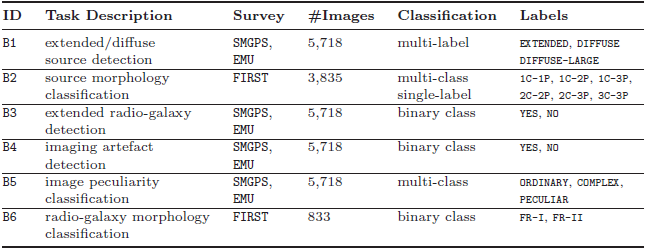
We used labelled radio image data from various surveys
 $-$
including MeerKAT SMGPS (Goedhart et al. Reference Goedhart2024), ASKAP EMU (Hopkins et al. Reference Hopkins2025; Norris et al. Reference Norris2021), and VLA FIRST (Becker et al. Reference Becker1995)
 $-$
to construct six radio classification tasks for VLM evaluation, summarised in Table 1.
Radio benchmarks.

We first assessed the zero-shot performance of several open-weight models
 $-$
LLaVA-OneVision (Li et al. Reference Li2024), Qwen2VL (Wang et al. Reference Wang2024), InternVL (Chen et al. Reference Chen2024), TinyLLaVA (Zhou et al. 2024)
 $-$
of different sizes (0.5B to 72B parameters) and a representative commercial closed-weight solution (OpenAI GPT-4.1).
We then evaluated a fine-tuned LLaVA-OneVision 7B model
 $-$
hereafter referred to as radio-llava
 $-$
trained on curated Q&A instructions derived from an independent set of 59k annotated radio images, as well as on curated 39k image-caption pairs extracted from a corpus of published radio astronomy papers (2000–2025). In all training runs we kept the vision encoder (siglip-so400m-patch14-384) frozen, while we fully fine-tuned the LLM (qwen2) and adapter (mlp2x_gelu) components. Fine-tuning results were compared with both the base LLaVA model and a vision-only baseline.
Finally, we conducted additional diagnostic analyses to explore alternative LLaVA hyperparameter settings and to evaluate the extent of catastrophic forgetting of previously learned multimodal tasks following fine-tuning.
Further details on the training/evaluation data and strategy can be found in Riggi et al. (Reference Riggi2025).
3. Results
Zero-shot benchmark results are presented in Fig. 1. GPT-4.1 (black histograms) outperforms the open-weight models in four out of six benchmarks, with a
 $\sim$
20% improvement in tasks B1 and B6. However, it unexpectedly underperforms in tasks B4 and B5. Among the open-weight models, the largest versions of LLaVA match or slightly exceed the performance of their counterparts. Overall, all models demonstrate relatively low performance, indicating the need for domain-specific specialization on radio astronomical data.
Classification “macro-averaged” F1-score obtained across tasks B1–B6 in zero-shot mode with open-weight VLMs of different sizes (0.5B, 2B, 3.1B, 7B, 8B, 72B), shown with coloured histograms (LLaVA: blue, TinyLLaVA: green, Qwen2VL: red, InternVL: orange), and OpenAI GPT-4.1 (black histograms).

Results for the fine-tuned radio-llava models, reported in Fig. 2 as blue and orange histograms for Q&A-only and combined training datasets respectively, indicate substantial improvements over the base VLMs (red histograms), with gains of
 $\sim$
30% in tasks B1 and B3. For the remaining tasks, the improvements are more modest
 $-$
around 10% in B2, B4, and B5
 $-$
and negligible in B6. With the exception of B6, the fine-tuned models also outperform GPT-4.1 (black histograms), though with smaller margins. Notably, VLMs trained jointly on all tasks consistently underperform relative to vision-only classifiers trained individually per task, as shown by the green histograms in Fig. 2.
Classification “macro-averaged” F1-score obtained across tasks B1–B6 with the radio-llava model, fine-tuned on the Q&A training dataset (blue histograms) and the combined Q&A and caption datasets (orange histograms) with different training strategies (full vs. LoRA fine-tuning) and depths (shallow vs. deep). Results from different baseline models are also shown: base llava-ov-7b (red histograms), fine-tuned siglip-so400m-patch14-384 vision encoder (green histograms), OpenAI GPT-4.1 (black histograms).

Models fine-tuned using alternative LLaVA hyperparameters
 $-$
such as learning rate and relative scheduling, batch size, and LoRA configuration
 $-$
exhibited performance broadly comparable to that obtained with the default settings. A modest improvement (
 $\sim$
2%) was observed when the vision encoder was also fully fine-tuned.
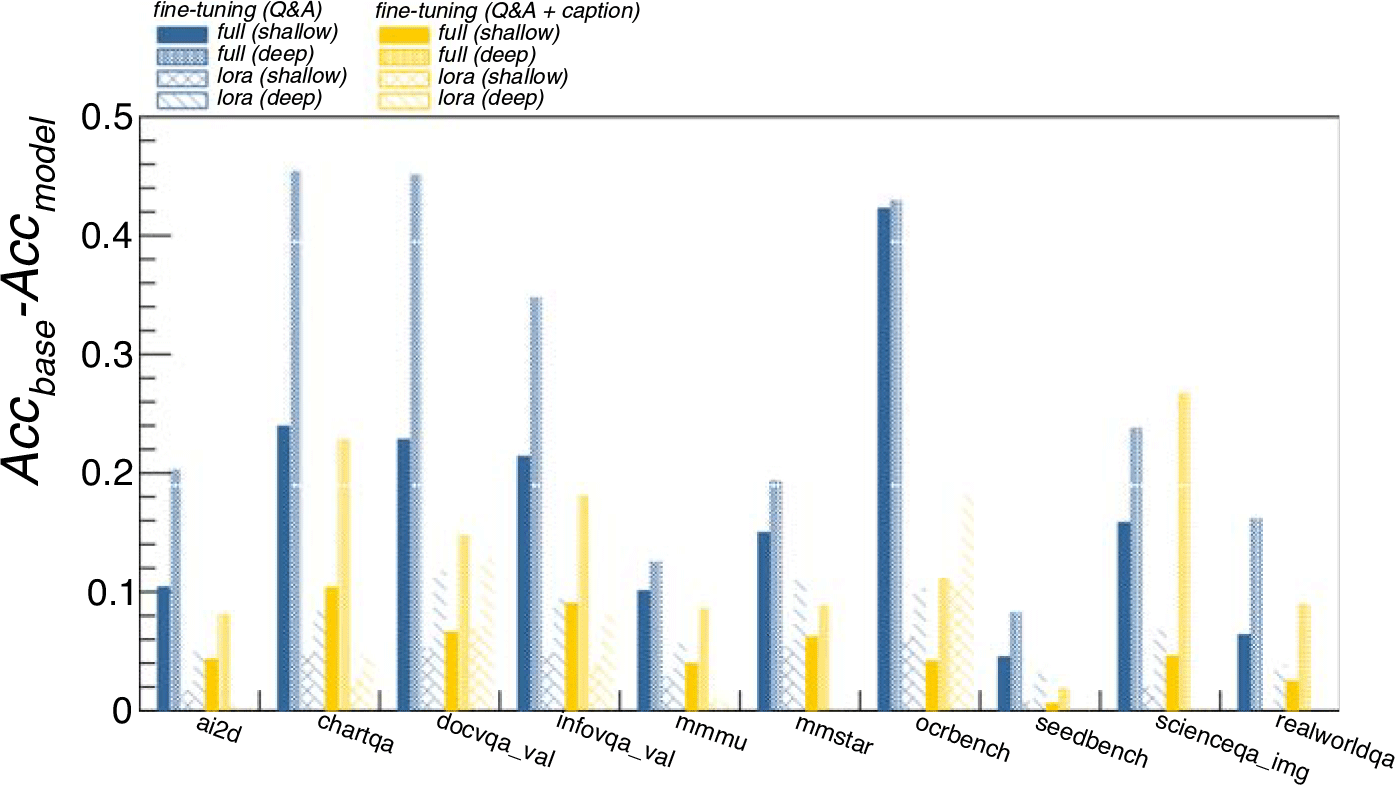
Deeper fine-tuning (e.g., three epochs vs a single epoch) had only a minor impact (few percent) on classification performance for most radio benchmarks. However, it led to substantial degradation in performance on standard multimodal tasks
 $-$
such as ChartQA, DocVQA, and InfoVQA
 $-$
with accuracy drops of up to 40%, indicative of catastrophic forgetting, as shown in Fig. 3. Incorporating more diverse training data, such as curated caption datasets, or adopting LoRA-based fine-tuning strategies partially mitigated this effect and helped recover some of the lost general multimodal capabilities.
Classification accuracy differences between the llava-ov-7b base model and the fine-tuned radio-llava models (blue and orange histograms), evaluated on various multimodal (non-radio) benchmarks.

4. Summary
This work investigates the feasibility of using small-scale Vision-Language Models (VLMs) as domain-specific assistants for radio astronomical image analysis. Our evaluation shows that large commercial models like GPT-4.1 deliver strong zero-shot results on some tasks but consistently underperform compared to specialized vision-only models trained specifically for radio astronomy.
Fine-tuning smaller open-weight models like LLaVA on curated radio datasets (Q&A and captions) significantly improves performance over both base and commercial models, with up to
 $\sim$
30% F1-score gains in certain benchmarks. However, these fine-tuned models still lag behind vision-only models trained per task and suffer from catastrophic forgetting, losing up to 40% accuracy on general multimodal benchmarks after full deeper fine-tuning. Incorporating caption data and adopting LoRA-based fine-tuning helps mitigate some of these issues, improving instruction-following ability and partially recovering lost generalization.
These results underscore both the potential and current limitations of VLMs in supporting astronomers through assistant-style interaction, and emphasize the need for better multimodal alignment, more diverse and high-quality training data, and improved fine-tuning strategies to fully realize their value in scientific workflows.



 Open access

