In recent years, scholars of comparative politics have devoted increasing attention to variation in authoritarian regimes.Footnote 1 One important type of authoritarian regime is the hegemonic party regime. Hegemonic party regimes are those regimes in which dictators rule with the aid of one dominant party, while still holding regular multi-party elections. Prominent examples of hegemonic party regimes include Zimbabwe under the Zimbabwe African National Union–Patriotic Front (ZANU-PF), Mexico under the Partido Revolucionario Institucional (PRI), Taiwan under the Kuomintang (KMT), Senegal under the Parti Socialiste (PS) and Paraguay under the Colorado party.
The defining institutions of hegemonic party regimes (elections and a single dominant party) serve the regime in distributing patronage, gathering information, co-opting elites and binding supporters to the regime.Footnote 2 The latter function of these institutions has led some scholars to note that party regimes are particularly durable forms of authoritarian regimes, able to maintain their integrity even through calamities such as economic crises.Footnote 3 But the same institutions that provide benefits to the regime can also have unexpected, indeed undesirable, consequences for the incumbent authoritarians. These regimes do fall, and often they fall at an election time, when key actors cease to acquiesce to the regime. One quite simple and direct way that elections can subvert an authoritarian regime is when key members of the hegemonic party defect from the party ranks and challenge the regime in the elections. Even when such defectors do not defeat the incumbent and initiate regime change, their defections can serve as defining moments in the life of these parties, compelling incumbents to change their ruling strategy.
We argue that economic performance can motivate potential defectors’ decisions over whether to split from the regime party. Disgruntled party members defect in times of economic crisis in order to capitalize upon popular and elite discontent with the regime in the hope of successfully challenging the incumbent in elections. Our main hypothesis is that poor economic performance should encourage elites to defect from hegemonic parties and challenge the regime in elections. We test our hypothesis using an original dataset that includes 227 relevant elections in all hegemonic party regimes from 1946 to 2004. The dependent variable is the first large-N measure of defection developed in the field. Our results are consistent with our hypotheses, even when including important control variables. To support our claim further, we examine two cases, Turkey and Zimbabwe, in which elite defections occurred in authoritarian elections. Both the historical and contemporary cases provide evidence of the underlying mechanisms linking the economy and elite strategies.
In this article, we contribute to existing literature in several ways. First, we contribute to the literature on authoritarian regimes by showing how the integrity of hegemonic parties is vulnerable to exogenous shocks. Thus, elite coalitions in these regimes are not only a function of the party’s apparent invincibility or the institutional bonds that constrain and channel elite conflict, but also a function of economic performance. Secondly, this research contributes to an older literature on democratization. While in this article we do not explore the relationship between economic crisis and democratic transition, we do provide the first empirical examination of one of the possible causal mechanisms behind the robust correlation between economic growth and transitions.Footnote 4 In this vein, we move beyond the earlier transitions literature, which emphasized elite cohesion as a necessary condition for authoritarian survival by positing exogenous factors that determine this cohesion in the first place.Footnote 5
Hegemonic parties and elite defections discussed in the literature
Ruling parties are institutions that serve to contain elite conflict while co-opting larger groups within society. Consequently, party regimes are more durable than other types of authoritarian regimes.Footnote 6 Yet party regimes vary enormously in their survival – an empirical pattern that has been explained by the behaviour of both the opposition parties that compete against hegemonic parties in authoritarian electionsFootnote 7 and the party cadres whose role is so central to the operation of ruling parties.Footnote 8 Party regimes appear to be most in danger when members have incentives to defect from the ruling institution. Defections lead directly to the unravelling of the party, or signal to other important actors (for example, the opposition or the military) that the regime is weak, or may even prompt illiberal changes in the regime’s ruling strategy.
What do we know about defection? Under what conditions are departures from the regime party more likely to occur? Many of our intuitions on this point come from the democratization literature. Elite cohesion has been used as an explanatory factor in studies of democratic transition.Footnote 9 In the late 1990s, however, this early transitions literature was criticized for over-reliance on a construct – elite cohesion – that was seen to evaporate when contextual circumstances changed.Footnote 10 Attention has since turned to the identification of secondary factors that make elite cohesion more likely. Fissures within the elite are thought to be most likely to appear when material circumstances dictate: either an economic crisis or destructive conflicts make defection from the regime more appealing.Footnote 11
More recently, a body of work on ruling parties in authoritarian states also examines the importance of elite defection. Elite unity is maintained in party regimes either through the strength of the party’s institutional bonds or via other mechanisms, such as the perceived electoral invincibility of the party, its ability to deliver patronage and its ability to use coercion in order to deter candidate entry.Footnote 12
To examine these claims empirically, scholars have adopted two strategies. One approach is to examine mechanisms – the conditions under which defections occur and their effects on regime stability – directly through the detailed study of particular cases. Consider the well-known example of Cuauhtémoc Cárdenas in Mexico. After a half-decade of economic stagnation and restructuring in the early and mid-1980s, a wing of the ruling Partido Revolucionario Institucional (PRI) emerged advocating an end to austerity programmes imposed by the International Monetary Fund (IMF) and a return to the PRI’s statist and popularist roots.Footnote 13 This PRI faction, called Corriente Democrático (CD), united around the figure of Cárdenas, son of one of Mexico’s most popular presidents, Lazaro Cárdenas, who was also one of the PRI’s founding fathers. As the 1988 presidential elections approached, the CD and Cárdenas recognized the opportunity for challenging the regime that the economic crisis was creating. As Langston observes, ‘The CD quickly realized that it had support in both the regime and society because of the past seven years of crisis and their effects on the Mexican people.’Footnote 14 Thus, in early 1988 prominent members of CD left the PRI and joined a coalition of parties, the National Democratic Front (FDN), which shortly thereafter nominated Cárdenas as its candidate in the 1988 elections. Magaloni notes that the reason the PRI in 1988 witnessed its first prominent defection since 1952 was that potential defectors sensed better electoral prospects outside the ruling party.Footnote 15 As history has shown, they were correct in their estimation. Cárdenas secured 31 per cent of the vote, more than any other opposition candidate in Mexican history, although most accounts agree that the PRI was forced to resort to massive electoral fraud in order to secure its own victory. Although the PRI would not lose office until 2000, the Cárdenas defection was clearly a turning point in the history of the PRI, demonstrating the vulnerability of the regime, emboldening opponents and attenuating the support base of the PRI. It is also clear that Cárdenas’s reckoning that he could achieve more by defecting and competing against the regime was predicated, in large part, on his observation of the economic crisis racking the country at that time.Footnote 16
The second approach is to test the implications of these claims using cross-national data in an attempt to provide circumstantial evidence for the mechanisms. So the idea of poor economic performance inducing splits within the ruling elite that ultimately lead to the demise of the regime is confirmed by robust quantitative evidence of the link between economic crisis and democratic transition.Footnote 17
In this article, we embrace a different empirical approach by examining cross-national data that shows how economic crisis impacts the integrity of elite coalitions in one important type of authoritarian regime, hegemonic parties.Footnote 18 We test our hypothesis using an original dataset that includes 227 relevant elections in all hegemonic party regimes during the post-war period. In using this approach, we attempt to combine the virtues of directly examining mechanisms with data and tools of analysis that speak to the generality of our claims. We adopt this approach in an attempt to find systematic evidence for the linkages between elite cohesion, economic growth and authoritarian regime survival. Finally, in finding that weak economic performance is connected to the defection of party members, we raise a larger theoretical point: while hegemonic parties are institutions that contain elite conflict in order to perpetuate authoritarian rule, the success of these institutions in controlling elites also varies as a function of exogenous circumstances.
While the defection of elites from ruling coalitions is not unique to hegemonic party regimes, we focus on this regime type for two reasons. One reason is operational, in that defections from the ruling party at election time allow for clear, observable and systematic coding of the dependent variable. Another reason is more substantive: the dynamics of defection in hegemonic party regimes may be unique in that they provide the institutions through which elites and masses can form expectations about the strategies to pursue. Scholars of ‘electoral’ or ‘competitive’ authoritarianism have emphasized the importance of elections for dictators in maintaining power.Footnote 19 Yet as Brownlee observes, the empirical evidence is mixed: elections sometimes have helped to consolidate authoritarian rule while, at other times, they have led to regime failure.Footnote 20 Brownlee argues that the crucial intervening variable is a strong ruling party such that elections can extend authoritarian rule in the presence of a dominant party and undermine it in the absence of such a party. In looking only at hegemonic party systems, we argue that the ability of elections to entrench regimes depends also on the satisfactory performance of the economy.
Hegemonic party regimes: the effect of economic performance on elite strategies
Hegemonic party regimes are those authoritarian regimes in which one party controls access to most important political offices, shares powers over policy and patronage, and uses privileged access to state resources or extra-constitutional measures to dominate multi-party elections.Footnote 21 This definition conforms closely to several others in the literature.Footnote 22 Operationally, hegemonic parties exist when the regime is authoritarian, the members of the legislature are chosen in multi-party elections, and the ruling party controls an absolute majority in the primary legislative chamber. Majority control of the assembly marks an operational dividing line between those incumbent rulers who have invested in organized institutions of bureaucratic co-option and mobilization and those that seek to buy off supporters and/or compete with opponents on an ad hoc basis. The 50 per cent cut point thus is intended to capture not only the party’s electoral dominance, but its degree of influence. A lower figure is clearly unwarranted since that would mean that the dominant party controls less than a majority of seats in the legislative chamber and could not, without securing other parties’ support, pass its own initiatives. By contrast, a higher figure is too restrictive since it would eliminate dominant party regimes that have operated in the presence of strong, but divided, opposition parties (such as KANU in Kenya after 1992).Footnote 23
Some definitions of hegemonic parties include a durability criterion.Footnote 24 We intentionally do not use the number of years ruling parties have been in power as part of our definition for several reasons. First, durability and the extent to which the hegemonic party structures politics are two different concepts, even if length of tenure often is an operational indicator of the latter. Secondly, even if durability and institutional strength are closely intertwined, then the issue of choosing a durability criterion becomes an issue of dichotomizing a continuous variable (i.e., length of tenure). Choosing to call ‘dominant’ those parties that survive in power past some threshold age only obscures variation on the lower end of the age variable. Finally, since our dependent variable of interest is elite defection, which may be tied conceptually to the duration of hegemonic parties, it becomes potentially tautological to include a durability criterion into the definition of these parties.Footnote 25
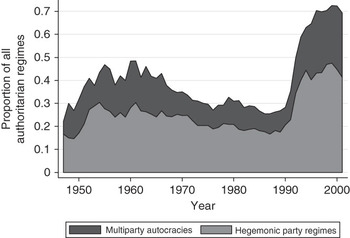
From 1946 to 2004, eighty-four hegemonic parties existed in seventy countries accounting for 23.7 per cent of all authoritarian country–years. As Figure 1 shows, hegemonic party regimes have consistently comprised about one quarter of the world’s non-democratic regimes.
Multi-party autocracies and hegemonic party regimes in the world

This pattern was stable until the 1990s when that proportion shot up to over 35 per cent. As of 2002, hegemonic party regimes have represented nearly half of all the world’s authoritarian regimes. Hegemonic party regimes, in most years, have comprised around 60 per cent of the world′s multi-party autocracies.
The set of hegemonic parties in the world today includes many well-established and frequently studied parties, such as the National Democratic Party (NDP) in Egypt, ZANU-PF in Zimbabwe, and the People’s Action Party (PAP) in Singapore. But it also includes many ‘new’ hegemonic parties such as the OTAN in Kazakhstan and the Cambodia People’s Party (CPP) in Cambodia. Indeed, it appears that some of the world’s most notable ‘emergent’ authoritarian regimes are opting for a hegemonic ruling party strategy. In Russia, Vladimir Putin’s regime has invested heavily in a pro-Kremlin political party, United Russia.Footnote 26 In 2007, the Nigerian People’s Democratic Party (PDP) facilitated the transfer of executive power from Olusegun Obasanjo to Umaru Musa Yar’Adua. Among dictatorships, hegemonic party regimes appear to be increasingly common.
Hegemonic parties confer an array of benefits on both leaders and other elites. The party may serve as: (1) a tool for co-opting latent allies and binding current supporters to the regime, (2) a mechanism for making the flow of patronage and the distribution of political appointments a routine affair, (3) a device for gathering information and/or (4) an apparatus for controlling legislatures. The institutional bonds of the ruling party serve to lengthen the time horizons of elites, thereby making these regimes uniquely resistant to defections and extending their lifespan. Like parties, elections confer many benefits on regime leaders. Besides serving as tools of co-option, elections also provide opportunities for the regime to put its dominance on public display, thereby deterring schisms and third-party challenges.
Yet fealty to the party is not maintained only by factors endogenous to the design of regime institutions, but also by exogenous changes that affect elites’ calculations of the costs and benefits associated with remaining in the party, such as the performance of the economy. Moreover, elections provide the opportunities at which elites, on the basis of their calculations, decide whether to stay within the fold or to defect from the regime party. As we argue, these regimes are more vulnerable to defection at electoral moments when the economy is faring poorly. Elections also present the most visible opportunity for members of the party to signal their dissatisfaction with the regime.
What motivates the decision to defect on the part of party members? In other words, what benefits result from defection? For those who truly go into opposition against the regime, departure from the ruling coalition to contest elections may hold out the hope of regime change. This may be the case if potential defectors expect that incumbents are so vulnerable that they will not be able to get away with ‘stealing the election’. In addition, if the potential defector leaves to become a credible challenger, he has the chance of obtaining political power for himself. The defector may win political office through elections or by creating a power-sharing deal with more viable opposition candidates who seek the defector’s endorsement. In Kenya, for example, Raila Odinga left the ruling coalition to support Mwai Kibaki’s opposition candidacy in the 2002 elections. In exchange, Odinga was promised the premiership under a potential Kibaki presidency.Footnote 27
Even if alternation in power is a distant possibility, defectors may stand to gain if the party makes changes in response to their actions. In this case, defection may be a threat carried out to win concessions. In Malaysia, for example, some leaders of the dissident faction that later became ‘Semangat 46’ were lured back to UMNO with cabinet posts and promises to reform.Footnote 28
Yet in order for these benefits to accrue to potential defectors, they must compete successfully in elections. The threat that a potential defector might pose to the regime is indicated by vote share. High vote shares for challengers indicate substantial support for the opposition in spite of regime attempts to manipulate the outcome. But in order to make a strong showing in elections, potential candidates must consider their position with voters. They must anticipate what issues might mobilize voters to care enough to express their discontent with incumbents and, in turn, support potential defectors. Otherwise, their bids for election are likely to fail in that they will have incurred the costs of challenging the regime while reaping few of the benefits.
Economic performance is one issue around which challengers might mobilize support. One reason why the performance of the economy is important is because it determines the level of benefits that can be distributed to voters. Increasing growth of total output allows the regime to spend more in buying votes. Indeed, evidence of political business cycles in non-democratic elections indicates that authoritarian incumbents do use fiscal and monetary tools to ensure victory at the polls. In Egypt, for example, NDP candidates have offered cash and benefits in kind to the urban poor while the government has provided public sector bonuses, increases in pensions and currency devaluations in an effort to buy votes.Footnote 29 During hard times, when the regime may have fewer resources at its disposal, these tools may disappear, creating an opening for possible challengers.
In addition, potential challengers may use the fact that economic performance influences voter evaluation of the regime’s competency.Footnote 30 Indeed, the ability of regime parties to deliver good economic performance should occupy a prominent space in political debate since the task of modernization (especially its economic facet) was a primary justification for their hegemonic status. Members of the regime party were expected to ‘play an active entrepreneurial role in the formation of new ideas, in the establishment of a network of communication for those ideas, and in the linking of the public and the leadership in such a way that power is generated, mobilized, and directed.’Footnote 31 In order to carry out these functions, however, it was necessary for other parties to play, at most, an auxiliary role to the regime’s own organization. As a self-stated goal, then, improvement of the material well-being of their citizens can be expected to serve as a yardstick by which voters evaluate hegemonic parties.
Economic decline, then, can provide a motive for elites to defect from the regime: poor economic performance leads to the loss of patronage and the emergence of policy differences. But it also provides the opportunity by which elite members can split from the party and not fade into irrelevance. Anticipating that voters care about the economy and are more likely to vote against incumbents when the economy is performing poorly, party members who are considering jumping ship will be more likely to defect during hard times. Therefore, the slower the growth of income, the more likely members are to leave the party and challenge authoritarian incumbents in elections.
Alternative Theories and Causal Mechanisms
A variety of alternative theories leads to different predictions about the relationship between economic performance and defection from the hegemonic party. First is the prediction that defection should be positively correlated with economic growth. This may be the case if, as voters become wealthier, they forgo the clientelism that characterizes their relations with the hegemonic party to make what Magaloni calls ‘ideological investments’ in other parties.Footnote 32 Party members, anticipating this behaviour on the part of voters, then, would be more likely to defect from the regime party during periods of prosperity.
Second is the prediction that defection and economic performance should appear uncorrelated. One reason may be because party institutions maintain elite loyalty even in times of hardship. Greene finds economic growth has an inconsistent and minor effect on the vote total of hegemonic party regimes.Footnote 33 Or, as Magaloni suggests, the party’s seemingly unassailable electoral position should allow it to deter elite splits even in times of crisis, since defectors would stand little chance of winning anyway.Footnote 34 Another possibility is that because dictatorships are regimes in which there has never been turnover in power and information flows are restricted, voters have little information about the policy positions of parties. As a result, the only informative cue that voters can utilize in this context is a pro-regime and anti-regime dimension. Anyone too closely identified with the regime will have difficulty drawing support. Anticipating this, potential defectors will realize that they have little chance of running against the regime during economic hard times. In this case, the likelihood of defection is not significantly different during times of good and bad economic performance.
We have argued that economic performance affects the decision of elites to leave the hegemonic party by influencing their expectations about how much support they can obtain from citizens in their electoral challenge to incumbents. In this way, the decision to defect is one that is made by elites, but conditioned on their anticipation of mass behaviour. A negative correlation between economic performance and defection would support this causal account, but would support three others as well. One is that a declining economy might result in a smaller pool of spoils for regime elites to divide amongst themselves. The loss of patronage that comes with poor economic performance might lead elites to re-evaluate remaining within the hegemonic party. We find this mechanism implausible because there are many empirical examples of dictators who have managed to funnel resources to elites and the military even during periods of extreme hardship for the citizens. Indeed, studies consistently report a negative correlation between corruption and economic growth,Footnote 35 indicating that even in the face of poor economic performance, political and economic elites rarely suffer.
Secondly, it may be that policy disputes and personal disagreements between high-ranking party members lead to defections, and they are more likely to emerge during economic hard times. Indeed, these are the reasons often cited as the proximate sources of discord in hegemonic parties.Footnote 36 Yet disputes over promotions and positions are likely to be ever-present regardless of the state of the economy. And policy disagreements may be exacerbated by economic crisis, but they are not likely to provoke an exodus from the regime party unless party members believe they can leverage their departure into yielding changes in policy. The degree of leverage potential defectors can maintain should be determined by how much mass support they can command. So economic crises are likely to present an opportunity for elites to challenge the regime when festering personal or policy disputes exist. When this is the case, the logic of our theory is unchanged. Elites will calculate that they can capitalize on popular disenchantment with the regime and be more successful in challenging the regime when the economy is faring poorly.
Finally, another possibility is that the correlation between poor economic performance and defection may be the result of reverse causation: the departure of key elites from the ruling coalition foments political instability which, in turn, adversely affects the economy.Footnote 37 Some of this concern is put to rest by the fact that our measures of economic growth are lagged to tap the performance of the economy before defection is witnessed. But to analyse this possibility further and to examine the micro-foundations of the link between economic performance and defection more generally, we shall turn to qualitative cases in a later section.
Cross-national analysis
Data and Methods
A major challenge in analysing the link between elite defection and economic performance lies in the problem of systematically identifying what behaviour constitutes elite defection. To address such problems, we define defection as a situation in which a member of the hegemonic party leaves the party to run either as an independent candidate or as a candidate for another party in elections that determine the chief executive. The unit of analysis thus is an election under dictatorship in which there are multiple contenders. To delineate the sample of non-democratic regimes, we rely on Przeworski et al.’s dichotomous measure.Footnote 38 We include all multi-candidate/party elections in country–years coded: (a) as a dictatorship and (b) as a democratic transition when there is evidence that the election occurred under the auspices of the outgoing authoritarian regime. Since we are interested in defectors who contest elections for the chief executive, the elections included in the sample may be either presidential or legislative, depending on the identity of the effective head of government. When the effective head of government is a directly-elected president, the relevant election is presidential; when the effective head is either an indirectly-elected president or a prime minister, we look at legislative elections.Footnote 39
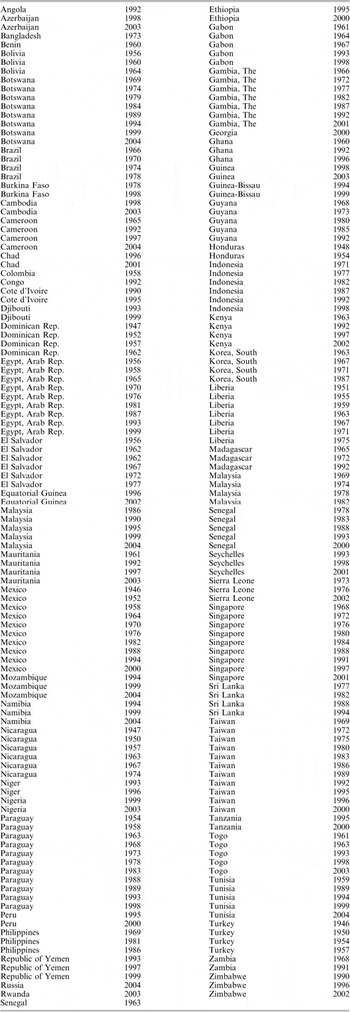
The sample includes 227 elections that were held between 1946 and 2004. These cases are listed in Table 1.
List of Cases Included in Analysis

Of these elections, 159 are presidential elections and 68 are parliamentary. Sub-Saharan Africa is the source of approximately 40 per cent of the observations while Latin America is the region with the next largest share with a quarter. Consistent with the increasing number of hegemonic parties shown earlier in Figure 1, over half of all elections in the sample occurred after 1980.Footnote 40
Defectors must have been members of the hegemonic party in order to be considered as such. Departure from the party must be voluntary. Expulsion from the party is not coded as a defection, because in such cases, the member no longer has a choice over leaving.Footnote 41 Departure from the party must occur between two elections or, in the country’s first multi-party election, after elections have been called or parties have been made legal. This latter rule is devised to address situations in which a single-party dominated politics for so long that anyone involved in politics and competing in the first (or subsequent) elections had to have been a member of the single party at some time in the past. In these cases, prior membership in the party is not a sufficient criterion for discerning defection. Finally, we assume that once a member leaves a party, he cannot return. So if any member runs in more than one election, it is not possible for the individual to be a defector in all elections subsequent to the one for which he may be a defector. Our measure of defection is dichotomous, coded 1 if there is a defection for a given election year and 0 if there is not. Since our measure of defection only taps high-level defections – instances in which a defector leaves to challenge for executive office – there are very few instances of multiple defections in the same year. Of the forty-two elections in which defection occurred, only in four did two defectors present themselves as candidates in the same election. There are no cases in which more than two defectors contested the same election.
Our main independent variable of interest is economic growth. Our primary measure of this is average growth in gross domestic product (GDP) for the period beginning with the year of the previous election in the hegemonic party regime and ending with the year prior to the election at hand. For those cases in which there is no prior election, the period begins five years before the election at hand. With this variable we seek to test our primary hypothesis that defection is more likely in relatively hard economic times: Average Growth should have a negative sign.Footnote 42
According to modernization accounts, voters will be more likely to make ideological investments in opposition candidates and/or value political competition in its own right as the level of economic development increases. Therefore, we also control for real GDP/capita. Higher levels of development may be associated with more defections.
We include a number of analytic control variables to capture the actions that regimes may take in order to deter elite departures from the party. As a proxy measure of the repressiveness of the regime, we include the POLITY measure of regime type, which varies considerably across our sample of hegemonic party regimes.Footnote 43 Higher POLITY scores indicate less repressive/more open regimes, so Polity should have a positive effect on defections. As a proxy measure of the resources that authoritarian leaders may have at their disposal, Rents is included as a control variable. It is a five-point scale variable measuring the value of exports from fuel, minerals and/or ores as a percentage of GDP. As Rents increase, defection should be less likely, since these autocrats have more resources to co-opt elites.
We also include several indicators of the regime’s perceived electoral vulnerability. Potential elite defectors should be less prone to defect when the perceived chances of defeating the regime or even making a respectable showing at the polls are slim. This perception is likely to be influenced by how well the regime was able to obtain support in previous elections – whether by genuine appeals, manipulation or fraud. Therefore, we control for the vote share of the regime candidate/party in the previous election with a variable called Previous Vote.Footnote 44 The variable’s coefficient should have a negative sign. In addition, elites may be in a good position to gauge the electoral position of the regime prior to an election. Therefore, we also control for the vote share of the regime in the election at hand: Vote share.
Our control for the incumbency status of the regime candidate is related to this. Dictatorships, in general, are vulnerable around the issue of succession, since they usually lack regular, institutional mechanisms for the alternation of power.Footnote 45 Potential defectors may be emboldened to run when an incumbent leader steps down, leaving a new, untested designate to run as the regime’s candidate. The variable Incumbency is coded 1 if the incumbent leader is running in the election, 0 otherwise and is expected to have a negative effect on departures from the ruling party.
Potential defectors, like any prospective electoral candidates, need to consider not only the regime, but also the strategies of the extant opposition. In particular, the number of other challengers affects the entry decision of potential candidates.Footnote 46 Highly fractionalized oppositions may be more conducive to defector entry than are highly united opposition forces. We measure the fragmentation of the opposition by dividing the vote share of the first opposition party by the sum of the vote share of all opposition parties, p 1/∑pi where p is the vote share received by the ith opposition party. This measure returns a value of 1 when there is only one opposition party, indicating a united opposition. This variable, Opposition Strength, should have a negative impact on defection.
We also include a number of other control variables related to the institutional environment surrounding the election. We control for the age of the party since the capacity of hegemonic parties to deter defection may increase with age. Older hegemonic parties may have more developed organizational and institutional capacity to ensure elite loyalty through the efficient distribution of patronage, making them appear more invincible. However, long-lived hegemonic parties may elicit more defectors than young ones because they are unable to pass the buck for any given malady. Whatever the relationship, we include a continuous measure in years of the length of time that the hegemonic party has held office: Age of Party.
A dummy variable, First Elections, indicates whether the election is the first multi-party election held under the hegemonic party after a period of single-party rule. Defections should be more likely when the opportunity to oppose the regime in elections emerges for the first time. We also control for the type of election (i.e., presidential or legislative) which determines the chief executive with a dichotomous variable called Indirect Elections. This variable takes the value of 1 when legislative elections determine the identity of the chief executive (i.e., the prime minister) or when the legislature votes for the president, and 0 for direct presidential elections.
Some countries may simply be characterized by more fractious political environments that engender constant defections from the ruling party. Therefore, we include a dichotomous variable, Past Defections, which takes a value of 1 if the party has experienced a defection at some time in the past.
Finally, since many of our cases come from Sub-Saharan Africa, we include a dummy for the region, Sub-Saharan Africa.
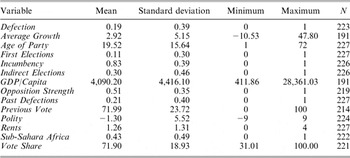
Table 2 provides descriptive statistics for all the variables used in the analysis. Within the sample, there are forty-two instances of defection. Due to the dichotomous nature of this variable, we estimate the effect of economic growth on defection using logit models. Variance in the error structure may be attributable to non-observable, party-specific factors that make defections more likely in some hegemonic party regimes. Therefore, we cluster robust standard errors on hegemonic party. Clustered standard errors take into account unit heterogeneity in the error structure and, along with it, the most likely source of serial correlation in our data.Footnote 47
Descriptive Statistics of Variables in Analysis

Note: See text for definition of variables.
Results
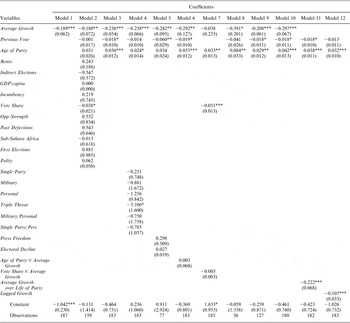
The results from the models show strong support for our hypothesis about the effect of economic performance on defection. The first column of Table 3 shows the results of a binary model that includes only the primary independent variable of interest. Average Growth rates over the most recent election cycle have a significantly negative impact on defection. When short-term economic performance has been good, elites are less likely to leave the ruling party. As subsequent models show, this result is remarkably robust to the inclusion of numerous controls.
Effect of Economic Growth on Defection from Hegemonic Parties

Note: Robust standard errors in parentheses (clustered by hegemonic party) ***p < 0.01, **p < 0.05, *p < 0.1.
Model 2 shows the impact of economic performance on the likelihood of defection after the battery of control variables discussed above has been included. The effect of economic performance remains robust. Most of the other control variables are statistically insignificant with some exceptions. The negative and statistically significant impact of Vote Share implies that if party members anticipate a strong incumbent showing, they are less likely to defect.Footnote 48 Age of Party approaches statistical significance. Older parties may be more likely to experience defection.
Other control variables in this model exhibit no effects significantly different from zero. Whether elections to the chief executive position are direct or indirect does not influence the likelihood of defection. In addition, the possibility of splits in the ruling party appears not to be influenced by issues of succession, as indicated by the results on Incumbency. The availability of Rents has no deterrent effect on departures from the hegemonic party. The level of development also appears not to matter, as signified by the insignificant coefficient on GDP/capita. Neither the strategies of the opposition nor the pattern of past defections from the party appear to influence possible defectors. First Elections is also insignificant, indicating that defections are not more likely in multiparty elections after a spell of single-party rule or no elections.Footnote 49 Finally, no variation in defection is explained by regional differences.Footnote 50
Model 3, then, is our reduced-form model, including only those control variables that approach conventional levels of statistical significance. In order to maximize efficiency and the number of observations, the succeeding models include these controls in addition to whatever other control variable or robustness check is of relevance for the model.
In Model 4, we control for the typology of authoritarian regime type developed by Geddes.Footnote 51 This three-fold classification of regime type (Single Party, Personalist and Military) has been widely employed in the literature. We include dummies for Geddes’s pure regime categories as well as the hybrid categories. We expected that single-party regimes and their associated hybrids would be more likely to deter defection because of the strength of their institutional bonds.Footnote 52 Yet the results show that the type of dictatorship has no independent impact on the likelihood of defection.
We introduce additional control variables in Model 5 to proxy some of the concepts that we attempted to capture with our original list of controls. Instead of Polity (which was statistically insignificant), we proxy the predilection of the regime to use repression by including Press Freedom, a scale ranging from 1 to 4 measuring the extent to which the press is controlled or censored by the government. Higher values indicate more government control of the media. Press Freedom should exhibit a negative effect on the likelihood of defection.Footnote 53 Instead of Previous Vote as a proxy for the regime’s perceived electoral vulnerability, we look at the change in the vote share of the regime candidate over time. Electoral Decline is the sum of the regime candidate’s difference in vote total for the previous two elections. For example, if Candidate A wins 70 per cent in election t, 50 per cent in election t + 1, and 60 per cent in election t + 2, Electoral Decline in t + 2 is (70–50) + (50–60) = 10. Since positive values indicate net vote decreases for the incumbent, Electoral Decline should be negatively correlated with defections. We include these two proxies in a separate model, because they significantly reduce the size of our sample (from 187 to 77 observations).
Model 6 interacts economic growth with the age of the party to determine whether the effect of the former is conditional on the length of time the party has been in power. The statistically insignificant coefficient on the interaction term indicates that the effect of growth does not vary with the age of the party. Instead, as an examination of the conditional coefficients from this model indicates, the substantive and statistical significance of Average Growth is unchanged across different thresholds of party duration. In other words, poor economic performance induces defections from hegemonic parties at the same rate in both young and old hegemonic parties. This result provides an empirical justification for not using a durability criterion in our definition of hegemonic parties.
Model 7 allows Vote Share to interact with Average Growth in order to test whether the effect of the latter is conditioned by the level of electoral dominance that the regime enjoys. The insignificant coefficient on the interaction term indicates that this is not the case. Average Growth’s effect on the probability of defection does not change across different levels of party hegemony. A look at the conditional coefficients for this interaction term confirms that the effect of economic performance on defection does not depend on the amount of votes that the party wins. Economic growth discourages defections both in those regimes that enjoy a strong electoral position and in those that are barely winning a majority of legislative seats. This provides some empirical justification for the 50 per cent threshold used in identifying hegemonic parties.
Models 8 and 9 show separate results for parliamentary and presidential regimes, respectively. The number of observations is reduced significantly in the sub-samples. Economic growth appears to have a substantial and significant impact on defection in presidential regimes, while the effect is not statistically significant in parliamentary regimes. While possibly an artefact of the low number of observations in the parliamentary sub-sample, this result also may have substantive foundations: growth’s effect on defections may be more volatile in parliamentary regimes due to the difficulty that voters have in assigning responsibility for economic performance in parliamentary regimes as compared to presidential regimes. Voters are more likely to reward/punish incumbents when they can accurately assign responsibility for economic outcomes.Footnote 54 In turn, voters in presidential elections are more likely to hold incumbents accountable for the economy than in parliamentary regimes, since, under the latter, legislatures can remove executives from office between elections, allowing those responsible for the performance of the economy to escape the judgement of voters.Footnote 55 While these claims concern voters in democracies, they may also be relevant for economic voting in non-democracies even if the possibility of incumbents losing is remote. Voters in non-democratic elections may either believe (incorrectly) that alternation in power is possible or want to signal their unhappiness with incumbent performance. That accountability is obfuscated in these systems, then, may deter potential defectors from exiting, since they anticipate that voters cannot judge the incumbent’s record clearly.
Average Growth contains several extreme values. To ensure that our results are robust to possible outliers, we examined the Cook’s D values and dropped four influential observations. The results in Model 10 show that our results remain substantively unchanged after dropping these observations. We also made sure that our results were robust after dropping the observations with the five highest and five lowest values of economic growth.
Finally, Models 11 and 12 show that the substantive results concerning the effect of growth on the likelihood of defection are robust to different measures of our primary independent variable of interest. Model 11 includes the average growth rate over the entire life of the party (Average Growth over Life of Party). More specifically, it is the average annual growth rate of real GDP per capita for the period beginning with the hegemonic party’s initial year in power and ending with the year prior to the election at hand. Alternatively, Model 12 includes Lagged Growth, or the growth rate of real GDP per capita during the previous year. Both models show that the length of time over which growth is measured does not affect the negative impact that good economic performance has on the likelihood of defection.
Clearly, the most important results to emerge from the models are the negative coefficients on Average Growth. Other results worth considering are the finding that less ‘autocratic’ regimes are more likely to experience defections, and that, even when controlling for regime openness, older parties are more likely to experience defections. This result may shed some empirical light on a tension in the literature between those who would imply that the institutional bonds of the party grow with timeFootnote 56 and those who point to dominant parties’ tendency to become sclerotic in their old age.Footnote 57 Our finding suggests that these coalitions may become more fractious over time even after controlling for their vote share.
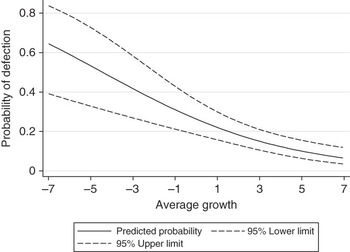
The impact of growth on the likelihood of defection also can be seen graphically in Figure 2, which shows the predicted probability of defection in Model 3 as other control variables are held at their sample means and Average Growth is varied across its range.
Effect of growth on the predicted probability of defection

When growth is positive, the predicted probability of defection is very low with a small confidence interval. In cases of negative average growth, the probability of splits in the hegemonic party increases, but the confidence interval in this range widens considerably. It seems that the economic record of incumbents need not be stellar. As long as authoritarian incumbents do not preside over either economic catastrophes or long periods of decline, they need not worry about the departure of members.
The results indicate that economic growth has a consistent effect on the likelihood that regime elites will desert hegemonic parties. In addition, it seems that potential defectors do not anticipate that more prosperous voters will make ‘ideological investments’ in the opposition. When growth of the economy is high, voters are likely to be content with the status quo. Observing this, members of the hegemonic party have few incentives to leave and challenge incumbents in elections.Footnote 58
Crisis and defection in Turkey and Zimbabwe
We now turn to a more in-depth analysis of the relationship between economic performance and defection under two important hegemonic parties, the Democratic Party in Turkey and ZANU-PF in Zimbabwe. Given that the purpose of the cases is to probe deeper into an already established and well-generalized cross-case relationship, it is entirely appropriate to select cases on values of both the independent and dependent variable.Footnote 59 Therefore, the cases chosen are ones in which the hegemonic party suffered a defection in the face of a mounting economic crisis. The two cases contextualize our theory, demonstrating that it has resonance in the real world of authoritarian politics from the more and less distant past. We also examine the possibility that policy and/or personal differences are behind the observed relationship between economic performance and defection. While the historical evidence does not allow us to completely rule out the role of policy and/or personal disputes in motivating defections, the strong temporal link between economic decline and departures from the regime party in both cases is suggestive. The sequential nature of events also casts doubt on the possibility of a reverse causal relationship in which defections affect the macroeconomic situation.
The First Turkish Republic: Defection of the Freedom Party
From 1923 until 1946, Turkey was a single-party state ruled by the Kemalist People’s Republican Party (CHP). Party and state were tightly fused in this period and opposition parties were banned. In 1946, the CHP permitted other political parties to organize, holding Turkey’s first multi-party elections in July of that year.Footnote 60 One of the first opposition parties to emerge was the Democratic Party (DP), founded in that year by a prominent group of CHP ministers and parliamentarians.Footnote 61 In the elections of 1950, the DP won easily, taking 416 out of 487 seats in parliament.
While the elections did bring alternation in office, the new DP government did little to further political liberalization. Despite its campaign promises to expunge anti-democratic statutes from Turkey’s legislation, the party quickly dropped this agenda and instead moved to further restrict freedom of expression and opposition.Footnote 62 As early as May 1951, the party promulgated a decree expanding the state’s control over the press. In July of the same year, the party moved to liquidate the assets of its main rival (the CHP).Footnote 63 Two years later in June 1953, the DP lashed out against another opposition party, the Nation party, at first banning it temporarily and then permanently closing it down. Further restrictions targeted the intelligentsia, as a law was passed in 1953 that banned university professors from engaging in political activity.Footnote 64 In these early years, the party also moved to establish tighter control over the judiciary and restricted the use of various types of campaigning. In sum, the DP demonstrated its willingness and ability to continue (and indeed expand upon) the illiberal tactics of the CHP, alienating many of its initial supporters, including members of the intelligentsia and liberal economic elite.Footnote 65 According to Erogul, ‘The general elections of 2 May 1954 [were] held in a climate where the intelligentsia was increasingly being silenced, the opposition crushed, the population dazzled by continuous foundation laying ceremonies, and where the misleading abundance created by liberal economic policies had not yet turned to crisis’.Footnote 66
The DP won a resounding victory in the 1954 elections capitalizing on the booming economy that had characterized the first four years of its rule.Footnote 67 Bolstered by bumper harvests, increasing public investment in heavy industry and mechanized agriculture and foreign loans, the economy expanded by 21 per cent in 1951, 4 per cent in 1952 and 10 per cent in 1953. However, the inability of production to keep up with investment contributed to spiralling inflation.Footnote 68 This coincided with a drought in the summer of 1954 that led to an exceptionally poor harvest and subsequent grain hoarding.Footnote 69 Moreover, the regime was accruing massive internal and foreign debt and the Central Bank had begun to run a significant deficit balance in its gold and foreign exchange reserves. To make matters worse, a $300 million loan from the United States that the government had been counting on to cover its deficit was cancelled.Footnote 70 Under the weight of these accumulating pressures, the Turkish economy plunged into recession in 1954 with a 12 per cent drop in GDP.Footnote 71
As the economic troubles spilled over into early 1955, opposition to the regime’s policies stiffened. With living standards falling and shortages of foodstuffs becoming common, the opposition stepped up its criticism of the government. Society also began to voice its opposition, for the first time. In September, riots broke out in Istanbul, spurred forward by economic dislocation among migrant workers from the countryside. By summer 1955, signs of discord emerged within DP party ranks. A liberal faction within the party began to voice its opposition to statist economic policies and the restriction of political freedoms.Footnote 72 Of particular prominence in this liberal faction, were nineteen parliamentary deputies led by former diplomat and interior minister, Fevzi Karaosmanoglu, and former minister of the economy, Fethi Celikbas. Celikbas was a known economic liberal who had long argued for a free market approach to economic development. In the fall of 1955, this ‘group of nineteen’ introduced a draft bill that would grant newspapers the right to bring evidence against government officials accused of corruption.Footnote 73 Unsurprisingly, the DP leadership opposed the bill and threatened to expel its co-sponsors for breaking party ranks. At the October party conference, the leadership followed through on its threat, expelling nine of the ‘nineteen’. In response, the other ten resigned from the party. In the following weeks, up to a dozen other deputies joined the defectors and turned in their party cards.Footnote 74 In December 1955, these thirty former DP deputies formally established the Freedom party to contest the upcoming elections. The party’s support base was primarily among liberals and intellectuals, former supporters of the DP.Footnote 75
Although historical accounts agree that the proximate cause for the deputies’ defection was their dissatisfaction with the restrictiveness of the press law, it must be noted that they only acted on their dissatisfaction as the Turkish economy faltered. Indeed, the press law amendment that left liberal deputies disenchanted was enacted in 1951 and, to our knowledge, remained unchanged thereafter. We acknowledge that DP loyalists in this period were increasingly disenchanted with the authoritarianism of the DP but we also emphasize that the DP had consistently demonstrated its non-democratic tendencies in the period from 1951 until 1954, introducing draconian amendments to the aforementioned press law, the penal code and legislation on the rights of the opposition.Footnote 76 And yet, crucially, during this early period, when the economy was expanding and incomes rising, the historical record reveals no prominent instances of internal party discord, and no rebellion on the scale seen in 1955. Furthermore, the possibility of an endogenous relationship between economic growth and defection can be ruled out in this case. Exogenous factors (such as the poor harvest in 1954 and the United States’ refusal to grant Turkey an additional $300 million in aid), combined with the Turkish government’s mismanagement of macroeconomic policy, put the economy in crisis mode well before the first signs of discord emerged in the ranks if the DP.
2008 Zimbabwe: Defection of Simba Makoni
Since independence in 1980, Zimbabwe has been ruled by President Robert Mugabe and ZANU-PF.Footnote 77 Originally chosen by the legislature, the president was selected through direct suffrage for the first time in 1990. Mugabe won this election easily and the following one in 1996 with 83 and 93 per cent of the vote, respectively.Footnote 78 He faced a greater challenge in the 2002 election in the form of the Movement for Democratic Change (MDC). A coalition of human rights, trade and student organizations, spearheaded by the Zimbabwe Congress of Trade Unions (ZCTU), the MDC formed in 1999 with the goal of pressuring Mugabe and ZANU-PF to enact political and economic reforms. Having captured 47 per cent of votes in the 2000 Assembly elections, the MDC and its candidate for the presidency, Morgan Tsvangirai, posed a strong threat to Mugabe and ZANU-PF.
To meet this challenge, Mugabe and ZANU-PF resorted to a variety of tactics. Just weeks before the 2002 election, the government enacted a repressive media law and suspended international missions to observe the elections. The regime also sought to mobilize support through a variety of economic measures, notably the intensification of land seizures. Implemented as early as 2000 to combat the growing popularity of the MDC, the government’s programme to expropriate white-owned commercial farms for redistribution to landless supporters was a clear bid to play on nationalist sentiment. These pre-electoral policies helped Mugabe secure victory, although with a much smaller share than in the past (only 56 per cent).
These policies, however, also set the stage for economic crisis. As worsening food shortages threatened famine, the government declared a state of emergency, blaming drought. Yet the transformation of Zimbabwe from a net food exporter to a desperate recipient of food aid was due to the disruption in agriculture resulting from the land seizures.Footnote 79 In July 2005, the government embarked on Operation Murambatsvina to eliminate illegal dwellings and informal economic activity by bulldozing several shantytowns surrounding Harare.Footnote 80 Designed to intimidate potential MDC supporters, the project deprived several thousand urban residents of their livelihoods. In addition, in 2007 the government prepared legislation that would force foreign-owned companies to transfer majority shareholdings to local interests.Footnote 81 Similar in spirit to the land seizures, the proposal had a chilling effect on investment. The cumulative results of these measures were evident in hyperinflation of 66,000 per cent, unemployment of 80 per cent and a formal economy contracting by 65 per cent, so that just three months before the election Zimbabwe had the world’s fastest shrinking peacetime economy.Footnote 82
In February 2008, Simba Makoni, a ZANU-PF Politburo member, declared that he would stand as a candidate in the elections. Makoni previously had served in various governments under Mugabe. When the first post-independence government was formed, Makoni was named deputy minister of agriculture. Over the next four years, he served as minister of energy and then minister of youth before abruptly leaving government. His departure was seen as a consequence of his attempts to reform and modernize government. Coming from a generation that came after Mugabe’s, Makoni was seen as ‘too clever and too young for the older members of the party. They wanted him out of the way’.Footnote 83 Makoni returned to government when Mugabe made use of him as finance minister in 2000. The economy already was exhibiting signs of crisis as foreign reserves ran low, debt mounted, unemployment grew and investor confidence declined. Brought in to restore Zimbabwe’s image with donors and investors, Makoni quickly embraced measures to liberalize the economy. In his zeal, however, he clashed directly with Mugabe, who worried about the political costs of economic reforms. As a result, Makoni commanded much respect among the business community and those outside of ZANU-PF, but fell out of favour with the president.
Upon launching his candidacy, Makoni immediately mounted a platform centred on improving economic conditions, and in a bid to widen his appeal, he made the argument that solving Zimbabwe’s economic crisis was the focus of his platform: ‘I also share the widely-held view that these hardships are a result of failure of national leadership and that change at that level is a prerequisite for change at other levels of national endeavour.’Footnote 84 Makoni’s message attracted support not only from the poor, but also from middle-class professionals who were hurt by declining living standards.Footnote 85 Perceiving that Makoni could mount a credible challenge, a group of ZANU-PF members rallied around Makoni ‘in the biggest rebellion against the Zimbabwean leader [Mugabe] in decades.’Footnote 86
Ultimately, Makoni polled many fewer votes in comparison to the incumbent, Mugabe, and the primary opposition candidate, Tsvangirai. Yet his departure from ZANU-PF raised expectations for the first time in the country’s electoral history that Mugabe might soon be retired from power. Makoni’s campaign against Mugabe on the basis of an economic platform is noteworthy for three reasons. First, despite his membership in the ruling apparatus, which was responsible for the economic calamity, Makoni carved out a reputation as someone who consistently advocated economic liberalization even at great cost to his own personal ambitions. That Mugabe did not heed his advice and Zimbabwe landed in such dire straits only seemed to confirm that Makoni potentially had solutions to the crisis. As one voter observed: ‘I like Makoni because he has demonstrated in the past that given a chance he can run the economy efficiently’.Footnote 87
Secondly, if policy disagreements and/or career ambitions were the only motivating factor for defections from the hegemonic party, then Makoni should have left ZANU-PF long before February 2008. Policy disagreements with Mugabe, culminating in his termination as finance minister in 2002, did not lead Makoni to leave ZANU-PF until the 2008 election – the moment when he could take advantage of the deepening economic crisis to make anti-incumbent appeals and to trumpet his own experience as a reformer. While policy and personal disagreements as motives are not inconceivable, they were acted upon only when the state of the economy provided a propitious moment.
Finally, the sequence of events between 2002 and 2008 clearly illustrates that the correlation between economic performance and departures from the regime party run in one direction. Coming after almost a decade of poor economic policies and lack of investor confidence, Makoni’s defection is the result, not the cause of these patterns.
Conclusion
Until the fall of the Soviet Union, single-party dictatorships were thought to be invincible due to the co-optive and repressive capacity of the regime party. Hegemonic party regimes share some of the characteristics of single-party states, yet they differ in two key respects: the holding of elections and the presence of opposition parties. While these institutions are likely to be designed to help authoritarian rulers stay in power, they also carry risks for incumbents. The greatest dangers appear to stem not from extant opposition forces, but rather from elites within the regime party who weigh the costs and benefits of staying within the fold.
Two important components of elite calculations are voters and the economy. Regime elites know that they must maintain the acquiescence, if not active support, of citizens. When the economy performs poorly, this social contract is in danger, but, even in economic hard times, mass uprising against the regime is unlikely; first, citizens acting on their own face collective action problems; and secondly, the regime’s ability to repress is likely to deter any political entrepreneurs from organizing the masses. By contrast, elites do have a way of reaching ordinary citizens and gathering their support; it is through elections rather than through militancy on the street.
When incomes decline, regime elites have the opportunity to defect from the hegemonic party and to challenge incumbents in elections. The economy provides an issue around which defectors can mobilize support that may cut across other social cleavages. Defectors anticipate that voters will want to punish incumbents at the polls for poor economic performance. Consistent with this idea, we find evidence that the rate of average growth of per capita income prior to elections has an impact on the likelihood of regime elites defecting from the hegemonic party. Particularly when incomes increase, or even remain the same, the incentives for elites to depart from the regime party are low.
This analysis reveals two important points about these regimes. The first is the way in which the regime’s own institutions – a ruling party and elections that ostensibly are designed to help incumbents survive – can become the means by which the regime unravels. The second is that the robustness of these institutions is not wholly attributable to the endogenous mechanisms of reproduction that scholars have emphasized, but also to exogenous factors that provide elites with incentives to remain loyal to the regime. Magaloni argues that it is the image of invincibility that deters elite splits in these regimes.Footnote 88 By controlling for the percentage of votes won by the regime party, we show that it is more than just this ‘hyper-dominance’ that contributes to elite cohesion. In addition, it is more than the institutional bonds of the party that ensures elite cohesion in these regimes. Indeed, Smith shows that the durability of party regimes relative to other authoritarian subtypes is reduced upon removing a few outliers (Mexico and the Soviet Union) and controlling for economic growth.Footnote 89 So, if it is the case that positive economic growth is required to attract and retain elite allies, the independent influence of dominant party institutions on elite loyalty is called into question.