

In April 1343 Cardinal Annibale da Ceccano (1320–50) gave a reception and feast for Pope Clement VI (1342–52) at his country residence at Sorgues near Avignon which was carefully described in a despatch from a Florentine diplomat, who claimed that ‘the cardinal had spent countless sums of imagination and exertion in organizing novelties to honour the pope’:Footnote 1
There were nine courses of three dishes each, twenty-seven in total.
After the first three courses . . . came as an intermezzo – an enormous castle of game; a huge stag which, although cooked, appeared alive, a wild boar, roe deer, hares and rabbits all cooked while appearing still to live. They were borne by squires who made an entry accompanied by gentlemen with different musical instruments. I believe that the sound of these instruments and the spectators’ shouts of joy could be heard in Avignon.
The ninth course arrived, and as intermezzo one heard the chant of an invisible choir. Voices of all kinds, deep, less deep, mezzo, high and of a sweetness so exquisite that silence descended on the room and attentive listeners silenced tongues, so suave was the sweet melody. As the song finished the plates were cleared.
During the fruit course the cardinal’s head cook arrived with a group of thirty assistants with torches and tinkling little bells after the Roman fashion. They danced gaily in the rooms and three or four times around the tables before leaving.
Finally, once the gentlemen and esquires had removed the tables, the music and song began again. Attracted by different melodies, dancing began in the courtyards and then on the lawns outside. While they were dancing there the company could watch the ballet and the very beautiful dances. A temporary bridge had been thrown across the Sorgue which one could cross to watch the dancing, hear the different instruments and enjoy the sweet melodies and suave voices.Footnote 2
Several marginal observations might be made here: music was customary at feasting in contemporary royal courts, such as that of Edward I.Footnote 3 More importantly, the start of the singing silenced conversation, and for the dances instruments were used.
At the beginning of the period a much briefer account of the papal procession to Saint Peter’s after the coronation of Pope Gregory IX in S. Maria Maggiore in 1227 states: ‘Then the singing burst forth as the people surged into the streets which rang with the Kyrie eleison; Egyptian carpets were strewn on the ground . . . and the clangour of trumpets resounded, competitively shouting encouragements to each other . . . and with childish enthusiasm a shameless Fescennine song was sung.’Footnote 4
These are two papal ceremonial occasions over a century apart: the earlier an open-air procession with the Roman populace exultantly singing in the streets: the other describing an opulent banquet within the livrée of a wealthy Roman cardinal. Both, in their different ways, describe singing and musical instruments, and both are very uncommon, in both length and specificity, in our sources. What happens in between is less precisely documented and mostly concerned with liturgical ceremonies within Roman churches. Among the sources we have are papal inventories, such as that of the papal treasure of 1295, although these are disappointing. Apart from listing a few musical texts, of which more later, the only entry with any relationship among the 1,600+ objects in the papal inventory is no. 384: ‘Item duas imagenes hominum de argento deauratas, unam cum viola et aliam cum urceum in manu.’Footnote 5 Nothing readily comparable survives.
POPES, CARDINALS AND FRIARS
We have several reports of the musical prowess of both popes and cardinals such as Nicholas III (1277–80) or his kinsman the Dominican Latino Malabranca, although they are mostly rather generic. Evidence can come from papal histories or even tomb epitaphs. Much more informative, however, are the descriptions of cardinals and famous mendicant musicians by the Franciscan chronicler Salimbene de Adam, who was himself a competent performer. His chronicle is also a precious source for singing contexts and audiences. Finally, under this heading there are the composer/musicians attached to the familiae of individual cardinals like Richard de Fournival or Amerus, or those soliciting employment or ecclesiastical preferment like Elias Salomon, or those who were already members of the Curia, like Bonaiuto da Casentino.Footnote 6
Ubi papa ibi Roma. In the 106 years between the accession of Innocent III (1198) and the death of Benedict XI (1304) the papacy spent over fifty years outside Rome. This was largely the summer villeggiatura: early in the century south of Rome at Segni, Ferentino or Anagni – later in the century at Orvieto, Viterbo, Rieti or Perugia.Footnote 7 Between 1245 and 1251 and 1272–4 the papacy was at Lyons, in exile or in council. Several popes – including the Frenchmen Urban IV, Clement IV and Martin IV – spent their time in Viterbo, Orvieto and Montefiascone and never visited Rome itself. Yet Rome was an outstandingly polyglot and cosmopolitan society: its patrons, however – to judge from the surviving works of art – were overwhelmingly clerical, male, celibate and highly educated.
First eminent practitioners. The description of Nicholas III Orsini (1278–80) in the Continuatio Romana Brevis, ‘Of the noble Orsini family, handsome of face and character, tall, a fine preacher in the vernacular, a singer with a fine voice, zealous in performance of the sacred mysteries, generous in charity both publicly and in private; he celebrated mass most devoutly and always wept at the canon, and in all his duties made good speed’, is surely a collection of topoi – although one should reflect on the grey eyes of his contemporary portrait in the Sancta Sanctorum.Footnote 8 Remigio de Girolami, a Florentine friar, is much more informative on Cardinal Latino Malabranca (†1294). They probably, as fellow Dominicans, knew each other from the period when Latino was papal legate in Tuscany and lodged at Santa Maria Novella.Footnote 9 In his funeral sermon Remigio stated: ‘in learning he surpassed many who are termed Masters (magistri): in eloquence, in composition, sermon-writing and preaching . . . and also in singing, not only himself, but more in the art of music, even more so in composing singable melodies (in cantabilium cantuum inventione), that is of hymns, sequences, responses and of all the offices’.Footnote 10
Best of all as source is the aristocratic Salimbene de Adam, a Franciscan friar from Parma who wrote one of the greatest of medieval chronicles. His evidence has been often used for French music – surprisingly less for Italy.Footnote 11 Salimbene was a trained singer: his teacher had been the Pisan Fra Enrico, who besides being a skilled manuscript illuminator could
compose the most beautiful and delectable chants, both artistically formed, that is rhythmicized, and plainchant. He was a splendid singer with a large, sonorous voice that filled the whole apse. He had a subtle falsetto, high and focused, yet sweet and attractive beyond measure. He was my warden in Siena and my singing-master in the time of Pope Gregory IX . . . He also set to music verses of Philip the Chancellor.Footnote 12
He was Salimbene’s teacher as a young friar at Pisa during the pontificate of Gregory IX (1227–41):
When Thomas of Capua, who was at cardinal at the Curia and the best stylist of the Curia, composed the sequence Virgo parens gaudeat and asked Brother Enrico of Pisa to set it to music – which he did, with a beautiful melody which it was delightful to hear . . . Also in honour of the blessed Francis he made the hymn In celesti collegio and another hymn, Decus morum, and the responsory Carnis spicam. And similarly he made that sequence of the blessed Virgin Virgo parens gaudeat, but just the words. The melody, however, at his request was made by Brother Enrico of Pisa, who was my warden and master in chant. Brother Vita of Lucca of the Franciscan Order, who also taught me music, wrote a melody against it (contracantus).Footnote 13
Several of Thomas’s surviving hymns have a strong Franciscan element, and he was regarded in his lifetime as the pre-eminent literary stylist at the Curia.Footnote 14 It may be that their high curial rank has been significant in the identification of these curial authors.
Salimbene knew and praised other distinguished Franciscan singers including Fra Vita of Lucca, the finest singer in the world in both types of chant, plain and diminished (‘melior cantor de mundo tempore suo in utroque cantu, scilicet firmo et fracto’) who sang before bishops, cardinals and popes. The nightingale stopped singing to listen to him, and Vita was very apologetic when a cold or some other ailment prevented him from singing his best. Yet he could expertly silence interrupters with a stern biblical quotation drawn from Ecclus. 32:5: ‘Non impedias musicum.’Footnote 15 All this singing of sacred music appears to have been unaccompanied.
While much of this is well known, other aspects of the Cronica have been somewhat ignored. The well-connected Salimbene knew several cardinals personally and his considerable familiarity with the Roman Curia has been rather overlooked. He guided the future cardinal Giacomo Colonna, when he was a student at Bologna, around the churches of Ravenna.Footnote 16 Elsewhere he provides interesting information about Cardinal Enrico da Susa, the pre-eminent canonist universally known as Hostiensis and his interest in Franciscan hymnody and musical arrangement, together with one fascinating comment on performance. The cardinal
was a great expert in chant and literature, and a man of honest and holy life. When once accosted for a tip by an itinerant musician who played the vielle in his presence he replied: ‘If you need to eat I give to you freely for the love of God: for your singing and playing I shall give you nothing, since I know that I can sing and play the vielle as well as you.’ . . . And since he was a good singer and a good cleric, and he liked the Alleluia of the blessed Francis, that is O patriarcha pauperum, he wanted to transform it, using the same melody, into a chant in honour of the glorious Virgin, writing the verse: ‘O consolatrix pauperum / Maria tuis precibus / auge tuorum numerum / in caritate Christi! / Quos tu de mortis manibus, / per filium humilimum, / mater, eripuisti.’Footnote 17
This suggests at least that instrumental proficiency was not just confined to the professional minstrel. It also marks a considerable shift of sensibility from the earlier condemnatory statements of Peter the Chanter and his disciple, the English cardinal Robert de Courson, about employing minstrels. It was licit to employ musicians so long as their music was not scurrilous or effeminate and liable to corrupt the young. If they played permissible works, that was useful to the church. But a priest who allowed them to perform inappropriate songs in church risked the leprosy of simony.Footnote 18
CARDINALS AND MUSIC
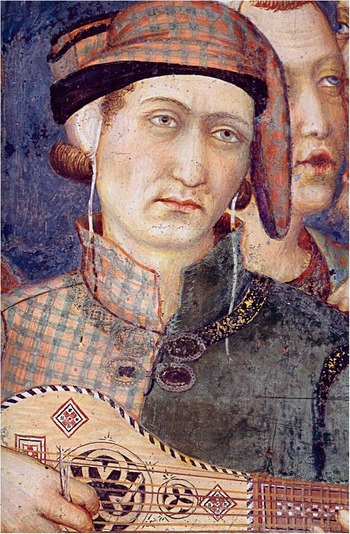
The follow-up on this is as much prosopographical as practical. ‘Cathedralism’ as an ontology is surely inapplicable in thirteenth-century Rome, where ‘modern’ churches were in a tiny minority, the Franciscans and Dominicans alone completing new churches by the end of the century.Footnote 19 The number of musical manuscripts directly linked to individual cardinals is very small. The well-known manuscript Assisi 695, a choirbook given by Cardinal Matteo Rosso Orsini, sometime Cardinal Protector of the Franciscan Order, to the library of San Franceso Assisi, is an exception.Footnote 20 The manuscript was not new when it was acquired by Matteo Rosso and was probably made for a religious of the archdiocese of Reims in the first half of the thirteenth century: it was subsequently mutilated. Matteo probably bought it – he was never, as were several Roman thirteenth-century cardinals, a canon of Reims cathedral.Footnote 21 Its possession implies a considerable musical knowledge. Many cardinals had studied at Paris, and two Franciscan cardinals, Matteo d’Aquasparta and Gentile da Montefiore, had served as regent masters there.Footnote 22 But perhaps the Parisian experience was more important than attending the University. Matteo gave several books with music including a pontifical and a psalter to the convent of his native Todi.Footnote 23 Gentile’s familia may well have contained music enthusiasts, if the frescoes in his tomb chapel at Assisi are anything to go by (see Figure 1).Footnote 24 It has been plausibly claimed that the two musicians who play the double flute and the mandora are in fact accompanying a three-part motet sung by the trio standing behind them. In the later scene of the series, the Funeral of St Martin, two friars are evidently singing a portion of the burial liturgy, a brilliant adaptation musically and iconographically from the motif of the singing friars in the Saint Francis Legend in the Upper Church, a cycle Simone demonstrably studied and used.Footnote 25 Cardinal Gentile, it should of course be borne in mind, had died at Lucca in October 1311 on a mission to transport part of the papal treasure from Italy to Avignon.Footnote 26 The frescoes were certainly painted some years after his death and may, in important respects, reflect the wishes of his unknown executors rather than those of Gentile himself.
Simone Martini, A Musician. Detail of The Investiture of Saint Martin, Chapel of Cardinal Gentile da Montefiore, Lower Church, San Francesco, Assisi (after) Leone de Castris

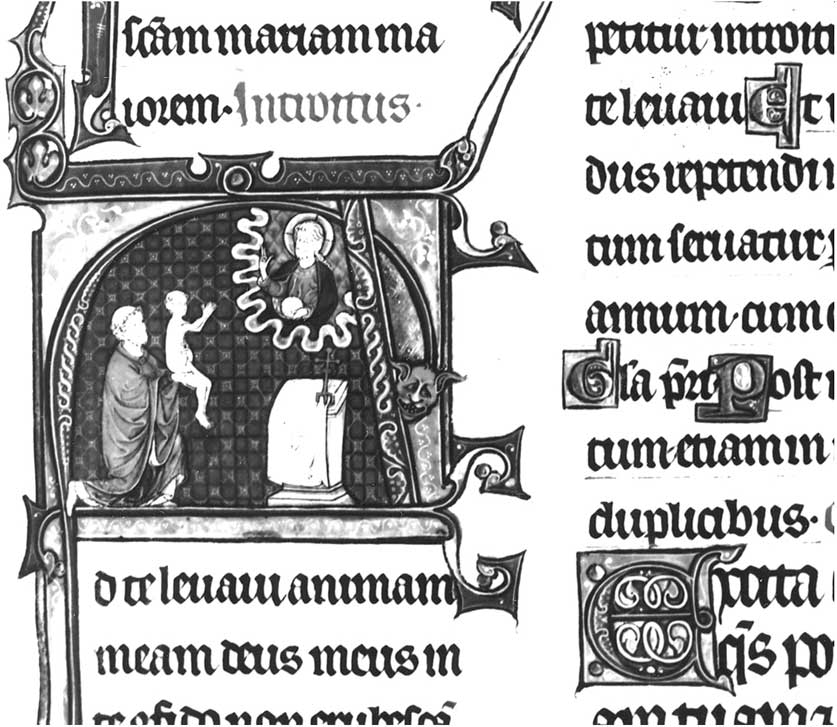
Cardinal Gonzalez Gudiel, a Castilian, owned anonymous works on music, simply listed in his inventory as opera de musica, but also a copy of Boethius’s De institutione musica.Footnote 27 The awe-inspiring library assembled by Boniface VIII (1294–1303) and his predecessors did, however, contain a considerable number of music books.Footnote 28 Of the seventy-odd liturgical books listed in the 1295 library inventory some half contained music.Footnote 29 Most interesting, perhaps, are two motet books connected with Notre-Dame in Paris, which Boniface, as Cardinal Benedetto Caetani, had certainly visited during his turbulent legation with Cardinal Gerardo Bianchi in 1290/1291. They are: ‘Item a book of conductus, proses and motets notated in organum with many lines and notes which begins on the first page viderunt’ and ‘a small book similar to the foregoing with chant’.Footnote 30Viderunt was, of course, Perotin’s great organum quadruplum.Footnote 31 Another substantial fragment of Notre-Dame music with texts by Philip the Chancellor has surfaced at Santa Sabina, mother house of the Roman Dominicans.Footnote 32 There may be a reason for this, since its titular cardinal between 1244 and 1263 was the Dominican Hugues de Saint-Cher, who had been a teacher at the University of Paris.Footnote 33 Equally it is perhaps not coincidental that the Parisian book-painting ateliers most closely associated with the production of musical manuscripts also produced an epistolary and a missal for Cardinal Jean Cholet before 1292. A splendid Missal which incorporates recent changes to the Roman liturgy is in the Chapter Library at Padua (see Figure 2).Footnote 34 Cholet was commissioning important service books in Paris when he was titular of Santa Cecilia in Trastevere, which was then being decorated by Pietro Cavallini.Footnote 35
Missal of Cardinal Jean Cholet. Padua, Biblioteca Capitolare, MS D 34, fol. 8r. Photo author

MUSICIANS IN THE SERVICE OF CARDINALS
Several musicians served in cardinals’ entourages. One was the trouvère Richard de Fournival (1201–60): his day-job was probably that of physician, but he was also chaplain in the familia of the English cardinal Robert of Somercote, who died in Rome in 1241.Footnote 36 Some twenty-two songs by him have survived. Richard was a canon and finally (by 1246) Chancellor of the cathedral of Amiens. His celebrated library list, the Biblionomia, mentions five books on music – Boethius’s liber musice, Augustine’s liber de arte musica, Guido Augensis’s liber de musica, Milo’s Liber consonantiarum and Guido d’Arezzo’s mycrologus et tonale. (It also housed 125 books on medicine).Footnote 37 Richard was the author of the widely popular Bestiaire d’Amour, where he remarks: ‘And those who have read and understood the high philosophies know well what the powers of music are. It is evident to them that in all things that exist there is no order as perfect or as exquisite as in song.’Footnote 38
The Englishman Amerus/Aluredus was in the familia of the great cardinal Ottobuono Fieschi, nephew of Innocent IV and legate in England between October 1265 and July 1268.Footnote 39 Ottobuono was an enthusiast for England and had an elegant new seal matrix engraved there during his legation.Footnote 40 His may well have had a music-loving entourage, for it also included Bonifazio, cantor of Verona – and thus he had both a musicus and a cantor.Footnote 41 Bonifazio subsequently wrote a poem about Cardinal Guillaume de Bray, whose tomb in S. Domenico at Orvieto was executed by the curial tomb-mason Arnolfo di Cambio, and where Guillaume’s musical interests are alluded to in his epitaph.Footnote 42 Ottobuono’s chaplain was Campano da Novara, the foremost mathematician of his age, who participated in the scientific coterie which included the Polish scientist Witelo at the papal curia in Viterbo.Footnote 43 Amerus/Aluredus composed his Pratica artis musicae in the household of Ottobuono Fieschi, Cardinal deacon of S. Adriano, in 1271 when the curia was at Viterbo.Footnote 44 For him ‘Musica est domina et regina omnium liberalium artium excelentissima . . .’, ‘The most excellent lady and queen of all the liberal arts’. One hint of Englishness, in addition to the purely English term ‘proprius cantus’ for the natural hexachord, is perhaps the mention of sailors singing sea-shanties during a storm.Footnote 45
MUSICIANS
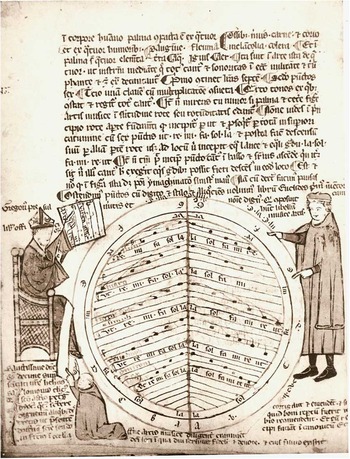
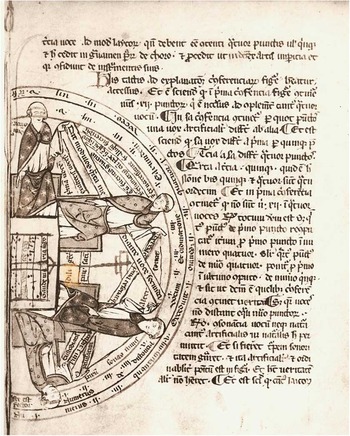
If cardinals were themselves patrons of musicians and music, can one also speak of musicians using their music in search of patronage? That musical knowledge was a viable road to ecclesiastical preferment is demonstrated by the elaborately decorated codex of his own Scientia artis musicae which Elias Salomon presented to Gregory X, identified as ‘Gregorius presul’, apparently in 1274 at the Council of Lyons.Footnote 46 Elias was a priest from Saint-Astier in the diocese of Périgueux. On fol. 4r of his manuscript Elias is represented kneeling at the foot of Gregory’s throne (see Figure 3). The treatise, which takes a studiedly conservative, if sharp-tongued, approach to chant, was particularly appropriate for a pope who had chosen the name of Gregory. Elias, a former curialist, presented the autograph manuscript to the pope at Lyons: the initiative was successful, and he was rewarded with a canonry at Saint-Astier in his native Périgord.Footnote 47 The Ambrosiana manuscript itself is a rare example of a French non-liturgical illuminated manuscript personally presented to a pope. It was evidently found to be useful, for a reader to whom Gregory had referred it made the marginal annotation ‘in ipso satis utilitatis reperi’. On fol. 17v plainchant is described as ‘bene ordinatum per angelos et per sanctos prophetas et per beatum Gregorium’: admirably ordered by the angels, the holy prophets and by saint Gregory. Elias was harshly critical of falsa musica (unwritten accidentals): ‘Falsa musica nihil aliud est, quam falsus musicus falsa mugiens’; falsa musica is nothing other than ‘an untrustworthy musician bellowing errors’.Footnote 48 He was very likely aware that such conservative doctrines would be well received in the papal entourage present in Lyons for the Oecumenical Council of 1274. The treatise has several exceptional illuminated pages. The first shows four singers gathered round a choirbook improvising polyphony in parallel organum on a plainsong in front of them (see Figure 4); by 1274 this would have been a very old-fashioned style. Improvised polyphony, not necessarily parallel, was a traditional >feature of Italian liturgical music, though not always clearly documented.Footnote 49 Surprisingly, Elias refers to playing the vielle and recognizes the superior skills of professional musicians. ‘On its five strings all music (cantus) can be made to sound.’Footnote 50 His view of these musicians is markedly at variance with that expressed a few years earlier by the Italian Cardinal Hostiensis, as reported by Salimbene.Footnote 51 Elias was zealous for a sober dignified chant style with extremely conservative enrichment.
Elias Salomon, Scientia artis musicae, dedication page. Milan, Biblioteca Ambrosiana, D.75 inf., fol. 4v. Photo Joseph Dyer

Elias Salomon, Scientia artis musicae, the singing of four-voice parallel organum. Milan, Biblioteca Ambrosiana, D.75 inf., fol. 27. Photo Joseph Dyer

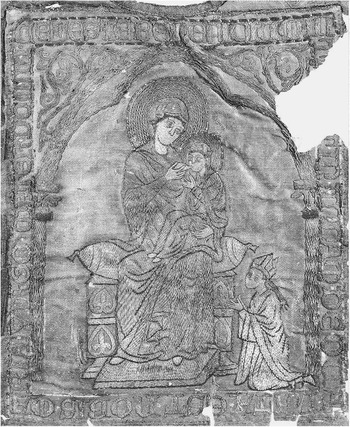
Elias may well have chosen the right pope to present his treatise to. Gregory X, a Piacentine who died at Arezzo in 1276, was clad with an exceptional embroidered scapular at his death (see Figure 5).Footnote 52 Its border was decorated with the text of celeste · beneficium in/t(roivi )t in annam de· qua / nata · est · nobis · ma/ria virgo · mater · domini. This is a well-known antiphon for the Vespers of St Anne, to whom Gregory was evidently devoted.Footnote 53 It is the first example of many vestments embroidered with sacred texts. Several appear in the papal inventories of 1295 and 1311.Footnote 54 The practice reaches its apotheosis in the 1333 panel painting of the Annunciation by the Sienese Simone Martini, who is documented as a resident at the papal Curia between 1336 and his death in 1344.Footnote 55
Scapular with the Virgin and Saint Anne from the grave goods of Pope Gregory X. Arezzo, Museo Civico. Photo GFN Rome

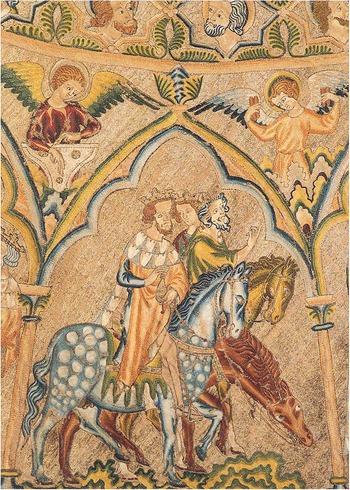
Gregory X was almost certainly the intended recipient of the Opus Anglicanum cope now in Ascoli Piceno, a donation of the first Franciscan pope Nicholas IV in July 1288, within months of his election, to his native town.Footnote 56 English ecclesiastical embroidery, Opus Anglicanum, was indisputably a channel by which northern iconography reached the Roman Curia. One great cope inventoried at Perugia in 1311, and thus in the papal treasury before 1304, was thus described: ‘Item, another beautiful cope of English work, embroidered in silk with roundels of various colours, in which there are scenes of Christ’s life, . . . and a border with six angels in silks of various colours, each playing a different musical instrument like a minstrel.’Footnote 57 A comparable motif recurs on the Opus Anglicanum cope now associated with Pope Benedict XI (1303–4), now in the Museo Civico Medievale at Bologna (see Figure 6).Footnote 58 The phrase ad modum gioculatoris recalls not only Hostiensis’s quip, but more profoundly for the clerical cataloguer the famous phrase ascribed to Francis of Assisi: ‘Nos sumus joculatores Domini.’Footnote 59 And Francis himself is a world apart from Honorius Augustodunensis, who was convinced that all twelfth-century joculatores went ineluctably to Hell.Footnote 60
Opus Anglicanum Cope. Three Magi and Musician Angels. Bologna, Museo Civico Medievale. Photo Museo

BELLS
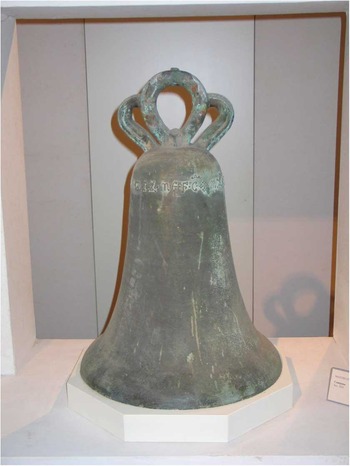
How might one characterize the soundscape of thirteenth-century Rome? It was largely conditioned by bells.Footnote 61 Twelve are documented for the thirteenth century, of which five survive. In the 1980s I discovered an unpublished bell in San Giovanni de’ Fiorentini, which possesses an extraordinary inscription: + magr · petr’· fr · minor · de lemoix · me · f · c · ‘Master Peter, Franciscan of Limoges, made me’ (see Figure 7).Footnote 62 In its context it is remarkably early, not just as a surviving Roman bell, but also as the earliest bell known from a Franciscan context.Footnote 63 The three major bells of San Francesco at Assisi were cast by Bartolomeo Pisano and his son Loteringo in 1239. Their sweet sonority was praised by Salimbene: ‘tota vallis illa consonantia delectabili repletur’.Footnote 64 A year earlier Bartolomeo had cast a bell for S. Cosimato in Trastevere, which had been granted to the Clares by Pope Gregory IX in 1234, and in 1239 he cast another for the Dominicans of Santa Sabina. In 1268 another son of Bartolomeo, Andreoctus, cast the bell of Santa Maria in Aracoeli, the mother house of the Franciscan Order in Rome, which was then probably nearing completion.
Bell signed by Pierre de Limoges, OFM. Rome, San Giovanni dei Fiorentini, Museo. Photo author

Astonishingly enough, there was another Roman bell cast by Brother Peter, a lost example once in Santa Maria in Cosmedin, which was dated 1230 by inscription.Footnote 65 Furthermore, it may possibly indicate a relative chronology, for it is only in the newly discovered bell that Petrus is designated Magister, which might suggest that bell was cast after 1230. The letter forms of the inscription appear to me to be perfectly compatible with a date in the first half of the thirteenth century. Famously, the Franciscans did not shy away from manual work. There occurs a crucial passage in the 1221 Regula Non Bullata: ‘And let the brethren who know how to work work and practise that art which they know if it is not contrary to the salvation of the soul and they can perform it honourably.’Footnote 66 Peter provides an early example of friars who distinguished themselves in other walks of life, not excluding the papal cook, a certain Fra Raulino, who had his own personal seal.
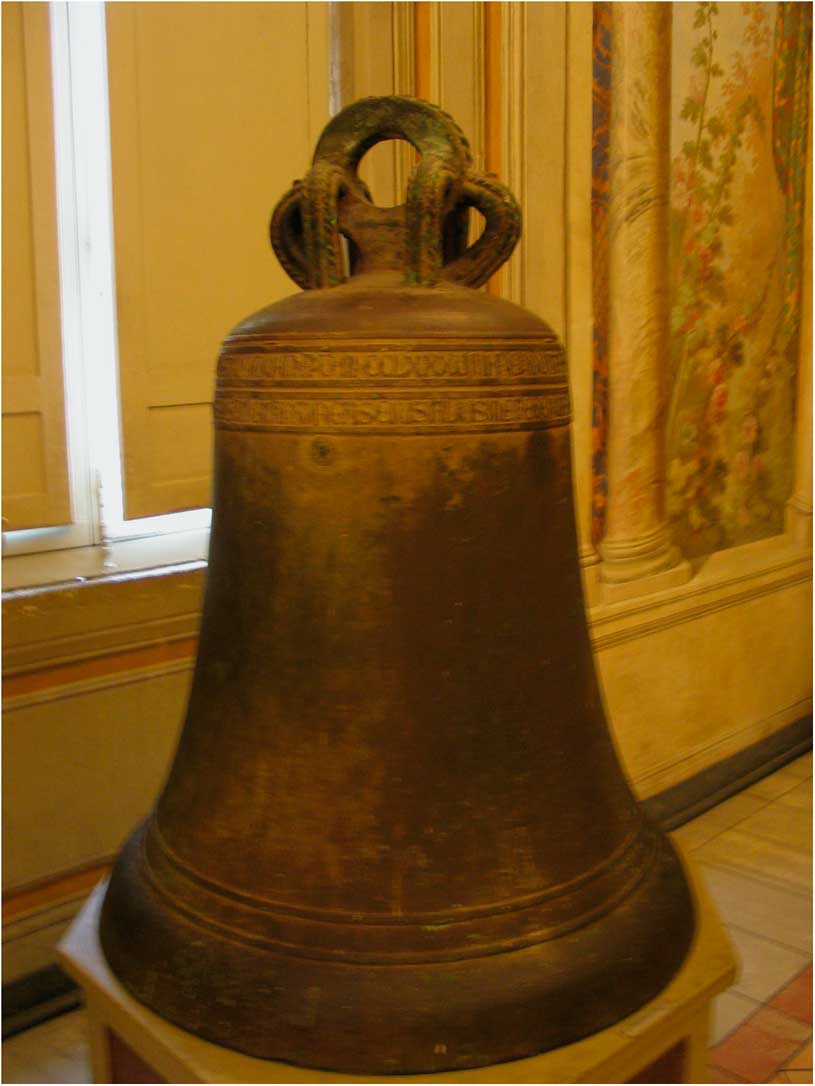
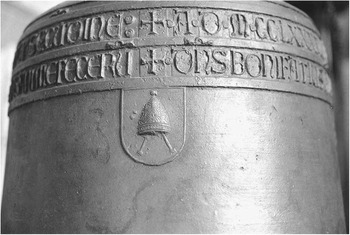
Salimbene is once again our guide on what patrons wanted from bells. In 1285 the citizens of Parma sent to Pisa for an expert bell-founder to provide a bell for the tower of the new communal palace. On arrival he was treated like a lord (‘sicut magnus baro’), but despite spending 1,000 imperial pounds his bell made a miserable sound. And thus, said Salimbene, God punished the citizens of Parma for their hubris in wanting a bell which could have been heard not only in Fidenza but even Reggio Emilia (a pardonable exaggeration – it is 30 km distant). Instead they got one which was barely audible in Parma itself.Footnote 67 Despite this failure the bell-founder received a commission for another bell from the Parmesan cardinal Gerardo Bianchi (†1302).Footnote 68 The twelfth-century Roman Ordo XII required bells to drive demons away, and to shelter the congregation from hail and thunder.Footnote 69 It seems more likely that thirteenth-century Roman patrons wanted neither minatory sound nor weather protection but a musical anniversary – a sonorous commendatio animae whenever the bells pealed. Thus Riccardo Annibaldi (†1289), an aristocratic papal scriptor and nephew of the great cardinal Riccardo Annibaldi della Molara, who was commemorated with an effigy carved by the papal tomb mason Arnolfo di Cambio, commissioned a bell for San Tommaso in Formis in the same year, perhaps as a musical anniversary (see Figure 8).Footnote 70 Nicholas III’s reform statue for St Peter’s stated that the bells should be sounded more solemnly and for a longer time on the more solemn feasts to augment popular devotion.Footnote 71 Now in the Vatican museum, in the modern fashion Riccardo’s bell was dedicated to the Apostle Thomas and the Virgin. Durandus provided a blessing for bells in his late thirteenth-century Roman Pontifical.Footnote 72 Popes too might commission bells – Nicholas III probably did so for his titulus S. Nicolò in Carcere, and Boniface VIII gave two bells, in 1295 and again in 1303, to the cathedral of his native Anagni (see Figure 9).Footnote 73 In 1302 he had given a set of six new bells to Old Saint Peter’s after a fire in the campanile: ‘very fine, double the weight and more than formerly’.Footnote 74
Bell dated 1289 commissioned by Riccardo Annibaldi for S. Tommaso in Formis. Musei Vaticani. Photo author

Bell dated 1295 with the arms of Pope Boniface VIII. Anagni, Duomo. Photo author

VISUAL EVIDENCE
Finally, what does the art of the thirteenth century in Rome bring to our knowledge? We cannot yet sift images mechanically with the speed and accuracy of texts, and we remain very ignorant of book production in the city.Footnote 75 There are two known Roman personifications of music among papal grave-goods. The first occurs on the virtually illegible scapular found in the tomb of the French pope Clement IV (†1268), the second, more spectacularly, in the recently uncovered palace murals at SS. Quattro Coronati.Footnote 76 The scapular is an extremely interesting document of musical knowledge within its conventional intellectual framework at the Curia. It is now almost wholly illegible. Music is shown seated together with Dialectic, Arithmetic, Geometry, Grammar, Astrology and Rhetoric. She turns upwards towards a sloping rail with four small bells, an iconography later closely imitated on the Perugia fountain.Footnote 77 It was Clement IV who wrote to Roger Bacon, no mean musical authority, demanding that he despatch copies of his works to him at Viterbo urgently.Footnote 78
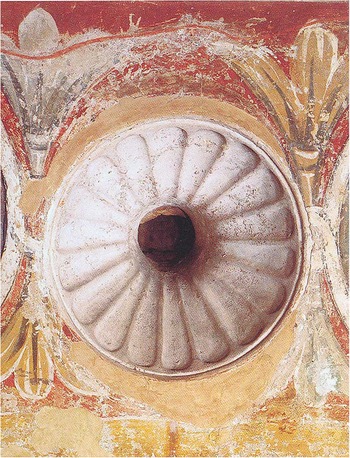
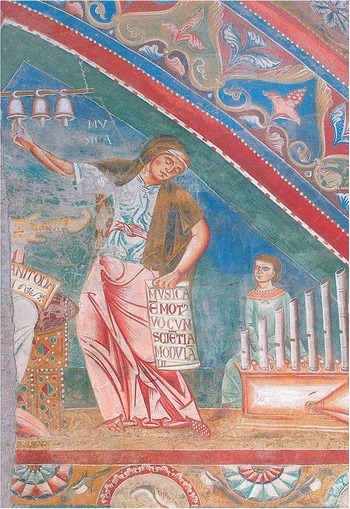
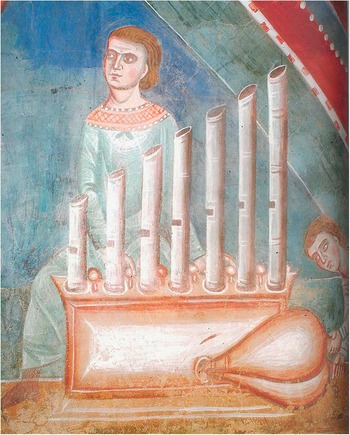
The murals raise more fascinating problems. Before 1996 the church of SS. Quattro Coronati was most celebrated for a chapel mural cycle with a strong political charge commissioned c. 1246 by Cardinal Stefano Conti, the vicar of the exiled Innocent IV when Frederick II was at the gates of Rome.Footnote 79 Understandably, the Constantine and Silvester cycle is strikingly political in its content. The Last Judgement, which completes the cycle in the palace chapel, has one conventional trumpeting angel. During a much earlier restoration of this chapel several ceramic tubes were discovered, apparently to carry the sounds of divine service into the cardinal’s apartments located above (see Figure 10).Footnote 80 These would, of course, have been the strains of sung sacred music. In 1996 a huge mural programme was revealed in the Gothic-vaulted hallabove the chapel.Footnote 81 This complex secular programme, almost certainly commissioned for the same patron, Cardinal Stefano Conti, contains not only a remarkable personification of Music, but several striking illustrations of musical instruments. (See Figures 11–12.) The organ is a competitor to that of the Rutland Psalter (British Library, Add. MS 62925, fol. 93v).Footnote 82 The text held by Musica reads mvsica est motvs vocvm scientia modvlandi; it is an amalgam of Boethius’s Musica est motus vocum and Augustine’s Musica est scientia bene modulandi.Footnote 83 This compares with one of Amerus’s definitions: ‘Musica est motus rationabilium vocum in arsis et thesis.’Footnote 84 There are many astonishing aspects of the new cycle, not least its bold mixture of courtly and quotidian elements. The personifications of Amor Celestis and Emulatio carry Francis and Dominic upon their shoulders in a motif recalling John of Salisbury’s famous citation from Bernard of Chartres: ‘We are as dwarfs on the shoulders of Giants.’Footnote 85 There seems no reason to date this new decoration any later than the Constantine and Silvester cycle in the chapel below. Significantly, what we have here appears to be the survival of important contemporaneous ecclesiatical and secular programmes for the same curial patron. Here perhaps too the period ear encounters the period eye.
Ceramic tube. Cappella di San Silvestro, Rome, Santi Quattro Coronati, c. 1246. Photo author

Personification of Music. Gothic Hall, Rome, Santi Quattro Coronati. After Draghi 2006

Organ, Gothic Hall, Rome, Santi Quattro Coronati. After Draghi 2006

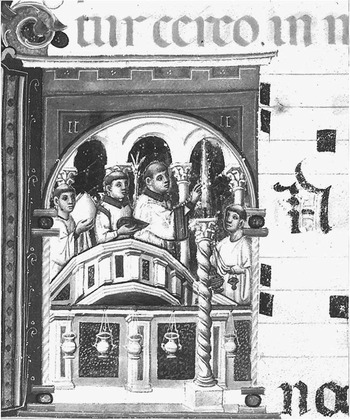
Cardinal Giacomo Stefaneschi (1295–1342), one of the greatest of all medieval patrons of painting, was probably most influential in his lifetime as the papal master of ceremonies, and would thus have had daily experience of elaborate liturgical ceremonies in the greatest Roman churches.Footnote 86 A graduate of the University of Paris, he was, like Robert de Courson, Stefano Conti, Ottobuono Fieschi and Hostiensis before him, also a canon of Notre-Dame. He commissioned two monumental works by Giotto for St Peter’s before the papacy left for Avignon. Whilst a relatively young cardinal in Rome he commissioned liturgical manuscripts for Saint Peter’s, where he was a canon for over forty years.Footnote 87Figure 13 shows the Blessing of the Paschal Candle from the Exultet, MS B 78, fol. 3r in the Archivio S. Pietro: a deacon in the presence of three priests reads the Exultet, beginning ‘Exultet iam angelica turba’, from the ambo. In a second historiated initial on fol. 15v a priest lights the lamps beneath.Footnote 88 The liturgical furniture occupied by the performers is similar to contemporary examples surviving in Rome such as that in San Lorenzo fuori le mura, rebuilt in the 1220s by Honorius III.Footnote 89 The setting, however, cannot reflect Old Saint Peter’s, for that was certainly a trabeated basilica, although the sung office predicates an important church. The cardinal deacon who officiates at the ceremony is most probably meant to be Giacomo Stefaneschi himself. Here – as everywhere else in Roman ecclesiastical representations – only singers are depicted.
Giacomo Stefaneschi, Exultet. Vatican City, Archivio Cap. San Pietro B. 78, fol. 13v. Photo author

Despite his enduring interest in music and liturgy, no music-making angels are present in the great double-sided triptych which Cardinal Stefaneschi commissioned from Giotto for Saint Peter’s.Footnote 90 Nor had they occurred in Jacopo Torriti’s apse mosaic for Santa Maria Maggiore commissioned by Pope Nicholas IV (1288–92). The orchestration of the Virgin’s Coronation is an achievement of Giotto’s old age.Footnote 91 Contemporary scholars were indeed sceptical of discussing music-making angels from a musical point of view. Johannes de Grocheio, understandably enough, pointed to the lack of firm evidence.Footnote 92
That more complex modes of singing might contemporaneously be depicted is indicated by the famous scene of the Miracle at Greccio in the Upper Church at Assisi. Just inside the choir screen two pairs of friars on either side of the lectern are obviously singing antiphonal plainchant. The constitutions of the Franciscan Order forebade anyone being sent to the studium unless they knew the Divine Office and were instructed in chant.Footnote 93 We should not, however, be deceived into imagining that Greccio in 1223 was anything like the fresco in the Francis Legend.Footnote 94 The cycle was probably a Franciscan commission during or just after the pontificate of Nicholas IV (1288–1292). It might also be noted that the friars can clearly see each other, reflecting Elias Salomon’s dictum ‘quod alter alterum viderit cantare’.Footnote 95
CONCLUSION
Stefaneschi was a creation of Boniface VIII and there is some further intriguing evidence of music in the Curia of the Caetani pope. Magister Buonaiuto da Casentino from Borgo a Collina near Poppi was another papal scriptor, who was also a canon of Aquileia, nuntius and collector of the papal tenth in Bohemia, Hungary and Moravia.Footnote 96 He composed a Lamentabile carmen, both text and music, on the death of Cardinal Benedetto Caetani junior, nephew of Boniface VIII, who was buried in Boniface’s celebrated tomb chapel in Old St Peter’s, completed whilst the pontiff was still alive.Footnote 97 Bonaiuto also wrote a Doctrinale carmen for Boniface, commemorating his tomb-chapel, and a facetious sequence Hec medela corporis addressed to the papal physician Accursino da Pistoia commemorating a successful papal purgation:Footnote 98 Bonaiuto’s original manuscript, Biblioteca Apostolica Vaticana, Vat. Lat. 2854, contains musical notation. He was also responsible for a dilatatio laudis beate Virginis on the antiphon Ave Regina celorum.Footnote 99
Finally, to end where we began, with Cardinal Annibale da Ceccano, who was buried in the tomb chapel of SS. Lorenzo e Giorgio founded by his uncle Giacomo Stefaneschi in St Peter’s.Footnote 100 Following the example of earlier French cardinals like Jean Cholet at Paris, he founded a college in Rome for students from his home region, the Ciocciaria around Frosinone in Lazio.Footnote 101 The students of the Roman college were required every Saturday, when lessons had finished, to go to the church of Santa Maria in Trastevere, where they sang an antiphon before the icon of the Virgin.Footnote 102 This, astonishingly enough, must be the celebrated eighth-century Madonna di Clemenza, the regal Madonna flanked by angels and painted in the ancient encaustic technique which an anonymous English visitor had also observed in 1344, recording that traditionally it had been a favourite of Thomas Becket when he was in Rome.Footnote 103 The Madonna di Clemenza had become a Laudesi panel, just as Duccio di Buoninsegna’s great Madonna served for the Compagnia dei Laudesi at S. Maria Novella.Footnote 104
The papal curia at the time of Boniface VIII’s death in 1303 was still recognizably similar to that of the beginning of the thirteenth century in terms of its composition and its functioning. Family links and nepotism remained influential and the old patronage networks still resisted. But the College of Cardinals and the curial bureaucracy were significantly larger, more cosmopolitan, better organized and more highly educated. The growth of their musical interest reflects this. It also betrays the impact, spiritual and organizational, of the new mendicant orders. By the end of the thirteenth century Rome was, incontrovertibly, the pre-eminent religious, cultural and artistic centre. The development of polyphonic music, the growing popularity of bells, and a lively interest among artists in portraying liturgical ceremonies and musical performance at the behest of their ecclesiastical clientele allows us to form a far more nuanced picture of the musical life of thirteenth-century Rome.