Caviar, sex and death
Censorship came early and often to Vienna. Between 1795 and 1848, the red-pencil men put more than a thousand French novels and two hundred English ones on their blacklist – blocking Walter Scott, Honoré de Balzac, Alexandre Dumas père, Paul de Kock, Eugène Sue and George Sand, to name a few. In the second half of the nineteenth century the pace picked up. Censors struck at newspapers, especially socialist–democratic ones, eased selectively in the 1890s, plunged back into an oppressive extreme during the First World War, loosened after the collapse of the Austro-Hungarian Empire, and then slammed the doors hard under Nazi rule. Here I want to look at censorship in Austro-Hungarian Vienna as it hit Sigmund Freud – the aim is to use practices of knowledge interdiction to explore Freud's formulation of the censorship concept as it oscillated between postal and newspaper censorship, on one side, and psychic censorship – of dreams and wishes – on the other. The goal is to show how, for Freud, the material reality of exterior censorship and the psychic reality of interior censorship formed what he called ‘parallel’ phenomena, a rescaling that extended beyond analogy to a re-territorialization of the mind.Footnote 1
Freud first mentioned censorship in his work on therapy for hysteria, finished and published in 1895, where he reflected on the general quality of ideas that we suppress:
I recognized a universal characteristic of such ideas: they were all of a distressing nature, calculated to arouse the affects of shame, of self-reproach and of psychical pain … they were all of a kind that one would … rather forget. From all this there arose, as it were automatically, the thought of defense … psychologists … have invented special technical names for this process of censorship to which the new arrival must submit.Footnote 2
Freud illustrated his concept of the censored with a patient's recollection of ‘the upper part of a woman's body draped with dress not properly fastened … [he] only later fitted a head to the remembered naked torso and so brought to mind his relation to her’. In the service of social decorum, censorship removed head, relationship and shame.Footnote 3
It seems that from the very start, or perhaps before the very start, of psychoanalysis, censorship – government censorship – was salient to Freud. In an anonymous essay, ‘Note on the prehistory of the technique of analysis’ (1920), Freud recalled how two of his colleagues had been struck by a short essay that Ludwig Börne had penned back in 1823, and reprinted in his 1862 collected works. Key to becoming an ‘original writer’, Börne instructed (‘The art of becoming an original writer in three days’), was to write down what you think ‘of yourself, of your wife, of the Turkish War, of Goethe … of the Last Judgment, of your superiors – and when three days have passed you will be quite out of your senses with astonishment at the new and unheard-of thoughts you have had’. Freud says that he was given Börne's books when he was fourteen, that this set of volumes was all he retained from his childhood library, and that he (Freud) had begun thinking about Börne's work over the following half-century. Looking back at Börne's pages two decades after his Interpretation of Dreams (1900), Freud was astounded to find a passage giving advice to the budding writer who sought originality: ‘A disgraceful cowardliness in regard to thinking holds us all back. The censorship of governments is less oppressive than the censorship exercised by public opinion over our intellectual productions’. Freud then went on to comment that here ‘is a reference … to “censorship”, which reappears in psychoanalysis as the dream-censorship’.Footnote 4
The censor (psychic and political), it seems, is especially touchy about the subject of censorship. Here the forgotten passage in Freud's oft-remembered Börne book was just that which bore on the unoriginality of Freud's ideas about censorship. As Freud explains many times, the key signal of censorship is the deletion or distortion of a fragment surrounded by clear text, so to speak. So what have we here? A memory-censored passage about censorship that had picked out the unoriginal origins of one of Freud's favourite ideas (censorship) in a text on … original writing. It is no surprise, of course, that such wily forgetting or ‘cryptamnesia’ (forgetting in such a way as to consciously believe in one's originality) and psychic censorship applied to Freud as much as to anyone else; salient here is that it occurs just at the moment that Freud is addressing the originality of his idea of … psychic censorship.Footnote 5
Over the whole of his career, Freud's view of political and psychic censorship reflected back and forth; they became, as we will see, far more than a very partial, one-way metaphor that took a figurative ground and mapped it to a literal target – instead we have before us the production of the most private interiority in the midst of the public sphere. We have here a switching point in which the same utterances (‘censor’, ‘censorship’, ‘blanked-out spaces’) shine back and forth between the political–literal and the psychic–figurative. We see such a reciprocity between material and figurative elsewhere in the history of science – for example, in time coordination. Synchronized clocks were really in play in the work of Albert Einstein and Henri Poincaré (in map-making and railroad technology) and at the heart of their more abstract reasoning (in relativistic physics and the philosophy of time). Through both censorship and time coordination, we need a re-literalization: a willingness to bring back into historical visibility the long-forgotten materiality of train- and telegraph-synchronized clocks.Footnote 6 We would do well to recognize that abstract concreteness – or concrete abstraction – is central throughout scientific thinking. Here, in the Freudian concept of censorship, we have one such domain. The dynamics of blocked information will not fall into one or the other box: figurative or allusive, internal or external, material or psychological. Censorship was, for Freud, even in the early days, both a psychic agency and a literal mechanism enlisted for political repression and stabilization.Footnote 7
If Freud had and had not known Ludwig Börne's writings on the psychological correlate of government censorship since 1870, there is no doubt at all that by the mid-1890s he explicitly had drawn a link between psychological and political censorship. By then, Freud had begun to think about psychodynamic censorship as being of a piece with public censorship that political authorities imposed on written material. Writing to his friend and disciple, otolaryngologist Wilhelm Fliess on 22 December 1897, Freud enumerated the many ways that the mind swaps acceptable for unacceptable thoughts – just at a time when Freud was asking Fliess, in letter after letter, to serve as Freud's own, private, red-pencilled censor.Footnote 8 Here, in the 22 December letter, Freud brought the duality of psychic and political censorship to the centre of attention:
Have you ever seen a foreign newspaper which has passed the Russian censorship at the frontier? Words, whole clauses and sentences are blacked out so that what is left becomes unintelligible. A Russian censorship of this kind comes about in psychoses and produces the apparently meaningless deliria.
But Freud's invocation of tsarist border censors seems unmotivated – what concrete case prompted Freud's turn to blacked-out spaces?
In the full letter to Fliess, Freud used a vivid, disturbing example of memory censorship to illustrate how close memory deletions were to the deletions imposed by heavy-handed censors on foreign texts arriving at the Russian border. We will see that this is a recurring theme (censoring the topic of censorship): in 1950 when Marie Bonaparte, Anna Freud and Ernst Kris redacted this 22 December letter as they prepared it for German publication; again in 1954 when Eric Mosbacher et al. translated it into English; and a third time when James Strachey kept the deletions while retranslating the letter for the 1966 Standard Edition – even though he had access to the full manuscript correspondence. All three redactions omitted under ellipses the example Freud actually used in that letter – the prime instance of psychic censorship that Freud had in view when he referred to the border censorship of incoming texts.Footnote 9
The ellipses-clipped sections were restored from the uncensored versions of the letters published in 1984–1985 (amidst, it should be said, much hyperbole) – here it is: a patient reported having witnessed a primal scene as a three-year old, when she entered a dark room where her mother was ‘carrying on’. ‘The father’, Freud reports, ‘belongs to the category of men who stab women, for whom bloody injuries are an erotic need’. The father had raped the girl child when she was two; she almost died from loss of blood after the assault, and contracted gonorrhoea. Now, older, all that the patient recalled was the mother shouting and cursing, the mother ripping her clothes off with one hand, holding them against herself with the other; the mother staring at a point in the room, her face altered in rage, covering her genitals with one hand, pushing something away with the other. She raises both hands, clawing at the air and biting at it. ‘Shouting and cursing’, she bends far backwards, then all the way forward, pointing her toes inward, and finally falling quietly over backward onto the floor, her face contorted with pain, weeping. Much later, at age sixteen, the patient again saw her mother bleeding from the uterus (from a carcinoma); then, upon hearing of a haemorrhoid operation, the daughter (Freud's patient) plunged into neurosis.Footnote 10
From these and other bits of evidence, Freud contended that the patient-as-child-of-three had seen her father attempt to rape her mother, after which he pushed the patient's mother forward, and raped her anally. For the patient, huge pieces of this primal scene simply vanished: most notably, her father himself – gone. The scene, minus the father, seemed ‘delirious’. All that remained were fragments, isolated details of the mother's motions and cries: the mother holding herself, crying, pitching forwards, toes inward, collapsing backwards and weeping after the event.Footnote 11
Freud filled in the blanks between the fragments of the patient's story and psychiatric history, and the shards of the primal-scene memory. It is just after recounting this appalling case to Fliess in 1897 that Freud wrote what in fact is otherwise rather incomprehensible in the censored version published in the Standard Edition – now, with the antecedent restored, we can reread Freud's allusion to Russian censorship in a different register: ‘Have you ever seen a foreign newspaper which has passed the Russian censorship at the frontier? Words, whole clauses and sentences are blacked out so that what is left becomes unintelligible. A Russian censorship of this kind comes about in psychoses and produces the apparently meaningless deliria’. Instead of the Russian censors deleting words, clauses and sentences, Freud was seeing here the mind of his patient deleting the unbearable violence of the father. After commenting on seemingly delirious utterances, Freud ended his December 1897 letter to Fliess with a comment, also dropped in favour of ellipses in the Standard Edition, no doubt because it signalled the case that itself had been deleted. Freud: ‘A new motto: “What has been done to you, poor child?”’ – and then, his parting words to Fliess: ‘enough of my smut’.Footnote 12
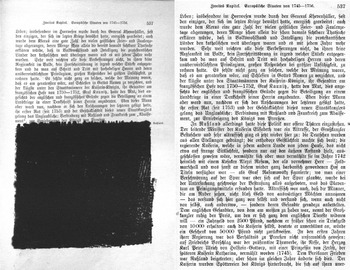
Newspapers, books and pamphlets were famously censored at the Russian frontier, especially German-language books – books that, for example, challenged the paternity of Catherine's offspring, that spoke of the murder of Peter III or Paul I, that imagined assassinations or recounted real ones; texts that criticized the tsarist form of government, prognosticated its fall; those that spoke of demoralization in Russia, or praised Islam, or tolerated Judaism, or criticized Russian Orthodoxy. In the second half of the nineteenth century, the censoring authorities banned sex in publications with particular enthusiasm (39.7 per cent); philosophy lost passages in about 16 per cent of their incoming items; history, religion and social-condition literature fell at the rate of 10–14 per cent. (Note that technology and science lost practically not a word – each suffered black spaces or worse in less than three-quarters of one percent. We must not read backwards from later history: rapidly applied science – so vaunted as decisive in the Second World War, was hardly a war-winning factor in the later 1800s and science was only a trivial portion of secrecy and censorship.)Footnote 13 And, in a theme that we encounter time and again, there was censorship of censorship news – even when critics blasted the censorship of Austro-Hungarian theatre. Time and again, the censors smeared black ink over offending passages (known at the time as ‘caviar’ – Figure 1) or pasted paper directly onto the page.Footnote 14
Caviar censorship. At the Russian border, censors blocked out passages of numerous German-language texts – precisely the process Freud cited in his letter to Fliess, 22 December 1897, and subsequently. The material buried under ‘caviar’ described the moral bankruptcy of Empress Elizabeth, the bribe-soliciting corruption of her diplomats, and the regime's unjust behaviour towards Germans. Left: censored version, right: uncensored. Oskar Jäger, Weltgeschichte. Bd. 3. Geschichte der neueren Zeit, 1516–1789, Bielefeld: Verlag von Velhagen & Klasin, 1888, p. 537, censored version from University of Illinois at Urbana-Champaign Library.

Of course, the greatest of Freud's work came less in these early works and letters than in The Interpretation of Dreams (1900). In this, his magnum opus, Freud returned to the notion of censorship, where it became ever more important, as he indicated a few years later (‘I may say that the kernel of my theory of dreams lies in my derivation of dream-distortion from the censorship’Footnote 15). Here is the introduction of the concept in Interpretation: ‘The stricter the censorship, the more far-reaching will be the disguise and the more ingenious too may be the means employed for putting the reader on the scent of the true meaning’. We do this often when speaking to a person more powerful than we are, Freud noted. The Interpretation of Dreams continues:
A similar difficulty confronts the political writer who has disagreeable truths to tell those in authority. If he presents them undisguised, the authorities will suppress his words – after they have been spoken, if his pronouncement was an oral one, but beforehand, if he had intended to make it in print. A writer must beware of the censorship, and on its account he must soften and distort the expression of his opinion.
Sometimes this induced self-censorship is by restraint – at other times by code or allusions instead of direct references, as when writers speak of Mandarins in the Middle Kingdom rather than of their own officials.Footnote 16
Making the point that sometimes, as in deliria, the work of censorship ‘no longer takes the trouble to conceal its operation’, Freud maintained that the apparently incoherent utterances were only incoherent because of the gaps torn from them by deletion. ‘This censorship’, he repeated in the Interpretation, ‘acts exactly like the censorship of newspapers at the Russian frontier, which allows foreign journals to fall into the hands of the readers whom it is its business to protect only after a quantity of passages have been blacked out’.Footnote 17
So by the late years of the nineteenth century, Freud's already politically allusive notion of censorship was tightly bound to the specific, and very real, tsarist Russian blacked-out censorship of Alexander III and his successor Nicholas II. But real as seizure, caviar and glued newsprint may have been, the Russian border censorship of German publications in history, philosophy and biography did not shake Freud directly. His interests were primarily around the blacked-out ‘caviar’ of the Russian frontier censors – seeing the raw, unhidden deletions of German text gave Freud a language in which to work out his original formulation of psychodynamic censorship in the years from 1897 to 1900.
Überwachungsstelle Wien (surveillance point Vienna)
Censorship broadened and deepened during the Great War of 1914–1918. At the height of the conflict, Freud returned to the notion of censorship and, facing the bruising everyday experience of press and postal censors, reframed the censorship idea in a much more vivid and central form. This was a time when not only every book and newspaper, but every letter and every postcard fell under the power of the censor. Every day people would see words excised – letters from the front blocked by the notorious black ink, newspapers sporting increasingly wide expanses of white. Sometimes an article or letter would be delayed, without explanation; on other occasions they might never arrive at all. At a time when Freud's professional life worked very largely through correspondence (Ernest Jones, Sándor Ferenczi, Lou Andreas-Salomé, Karl Abraham), this was no small matter. With two of Freud's sons in the thick of combat, censorship imposed a brutal loss of contact.
Behind this pervasive gamut of Verbot stood the Viennese police censors, numbering some three thousand, disported around the city among three offices, where they examined photos and checked the moral rectitude of drawings on postcards.Footnote 18 These blocking measures weighed on Freud, and they arise again and again in his voluminous correspondence.
Freud wrote to Ferenczi on 23 August 1914 about his reaction to the launch of war just a few weeks earlier:
the rush of enthusiasm in Austria swept me along with it, at first … I hoped to get a viable fatherland from which the storm of war had wafted away the worst miasmas and in which the children could live with confidence. Like many others, I suddenly mobilized libido for Austria-Hungary … Gradually a feeling of discomfort set in, as the strictness of the censorship and the exaggeration of the smallest successes
called to mind a story of a ‘Daetsch’ (an assimilated Jew who had become German), who returned to his Orthodox family as a thoroughly modern man, admired by all his relatives. Eventually his grandmother orders him to take his clothes off, and he is revealed to have closed the flap of his underpants with a clothespin because the drawstrings had torn off – the grandfather pronounces him no ‘Daetsch’ at all. Like the Daetsch hiding his clothes-pinned underpants, censorship had obscured the true war situation. As the dressed-up propaganda image gapped here and there, the tawdry reality broke through. ‘I have finally secured this conviction for Austria-Hungary, and I am experiencing the ferment of my libido into anger’.Footnote 19 Ferenczi responded the next day, avoiding the anticipated censoring by transforming (displacing) Austria into the figure of a woman: ‘your letter, which illustrates so splendidly the mood swings, alternating every hour, to which we are all subject, culminates in the same disparaging assessment of Frau A[ustria] that I, too, had to make’.Footnote 20 Austria became Frau A – displacement (code) as a method of coping with postal censorship.
To his long-term correspondent, psychoanalyst Lou Andreas-Salomé, Freud offered a reprint of his ‘On narcissism’ on 25 November 1914, hopeful it could arrive quickly because its subject matter seemed unlikely to arouse the displeasure of the censors. Freud continued,
I know for certain that for me and my contemporaries the world will never again be a happy place. It is too hideous. And the saddest thing about it is that it is exactly the way we should have expected people to behave from our knowledge of psycho-analysis … since we can only regard the highest present civilization as burdened with an enormous hypocrisy, it follows that we are organically unfitted for it. We have to abdicate, and the Great Unknown, He or It, lurking behind fate will someday repeat this experiment with another race.
Freud added, ‘science is only apparently dead, but humanity seems to be really dead’.Footnote 21
That same day, 25 November 1914, Freud wrote to Karl Abraham in puzzlement: ‘your last letter arrived unopened. Can the censorship have been reduced for you’? No, Abraham replied a month later, bursting any hope that the eye of the censor had closed. In Mecklenburg, Abraham continued, letters to Austria must also be sent unsealed. ‘The fact that my last letters arrived in closed envelopes must have been due to the censorship department. Your letters also sometimes arrive sealed, with the censor's stamp on the reverse’.Footnote 22 Freud's hope was dashed: the sealed letters meant precisely the opposite – the censors had read and closed the letters.
In his ‘Thoughts for the times on war and death’, written in March–April 1915, Freud vented his accumulating anger:
The State exacts the utmost degree of obedience and sacrifice from its citizens, but at the same time it treats them like children by an excess of secrecy and a censorship upon news and expressions of opinion which leaves the spirits of those whose intellects it thus suppresses defenceless against every unfavorable turn of events and every sinister rumour.Footnote 23
Every day the Viennese newspapers had articles yanked from their pages, leaving only the scar of a white block where news had been.
By 1 August 1915, Freud was used to the postal censorship, and unhappy about it. On his sons, then fighting, he reported to Abraham: ‘Ernst [Freud's youngest son] should have left for Galicia yesterday. Martin has been through some severe fighting, a bullet grazed his right arm and another went through his cap, both without disturbing his capacity for action. He has been praised for bravery’. The violence of the war was no abstraction to Freud, contact with his sons was increasingly difficult, even professional exchanges became more and more difficult. Freud continued to Abraham, ‘Censorship seems now to have made the sending of manuscripts much more difficult’.Footnote 24
‘What disturbs and preoccupies me painfully is the lethal danger that I know Ernst is in’. On 24 October 1915, Freud got the news that Ernst's unit had been under heavy fire, and that, except for him, the entire unit of five men had been blown to pieces and buried. Apparently, a reconnaissance plane had spotted the unit, and an Italian barrage had scored a direct hit, sparing young Ernst Freud only because he happened to be outside the dugout at the moment the shell slammed into it. After the death of his unit, Ernst had been sent to Görz for rest, recreation and a promotion.Footnote 25 Unexpectedly, Freud's son Oliver, working as an engineer, came home one last time before his marriage. Freud: ‘I don't believe in peace, but rather in an increase in the bitterness and ruthlessness in the second year of the war. Contributions have been announced by [Karl] Abraham, [Oskar] Pfister, and Lou Andreas [Lou Andreas-Salomé; Abraham's article went, for example, to the Internationale Zeitschrift für ärztliche Psychoanalysis, Lou Andreas-Salomé's to Imago]. If only the censor lets them through.’Footnote 26
Even closer to home, Oliver (Oli) was about to be married – Freud, in early December 1915, worried about the couple's prospects given Oli's temperament:
Since we can't talk to him and are hardly able to write to him on account of censorship, we have to let everything go as it may, and we are, by the way, also being restrained by the consideration that parents' mixing in seldom brings about anything good.Footnote 27
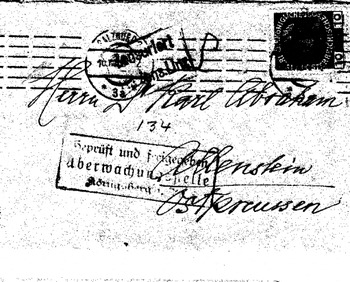
Suddenly, in a world bound by letters, a world of both affective and professional ties, the post itself had been strangled. Freud's role as the father of sons caught up in the war was threatened, his connection with his friends and colleagues in the growing network of psychoanalysts was put under stress, and sometimes even professional papers hit the censors' blockades. As Freud would know from the envelopes themselves, some letters were censored once. Others fell under several censors' gazes (Figure 2) – for example, under the surveillant stamp in Vienna and then again in East Prussia (Königsberg), en route to Karl Abraham, or Vienna and then Britain, on the way to Ernest Jones in London.
Twice-censored letter. Censors inspected Freud's correspondence to Karl Abraham (mailed 10 August 1916, sent from Salzburg to Königsberg (E. Prussia)), twice – in both Austria and Germany. Container 15, Sigmund Freud Papers, Sigmund Freud Collection, Manuscript Division, Library of Congress, Washington, DC.

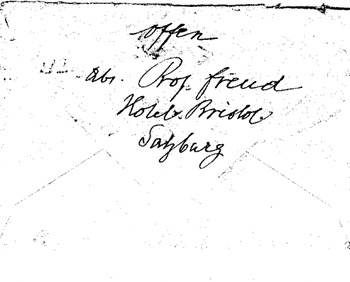
Open envelope. Freud's letter to Karl Abraham (10 August 1916, Salzburg to Königsberg), was not sealed – Freud labelled the back of the letter ‘open’ (offen) so that the censors would know they could read it freely without tearing the paper. Container 15, Sigmund Freud Papers, Sigmund Freud Collection, Manuscript Division, Library of Congress, Washington, DC.

In a burst of writing, Freud shifted from writing about death and war – blasting the system of censorship in March–April 1915 – to a ‘topographical’ picture of the unconscious that, like war-torn Europe itself, had its own censorship boundaries; the psyche had its multiple border crossings, its stamp-men (so to speak) at the ready. Here is the double-censor system that Freud saw at work during the war, and also paralleled in the mind. We see this doubling of borders and censors in Freud's wartime essay ‘The unconscious’ (published in the Internationale Zeitzshrift and written in the few weeks between 4 and 23 April 1915):
In the first phase the psychical act is unconscious and belongs to the [unconscious] system Ucs.; if, on testing, it is rejected by the censorship, it is not allowed to pass into the second phase; It is then said to be ‘repressed’ and must remain unconscious. If, however, it passes this testing, it enters the second phase and thenceforth belongs to the second system, which we will call the [conscious] system Cs. But the fact that it belongs to that system does not yet unequivocally determine its relation to consciousness. It is not yet conscious, but it is certainly capable of becoming conscious (to use Breuer's expression) – that is, it can now, given certain conditions, become an object of consciousness without any special resistance … the rigorous censorship exercises its office at the point of transition from the Ucs. to the [preconscious system] Pcs. (or Cs.).Footnote 28
Freud developed the topographical picture as part of his ‘Unconscious’ paper (drafted in those days of April 1915). But the topographic did not yet have its diagram. In the Standard Edition appendix to ‘The unconscious’, Freud's translator, James Strachey, imported one (in my view problematically) – an 1891 diagrammatic representation of the separation of the thing-presentation (which resides in the realm of the unconscious system, Ucs.) from the word-presentations (which is in the realm of the preconscious system, Pcs.). The lines of connection are, however, in no way spatial (topographic) – these are purely associative lines of connection. As Freud sketched the systems back then, the Ucs. is a web of visual, tactile and acoustic associations; the word presentations are a linked set of writing-, reading-, sound- and motor-images. The passage between the two dominions takes place in a specific way: through a double-lined link of the sound-image and the visual object-association.Footnote 29
In short, the 1891 diagram is most assertively not topographic – neither neuro-anatomically (spatial–material) nor psychically (spatial–conceptual). Specifically, by 1891, Freud had clearly rejected his own earlier (and others') localization of psychic functions to specific places in the brain. Here is Freud on why he did not want to continue with what one might call the material territorialization of the psyche:
After … the discovery of motor and sensory aphasia ([Paul] Broca and [Carl] Wernicke), the authorities set about tracing the more subtle symptoms of aphasia … to factors of localization [of brain function]. In this way they arrived at the hypothesis of conduction aphasia, with subcortical and transcortical, and motor and sensory forms. This critical study [Freud's own] is directed against this view of speech disorders and it seeks to introduce for their explanation functional factors in place of the topographical ones.Footnote 30
Back in the 1880s, Freud, like so many neurologists, had engaged with a material territorialization that mapped psychic elements on physically located topoi of the brain. He then rejected it in the 1890s. On this repudiation he was utterly insistent – sure, one could map body parts to brain parts, but, as he insisted, the analogue project of mapping ideas to brain parts had failed. Now – April 1915 – he could go further, introducing a new kind of topography:
every attempt to go on … to discover a localization of mental processes, every endeavor to think of ideas as stored up in nerve-cells and of excitations travelling along nerve-fibres, has miscarried completely. The same fate would await any theory which attempted to recognize, let us say, the anatomical position of the system Cs. – conscious mental activity – as being in the cortex, and to localize the unconscious processes in the subcortical parts of the brain.
There was nothing for it, ‘nor is it one of the tasks of psychology to fill it’. For the present (Freud stresses that this is the situation as he writes), ‘psychical topography has … nothing to do with anatomy; it has reference not to anatomical localities but to regions in the mental apparatus, wherever they may be situated in the body’.Footnote 31
Despite this certainty, Freud did return to the topographic during the First World War and in the years directly following, but this time to a ‘psychical topography’ that no longer attached to places in the brain. This new form of topography was labelled ‘regions in the mental apparatus’. Because the psychical topographic has lost its literal, material localization, I suggest that we think of it as a re-territorialization, in which Freud's psychic maps replaced brain maps. By doing so, Freud maintains the notion of place (topography), even if those places are not cortical sites. (In Freud's terms, the diagrams are ‘no more than graphic illustrations’, a phrase that avoids redundancy insofar as ‘illustration’ is a restriction on the graphic: the diagrams are not meant to be metrically, spatially referential.) Instead, Freud posits a ‘cruder’ but ‘more convenient’ hypothesis that there are two ‘phases’ of an idea, one located in the psychical territory of the unconscious, Ucs., followed by a fresh registration of it in a region of the conscious, Cs. A second account that Freud calls ‘seemingly’ more probable is that the shift of an idea from unconscious to conscious is just a ‘functional change of state’ in a single psychological place.Footnote 32
Freud sets aside the ‘change-of-state’ account because he judges that it is ‘less plastic, less easy to manipulate’, than that of the topographic notion of an idea actually moving from one zone to another. What does he mean here by the adjective ‘plastic’? Derived from the Greek plastikos, the term indicates being capable of shaping or moulding. The psychical topographic offers the possibility of shaping and altering the concept as if it were material, distinguishing and altering (non-brain) locations, allowing motion, connection, interruption or distortion between them.
Further, according to Freud in 1915, the
topographical … hypothesis is bound up with that of a topographical separation of the systems Ucs. and Cs. and also the possibility that an idea may exist simultaneously in two places in the mental apparatus – indeed, that if it is not inhibited by the censorship, it regularly advances from the one position to the other, possibly without losing its first location or registration.
Suppose, Freud says, a patient is both told X, and told that he had previously heard and repressed X. Hearing X anew does not automatically remove either the repression or its effects – but it does seem as if proposition X is now in two (psychic) places but in two distinct forms (X-as-communicated, located in the Cs.; X-as-repressed, located in the Ucs.). One could (and Freud did) go on to ask precisely what relation stood between the two instantiations of X.Footnote 33
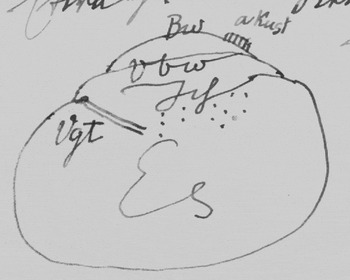
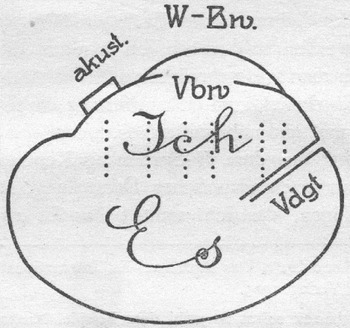
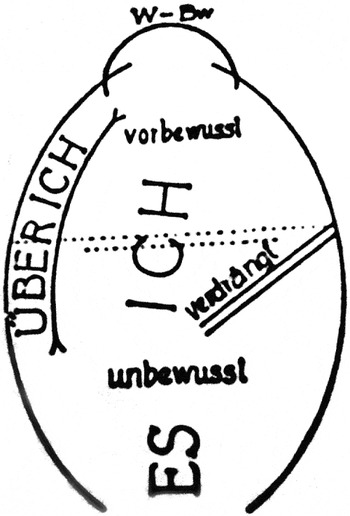
Freud made clear the distinctness of X-as-communicated and X-as-repressed through re-territorialization (that is, by replacing material with psychical topography). Distinctness of (psychical) place underscores the distinctness of the communicable and repressed idea X; but more than that, this new form of placed-ness that begins in 1915 becomes a generative, plastic frame that captures old psychological concepts and gives form to new ones. This becomes clear (as we will see) in Freud's 1923 reformulation of the psychic schema (with the introduction of the id) and its revision in 1932 with another diagram (this time adding the superego) (Figures 3 and 4).
Ego–id diagram draft (1923). Container OV-8, Sigmund Freud papers, Sigmund Freud Collection, Manuscript Division, Library of Congress, Washington, DC.

Ego–id diagram, published (1923). Note that in the printed form, Freud has switched the ‘acoustic’ element from right to left, mirroring the brain topography (where the left auditory cortex is more sensitive to speech). Sigmund Freud, Das Ich und das Es, Leipzig, Vienna and Zürich: Internationaler Psychoanalytische Verlag, 1923, 26.

In the psychic topography of 1915, it was the real, political, wartime notions of censorship that figured powerfully. Freud, 1915: the ‘psychical act’ carried within the ‘system’ of the unconscious approaches the frontier – the way a person carrying a dangerous text comes up to a frontier – with similar results:
The Ucs. is turned back on the frontier of the Pcs. by the censorship, but derivatives of the Ucs. can circumvent this censorship, achieve a high degree of organization and reach a certain intensity of cathexis in the Pcs. When, however, this intensity is exceeded and they try to force themselves into consciousness, they are recognized as derivatives of the Ucs. and are repressed afresh at the new frontier of censorship, between the Pcs. and the Cs.
Censorship is twice applied at frontiers, first against material from the Ucs. that attempts to move into the preconscious, and then against derivative ideas that escaped the first censorship (of the Ucs.) and appeared in the Pcs. (where thing-representations are attached to words and a second censorship goes to work). This second border censorship stands like a guarded boundary to the territory of the conscious. Wryly, Freud adds that the censorship has become more sophisticated as it pursues the escapees from the first psychical block – ‘One might suppose that in the course of individual development the censorship has taken a step forward’.Footnote 34
Frontiers, topographical lines of division, censors turning back unacceptable material at two territorial borders … the reality of military censorship in a continent at war came home to the psyche. Many commentators on Freud have assimilated Freud's topographic model to all of his work from the late nineteenth century all the way to the introduction of his ‘structural’ account of the ego, id and superego in 1923. That, it seems to me, is a highly problematic claim given both his 1890s polemics against (literal) brain topography and his re-territorialization of the mind by a psychical topography (in evolving forms, from 1914–1915 to its revision in the 1920s and 1930s). True, by 1915 Freud had been talking about the conscious, unconscious and preconscious for some time. But the relation and passages among the Ucs., Pcs. and Cs. were not given a particularly sited and border-patrolled frame. That was a product of his reflections in the midst of the massive censorship of the Great War.
Let us return to Freud's April 1915 article, ‘The unconscious’, and contrast it with a similarly titled intervention three years earlier, ‘A note on the unconscious’. In 1915, the topography of the mind's psychic agencies lies over the whole of the work. Indeed, Section IV is subtitled ‘Topography and the dynamics of repression’. But in 1912 Freud was using none of this territorial language. In fact, he deployed an entirely different metaphorical structure taken from camerawork:
A rough but not inadequate analogy to this supposed relation of conscious to unconscious activity might be drawn from the field of ordinary photography. The first stage of the photograph is the ‘negative’; every photographic picture has to pass through the ‘negative process’, and some of these negatives which have held good in examination are admitted to the ‘positive process’ ending in the picture.Footnote 35
Censorship and repression are both present – not every negative is printed to positive. Unlike the case of censorship (which Freud dubs a ‘parallel’ and which he goes on to expand, explore and articulate), the photographic is a two-feature ‘analogy’. One could even capture the photographic analogy with a rule: in every negative, black and white will become, in the positive image, white and black – but only some negative images (elements of the unconscious) will be chosen to print to positives (elements of the conscious). Moreover, the photographic analogy is presented with an essentially flat affect, while the emotional relation of Freud, his interlocutors, indeed much of Vienna, to the crushing repression of postal and newspaper censorship was powerful and sustained. One more contrast: in the ‘Introductory lectures’ (1917), Freud repeats the photographic analogy and then immediately sets it aside: ‘The crudest idea of these systems [of censorship] is the most convenient for us – a spatial one’. Freud: picture a large entrance room (the unconscious) joined by a passageway to a drawing room (the conscious), with a ‘watchman’ or ‘censor’ guarding the doorway between them, allowing only certain individuals (impulses) to pass and even, occasionally, jettisoning some from the drawing room back into the entrance room.Footnote 36
In sum: in Freud's writing on the unconscious in 1912, there was nothing of the idea of material being delivered across territory to guarded boundaries; nothing of a movement of dangerous texts from site to site, sometimes turned back, sometimes encoded, sometimes blurred – with censors on the frontiers, ready to delete, reject or transform. In the photographic analogy, there is no psychic ‘tell’, no blurring, softening or delirium to indicate, like a swab of ‘caviar’ on the page, that the censorship has occurred.
The convulsions of war intervened in a myriad of ways. In 1915, Freud came back to adumbrate his The Interpretation of Dreams, at exactly the point in his masterwork where he had introduced the concept of censorship. At that location in the text, Freud inserted a 1915 dream report, taken in part from his wartime ‘Introductory lectures’ – more specifically from Lecture IX (‘The censorship of dreams’) given in early December 1915.Footnote 37 Freud's insertion into The Interpretation of Dreams mapped wartime dream censorship directly onto wartime post censorship:
Frau Dr H. von Hug-Hellmuth (1915) has recorded a dream which is perhaps better fitted than any to justify my choice of nomenclature [for censorship]. In this example the dream-distortion adopted the same methods as the postal censorship for expunging passages which were objectionable to it. The postal censorship makes such passages unreadable by blacking them out; the dream censorship replaced them by an incomprehensible mumble.Footnote 38
This dreamer was a fifty-year-old ‘cultivated and highly esteemed lady’ who had (in her dream) gone to Garrison Hospital No. 1 saying that she wanted to volunteer for ‘service’ meaning (as was evident to everyone in earshot): ‘love service’ (Liebesdienste). To the sentry at the entrance she allowed that she would be reporting to the chief medical officer. Venturing further inside, in the interior of the hospital (so the dream continued) she found a gloomy apartment where officers and army doctors had gathered. ‘I and many other women and girls in Vienna are ready to [mumble, mumble]’. And yet everyone in the dream understood her. She continued, ‘I'm aware that our decision must sound surprising, but we mean it in bitter earnest. No one asks a soldier in the field whether he wishes to die or not’. One of the officers: ‘Suppose, madam, it actually came to … (mumble)’. Or later, the dreamer: ‘It must never happen that an elderly woman … (mumble) … a mere boy. That would be terrible’. As she walked up the staircase she heard an officer comment, ‘That's a tremendous decision to make – no matter whether a woman's young or old! Splendid of her’! The dream came back to our esteemed lady, twice, in the following weeks.Footnote 39
What intrigued Freud in this 1915 dream was its gaps – not gaps of memory but in the dream-content itself; Freud particularly focused on the intercession of mumbles. ‘Where shall we find a parallel to such an event?’ Freud asks,
You need not look far in these days. Take up any political newspaper and you will find that here and there the text is absent and in its place nothing except the white paper is to be seen. This, as you know, is the work of the press censorship. In these empty places there was something that displeased the higher censorship authorities and [so] was removed – a pity, you feel, since no doubt it was the most interesting thing in the paper – the ‘best bit’.Footnote 40
Freud was not alone in noticing – and experiencing – that the forbidden slides easily into the desirable, the apple of one's eye. The social democratic women who ran the Arbeiterinnen-Zeitung (‘working women's newspaper’) took the opportunity of one such white space stamped ‘Under confiscation’ in 1915 to proclaim, ‘Many of our comrades have asked us in letters, what dangerous thing had been there? We are pleased about this. We have always been of the opinion that confiscations have a more provocative effect than the content itself’.Footnote 41 War year after war year, these excisions were part of daily life in the European capitals – censorship and the experience of dealing with it, the fascination and even privileging of the blacked-out, had become part of everyday life. Freud gauged his response to war through a language of psychology; he elaborated his account of psychology through his encounter with war.
Continuing in his 1915–1916 reflections on censorship (Introductory Lecture XV), Freud added,
On other occasions the censorship has not gone to work on a passage after it has already been completed. The author has seen in advance which passages might … give rise to objections from the censorship and has … toned them down in advance … In that case there are no blank places in the paper, but circumlocutions and obscurities … censorship in advance.
Just so were pre-censors of the mind, sometimes punching gaps; more often, as Freud had it, ‘censorship takes effect [by pre-censoring], by producing softenings, approximations and allusions’.Footnote 42 In these cases there are no ‘blank places in the paper’ (as there are in censored newspapers), but instead ‘circumlocutions and obscurities of expression’ that can indicate just where the censor of the mind went to work.
Jokes, neurotic symptoms, dreams and … politics itself: everywhere from political to everyday life, from the distortions of sleep to the proclamations of the newspaper headlines. Everywhere, branching associations were both enforcing censorship and attempting to escape its grasp.
‘Well’, Freud then says in his 1915 lecture on censorship in dreams, ‘we can keep close to this parallel [dream censorship with press censorship]. Wherever there are gaps in the manifest dream the dream-censorship is responsible for them’. In fact, Freud went further, concluding that censorship could be called to account every time there was a dream element remembered ‘especially faintly, indefinitely and doubtfully’ among other, more vivid dream fragments. But it is rare that the censor of the mind reveals its hand quite so obviously – much more frequently, the effect of the censor is indirection – the ‘softenings, approximations and allusions instead of the genuine thing’.Footnote 43 The ‘parallel’ is deep and generative between the political press and the psychodynamic mind – but, as an old saying of Coleridge has it, ‘no simile runs on all four legs’.Footnote 44 While the mind has another form of displacement (regrouping material, for example), this is not something the political censor is inclined to do.Footnote 45
Freud: what a world of horrors the sleeping mind unveils – or tries to unveil. A wife wishes her husband dead, a man feels sexual desire for his sister, another regrets spending money on his sister's dowry or his brother's education. And yet … ‘when you reject something that is disagreeable to you, what you are doing is repeating the mechanism of constructing dreams rather than understanding it and surmounting it’.Footnote 46 At this point, Freud speaks directly to his Viennese audience, pressing them: do you really find so much benevolence among your superiors and competitors, such chivalry among your enemies, such equanimity in the conduct of sexual life? Really? He insists: are you so persuaded by this that you have to defend the honour of human nature in all its aspects?
Back and forth Freud moves in an unending cycle, from inner mind to outer world – and so from Morpheus to Mars and back:
And now turn your eyes away from individuals and consider the Great War which is still laying Europe waste. Think of the vast amount of brutality, cruelty and lies which are able to spread over the civilized world. Do you really believe that a handful of ambitious and deluding men without conscience could have succeeded in unleashing all these evil spirits if their millions of followers did not share their guilt? Do you venture, in such circumstances, to break a lance on behalf of the exclusion of evil from the mental constitution of mankind?
Freud anticipates that the reader may be critical of his passing over too lightly the noble self-sacrifice in ‘our’ soldiers. But in this you are only stressing that which adds to the common view: ‘I am exhibiting to you not only the evil dream-wishes which are censored but also the censorship, which suppresses them and makes them unrecognizable’.Footnote 47 Freud makes his picture of the inner psyche with its censorship and guarded borders comprehensible to his audience by invoking the bloody, war-Europe in which his audience was living.
Back in 1914, in a relatively rare moment, Freud used the personified term Zensor (‘censor’) instead of the almost universal use he made elsewhere of the corresponding institution or practice, Zensur (‘censorship’): ‘If we enter further into the structure of the ego, we may recognize in the ego ideal and in the dynamic utterances of conscience the dream-censor as well’.Footnote 48 He then returned (after writing ‘On narcissism’ in 1914) to The Interpretation of Dreams and added a section that brought up the censor (the only such example in the Interpretation other than the one that refers to mandarins mentioned earlier): ‘It has seemed plausible to recognize in the mental agency which thus remains awake the censor to whom we have to attribute such a powerful restricting influence upon the form taken by dreams’.Footnote 49 Again, and even more directly, in a lecture during the winter term of 1916–1917, Freud says, ‘We know the self-observing agency as the ego-censor, the conscience; it is this that exercises the dream-censorship during the night’.Footnote 50 For although Freud occasionally cautions his readers not to think of the organs of the mind as homunculi, in his new psychic geography it is too convenient even for him to avoid slipping into a language in which the censor gains agency. The censor is the first of a population of homunculi – ego, ego-ideal, superego, id – that increasingly stood as ‘persons’ (tyrants, masters or other personifications). In his 1915 essay ‘The unconscious’, Freud even compared the unconscious with ‘an aboriginal population in the mind’.Footnote 51 Faced with the inaccessible but nonetheless wilful postal and press censors, once Freud and his interlocutors were in the language game of censorship, once they (and so many others) lived every day in the oppressive and distorting relation with powerful, anonymous censors, it became ever more natural in 1914–1918 to pass from censorship to censor both in society and in the society of the mind.
Radiant censorship
Freud's correspondents, students and friends knew perfectly well how the all-too-real postal censorship constrained the most famous practitioner of psychoanalysis uncomfortably about what he could say and how he could say it.Footnote 52 For someone who used the numerous letters he launched each day as a vehicle for thinking, this was no small burden. Ernest Jones wrote to Freud on 31 October 1916 to query the author about clarifying his German script – but listen to the context, fearful that the demand for clarity might otherwise obscure: ‘Would it be increasing the inhibition you probably feel too much from the censorship to ask you to write in Latin characters? If so, please don't trouble’.Footnote 53 Postal censorship as inhibition – here is war infrastructure, the censor corps, as the direct source of a psychological interior state. This is more-than-simile, even more-than-metaphor, this is conjoint action, the parallel, that was psychiatric thinking and wartime experience all at once.
Censors were holding up Freud's correspondence and he knew it. In February 1918, Freud wrote to Lou Andreas-Salomé, lauding Dr Ernst Simmel's Kriegsneurosen und pyschisches Trauma (which, Freud commented, was based on Simmel's experiences in a military hospital in Posen) about the application of psychoanalysis to shell-shocked soldiers. Freud lamented the ascendancy of the Bolsheviks. In Freud's correspondence was talk of German war trauma and the Russian Revolution. Which or both might seem dangerous? Whatever the cause, censors blocked his letter for some ten days. ‘On this occasion’, Lou Andreas-Salomé replied,
the censorship almost relieves me of my scruples in replying to your letter at once … and my previous letter seems to have taken a good three weeks to reach you. Obviously we have offended in some way or other, both of us, only unfortunately I have no idea in what respect.Footnote 54
This is just the kind of irradiation effect that we know so well from Freud's study of psychological mechanisms – where emotion is intense, associative objects get caught up, through fetishism, for example. But here the action of the censor does more than the censorship aims for – or maybe we should conclude that it achieves precisely what it aims for. The censored person begins to worry just as Lou Andreas-Salomé and Freud did – ‘how have I offended’ – and self-censorship radiates ever outward to establish a more generalized inhibition, a cautious demeanour, a well-behaved citizen.
As Freud began in March–May 1919 to sketch a preparatory manuscript toward his ‘Beyond the pleasure principle’, he started to talk about the ‘I’ who experiences pleasure in an explicitly, socially fragmented form. He wants a pleasure principle to underlie so much – and yet can no longer imagine a self under the unique dominion of King Reason or, for that matter, King Will – no ‘I’ that can alternately be the ego, the id … or the censor. Here is a form of internalized sociality, a governmentality that no longer is composed of individuals (organically or mechanically) but instead an individual only to be understood as an internal society of homunculi. On 9 September 1920, Freud gave an address to the International Psycho-analytical Congress at the Hague – the author's abstract included this:
If we took into account the justifiable assumption of the existence of a special self-observing and critical agency in the ego (the ego ideal, the censor, conscience), these punishment dreams, too, should be subsumed under the theory of wish fulfillment; for they would represent the fulfillment of a wish on the part of this critical agency.Footnote 55
The homunculus-censor has become the seat of pleasure in the wartime society of the mind.
Back to the press and postal censors of 1919: the black-ink authorities took their time before they finally lifted their pens, released their captive letters and retired their scissors, glue and letter openers. Months after the end of hostilities, censorship continued unabated – even after the Austro-Hungarian Empire had ceased to exist (31 October 1918). This inner psychoanalytic circle looked forward with great anticipation to the lifting of censorship, as exchanges between Freud, Jones and Ferenczi made clear. Here is Jones to Freud on 17 March 1919:
If only you were here! There is so much to write about that I am surprised at my courage in attempting a letter, especially as unfortunately my health is very poor, so that there is little energy left. But it is good to feel near you again, with no censorship in between.Footnote 56
Not so fast – on 18 April 1919, Freud's missive to Jones was indeed opened – twice, first by the Viennese and then by the British. As for Freud, this constant prying, opening, delaying, removing wore him down – the open (offen) letters, with their forced displacements, pre-censorships, allusions and softenings, had become almost unbearable. On 19 April 1919, he could finally say more definitively, ‘Dear Jones, The first window opening in our cage. I can write you directly and a closed letter’!Footnote 57 Freud and the ego, both oppressed by their censors.
Even after Versailles, the psycho-political parallel persisted in Freud's thought. In his 1925 ‘Negation’, Freud contended that the unconscious held no ‘no’. Indeed, when the analyst asks the patient about a dream figure, and the patient responds ‘It's not my mother’, the analyst registers: ‘It is his mother’. The ‘no’ functions like a ‘certificate of origin’, stamped, in a form of censorship, on the thought as it passes from the unconscious to the conscious. Here, Freud claims, is a process very much like the (English-language) stamp ‘Made in Germany’ placed on goods.Footnote 58 That registration, imposed by the Allied Powers post-Versailles, was itself a post-First World War punishment – a peacetime censor's warning to the world consumer of the good's source.
Not everyone accepted Freud's intensification of his political–psychical parallel, but even some well-known critics registered its force. For example, in 1918, the Cambridge anthropologist W.H.R. Rivers wanted to identify the unconscious dynamics of dreams with the ‘rites and customs of savage peoples’, arguing for a strong relation between the features of ‘rude culture’ and Freudian ‘endopsychic censorship’. But, as he explained in 1920, willing as Rivers was ‘to go far with Freud’, he bridled when Freud's notion of censorship acquired a deterministic, agential aspect that was so ‘wholly in the pattern of the conscious’. As Rivers put it,
The concept [of censorship] is based on analogy with a highly complex and specialized social institution, the endopsychic censorship being supposed to act in the same way as the official whose business it is to control the press and allow nothing to reach the community which will in his opinion disturb the harmony of its existence.
Much more satisfactory (according to Rivers) would be a reliance on the physiological rather than the sociological – Rivers then took off in hot pursuit of a nervous-system analogy in which more recently evolved elements of physiology controlled older ones.Footnote 59 Reading Rivers, one might conclude that Freud had simply slipped late in his argument, and that the interior censor had accidentally mimicked the conscious dynamics of an actual stamp-wielding Viennese censor.
But Freud's political–psychic censorship parallel was most certainly not a casual analogy that could be swapped out for a piece of physiology. Instead, his intense reasoning about borders, secret packets turned back, softenings, codes, pre-censorship and censors helped constitute the re-territorialization of the mind toward a new, less literal psychic topography. This reasoning set the ground for the diagram he began sketching three years after the June 1919 Treaty of Versailles. For it was in July 1922 that he began framing ‘The ego and the id’, his theoretical treatise on the structure of mind, that appeared in April 1923. In that work, Freud recoded anatomy into psychiatry:
We shall now look upon an individual as a psychical id, unknown and unconscious, upon whose surface rests the ego, developed from its nucleus, the Pcpt. system. If we make an effort to represent this pictorially, we may add that the ego does not completely envelop the id, but only does so to the extent to which the system Pcpt. forms its [the ego's] surface, more or less as the germinal disc rests upon the ovum. The ego is not sharply separated from the id; its lower portion merges into it.
Already, in the invocation of the germinal disk and the ovum, there is a kind of (psychic) return to anatomy that builds on the place-based topography Freud began developing during the war – in neither case is the topography one of the brain.Footnote 60
So what are Freud's ‘topographic’ diagrams, implicit and explicit between 1915 and 1932? They are a kind of territorial palimpsest. They began life, decades earlier, as carry-overs from the material topography of the brain – ‘topographic anatomies’ (gross anatomies) – with their trace in Freud's allusion, for example, to the germinal disk and its relation to the ovum or to the location of the acoustic system on the left side of the psychical diagram to mimic the speech centre of the brain. But those anatomical territories were later overlaid with other territories: cartographic mapping of the shifting, disputed land territories of a continent at war; land moving, monitored, under shifting control with guarded frontiers. Out of wartime experience came a topographic study of psychic components; the production of a psychical, topological map of relations, not proportions. Freud's verbal description of psychical topographies of 1915, his diagrams of 1923 and 1932, all carried this history – recoding his much older anatomical aspirations and reinscribing into the mind-map the bloody, shifting war zones, censors and control points of the great European conflict.
Freud continued with the now de-literalized, re-territorialized anatomy a bit father down in ‘The ego and the id’, where he indicated how, even in neurological studies, when the cortical surface was probed and mapped, the mapping of the brain surface to the body yields an image that is by no means mimetically representational:
the ego is first and foremost a bodily ego; it is not merely a surface entity, but is itself the projection of a surface [the projection of the surface of the body]. If we wish to find an anatomical analogy for it we can best identify it with the ‘cortical homunculus’ of the anatomists, which stands on its head in the cortex, sticks up its heels, faces backwards and, as we know, has its speech-area on the left hand side.Footnote 61
The homunculi return.
Freud takes up this schematic, cartographic/anatomical idea again in 1932 to illustrate the topographical–conceptual relations of the psychoanalytic offices in his ‘Anatomy of the mental personality’: ‘I should like to portray the structural relations of the mental personality … in [this] unassuming sketch’ (Figure 4).
Ego–id–superego. In this 1932 diagram published in 1933, Freud shows a revised topography in which the superego is introduced explicitly. Note that both the ego and the superego are divided with part lodged in the conscious and part in the unconscious. The opening at the bottom of the diagram allows a link with the body – again an echo of an earlier brain topography where the brain stem led out to the nervous system. Sigmund Freud, Neue Folge der Vorlesungen zur Einführung in die Psychoanalyse, Vienna: Internationaler Psychoanalytische Verlag, 1933.

The id, Freud notes, should be ‘incomparably greater’ in spatial extent than the ego or preconscious. Freud's diagram is relational, not metric: a topological topography, if you will. Freud, once more availing himself of the ‘plastic’ nature of the topographic, adds the superego, all while once again cautioning the reader about the limits of this form of visualization:
here is another warning … In thinking of this division of the personality into an ego, a super-ego and an id, you will not, of course, have pictured sharp frontiers like the artificial ones drawn in political geography. We cannot do justice to the characteristics of the mind by linear outlines like those in a drawing or in primitive painting, but rather by areas of colour melting into one another as they are presented by modern artists.
Great variation can be found among individuals, he adds, and in psychical illnesses the territory can be re-partitioned in dramatic ways.Footnote 62
I want to come back to The Interpretation of Dreams because there is a dream there – one of Freud's own – that is so remarkable that it can only come here, and only just here, after we have wandered through the fields of black-ink caviar, political and psychoanalytic.
Freud dreamed, censored of course, of censorship, as he reported in The Interpretation of Dreams:
A crowd of people, a meeting of students. – A count (Thun or Taaffe [both Thun and Taaffe were reactionary Austrian politicians]) was speaking . He was challenged to say something about the Germans, and declared with a contemptuous gesture that their favorite flower was colt's foot, and put some sort of dilapidated leaf – or rather the crumpled skeleton of a leaf – into his buttonhole. I fired up – so I fired up, though I was surprised at my taking such an attitude. (Then, less distinctly:) It was as though I was in the Aula [ceremonial auditorium]; the entrances were cordoned off and we had to escape. Footnote 63
To Freud the whole dream was a fantasy of being back in the Revolutionary year of 1848 – the dream structure disordered, full of gaps, with inner constructions forcing their way to the exterior.Footnote 64 The first part of the dream revolved around his having seen Count Thun; from his old school days Freud recalled a conspiracy against one of their teachers (a mini-revolution), and from that thought came the memory of a long-limbed aristocrat the boys nicknamed ‘the Giraffe’ an aristocrat like a count, Count Taaffe, ‘Taaffe’ word-morphed into ‘Giraffe’. In the dream, a leaf had slid into a buttonhole. The chain of associations that Freud followed took him to a flower in the buttonhole, from flower to rose, and to roses white (anti-Semitic symbol at the time in Vienna) versus roses red (Social Democrats).Footnote 65
From a later scene of the dream, set in student days, inside a German student club, Freud appeared, discussing the relation of philosophy to the natural sciences:
I was a green youngster, full of materialistic theories, and thrust myself forward to give expression to an extremely one-sided point of view. Thereupon someone who was my senior and my superior, someone who has since then shown his ability as a leader of men and an organizer of large groups (and who also, incidentally, bears a name derived from the Animal Kingdom [like giraffe]), stood up and gave us a good talking-to.
That man was Adler, Victor Adler, founder and head of the Austrian Social Democratic Party; Adler=‘eagle’. Freud: ‘[Adler] too, he told us, had fed swine in his youth and returned repentant to his father's house’. Freud recalled having responded insolently; the crowd called on him to stand down; Adler, himself being ‘too sensible to look upon the incident as a challenge’, let the affair drop.Footnote 66
Freud's Adler dream is about many things, including, importantly, an infantile return to his father's house, and in particular about an incident in which, Freud recalled, he as an infant had peed in his parents' bedroom, upon which his father let drop that ‘the boy will come to nothing’. Freud's urgent and megalomaniacal retort in returning dreams ever since was: ‘You see I have come to something’. The whole dream, Freud recalled, seemed suffused with the arrogance of the 1848 revolutionaries – ‘putting myself in the place of an exalted personage of those revolutionary times, who also had an adventure with an eagle [Adler again]’. Adler now – in 1900 – was the closest and most powerful symbol of such neo-1848 revolutionary leanings; admired by Freud, it was Victor Adler, the real revolutionary Freud aspired to be, and Adler, his ‘senior and superior’, who directed Freud away from his naively materialistic views. (Freud and Victor Adler's paths crossed at many points: Freud dined with the Adlers at their home, 19 Berggasse, and eventually occupied those very rooms for more than three decades.)Footnote 67
Freud's dream, then, in the next sentence, went on to address the problem of censorship – inside the dream itself. This bit begins, as cited above from Interpretation, ‘(Then, less distinctly:) It was as though I was in the Aula’. As Freud often noted, the ‘less distinct’ was a characteristic trace of censorship. So Freud found himself cordoned into the auditorium and had to escape: ‘I thought to myself that I should not be justified in passing the censorship at this point’, even though he would seem to have authority to do so since he had been told the story by a Hofrat (consiliarius aulicus, court councillor – Freud associated ‘Aulicus’ with ‘Aula’). In 1910, in a revision to this section of the Interpretation, Freud added here that a critic was right in pointing out that the dream contained the ‘psychical processes that take place during the formation of dreams’. And in 1914, Freud came back to the passage yet again to add that this critic had nonetheless overlooked that ‘in this boastful dream I was evidently proud of having discovered those [psychical] processes [that take place in the formation of dreams]’: censorship and its resulting distortions are actually very much ‘the material of my dream thoughts’ – the censoring process itself.Footnote 68
In the Adler–Aula dream, Freud was dreaming about his discovery of censorship, of bypassing censorship, and dreaming it in a way distorted by dream-censorship. We are back again, full circle, to the case with which we began: Freud's cryptamnesia about Börne's discussion of censorship. In this dream, there is Freud, dream-presenting his discovery of censorship to his father, censoring that presentation of censorship (rendering it an attempted, blocked escape from the Aula). In his retort to his father-stand-in, Freud recalled his youthful bark at the revolutionary eagle, Victor Adler.
The real Victor Adler and his militant, physicist and magazine editor son, Friedrich, were, about the time Freud was revising the Traumdeutung in 1914, escorting Leon Trotsky to a hasty flight from Vienna – before the secret police could lower its massive political censorship and repression on the city.Footnote 69 The absolutist state of emergency, with its accompanying censorship, worsened with each passing month of the war. On Saturday 21 October 1916, Friedrich Adler took his Browning pistol and put three bullets through the head of Austria's prime minister, Count Karl von Stürgkh. Arrested on the spot, Friedrich began 18 May 1917 in one of the most public and influential proceedings in Austrian history – insisting over and over on the democracy-crushing weight of censorship. Hundreds gathered outside the courtroom intent on hearing every word; the trial was the biggest news in the country. Fritz (as he was called) insisted on the deliberate nature of his act, and his speeches to the Emergency Court were widely reproduced; overnight his name was associated with Trotsky and Lenin, who lauded him.
Friedrich Adler's biggest battle with the Austrian politics as he told the court? ‘Above all’, the assassin declaimed, ‘censorship’! Friedrich Adler's journal Das Volk was banned at the outset of the war. Another periodical he edited, Kampf, the scientific (wissenschaftlich) organ of the party, took a beating. Look, he said to the court, ‘You see here an edition of Kampf with the conclusion: “25 blank pages of this edition of Kampf for which we have to thank censorship”’. Censors delayed articles for months; editors and writers could discern no rules for what could and could not be published; the anonymous black-inkers blocked a ‘factual’ article on military training of youth; the censors even banned ‘The Song of a Mother against War’. Even forbidden sentences written in private letters found their way into court as dangerous ‘public expressions’. Behind the whole absolutist nightmare, according to Friedrich Adler in 1917: Prime Minister Stürgkh.Footnote 70
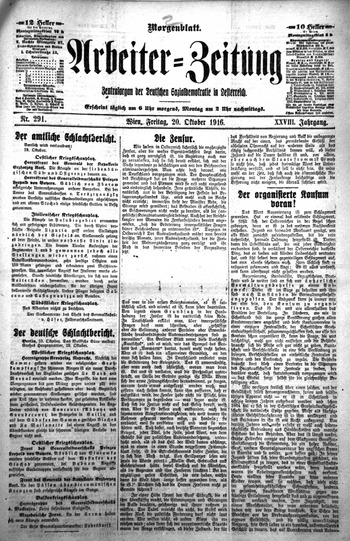
On the morning of Friday, 20 October 1916, Stürgkh cancelled a planned, closed meeting by a group of professors to argue for the reopening of parliament. Fritz suggested they report the cancellation, criticizing Stürgkh in the Arbeiter-Zeitung, the Austrian Social Democratic Party's official newspaper that Victor Adler had founded back in 1889. One party member replied that it would surely be censored – so Fritz proposed that they reprint the censors' report along with news of the cancelled meeting. Already that Friday, the Arbeiter-Zeitung planned, front and centre, a first-page article, ‘Censorship’. That article was itself censored, the blocked bit left, as always, with a white hole dead-centre on the page (Figure 5). With a little gumshoe work we can find out what was there – all the unredacted papers are still archived at Socialist Party headquarters in Vienna:
No one has been successful in moving Count Stürgkh – he who is indeed the originator of the whole system designed to abolish press freedom – to actually speak. His ‘obsession’ with censorship is a far more weighty question than superficial consideration might indicate; indeed, the mood (described as essential) of the hinterland depends not a little on censorship. [Count Stürgkh] has insisted, during these thirty months of a state of emergency, that he has [merely] accepted the proposed [censorship] submissions from [his] Section Chief Erner.Footnote 71
Censored censorship. Arbeiter-Zeitung, 20 October 1916, p. 1. Uncensored version in the Verein für Geschichte der Arbeiterbewegung, Vienna, Zeitungs- und Zeitscrhiftensammlung.

Friedrich Adler killed Stürgkh the next day, 21 October 1916. For decades, assassinations and assassination attempts against the tsars had been censored – and they were numerous. Revolutionaries had attacked Tsar Alexander II unsuccessfully in 1866, twice in 1879, and once in 1880. On the fifth try, the plotters succeeded in killing him with bombs in 1881. Assassination precipitated censorship, and now censorship had become a rallying point; on various occasions the assassins, like Friedrich Adler, testified that it was censorship that had led them to their acts.
In wartime Vienna, censorship weighed on the population, not just on Freud and his correspondents. The black ink and white sections were perpetually front-page news, explicitly, in its consequences, and in the raw visibility of blank white paper.
An assembly of psychic agencies – on war footing
Psychoanalytic subjectivity has a history, and it is written, in part, in the black and white spaces of censorship. Psychic elision and distortion was always already implicating politics – as we have seen, Freud's interlaced talk of inner and outer censorship goes all the way back not just to the war of 1914–1918, not even to The Interpretation of Dreams (1900), or even to the letter to Fliess (1897), but earlier still, back through 1895–1896, and even, if we follow Freud himself, to that set of books from his childhood in the 1870s (Ludwig Börne) with its (suppressed) ‘hint’ (as Freud called it) that censorship was a powerful psychological force. The goal, on all sides, through political, press and psychic censorship: to achieve peace; to remove threats of sex, violence or intolerable thoughts – threats that might as well damage sleep as damage the pacific continuation of government. Fail though they might, the censors persisted in both real and homunculus forms.
At a first level, the censor deletes – cutting, pasting, inking or destroying the offending text: in the case Freud described to Fliess, the child so thoroughly exorcized her brutal father from memory that, in the patient's recollection, her mother had gestured, pitched, fallen, undressed and wept as if she had been alone and delirious. The Empress Catherine's lovers and illegitimate children vanished from print memory: border guards excised the writings of foreign historians; the censors buried the legitimacy-threatening lovers under the ‘caviar’ of black ink and strips of glued paper.
The memory-distending mechanisms of censorship went farther. For Freud, it meant following the dynamics of displacement, just the sort of thing that his correspondent was doing when he substituted ‘Frau A’ for ‘Austria’. Here the Austrian censor had entered into the experience and expression of the letter-writers, training them, as it were, to pre-censor by allusion and substitution, softening what they had to say just in case. What, Lou Andreas-Salomé asked Freud in 1918, have we done to offend the censors? Just by asking that question, she, Freud and so many in wartime Europe would begin to write with more caution, with what Ernest Jones called, in his letter to Freud, ‘inhibition’. Absolutist power and bureaucracy crosses with the media history of writing and the development of the psychoanalytic self.
Freud's war years were, in a sense, a double training. On the one hand, they witnessed productivity, clinical work and theoretical reflection that had begun long before. On the other, the war years inflicted an oppressive conditioning in discourse control. If, as Freud said, happiness issues from love and work, then print interference raised formidable obstacles on both sides: his sons, fighting and narrowly escaping death, were censored out of postal and newspaper communication; all while his psychoanalytic work-by-letter was perennially dampened by the ever-present censors, by open letters and by blocked articles. Yet this subtle violence was not unproductive. After four years of so many forms of postal and print censorship, it comes as little surprise that Freud's role for the psychic censor became ever larger. By the time the bloody conflict had ended, by 1920, when he wrote the Hague abstract (and as he prepared to publish ‘Beyond the pleasure principle’), Freud had articulated this picture of a society-in-self (ego, id, censors – an unconscious with its population of aboriginals). This assembly of homunculi struggling against one another for territory became not only the commonly understood Freudian but also the everyday psychological description of mind for the twentieth century. There was sufficient agency and sentience to these entities that Freud could ascribe the pleasure of the pleasure principle to the ego – or, alternatively, to the (internal) censor.
In the wartime psychoanalytic picture, battleground and homeland had joined. Interior life had, in a certain sense, begun to give up even the idea of pleasure localized entirely in a homunculus-like ego. Instead, the self had taken on a newly defined topography with defended regions, psychic anatomies, borders and censors. The self had become an assembly of psychic agencies – on war footing.
Pull back, then, to take one final glimpse at censorship. Freud famously introduced the id with an analogy to a ‘cauldron of seething excitement’ and then immediately cautioned that ‘analogies decide nothing, it is true, but they can make one feel more at home’.Footnote 72 Indeed, his explicit analogies are legion – from hydraulics and photographs to reservoirs, inoculations, battlefields and X-rays.Footnote 73 Most often these take a psychic phenomenon or function and illustrate it with a vivid scene.
Not so with censorship. For Freud, censorship was not a device or literary allusion. Censorship blocked from Freud the daily, dangerous reality faced by his sons on the front, one of them nearly annihilated under the impact of a shell that killed his entire unit, the other grazed twice by bullets that tore through the skin of his arm and the fabric of his cap. Censorship flayed newspapers; stripped out sections of philosophy; and blocked history, politics, literature and his own correspondence and professional papers – and it did so in front of every Viennese, every day. Censorship, Freud insisted, infantilized the citizen. But not one bit less immediate to Freud was the psychic censorship that deleted memories surrounding the shattering violence of rape, the intrusion of forbidden thoughts of violence, incest, theft. Freud used his psychological insights to illuminate the events unfolding in the war (‘I suddenly mobilized my libido for Austro-Hungary’); and he used the experience of wartime censorship to articulate his psychoanalytic account – censorship calling attention to deletions (‘best bits’), softening, coding, even pre-censoring. Freud read psychodynamics into society and read society into a new topography of mind.
In fact, Freud generally refrained from calling the relation of exterior to interior censorship one of metaphor or analogy, not even implicitly through the construction of a simile – but instead a ‘parallel’, suggesting, I would argue, a refusal to divide these two dynamical systems (society, mind) between reality and symbol. When he did bring up ‘analogy’ in conjunction with censorship, as in his late (finished in 1937) ‘Analysis terminable and interminable’, he actually went to some pains to show how the analogy overcame the objection that it was not full even while conceding that ‘analogies never carry us very far’. ‘Let us imagine’, Freud wrote, that a book such as one written by Flavius Josephus contained objectionable passages about Jesus Christ that later authors, copying by hand, could cross out. Early copies would expose the deletions. But later copyists might distort, even falsify, the text, inserting new sentences to hide the omissions. ‘An attempt might be made to raise the objection that the analogy goes wrong in an essential point’ – someone dismissing the link as a mere analogy might say that the political side involved ‘a tendentious censorship’ not to be found in the ego. Not so, Freud insisted: ‘a tendentious purpose of this kind is to a great extent represented by the compelling force of the pleasure principle’. In fact, the ego distorts its internal perception and produces an ‘imperfect and distorted picture of one's id’.Footnote 74 This analogy, it seems, was more than an analogy: it carries us far – more a rescaling of thought-blocking practices and affects than a more traditional metaphor might suggest. As Freud said in The Interpretation of Dreams, censorship at psychic boundaries was ‘exactly like’ the Russian guards at the frontiers of empire.
Freud saw in society the impulses, writ large, of individuals, especially in wartime fanaticism and destruction. Did the war cause censorship to arise in Freud's theory of mind? Of course not – on and off, censorship had figured in Freud's writing since the 1890s and, if we take him at his word, even earlier. But the punishing daily experience of postal, newspaper and military censorship certainly added articulation to the account, setting Freud's account of mind, with its frontiers, messages and censors, into an articulated topographical frame.
In censorship we catch a glimpse of the double action that takes interior soul to exterior world and back – with neither side safely abstracted from the vicissitudes of conflict and history, neither side wrenched free of the figurative. It may be that this elision of scales is more general yet – if we can pry our way out of the habitual boxes of metaphors, traditionally conceived as joining a real situation with a less-than-real illustration; if we can refrain from the slow erosion of the literal into abstraction (‘just a metaphor’) and keep the literal in our grasp alongside the allusive. But this concern about the prevalent picture of abstraction as leaving concreteness far behind takes us beyond Freud's immediate concern: the persistent attempt, still very much with us, to slide the unsupportable, disturbing features of our world into the blacked-out spaces of our psychological and political lives, lives that are still always turning inside out, and outside in.