Parenting is widely regarded as a major contributor to child mental health (Belsky, Reference Belsky1984; Belsky & de Haan, Reference Belsky and de Haan2011; Cox & Paley, Reference Cox and Paley1997; Minuchin, Reference Minuchin1985), yet little is known about the processes that underlie parenting behaviors. Parenting at risk is commonly studied in the context of specific risk groups, identified in terms of family/personological/ecological risk conditions known to compromise parenting, with comparisons made between groups with and without the risk condition. Studies of this type include parental psychopathology (e.g., maternal depression and parental substance abuse; Allen, Manning & Meyer, Reference Allen, Manning and Meyer2010; Conners et al., Reference Conners, Bradley, Mansell, Liu, Roberts and Burgdorf2003; Haller & Chassin, Reference Haller and Chassin2011; Jameson, Gelfand, Kulcsar, & Teti, Reference Jameson, Gelfand, Kulcsar and Teti1997), parental abuse (De Bellis, Reference De Bellis2001; Howell, Graham-Bermann, Czyz, & Lilly, Reference Howell, Graham-Bermann, Czyz and Lilly2010; Paz, Jones, & Byrne, Reference Paz, Jones and Byrne2005), and marital conflict and divorce (Amato & Keith, Reference Amato and Keith1991; Grych & Fincham, Reference Grych and Fincham1990; Lansford, Reference Lansford2009). New perspectives on parenting at risk, however, call for increased study of parenting “online,” with special focus on the emotions that parents experience in response to child-created events, and parents' capacities for regulating these emotions in the moment (Teti & Cole, in press). Such an approach should provide researchers and clinicians with a better understanding of how specific parental emotions organize ongoing parenting behavior and of individual differences in parenting within a given risk condition. In addition, this approach should better inform clinicians about specific targets for and timing of intervention efforts. More broadly, and drawing from a developmental psychopathology framework (Cicchetti & Toth, Reference Cicchetti and Toth2009), focusing on experienced parental emotions and emotion regulation during parenting of infants could provide important insights into the foundations of emotion regulation (ER) in early infancy, and in turn, how individual differences in early ER capabilities interact with individual differences in caregiving in predicting adaptive versus maladaptive developmental trajectories across childhood.
Parenting as an Emotional Process
The study of emotion generated during parenting has emerged as a central focus in models of the determinants of parenting competence (Dix, Reference Dix1991; Leerkes & Crockenberg, Reference Leerkes and Crockenberg2006; Martin, Clements, & Crnic, Reference Martin, Clements and Crnic2002; Rueger, Katz, Risser, & Lovejoy, Reference Rueger, Katz, Risser and Lovejoy2011). These models suggest that emotions are activated in relation to childrearing goals and concerns, have organizing, orienting, and motivating effects on parents that direct them to meet the needs of their children, and must be regulated in order to maintain an optimal level of arousal to support adaptive parenting behaviors (Dix, Reference Dix1991; Teti & Cole, in press). Parental positive affect has repeatedly been associated with favorable outcomes in young children including greater positive affect in preschoolers' friendships (Denham, Mitchell-Copeland, Strandberg, Auerbach, & Blair, Reference Denham, Mitchell-Copeland, Strandberg, Auerbach and Blair1997), higher sociometric ratings of children by their peers and greater prosocial traits (Boyum & Parke, Reference Boyum and Parke1995; Cassidy, Parke, Butkovsky, & Braungart, Reference Cassidy, Parke, Butkovsky and Braungart1992; Dunsmore, Bradburn, Costanzo, & Fredrickson, Reference Dunsmore, Bradburn, Costanzo and Fredrickson2009), more constructive strategies in emotionally charged peer interactions (Garner & Spears, Reference Garner and Spears2000), greater compliance and internalization of family rules (Kochanska, Aksan, & Koenig, Reference Kochanska, Aksan and Koenig1995), and lower rates of externalizing behaviors in toddlers (Lunkenheimer, Olson, Hollenstein, Sameroff, & Winter, Reference Lunkenheimer, Olson, Hollenstein, Sameroff and Winter2011; Pettit & Bates, Reference Pettit and Bates1989). Conversely, parental negative affect has been repeatedly associated with unfavorable outcomes in young children including difficulties in peer interactions (Cummings, Zahn-Waxler, & Radke-Yarrow, Reference Cummings, Zahn-Waxler and Radke-Yarrow1981; Gottman & Katz, Reference Gottman and Katz1989), childhood antisocial behavior (Larsson, Viding, Rijsdijk, & Plomin, Reference Larsson, Viding, Frijsdijk and Plomin2008), avoidant coping strategies (Goodvin, Carlo, & Torquati, Reference Goodvin, Carlo and Torquati2006), lack of confidence in challenging situations (Crockenberg, Reference Crockenberg1987), depressive symptoms (Tompson et al., Reference Tompson, Pierre, Boger, McKowen, Chan and Freed2010), anger reactions with peers (Garner & Estep, Reference Garner and Estep2001), parent and teacher reports of externalizing behaviors (Denham et al., Reference Denham, Workman, Cole, Weissbrod, Kendziora and Zahn-Waxler2000), and exacerbation of child conduct problems (Cole, Teti, & Zahn-Waxler, Reference Cole, Teti and Zahn-Waxler2003).
Parents' emotions also serve as a barometer for the quality of the parent–child relationship (Biringen, Robinson, & Emde; Reference Biringen, Robinson and Emde1998; Emde & Easterbooks, Reference Emde, Easterbooks, Frankenburg, Emde and Sullivan1985). Parental positive emotion has become a defining feature of adaptive parenting styles (Baumrind, Reference Baumrind1971; Maccoby & Martin, Reference Maccoby, Martin and Hetherington1983) and parental sensitivity (Ainsworth, Blehar, Waters, & Wall, Reference Ainsworth, Blehar, Waters and Wall1978; Bowlby, Reference Bowlby1969). Parenting that is sensitive, warm, supportive, responsive, child-oriented, and emotionally synchronous is typically associated with positive outcomes in children including emotional security, prosocial behavior, self-regulatory abilities, and intellectual achievement (Cummings & Davies, Reference Cummings and Davies1996; Eisenberg et al., Reference Eisenberg, Fabes, Spinrad, Eisenberg, Damon, Lerner, Damon, Lerner and Eisenberg2006; van IJzendoorn, Dijkstra, & Bus, Reference van IJzendoorn, Dijkstra and Bus1995). Biringen and colleagues (Reference Biringen, Robinson and Emde1998) propose that parental emotion, and in particular the degree to which parental affect is appropriately attuned to child affect during the course of parent–child exchanges, is at the core of parent–child relationship quality. Emotional availability (EA) has been linked to numerous adaptive child outcomes including the development of secure parent–child attachment relationships (Biringen et al., Reference Biringen, Brown, Donaldson, Green, Krcmarik and Lovas2000; Easterbrooks, Biesecker, & Lyons-Ruth, Reference Easterbrooks, Biesecker and Lyons-Ruth2000), better regulated infant sleep (Teti, Kim, Mayer, & Countermine, Reference Teti, Mayer, Kim and Countermine2010), and buffered cortisol elevations in response to threat for extremely socially inhibited children (Kertes et al., Reference Kertes, Donzella, Talge, Garvin, Van Ryzin and Gunnar2009).
Empirical study of emotion within the parenting context has primarily examined behavioral expression of emotion during parent–child interactions (e.g., observed facial expressions; Cole et al., Reference Cole, Teti and Zahn-Waxler2003; Denham et al., Reference Denham, Mitchell-Copeland, Strandberg, Auerbach and Blair1997; Hollenstein & Lewis, Reference Hollenstein and Lewis2006), rather than emotions experienced by the parent in the moment (e.g., subjective emotional experience). This is an important distinction as studies have demonstrated that behavioral expression and self-reported experience of emotion are only moderately, if at all, correlated (Martin et al., Reference Martin, Clements and Crnic2002; Rosenberg & Ekman, Reference Rosenberg and Ekman2005). Such evidence suggests that expressed and experienced emotion tap related, yet distinct processes occurring during parent–child interactions. The present study focused on parental emotions as experienced, in relation to infant-created emotional events, and mother–infant EA.
Frontal EEG Alpha Asymmetry, Motivation, and Emotion
A substantial body of literature has accumulated in recent decades examining the association between frontal EEG asymmetry and patterns of emotional/motivational responding. These empirical investigations can be categorized as studies either examining frontal EEG asymmetry at rest (during a baseline procedure) or in response to emotional stimuli (Coan & Allen, Reference Coan and Allen2003, Reference Coan and Allen2004). An individual's diathesis for the development of psychopathology and/or their predisposition to respond in a particular way to environmental stimuli has been termed affective style by Richard Davidson (Reference Davidson1998), and appears to be partially moderated by frontal EEG asymmetry at rest. This model of the trait capacity of frontal EEG asymmetry has received substantial empirical support (for a review, see Coan & Allen, Reference Coan and Allen2004). Indeed, frontal EEG asymmetry at rest has demonstrated high internal consistency and acceptable test–retest reliability, supporting its status as a trait (Tomarken, Davidson, Wheeler, & Kinney, Reference Tomarken, Davidson, Wheeler and Kinney1992). Empirical investigations demonstrate that greater relative right frontal activity at rest is consistently associated with behavioral inhibition (i.e., withdrawal orientation; Sutton & Davidson, Reference Sutton and Davidson1997), negative emotionality (Tomarken, Davidson, Wheeler, & Doss, Reference Tomarken, Davidson, Wheeler and Doss1992), and as a propensity to respond to emotional stimuli with a greater intensity of withdrawal-oriented emotions (i.e., sadness, disgust, fear; Allen, Harmon-Jones, & Cavender, Reference Allen, Harmon-Jones and Cavender2001; Tomarken, Davidson, & Henriques, Reference Tomarken, Davidson and Henriques1990; Wheeler, Davidson, & Tomarken, Reference Wheeler, Davidson and Tomarken1993). In contrast, greater relative left frontal activity at rest is consistently associated with behavioral activation (i.e., approach orientation), positive emotionality, and a propensity to respond to emotional stimuli with a greater intensity of approach-oriented emotions (i.e., joy, anger).
Whereas investigations of frontal EEG asymmetry at rest examine an individual's predisposition to respond in an expected way across situations, investigations of frontal EEG asymmetry in response to specific emotional stimuli examine patterns of response that are specific to a situation. Empirical studies utilizing voluntary facial expressions (Coan, Allen, & Harmon-Jones, Reference Coan, Allen and Harmon-Jones2001), emotional films (Davidson, Ekman, Saron, Senulis, & Friesen, Reference Davidson, Ekman, Saron, Senulis and Friesen1990), odors (Kline, Blackhart, Woodward, Williams, & Schwartz, Reference Kline, Blackhart, Woodward, Williams and Schwartz2000), and personally relevant vignettes (Harmon-Jones, Sigelman, Bohlig, & Harmon-Jones, Reference Harmon-Jones, Sigelman, Bohlig and Harmon-Jones2003) have all demonstrated a pattern of right frontal EEG activation in response to typically negative, withdrawal-oriented stimuli (e.g., sadness, disgust, fear), and a pattern of left frontal EEG activation in response to positive and negative approach-oriented emotional stimuli (i.e., joy, anger). Recent findings indicate that dynamic changes toward right frontal EEG asymmetry in response to stimuli may also be associated with positive emotions, if such emotions are not linked to an approach orientation or stance. Light, Coan, Frye, Goldsmith, & Davidson (Reference Light, Coan, Frye, Goldsmith and Davidson2009), for example, found changes toward right frontal EEG asymmetry in children in response to a game, which they associated with low-level joy or contentment, without an approach orientation. Thus, both positive and negative emotions have been associated with changes toward left or toward right frontal EEG asymmetry (Harmon-Jones, Sigelman, Bohlig, & Harmon-Jones, Reference Harmon-Jones, Sigelman, Bohlig and Harmon-Jones2003; Light, Coan, Frye, et al., Reference Light, Coan, Zahn-Waxler, Frye, Goldsmith and Davidson2009). What appears to differentiate left from right frontal EEG asymmetry is the motivational stance associated with particular emotions.
Coan, Allen, and McKnight (Reference Coan, Allen and McKnight2006) have referred to the changes in asymmetry in response to specific events as an index of one's capacity to respond given situational demands, a potential index of emotion regulation. In their view, individual differences in frontal EEG asymmetry can be thought of as an interaction between individuals' emotion regulation abilities and the emotional demands of a given situation. Assessing mothers' capacity for emotional/motivational responding to their infants in an emotional context may be particularly important for understanding parenting as a process. Indeed, we view parenting competence not as the possession of a set or toolbox of adaptive parenting skills per se, but as the capacity to utilize these skills in the moment given the situation demands incurred during parent–child interaction.
The Current Study
This study examines the links between macrolevel indices of maternal functioning (blind ratings of mother–infant EA, maternal reports of anxious and depressive symptoms, and mothers' emotions experienced in response to infant emotion stimuli), and microlevel maternal affective/motivational responding (frontal EEG asymmetry). It is consistent with recent calls for understanding the impact of parental emotion processes on quality of parenting (Teti & Cole, in press). It draws from a developmental psychopathology framework (Cicchetti, Reference Cicchetti1993; Cicchetti & Toth, Reference Cicchetti and Toth2009) in its attempts to characterize parenting and emotion processes in parenting contexts across multiple levels of analysis (physiology, experienced emotion, and observed behavior). It taps into what we believe are formative processes underway during infants' preverbal period that reflect capacities on the part of mothers for regulating emotions in response to infant emotional stimuli, capacities that could have important implications for infants' emotion regulation and adaptive functioning and for the quality of mother–child relations at later points in development.
The following hypotheses were addressed in the current study: (a) mothers' frontal EEG asymmetry at rest (a measure of affective style, with higher scores indicating greater relative left frontal activity) will be inversely associated with mothers' reports of anxiety and depression and mothers' reports of negative emotions in response to infant emotional stimuli, and positively associated with mothers' reported positive emotions to infant emotional stimuli and with blind ratings of mother–infant EA; (b) the capability model has not yet been applied to parenting, which is a highly complex, nuanced process; thus, these hypotheses are tentative. Nevertheless, we examined for and anticipated that certain linked patterns of brain activity and experienced maternal emotions in response to specific infant stimuli would be associated with mothers' capacity for parenting competence and, specifically, EA. For example, a shift toward greater relative left frontal activation in response to infant joy, if accompanied by maternal reports of high-intensity joy (but not anger) to that stimulus, was expected to be associated with better maternal functioning and greater mother–infant EA. A shift toward greater relative right frontal activation in response to infant anger/distress, if associated with maternal sadness in response to infant anger/distress, may reflect mothers' capacity for empathizing with their infant and would be expected to be associated with mother–infant EA. A shift toward greater relative right frontal activation in response to infant joy or neutral stimuli, if accompanied by low levels of maternal experienced joy, might also be expected to associated with greater mother–infant EA, based on Light, Coan, Frye, et al.'s (Reference Light, Coan, Frye, Goldsmith and Davidson2009) finding of linkages between a shift toward greater relative right frontal activation and low-level joy and contentment.
Method
Participants
The participants were 27 right-handed mothers and their infants. There were 23 Caucasian mothers, 2 African American mothers, 1 Hispanic/Latino mother, and 1 mother who did not provide information regarding ethnicity. Mothers were 30.7 years old on average (range = 22–45 years), with an average household annual income of $78,308 (range = $12,000–$300,000). All mothers had at least a high school degree, with 12 mothers holding advanced degrees. Eighteen mothers reported that they were not working outside of the home, and all mothers were living with a partner. T scores from the depression and anxiety subscales of the Symptom Rating Checklist 90—Revised (SCL-90-R; Derogatis, Lazarus, & Maruish, Reference Derogatis, Lazarus, Maruish, Beutler, Wakefield, Williams and Maruish1994) indicated that no mothers were considered to be clinically depressed (M = 51.4, SD = 8.6, range = 34.0–68.0) or anxious (M = 46.2, SD = 8.5, range = 37.0–67.0) at the time of the study. Mothers' infants were 6.94 months old on average (range = 5–8 months). There were 14 female and 13 male infants; 12 were first born, 12 were second born, and 3 were third born.
Procedure
The current study was divided into three phases. Phase I involved a home visit in which infant emotional expressions were videotaped in order to create the stimuli for use during mothers' continuous EEG recording, and a questionnaire battery including a report of internalizing symptoms was completed. Phase II involved a second home visit, typically within 1 week of the first, in which mother–infant free play interactions were videotaped for later coding of mother–infant EA. Phase III involved mothers' laboratory visit, typically within 1 week of the second home visit, to participate in a continuous EEG recording protocol utilizing the prerecorded videos of infant emotional expressions from Phase I, and mothers' self-report of their emotional experiences in response to the infant emotion videos was completed. Parenting processes in the current study was assessed by mothers' self-reported internalizing symptoms, self-reported emotional experience in response to infant emotion videos, and blindly rated observational ratings of mother–infant EA. Each is described in detail below. Standard procedures for acquiring informed consent were used, and tasks were briefly described to mothers prior to the start of each visit.
Creation of infant emotion videos
At the time of the first home visit, infants were placed securely in an infant seat situated within auditory, but not visual, proximity of their mothers. A video camera was focused solely on the infant's face and continuously recorded infant facial activity. Infant neutral/interest expressions were elicited by having infants visually track a research assistant's moving finger or an orange block in the research assistant's hand. Infant joy expressions were elicited by having the research assistant smile and quietly vocalize to the infant, and/or play a game of peek-a-boo. In the few instances when the research assistant was unable to elicit positive emotion from the infant, the infant's mother was brought into the room to elicit infant smiling using the same procedures. Infant anger/distress expressions were elicited through the use of the gentle arm-restraint procedure, a well-established procedure used in studies of emotion regulation in very young children (Stifter & Braungart, Reference Stifter and Braungart1995; Stifter & Jain, Reference Stifter and Jain1996). In this task, the research assistant sat directly behind the infant in the infant seat and gently held the infant's arms down at his/her side for 2 min or 20 s of hard crying, whichever came first. Five unique 10-s segments of infant expressed emotion were extracted from the continuous video recording: one neutral/interest clip, two discrete joy clips, and two discrete anger/distress segments. The 10-s video clips were centered on the peak intensity of an expressed emotion (i.e., peak emotional expression occurred around the 5-s mark for each video).
Maternal internalizing symptoms
The SCL-90-R (Derogatis et al., Reference Derogatis, Lazarus, Maruish, Beutler, Wakefield, Williams and Maruish1994) depression (13 items) and anxiety (10 items) subscales were used to assess the severity of mothers' depressive symptoms. Participants were asked to rate how much each listed problem had bothered them during the past 7 days on a 5-point scale from 0 (not at all) to 4 (extremely). An average score for the subscale was computed and converted to a T score, using norms from nonpatient adult females. In addition, a Lifetime Depression Interview was created for the current study. Participants were asked to describe any periods during their lifetime in which they felt depressed or down for most of the day, for longer than a 2-week period. Trained clinical psychology doctoral students coded the content of the interview and dichotomously categorized mothers' depression history. A positive depression history was defined as having two or more episodes of depression with each episode lasting at least 1 month. The total number of months spent depressed in mothers' lifetime was also used as a measure of lifetime history of depression.
Maternal emotional experience in response to infant emotion videos
Following the EEG recording session in which mothers viewed the emotion videos of their own infants, mothers were presented with each of the five unique 10-s emotion video clips individually (one neutral/interest clip, two discrete joy clips, and two discrete anger/distress clips), and responded to a series of questions about the emotions she and the infant were experiencing. Based on work by Cole et al. (Reference Cole, Teti and Zahn-Waxler2003), mothers were presented with several discrete emotions (joy, irritability/anger, sadness, anxiety/fear, disgust, concern/worry, embarrassment, and guilt) after they viewed each video clip, and selected all of the emotions they had experienced while viewing that particular video clip. For each emotion that mothers endorsed, they then rated its intensity from 1 (weak intensity) to 3 (strong intensity). Mothers also selected one of 13 emotions/states that they felt exemplified their child's emotional display in the video (joy, surprise, anger/frustration, sadness, anxiety/fear, disgust, concern/worry, fatigue, interest, excitement, hunger, boredom, or pain), with the option of providing and explaining an alternative emotion/state. For the selected emotion/state, mothers rated the intensity of their infants' emotional display compared to the infant's typical display of that emotion, from 1 (very little) to 9 (very much). The blended, social emotions of embarrassment and disgust were endorsed by two or fewer participants (<10% of the participant sample) and were excluded from analyses.
Observed mother–infant EA
During the second home visit, mothers were videotaped while playing with their infants for 30 min. Mothers were free to structure the activity in whatever way was typical for them. The mother–infant interactions were assessed with the EA Scales (Biringen et al., Reference Biringen, Robinson and Emde1998), a system closely aligned with attachment theory and Ainsworth's conceptualization of parental sensitivity (Bretherton, Reference Bretherton2000). Mother–infant EA is assessed with six dimensions: sensitivity (a 9-point scale assessing parental warmth and emotional connectedness with the child); structuring (a 5-point scale assessing parents' ability to scaffold their child's play and set appropriate limits); nonintrusiveness (a 5-point reversed scale assessing parental controlling behavior during the interaction); nonhostility (a 5-point reversed scale assessing covertly and overtly directed hostility during the interaction); child responsiveness (a 7-point scale assessing infants' enthusiasm and pleasure in interactions with their mothers); and child involvement (a 7-point scale assessing the degree to which infants attend to and directly engage their mothers in interaction). Two female coders, trained and certified by the EA Scales developer, Zeynep Biringen, blindly coded the interactions. Adequate interrater reliability was achieved for all scales (intraclass correlations range from 0.668 to 0.738), with the exception of nonhostility (intraclass correlation = 0.411), which was likely due to the limited range in scores on that subscale. Thus, nonhostility is not examined in the current study.
Continuous EEG acquisition
During mothers' laboratory visit, continuous EEG recordings were obtained during an 8-min baseline procedure and during presentation of the emotion videos of their own infant. The current study used an Electrical Geodesics, Inc. HydroCel Geodesic Sensor Net with 128 channels of data, the placement of which maps onto the traditional International 10-20 system (Klem, Luders, Jasper, & Elger, Reference Klem, Luders, Jasper and Elger1999). During acquisition, data were referenced to channel 129 (Cz; vertex) and were rereferenced offline to the average reference with PARE correction (see further description below). All electrode impedances in all EEG recordings were kept below 50 kΩ and signals were sampled at a rate of 250 samples/s.
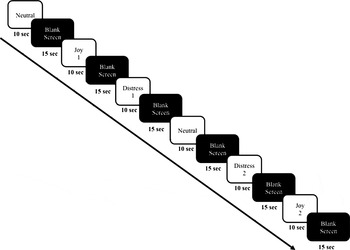
Following the procedure of Tomarken, Davidson, Wheeler, and Doss (Reference Tomarken, Davidson, Wheeler and Doss1992) each mother participated in an 8-min baseline recording session, subdivided into eight 1-mintrials (four with eyes open [O], four with eyes closed [C], in the following order: C, O, O, C, O, C, C, O). Participants heard instructions to either open or close their eyes each minute. In his review of methodological issues attendant to studies of frontal EEG asymmetry, Hagemann (Reference Hagemann2004) noted that an 8-min resting period such as this is likely to yield a highly reliable baseline measurement of asymmetry. Continuous EEG data were also recorded while mothers watched a 15-min video stream of their infant's emotion video clips. The clips were cut together into a single video presentation and repeated several times such that mothers saw 12 total video clips of their infant expressing joy (joy clip 1 × six total presentations + joy clip 2 × six total presentations), 12 total video clips of their infant expressing anger/distress (anger/distress clip 1 × 6 total presentations + anger/distress clip 2 × 6 total presentations), and 12 total video clips of their infant in a neutral emotional state. A 15-s black screen was presented between each emotion clip. The order of the 2 discrete joy, 2 discrete anger/distress, and 1 neutral video clips was counterbalanced within the overall video stream; all mothers viewed the emotion clips of their own infants in the same order (see Figure 1 for a partial diagram illustrating the video presentation).
Flow diagram of the beginning presentation of infant emotion video clips to mothers.

After EEG data acquisition, a 1–30 Hz bandpass filter was applied to isolate EEG activity within the 1–30 Hz range (Ray, Reference Ray, Cacioppo and Tassinary1990). Artifacts were screened and bad channels were replaced using automated Net Station 4.1.2 artifact detection software. In bad channel replacement, data from “bad” channels (fast transits exceeding 200 µV in a 640-ms window size) were replaced with data interpolated from the remaining channels using spherical splines. Studies have demonstrated that by utilizing spherical splines, voltage values at a given scalp location can be accurately interpolated from other evenly distributed scalp locations (Luu et al., Reference Luu, Tucker, Englander, Lockfeld, Lutsep and Oken2001; Perrin, Pernier, Bertrand, Giard, & Gechallier, Reference Perrin, Pernier, Bertrand, Giard and Gechallier1987). Data were rereferenced offline using an average reference with polar average reference effect (PARE) correction. An average reference is preferable to a Cz reference because no single scalp location can be assumed to have a voltage value of 0, against which all other locations can be referenced. Average reference with PARE correction uses spline interpolation to interpolate voltages at the bottom of the head where there are no electrodes, and uses this information to calculate a more accurate average reference (Junghoefer, Elbert, Tucker, & Braun, Reference Junghoefer, Elbert, Tucker and Braun1999). Last, principal components analysis (PCA) was used to remove artifacts in the continuous EEG record. PCA decomposes complex, superimposed effects in the EEG signal into uncorrelated constructs that are spatially orthogonal. PCA effectively reduced ocular artifact in the EEG record with minimal spectral distortion.
Each 10-s infant emotion clip and 15-s prestimulus blank screen was subdivided into 2-s epochs that overlapped by 1.5 s. Small epoch lengths improve the accuracy of estimating spectral power in the alpha bands (Wallstrom, Kass, Miller, Cohn, & Fox, Reference Wallstrom, Kass, Miller, Cohn and Fox2004), and the overlap compensates for the minimal weight accorded to the ends of each epoch from the application of a Hamming window weighting function. A fast Fourier transform was applied to all artifact-free epochs (after PCA analyses), and all power measures were log-transformed to avoid nonnormal distribution. The natural log transformation is customary in research on EEG asymmetry as EEG power values tend to be positively skewed (Tomarken, Davidson, Wheeler, & Doss, Reference Tomarken, Davidson, Wheeler and Doss1992). Average power in the 8- to 13-Hz band was taken as an index of alpha power.
EEG data reduction
An alpha asymmetry score was computed by taking the difference of natural log-transformed alpha power scores during all of the epochs at electrode sites that have symmetrical left and right locations. A cluster of six electrodes surrounding the F3 (left medial–frontal) location of the International 10-20 System (Ray, Reference Ray, Cacioppo and Tassinary1990; electrodes 19, 20 23, 24, 27, and 28) were averaged and subtracted from the average of a symmetrical cluster of six electrodes surrounding the F4 (right medial–frontal) location of the International 10-20 system (electrodes 3, 4, 117, 118, 123, and 124). Alpha asymmetry at lateral–frontal sites (F7/F8) was also examined. However, because of limited relations between lateral–frontal EEG asymmetry and the variables of interest, only the F3/F4 EEG asymmetry results are discussed below. The asymmetry score was computed such that the left log-transformed score was always subtracted from the right (i.e., ln[right]–ln[left]). Power in the alpha band is inversely associated with cortical activation. Thus, positive values on this index reflect relatively greater left cortical activity, and negative values reflect relatively greater right cortical activity.
Multiple composite scores of frontal EEG asymmetry were examined (i.e., an asymmetry score for each individual 10-s emotion video presentation, a single asymmetry score that averaged all presentations of the same infant emotion video clip, etc.); all yielded similar patterns of results when linked with the parenting process variables (mother–infant EA, maternal experienced emotions, and internalizing symptoms). Furthermore, there was no evidence of habituation or activation over the course of the video presentation, as frontal EEG asymmetry scores were generally consistent for duration of the continuous EEG recording. Thus, the most parsimonious approach is reported in the current study: three frontal EEG asymmetry scores were created. This was accomplished by averaging frontal EEG asymmetry scores extracted during all epochs within a given emotion type. For instance, a single alpha asymmetry score was computed for mothers while they watched their infant express joy by averaging all of the epochs from the 6 presentations of the infant joy video version 1 and the 6 presentations of the infant joy video version 2. The same procedure was completed for the six presentations of infant anger/distress video version 1 and the 6 presentations infant anger/distress video version 2, as well as the 12 presentations of the infant neutral video. In addition, all of the epochs corresponding to the presentations of the 15-s prestimulus blank screens were averaged together to create a single frontal EEG asymmetry score for the prestimulus period. Last, frontal EEG asymmetry extracted during the prestimulus period in the infant emotion video stream was subtracted from frontal EEG asymmetry during each of the 3 infant emotion videos (i.e., joy, anger/distress, and neutral interest). This computed difference score reflects an immediate shift toward greater relative right or left frontal activation in response to each infant emotion type, and is conceptualized as a potential index of maternal emotion regulation.
Results
Frontal EEG asymmetry during 8-min baseline (affective style)
There were no significant relations between frontal EEG asymmetry measured during the 8-min baseline period and mothers' endorsement or intensity ratings of discrete emotions after watching the infant emotion videos, observed EA, or reported depressive symptoms. However, as hypothesized, greater relative right frontal activation during the 8-min baseline period was associated with higher T scores on the SCL-90-R anxiety subscale, r (25) = −.43, p < .05. This relation appeared to be driven by the large correlation with “feeling tense,” r (25) = −.64, p < .001.
Frontal EEG asymmetry during infant emotion videos
A 3 × 2 within-subjects analysis of variance was conducted with infant emotion video (joy vs. anger/distress vs. neutral/interest) and hemisphere site of measured EEG alpha power (left hemisphere vs. right hemisphere) as the independent variables in order to test the hypothesis that left frontal activation would be greater during the infant joy videos than during infant anger/distress videos, and right frontal activation would be greater during infant anger/distress videos than during infant joy videos. There was no significant main effect of infant emotion video on alpha power, F (2, 25) = 2.319, p > .05. However, there was a significant main effect of hemisphere site such that left alpha power was significantly greater than right alpha power across all infant emotion video conditions, F (1, 26) = 7.842, p < .01. As alpha power is inversely related to activation, this indicated that mothers experienced greater relative right frontal than left frontal activation during all infant emotion videos, regardless of emotional valence. There was no significant Video × Hemisphere interaction, F (2, 25) = 0.99, p > .05.
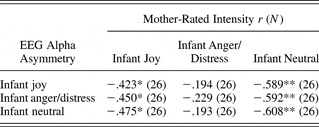
There were no significant relations between mothers' frontal EEG asymmetry during the infant emotion videos and mothers' reported depressive or anxious symptoms or observed mother–infant EA. However, frontal EEG alpha asymmetry during the infant videos was related to mothers' reported emotional experience in response to viewing the videos. Greater relative right frontal activation (negative asymmetry scores) during all three infant emotion videos (joy, anger/distress, and neutral interest) was associated with mothers' endorsement of irritability/anger in response to seeing their own infant in distress. The greater mothers' relative right frontal activation while watching their infants (regardless of their infant's emotional state), the more likely they were to report irritability/anger upon seeing their infant in distress (see Table 1). Mothers' frontal EEG asymmetry while watching the infant emotion videos was unrelated to the intensity of mothers' emotional experiences in response to the videos. However, greater relative right frontal activation during all the three infant emotion videos was associated with greater intensity of infant expressed emotion in the joy and neutral videos only, as rated by their mothers. Mothers described their own infant as expressing primarily joy (50.0%), excitement (27.7%), or interest (14.8%) in the infant joy videos, and primarily expressing interest (59.3%) or contentment (14.8%) in the infant neutral interest videos. Thus, the greater mothers' relative right frontal activation when viewing their infants (regardless of their infant's emotional state), the more intense they perceived their infant's joy/excitement to be in the infant joy videos, and the more intense they perceived their infant's interest/contentment to be in the infant neutral video (see Table 2). The magnitude of mothers' frontal EEG asymmetry during the infant emotion videos was unrelated to mothers' perception of the intensity of their own infant's distress in the infant anger/distress videos.
Frontal EEG alpha asymmetry during infant emotion videos and mothers' endorsement of emotions experienced in response to infant anger/distress video version 1

*p < .05.
Frontal EEG alpha asymmetry during infant emotion videos and mothers' ratings of intensity of infants' displayed emotion in videos

*p < .05. **p < .01.
Shift in frontal EEG asymmetry from prestimulus period to infant emotion video (“capability model”)
Mothers' frontal EEG asymmetry during the infant emotion videos was highly correlated (mean rs = .99, p < .001) with frontal EEG asymmetry during the prestimulus period (15-s blank screens that were presented to mothers prior to each presentation of a 10-s infant emotion video clip). This strong correlation, however, can mask subtle shifts in frontal EEG asymmetry that occur in response to each infant emotion video. Therefore, frontal EEG asymmetry during the prestimulus (blank screen) period was subtracted from frontal EEG asymmetry during the infant emotion videos. This computed difference score reflects a shift toward greater relative right or left frontal activation from the prestimulus period to each infant emotion video, and was linked to mother–infant EA and mother-reported experienced emotions in response to infant emotion videos.
Mothers' reported emotional experience in response to infant emotion videos
A shift toward greater relative right frontal activation in response to infant joy videos was associated with mothers not endorsing guilt when seeing their infant in distress. A shift toward greater relative right frontal activation in response to infant anger/distress videos was associated with mothers not endorsing joy and endorsing irritability/anger when seeing their infant in distress. Last, a shift toward greater relative right frontal activation in response to infant neutral videos was associated with mothers not endorsing joy when seeing their infant in distress (see Table 3).
Shift in frontal EEG alpha asymmetry from prestimulus (blank screen) intervals to infant emotion videos and mothers' endorsement of emotions experienced in response to infant anger/distress video version 1

*p < .05. **p < .01.
Regarding the intensity of mothers' emotional experiences, a shift toward greater relative right frontal activation in response to infant anger/distress videos was associated with a greater intensity of mother-reported sadness and concern/worry when seeing their infant in distress. In addition, a shift toward greater relative right frontal activation in response to infant anger/distress was also associated with a greater intensity of mother-rated child emotional expression in the infant anger/distress videos (see Table 4). Mothers described their own infant as expressing primarily anger/frustration (78.8%) in the infant anger/distress video conditions. Thus, the greater the shift toward relative right frontal activation in response to infant anger/distress videos, the more intensely mothers rated their own infant's negative state.
Shift in frontal EEG alpha asymmetry from prestimulus (blank screen) intervals to infant emotion videos and mothers' ratings of intensity of emotions in response to infant anger/distress videos and ratings of intensity of infants' displayed emotion

*p < .05.
Observed mother–infant EA
A shift toward greater relative right frontal activation during infant joy and infant anger/distress videos was associated with greater observed EA sensitivity and structuring. In addition, a shift toward greater relative right frontal activation during infant joy was associated with greater observed EA nonintrusiveness (see Table 5). A shift in frontal EEG asymmetry in response to infant emotion videos was unrelated to the child-focused EA Scales (i.e., child responsiveness and child involvement). It is interesting that only a shift in frontal EEG asymmetry in response to infant positive and negative emotion videos was related to observed EA; a shift in frontal EEG asymmetry in response to infant neutral interest videos was unrelated to observed EA.
Shift in frontal EEG alpha asymmetry from prestimulus (blank screen) intervals to infant emotion videos and observed emotional availability

*p < .05.
Internalizing symptoms
Because of the significant relation that emerged between frontal EEG asymmetry during the 8-min baseline period and anxious symptoms, it is possible that an underlying predisposition for internalizing symptoms may mask subtle shifts in asymmetry that occur in response to each infant emotion video. Thus, frontal EEG asymmetry during the 8-min baseline was subtracted from frontal EEG alpha asymmetry during the infant emotion videos, and this computed difference score reflects a shift toward greater relative right or left frontal activation from the resting (baseline) period to each infant emotion video. A shift toward greater relative right frontal activation from the 8-min baseline period to the infant joy, anger/distress, and neutral interest videos was associated with lower T scores on the SCL-90-R anxiety subscale, r (25) = .41, p < .05; r (25) = .40, p < .05; and r (25) = .393, p < .05, respectively. Thus, the greater the shift toward relative right frontal activation from mothers' resting frontal EEG asymmetry to the infant emotion videos, the less anxiety mothers reported. There were no significant relations between shift in frontal EEG asymmetry and current or past depressive symptoms.
Discussion
Drawing from a developmental psychopathology framework (Cicchetti & Toth, Reference Cicchetti and Toth2009), child development is conceptualized as a dynamic process that involves transactions between biological, psychological, and social/environmental systems. The parent–child relationship is a critical environmental system that influences child adaptive and maladaptive developmental trajectories (i.e., Belsky, Reference Belsky1984; Cox & Paley, Reference Cox and Paley1997; Minuchin, Reference Minuchin1985). New perspectives on parenting at risk call for increased study of parents' in the moment, or online, emotional experiences and emotion regulation capacities during parenting events (Teti & Cole, in press). This study utilized ecologically valid and highly relevant emotional stimuli—video recordings of mothers' own 5- to 8-month-old infants displaying three emotion states (joy, anger/distress, and neutral interest)—in the examination of the links between mothers' frontal EEG asymmetry and observed mother–infant EA in the home, mothers' reports of depressive and anxious symptoms, and mother-reported emotional experience in response to infant emotion cues. Frontal EEG asymmetry was examined at rest (baseline), during infant emotion videos (online), and as a shift from the prestimulus interval to the infant emotion videos, as a potential index of maternal emotion regulation.
First, we found that frontal EEG asymmetry at rest (baseline) was unrelated to observed mother–infant EA in the home and mother-reported emotional experience in response to infant emotion cues. Although extensive research suggests that frontal EEG asymmetry at rest can be conceptualized as a predisposition to respond in a particular way to environmental stimuli (termed affective style; Davidson, Reference Davidson1998), it may be that mother–infant EA and maternal experienced emotions in response to infant cues are more dependent upon context rather than individual differences in affective/motivational tendencies (i.e., an approach- vs. withdrawal-orientation). Positive and negative emotionality involves personal goal attainment or failure. In the parenting context, however, positive and negative emotions likely reflect an interaction between both parent- and child-oriented goals and concerns (Dix, Reference Dix1991; Leerkes & Crockenberg, Reference Leerkes and Crockenberg2006). In addition, frontal EEG asymmetry at rest (baseline) was unrelated mothers' reports of depressive symptoms, but as expected, greater relative right frontal activity at rest was associated with greater reported anxiety. Extensive empirical investigations have linked frontal EEG asymmetry at rest and depression (for a meta-analytic review, see Thibodeau, Jorgensen, & Kim, Reference Thibodeau, Jorgensen and Kim2006). Although participants in the current study reported a range of depression scores on a self-report measure of symptoms, none of the mothers reported symptoms within the clinical range (i.e., T scores ≥ 69), and most scores would be considered within normal limits. It may be that affective style is a better predictor of more severe affective symptomatology (Sutton & Davidson, Reference Sutton and Davidson1997; Thibodeau et al., Reference Thibodeau, Jorgensen and Kim2006; Tomarken, Davidson, Wheeler, & Doss, Reference Tomarken, Davidson, Wheeler and Doss1992), and less useful as a marker of normative variance in depressive symptoms within a nonclinical sample. However, research on the link between frontal EEG asymmetry at rest and anxiety has been mixed (Coan & Allen, Reference Coan and Allen2003; Sutton & Davidson, Reference Sutton and Davidson1997; Tomarken & Davidson, Reference Tomarken and Davidson1994). To account for variability in these findings, Heller and colleagues (Heller, Nitschke, Etienne, & Miller, Reference Heller, Nitschke, Etienne and Miller1997; Nitschke, Heller, Palmieri, & Miller, Reference Nitschke, Heller, Palmieri and Miller1999) have suggested a distinction between “anxious arousal” and “anxious apprehension,” with the former involving physiological arousal and hyperreactivity under panic conditions, and the latter involving worry and verbal rumination. Greater relative right frontal activity during a baseline condition has been associated with higher anxious arousal, whereas greater relative left frontal activity during a baseline has been associated with higher anxious apprehension (Mathersul, Williams, Hopkinson, & Kemp, Reference Mathersul, Williams, Hopkinson and Kemp2008). Indeed, the relation between frontal EEG asymmetry at rest and anxiety symptoms in the current study was largely driven by the strong correlation with the item, “feeling tense,” a symptom of physiological arousal. Findings from the current study suggest that frontal EEG asymmetry at rest may serve as a marker for anxiety, even when considering normal variation within a nonclinical sample.
Next, and contrary to expectation, mothers did not demonstrate a differential pattern of affective/motivational responding to the infant emotion videos (joy, anger/distress, neutral interest); a pattern of greater relative right frontal activation emerged during all infant emotion videos. Although frontal EEG asymmetry research has consistently linked greater relative right frontal activation in response to emotional stimuli with negative, withdrawal-oriented emotions (e.g., sadness, disgust; Coan et al., Reference Coan, Allen and Harmon-Jones2001; Davidson et al., Reference Davidson, Ekman, Saron, Senulis and Friesen1990; Harmon-Jones et al., Reference Harmon-Jones, Sigelman, Bohlig and Harmon-Jones2003), recent investigations suggest that low-level, internally focused, positive emotions without an approach-orientation (e.g., contentment, empathy) are associated with shifts toward greater relative right frontal activation (Light, Coan, Frye, et al., Reference Light, Coan, Frye, Goldsmith and Davidson2009). Mothers in the current study may have experienced a sense of contentment or low-level joy when seeing videos of their own infants, regardless of the infant's emotional displays, because the context did not require nor permit their intervention. Mothers consented to the procedures that were used to elicit positive and negative emotions from their infants, and they were aware of the time lapse between the video recordings and the lab visit. This provided ample time for mothers to be confident that their infant was not experiencing any continual distress from the procedures used.
We also found that frontal EEG asymmetry during infant emotion videos was unrelated to observed mother–infant EA in the home or internalizing symptoms, but was, in fact, related to maternal reported experience of emotion in response to the infant emotion videos. Greater relative right frontal activation while viewing videos of one's own infant, regardless of the infant's emotional state, was linked to maternal experience of irritability/anger when watching the infant anger/distress video, as well greater perceived intensity of infant joy during the joy videos. Thus, greater relative right frontal activation in response to seeing one's own infant is related to maternal negative affect matching during times of infant distress, and greater perceived intensity of infant joy during times of joy.
The most striking evidence, however, in regard to the findings of online maternal affective/motivational responding was that a shift toward greater relative right frontal activation from the prestimulus interval to the infant anger/distress videos—a potential index of maternal emotion regulation—was related to greater EA sensitivity and structuring in the home, and mothers' endorsement of irritability/anger, a greater intensity of maternal sadness and concern, and greater perceived intensity of infant anger/distress in response to the infant anger/distress video. In addition, a shift toward greater relative right frontal activation from the prestimulus interval to the infant joy video was related to greater EA sensitivity, structuring, and nonintrusiveness, as well as a lower intensity of maternal guilt in response to the infant anger/distress video. This pattern of findings suggests that parents' capacity for affective/motivational responding in an emotional context, and not just in the parent–infant context more broadly (i.e., when the infant is expressing neutral interest), is related to mother–infant EA. Taken together, these findings suggest that a shift toward greater relative right frontal activation from the prestimulus period to the infant emotion videos, a potential index of maternal ER, may reflect an empathetic process; it is linked to greater mother–infant EA in the home, and mothers' negative affect matching with their infant, without guilt, during periods of infant distress. Recent investigations suggest that empathetic processes may be linked to greater relative right frontal activation (Light, Coan, Zahn-Waxler, et al., Reference Light, Coan, Zahn-Waxler, Frye, Goldsmith and Davidson2009). Light and colleagues make a distinction between empathetic concern (i.e., experiencing feelings of goodwill and concern in response to someone's distress), empathetic cheerfulness (i.e., a tendency to exude positive emotion in response to the negative emotions of another as a means to alleviate another's suffering), and empathetic happiness (i.e., positive affect sharing). They found that children rated high on empathetic concern during an empathy task showed greater relative right frontal activation for at least the first 30 s of a pleasurable task, and then shifted toward greater relative left frontal activation for the remainder of the pleasurable task. In contrast, children rated high on empathetic happiness exhibited and maintained relatively equal left and right frontal activation over the course of the pleasurable task, and children high on empathetic cheerfulness exhibited consistently greater relative left frontal EEG asymmetry over the course of the pleasurable task. The current study recorded frontal EEG asymmetry during emotion epochs that were only 10 s in duration, which may reflect only the initial stages of an empathetic concern experienced by mothers in response to their own infant's distress.
It was also particularly interesting that a shift toward greater relative right frontal activation from the 8-min baseline (conceptualized as measuring mothers' predisposition to the development of psychopathology and grounded in the affective style research and theory) to all infant emotion videos (joy, anger/distress, neutral interest) was associated with less anxiety in mothers. This finding stood in contrast to the findings that greater relative right frontal activity at rest was associated with greater anxiety, and a lack of an association between frontal EEG asymmetry during infant emotion videos and anxiety. We would contend that a mothers' capacity to shift toward a more internally focused, low-level joy/contentment in response to seeing their own infant expressing a range of emotions, in a context in which there is no opportunity to intervene, is congruent with lower anxiety. Although mothers who are more right frontally activated at rest may be more anxious in general (but within the nonclinical range of severity), mothers with the capacity for empathetic concern and the experience of contentment in a parenting context are less likely to be anxious when they see their infant in an emotional context. Taken together, the findings of the current study suggest that microlevel affective/motivational responding measured at rest or in response to infant emotional stimuli does not fully capture online parenting processes. It is instead the mothers' capacity for an affective/motivational response to a child-created emotional event that is related to mother–infant EA, maternal experienced emotions, and internalizing symptoms, which is congruent with Coan et al. (Reference Coan, Allen and McKnight2006) capability model of frontal EEG asymmetry.
Strengths of the current study include the ecologically valid and personally relevant infant emotion videos, the range of emotional contexts including infant displays of joy, anger/distress, and neutral interest, and the measurement of parenting processes from multiple levels of analysis including physiological assessment, maternal self-report, and behavioral observation. The present study is among the first to capture frontal EEG asymmetry in mothers as they respond to video—not just static photographs—of their own infants. The current study had several limitations as well. The emotional stimuli were created using mothers' own infants; future investigations of frontal EEG asymmetry as an index of online parenting processes must employ a control condition of an unfamiliar infant in order to truly identify a parenting response versus a more global response of a parent to an infant. Future research should also investigate online parenting processes at different developmental stages (i.e., infancy, toddlerhood, childhood), with developmentally sensitive emotion stimuli (i.e., noncompliance episodes in toddlers, successful completion of a puzzle by young children). In addition, affective chronometry investigations (Light, Coan Frye, et al., Reference Light, Coan, Frye, Goldsmith and Davidson2009; Light, Coan, Zhan-Waxler, et al., Reference Light, Coan, Zahn-Waxler, Frye, Goldsmith and Davidson2009) suggest that studying change in parental emotional experience over the course of unfolding parent–child interactions may further explicate the nature of online parenting processes.
Patterns of frontal EEG asymmetry in the current study might have been different if mothers believed they could take action to maintain infant positive affect or alleviate infant distress. Future work might attempt to incorporate methods by which mothers could take some form of action. In addition, the present study was limited by a small sample size, and thus had limited power to detect anything but large effects. Many correlations in the present study exceeded 0.30—a “medium” effect size (Cohen, Reference Cohen1992) but did not reach significance at the p < .05 level. Last, despite a wide range of internalizing symptoms endorsed by mothers in the present study, levels of depression and anxiety were subclinical. A larger sample, including participants with clinical levels of internalizing symptoms, might shed light as to the nature of online parenting processes in response to infant cues within a clinically depressed or anxious population, and how thoughts, feelings, and behaviors associated with these disorders serves to undermine parental competence. In sum, results of this study suggest that frontal EEG asymmetry, as a measure of emotional/motivational disposition and/or response to emotion events, is limited as an index of emotionally available parenting, subjective emotional experience in a parenting context, and depressive and anxious symptoms. However, mothers' capacity for an affective/motivational response, given a child-created emotional event, is related to mother–infant EA, maternal experienced emotions, and internalizing symptoms. Investigations of this nature may aid in the identification of risk and resilience factors within the parent–infant relationship that predict adaptive versus maladaptive child developmental trajectories.