Introduction
A possible reciprocal relation between sleep function and the vestibular system has been the object of previous research; it has been shown that in addition to balance control, the vestibular network contributes to regulating heart rate, blood pressure and breathing.Reference Quarck, Ventre, Etard and Denise1–Reference Micarelli, Viziano, Pistillo, Granito, Micarelli and Alessandrini3
In this scenario, studies have elucidated some contribution of the vestibular system to the sleep cycle; such an association may be underpinned by the anatomical contiguity between neurons involved in sleep organisation, located in the raphe nuclei and in the pontine reticular formation, and anatomical structures receiving input from the otolithic organs, possibly exerting an influence on mediation between sleep stages.Reference Puligheddu, Figorilli, Serra, Laccu, Congiu and Tamburrino4,Reference de Natale, Ginatempo, Laccu, Figorilli, Manca and Mercante5 Furthermore, changes in autonomical functions, such as pupillary responses or variation of heart rate and blood pressure peaks typical of rapid eye movement (REM) sleep, are abolished in cases of vestibular nuclei lesions.Reference Morrison and Pompeiano6
It is worth noting that when a multiparametric sleep analysis was performed on a large sample of patients suffering from chronic unilateral vestibular hypofunction, a different pattern in sleep behaviour was found.Reference Micarelli, Viziano, Pistillo, Granito, Micarelli and Alessandrini3,Reference Albathi and Agrawal7 Individuals with unilateral vestibular hypofunction were spending less time sleeping and taking more time to go from being fully awake to sleeping; moreover, self-reported, sleep-specific questionnaires depicted such patients as more prone to having poor sleep quality.Reference Micarelli, Viziano, Pistillo, Granito, Micarelli and Alessandrini3,Reference Albathi and Agrawal7 Such findings may reinforce the hypothesis on connections between sleep and the vestibular system being bidirectional, not limited to known effects of sleep deprivation or sleep apnea on vestibular functionReference Quarck, Ventre, Etard and Denise1,Reference Alessandrini, Liguori, Viziano, Izzi, Capoccia and Lanzillotta8–Reference Micarelli, Liguori, Viziano, Izzi, Placidi and Alessandrini11 but also extending to a direct effect of vestibular dysfunction on sleep performance.Reference Besnard, Tighilet, Chabbert, Hitier, Toulouse and Le Gall10 On this point, previous research on human and animal models has already hinted at the fact that stimulation, or training, of the vestibular system could in turn improve sleep quality.Reference van Sluijs, Rondei, Schluep, Jäger, Riener and Achermann12,Reference Kompotis, Hubbard, Emmenegger, Perrault, Mühlethaler and Schwartz13
Vestibular rehabilitation can be defined as a blend of several different strategies to enhance neuroplasticity, with the goal of diminishing residual symptoms from chronic vestibular dysfunction and improving static and dynamic balance.Reference Hall, Herdman, Whitney, Anson, Carender and Hoppes14 Moreover, it has demonstrated positive effects on multiple vestibular-related domains and quality of life.Reference Hall, Herdman, Whitney, Anson, Carender and Hoppes14,Reference Micarelli, Viziano, Augimeri, Micarelli and Alessandrini15 On this point, recent evidence has offered an interesting insight on possible effects of vestibular rehabilitation going beyond vestibular function: an improvement in metabolic parameters and daily-living activities was found after vestibular rehabilitation was performed in a population suffering from chronic unilateral vestibular hypofunction.Reference Micarelli, Viziano, Carbini, Misici, Guzzo and Micarelli16 This may suggest that by enhancing neuroplasticity and opposing long-term changes due to deafferentation, or merely because of patients being more motivated to follow an active lifestyle, vestibular rehabilitation could exert a beneficial effect on parameters that may not be specific to balance function.
To date, the impact of vestibular rehabilitation on sleep function and structure in individuals affected by chronic uncompensated unilateral vestibular hypofunction has not been quantified. The aim of this study was to investigate possible changes in sleep parameters and in self-perceived sleep quality in a cohort of patients affected by chronic unilateral vestibular hypofunction, after a cycle of vestibular rehabilitation was performed.
Materials and methods
Participants selection
A total of 51 consecutive unilateral vestibular hypofunction participants were enrolled from February 2019 to March 2021 by the Uniter Onlus, a regional institutional interdisciplinary disorder clinic, after they had been enrolled in the local longitudinal cohort study. Only patients presenting with a concurrent reduction in vestibulo-ocular reflex gain were included in this study (see Video Head Impulse Test paragraph below).
By using a frequency-matching procedure, a population of 60 gender- and age-matched healthy patients serving as the control group were extracted from the institutional database by a biostatistician who was not involved in the study.
According to previous experiences, diagnosis of chronic unilateral vestibular hypofunction was achieved,Reference Hall, Herdman, Whitney, Anson, Carender and Hoppes14 using bithermal caloric irrigation, with a reduced response on one side of at least 25 per cent when calculated by means of Jongkees’ formula. Disease onset was to be at least three months earlier.Reference Alessandrini, Micarelli, Chiaravalloti, Candidi, Bruno and Di Pietro17 No patient had ever undergone vestibular rehabilitation treatment before.
A clinical otoneurological examination, including binocular electro-oculography analysis with positional manoeuvres, Head Shaking Test, clinical Head Impulse Test, gait observation, limb co-ordination tests, Romberg stance test, pure tone audiometry and impedance was performed on all study participants.Reference Micarelli, Viziano, Bruno, Micarelli and Alessandrini18 Hearing loss was accounted for in the matching procedure between unilateral vestibular hypofunction participants and the control group, according to the American Academy of Otolaryngology guidelines.19
Demographic data, such as age and gender, and anthropometric measurements for all study participants were extracted from their charts, as well as (for patients with unilateral vestibular hypofunction) disease cause, side and duration from onset (disease duration, in months).
Sleep evaluation
According to the American Academy of Sleep Medicine criteria,Reference Berry, Budhiraja, Gottlieb, Gozal, Iber and Kapur20 and in order to exclude sleep disorders,Reference Micarelli, Liguori, Viziano, Izzi, Placidi and Alessandrini11 all patients underwent home-based polygraphic cardiorespiratory monitoring in order to evaluate the Apnea–Hypopnea Index and parameters related to arterial oxygen saturation: mean arterial oxygen saturation, lowest arterial oxygen saturation, mean arterial oxygen desaturation and Oxygen Desaturation Index (number of oxygen desaturation episodes of equal to or more than 3 per cent per hour).Reference Berry, Budhiraja, Gottlieb, Gozal, Iber and Kapur20,Reference Liguori, Romigi, Izzi, Mercuri, Cordella and Tarquini21
Exclusion criteria
Participants were excluded from this study if the clinical history on their charts reported cardiovascular, rheumatological, orthopaedic or neurological conditions, or previous falls. All participants were screened for blood test abnormalities, such as evidence of kidney or liver dysfunction. Pregnant or breastfeeding patients were excluded. Chronic neurological impairment was excluded by means of the Mini Mental State Examination and magnetic resonance imaging. Other abnormalities possibly causing otoneurological dysfunction, such as neuro-psychiatric disorders, lung disease, vitamin deficiencies, diabetes and hypothyroidism were screened for, and patients with positive history or examination were not included in the study. Participants taking drugs impacting on the cochleo-vestibular system or with a history of drug or tobacco or alcohol addiction were excluded. Individuals were also excluded from the study if they were unable to understand examination procedures or participate in such procedures because of other physical conditions.Reference Micarelli, Viziano, Carbini, Misici, Guzzo and Micarelli16
Ethics committee and public registration
The study was approved by the Regional Lazio institutional review board (registration number: 1668/2017), and it adhered to the principles of the Declaration of Helsinki. The study was registered in the public registry ClinicalTrials.gov (number: NCT05174104), and all participants provided written informed consent after receiving a detailed explanation of the study. Participants with unilateral vestibular hypofunction, before and after vestibular rehabilitation, and the control group underwent the tests in the following sections.
Video Head Impulse Test
For Video Head Impulse Test measurements, a protocol used in previous studies was implemented.Reference Micarelli, Viziano, Bruno, Micarelli and Alessandrini18,Reference Blödow, Pannasch and Walther22,Reference Alessandrini, Micarelli, Viziano, Pavone, Costantini and Casali23 Results were classified as abnormal if gain was off the scale of calculated normative data and if refixation saccades (showed by visual inspection, according to Blödow et al.Reference Blödow, Pannasch and Walther22) were present. With the manufacturer's software (OtoAccess™), median values from both sides, recorded at 60 ms were extracted on Excel® spreadsheet software files for raw data analysis. Diagnosis of unilateral vestibular hypofunction, as per previous procedures,Reference Micarelli, Viziano, Bruno, Micarelli and Alessandrini18,Reference Blödow, Pannasch and Walther22 was confirmed with vestibulo-ocular reflex gain values below 0.75 and 0.76 for left and right sides, respectively. This was calculated as the lower value of the laboratory gain reference range regarding a population of healthy volunteers (calculated as meannormal ± 2 (standard deviations (SDs)), which is equal to 0.89 ± 2 (0.07) and to 0.88 ± 2 (0.06) for left and right sides, respectively.
Static posturography testing
In order to monitor the centre of pressure during posturography analysis, each patient was instructed to keep an upright position on a standardised platform (ED800, Medi-Care Solutions, Euroclinic, Bologna, Italy).Reference Alessandrini, Micarelli, Viziano, Pavone, Costantini and Casali23 The recording period was 60 seconds for each test (eyes closed or open while standing on the stiff platform), and the sampling frequency in the time domain was 25 Hz.Reference Alessandrini, Micarelli, Viziano, Pavone, Costantini and Casali23–Reference Micarelli, Viziano, Della-Morte, Augimeri and Alessandrini25 The centre of pressure was monitored while performing the test. The posturographical parameters considered in our study were the path length (in millimetres) and the 95 per cent confidence ellipse area (area in millimetres squared), both calculated according to Prieto et al.Reference Prieto, Myklebust, Hoffmann, Lovett and Myklebust26
Actigraphy-based sleep analysis
Actigraphy analysis was performed for a period of one week by means of the wGT3X-BT device by ActiGraph (Pensacola, USA). Such a device is a triaxial accelerometer measuring wrist acceleration in three orthogonal axes at a sampling frequency of 80 Hz. This device is waterproof, with a battery life of approximately three weeks. The device did not provide any feedback to the participants about their activity or sleep.Reference Asgari Mehrabadi, Azimi, Sarhaddi, Axelin, Niela-Vilén and Myllyntausta27 Data collected by the device were utilised to estimate the following sleep parameters: sleep onset latency, total sleep time, wake time after sleep onset, and sleep efficiency for each participant. These parameters were calculated for the whole week period.Reference Micarelli, Viziano, Pistillo, Granito, Micarelli and Alessandrini3,Reference Martin, Moussay, Bulla, Bulla, Toupet and Etard28
Raw data were converted into 60-second epochs by means of manufacturer-provided software (ActiLife software version 6.13, ActiGraph).Reference Asgari Mehrabadi, Azimi, Sarhaddi, Axelin, Niela-Vilén and Myllyntausta27 Non-wear periods were excluded based on criteria followed in previous experiences.Reference Troiano, Berrigan, Dodd, Mâsse, Tilert and McDowell29 Sleep data were systematically checked for accuracy by the same researcher, with the subsequent exclusion of obvious outliers.Reference Asgari Mehrabadi, Azimi, Sarhaddi, Axelin, Niela-Vilén and Myllyntausta27 According to recommendations,Reference Asgari Mehrabadi, Azimi, Sarhaddi, Axelin, Niela-Vilén and Myllyntausta27,Reference Ancoli-Israel, Cole, Alessi, Chambers, Moorcroft and Pollak30 both groups’ patients were also asked to report their sleep times, such as bedtime, wake-up time and naps, during the seven-day study period via a self-report form, structured like a daily log. Patients were also instructed to report other relevant events happening during the study recording period, such as device removal from the wrist or clinical symptoms. The self-report data were used as an aid and an integration in the interpretation of actigraphy data, thus mitigating possible errors.
Self-report and performance measures
The Italian Dizziness Handicap Inventory version was used for this study. It comprises 25 items designed to assess functional (9 questions), emotional (9 questions) and physical (7 questions) limitations on a three-point scale and their sum (total Dizziness Handicap Inventory).Reference Nola, Mostardini, Salvi, Ercolani and Ralli31
The Activities-Specific Balance Confidence scale was used in order to assess patient perceived level of balance confidence during 16 daily living activities, with scores ranging from 0 to 100 per cent.Reference Herdman, Hall, Maloney, Knight, Ebert and Lowe32
The Dynamic Gait Index was used to evaluate the ability to perform various gait activities, such as walking with head turns and avoiding obstacles.Reference Herdman, Hall, Maloney, Knight, Ebert and Lowe32 The scale has eight items, and each item is scored from zero to three.Reference Herdman, Hall, Maloney, Knight, Ebert and Lowe32
Pittsburgh Sleep Quality Index is a self-rated questionnaire about sleep quality during the last month, consisting of 19 items with a 4-point Likert-type response format.Reference Curcio, Tempesta, Scarlata, Marzano, Moroni and Rossini33 Pittsburgh Sleep Quality Index contains a zero to three interval scale with seven components (subjective sleep quality, sleep latency, sleep duration, habitual sleep efficiency, sleep difficulty, use of sleeping medication and difficulty of diurnal awakening). A cut-off score of five has shown good sensitivity and specificity for people with sleep disorders.Reference Curcio, Tempesta, Scarlata, Marzano, Moroni and Rossini33
The Italian version of the reduced Morningness–Eveningness Questionnaire was used to evaluate the patient circadian rhythm.Reference Natale, Esposito, Martoni and Fabbri34 This scale contains five items, related to preferred bedtime, get-up time, tiredness in the morning, peak performance and a global self-assessment item. Based on their scores, individuals were categorised as being evening type (4–10), intermediate type (11–18) and morning type (19–25).Reference Natale, Esposito, Martoni and Fabbri34
Vestibular rehabilitation protocol
In light of diagnostic test results, history and physical examination, a personalised exercise programme was developed by an otoneurologist and administered to patients by a skilled physiotherapist, who was blinded to the study. The treatment programme consisted of training and exercise components. The rationale and clinical basis, as well as contraindications for performing any exercise were explained during the training component. Patients affected by unilateral vestibular hypofunction were actively involved in adapting the exercise programme to suit their symptoms, capabilities and lifestyle. The execution of such exercises was personalised as much as possible by the therapist, based on individual symptoms and disability. The exercises were designed to be challenging during the training period, and different aspects of balance training were emphasised for different participants to provide further individualisation. Exercises can be summarised as follows.Reference Herdman, Hall, Maloney, Knight, Ebert and Lowe32,Reference Giray, Kirazli, Karapolat, Celebisoy, Bilgen and Kirazli35
Adaptation exercises
Patients were initially asked to move only their heads in yaw rotation while focusing on a stationary hand-held target, named X (times) 1 viewing. They then progressed to the named X2 viewing, in which the target and the head rotated in equal and opposite yaw directions. Exercises were performed in the horizontal and vertical plane, three times a day, for one minute each.
Substitution exercises
Participants with very little residual vestibular input were taught to use vision and somatosensation in order to replace their loss of vestibular function. For example, a patient might be instructed to fixate gaze to stabilise walking and to decrease veering to the side, or to stand on the foam with eyes closed to keep balance. Substitution exercises could be modified to become increasingly more difficult as participants improved.
Desensitisation exercises
Disturbances that the patients experienced during their daily activities were determined. Additional desensitisation exercises were added for those participants who reported enhanced sensitivity or poor tolerance to self or visual motion.
Balance exercises
Patients attempted to restore balance while switching between static (for example standing) and dynamic movements (for example walking) by altering visual, somatosensory and vestibular impulses.
The exercise programme consisted of 2 sessions per week for a period of 4 weeks, with each session lasting for approximately 30 to 45 minutes in the rehabilitation unit. All participants affected by unilateral vestibular hypofunction were followed up once a week by the otoneurologist, who reviewed the exercises and suggested changes to the rehabilitation programme together with the therapist. In addition to the exercises they performed at the clinic, all patients were given instructions about exercises to be performed at home, twice a day. Each home programme was designed to take approximately 30 to 40 minutes. Home programmes consisted of 4 to 5 exercises, encompassing substitution, habituation and balance, chosen among the ones that participants were performing at the rehabilitation unit. During the training period, compliance was monitored by the otoneurologist and therapist. Home exercises were monitored with a chart that was filled in every day by the patient.Reference Giray, Kirazli, Karapolat, Celebisoy, Bilgen and Kirazli35
Data handling and statistical analysis
Following previous experiences strongly associating unilateral vestibular hypofunction with balance control alterations and to changes in self-report measures or performance measures,Reference Micarelli, Viziano, Augimeri, Micarelli and Alessandrini15,Reference Micarelli, Viziano, Bruno, Micarelli, Augimeri and Alessandrini36 the sample size was calculated to detect inter-group differences in the results for the posturography variables (surface and length in both closed and open eye conditions) and Dynamic Gait Index, Dizziness Handicap Inventory and Activities-Specific Balance Confidence scale.
The sample size for the test hypothesis was calculated accordingly with the context (independent samples and continuous variables), using a statistical power of 80 per cent (1-β) for an error probability of 0.05. We used the t-test for independent samples and an effect size of 0.80. We thus determined to include at least 44 participants per group.
The chi-squared test was carried out to define associations between categorical factors (including Pittsburgh Sleep Quality Index and reduced Morningness–Eveningness Questionnaire categorisations) and groups. Given their quantitative nature, descriptive data were calculated as mean and SD for otoneurological values, self-report and performance measure scores, and actigraphy measurements. In order to assess that data for independent samples were of Gaussian distribution, D'Agostino's K-squared normality and Levene's homoscedasticity test were applied (where the null hypothesis is that the data are normally and homogeneously distributed).
A between-group analysis of variance was performed for each otoneurological, self-report or performance measure score and actigraphy variable. In order to obtain a unique entry of the vestibulo-ocular reflex gain, the average between right and left side was calculated in control group participants in agreement with previous quantitative studies.Reference Micarelli, Liguori, Viziano, Izzi, Placidi and Alessandrini11,Reference Moon, Chang and Kim37 Gender was treated as a categorical predictor, and age and unilateral vestibular hypofunction disease duration were treated, where possible, as continuous predictors. The significant cut-off level (α) was set at a p-value of 0.05. Bonferroni correction for multiple comparisons was used for the post hoc test of the significant main effects, and the corrected level of significance was set at 0.017. Then, according to previous protocols,Reference Micarelli, Viziano, Della-Morte, Augimeri and Alessandrini25 and given the exploratory nature of the study, a two-tailed Spearman's rank correlation was performed in unilateral vestibular hypofunction participants between pre- and post-treatment differences (change) in those otoneurological, self-report and performance measures and actigraphy measurement scores that were significantly different when comparing the pre- and post-scores. Given the large sample size of this group and the two-tailed nature of the test, a significant cut-off level (α) was set at a p-value of 0.05 (Statistica® 7 package for Windows).
Results
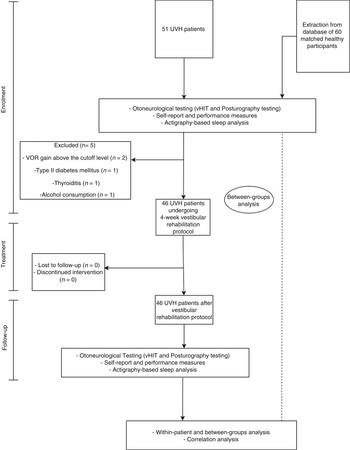
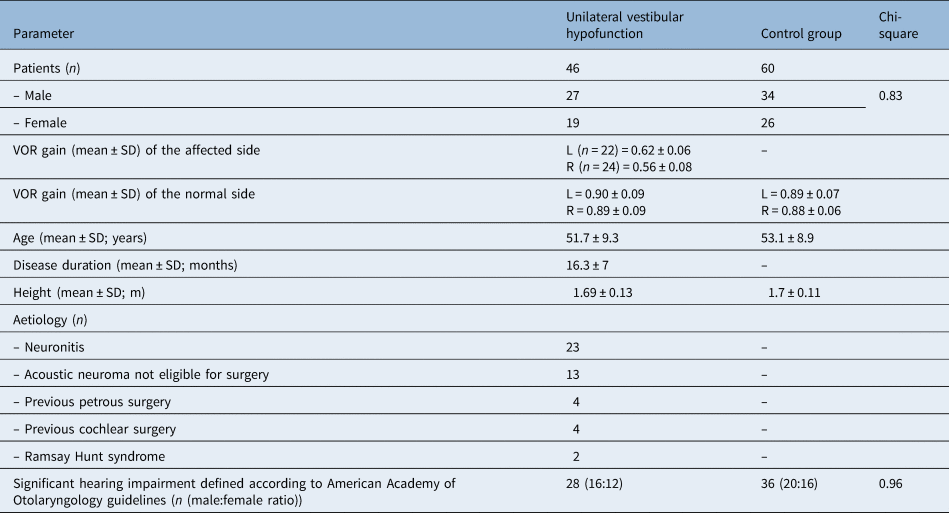
Among 51 right-handed unilateral vestibular hypofunction participants, two presented vestibulo-ocular reflex gain above the cut-off level, one was affected by type 2 diabetes mellitus, one suffered from thyroiditis and one reported alcohol consumption above reference levels. Thus, 46 adults affected by chronic unilateral vestibular hypofunction participated in the study (Figure 1). No differences were found between the control group and unilateral vestibular hypofunction pre-vestibular rehabilitation participants in terms of socio-demographic and nutritional aspects (detailed information in Table 1).
Diagram depicting enrolment, treatment and follow-up stages of the protocol. UVH = unilateral vestibular hypofunction; vHIT = video-head impulse test; VOR = vestibulo-ocular reflex.

Socio-demographic and aetiological aspects of unilateral vestibular hypofunction and control group participants

VOR = vestibulo-ocular reflex; SD = standard deviation; L = left; R = right
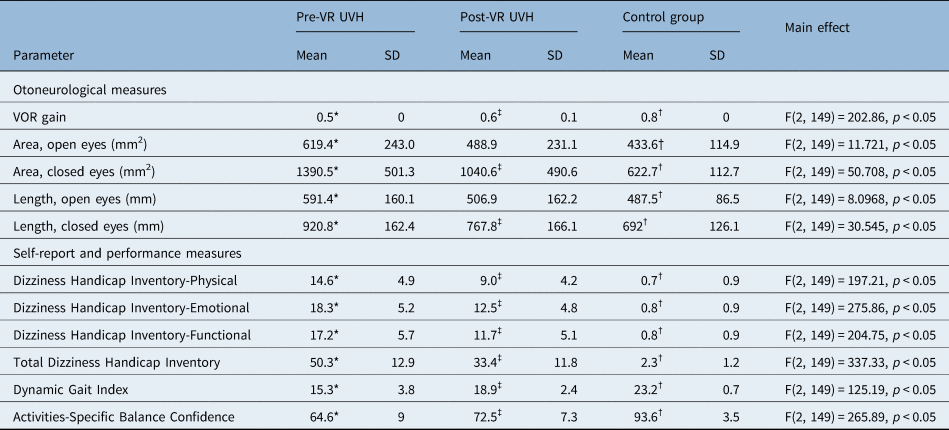
Post-hoc comparisons demonstrated unilateral vestibular hypofunction participants to have a significant post-treatment improvement in vestibulo-ocular reflex gain of the affected side (p < 0.001), in area (p = 0.004 and p < 0.001 in eyes open and closed, respectively) and length (p = 0.006 and p < 0.001 in eyes open and closed, respectively) measures and along Dizziness Handicap Inventory subscales (p < 0.001 in Dizziness Handicap Inventory-Functional, Dizziness Handicap Inventory-Emotional, Dizziness Handicap Inventory-Physical and total Dizziness Handicap Inventory), Dynamic Gait Index (p < 0.001) and Activities-Specific Balance Confidence (p < 0.001) scales (Table 2). All the pre-treatment measurements were found to be significantly (p < 0.001) worse when compared with the control group. Post-treatment measures, except area and length in the eyes open condition, were found to be significantly (p < 0.001) worse when compared with the control group (Table 2).
Within-patient and between-group effects of otoneurological, self-report and performance measures in unilateral vestibular hypofunction for pre- and post-vestibular rehabilitation and control group participants
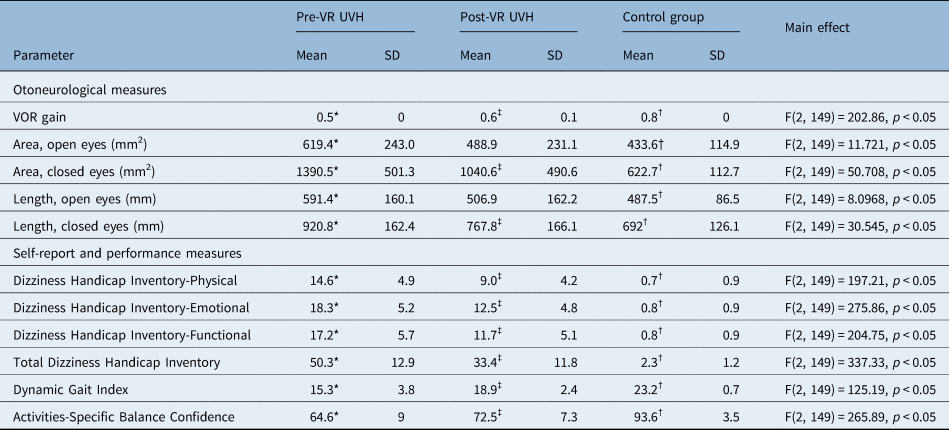
*Post-hoc significant comparison between pre- and post-VR UVH; †post-hoc significant comparison between pre-VR UVH and control group; ‡post-hoc significant comparison between post-VR UVH and control group. Exact p-values of post-hoc comparisons are given in the text. Table shows main pre- and post-VR and between-group effects of otoneurological, self-report and performance measures and anthropometric variables in UVH and control group participants. VOR gain refers to the affected side and to the average between right and left side for UVH and control group participants, respectively. VR UVH = vestibular rehabilitation unilateral vestibular hypofunction; SD = standard deviation; VOR = vestibulo-ocular reflex
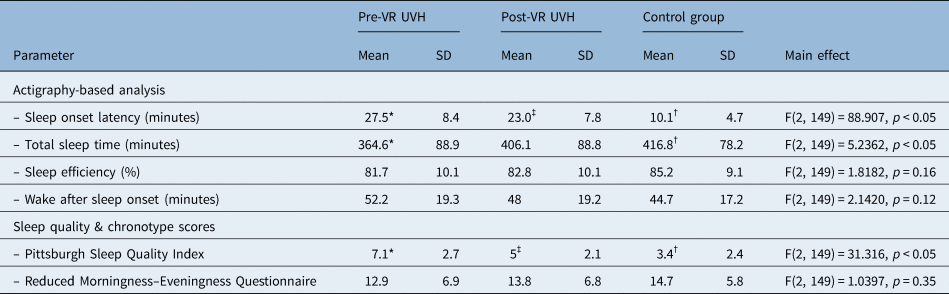
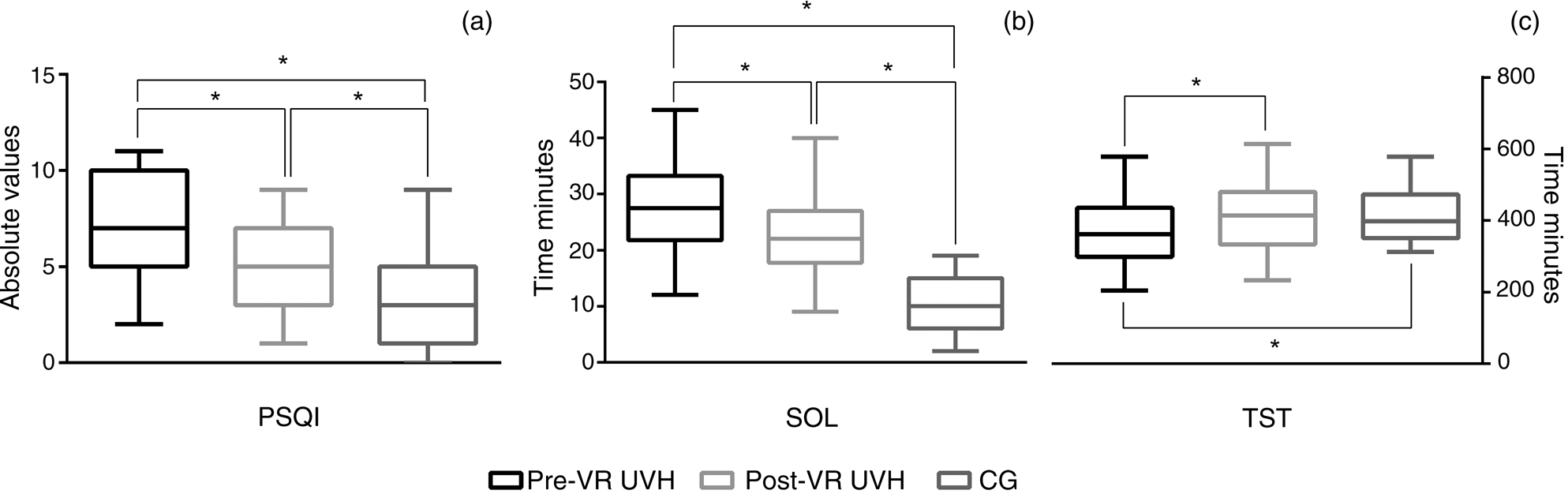
Unilateral vestibular hypofunction participants before vestibular rehabilitation demonstrated significant prolonged latency of the sleep onset, reduced amount of time spent sleeping and a worse quality of sleep (i.e. higher values of sleep onset latency (p < 0.001) and lower values of total sleep time and Pittsburgh Sleep Quality Index (p = 0.0017 and p < 0.001, respectively)) when compared with the control group (Table 3).
Within-patient and between-group effects of actigraphy-based analysis, sleep quality and chronotype scores in unilateral vestibular hypofunction for pre- and post-vestibular rehabilitation and control group participants
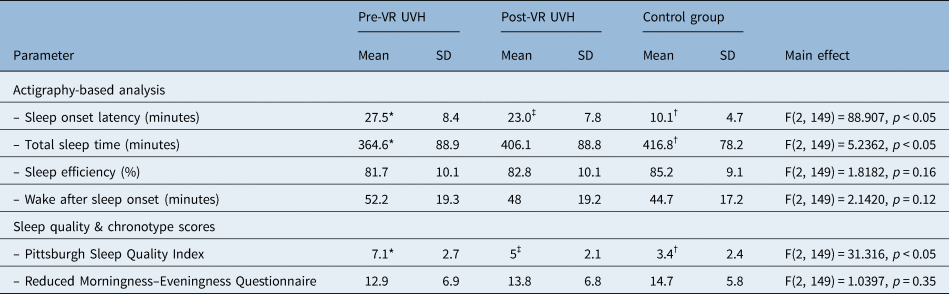
*Post-hoc significant comparison between pre- and post-VR UVH; †post-hoc significant comparison between pre-VR UVH and control group; ‡post-hoc significant comparison between post-VR UVH and control group. Exact p-values of post-hoc comparisons are given in the text. Table shows main pre- and post- VR and between-group effects of bioelectrical impedance analysis and free-living data measurements in UVH and control group participants. VR UVH = vestibular rehabilitation unilateral vestibular hypofunction; SD = standard deviation
After vestibular rehabilitation, unilateral vestibular hypofunction participants were found to significantly improve in these parameters (i.e. decrease in Pittsburgh Sleep Quality Index (p < 0.001) and sleep onset latency (p = 0.004) and increase in total sleep time (p = 0.014)). When compared with the control group, unilateral vestibular hypofunction participants after vestibular rehabilitation were found to still have a reduced sleep quality and a prolonged latency of sleep (i.e. higher values of Pittsburgh Sleep Quality Index (p < 0.001) and sleep onset latency (p < 0.001)), but no significant changes were found in total sleep time. No significant differences were found in wake time after sleep onset, sleep efficiency and reduced Morningness–Eveningness Questionnaire when comparing the three groups (Table 3, Figure 2).
Box and whisker plot of differences in (a) Pittsburgh Sleep Quality Index (PSQI), (b) sleep onset latency (SOL) and (c) total sleep time (TST) between unilateral vestibular hypofunction (UVH) before and after vestibular rehabilitation (pre-VR and post-VR, respectively) and control group (CG) participants. Brackets with asterisk indicate significant post-hoc comparisons. Values are reported as mean ± standard deviation.

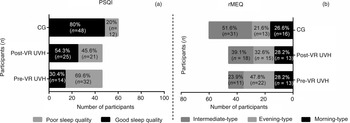
When study participants are put in sub-groups based on Pittsburgh Sleep Quality Index results and its categorisation of good sleep quality,Reference Curcio, Tempesta, Scarlata, Marzano, Moroni and Rossini33 a different distribution can be observed; among the healthy control group, 80 per cent (n = 48) showed good sleep quality, and 20 per cent (n = 12) demonstrated poor sleep quality. Conversely, the percentage of pre-vestibular rehabilitation unilateral vestibular hypofunction participants suffering from poor sleep quality, according to questionnaire results, was 69.6 per cent (n = 32). After vestibular rehabilitation, the percentage of unilateral vestibular hypofunction participants still reporting poor sleep quality, as calculated by the Pittsburgh Sleep Quality Index questionnaire, descended to 45.6 per cent (n = 21).
When considering reduced Morningness–Eveningness Questionnaire categorisations, dividing patients into morning type, intermediate type and evening type, 13 control group patients (21.6 per cent) were found to be evening type, while in unilateral vestibular hypofunction participants before vestibular rehabilitation the percentage of such evening-type patients was 47.8 per cent. After rehabilitation, the percentage of evening-type patients in the unilateral vestibular hypofunction group decreased to 32.6 per cent. This decrease was paralleled in the unilateral vestibular hypofunction group by an increase, post-rehabilitation, of patients reporting an intermediate-type behaviour (Figure 3).
Differences in sleep quality and chronotype behaviour in unilateral vestibular hypofunction (UVH) before and after vestibular rehabilitation (pre-VR and post-VR, respectively) and in the control group (CG) with participants put into subgroups according to (a) Pittsburgh Sleep Quality Index and (b) reduced Morningness–Eveningness Questionnaire.

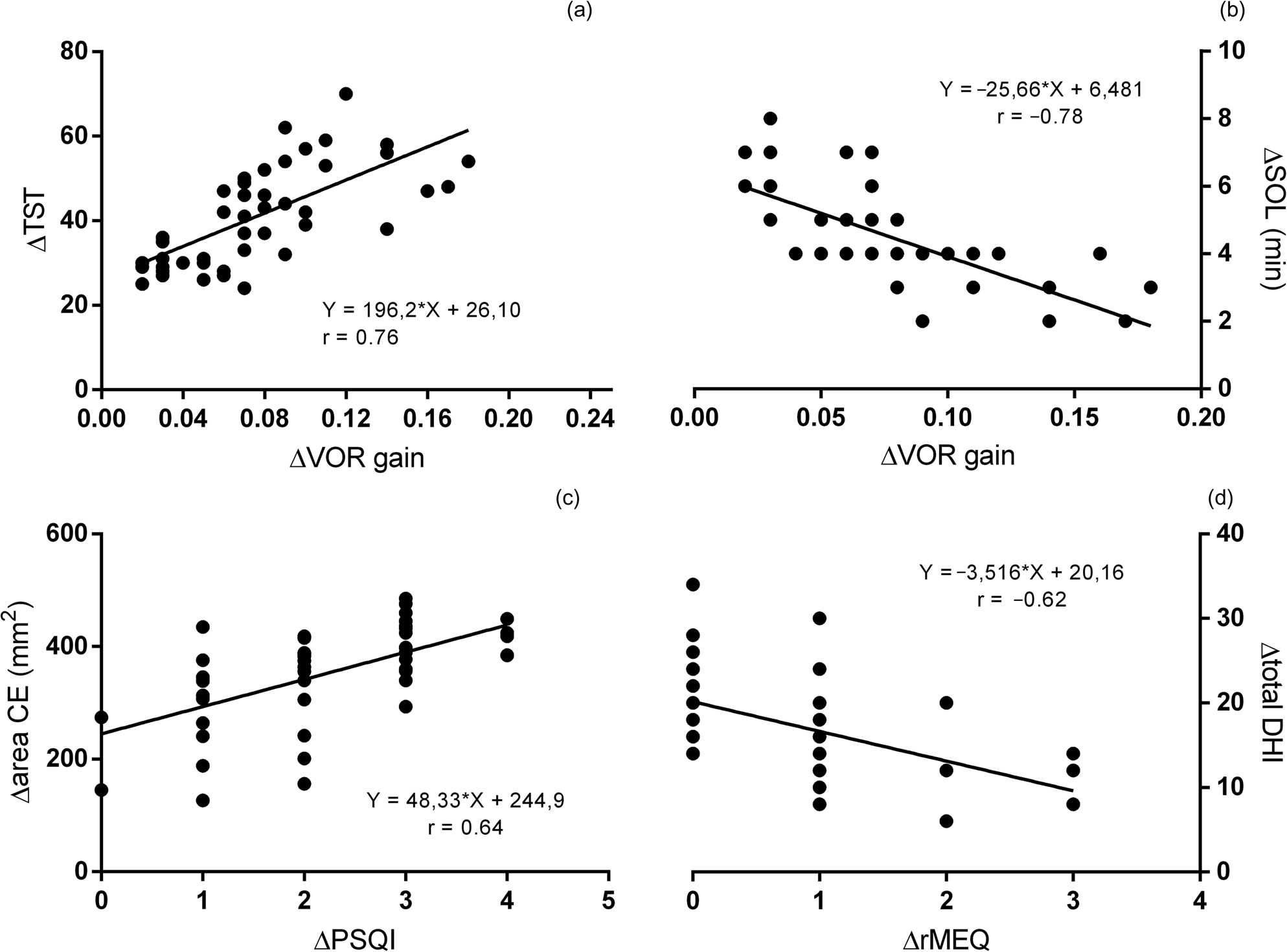
Finally, significant positive correlations were found in unilateral vestibular hypofunction participants between change in vestibulo-ocular reflex gain and change in total sleep time (r = 0.76) and between change in Pittsburgh Sleep Quality Index and change in area in the eyes closed condition (r = 0.64). Conversely, significant negative correlations were found between change in vestibulo-ocular reflex and change in sleep onset latency (r = −0.78) and between change in reduced Morningness–Eveningness Questionnaire and change in total Dizziness Handicap Inventory (r = −0.62) (Figure 4).
(a) Significant positive correlation found in unilateral vestibular hypofunction (UVH) in difference between pre- and post-vestibular rehabilitation (VR) protocol for change in total sleep time (TST) and change in vestibulo-ocular reflex (VOR) gain. (b) Significant negative correlation found in UVH in difference between pre- and post-VR protocol for change in sleep onset latency (SOL) and change in VOR gain. (c) Significant positive correlation found in UVH in difference between pre- and post-VR protocol for change in area in eyes closed (CE) condition and change in Pittsburgh Sleep Quality Index (PSQI) scores. (d) Significant negative correlation found in UVH in difference between pre- and post-VR protocol for change in total Dizziness Handicap Inventory (DHI) and change in reduced Morningness–Eveningness Questionnaire (rMEQ).

Discussion
Besides the expected improvement in otoneurological parameters (vestibulo-ocular reflex gain, static posturography testing parameters) and self-report measures or performance measures (Dizziness Handicap Inventory, Dynamic Gait Index and Activities-Specific Balance Confidence) after vestibular rehabilitation in unilateral vestibular hypofunction participants (Table 2), which confirms previous studies related to the effectiveness of this kind of rehabilitation protocol,Reference Micarelli, Viziano, Augimeri, Micarelli and Alessandrini15,Reference Herdman, Hall, Maloney, Knight, Ebert and Lowe32,Reference Micarelli, Viziano, Bruno, Micarelli, Augimeri and Alessandrini36,Reference Hall, Herdman, Whitney, Anson, Carender and Hoppes38 the main interesting findings of the present study reside in the significant improvement found in Pittsburgh Sleep Quality Index (with an increased number of participants reporting good sleep quality), sleep onset latency and total sleep time after vestibular rehabilitation, resulting in a non-significant difference in total sleep time between the control group and post-vestibular rehabilitation unilateral vestibular hypofunction participants (Table 3, Figure 2). Also, reduced Morningness–Eveningness Questionnaire score was found to be reduced in unilateral vestibular hypofunction patients after vestibular rehabilitation, although this did not reach statistical significance, with an increased percentage of unilateral vestibular hypofunction participants transitioning from an evening to an intermediate type of sleep behaviour (Figure 3).
Since multiple neuronal pathways at central levels show connections to the vestibular system, previous evidence suggested vestibular dysfunctions as complex syndromes, whose features may also include a wide spectrum of disorders involving spatial memory, cognitive and autonomic function.Reference Vignaux, Besnard, Denise and Elefteriou39 Projections from the vestibular nuclei to brainstem autonomic centres may play a role,Reference Cai, Ma, Wang, Li and Li40 for example, in the connections of vestibular output to respiratory, heart rate, blood pressure and, especially, sleep regulation, in both animals and humans.Reference Abe, Kawada, Sugimachi and Morita2,Reference Albathi and Agrawal7,Reference Andrade Junior, Stefanini, Gazzola, Haddad and Ganança9,Reference Besnard, Tighilet, Chabbert, Hitier, Toulouse and Le Gall10,Reference Vignaux, Besnard, Denise and Elefteriou39,Reference Wu, Liu, Yu, Li, Jia and Zhang41 Previous work has already demonstrated that vestibular weakness patients suffer from poor sleep quality, abnormal sleep patterns and shorter sleep duration in a high percentage of cases, while experiencing reduced quality of life in cases of sleep disturbances.Reference Micarelli, Viziano, Pistillo, Granito, Micarelli and Alessandrini3,Reference Albathi and Agrawal7,Reference Andrade Junior, Stefanini, Gazzola, Haddad and Ganança9,Reference Martin, Moussay, Bulla, Bulla, Toupet and Etard28 It has also been shown that dizziness is closely related to the severity of sleep disorders in patients with different types of vertigoReference Wu, Liu, Yu, Li, Jia and Zhang41,Reference Kim, Kim, Jeon and Hong42 and that vestibular stimulation may possibly promote sleep with beneficial effect on brain activity.Reference van Sluijs, Rondei, Schluep, Jäger, Riener and Achermann12
Several mechanisms have been proposed to explain the link between the vestibular system and sleep function. Results from animal studies suggest that, in tandem with input from the visual and somatosensory systems, the vestibular system is involved in the regulation of circadian rhythms.Reference Martin, Mauvieux, Bulla, Quarck, Davenne and Denise43 Experiments carried out in mice by using simulated hypergravity conditions introduced the hypothesis that vestibular neuronal input activates autonomic, limbic and hypothalamic nuclei.Reference Fuller, Jones, Jones and Fuller44 Findings from another recent study suggested that vestibular input directly influences the suprachiasmatic nucleus, with a potential regulatory effect on circadian rhythmicity in humans.Reference Martin, Mauvieux, Bulla, Quarck, Davenne and Denise43 However, it is also suggested by other studies that abnormal sleep duration may, in turn, impact vestibular signaling.Reference Micarelli, Liguori, Viziano, Izzi, Placidi and Alessandrini11,Reference Martin, Moussay, Bulla, Bulla, Toupet and Etard28 The vestibular system has also been shown to control autonomic functions during REM sleep,Reference Morrison and Pompeiano6 and work by Krystal et al. reported that the electrical stimulation of the vestibular apparatus decreased sleep latency in individuals with sleep latency more than 14 minutes.Reference Krystal, Zammit, Wyatt, Quan, Edinger and White45
Vestibular rehabilitation has been demonstrated to be capable of positively influencing the basic outputs of the vestibular system,Reference Hall, Herdman, Whitney, Anson, Carender and Hoppes14 and the present data showed, for the first time, that its effectiveness may extend beyond those boundaries and also influence its connections with sleep-related structures. The implementation of vestibular rehabilitation may have possibly counteracted those detrimental biological events that are known to occur during the chronic stages of unilateral vestibular hypofunction, when deafferentation of vestibular nuclei takes place.Reference Micarelli, Viziano, Carbini, Misici, Guzzo and Micarelli16,Reference Darlington, Dutia and Smith46 Although more experimental evidence is surely needed, the patient-tailored, structured vestibular rehabilitation cycle used in this study could have enforced structural changes, such as reactive synaptogenesis or collateral axonal sprouting, which are thought to be less present within the deafferented vestibular nuclei. In turn, the lack of rearrangement in these circuits may have consequences along brainstem autonomic centres involved in chronotype behaviour and sleep performance, in which the vestibular system is probably entangled.Reference Micarelli, Viziano, Pistillo, Granito, Micarelli and Alessandrini3,Reference Tighilet and Chabbert47
Associations between sleep performance disturbances and vestibular disorders are further supported by the multiple correlations between vestibular-related functionality indexes (area in eyes closed condition, vestibulo-ocular reflex gain and Dizziness Handicap Inventory)Reference Teggi, Caldirola, Fabiano, Recanati and Bussi48 and subjective (Pittsburgh Sleep Quality Index and reduced Morningness–Eveningness Questionnaire) and objective (total sleep time) consequences on sleep quality found in unilateral vestibular hypofunction participants (Figure 4). These associations could confirm the hypotheses that connections between sleep and the vestibular system are bidirectional.Reference Besnard, Tighilet, Chabbert, Hitier, Toulouse and Le Gall10 Furthermore, they could add strength to previous results reporting that vestibular stimulation could improve sleep quality in human and animal models,Reference van Sluijs, Rondei, Schluep, Jäger, Riener and Achermann12,Reference Kompotis, Hubbard, Emmenegger, Perrault, Mühlethaler and Schwartz13 while also reinforcing those findings in humans exposed to microgravity and complaining of sleep and postural disorders,Reference Pandi-Perumal and Gonfalone49 possibly because of peripheral and central recalibration of vestibular information, compensating for the lack of otolithic signals and readjusting the vestibular system to changes in gravity.Reference Pompeiano50
In conclusion, the present findings show, for the first time, that vestibular rehabilitation protocols may impact on sleep performance and chronotype behaviour, possibly by opposing long-term structural changes as a result of the deafferentation of the vestibular nuclei, with consequences on neural pathways entangled in sleep activity. These results could open future perspectives in terms of the clinical and research approaches to vestibular weakness and vestibular rehabilitation, which deserve further in-depth studies.
Limitations
The main limitation of the present study resides in the absence of a thorough polysomnography, usually including electroencephalography, electrocardiography, electronystagmography, electro-oculography and electromyography.Reference Berry, Budhiraja, Gottlieb, Gozal, Iber and Kapur20 Indeed, the choice to perform only a home-based polygraphic test was aimed at excluding other possible sleep disturbances, such as obstructive sleep apnoea, which have been already associated with vestibular weaknessReference Besnard, Tighilet, Chabbert, Hitier, Toulouse and Le Gall10,Reference Micarelli, Liguori, Viziano, Izzi, Placidi and Alessandrini11 and thus could have biased the study sample.
• Vestibular weakness may lead to changes in sleep performance and chronotype behaviour
• This can occur in relation to the anatomical contiguity between structures receiving input from the otolithic organs and neurons involved in sleep organisation
• Vestibular rehabilitation showed effectiveness in ameliorating balance function and several other daily-living aspects
• This study showed that vestibular rehabilitation may improve sleep onset latency and total sleep time and a transition from evening to an intermediate type of sleep behaviour
• This change was possibly related to vestibular rehabilitation opposing the long-term structural changes caused by the deafferentation of the vestibular nuclei
The selection of patients enrolled in a longitudinal study, and thus routinely tested for several clinical aspects, as a control group, could represent a suboptimal solution with respect to a group of healthy volunteers. However, the same polygraphic protocol was used both for unilateral vestibular hypofunction patients (before and after vestibular rehabilitation) and controls, and the same inclusion and exclusion criteria were used in order to minimise confounding variables. On the same note, only patients presenting with both caloric and Video Head Impulse Testing impairment were included in the unilateral vestibular hypofunction group; it is possible that differences in the temporal course and definition of unilateral vestibular hypofunction could lead to variability in results in different patient cohorts.
Competing interests
None declared