In March 2015, the Census Bureau projected that whites would become a minority of the U.S. population within thirty years.Footnote 1 The news reverberated through American media to both ends of the political spectrum. Breitbart described the “nation as a whole barreling toward a majority-minority future.”Footnote 2 The Huffington Post produced a black-and-white spoof of a 1950s instructional video entitled, “So You’re About to Become a Minority” that purported to inform whites about their future life inhabiting blighted inner cities, working dead-end jobs, and abused by police.Footnote 3
News reports about the Bureau’s projections captured the public imagination in ways that technical forecasts seldom do. A growing body of research spanning multiple disciplines has explored the political fallout. The white majority, it concludes, is not going gentle into that good night. Researchers have linked the expectation of a majority-minority future to what New York Times columnist Charles Blow describes as “White Extinction Anxiety.”Footnote 4 Its symptoms include a heightened sense of threat over waning group status that fuels racial prejudice, anticipation of rising anti-white discrimination, backlash against immigration, opposition to government programs assisting the poor, increased conservative and Republican self-identification, and support for Donald Trump (for a review, see Craig, Rucker, and Richeson Reference Craig, Rucker and Richeson2018; see also Abascal Reference Abascal2015; Gest Reference Gest2016; Mutz Reference Mutz2018; Wetts and Willer Reference Wetts and Willer2018; Jardina Reference Jardina2019). As sociologist Mary Waters put it, “These nerdy projections are scaring the hell out of people.”Footnote 5
We challenge the conventional interpretation of these powerful and broad-ranging effects as reactions to the raw fact of changing racial demography. We demonstrate that they are instead, to a large extent, byproducts of a narrative about the country’s racial future that dominates political rhetoric and media coverage. The irony is that this prevailing narrative depicts future racial change in the twenty-first century through the lens of nineteenth century stereotypes of racial identity and classification. In the face of a rising tide of mixed-race marriage and racial fluidity and pluralism among America’s young—one multiplied forward in the Census Bureau’s own forecasts—the dominant narrative of racial change assumes the continuation of a strict white-nonwhite binary decades into the future. We find that accounts of racial projections that call attention to ongoing changes in the configuration and rigidity of the traditional color line evoke little of the alarm and backlash that the standard majority-minority narrative has caused.
We begin by showing that the expectation of a majority-minority population by the mid-2040s, the centerpiece of the standard majority-minority narrative that has framed most news accounts about the Census Bureau’s racial forecasts, hinges on the blunt classification of multiracial and white-Hispanic Americans and their offspring as singularly “nonwhite.” In effect, it applies the rule of hypodescent to such individuals regardless of the identities they and their offspring assign to themselves.
The norm of race classification that undergirds this narrative is contested and increasingly untenable in light of the current facts of rising rates of interracial marriage and multiracial identification. The heart of the classification problem is that increasing numbers of individuals proclaim that they belong to multiple groups, without strict demarcation or forced assignment. This poses a challenge for projections. Consequently, since 2004, the Census Bureau has produced multiple versions of its race and ethnicity projections to better represent a population with growing prevalence of mixed backgrounds and self-identities (Hogan, Ortman, and Colby Reference Hogan, Ortman and Colby2015). As many as six different treatments of “white” population are produced, ranging from the most narrow and exclusive definition to the broadest and most inclusive (Myers and Levy Reference Myers and Levy2018).
Alternative versions of the Bureau’s race forecasts support markedly different narratives about rising diversity in the coming decades. The standard majority-minority narrative draws on the forecast version that is simplest to convey to mass audiences, in part because it hews to old and familiar stereotypes. It defines the white population in the most restrictive terms possible. Other, less publicized, forecast versions count people as belonging to all groups they say they belong to. These more detailed projections support a narrative of rising diversity that highlights the blurring of traditional racial boundaries in a society where the terms “minority” and “majority” have lost their traditional connotation.
The main objective of this study is to compare how the public responds to different media narratives that can be constructed based on alternative versions of the Census Bureau’s own racial and ethnic forecasts. The choice of narrative proves enormously influential. The standard majority-minority narrative is far and away most threatening to whites. Alternative accounts that highlight multiracialism elicit decidedly more positive reactions. We also move beyond the literature’s focus on white racial threat to examine how Blacks, Latinos, and Asian-Americans react to alternative news accounts of the Census race forecasts. Individuals in all three of these groups respond favorably to all narratives of rising diversity irrespective of whether they include the conventional majority-minority framing or emphasize rising multiracialism.
The Contingency of a Majority-Minority Future
Racial forecasts and the narratives they support rest on contested assumptions about race classification in the present and even more tenuous assumptions about the salience and meaning of racial identities well into the future (Alba Reference Alba2020; Myers and Levy Reference Myers and Levy2018). In an era of increasing racial fluidity, raw demographic facts can support multiple narratives describing how the racial landscape will evolve. Multiple narratives are not only possible in a vacuum but plausible in the present cultural and demographic context. By “plausible,” we mean narratives of forecasted racial change that are relevant to the future but also understandable to people today. Such narratives should reflect current and emerging patterns of behavior and norms concerning racial and ethnic identity and be legally, lexically, and socially communicable and comprehensible to mass audiences. In this section, we describe how divergent assumptions about the rigidity of the twenty-first century color line imply different rules of race classification that feed multiple versions of race projections and drive alternative plausible narratives about racial change.
Mixed-Race Marriage and Multiracialism
The assignation of a singular and fixed “nonwhite” identity to anyone with non-white or Hispanic parents or grandparents fits uneasily with emerging demographic and sociological realities in the United States. (Alba Reference Alba2020; Alba, Rumbaut, and Marotz Reference Alba, Rumbaut and Marotz2005, Alba, Beck and Sahin Reference Davenport2018). Sharp rises in mixed-race unions and multiracial identification in an era of large-scale nonwhite immigration, amid continuing marginalization and exclusion of African Americans, are at least as suggestive of an emerging Black-nonBlack as of a white-nonwhite color line (Lee and Bean Reference Lee and Bean2010). Though marriages between Black and white Americans lag marriages between whites and Hispanics and whites and Asians, they are increasing rapidly too. The share of new marriages that joined spouses across lines of race and Hispanic origin increased from 7% in 1980 to 17% in 2015 (Livingston and Brown Reference Livingston and Brown2017). In 2015, Asians were most likely (29%) to marry a person of a different race, especially among U.S.-born Asians (46%), closely followed by Hispanics (27%, 39% of U.S.-born). The share of African American newlyweds in mixed marriages has more than tripled from 5% to 18%. Fully 83% of all mixed marriages were with a white spouse (Livingston and Brown Reference Livingston and Brown2017, 22), highlighting rapid growth in the number of people with both white and minority-group parentage.
In a sharp departure from the one drop of blood rule, the self-identities of an increasing number of children with mixed backgrounds reflect both sides of their ancestry. This applies to the offspring of whites and Asians, Hispanics, and Blacks alike (Davenport Reference Davenport2016, Reference Davenport2018). Richard Alba (Reference Alba2020) argues that intermarriage produces kin networks that bridge the color divide, providing mixed race children social access to cultural traditions and sense of belonging on both sides. Americans with mixed-race and mixed-ethnic backgrounds that include white ancestry also tend to feel closer to, and more commonality with, whites than their minority identity group (Lee and Bean Reference Lee and Bean2010; Davenport Reference Davenport2018, Reference Davenport2020; Masuoka Reference Masuoka2008, Reference Masuoka2010, Reference Masuoka2017).
Far from yielding a permanent subtraction from the white population, the rising prevalence of mixed-race marriage and plural identification therefore suggest a high persistence of white identification after multiple generations. Indeed, among the descendants of Hispanic and Asian immigrants, there is evidence of significant attrition across generations in the use of minority group self-identities. Approximately one-quarter of people with at least one Hispanic grandparent and half of those with a Hispanic great-grandparent do not identify as Latino or Hispanic (Duncan and Trejo Reference Duncan and Trejo2011, Reference Duncan and Trejo2018; Lopez, Gonzalez-Barrera, and López Reference Lopez, Gonzalez-Barrera and López2017). If it would greatly oversimplify matters to declare that Hispanics eventually will “become (exclusively) white” in the manner of the white ethnics (e.g., Ignatiev Reference Ignatiev1995), such dynamics are in fact quite a bit more common among these groups than is often recognized.
To be sure, identity choices among racialized groups remain constrained by the racial order (Masuoka Reference Masuoka2017). Self-identities and ascribed identities often diverge, and the residue of hypodescent persists (Ho et al. Reference Ho, Sidanius, Levin and Banaji2011; Krosch et al. Reference Krosch, Bernsten, Amodio, Jost and Bevel2013). Moreover, “honorary whites” may be selectively ascribed whiteness while still being excluded from its full range of privileges (Bonilla-Silva Reference Bonilla-Silva2002).
Yet considerable evidence points to rising embrace of interracial marriage, including to close relatives, and plural identification (Livingston and Brown Reference Livingston and Brown2017, 7; Campbell and Herman Reference Campbell and Herman2010; Citrin, Levy, and Van Houweling Reference Citrin, Levy and Houweling2014). Information about mixed backgrounds and identities reduces reliance on hypodescent in racial categorization (Peery and Bodenhausen Reference Peery and Bodenhausen2008). Coupled with the rising prevalence of multiracialism as a norm of self-identification (Hochschild and Weaver Reference Hochschild and Weaver2010; Hochschild, Weaver, and Burch Reference Hochschild, Weaver and Burch2012), public acceptance of such identities suggests that the technical linchpin of the majority-minority narrative—the blanket classification of multiracial Americans who identify as white and another race as exclusively “non-white”—errs in ignoring these momentous trends.
Race Classification and Projections
Official race categories are always contested and controversial (Omi and Winant Reference Omi and Winant2014; Hochschild and Powell Reference Hochschild and Powell2008). The fact that race classifications are historical constructs makes the enterprise of projecting unfolding changes into the future even more fraught. Ironically, had the Census Bureau preserved the categories offered to respondents in the 1960 Census—the first to record self-reported identities rather than enumerator-ascribed identities—it would have continued to “find” a very large and stable white majority to this day and would have projected its indefinite persistence. However, the Bureau found need to variegate its race and ethnicity menu in order to better document and describe rising racial pluralism and fluidity (Prewitt Reference Prewitt2013; Alba Reference Alba2020). Among the most consequential changes in this regard were the restoration of an “Other” race category in 1970, the addition of Hispanic origin in 1980, the proliferation of Asian origin categories over several decades, and the allowance for identification as multiple races starting in 2000.
This variety entails choices about how to use the data. The most publicized version of the Bureau’s projections is the simplest to describe to the public. It uses the most exclusive possible definition of “white,” counting as white only those who identify as non-Hispanic and white alone, not in combination with any other race. The non-white residual includes everyone who identifies as a member of any other racial or ethnic group, even if they also identify as white (Myers and Levy Reference Myers and Levy2018; Alba Reference Alba2020). Far less publicized is the fact that the Bureau also projects the size of each racial group and Hispanics under multiple categorization schemes, each of which adopts a distinct classification rule for mixed-race and Hispanic identifiers and their offspring.
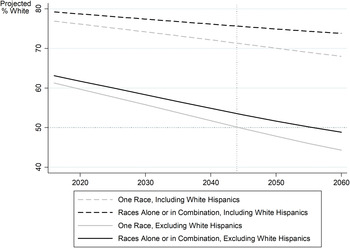
As figure 1 illustrates, the contingency of race projections on classification rules is enormous, and the differences between the alternatives grow with the passage of time. The figure plots the projected percent white of the U.S. population through 2060, using figures provided in the Census Bureau’s own 2017 race projection summary table for the main series.Footnote 6 Only the most exclusive definition of whiteness—non-Hispanic White Alone—yields a white minority by the much heralded 2044 date. Notably, however, over one-third of the individuals included in this “nonwhite majority” are expected to self-identify as white. By 2060, this figure rises to 40% of the ostensibly “non”-white majority.
Alternative Census Bureau forecasts of white population share
Source: Census Table np2017-t5, Race by Hispanic Origin: Projections for the United States, 2017-2060.

Defining “white” inclusively, to include all those individuals who say they are white, gives a starkly different impression of the plausibility of “white decline.” It leaves a broadened and more diverse white majority intact for more than an additional decade longer into an uncertain future. One group does not grow at the expense of another. Rather, all groups grow at once as overlap increases. Excluding multiracial identifiers but including Latinos who identify their race as white alone leaves more than 70% of the population identifying at least in part as white in 2044 and over two-thirds in 2060. The most inclusive definition of whiteness yields only an approximately 5 percentage point decline in the white population share over the next forty years. That is, the Census Bureau’s own projections show approximately three-quarters of the U.S. population in 2060 identifying as white, with fully 40% of these self-identifying whites forecast to identify also as another race or Hispanic.
It should be clear that none of these trajectories has an exclusive claim on demographic or sociological truth. For example, how should white-identifying Hispanics be categorized? Many white Hispanics so identify for want of any apt race category alternative (Dowling Reference Dowling2014). However, many white Hispanics clearly do consider whiteness important to their self-identities. On the 2012 American National Election Study, 70% of Hispanics identified as white.Footnote 7 Fully 57% of them rated white at least as important as Hispanic to their identities (13% more and 44% equally). Among those who have a U.S.-born parent, the figure was 70%. If even a fraction that many white Hispanics are considered white, the expectation of a white minority by 2044 badly misses the mark. Nonetheless the most narrow and exclusive definition of “white” has often been portrayed as the only, or most important, fact in describing the nation’s future.
Numbers and Narratives
These different interpretations of racial and ethnic identity, and the classification and projections techniques that reflect them, support distinct narratives about how the country’s racial context is likely to evolve. The most exclusive definition of whiteness, which undergirds what has become the conventional wisdom about America’s majority-minority future, portrays what is often described as white decline as a zero-sum numerical competition between separate and rigidly defined blocs of whites and nonwhites. Multiracialism and mixed backgrounds have no salience in this narrative except as additions to the impending “non-white” majority. The most inclusive definition of whiteness portrays a future in which the white majority persists for the foreseeable future but the boundaries of whiteness expand to include a large number of Americans who identify both as white and members of other racial and ethnic groups. Whiteness loses its traditional delineation and exclusivity as group boundaries blur and identities overlap and older norms of monoracialism give way to more pluralistic identities.
A comparison of the race-related content from the Census Bureau’s own press releases about its demographic projections in 2015 and 2018 underscores the plausibility of either narrative. The text of the bullet points and the accompanying graphics from these releases are provided in online appendix A. The 2015 press release hewed entirely to the majority-minority narrative. It emphasized the decline of the single-race non-Hispanic white population and the rise of “the minority population” and identified 2044 as the year that the general population would cross that threshold. Among children under 18, the transition to majority-minority would occur as of 2020. The press release linked to a graph (refer to online appendix A) that shows race projections only using the most exclusive method of counting whites, noting only the 2020 and 2044 cross-over points (compare to figure 1). The 2018 press release also noted that the non-Hispanic white-alone population would “shrink,” that under half of children were projected to be non-Hispanic white alone by 2020, and that under half of adults would be non-Hispanic white alone as of 2060. But in sharp contrast to the 2015 press release, each of these statements was followed quickly by information that the white-alone population of adults and children, regardless of Hispanic ethnicity, was projected to grow and remain in the majority. Also in contrast to the 2015 press release, the 2018 release also noted that the fastest increases would be among people of two or more races, both among adults and children. Each of these plural-identity categories received no mention at all in the 2015 release. Thus the Bureau has become keenly aware that its own multiple versions of race and ethnicity projections support more than just one idea about the nature of the American racial landscape decades into the future.
Does the Narrative Matter?
The vagaries of racial identity and classification are of little importance to contemporary mass politics unless ordinary citizens find distinct narratives about racial change meaningful and compelling. Existing research focuses on reactions to one particular narrative of racial change, making it impossible to disentangle reactions to the majority-minority narrative from reactions to rising diversity per se. We do know how this dominant narrative influences white public opinion. Exposure to news stories in the majority-minority genre increases status anxiety (Craig and Richeson Reference Craig and Richeson2014a; Outten et al. Reference Outten, Schmitt, Miller and Garcia2012; Danbold and Huo Reference Danbold and Huo2015; Jardina Reference Jardina2019; cf. Smith Reference Smith, Mackie and Hamilton1993). It heightens hostility toward outgroups (Craig and Richeson Reference Craig and Richeson2014a; Outten et al. Reference Outten, Schmitt, Miller and Garcia2012). It leads to conservative policy preferences on public spending and, impressively, also greater conservative and Republican self-identification among independents (Craig and Richeson Reference Craig and Richeson2014b). It fosters fears of increased anti-white discrimination (Craig and Richeson Reference Craig and Richeson2017). It may also make whites likelier to classify “racially ambiguous” faces as non-white (Abascal Reference Abascal2020), although Bayesian updating may account for these effects rather than threat. In sum, it propels “white backlash” against changing demographic and cultural change (Mutz Reference Mutz2018; Gest Reference Gest2016; Abrajano and Hajnal Reference Abrajano and Hajnal2015).
It is unknown whether these effects are contingent on narrative. Prior research has noted this ambiguity. Craig and Richeson, for example, call for research that “examine[s] how the framing of these racial demographic changes affects whites’ racial attitudes” (Reference Craig and Richeson2014a, 10). Indeed, virtually all studies of whites’ reactions to the majority-minority narrative are estimated relative to a control condition in which there is no reference to rising ethno-racial diversity at all or a condition in which respondents are exposed to “alternative facts” rather than alternative narratives.Footnote 8 None has tested whether framing rising diversity as a conduit to a majority-minority society is critical to generating these reactions or whether an alternative narrative of rising diversity that does not assume the persistence of a rigid white-nonwhite binary has such effects.Footnote 9
Existing research also has little to say about how members of America’s largest ethnic and racial minority communities react to information and narratives about rising racial diversity (Craig, Rucker, and Richeson Reference Craig, Rucker and Richeson2018). The projection of a white minority has been a source of excitement among progressive groups and activists who expect it to usher in reforms aimed at reducing racial and class inequality.Footnote 10 Whether forecasts of rising diversity garner such reactions from ordinary citizens is unknown.
Hypotheses: Non-Hispanic Whites
The standard majority-minority narrative can be seen to contain at least three components that can accentuate racial threat. First, by focusing on a future point at which the dominant group cedes its majority status to subordinate groups, this narrative fosters a sense of status vulnerability, or tenuous group position, that can lead dominant group members to ratchet up social control and prefer policies that aim to keep subordinate groups at bay (Blalock Reference Blalock1967; Bobo and Hutchings Reference Bobo and Hutchings1996; Stephan and Renfro Reference Stephan, Renfro, Mackie and Smith2002; Craig and Richeson Reference Craig and Richeson2017). Second, the zero-sum nature of this portrayal of realistic group competition for numerical dominance between exclusive groups “whites” and “non-whites” can accentuate outgroup-directed hostility and concerns about loss of status and power (Jackson Reference Jackson1993). Finally, by telescoping the future and seeming to accelerate the pace of change (Myers Reference Myers2007), the majority-minority narrative may contribute to whites’ inflated perceptions of the number of racial and ethnic minorities living in their communities and in the country (Alba, Rumbaut, and Marotz Reference Alba, Rumbaut and Marotz2005; Wong Reference Wong2007). Thus our first hypothesis:
H1: Narratives of rising racial diversity shorn of the majority-minority framing are less threatening than the standard account.
We expected that alternative narratives predicated on the rise of multiracialism and the blurring of the traditional color line would be processed as less threatening than the standard account. This is in part because they discard several of its potentially threatening components– specifically, its zero-sum formulation of discrete racial groups in competition for numerical supremacy. Beyond this, however, they articulate a future that involves increased intermarriage and multiracialism, which many whites at least claim to support. This results in our second hypothesis.
H2: Alternative narratives that foretell rising mixed-race marriage and multiracialism are less threatening to non-Hispanic whites than those that foretell a white minority.
We consider two varieties of alternative narrative. One emphasizes a persistent white majority that itself becomes more ethno-racially diverse by including large numbers of people who possess both white self-identity and also have a minority heritage and self-identity as well. The other describes rising racial diversity and emphasizes increases in multiracialism but without drawing any conclusions about majority and minority groups. This second alternative reflects the idea that it makes little sense for projections to naively carry these designations forward when their connotation is likely to change dramatically. If rising diversity and changing racial norms are themselves somewhat threatening to whites, the preservation of a white majority, albeit a racially inclusive one, might provide a measure of reassurance.
H3: Narratives focused on rising multiracialism that allude to a persistent, though transformed, white majority will be less threatening than those that describe rising multiracialism without forecasting a persistent white majority.
H2 and H3 are hardly self-evident. To influence public opinion, these alternative narratives must be accepted, or at least viewed as plausible. Given the strong residue of hypodescent in the way many white Americans think both implicitly and explicitly about race, we might be skeptical whether whites would see narratives about rising multiracialism as meaningfully distinct from the standard majority-minority frame. To the extent that the alternative narratives are seen as bizarre, arcane, or simply false, they would not impact public opinion. Even if whites find these alternative narratives credible, it is not clear ex ante that they would be mollifying. If narratives about multiracialism subvert the projection of an imminent white minority, they also imply the erosion of traditional group boundaries and the reconfiguration of the nation’s longstanding racial structure and strata (Abascal Reference Abascal2020; Omi and Winant Reference Omi and Winant2014). The more common such reactions, the less support we will observe for H2 and H3.
Expectations about which segments of the white public respond more to narrative framing are hard to pin down. Whites who are older, less educated, and Republican are overtly less supportive than others of diversity as a social value and likelier to hold inegalitarian views about race (e.g., Sears and Henry Reference Sears and Henry2009; Tesler Reference Tesler2016) and hence more likely threatened by any news story about rising diversity than their younger, more educated, or Democratic counterparts, regardless of narrative frame. But it is not clear ex ante whether the majority-minority narrative would intensify threatened reactions more among these groups, over and above bare information about rising diversity stripped of this framing. By the same token, exposure to emerging norms of multiracial identity and mixed-race marriage may be lower among older generations and those without a college degree and receptivity possibly lower among conservatives. However, unfamiliarity could leave more latitude for narratives to persuade as well as lead to their rejection. Moreover, racial conservatives could be as or more threatened by the idea of blurring racial boundaries and the loss of majority status. In the studies that follow, we therefore treat analyses of moderation by age, education, and partisanship as exploratory.
Hypotheses: Non-Whites
Blacks, Latinos, and Asians tend to be more sanguine than whites about immigration and the expansion and growth of ethnic and racial diversity. The expectation of majority status may promote a sense of group empowerment (cf. Bobo and Gilliam Reference Bobo and Gilliam1990). This would suggest an especially positive reaction to the projection of a majority-minority society, which is the prediction of our fourth hypothesis.
H4: Appending the majority-minority narrative to an account about projected rises in racial diversity elicits positive emotional responses among non-whites and heightens the expectation of more equal treatment in the future.
One caveat is that the particular resonance of this narrative is contingent on whether members of minority groups that comprise the future “non-white” majority perceive this composite racial bloc to be a present or future ingroup.Footnote 11
We also expect narratives about multiracialism to generate positive reactions among minority group members. Multiracialism and mixed-race marriage powerfully signal the erosion of traditional racial barriers and may herald de facto more equal treatment. Some Blacks, Latinos, and Asians might find this future more palatable than one in which their own particular group remains a minority, whites remain the plurality, and there is no indication that traditional racial divides give way. Others may find this portrayal too much at odds with their own experience to give much weight or prefer the idea of an ascendant non-white majority. It is uncertain how the appeal of a narrative grounded in rising multiracialism would compare to that of the majority-minority narrative. We do, however, expect the following:
H5: Non-whites will react more positively to a narrative about multiracialism that does not project a persistent (and more diverse) white majority than to one that does not.
Study 1
Our first experiment, conducted on a national U.S. sample of non-Hispanic whites, had two purposes. The first was to isolate the impact of the majority-minority narrative on racial threat, over and above information about projected rises in racial diversity (H1). The second was to compare reactions to the majority-minority narrative to reactions to an alternative narrative that amplifies the rise of multiracialism (H2). In this case, we examine the impact of a narrative that foretells the persistence of a transformed and more inclusive white majority that would include a growing number of individuals with mixed backgrounds and multiracial identities.
Research Design
The experiment was embedded into a national Internet survey of non-Hispanic white Americans fielded by Survey Sampling International (for descriptive statistics, refer to online appendix table B1) in August 2016. Because the experiment was reading-intensive, we included a question gauging attentiveness (for wording of this question, refer to online appendix C) after asking questions about political interest and respondents’ feelings about their own financial condition and the condition of the country, all before administering the treatments. The attention question weeded out a surprising 45% of the initial sample, yielding a final N of approximately 2,600 who participated in the experiment and all of whom completed the full questionnaire.Footnote 12
One-quarter of the respondents were randomly assigned to read a story about animal conservation that was unrelated to racial projections (control). One-quarter read a story reporting on projections of continued increases in U.S. racial diversity, led by rapid growth among Hispanics and Asians (diversity). This story also noted that diversity would rise most among the young while older Americans remained more heavily white but made no reference to the majority-minority narrative or any alternative. The remaining respondents read versions of this diversity story augmented with one of two narratives about what rising diversity would mean for the persistence of a white majority in America. Half read that whites, defined inclusively to include a growing number of Americans with mixed racial ancestry who identify as white and another race or ethnicity, would remain in the majority (blending). The other half read an article modeled on the predominant media framing of the Census Bureau’s 2015 forecasts (minority). This story cited rising white mortality and declining fertility as factors leading to a majority-minority nation by 2044. The full text of each story is provided in online appendix C.
We tested the effect of these treatments on three gauges of racial threat—self-reported emotional reactions to the news story, opposition to increasing taxes to fund spending on public education, and anti-immigrant sentiment (wording of all items is provided in online appendix C). Our measure of emotions came right after a question gauging familiarity with the news story. It asked respondents whether reading the story had made them feel angry, anxious, hopeful, or enthusiastic. Intergroup emotions theory ties particular negative affective reactions to changes in intergroup contexts to individuals’ interpretation of the way their own group’s status is affected. Perceptions that one’s own group is becoming more vulnerable produce fear while perceived zero-sum competition fosters anger (Smith Reference Smith, Mackie and Hamilton1993). A five-point agree-disagree measure of support for a tax hike to fund public education served as a gauge of economic conservatism. It followed a question assessing comprehension of the main “takeaway” from the news story and a series of buffer questions about the regulation of self-driving cars, and ordinances limiting construction noise. Prior research shows that news stories akin to the minority narrative dampen support for public spending (Craig, Rucker, and Richeson Reference Craig, Rucker and Richeson2018). Education spending is a particularly apt dependent variable because it can be construed as a transfer from an older, whiter, generation to a younger, more racially diverse, cohort that the minority narrative casts as on the very precipice of majority-minority (cf. Poterba Reference Poterba1997). Two post-treatment questions measured opposition to immigration—the level respondents preferred and whether immigrants are a benefit or burden to the nation.
Results
On balance, respondents reported a high degree of unfamiliarity with three of the four news stories. Unsurprisingly, only 11% said they had heard of the control story about conservation, but only 23% said they had heard the story about rising levels of diversity. The blending story about increasing mixed-race background and identification was familiar only to 14% of respondents. The clear exception was the white minority story, known to 40% of respondents. Strikingly, this figure is almost twice as high as the reported degree of familiarity with the bare diversity story that it fully contains. This suggests that many more whites find forecasts of rising diversity familiar only when they reference the standard narrative about their group’s imminent minority status and attests to the centrality of narrative in the public’s interpretations and even recall of information about rising diversity. Lack of familiarity did not prevent most respondents from absorbing the main point of the articles, however. Overall, 83% correctly selected the main point of the article from a menu of five options, though the error rate was noticeably higher for the more complex and, doubtless, less familiar blending story (24%) than the others.
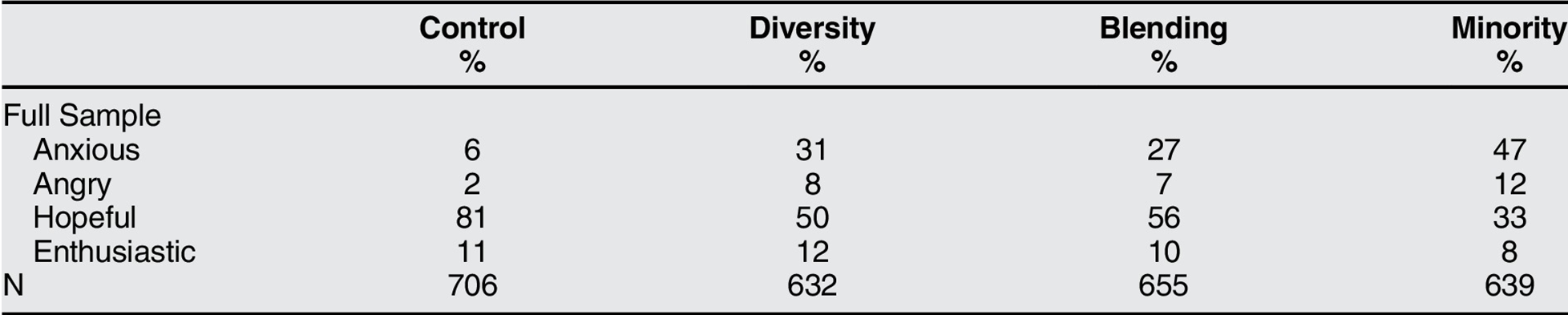
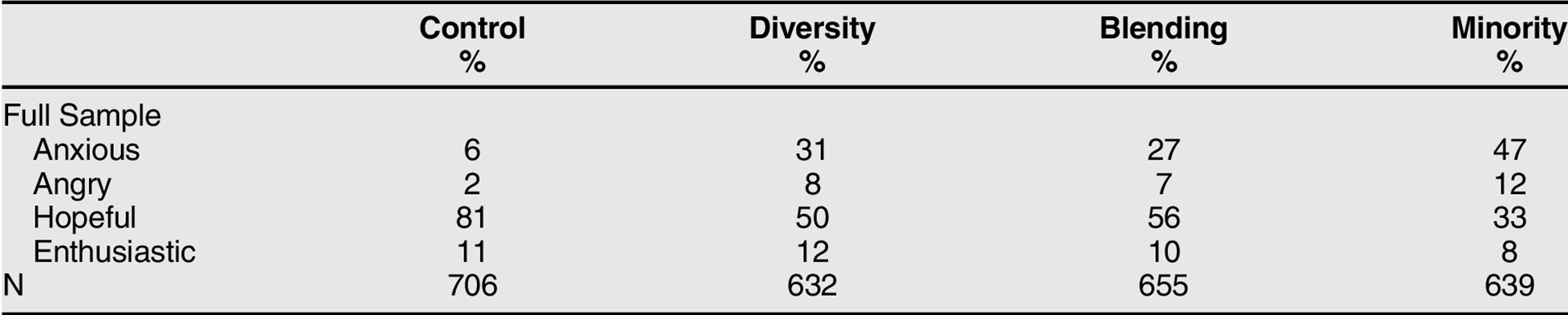
Table 1 shows that whites’ emotional reactions to these news stories varied dramatically. The impending white minority narrative greatly increases self-reported anxiety while dampening hopefulness, both by approximately 17 percentage points over the bare diversity rising narrative. The blending narrative, by contrast, is reassuring, even compared to the diversity narrative, raising those who report feeling hopeful by about six percentage points. To gauge the statistical significance of the narrative treatment effects on emotions over and above bare diversity, we estimated a multinomial logit model in which the measure of emotions was the dependent variable and the treatments were independent variables. Refer to online appendix table B2. The majority-minority narrative forecasting rises in racial diversity significantly raises anxiety while the blending narrative reduces anxiety. This is strong evidence for both H1 and H2.
Emotional reactions to news stories, Study 1
As an exploratory analysis of heterogeneous effects by age, education, and partisanship, we estimated multinomial logistic regression models (refer to online appendix table B3, for regression results and table B4 for basic tabulations), in which the dependent variable was the four-level measure of feelings and the independent variables were the indicators of treatment status, interacted with each potential moderator. There were no statistically significant differences by age and education in the effect of the blending and minority treatments, relative to the diversity story. Age dampens enthusiastic responses to any story about rising diversity but does not significantly heighten anxiety. Those with a college degree react less angrily (though not more anxiously) than non-college whites, but there is no significantly differential response to narrative choice by age or education. Also consistent with wide-ranging effects of narrative choice, the blending narrative is at least as appealing to Republicans as it is to Democrats. The diversity story induces almost twice as much anxiety among Republicans as among Democrats. But the blending treatment eases Republicans’ negativity dramatically, to the point that they exhibit similar emotional responses to this story to Democrats. The minority treatment ratchets up negative emotions among Democrats and Republicans alike, over and above diversity. Almost half of white Democrats and fully three-quarters of Republicans said they were anxious or angry about the standard account.
While we cannot rule out that emotional self-reports are influenced by a social desirability response set, the sweeping effects of narrative framing across a broad swath of the white public, and the prevalence of expressed anxiety and anger toward the dominant public narrative, suggest little wariness. Recent research suggests that many citizens who recognize explicit “racially hostile” messages in political communications do not reject them (Valentino, Neuner, and Vandenbroek Reference Valentino, Neuner and Vandenbroek2018).
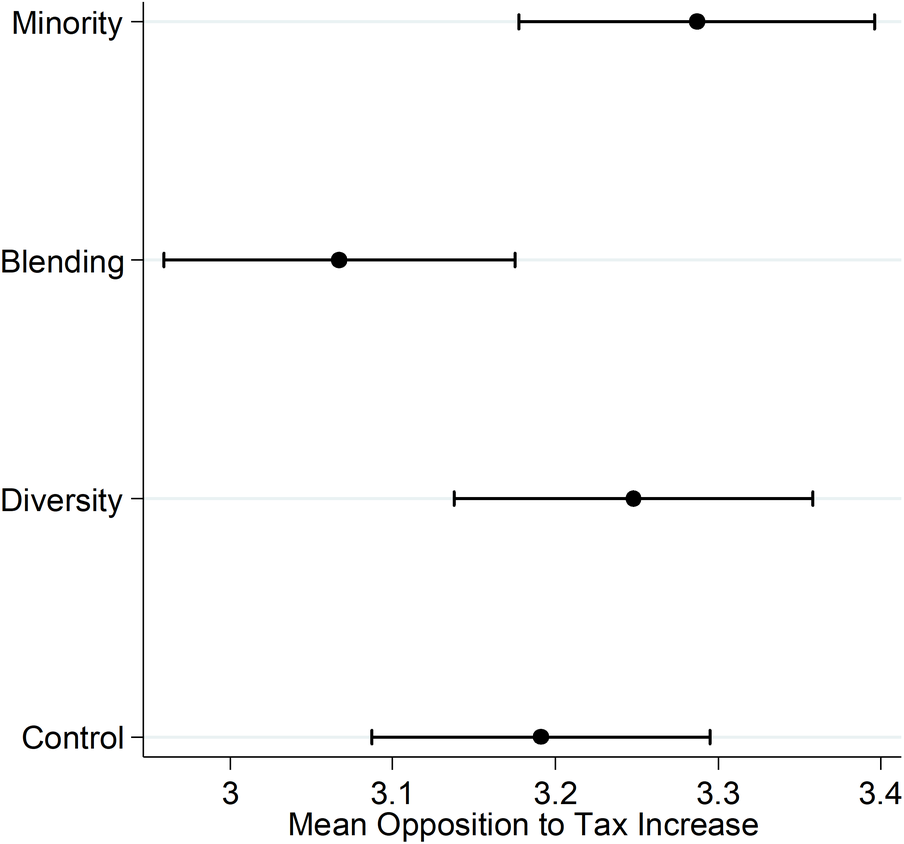
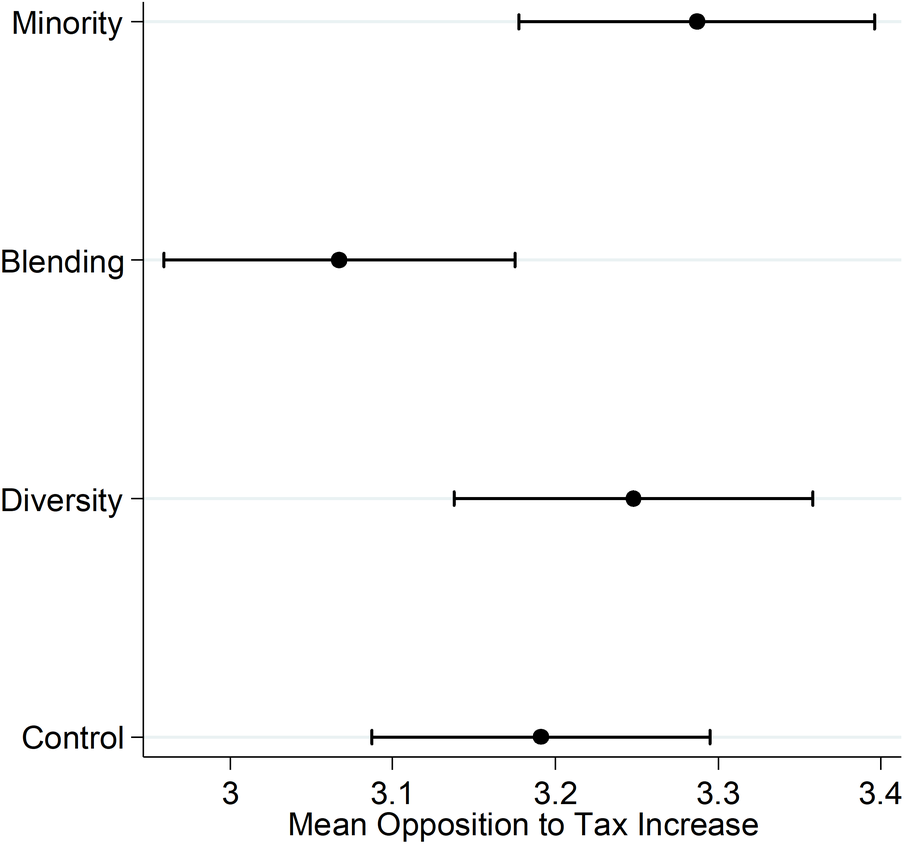
Narrative framing also substantially determines how news about projections of rising racial diversity influences support for spending on education. As shown in figure 2, the diversity and minority treatments only slightly and insignificantly increase opposition to the bill to increase property taxes 10% to increase school funding. Contrary to H1, opposition is only slightly and insignificantly higher in the minority condition than in the diversity condition. However, consistent with H2, opposition to the bill is significantly (p<.05) lower in the blending condition than in minority.
Mean opposition to bill increasing taxes to fund education, Study 1
Note: Opposition is measured on a 5-point scale, where 5 indicates greatest opposition to a 10% increase in property taxes to fund education.
On this dependent variable, there is no evidence of moderation by age, education, or party identification. We estimated separate OLS regression models predicting opposition to the property tax increase, in which the treatment indicator variables were interacted with age, education, and party identification. None of the interaction terms in any of the models were significant at p<.05 (refer to online appendix table B5).
To our surprise, we found no statistically significant effect of the majority-minority narrative on responses to either the level of immigration item or the benefit versus burden item (refer to online appendix table B6). However, the blending narrative did modestly reduce support for reducing immigration (p<.05) and insignificantly tilt attitudes toward seeing immigration as a benefit. The muted effects of the standard narrative may be because these items were asked late in the survey or because immigration naturally conjures changing racial demographics. Given that anti-minority attitudes are often cited as a consequence of threat and reactions to the majority-minority narrative in particular, these non-effects are noteworthy and merit further study. It may be that as the majority-minority narrative has become more widely known, its effect has already become embedded in the “pretreatment” (cf. Druckman and Leeper Reference Druckman and Leeper2012).
Study 2
A follow-up study conducted in June 2020 on a sample fielded by Lucid Labs was designed to address several potential concerns about the design of Study 1. Well established experimental benchmarks can be successfully recovered using Lucid samples (Coppock and McClellan Reference Coppock and McClellan2019). For sample descriptive statistics, refer to online appendix table B1. Wording for treatments and variables is provided in online appendix C.
Research Design
Modifications to the design of Study 1 were as follows. First, Study 2 included the same attention check question as in Study 1 (refer to online appendix C) but retained all respondents even if they failed it. Second, Study 2 employed stripped-down variants of the treatment stories that eliminated any reference to potentially confounding information, such as the fact that certain locales had already crossed the majority-minority “threshold” and references to younger generations. While such information is arguably part and parcel of the standard narrative majority-minority narrative about racial change, the more austere treatments zero in on variation in conceptions of racial identity rather than other cues commonly embedded in accounts about racial change. Third, Study 2 replaced the single multinomial indicator of emotions with the measurement employed in the American National Election Study, where people are asked sequentially whether they feel or do not feel any of multiple emotions. Fourth, respondents in Study 2 were not asked the main takeaway of the news story so as not to artificially draw their attention to the main idea we had in mind. Fifth, Study 2 included one additional treatment that was identical to blending except that it simply foretold the endurance of an expanded and more diverse white majority through 2060 without projecting a figure of 74%. That figure counted as white all people projected to identify as both white and Hispanic. Given the ambiguous meaning of whiteness to many Hispanics who so identify (Dowling Reference Dowling2014), we test a version of blending that relaxes this assumption and is mathematically accurate if even slightly over 10% of projected white-identified Hispanics as of 2060 are classified as white.
Results
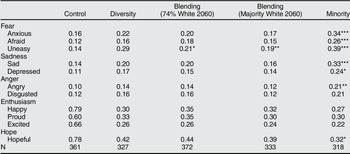
Notwithstanding these modifications to the design, the results from Study 2 strongly corroborate those from Study 1. All three emotions associated with fear (anxious, uneasy, afraid) were much higher in the white minority condition than in any other, as were more general measures of negative emotions (sad or depressed) and anger. In all cases, the blending narrative either reduced these negative emotions or left them unchanged. Moreover, it is clear that response to the blending narrative is insensitive to the somewhat arbitrary choice about how much of the projected white-Hispanic population one classifies as part of the expanded and more diverse white group into the future. Finally, the results in table 2 indicate that the findings in Study 1 were not a function of our decision to weed out respondents who failed the attention check. Fully 39% of the sample failed the same attention check in Study 2, but their inclusion or exclusion does not materially affect the results. For a tabulation that mimics Study 1 by excluding respondents who did not pass the attention check, refer to online appendix table B7.
Emotional reactions to news stories among non-Hispanic whites, Study 2
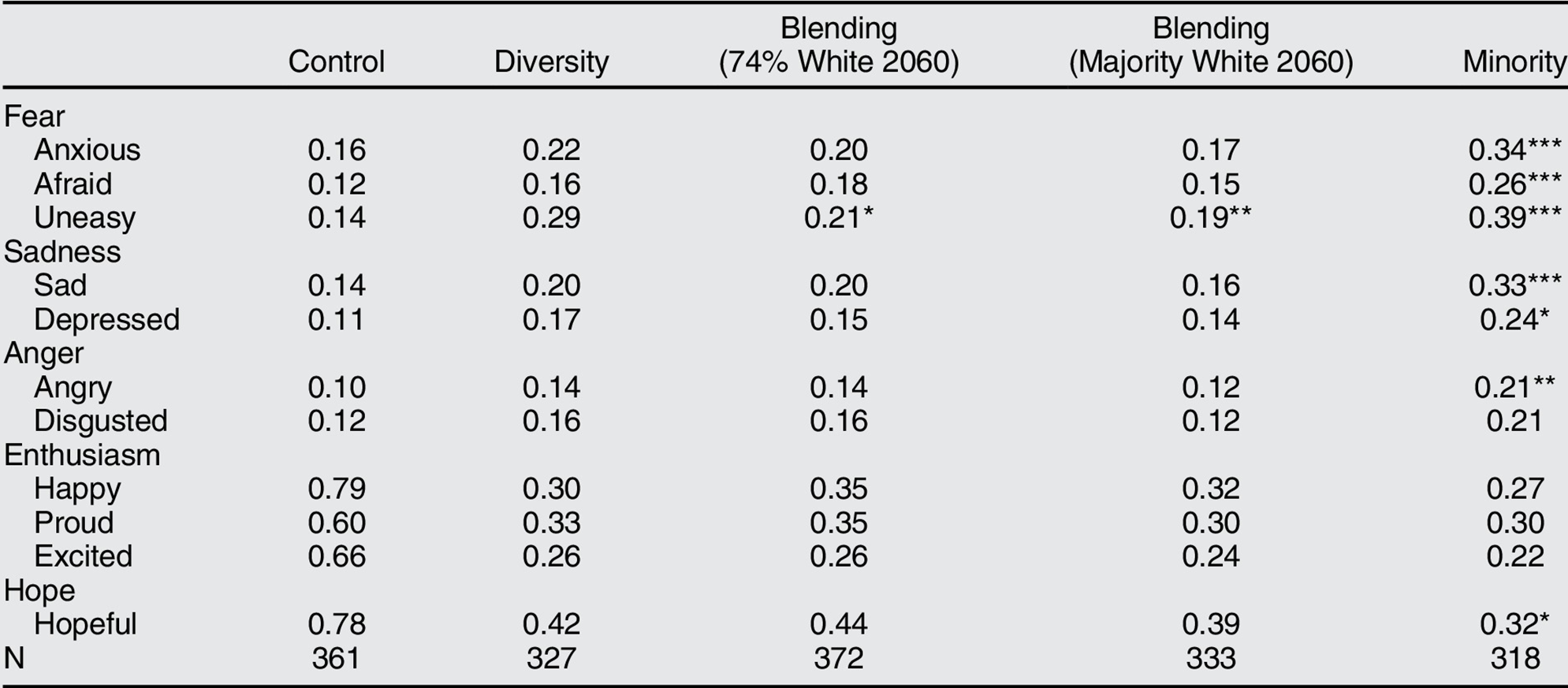
Note: Entries are the proportion of respondents reporting feeling each emotion. Asterisks indicate significance of difference from the proportion reporting the emotion in the Diversity condition (assessed via OLS regression of each dichotomous outcome on assignment to treatment). *p<.05, **p<.01, ***p<.001.
Study 3
The blending narrative from Study 1 contained two complementary but distinguishable elements that could have been responsible for its reassuring effect: the idea that multiracial unions between whites and non-whites are on the rise and the idea that this would lead to a persistent but more diverse white majority that includes many Americans with mixed backgrounds. Our third study included a treatment that describes the rise of multiracialism amid increasing racial diversity, without making any reference to a white majority or minority. This allows us to ascertain to what degree positive reactions to this narrative would hold up even without the reassurance of a continued white majority (H3).
We were also interested in determining whether reassuring effects of alternative narratives could withstand a counter-frame: if the blending and minority narratives were presented in tandem as competing perspectives held by different groups of demographers, which would prevail? Given the far greater propagation and familiarity of the standard majority-minority narrative, would it be viewed as more credible and suggest that the more complex story about multiracialism and expanding boundaries of whiteness is hollow, utopian, or simply false? After all, the dominant narrative reflects the persistence of hypodescent in elites’ and masses’ routine modes of thinking and talking about race. Thus it is endowed with the force of habit and the familiarity that whites have developed over generations with a system of race classification that has protected their group’s position and exclusivity. Recent research by Abascal (Reference Abascal2020) suggests that exposure to the majority-minority narrative causes whites to contract the boundaries of the ingroup. Abascal suggests that this might make whites less receptive to alternative narratives rooted in evolving norms of racial identification and fluidity. Given the results of Studies 1 and 2, the predominance of the majority-minority narrative in general clearly has not closed whites to accepting other alternatives. However, it may be that a reminder of the standard account would have such an effect and negate the receptivity to an expanded notion of whiteness that we observed in the first two studies.
Study 3 also contained a large sample of non-whites and included the option to take the survey in Spanish or English. This permits us to assess non-whites’ reactions to alternative narratives about rising diversity, which most prior research on this topic has overlooked. Specifically, we test two theoretical expectations: that the majority-minority narrative is distinctly empowering to non-white respondents and most strongly promotes positive emotions and the expectation of more equal treatment in the future (H4) and that narratives foretelling a persistent white majority are greeted less positively than those that refer to rising multiracialism without reference to the endurance of a white majority, albeit a far more diverse one (H5).
Research Design
Study 3 was conducted on 5,546 respondents in the February 2019 Understanding America Study (UAS), a nationally representative Internet panel based at the University of Southern California that has previously hosted the Los Angeles Times Daybreak Poll. Sample descriptive statistics are provided in online appendix table B1. For each dependent variable, we begin by analyzing those who identified as white and not Hispanic and we follow with separate analyses of Hispanics, non-Hispanic Blacks, and non-Hispanic Asians.
All respondents were assigned at random to read one of five news stories. In the control condition, we presented a story that discussed projections about the growth of the elderly population but made no reference to race or ethnicity. Those assigned to the minority condition read a shorter version of the story used in Study 1 about rising diversity and the approach of a majority-minority society. We also included a multiracial condition that discussed a forecast of rising diversity but emphasized increases in the number of Americans who have mixed backgrounds and identify as both white and a minority group. Unlike the blending condition in Studies 1 and 2, this condition made no reference to the status of whites as a persistent or declining majority group. The treatment condition we term white majority in this study adds to the multiracial news story by stating that a broadened and more diverse white public would remain the majority of the U.S. population. This condition most closely resembles the blending treatment in the previous two studies. Finally, we added a competing condition in which a persistent but transformed white majority is presented as a contested view among experts. This news story contained the same information as the white majority treatment but expressed it as what “Some Demographers See” rather than a matter of expert consensus. It also included an extended counterpoint from a fictitious demographer (and others who agree with her) that disagreed with the idea that whites would accept multiracial Americans as white and alluded to the standard majority-minority narrative. The text of all treatments is included in online appendix C. Study 3 included no pre-treatment general check on attentiveness, no question about the main idea or takeaway from the stories, nor any measure of familiarity with the stories’ content.
As dependent variables (for the wording, refer to online appendix C), we again measured emotional reactions to the story and, immediately afterward, perceptions of current and future discrimination against whites, Blacks, Latinos, and Asians. Respondents answered both on a sliding scale from 1 (none at all) to 10 (very much). Craig and Richeson (Reference Craig and Richeson2017) find that exposure to the white minority narrative substantially increases whites’ beliefs that their group will face more discrimination in the future than now, an expectation consistent with threat. Our setup allows us to corroborate this result and also to examine whether it manifests in response to any of the alternative narratives about rising racial diversity. The expectation of increased discrimination measure is scaled to run from -1 (less future than present discrimination against whites) to 1 (more future than present discrimination against whites).
Results
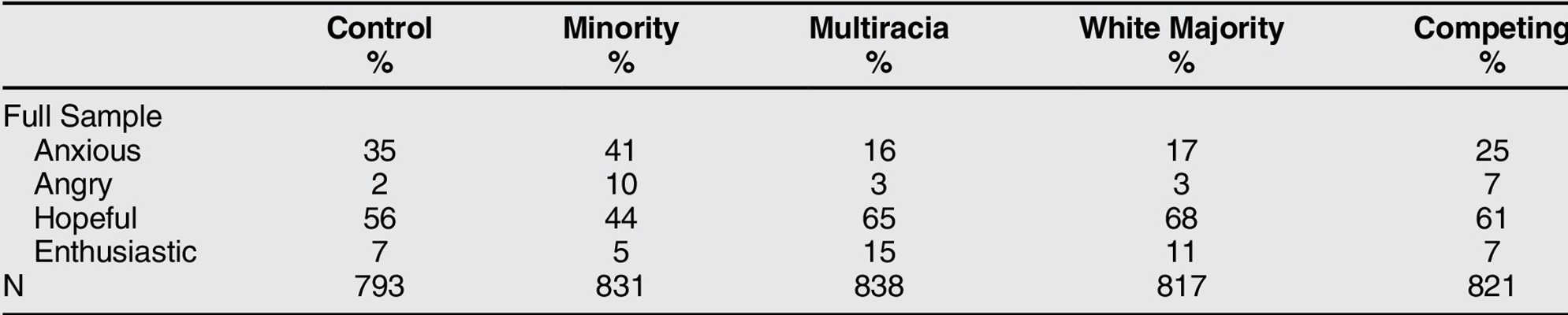
We begin by considering respondents’ self-reported emotional reactions to each story. Results for non-Hispanic whites are tabulated in table 3. Statistical significance of treatment effects was assessed via multinomial logit of the measure of emotions on dummy variables for each treatment condition (refer to online appendix table B8). What stands out, once again, is the distinctly alarming character of the minority condition. While the effects are modest relative to the control condition (a potentially worrisome story about the aging of American society), the theoretically relevant comparisons of this narrative about rising diversity to the alternatives reveal enormous differences, similar in magnitude to Studies 1 and 2.
Emotional reactions to news stories among non-Hispanic whites, Study 3
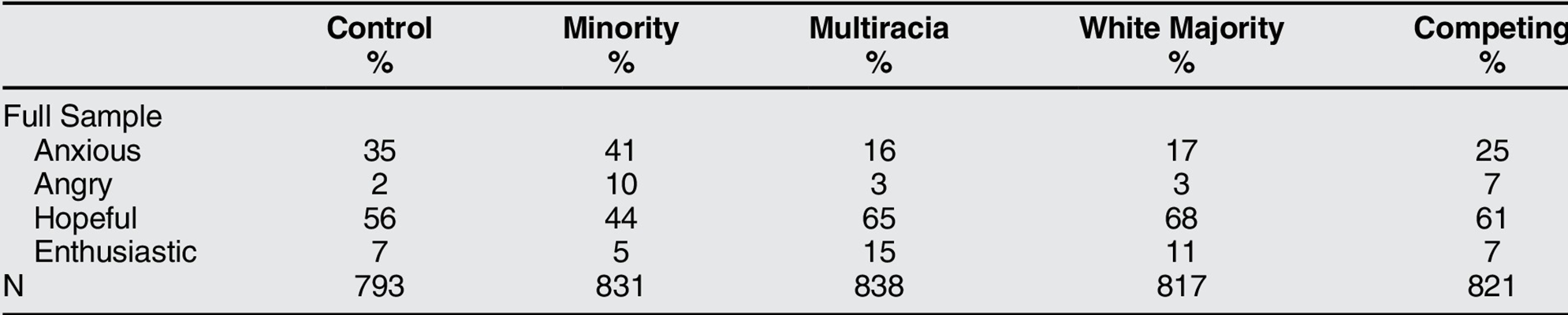
Contrary to H3, there is no evidence that whites are any less reassured by the story about increasing multiracialism devoid of reference to majority and minority groups than they are by the white majority narrative. A story about blending that makes no reference to a persistent white majority is no less reassuring than one that makes the endurance of a more diverse white majority salient. The key catalyst to anxiety and anger is quite clearly the majority-minority framing of projections about rising racial diversity. News stories that dispense with this framing in favor of narratives that emphasize rising multiracialism and mixed-race marriage do not elicit nearly as much threat, and this is true regardless of whether they foretell a persistent white majority in any form or simply draw no inferences about future majority and minority racial groups or blocs.
There is evidence that the introduction of the competing majority-minority frame somewhat counteracted the salutary effects of the white majority treatment, but these counter-framing effects amount to far less than a full reversal. Overall, while the competing frame boosted negative emotions by almost 10 percentage points relative to the unchallenged white majority story, negativity remains far lower than in the minority condition. People take stock of the uncertainty and disagreement presented in the competing story but most do not simply reject the less familiar story of racial blending in favor of the more familiar white minority narrative.
Exploratory analysis of moderation effects found no significant interaction between the treatments and age. A college degree was associated with less anxiety in response to all treatments, relative to the placebo, but there were no significant interactions between particular narratives and education. As online appendix table B10 clarifies, the majority-minority narrative engendered no more anxiety than the placebo among college-educated whites in Study 3, while the blending treatments evoked less anxiety than the placebo. Among non-college whites, the majority-minority story significantly boosted anxiety relative to the placebo but none of the other treatments did. Put differently, the minority treatment is uniquely alarming to non-college whites in this study, but patterns across the different narratives of racial change are very similar among college and non-college whites. Similar differences emerge across party lines. Democrats are not made more anxious (though somewhat angrier) by the majority-minority treatment, relative to the baseline. The blending treatments, however, leave anxiety among white Democrats significantly below the baseline. Among Republicans, on the other hand, the majority-minority narrative greatly increases anxiety and somewhat increases anger, while the other treatments dampen these effects. In short, non-college whites and white Republicans react more negatively to any given narrative about projected racial change than do their college-educated and Democratic counterparts. But all groups prove quite similarly responsive to variation in narrative framing.
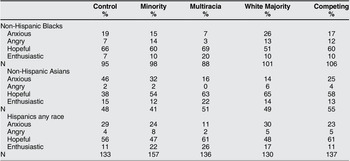
What about the largest constituent groups in the supposedly imminent non-white majority? Our third study permits a foray into effects on non-Hispanic black (N=530) and Asian (N=244) respondents as well as Hispanic respondents of any race (N=696). Emotional reactions to the different accounts among those who identify with each of these groups are tabulated in table 4 (for multinomial logistic regressions of feelings on the treatments in each group, refer to online appendix table B11).
Effects on Emotions of non-Hispanic Blacks and Asians and Hispanics of Any Race, Study 3
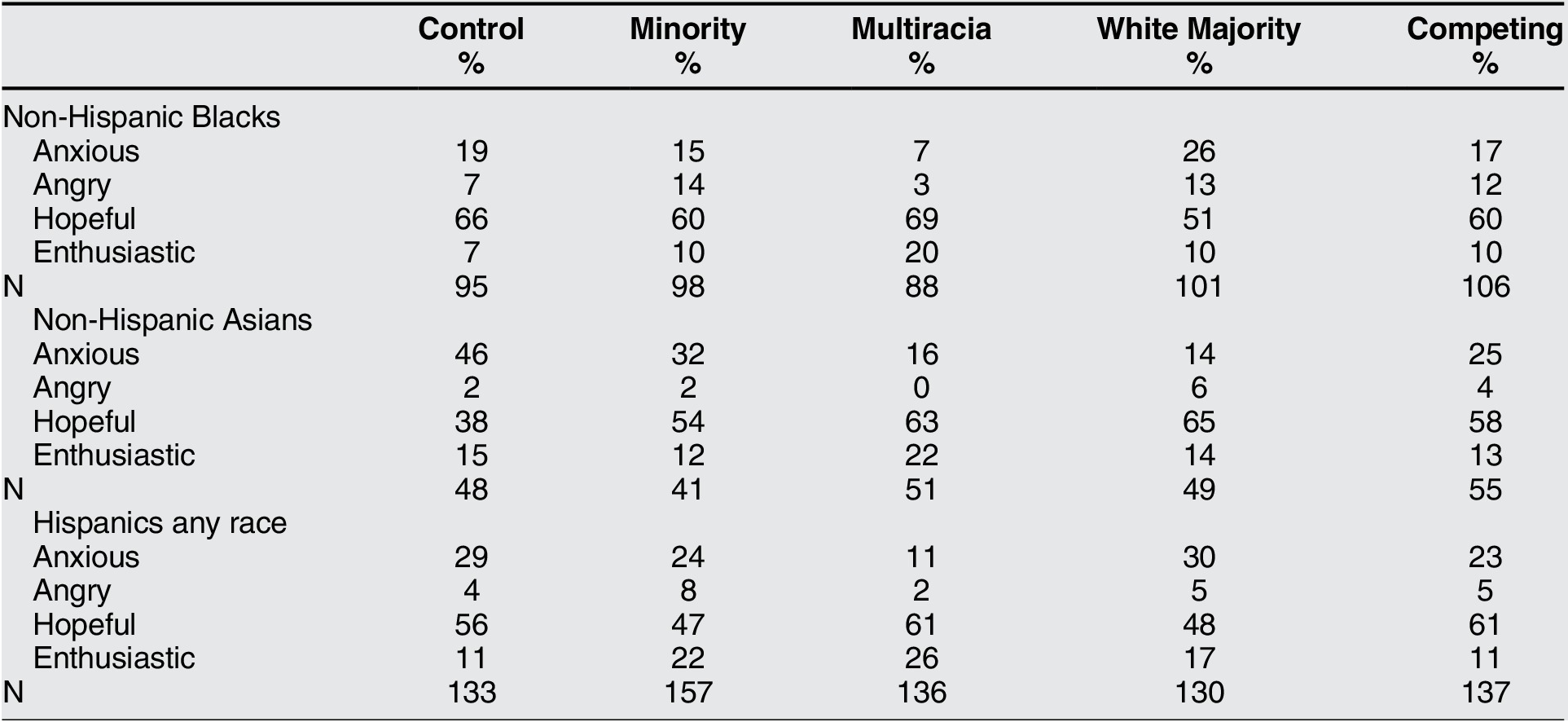
As might be expected, the standard minority narrative elicits generally far more positive emotions in all three groups than it does among whites. Fully 70% of Blacks, 66% of Asians, and 69% of Hispanics express either hopefulness or enthusiasm in this condition. However, contrary to H4, we see no greater positive reaction to this story among any of the minority groups than toward the alternative white majority or multiracial treatments. Instead, the multiracial treatment receives far and away the most positive reactions in all three groups—89% hopefulness or enthusiasm among Blacks, 85% among Asians, and 87% among Hispanics. Whereas there was little difference in the emotional resonance of the multiracial and white majority accounts among whites, consistent with H5, the idea of a persistent though broadened white majority somewhat dampens positive emotions among the three minority groups, relative to the multiracial narrative. Yet even in the white majority condition, 61% of Blacks, 79% of Asians, and 65% of Hispanics express hopefulness or enthusiasm—not all that different from the distribution of emotions expressed in response to the minority treatment. Adding the majority-minority rejoinder in the competing condition modestly boosts aggregate positivity among Blacks (70% positive emotions) and Hispanics (72%) relative to the white majority condition and modestly reduces it among Asians (71%).
These results, which will need corroboration and development in future research, suggest that most members of the country’s largest racial and ethnic minority groups have generally positive reactions to any of the narratives about rising racial diversity—even, it seems, to the idea of a persistent but broadened and more inclusive white majority. The most appealing formulation appears to be one that emphasizes the rise of multiracialism without invoking questions of future white majority or minority status. The expectation of a racially diverse non-white majority engenders no more emotional positivity than the expectation of a racially diverse white majority.
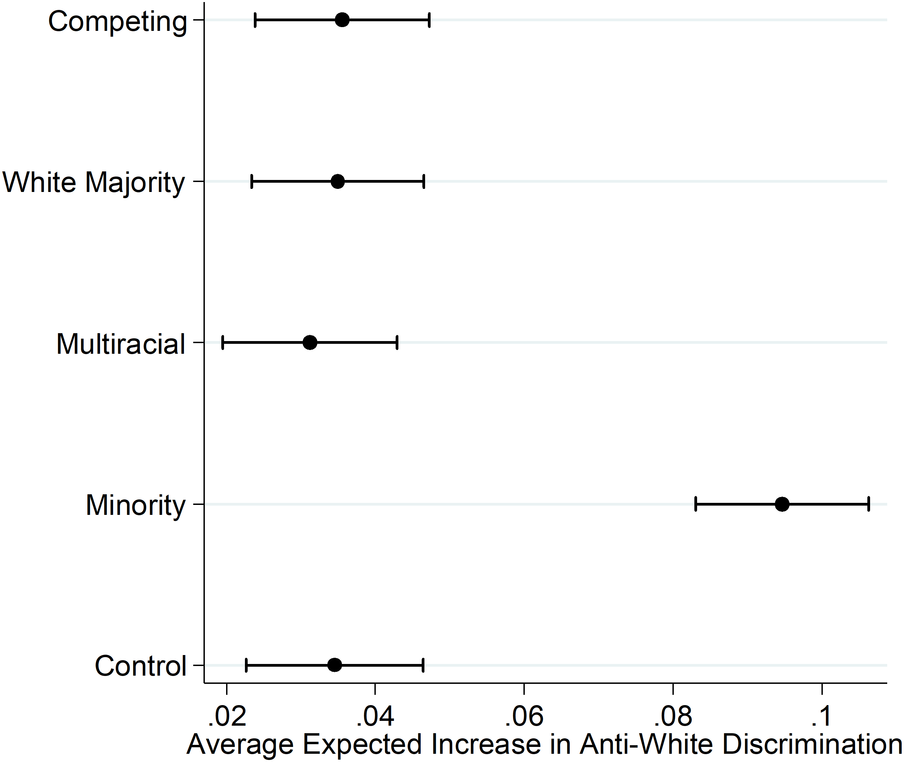
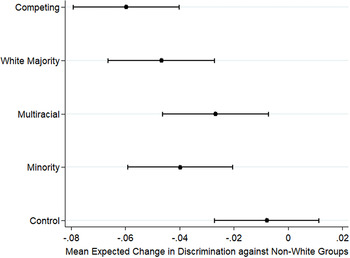
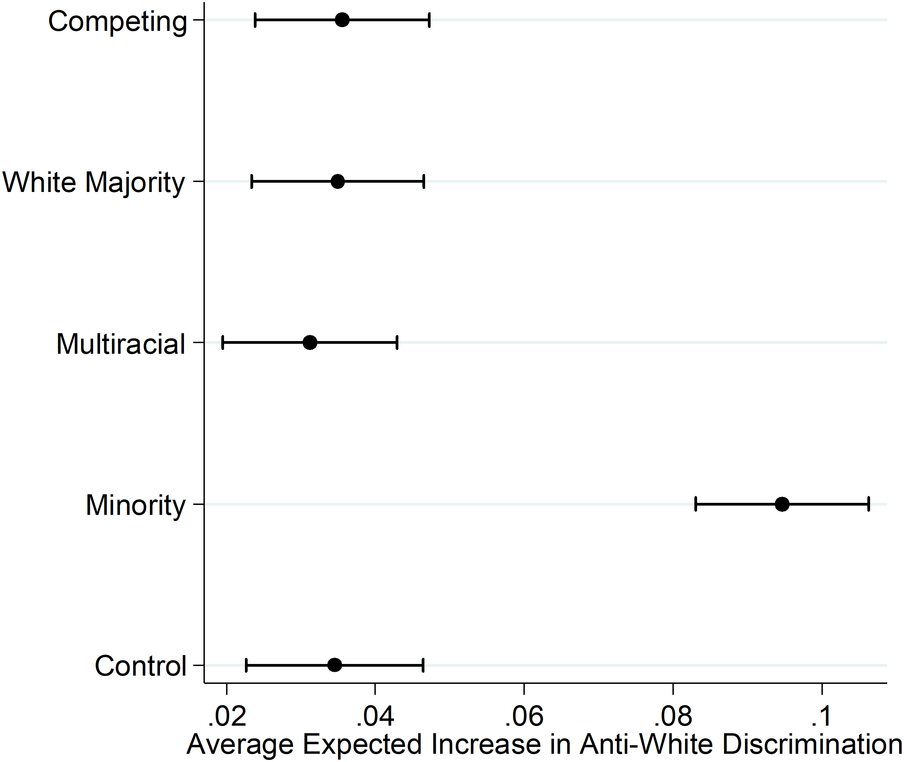
Turning to effects on the expectation of rising anti-white discrimination on non-Hispanic whites, figure 3 demonstrates once again that the majority-minority narrative is the key ingredient in generating racial threat. In keeping with previous research, exposure to the white minority narrative increases whites’ expectation that their group will face more discrimination in the future than now (cf. Craig and Richeson Reference Craig and Richeson2017). Relative to the control, the expected increase rises by approximately .06 (p<.001). Crucially, however, this manifestation of threat does not materialize in any of the other treatment conditions. Describing forecasts of rising diversity that emphasize multiracialism—with or without reference to a persistent and more diverse white majority—does not boost average scores on this measure. And there is no evidence at all of a counter-framing effect: challenging the validity of the persistent white majority narrative and reminding people of the standard majority-minority frame does not boost expectations of increased anti-white discrimination. Further analysis revealed no evidence of moderation by age, education, or partisanship of any of these effects (refer to online appendix table B12).
Mean expected increase (future minus present) in anti-white discrimination, among non-Hispanic whites, Study 3
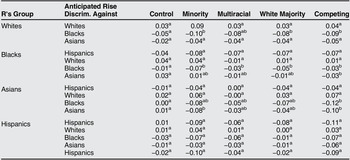
Broadening the inquiry to include each group’s assessment of change in discrimination against itself and each other group, we see some interesting points of agreement. Table 5: shows that all four groups by and large agree in anticipating somewhat more anti-white discrimination in the future than in the present, especially, it seems, when exposed to treatment conditions that reference an impending white minority (minority and competing). Members of each minority group also generally agree with whites in expecting less future discrimination against their own and other non-white groups when given information about forecasted rises in racial diversity.
Effects on Expectations of Increased Discrimination
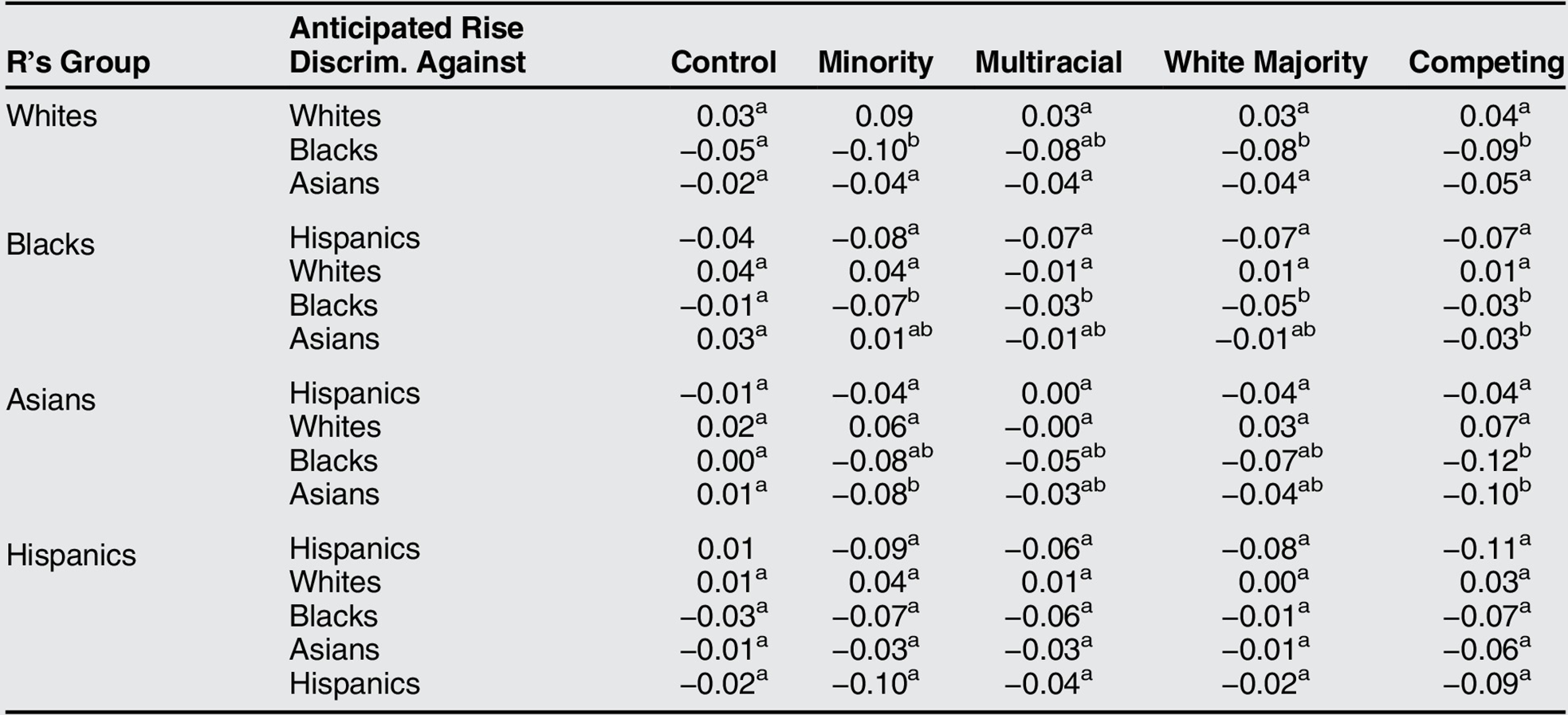
Note: Entries are mean expected increase in discrimination against each group, by respondents from each group, in each treatment condition. Entries in the same row that are labeled with the same superscript letter do not differ significantly (p<.05) from one another in pairwise t-tests.
Exposure to the minority or competing narratives mostly bolsters expectations of reduced future discrimination against groups other than whites, especially when it comes to expectations concerning minority respondents’ own group. However, none of these differences across narrative frames is statistically significant, reflecting both the small size and inconsistency of the substantive differences and small samples sizes. Even the white majority treatment heightens expectations of reduced anti-minority discrimination among Asians and Blacks, though average expectations among Hispanics are almost identical to the baseline.
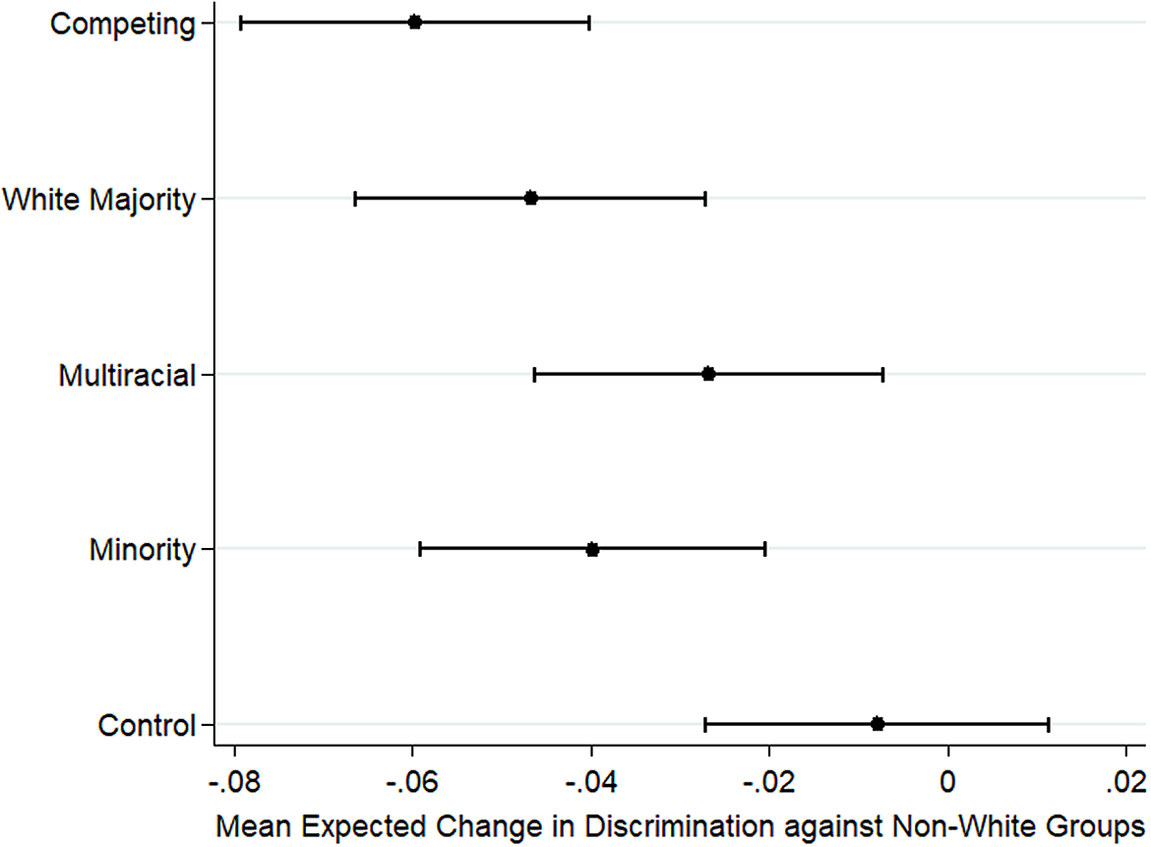
We can gain some statistical precision at the expense of some sociological precision by pooling the responses of all respondents who do not identify racially as singularly white in the survey and averaging across their expectations about future changes in discrimination against Blacks, Latinos, and Asians. As figure 4 shows, all accounts modestly increase non-whites’ expectations of more equal treatment of these three groups, though the effect of the mixed-race treatment falls just short of statistical significance. The mean expected change in discrimination against these groups is statistically indistinguishable across all four narratives about rising diversity. Contrary to H4 and H5, then, both multiracial narratives elicit similar responses and suggest to respondents as much evolution toward equal treatment as does the standard narrative foretelling a white minority and non-white majority. Whereas the dominant narrative of racial change is uniquely threatening to large numbers of whites, non-whites, taken together, evidently regard a future marked by rising racial mixing and multiracialism with optimism.
Mean expected increase (future minus present) in discrimination against non-white groups, pooling all non-white Respondents, Study 3
Conclusion
In an era marked by rising rates of interracial marriage and growing public acceptance of multiracialism, the metaphor of the American ethnic landscape as a kaleidoscope is as apt as ever (Fuchs Reference Fuchs1990). But the dominant narrative about racial diversity in America reduces all of this nuance and complexity to a single caricature of nineteenth century racial identity that is at odds with social and demographic realities experienced by younger generations in the twenty-first century.
In the people’s court, the consequences of this narrative choice have been severe. The heralded arrival of a majority-minority society has become a flashpoint in American mass politics. The specter of white decline has animated fringe racist groups enraged over the idea that whites will be “replaced.” While these reactions are extreme, anxiety over demographic change is widespread in the white public and can lead to a variety of political reactions linked to racial threat.
The question we have pursued is whether threatened reactions are driven by fears of rising racial diversity per se or by the way that rising diversity has been framed in mass media and political discourse. Consistent with prior research, we have found that the dominant majority-minority frame engenders strong emotional reactions among whites, more conservative attitudes about public spending, and the expectation of increased anti-white discrimination. What we have also shown, however, is that these effects, both large and small, are in no small part reactions to narrative framing. Stripped of the idea that groups are sharply bounded, that numerical dominance should be thought of as zero-sum, and that whites are in decline, the forecast of rising diversity has far more muted effects on emotions and political attitudes. Indeed, we find that a broad cross-section of whites not only accepts but embraces the rise of multiracialism and the emergence of a more diverse but persistent white majority as visions of the country’s racial future. This is true even in the face of counter-framing that reminds people of the standard narrative and challenges the idea that mixed-race and multiethnic people can be considered white.
Our third study also provided a much-needed examination of minority group members’ reactions to alternative narratives about racial change. It goes without saying that these groups are anything but monolithic. On the whole, however, reactions were positive, regardless of whether increased diversity was framed as tending toward a non-white majority or multiracialism. We also identified two intriguing points of commonality in how white and minority groups construed the implications of different narratives for the equal treatment of racial groups. All groups—not just whites—appeared to greet the majority-minority narrative with the anticipation of more anti-white discrimination. All groups also viewed any account of rising diversity as leading to more equal treatment of minority group members. These commonalities suggest that public interpretations of narratives about rising racial diversity are not as racially polarized as one might expect.
When it comes to public reactions to rising diversity now and into the future, demography is not destiny. Narratives powerfully influence what people make of demographic change and their political responses to it. Narratives can heighten threats or defuse them, augment divisions or mitigate them. When presented as objective facts, narratives can also mislead. The range of plausible narratives about rising diversity that we have considered reflects the variety of contradictory truths about racial identity alive in a society where the historic color line is still formidable but ever blurrier. No one of these narratives has a singular claim to scientific validity. Yet the political discourse has been dominated by one single narrative, rooted in backward-looking conceptions of race, to the near exclusion of any other. Citizens deserve a chance to consider as well a vision of the future racial landscape that better reflects the momentous changes afoot in twenty-first century America.
Supplementary Materials
Appendix A. Comparison of Race-Related Content in 2015 and 2018 Census Bureau Press Releases about Demographic Forecasts
Appendix B. Sample Statistics and Supplementary Analyses
Appendix C. Wording of Treatments and Survey ItemsTo view supplementary material for this article, please visit http://dx.doi.org/10.1017/S1537592720003679.