Neonatal ductal stenting is favoured over surgical Blalock–Taussig shunts in duct-dependent pulmonary circulation.Reference Mallula, Vaughn, El-Said, Lamberti and Moore 1 – Reference Alwi, Choo, Latiff, Kandavello, Samion and Mulyadi 3 Ductal stent migration is a rare but serious complication, especially in a hypoxic small neonate.Reference Alwi, Choo, Latiff, Kandavello, Samion and Mulyadi 3 , Reference Alwi 4 Migrated ductal stents have been surgically retrieved or expanded in the pulmonary arteries until now.Reference Buys, Brown and Greig 5 – Reference Vida, Speggiorin and Maschietto 7 A migrated stent was safely retrieved and repositioned in the ductal position in a neonate. This report details the reasons for the stent migration and strategies adopted for stent retrieval. Successful transcatheter retrieval and repositioning of a migrated ductal stent has not been reported so far.
Case report
A full-term neonate weighing 2.3 kg with pulmonary atresia, intact ventricular septum, right ventricle-dependent coronary circulation, and hypoxia on first postnatal day was stabilised on Prostaglandin E1. The duct was short and conical and arose from the proximal descending aorta. Ductal stenting was planned after detailed informed consent.
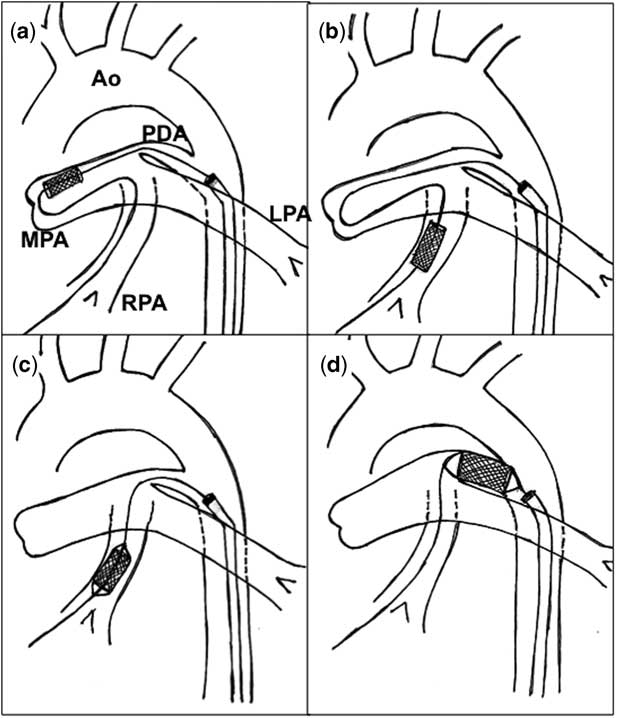
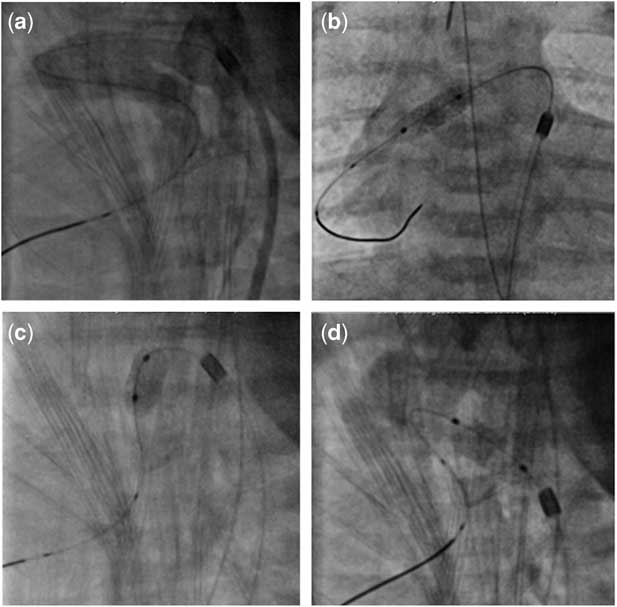
Under elective mechanical ventilation after discontinuing Prostaglandin at the beginning of the procedure, a 4 F Performer CHB long sheath (Cook Medical, Bloomington, Indiana, United States of America) was inserted into the right femoral artery upto the aortic origin of the duct. An early Prostaglandin withdrawal was not tolerated owing to hypoxia. Angiogram showed a conical short straight duct, 6 mm long and 2.5 mm at the narrow pulmonary end. The coronary guidewire across the duct was intentionally looped in the main pulmonary artery to orient the ductal stent towards the main pulmonary artery and avoid protrusion into the branch pulmonary arteries. A 4×9 mm drug-eluting Endeavor Resolute stent (Medtronic Inc., Minneapolis, Minnesota, United States of America) was deployed in the duct at 12 atmospheres. While performing an angiogram with hand injection through the side arm of the long sheath, the stent migrated into the main pulmonary artery (Figs 1 and 2).
The ductal stent migrated initially to the main pulmonary artery (MPA) during a check angiogram ( a ), and subsequently further migrated to the right pulmonary artery (RPA) ( b ). The stent was gripped with a larger balloon ( c ) and gently pulled back to the ductal position ( d ). LPA=left pulmonary artery; PDA=patent arterial duct; RPA=right pulmonary artery.

Lateral view angiogram showed migrated stent ( a ) in the main pulmonary artery. The stent was crossed by a 4.5-mm balloon, which was gently inflated ( b ) to grip the stent. The stent was gently pulled with due care ( c ) from the right pulmonary artery to the ductal position and fully expanded ( d ) within the duct.

While planning another overlapping long stent to stabilise the migrated stent, there was a further distal stent migration to the right pulmonary artery. A 4.5-mm balloon was manipulated within the expanded stent in the right pulmonary artery, inflated to grip the stent, and pulled back gently to reposition across the duct. The stent was expanded at 18 atmospheres covering the entire duct. In view of previous migration, indomethacin was administered intravenously at a dose of 0.2 mg/kg to constrict the duct. The stent position and flows remained stable. Oxygen saturation improved from 60 to 88%. She was discharged after 3 days on aspirin, clopidogrel, and furosemide. On a cardiac catheterisation at 1 year after the procedure, the pulmonary artery pressure was 18 mmHg, pulmonary arteries were of adequate size, and she was planned for a bidirectional Glenn shunt.
Discussion
Ductal stenting is favoured over surgical shunts in pulmonary atresia with intact ventricular septum owing to higher mortality associated with surgery.Reference Mallula, Vaughn, El-Said, Lamberti and Moore 1 – Reference Alwi, Choo, Latiff, Kandavello, Samion and Mulyadi 3 , Reference Gladman, McCrindle, Williams, Freedom and Benson 8 Its procedural success is improving over time with operator experience and the availability of low-profile coronary stents.Reference Alwi 4 To prevent intimal ingrowth that narrows the lumen and limits the longevity of palliation provided by this procedure, drug-eluting stents are used recently.Reference Sivakumar, Bhagyavathy, Coelho, Satish and Krishnan 9 , Reference Lee, Seto, Benson and Chaturvedi 10 We used a zotaralimus-eluting stent in this patient. Stent migration is a major complication of ductal stenting, caused by inadequate ductal constriction, dynamic changes in the ductal size, persistent prostaglandin effect, or choice of a smaller stent.Reference Alwi, Choo, Latiff, Kandavello, Samion and Mulyadi 3 , Reference Alwi 4 If early prostaglandin withdrawal is not tolerated owing to hypoxia as in our patient, intravenous ibuprofen is recommended after securing a guidewire across the duct to enhance ductal constriction before stenting.Reference Buys, Brown and Greig 5 We administered indomethacin after repositioning the migrated ductal stent to induce ductal constriction. Short straight ducts may be prone for stent migration than the long tortuous ducts. Angiogram in an orthogonal right anterior oblique projection may help to identify the duct diameter precisely. Migrated ductal stents have been either retrieved surgically or deployed in the mediastinal pulmonary arteries.Reference Alwi, Choo, Latiff, Kandavello, Samion and Mulyadi 3 – Reference Vida, Speggiorin and Maschietto 7 Expanding the stent in the right pulmonary artery was not possible in our patient as the artery was larger than the stent.
Transcatheter retrieval and repositioning of a migrated ductal stent has not been described in literature. Even though we managed to redeploy the stent across the ductus, this manoeuvre needs to be done with due care. Stent migration in our patient was possibly influenced by inadequate ductal constriction, persisting prostaglandin effect, and straight short ductal morphology. Our strategies included recapturing the expanded stent with a larger balloon before repositioning and utilising indomethacin to counter the prostaglandin effect. If ductal stent migration is anticipated owing to relatively large ductal size above 2.5 mm, short and straight duct morphology, or recent prostaglandin withdrawal, intravenous ibuprofen or indomethacin may be considered as a maturational duct responds to pharmacological manipulations.
Conclusions
Neonatal ductal stent migration is a serious complication, and it occurs in straight short ducts if ductal constriction is inadequate and smaller stents are chosen. Intravenous indomethacin after securing a guidewire across the duct may aid in ductal constriction. While a migrated ductal stent has been retrieved surgically or expanded in the pulmonary artery, transcatheter retrieval and repositioning may be feasible and can be attempted with due care.
Acknowledgements
None.
Financial Support
This research received no specific grant from any funding agency, commercial or not-for-profit sectors.
Conflicts of Interest
None.
Ethical Standards
The authors assert that all procedures contributing to this work comply with the ethical standards of the Indian Council of Medical Research and with the Helsinki Declaration of 1975, as revised in 2008, and has been approved by the institutional committees of Madras Medical Mission, Chennai, India.