


1. Introduction
…. medicine is a social science, and politics is nothing but medicine on a grand scale. Virchow (Reference Virchow1848: 2) cited in Taylor and Rieger (Reference Taylor and Rieger1985)
Can we advance governance as a leading political determinant of health? Our study addresses this larger question using a worldwide cross-country dataset to examine the role of governance in shaping maternal mortality ratio (MMR – the ratio of the number of deaths due to complications from pregnancy or childbirth per 100,000 live births). The significance of governance has been highlighted by economists, largely for its role in improving economic performance (Hall and Jones, Reference Hall and Jones1999). In tune with this view, research in development studies has emphasized the influence of good governance on social outcomes, such as education and health (Pritchett and Summers, Reference Pritchett and Summers1996; Filmer and Pritchett, Reference Filmer and Pritchett1999). Building on this, a small but growing number of studies have been investigating the association between governance and multiple health indicators (Berger and Messer, Reference Berger and Messer2002; Gupta et al., Reference Gupta, Verhoeven and Tiongson2002; Anyanwu and Erhijakpor, Reference Anyanwu and Erhijakpor2009; Gani, Reference Gani2009; Arthur and Oaikhenan, Reference Arthur and Oaikhenan2017; Abbas and Awan, Reference Abbas and Awan2018). Such literature has also influenced global developmental agendas. Further, the emergence of COVID-19 has strengthened the role of governance in health care.
The last two decades of universal development agendas, specifically with the United Nations platform, Millennium Development Goals (MDGs) and Sustainable Development Goals (SDGs), have brought significant changes in global health priorities, health care spending and governance. SDGs have redefined global health problems in a much broader and inclusive manner, provided new norms and demanded political and institutional commitments to handle global health challenges (McIntyre et al., Reference McIntyre, Meheus and Rottingen2017; Montoya-Williams and Fuentes-Afflick, Reference Montoya-Williams and Fuentes-Afflick2019). Despite these new developments, there are differences in health care and outcomes across countries, particularly in the maternal mortality ratio.
MMR is one of the most sensitive health indicators. It reflects the status of the national health system and the level of human development in a country (Sajedinejad et al., Reference Sajedinejad, Majdzadeh, Vedadhir, Tabatabaei and Mohammad2015). A higher level of maternal mortality reflects inequities in access to health services, poor health care and education quality and maternal malnutrition (Molla et al., Reference Molla, Mitiku, Worku and Yamin2015; Goli et al., Reference Goli, Puri, Salve, Pallikadavath and James2022). The latest data also reveals that regardless of the reduction in MMR, notable differences are observed across the regions (Figure 1). For instance, the global MMR has declined by 38%, from 342 deaths to 211 deaths per 100,000 live births between 2000 and 2017. However, the progress is still falling short of the required levels to reach the SDG target 3.1: ‘to reduce the global MMR to less than 70 per 100,000 live births by 2030’. Besides, there are significant disparities in the levels and rate of decline in MMR across world regions. In particular, the level of MMR is unacceptably high in parts of Africa (notably Sub-Saharan Africa) and South Asia, accounting for around 86% of maternal deaths worldwide.
Trends in Maternal Mortality Ratio (MMR) by region.
Source: World Health Organization, UNICEF, United Nations Population Fund and the World Bank.

One possible explanation for such heterogeneous progress across countries could be that ‘health is a political choice’, and political philosophies across the countries differ significantly, impacting commitment to public healthcare spending and health outcomes (Kickbusch, Reference Kickbusch2015). Recent literature recognizes that apart from the socioeconomic factors that determine the health and well-being of human populations across countries, public health expenditure and the quality of governance are the most important political factors contributing to improving health outcomes (Arthur and Oaikhenan, Reference Arthur and Oaikhenan2017; Langnel and Buracom, Reference Langnel and Buracom2020; Ibukun, Reference Ibukun2021).
While some studies have found a positive impact of health expenditure on various health outcomes (Berger and Messer, Reference Berger and Messer2002; Gupta et al., Reference Gupta, Verhoeven and Tiongson2002; Anyanwu and Erhijakpor, Reference Anyanwu and Erhijakpor2009; Gani, Reference Gani2009; Mishra and Newhouse, Reference Mishra and Newhouse2009; Yousuf, Reference Yousuf2012; Arthur and Oaikhenan, Reference Arthur and Oaikhenan2017; Abbas and Awan, Reference Abbas and Awan2018), in sharp contrast, Kizhakethalackal et al. (Reference Kizhakethalackal, Mukherjee and Alvi2013) established that health aid loses its effectiveness at relatively higher quantiles of infant mortality. Studies by Bayati et al. (Reference Bayati, Akbarian and Kavosi2013) for the East Mediterranean region from 1995 to 2007 also reached the same conclusion. Therefore, the existing literature suggests mixed evidence for the impact of health spending on health outcomes due to the omission of a critical variable, particularly the quality of governance which has a confounding relationship with public health expenditure.
Similarly, multiple studies have addressed the question of whether better governance helps in reducing maternal mortality. However, some of the major limitations of these studies are that they either focused on one specific dimension of governance (Manandhar et al., Reference Manandhar, Osrin, Shrestha, Mesko, Morrison, Tumbahangphe and Costello2004; Faguet and Ali, Reference Faguet and Ali2009; Holmberg and Rothstein, Reference Holmberg and Rothstein2011; Muldoon et al., Reference Muldoon, Galway, Nakajima, Kanters, Hogg, Bendavid and Mills2011; More et al., Reference More, Bapat, Das, Alcock, Patil, Porel and Osrin2012; Hamal et al., Reference Hamal, Buning, Brouwere, Bardají and Dieleman2018) or conducted only cross-sectional analyses in most cases and thereby ignored changing dynamics of governance quality across countries over time (Sajedinejad et al., Reference Sajedinejad, Majdzadeh, Vedadhir, Tabatabaei and Mohammad2015; Ruiz-Cantero et al., Reference Ruiz-Cantero, Gujjarro-Garvi, Bean, Martizen-Riera and Fernandez-Saez2019). Some of them were also limited in geographical scope (Manandhar et al., Reference Manandhar, Osrin, Shrestha, Mesko, Morrison, Tumbahangphe and Costello2004; Faguet and Ali, Reference Faguet and Ali2009; More et al., Reference More, Bapat, Das, Alcock, Patil, Porel and Osrin2012; Hamal et al., Reference Hamal, Buning, Brouwere, Bardají and Dieleman2018; Chimere et al., Reference Chimere, Agubutun, Chinonyerem, Godfrey and Osuagwn2019) and methods (Sajedinejad et al., Reference Sajedinejad, Majdzadeh, Vedadhir, Tabatabaei and Mohammad2015; Bishai et al., Reference Bishai, Cohen, Alfonso, Adam, Kuruvilla and Schweitzer2016; Kim and Wang, Reference Kim and Wang2019), and therefore, could not identify the pathways critical for effective designing of channels to act on reduction of MMR (Ciccone et al., Reference Ciccone, Vian, Maurer and Bradley2014; Hall et al., Reference Hall, Lopez, Murray and O'Hare2021). Therefore, this study fills critical gaps by re-examining the links between the quality of governance, health expenditure and MMR drawing on cross-country panel data of 186 countries over 1996–2019 covering the transition period from MDGs to SDGs.
1.1 Contribution of the study
In the context of ever-changing political philosophies and governance quality across countries, using a more comprehensive definition of governance based on the World Governance Indicators (WGI), this is the only recent study to examine the role of governance in the reduction of MMR. In contrast to the previous studies, the present study systematically employs multiple empirical tests and, more importantly, draws the mechanisms through which the quality of governance influences MMR. In particular, this study makes important contributions on the methodology front: (1) We cautiously check for the interaction of health expenditure with the governance quality along the lines of Doucouliagos et al. (Reference Doucouliagos, Hennessy and Mallick2021), Bousmah et al. (Reference Bousmah, Ventelou and Abu-Zaineh2016) and Makuta and O'Hare (Reference Makuta and O'Hare2015) to ascertain previous finding if the negative effects of health expenditure on maternal mortality reduction are robustly conditioned on the level of governance quality of a country? (2) We account for potential endogeneity issues by employing the Arellano-Bover/Blundell-Bond system estimator for the dynamic panel model, following the previous literature (Mishra and Newhouse, Reference Mishra and Newhouse2009; Roodman, Reference Roodman2009; Tarverdi and Rammohan, Reference Tarverdi and Rammohan2017). The robustness of the results is checked by taking alternative instruments. (3) We have employed Quantile Regression estimates to check the consistency of the results across all levels of MMR, keeping with the literature stimulated by Kizhakethalackal et al. (Reference Kizhakethalackal, Mukherjee and Alvi2013). (4) We explored the direct and indirect mechanisms through which governance affects maternal mortality using a Path Regression Analysis based on Structural Equation Modeling (SEM). Therefore, our focus on governance, health expenditure and MMR complement this significant but under-searched area.
Our study throws up several insightful results. (1) Dynamic panel estimates suggest that a point improvement in the governance index decreases maternal mortality by 10–21%. (2) The Quantile Regression estimates further reveal that health expenditure is effective in countries with lower levels of MMR. Nevertheless, in countries suffering from higher levels of MMR, governance matters more for the effectiveness of health expenditure. (3) Finally, using Path Regression Analysis, we found that governance, directly and indirectly, is related to MMR through other socioeconomic correlates.
The rest of the paper is organized as follows. Section 2 reviews the relevant literature. Section 3 provides the data description and summary statistics. The empirical strategy is presented in Section 4. Section 5 discusses the estimation results and carries out robustness checks. Section 6 presents our concluding remarks.
2. Literature review
There is substantial cross-national, quantitative evidence to suggest that good governance or state capacity (broadly defined) has an independent effect on various health outcomes and mediates its effect through health expenditure to achieve better health outcomes (Brieba, Reference Brieba2018). Klomp and de Haan (Reference Klomp and de Haan2008) used a cross-sectional analysis of 101 countries from 2000–2005. However, they did not find any direct effect of governance on health outcomes but an indirect positive effect via income and quality of the healthcare sector. Another study by Rajkumar and Swaroop (Reference Rajkumar and Swaroop2008) found that in countries with good governance, a one percentage point rise in the share of public health spending in GDP lowers the mortality rate among the under-5s by 0.32%. In contrast, such a relationship does not exist in countries with weak governance. Farag et al. (Reference Farag, Nandakumar, Wallack, Hodgkin, Gaumer and Erbil2013) have also shown a significant effect of health spending in reducing infant and under-five mortality for 133 low- and middle-income countries, conditional on good governance. Hu and Mendoza (Reference Hu and Mendoza2013) have affirmed the importance of public spending on healthcare and quality of governance to improve child mortality rates for 136 countries during 1960–2005. Using two-stage least squares, the study by Makuta and O'Hare (Reference Makuta and O'Hare2015) found a significant impact of governance quality on the effectiveness of public health spending in child mortality in panel data of 143 countries in sub–Saharan Africa over 1996–2011. Another study by Emamgholipour and Asemane (Reference Emamgholipour and Asemane2016) for 27 OECD countries from 1996 to 2016 revealed that governance quality reduces under-5 mortality using the generalized method of moments (GMM).
Similarly, Bousmah et al. (Reference Bousmah, Ventelou and Abu-Zaineh2016) highlighted the role of the quality of institutions in the efficacy of health expenditure on health outcomes in a panel data set of 18 countries from the Middle East and North Africa region over 1995–2012. Tarverdi and Rammohan (Reference Tarverdi and Rammohan2017) found a negative association between governance and child mortality using the system GMM dynamic panel, quantile and semiparametric regression in a cross-country dataset. Akinlo and Sulola (Reference Akinlo and Sulola2019) showed no significant improvement in under-5 mortality in sub-Saharan Africa, possibly due to a high level of corruption. The study by Langnel and Buracom (Reference Langnel and Buracom2020) showed that the effectiveness of health expenditure on infant mortality depends on the administrative capacity of 32 sub-Saharan African (SSA) countries from 2000 to 2015, after accounting for potential endogeneity issues using a system-generalized method of the moment. Doucouliagos et al. (Reference Doucouliagos, Hennessy and Mallick2021), based on panel data for 96 recipient countries for the 2002–2015 period, reassured the importance of governance in the effectiveness of health aid in reducing infant mortality. Another study by Ibukun (Reference Ibukun2021) also concluded that countries with a higher quality of governance get more benefit from their public health expenditure for all forms of outcomes of health, namely, infant mortality, under-five mortality and life expectancy in 15 West African countries between 2000 and 2018.
While there are many studies on the determinants of infant, under-5 and child mortality rates, there has not been much work on the relationship between ‘governance and MMR’. Below we have reviewed the salient findings of previous studies linking governance and MMR and presented them in Table 1. These studies can be categorized into two parts, one set of studies analyzing a specific process or structure within local governance while the other compares national-level governance indices between countries over time, demonstrating the breadth of extant research on governance. The first set of studies that have tried to highlight the mechanisms through which governance may influence MMR, such as enhanced community engagement, health system decentralization and social accountability, have been particularly region specific. For instance, Manandhar et al. (Reference Manandhar, Osrin, Shrestha, Mesko, Morrison, Tumbahangphe and Costello2004) constructed a governance indicator by looking at the impact of a community-based, participatory health intervention on MMR and found significant reductions in MMR in the rural Makwanpur district of Nepal. Another district-level study by Faguet and Ali (Reference Faguet and Ali2009) revealed the positive impact of a decentralized health system (capturing better local governance) in reducing maternal mortality in Bangladesh. The study by More et al. (Reference More, Bapat, Das, Alcock, Patil, Porel and Osrin2012) found no significant effect of using community-based women groups' initiatives on maternal health outcomes in India. In contrast, the study by Hamal et al. (Reference Hamal, Buning, Brouwere, Bardají and Dieleman2018) for Gujarat, India, highlighted the strong influence of social accountability mechanisms on governance, which improves maternal health outcomes. A recent study by Bhalotra et al. (Reference Bhalotra, Clarke, Gomes and Venkataramani2022) suggested a new policy tool for tackling maternal mortality by identifying the role of quota legislation and its possible positive impact on skilled birth attendance, prenatal care utilization, the decline in fertility and an increase in the schooling of young women.
Summary of findings from previous studies on the Impact of Governance on Maternal Mortality Ratio (MMR)

Source: Authors' compilation.
In contrast to these studies, cross-country studies in global health, like Muldoon et al. (Reference Muldoon, Galway, Nakajima, Kanters, Hogg, Bendavid and Mills2011) and Holmberg and Rothstein (Reference Holmberg and Rothstein2011), though finding that quality of government leads to lower maternal mortality ratios, have considered only specific dimensions of governance. However, Ciccone et al. (Reference Ciccone, Vian, Maurer and Bradley2014), in a synthesis of previous literature, have concluded that the concept of governance is much wider, more complex and widely contested. Closer to our study, another set of studies that assessed the relationship between Worldwide Governance Indicators (WGI) and MMR, in general, found that better governance lowers maternal mortality (Sajedinejad et al., Reference Sajedinejad, Majdzadeh, Vedadhir, Tabatabaei and Mohammad2015; Bishai et al., Reference Bishai, Cohen, Alfonso, Adam, Kuruvilla and Schweitzer2016; Chimere et al., Reference Chimere, Agubutun, Chinonyerem, Godfrey and Osuagwn2019; Ruiz-Cantero et al., Reference Ruiz-Cantero, Gujjarro-Garvi, Bean, Martizen-Riera and Fernandez-Saez2019; Hall et al., Reference Hall, Lopez, Murray and O'Hare2021), except for the study by Kim and Wang (Reference Kim and Wang2019). However, these studies suffer from some limitations, such as (a) the study by Sajedinejad et al. (Reference Sajedinejad, Majdzadeh, Vedadhir, Tabatabaei and Mohammad2015) and Ruiz-Cantero et al. (Reference Ruiz-Cantero, Gujjarro-Garvi, Bean, Martizen-Riera and Fernandez-Saez2019) undertook a static cross-sectional analysis and ignored the idea of governance as a dynamic process; (b) Bishai et al. (Reference Bishai, Cohen, Alfonso, Adam, Kuruvilla and Schweitzer2016) did not specifically investigate the relationship between governance and maternal mortality, but rather used governance as one of the socioeconomic factors; (c) Chimere et al. (Reference Chimere, Agubutun, Chinonyerem, Godfrey and Osuagwn2019) specifically focused on the Sub-Saharan samples and could not comment on global heterogeneity in the quality of governance; (d) Sajedinejad et al. (Reference Sajedinejad, Majdzadeh, Vedadhir, Tabatabaei and Mohammad2015) and Kim and Wang (Reference Kim and Wang2019) have linked governance, health expenditure and MMR on a standalone basis, neglecting the inter-linkage between them; (e) finally, none of these studies have focused on mechanisms through which the quality of governance can influence maternal mortality. A detailed summary of data, methods and key findings of previous studies is presented in Table 1. Our study improves upon the geographical spread and methodological limitations and makes a significant contribution to the existing literature on ‘governance and MMR’ by identifying the pathways critical for the effective design of channels through which governance acts on the reduction of MMR, which, to our knowledge has not been attempted by previous studies.
3. Role of governance in defining health outcomes: mechanism
While social determinants of health are the socioeconomic factors that influence health, political determinants of health are the policy options and their implementation that impact those social determinants of health first (McKee, Reference McKee2017; Mishori, Reference Mishori2019; Dawes, Reference Dawes2020). In particular, the political determinant of health is defined as:
‘The Political determinants of health involve the systematic process of structuring relationships, distributing resources, and administering power, operating simultaneously in ways that mutually reinforce or influence one another to shape opportunities that either advance health equity or exacerbate health inequities’. – Dawes (Reference Dawes2020)
Governance is a critical output of a political process (Mackenbach, Reference Mackenbach2014). Governance as a political determinant of health shapes policy options and plays a significant role in their effective implementation. It denotes how states and institutions obtain and exercise power to shape public policy and provide public goods and services (Kickbusch and Gleicher, Reference Kickbusch and Gleicher2012; Rao, Reference Rao2016). Further, as the political determinants of health, governance produces the social drivers, which include equitable distribution of opportunities and resources, social cohesion, brotherhood, poor environmental conditions, inadequate transportation and lack of access to adequate and quality food options, directly and indirectly affecting several dynamics of health (Dawes, Reference Dawes2020).
While good quality governance can be broadly defined as the ability of the government to make sound policies for national development and their effective implementation (Rajkumar and Swaroop, Reference Rajkumar and Swaroop2008; Lin et al., Reference Lin, Chien, Chen and Chan2014; Batniji et al., Reference Batniji, Khatib, Cammett, Sweet, Basu, Jamal, Wise and Giacaman2014), since public spending on health is channeled mainly through public institutions, it implies that good governance is a key to development effectiveness (Biermann et al., Reference Biermann, Kanie and Kim2017). Studies have suggested governance influences health outcomes differently in developed and developing countries. In developed countries, good governance has a positive effect on health through the healthcare sector, whereas in developing countries, governance affects health outcomes largely through its indirect impact on income, poverty and inequality (Rajkumar and Swaroop, Reference Rajkumar and Swaroop2008; Makuta and O'Hare, Reference Makuta and O'Hare2015; Arthur and Oaikhenan, Reference Arthur and Oaikhenan2017).
In this study, we construct a conceptual framework that combines ‘socioeconomic factors’ with ‘political factors’ as a structural determinant that directly and indirectly affects MMR (Figure 2). The framework demonstrates that the mechanisms through which governance influences health outcomes are channeled directly or indirectly through several macro and micro socioeconomic, demographic and healthcare factors. Governance quality determines economic growth, poverty and inequality, which are defining factors of maternal and child mortality in a country. Governance quality also determines social factors such as education, women's status and age at marriage, which are critical predictors of maternal mortality. Fertility levels in a country also depend on political philosophies of population policies. The number of pregnancies or childbirths is directly proportional to women's risk of maternal death. Thus, in this study, we examine how far changing dynamics of governance quality across countries have a direct and indirect influence on MMR via socioeconomic factors.
A theoretical framework for the relationship between governance, health expenditure and MMR.
Source: Authors' own framework.

4. Data and variables
Our dataset contains balanced annual panel data for 184 countries from 1996 to 2019. The dependent variable is MMR. In our study, MMR is defined as the maternal deaths in 100,000 live births, a modeled estimate sourced from World Development Indicators (WDI). The maternal mortality ratio can be calculated directly from data collected through vital registration systems, household surveys or other sources. However, there are often data quality problems, particularly related to the underreporting and misclassification of maternal deaths. Therefore, data are often adjusted to consider these data quality issues. The main explanatory variable of the study is the governance index. Governance is so multifaceted that several indicators have been developed to try and capture its different dimensions. This study is created by taking the average of six dimensions of governance of World Bank Governance Indicators (WGI): Voice and Accountability, Political Stability and Absence of Violence, Government Effectiveness, Regulatory Quality, Rule of Law and Control of Corruption.Footnote 1 Health spending (as % of GDP) by the country is another important explanatory variable. Public health spending can help reduce maternal mortality by augmenting the household's ability to invest in mothers' and children's nutrition, health and well-being. However, their effectiveness is subject to inquiry as the government's policy and expenditures do not always translate into outcomes. The income variable, gross national income (GNI) per capita taken at 2010 US$ prices, is another necessary control variable. National income may, directly and indirectly, affect maternal mortality (Hu and Mendoza, Reference Hu and Mendoza2013).
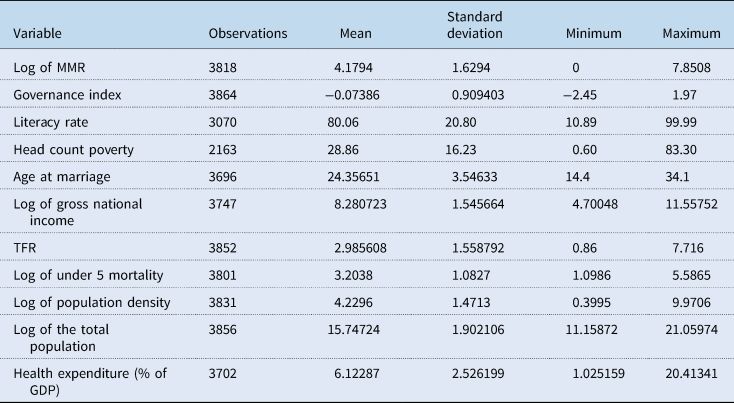
In countries with higher per capita income, the ability of households to secure better nutrition, housing, access to clean water and sanitation and meet medical needs is higher. Also, higher income may affect maternal mortality indirectly by reducing the total birth rate. Similarly, poverty is another important factor that negatively affects health outcomes by limiting access to quality healthcare and denial of nutritious food. Previous researchers have shown education to be an important determinant of maternal mortality (Mishra and Newhouse, Reference Mishra and Newhouse2009; Yousuf, Reference Yousuf2012). In this study, we have used the literacy rate as a proxy for education levels. Certain health outcomes, such as total fertility rate (TFR) and under-five mortality rates, may also affect the mortality rates. Besides this, the women's age at marriage is also included as a control variable since it has a significant bearing on TFR and affects maternal mortality. Finally, the influence of demography is analyzed by taking population density, which indicates that a high population density can limit the health sector's capacity (Klomp and de Haan, Reference Klomp and de Haan2008).
4.1 Summary statistics
Summary statistics for the key variables are presented in Table 2. The sample comprises around 3800 (2163 for poverty rate) observations covering 120 countries. Our dependent variable MMR ranges from 2 to 2567, with a mean value of 199.8. The mean value for the governance indicators is −0.08. Descriptive statistics for other control variables are of varying ranges. The range of literacy rates is quite wide, from 10.8 to 99.99%, and the headcount poverty rate varies from 0.60 to 83.3%. Thus, we can say that still many countries are lagging in terms of education and poverty levels.
Summary statistics

Source: Authors' estimations.
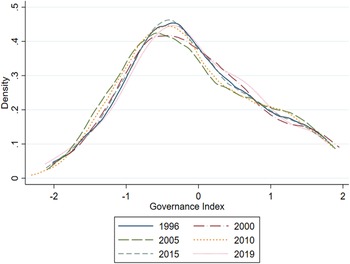
Further, the fertility level ranges from 0.86 to 7.7, with a mean value of around three children per woman. The sample's mean under-five mortality is approximately 41 per 1000 live births. Health expenditure (% of GDP) also varies from 1 to 20% across the countries, interestingly very high. The average percentage of GDP on health expenditure is found to be %. The kernel distribution of the Governance index and MMR for 5-year intervals have also been shown in Figures 3 and 4.
Kernel density plots of the Governance Index at each 5-year interval in a single plot.
Source: Authors' estimations.

Kernel density plots of MMR of each 5-year interval in a single plot.
Source: Authors' estimations.

Figure 5 suggests that the level of MMR considerably varies across the countries by the quartile of the governance index. The level of MMR is three-times higher between countries of quartile 1 compared to quartile 4 in terms of quality of governance index, where the countries in quartiles 1 and 2 represent the lowest and highest quality of governance.
Level of MMR across the quartile of the Governance Index, 1996 to 2019.

4.2 Correlation and co-evolution of global and regional-level MMR with governance quality
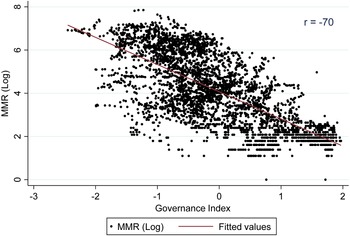
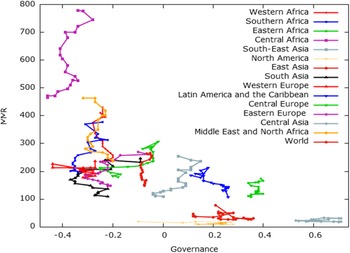
Figure 6 displays a strong negative (r = −70) correlation between MMR and governance index in the pooled sample, 1996–2019. Further, we have checked how the MMR and governance index have evolved across regions from 1996–2019 (Figure 7). It is visible that governance quality has improved across all regions over time (moving to the right), ascertaining that governance is a dynamic process. Moreover, there is a massive disparity in the level of governance across regions, with some regions like Central Asia, Eastern Africa, East Asia, North America, Latin America and the Caribbean and South-East Asia taking the lead. It is to be noted that regions with a high level of governance are also associated with low levels of MMR, indicating that improvement in MMR and good governance are strongly correlated. This graphical illustration provides an ideal setting to test our hypothesis.
Correlation between MMR and Governance Index in the pooled sample, 1996–2019.

Co-evolution of MMR with Governance quality across regions, 1996–2019.
Source: Authors' estimations.
Note: Each colored symbol represents a successive year from 1996 to 2019 for the global and regional levels.

5. Empirical strategy
To assess the statistical and quantitative significance of governance on MMR, we have adopted Grossman's ‘health production function’ modified by Makuta and O'Hare (Reference Makuta and O'Hare2015). The health outcome, MMR, is expressed as a function of governance indices and other socioeconomic control variables.

5.1 Linear dynamic panel data estimation
The OLS results can be biased if the explanatory variable is correlated with the unobserved component of maternal mortality. Following previous literature (Mishra and Newhouse, Reference Mishra and Newhouse2009; Roodman, Reference Roodman2009; Tarverdi and Rammohan, Reference Tarverdi and Rammohan2017), we have used a linear dynamic panel-data model (Arellano-Bover/Blundell-Bond system estimator) where the unobserved effects are correlated with the lags of the dependent variable. This is an extension of the Arellano Bond estimator that accommodates large autoregressive parameters and a large ratio of the variance of the panel-level effect to the variance of idiosyncratic error. It is designed for situations with ‘small T, large N’ panels, meaning few periods and many individuals. In the GMM approach, instead of using traditional instrumental variables, assuming that differenced residuals are uncorrelated with a lagged difference (levels) of endogenous variables, lagged variables are used as instruments. This study uses optimal GMM (two-step) procedures to estimate the Arellano-Bover/Blundell-Bond linear dynamic panel regression model. The statistical expression is as follows:

where log MMR it is the natural logarithm of the maternal mortality ratio of country i in period t, GI it is the mean of governance indices of six dimensions. X it is a vector of other socioeconomic control variables. As an extension of the model, the interaction effect of the governance index with health expenditure is also studied.
Moreover, for the validity of our model, the autocorrelation in the residual should be absent, and the Sargan-Hansen over-identification restrictions tests of the validity of instruments should be valid. To limit the problem of instrument proliferation, we ensured that the number of instruments in each regression was less than the number of groups.
5.2 Quantile regression
The quantile regression approach adopted in this paper is from Koenker and Bassett (Reference Koenker and Bassett1978) or Koenker and Hallock (Reference Koenker and Hallock2001). The purpose of including quantile regression is to study the role of governance and health expenditure at various levels of MMR. The specification of the model is $Y_i = X{\rm ^{\prime}}_i\beta _\tau + \mu _{i, \pi }$ and assumes that the τ − th quantile of the error term conditional on the regressors is zero. This model is used to scrutinize the effect of governance and health expenditure across all levels of MMR (Roger Koenker and Hallock, Reference Koenker and Hallock2001).
5.3 Path regression analysis using structural equation modeling (SEM)
Path regression analysis is a form of multiple regression statistical model that is used to examine causal models by establishing the relationships between a dependent variable and two or more independent variables. As already highlighted, there are instances when direct effects cannot be established. However, there are indirect channels and pathways in which two variables interact and influence each other. In the present case, we have already studied the role of governance on MMR. However, it is important to explore the pathways in which governance influences MMR. Thus, path regression enables us to examine how far governance, directly and indirectly, affects MMR. SEM is used to test the hypothesis about relationships among variables at each level of assessment by often drawing Path Diagrams. Mathematical proofs are presented elsewhere (see Retherford and Choe, Reference Retherford and Choe2011). In this paper, we address the simultaneity issues in governance and quality of health care by using this method to identify the direct and indirect mechanisms through which governance affects maternal mortality. We have tested several hypotheses stated in path diagrams with arrows leading from the governance to MMR via its impact on other socioeconomic covariates.


6. Estimation results
6.1 Results from Arellano-Bover/Blundell-Bond system estimates
Using equation (2), the linear dynamic panel model was used to estimate the parameters and the results are reported in Table 3. We note the absence of second-order autocorrelation (AR (2) not significant) and the validity of the Sargan over-identification test (test statistic not significant). In addition, the probability associated with the Wald statistic is significant at 1%, which reflects the acceptable overall significance of the model and the validity of the results obtained. Results show that coefficients for the governance index are negative and significant in models (models 2 and 3). A unit increase in the governance index reduces MMR by 21% (in model 2) and 10% (in model 3). In model 1, we see health expenditure does impact maternal mortality. For instance, each percentage increase in health expenditure as a share of GDP is associated with as much as a 1.4% reduction in maternal mortality. However, the governance index is slightly positive and significant after accounting for the health expenditure proportion. But the interaction between governance and health expenditure is positive and significant (models 2 & 3), contrasting with the previous findings (Rajkumar and Swaroop, Reference Rajkumar and Swaroop2008; Bousmah et al., Reference Bousmah, Ventelou and Abu-Zaineh2016). Even after including health expenditure in the model, the impact of governance on MMR is significant. The interaction term with health expenditure shows that the total effect of governance is still negative and significant in model 4 (−0.312 + 0.043 = −0.17) and in model 5 (−0.101 + 0.019 = −0.082). Thus, improvement in governance reduces maternal mortality by 8–17%. GMM assumes that governance is strictly exogenous and enters the instrument matrix without any lag, with other control variables to be predetermined. The income elasticity of maternal mortality is 0.02.
Arellano-Bover/Blundell-Bond system results (dependent variable – log of MMR)

Note: *10% significance level. **5% significance level. ***1% significance level.
6.2 Quantile regression results
Quantile regression provides a valuable tool for describing the effects over the entire distribution of observed outcomes (Koenker, Reference Koenker2005). The advantage of using quantile regression is twofold. First, it will reveal whether the findings are consistent across all levels of MMR. In the cross-country dataset, some countries had extreme MMRs in 2019 (e.g., Chad, 1138; Sierra Leone, 1104; Nigeria, 908; and Somalia, 818), while other countries were less severe with lower rates (e.g., Poland, 2; UAE, 3; Spain & Switzerland, 4; and the Netherlands 5). Using quantile regression, we can provide insights into whether the results are stable across the extreme observations. Second, previous semi-parametric studies have shown that the effect of health expenditure on health outcomes could be different (Kizhakethalackal et al., Reference Kizhakethalackal, Mukherjee and Alvi2013). So, it was necessary to test the equivalent hypothesis for governance and health expenditure using nonparametric methods (Kizhakethalackal et al., Reference Kizhakethalackal, Mukherjee and Alvi2013).
The results of the quantile estimation are presented in Table 4. We have used six quantiles in our analysis (0.10, 0.25, 0.50, 0.75, 0.90 and 0.95). Despite the various quantiles in the six columns, we notice a consistently significant negative effect of governance on MMR. The effect of governance is the strongest in upper quantiles (0.75, 0.90 and 0.95). We also notice a significant negative effect of health expenditure in lower quantiles of MMR but lose its significance in higher quantiles of MMR. This suggests that health expenditure is effective in countries with lower levels of MMR. Still, in countries suffering from higher levels of MMR, governance matters more for the effectiveness of health expenditure. Similar findings were found by Kizhakethalackal et al. (Reference Kizhakethalackal, Mukherjee and Alvi2013). Results from quantile regression supplement our previous results for the interaction between governance and health expenditure (Kizhakethalackal et al., Reference Kizhakethalackal, Mukherjee and Alvi2013).
Quantile regression estimates (dependent variable – log of MMR)

Note: *10% significance level. **5% significance level. ***1% significance level.
6.3 Path regression analysis using structural equation modeling (SEM)
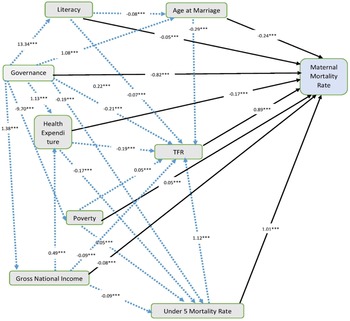
The path diagram shown in Figure 8 establishes the relationship between governance and MMR by examining the specific mechanism of this causal influence. It has been recognized that governance affects the healthcare sector through its indirect effect on GNI (using equation (3)) since good quality governance increases economic growth (Makuta and O'Hare, Reference Makuta and O'Hare2015). In turn, the higher national income induces higher health expenditure, resulting in improved health outcomes, such as under-five mortality rates. The anticipation of higher chances of a child's survival makes TFR lower, thereby improving maternal mortality. The arrows leading from governance to MMR (both direct and indirect effects) in the path diagram have statistically significant coefficients with the expected signs and conform to the previous studies (Klomp and de Haan, Reference Klomp and de Haan2008; Rajkumar and Swaroop, Reference Rajkumar and Swaroop2008; Sirag et al., Reference Sirag, Nor, Abdullah and Ghani2017).
Path Regression Analysis using SEM.
Source: Authors' estimations.
Note: The black colored lines indicate the direct effects of explanatory variables on the dependent variable, whereas the blue-colored dotted lines indicate the hypothesized indirect effects of explanatory variables on the dependent variable.

Similarly, there is a statistically significant path through which good quality governance positively affects the literacy rate (using equation (4)), which increases women's age at marriage. Late marriage reduces the window for a greater number of births (that is, a fall in TFR), thereby reducing maternal deaths. Next, we have hypothesized in equation (5) that poverty could be higher in nations with poor-quality governance since there will be more corruption and a lack of effective welfare policies and outreach programs. This would manifest in poor sanitation, lack of access to clean drinking water, nutritious food, vaccination facilities and inadequate health care, increasing under-five mortality. As a result, it will push parents to go for a higher number of births to maintain a sufficient number of children and thus, resulting in more maternal deaths. We found that the associated coefficients do indicate significant complementarity among these variables.
7. Robustness checks
7.1 Alternative instruments in GMM estimation
The GMM estimation is often criticized for giving freedom to the researchers about the number of lags to be used as instruments (Mishra and Newhouse, Reference Mishra and Newhouse2009). We check the robustness of the results by taking different lag structures as instruments. The findings in Table 5 estimated the effect of lagged MMR, governance index and interaction between governance and health expenditure on MMR is not only statistically significant but also increases in magnitude as we take a larger number of lags.
Estimated effects of Governance on MMR with different lag limits (dependent variable – log of MMR)

Note: *10% significance level. **5% significance level. ***1% significance level.
7.2 Alternative measures of health outcomes and governance
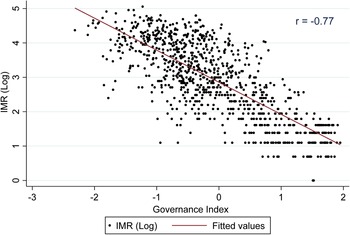
In the literature, researchers have used other indicators of health outcomes. For this study, we only focused on MMR due to data availability for longer. However, we also used the infant mortality rate (IMR) and life expectancy at birth (LEB) as a robustness check. The GMM estimation is not possible due to fewer observations. But we used lagged values of the governance index. The results are reported in Figures 9, 10 and Table 6. Figures 9 and 10 show a strong negative correlation (r = −0.77) between IMR and governance index and a positive correlation (r = 61) between LEB and governance index, respectively, in a pooled sample from 1996 to 2019. Results in Table 6 show a significant effect of the governance index on alternative health outcomes, reducing IMR by 33% and improving life expectancy by around 4%. The interaction effect of the governance index with health expenditure also remains negative and significant, signifying the robustness of our previous results.
Correlation between IMR and Governance Index in the pooled sample, 1996–2019.

Correlation between LEB and Governance Index in the pooled sample, 1996–2019.

Alternative dependent variables (different health outcomes)

Note: *10% significance level. **5% significance level. ***1% significance level.
Furthermore, in line with previous studies (Chimere et al., Reference Chimere, Agubutun, Chinonyerem, Godfrey and Osuagwn2019; Kim and Wang, Reference Kim and Wang2019; Ruiz-Cantero et al., Reference Ruiz-Cantero, Gujjarro-Garvi, Bean, Martizen-Riera and Fernandez-Saez2019; Hall et al., Reference Hall, Lopez, Murray and O'Hare2021), the effectiveness of governance is measured by taking its different dimensions, such as voice and accountability, political stability, lack of violence, government effectiveness, regulatory quality, the rule of law and control of corruption. Results reveal that the effect of governance varies depending on which type of governance it is. For instance, control of corruption, followed by political stability and lack of violence and the rule of law, has the strongest association with the MMR, consistent with the findings of Ruiz-Cantero et al. (Reference Ruiz-Cantero, Gujjarro-Garvi, Bean, Martizen-Riera and Fernandez-Saez2019) (Table 7).
Arellano-Bover/Blundell-Bond system model by different dimensions of governance (dependent variable – log of MMR)

Standard errors in parentheses.
*** p < 0.01, ** p < 0.05, * p < 0.1.
7.3 Sub-national analysis
We have also checked the relationship between the governance index and MMR at the sub-national level. To replicate the analysis at the sub-national level, we used a state-level data set for India. We used state-level governance estimates for India using indices developed by Maurya (Reference Maurya, Kumar, Verma and Trivedi2016) and MMR, IMR and LEB estimates from Sample Registration System (SRS). The correlation graph is plotted in Figures 11–13. The graph depicts an inverse relationship between the governance index and IMR and MMR and a positive relationship between the governance index and LEB.
MMR and Governance Index for Indian states.

IMR and Governance Index for Indian states.

Life expectancy at birth and Governance Index for Indian states.

8. Conclusion
This study empirically examines the effect of governance on maternal mortality by revisiting the links across health expenditure, governance quality and maternal mortality. We use a comprehensive cross-country panel dataset on health expenditure, health outcome variables and six governance dimensions. Using various panel data models, the empirical analysis in this paper yields broadly consistent results: first, health expenditure and quality of governance are essential pathways to improve maternal health. Second, health expenditure is independently effective in countries with lower levels of MMR. Nevertheless, in countries suffering from higher levels of MMR, governance matters more for the effectiveness of health expenditure. Third, both directly and indirectly, governance is related to MMR through other socioeconomic correlates. The results are robust even after accounting for potential endogeneity issues and alternative health indicators, i.e., IMR and LEB. These findings are particularly relevant for developing countries, where there is an ongoing debate about the slight chances of achieving Sustainable Development Goal-3 (SDG-3). Often, policymakers assume, explicitly or implicitly, that health-related SDGs can be achieved by sufficiently increasing spending in the health sector. Plenty of reports and policy documents compare health spending across countries especially developing countries, and stress increasing public health spending for improving health outcomes (Goli et al., Reference Goli, Moradhvaj, James, Singh and Srinivasan2021). But in reality, the average level of governance in most developing countries is relatively poor. Increasing health expenditure might seem an easier policy option, but as the findings suggest, more attempts should be devoted to better governance that can translate the investment into desired outcomes by increasing the efficacy of public health spending (Goli and Arokiasamy, Reference Goli and Arokiasamy2014; Goli et al., Reference Goli, Chakravorty and Rammohan2019). Thus, low- and middle-income countries, where the level of MMR is high, should prioritize improving governance quality and higher health expenditure.
In conclusion, taking forward Dawes's political determinants of health framework, this study advances that governance is a key political determinant of health and significantly predicts MMR and other alternative indicators, e.g., IMR and LEB. Political priorities intersect health outcomes through how public health spending, resource distribution, equitable access, social accountability, control over corruption and quality of care operate in a country. With the emergence of the COVID-19 pandemic, the defectiveness in the governance of several healthcare systems and social safety nets in the world countries have been unveiled, stressing how inequities in income, education and healthcare resource distribution and access lead to devastating health outcomes. The pandemic also had deep consequences on several other health outcomes, including maternal and child death, for which evidence is not emerged from several developing countries in the world (Abdisa et al., Reference Abdisa, Jaleta, Feyisa, Kitila and Berhanu2022). Thus, this study is a timely exercise in understanding how the political environment, especially the quality of governance and public spending, affects health outcomes for countries.
Data
The data used in this study is publicly accessible from World Bank Governance Indicators and World Development Indicators.
Financial support
This paper did not receive any specific grant from funding agencies in the public, commercial or not-for-profit sectors.
Conflict of interest
None.