The investigation of risk factors for child problem behaviors often focuses on children with either internalizing or externalizing problems (Fox, Henderson, Marshall, Nichols, & Ghera, Reference Fox, Henderson, Marshall, Nichols and Ghera2005; Simmel, Brooks, Barth, & Hinshaw, Reference Simmel, Brooks, Barth and Hinshaw2001). Although these are meaningful groups to examine, considerably less research has focused specifically on children who exhibit both internalizing and externalizing symptoms. This investigative limitation is noteworthy because the co-occurring phenotype is highly prevalent, with co-occurring symptoms represented in up to 50% of externalizing samples (Cosgrove et al., Reference Cosgrove, Rhee, Gelhorn, Boeldt, Corley and Ehringer2011; Lavigne et al., Reference Lavigne, Gibbons, Christoffel, Arend, Rosenbaum and Binns1996; Lilienfeld, Reference Lilienfeld2003; McConaughy & Skiba, Reference McConaughy and Skiba1993). Children with co-occurring symptoms, across age ranges from young childhood to early adolescence, commonly experience more negative outcomes than do those without co-occurring symptoms. These outcomes include increased risk taking, suicidality, psychiatric inpatient admissions, and substance use problems compared to children with either externalizing-only or internalizing-only problems (Dishion, Reference Dishion2000; Fanti & Henrich, Reference Fanti and Henrich2010; Fite, Stoppelbein, Greening, & Dhossche, Reference Fite, Stoppelbein, Greening and Dhossche2008; Pardini, White, & Stouthamer-Loeber, Reference Pardini, White and Stouthamer-Loeber2007).
A developmental psychopathology approach offers a promising framework for conceptualizing the development of problem phenotypes (externalizing only, internalizing only, or co-occurring; Cicchetti, Reference Cicchetti1984; Cicchetti & Rogosch, Reference Cicchetti and Rogosch1996). A central feature of this framework is the consideration of how risk factors for a given problem phenotype (such as co-occurring) may originate from multiple interacting levels, including inherited genetic vulnerabilities and early rearing environmental influences (Cicchetti, Reference Cicchetti and Zelazo2013). An additional question is whether risk factors for co-occurring problems are separable or shared with those that predict the development of internalizing and/or externalizing symptoms.
Although it has been well documented that a child's early rearing environment contributes to the emergence of problem behavior through risk factors such as ineffective discipline (Maccoby & Martin, Reference Maccoby, Martin, Müssen and Hetherington1983), research suggests that genetic contributions also play a substantial role (Burt, Reference Burt2009). However, identifying separable genetic and environmental risk factors is difficult because much of the support for genetic contributions to child problem behavior comes from research on familial aggregation of symptomatology, which does not trace the contributions of specific risk factors (Burt, Reference Burt2009; Deater-Deckard & Plomin, Reference Deater-Deckard and Plomin1999). Other research designs follow parents and their biological children, but in these designs, genetic and environmental influences within the family are confounded because the child receives both from his/her rearing parents. In such designs, the effects of genetic and environmental influences cannot be disentangled; thus, it is difficult to isolate discernable antecedents of children's negative behaviors.
In contrast to prior research in this area, our study used a unique methodological design that enabled us to separately examine inherited and environmental influences on child problem phenotypes, including internalizing, externalizing, and co-occurring symptomology. In particular, we investigated maternal risk factors for the emergence of problem behavior during childhood by using a prospective longitudinal adoption design that collected information from both birth and adoptive parents. Data were drawn from a sample of children reared from birth with adoptive parents they were not genetically related to (The Early Growth and Development Study; Leve et al., Reference Reiss, Leve and Neiderhiser2013). In this type of design, associations between characteristics of birth parents and characteristics of the adopted child can be inferred to reflect inherited and/or prenatal influences. The influence of postnatal environmental factors is identified through associations between adoptive parent characteristics and adopted child characteristics. In addition, by investigating the independent contributions of specific birth mother and adoptive mother variables, we were able to examine the possible role of gene–environment interplay in predicting co-occurring problems (Reiss, Leve, & Neiderhiser, Reference Reiss, Leve and Neiderhiser2013).
Examining problem behaviors in children ages 6–7 was of particular interest because children in this age group have recently made the transition to elementary school and may exhibit problem behaviors both at home and in school. Understanding problem behaviors at early elementary school age is of further importance because these behaviors have substantial stability over time and predict the development of academic problems in later years (Masten et al., Reference Masten, Roisman, Long, Burt, Obradović and Riley2005). We focused on maternal variables and not on paternal variables, or both, because of the limited previous research on co-occurring symptoms and the increased effect size found for maternal risk variables as opposed to paternal risk variables for predicting later child behavior (Connell & Goodman, Reference Connell and Goodman2002).
While constructing a framework to examine inherited and environmental influences, we drew from multiple perspectives, including social learning theory and gene–environment interplay, to identify candidate risk factors for co-occurring problem behavior, in accordance with a developmental psychopathology perspective (Cicchetti, Reference Cicchetti and Zelazo2013). This approach was chosen because it is consistent with the assumption that co-occurring symptoms may arise from a range of influences at both genetic and environmental levels (Cosgrove et al., Reference Cosgrove, Rhee, Gelhorn, Boeldt, Corley and Ehringer2011; Fanti & Henrich, Reference Fanti and Henrich2010).
Social learning theory suggests that the social environment in which a child is reared influences his or her behavior (Bandura, Reference Bandura1986). Parents are primarily responsible for the social environment of young children, which can include multiple pathways to problem behavior (O'Connor, Matias, Futh, Tantam, & Scott, Reference O'Connor, Matias, Futh, Tantam and Scott2013). Examples of such parenting influences include social modeling of negative emotions, a lack of reinforcement for positive emotionality, and uninvolved parenting that reduces children's socialization to compliant behaviors (Barber, Olsen, & Shagle, Reference Barber, Olsen and Shagle1994; de Rosnay, Cooper, Tsigaras, & Murray, Reference de Rosnay, Cooper, Tsigaras and Murray2006; Elgar, McGrath, Waschbusch, Stewart, & Curtis, Reference Elgar, McGrath, Waschbusch, Stewart and Curtis2004; O'Connor et al., Reference O'Connor, Matias, Futh, Tantam and Scott2013; Patterson, DeBaryshe, & Ramsey, Reference Patterson, DeBaryshe and Ramsey1989).
Gene–environment interplay theory posits that genetically influenced attributes may increase some children's more sensitivity to their environmental context or may exacerbate the effects of risky environments (for a review of different forms of gene–environment interplay, see Reiss et al., Reference Reiss, Leve and Neiderhiser2013). In our study, birth mother characteristics were conceptualized to index inherited liabilities that may be moderated by social environmental factors, which are indexed by adoptive mother characteristics. In addition to potential main effects of genetic attributes, inherited and social–environmental attributes may moderate each other through a number of processes, such as differential susceptibility to either favorable or adverse environments or goodness of fit between an individual's inherited attributes and qualities of the social environment (Belsky & Pluess, Reference Belsky and Pluess2009; Reiss et al., Reference Reiss, Leve and Neiderhiser2013).
As described below, social learning and gene–environment interplay perspectives supported our investigation of multiple risk factors, including maternal internalizing symptoms as indexed by depressive and anxious symptoms (measured in birth mothers and adoptive mothers), maternal processing speed deficits (measured in birth mothers and adoptive mothers), and uninvolved parenting as indexed by higher levels of inconsistent discipline and poor monitoring (measured in adoptive mothers). By simultaneously investigating these contributors to co-occurring problem behavior, we aimed to better describe how co-occurring problems may develop through multiple risk pathways. Furthermore, we examined if these pathways were shared or distinct from the development of single-dimension (internalizing-only/externalizing-only) behavior.
The Role of Maternal Internalizing Symptoms
According to social learning theory, observed behavior (i.e., modeling) is one mechanism that can contribute to the development of problem behavior (Bandura, Reference Bandura1986). Research has confirmed that young children tend to affectively match their mother's internalizing symptoms (de Rosnay et al., Reference de Rosnay, Cooper, Tsigaras and Murray2006; Elgar et al., Reference Elgar, McGrath, Waschbusch, Stewart and Curtis2004). For example, infants were found to be more fearful and avoidant of strangers when they observed their mothers interacting with the strangers in a socially anxious rather than in a nonsocially anxious manner (de Rosnay et al., 2004). Young children of depressed mothers have also been documented to match the low tone and slow rate of their mother's speech during routine interactions while also matching their mother's fast-paced and anxious style of speech in response to mild stressors (Breznitz & Sherman, Reference Breznitz and Sherman1987). Such findings suggest that in the process of social modeling, young children's exposure to maternal internalizing symptoms may be associated with child internalizing behavior (Goodman & Gotlib, Reference Goodman and Gotlib1999).
Other research suggests that mothers with higher levels of internalizing symptoms (depression, anxiety, or both) are less likely to provide a parenting environment that is responsive and warm, which may lead to the development of both internalizing and externalizing symptoms (Feldman et al., Reference Feldman, Granat, Pariente, Kanety, Kuint and Gilboa-Schechtman2009). Mothers with internalizing symptoms are more likely to be disengaged from parenting and exhibit a negative parenting style, which predicts the emergence of both internalizing and externalizing problem behaviors in young children (Bögels & Brechman-Toussaint, Reference Bögels and Brechman-Toussaint2006; Dawson et al., Reference Dawson, Ashman, Panagiotides, Hessl, Self and Yamada2003; Goodman & Gotlib, Reference Goodman and Gotlib1999; McLeod, Wood, & Weisz, Reference McLeod, Wood and Weisz2007; Pemberton et al., Reference Pemberton, Neiderhiser, Leve, Natsuaki, Shaw and Reiss2010). Negative and insensitive parenting styles also influence the social environment in that the parents are less likely to provide appropriate parental scaffolding of effective emotion regulation strategies. Without such environmental input, children are likely to exhibit poor regulation of negative emotions, which contributes to internalizing (e.g., sadness) and externalizing (e.g., anger) behaviors (Hoffman, Crnic, & Baker, Reference Hoffman, Crnic and Baker2006; Morris, Silk, Steinberg, Myers, & Robinson, Reference Morris, Silk, Steinberg, Myers and Robinson2007). Previous research among children aged 2–12 years has found that early exposure to maternal depression confers exaggerated risk for developing chronic co-occurring problems (compared to internalizing-only or externalizing-only problems), but similar research has not examined outcomes related to maternal anxiety (Fanti & Henrich, Reference Fanti and Henrich2010).
Research about genetic contributions of maternal internalizing symptoms to child problem behavior in the current sample found that birth mother lifetime depression predicted children's externalizing symptoms during the preschool years, after controlling for prenatal risk and environmental experiences (Kerr et al., Reference Kerr, Leve, Harold, Natsuaki, Neiderhiser and Shaw2013). However, other research has found that the link between birth mother depression (prior to pregnancy) and toddler depressive symptoms was present only in the context of prenatal risk experiences (Pemberton et al., Reference Pemberton, Neiderhiser, Leve, Natsuaki, Shaw and Reiss2010). An integrative review about childhood anxiety noted that, although familial aggregation is commonly reported, most studies do not separate genetic from environmental influences, so there is meager evidence for heritability (Murray, Creswell, & Cooper, Reference Murray, Creswell and Cooper2009). In sum, genetic contributions of maternal internalizing symptoms to child problem behavior may be found only in the context of additional environmental risk. Despite the limited evidence of heritable effects of birth mother internalizing symptoms on child problem behavior, it was necessary to include this variable to highlight the comparative importance of early environmental exposure to maternal internalizing symptoms to child problem behaviors at school entry. Based on these findings, we predicted that adoptive mother internalizing symptoms would predict child co-occurring behavior. We also expected that birth mother internalizing symptoms would confer inherited sensitivity to adverse environmental experiences, consistent with the gene–environment interplay perspective, but we did not expect birth mother internalizing symptoms to have a direct effect on child problem behavior (Reiss et al., Reference Reiss, Leve and Neiderhiser2013).
Maternal Processing Speed
Maternal processing speed was another variable of primary interest with regard to the development of co-occurring problems. This cognitive skill reflects the efficiency with which information is processed throughout the brain (Brunnekreef et al., Reference Brunnekreef, De Sonneville, Althaus, Minderaa, Oldehinkel and Verhulst2007). It is unfortunate that we did not have a measure of child processing speed, but on the basis of the moderate to high heritability of cognitive skills, we considered birth mother processing speed to reflect an inherited risk factor (Beaujean, Reference Beaujean2005; Friedman et al., Reference Friedman, Miyake, Young, DeFries, Corley and Hewitt2008). We identified birth mother processing speed as a risk factor because rapid processing speed contributes to effective self-regulation and social information processing, which have been theorized to be central to the co-occurring problem behavior phenotype (White, Jarrett, & Ollendick, Reference White, Jarrett and Ollendick2013). Children with co-occurring problems exhibit self-regulatory difficulties in willfully disengaging from negative affect (common to internalizing) and inhibiting reactive aggression (common to externalizing) responses (Bubier & Drabick, Reference Bubier and Drabick2009; White et al., Reference White, Jarrett and Ollendick2013). Slower processing speed can also contribute to deficits in social information processing, which could exacerbate co-occurring problems through negative attribution biases (Drabick, Ollendick, & Bubier, Reference Drabick, Ollendick and Bubier2010). Further evidence about the importance of inherited risk for processing speed deficits includes findings of slow processing speed in children with co-occurring symptoms (Brunnekreef et al., Reference Brunnekreef, De Sonneville, Althaus, Minderaa, Oldehinkel and Verhulst2007; Kusche, Cook, & Greenberg, Reference Kusche, Cook and Greenberg1993). We hypothesized that birth mother slow processing speed would confer genetic risk for the co-occurring problem behavior phenotype. The role of gene–environment interplay was also of interest because of the possible role of birth mother processing speed contributing inherited risk or differential susceptibility to environmental stressors in predicting child problem behavior. However, because of the lack of previous research about gene–environment interactions with inherited risk for poor processing speed, these specific interactions were largely exploratory. Adoptive mother processing speed was not predicted to be associated with child problem behavior, because in previous research it has not been linked to internalizing or externalizing symptoms.
Uninvolved Parenting
As described by Barber and colleagues (Reference Barber, Olsen and Shagle1994), social learning theory emphasizes the need for adequate parental structure and discipline to socialize conformity and rule adherence. If predictable contingencies and monitoring are not in place to instill desired behaviors, children may be less likely to learn to inhibit externalizing behaviors and develop appropriate self-regulatory mechanisms (Maccoby & Martin, Reference Maccoby, Martin, Müssen and Hetherington1983). Social learning and related models of socialization (e.g., Baumrind, Reference Baumrind1971; Maccoby & Martin, Reference Maccoby, Martin, Müssen and Hetherington1983) link low levels of parental involvement (conceptualized here to include both poor parental monitoring and high inconsistent discipline) to externalizing behaviors (Dishion & McMahon, Reference Dishion and McMahon1998; Shaw, Criss, Schonberg, & Beck, Reference Shaw, Criss, Schonberg and Beck2004). For example, in some studies, mothers' uninvolved parenting has been associated with young children's expression of internalizing and externalizing problem behavior (McWayne, Fantuzzo, Cohen, & Sekino, Reference McWayne, Fantuzzo, Cohen and Sekino2004). Other studies suggest that uninvolved parenting is associated only with externalizing problems (Howes, Reference Howes1990) or that the relationship between uninvolved parenting and internalizing problems is no longer present when other parenting domains are controlled for (Stormshak, Bierman, McMahon, & Lengua, Reference Stormshak, Bierman, McMahon and Lengua2000). More specifically, effective maternal monitoring has been found to buffer the development of externalizing behaviors in young children living in low-quality neighborhoods (defined by high rates of serious crime, overcrowding, and poverty; Supplee, Unikel, & Shaw, Reference Supplee, Unikel and Shaw2007). Inconsistent maternal limit setting has been found to relate to externalizing problem behaviors, across studies, including those with early school-age children (Gonzales, Pitts, Hill, & Roosa, Reference Gonzales, Pitts, Hill and Roosa2000; Kilgore, Snyder, & Lentz, Reference Kilgore, Snyder and Lentz2000; Lengua & Kovacs, Reference Lengua and Kovacs2005). In some studies, inconsistent maternal discipline predicted internalizing problems (Gonzales et al. Reference Gonzales, Pitts, Hill and Roosa2000), but not in other studies (Lengua & Kovacs, Reference Lengua and Kovacs2005). We hypothesized that inconsistent discipline and low monitoring (combined into a “uninvolved parenting” variable) would predict the externalizing-only symptom phenotype, but on the basis of inconsistent previous findings, it was unknown if uninvolved parenting would predict the child internalizing symptom phenotype. Uninvolved parenting was also expected to predict co-occurring problem behavior, based on the strong associations between these dimensions of parenting and externalizing behaviors identified in previous research.
This Study
Consistent with previous developmental psychopathology research, the hypotheses presented are based on the assumption that childhood problem behaviors can arise from different mechanisms at the genetic and environmental levels (Racer & Dishion, Reference Racer and Dishion2012). We expected main effects of adoptive mothers' higher levels of internalizing symptoms, birth mothers' slower processing speed, and adoptive mothers' uninvolved parenting on child co-occurring behavior. We also hypothesized that birth mothers' higher levels of internalizing symptoms and birth mothers' slower processing speed would confer inherited sensitivity to the social environment, so we investigated interactions between genetic and environmental indices as predictors of child problem behavior. Because previous research on co-occurring problem behavior has not examined specific mechanisms of gene–environment interplay in young children, these interactions were largely exploratory.
Due to the minimal research about risk factors for co-occurring symptoms, we used two approaches to analyze the data and compared the patterns of results. First, we investigated risk factors for child problem phenotypes by considering children with internalizing-only, externalizing-only, and co-occurring problems as three distinct and mutually exclusive problem phenotype groups compared with those of a low-symptom group (defined by a clinically insignificant number of internalizing or externalizing symptoms). Next, we used a dimensionalized approach to reanalyze the data by considering children with internalizing problems (vs. low symptom) and externalizing problems (vs. low symptom) to investigate whether this method of analysis would yield a different set of risk patterns. In these dimensionalized analyses, children with co-occurring symptoms were included in internalizing and externalizing symptom groups.
The underlying aim of the analyses was to gain a better understanding of (a) whether dissociable genetic, environmental, and interacting pathways predict co-occurring, internalizing-only, and externalizing-only symptom groups (compared with a low-symptom group), and (b) whether the mutually exclusive group patterns have distinctive predictors from dimensionalized methodological designs.
Methods
Participants
Participants (n = 293) were drawn from a study of 361 linked sets of adoptive parents, children, and birth mothers in Cohort 1 of The Early Growth and Development Study. Children were excluded from this study's analyses if there were no outcomes data on the Child Behavior Checklist (CBCL) from either parent at child age 6 or age 7 (n = 59), or if both adoptive parents were men (n = 9; because of our study's focus on maternal risk variables). Cohort 1 of this longitudinal study was recruited between 2003 and 2006 from 33 adoption agencies in 10 states across the Northwest, Mid-Atlantic, and Southwest regions of the United States. These agencies comprised the full range of adoption agencies operating in the United States, including public, private, religious, secular, those favoring open adoptions, and those favoring closed adoptions. Participants were identified by agency staff if they met all the following eligibility criteria: (a) the adoption placement was domestic; (b) the infant was placed within 3 months postpartum (M = 7.11 days postpartum, SD = 13.28; median = 2 days); (c) the infant was placed with a nonrelative adoptive family; (d) birth and adoptive parents were able to read or understand English at the eighth-grade level; and (e) the infant had no known major medical conditions, such as extreme prematurity or extensive medical surgeries. Of the families who met eligibility criteria, 68% agreed to participate. The participants were representative of the adoptive parent population that completed adoption plans at the participating agencies during the same time period (Leve et al., Reference Reiss, Leve and Neiderhiser2013).
The adopted children demographically included 57% males and 43% females from a range of racial and ethnic backgrounds, including 57.6% non-Hispanic White, 11.1% Black/African American, 9.4% Latino, 20.8% multiracial, 0.3% American Indian/Alaskan native, and 0.6% unknown or not reported. The mean age for birth mothers at childbirth was 24.78 (SD = 6.28), with 41.8% single and never married and 48.1% in a stable marital or marriage-like relationship. Half of the birth mothers reported an education level as high-school equivalent, 18.8% had less than a high school degree, and 31.0% had trade school or higher. Adoptive mothers had a mean age of 37.59 (SD = 5.53) at childbirth and predominantly reported a stable marital or marriage-like relationship (90.2%), White racial identity (92.0%), and an education level of trade school or higher (92.4%). Adoptive fathers had a mean age of 38.13 (SD = 5.81) at childbirth and also predominantly reported a stable or marriage-like relationship (90.6%), White racial identity (92.1%), and an education level of trade school or higher (84.9%).
Current analyses are based on the subset (n = 293) of the total sample for which maternal reports or paternal reports of child problem behavior data at child age 6 or 7 were available. Although data collection was attempted for each child at age 6 and age 7, some families declined to participate at a given wave or declined to complete the CBCL measure, and thus there was missing CBCL data (26.3%–33.5%) at each time point. When data from both time points were available, the highest score was used as the criterion for inclusion or exclusion from the problem behavior group. Parent and child data for this study were collected through in-person interviews, home-based questionnaires, and web-based assessments. Little's missing completely at random chi-square tests found no significant patterns of missing data, suggesting that the data were missing completely at random, χ2 (194) = 208.10, p > .05.
Measures
Symptom phenotypes
Child externalizing-only, internalizing-only, co-occurring, and low-symptom phenotypes were classified based on the CBCL borderline clinical scores (T scores ≥ 60) as rated by adoptive parents (mothers or fathers) at child age 6 or 7 (Achenbach, Reference Achenbach1991; Eisenberg et al., Reference Eisenberg, Cumberland, Spinrad, Fabes, Shepard and Reiser2001). Parents were asked to base their ratings on child behavior during the prior 2 months at child age 6 and during the prior 6 months at child age 7. The CBCL Internalizing scale included items from three domains: withdrawal, somatic complaints, and anxiety/depression (mother α = 0.81–0.85, father α = 0.82–0.89). The withdrawal domain includes problems related to a child's shyness, withdrawal, and inclination to be alone, and the somatic complaints domain includes child symptoms related to aches, fatigue, or stomach problems. Anxiety/depression items included child experiences of sadness, fear, perfectionism, and worry. The externalizing scale included items related to aggressive symptoms (e.g., attention seeking, arguing, bragging, teasing, having a temper) and delinquent symptoms (e.g., lying, cheating, stealing; mother α = 0.89–0.91, father α = 0.89–0.93; Achenbach, Reference Achenbach1991).
If children had clinically significant symptoms at either time point, as rated by either parent, they were placed in the appropriate “problem phenotype” group that included child internalizing-only (n = 23), externalizing-only (n = 44), co-occurring (n = 39), and low-symptom (n = 187) behaviors. A score of 60 represents the 84th percentile in normative populations, in which ≈16% of children would be expected to have scores of 60 or higher. In our study sample, borderline clinical scores were found for externalizing symptoms in 28.5% of children and for internalizing symptoms in 23.0% of children. This finding suggests a slightly higher rate of problems when compared with normative samples but similar rates to other nonclinical samples, such as children from low socioeconomic neighborhoods where problem behavior that exceeds borderline clinical scores has been found in 21%–27% and 13%–40% of children for externalizing and internalizing problems, respectively (reviewed in Qi & Kaiser, Reference Qi and Kaiser2003).
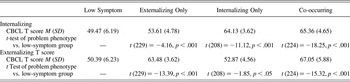
The means for internalizing and externalizing T scores for each symptom phenotype are presented in Table 1. We compared of level of internalizing and externalizing behavior in the low-symptom group with each of the problem-behavior groups using independent sample t tests in SPSS v.19. Each problem behavior group exhibited significantly elevated levels of both internalizing and externalizing symptoms, compared with the low-symptom group, with the exception of externalizing symptoms in the internalizing-only symptom group, which reached only marginal significance (p > .05). These t-test statistics are presented in Table 1. Independent sample t tests were also conducted on symptom levels between children in the co-occurring group and children in the internalizing-only and externalizing-only groups to examine if children in the co-occurring group exhibited higher levels of symptoms. Results indicated that children in the co-occurring group scored higher than children in the externalizing-only group on both internalizing, t (81) = 11.31, p < .001, and externalizing, t (81) = 3.28, p < .01, symptoms. Children in the co-occurring group scored higher than children in the internalizing-only group on externalizing, t (60) = 9.93, p < .001, but not internalizing (p > .05) symptoms.
Average levels of problem behaviors, by symptom phenotype

Note: CBCL, Child Behavior Checklist.
Risk factors
Birth mothers' internalizing symptoms, birth mothers' processing speed, adoptive mothers' internalizing symptoms, and uninvolved parenting were collected when the child was approximately 4.5 years old. Adoptive mothers' processing speed was measured at child age 6 years. Thus, with the exception of adoptive mothers' processing speed, all risk factors were assessed prior to parental ratings of child behavioral problems (child age 6–7 years). Given the high stability of processing speed over time, this likely does not pose a major limitation (Strauss, Allen, Jorgensen, & Cramer, Reference Strauss, Allen, Jorgensen and Cramer2005). Each risk factor is described in the following subsections.
Maternal internalizing symptoms
Internalizing symptoms for both the birth mother and adoptive mother were a composite of the Beck Anxiety Inventory (BAI) and the Beck Depression Inventory (BDI) scores. The BAI and BDI are validated and reliable measures of depression and anxiety symptoms (Beck & Steer, Reference Beck and Steer1993; Beck, Steer, & Carbin, Reference Beck, Steer and Carbin1988). Each scale consists of 21 questions with four possible answers related to the relative presence or absence of each investigated symptom during the past week, resulting in a maximum possible score or 63. The suicidal item was dropped from the original BDI 21-item scale in this study to reduce situations that would require a clinical follow-up. Alphas were acceptable for BAI and BDI scores for both birth and adoptive mothers (α = 0.83–0.90). To maximize symptom range in our study sample, the internalizing scores were determined as the cumulative number of depression and anxiety symptoms for both birth mothers and adoptive mothers. These scores were log-transformed because of a large positive skew (>1.5), which violated assumptions of normality. The log-transformed scores were then multiplied by 10 so that they reflected a similar range to other variables used in statistical analyses.
Maternal processing speed
Average reaction time in correct trials during the Stroop color-word naming task was used as a proximal measure of maternal processing speed (Stroop, Reference Stroop1935). The Stroop color-word naming task provides color words (e.g., blue, green, yellow) in either the matching, congruent color or nonmatching, incongruent color. Participants are required to press a button indicating the color of the word, and the reaction time is measured as the latency between when the word appears on the screen and when the participant presses the button box. To index processing speed, we averaged reaction time scores across all correct trials for each participant. This index of processing speed has been shown to have strong reliability over time (Strauss et al., Reference Strauss, Allen, Jorgensen and Cramer2005). In our sample, birth mothers' and adoptive mothers' reaction times were found to be highly consistent across trial sets (r = .71 and .77, respectively) and were log-transformed following standard reaction time analysis procedures (Whelan, Reference Whelan2010).
Uninvolved parenting
Uninvolved parenting was assessed with adoptive mothers when children were age 6 through a summation of the inconsistent discipline and poor monitoring subscales of the Alabama Parenting Questionnaire (Shelton, Frick, & Wootton, Reference Shelton, Frick and Wootton1996). In the Alabama Parenting Questionnaire, parents are asked 35 questions relating to frequency of parenting behaviors on a 5-point Likert scale ranging from 1 (never) to 5 (always). The subscale scores represent average frequencies of behaviors among the subscale items. Higher scores on these subscales are reflective of more uninvolved parenting (i.e., higher rates of inconsistent discipline and higher rates of poor monitoring/low involvement; mother ratings α = 0.48–0.69). These subscales have been shown to have good divergent validity, reliability, and meaningful correlations to disruptive behaviors (Shelton et al., Reference Shelton, Frick and Wootton1996). Data from one participant was greater than three standard deviations above the mean and was Winsorized to reduce the impact of outliers on results.
Covariates
Although some sex differences have been found for internalizing and externalizing problems, we did not expect distinct differences in the associations between risk factors and child symptoms to have emerged by age 6. However, child sex was investigated as a covariate, given that some differences have been found (Brennan & Shaw, Reference Brennan and Shaw2013; Leve, Kim, & Pears, Reference Leve, Kim and Pears2005). We also investigated child age as a covariate to account for possible developmental differences (age range = 60–72 months). The “openness in adoption” variable was investigated to account for possible contact between birth mother and adopted children that could muddle effects of genetic and environmental influences because of differences in contact. This variable is determined from a 7-point scale of perceived adoption openness ranging from 1 (very closed) to 7 (very open). We computed a composite of openness ratings from each of the birth-mother, adoptive-mother, and adoptive-father ratings of the level of contact between parties (Ge et al., Reference Ge, Natsuaki, Martin, Leve, Neiderhiser and Shaw2008). In addition, we investigated obstetric complications (including pregnancy and neonatal complications, substance use during pregnancy, and exposure to toxins during pregnancy) based on birth mother report at 4 months postpartum, weighted for severity, because intrauterine events could confound estimates of genetic influences (Marceau et al., Reference Marceau, Ram, Neiderhiser, Laurent, Shaw and Fisher2013). These covariates were used in all following structural equation models.
Analysis plan
Bivariate correlations were first examined in SPSS v.19 to determine how the child symptom membership (externalizing only, internalizing only, or co-occurring) as opposed to low-symptom group membership related to each hypothesized risk factor. We used structural equation modeling (SEM) in Mplus v.6 with two models to determine (a) main effects of genetic and environmental risk factors, and (b) interaction effects of Genetic × Environmental risk variables in a full model (with centered variables; Muthén & Muthén, Reference Muthén and Muthén2010). In these structural equation models, children's exclusionary phenotype group membership was considered a nominal variable and each “problem” phenotype (i.e., internalizing, externalizing, and co-occurring) was contrasted against the low-symptom group. Birth mothers' risk factors were allowed to covary with each other, as were adoptive mothers' factors. Because age has been associated with slower processing speed, birth mother and adoptive mother processing speed variables were regressed on participant age to control for possible age-related influences (Salthouse, Reference Salthouse1996).
Next, we repeated the SEM analyses by using the typical dimensionalized approach to studying child problem behavior for two-group analyses of low-symptom versus internalizing symptomatology and low-symptom versus externalizing symptomatology. In these analyses, children in the co-occurring group were included in both the internalizing (n = 67) and externalizing (n = 83) groups. This analysis enabled us to examine if risk factors for groups with internalizing and externalizing symptoms would be confounded with findings associated with the co-occurring symptom group.
Results
Correlations among primary variables and covariates
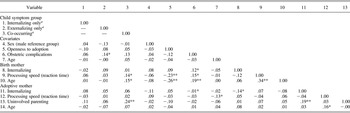
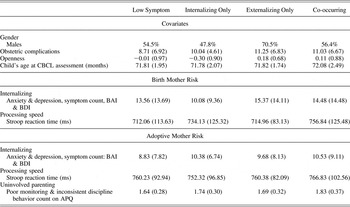
Bivariate correlations between each of the covariates and dummy-coded symptom group variables comparing each problem group with the low-symptom group are shown in Table 2. Of the covariates investigated, child age, openness of adoption, and child sex were not significantly associated with any of the problem symptom groups (p > .05). Obstetric complications were significantly associated with the externalizing-symptom group compared with the low-symptom group (r = .14, p < .05). Descriptive data for each of the covariate predictors are presented in Table 3. In all the subsequent analyses, the log-transformed data (birth mother internalizing, adoptive mother internalizing, birth mother processing speed, adoptive mother processing speed) were used, but for the descriptive data, raw values have been presented for interpretability.
Bivariate correlations
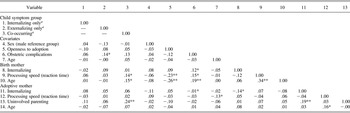
a Child symptom groups, with low-symptom reference group.
*p < 0.05. **p < 0.01.
Predictive risk factor descriptives, by symptom phenotype

Note: All values except gender are means (standard deviations). CBCL, Child Behavior Checklist; BAI, Beck Anxiety Inventory; APQ, Alabama Parenting Questionnaire.
Mutually exclusive group analyses (internalizing only, externalizing only, and co-occurring vs. low symptom)
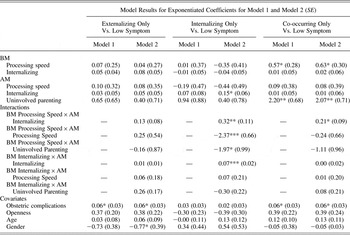
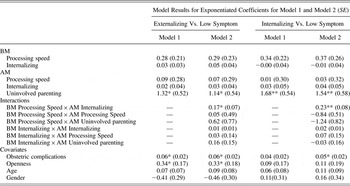
The first structural equation model (Model 1; log likelihood = −5,871.63, Akaike information criterion = 11,907.26, Bayesian information criterion = 12,209.04) examined whether each birth mother and adoptive mother risk factor significantly predicted membership in each symptom group rather than in the low-symptom group. Next, we examined possible Genetic × Environmental risk factors by examining interaction terms for each inherited risk factor (birth mother processing speed, birth mother internalizing) and social environmental variable (adoptive mother internalizing symptoms, adoptive mother processing speed, and uninvolved parenting (Model 2; log likelihood = −8,191.85, Akaike information criterion = 16,733.70, Bayesian information criterion = 17,377.73). Standardized coefficients from Models 1 and 2 are presented in Table 4. Logistic odds ratios for significant effects are presented in the text.
Hierarchical multinomial logistic regression analysis predicting child-symptom group membership using mutually exclusive three-symptom group analysis models

Note: BM, Birth mother; AM, adoptive mother.
*p < .05. **p < .01. ***p < .001.
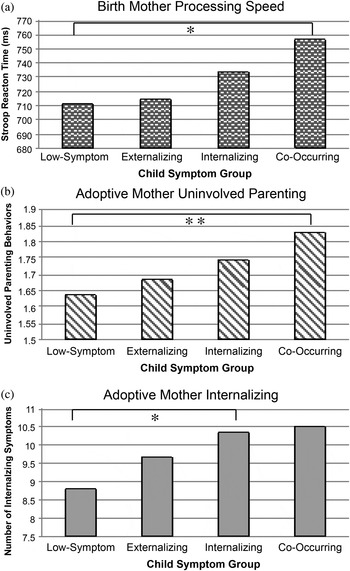
In the main effects model (Model 1; see Table 4) birth mothers' processing speed, odds ratios [OR] = 1.78 (1.13–2.79), and adoptive mothers' uninvolved parenting, OR = 9.05 (2.94–27.88) predicted membership in the co-occurring group versus low-symptom group, and obstetric complications predicted membership in the externalizing-only versus the low-symptom group, OR = 1.06 (1.02–1.11) and co-occurring versus low-symptom group, OR = 1.06 (1.01–1.11). Results from the full model (Model 2; see Table 4) indicated that main effects of adoptive mothers' uninvolved parenting, OR = 7.91 (2.45–25.69) (Figure 1a) and main effects of birth mothers' slower processing speed, OR = 1.88 (1.16–3.05; Figure 1b) remained significant for predicting membership in the co-occurring versus low-symptom group. In addition, the interaction of Birth Mother Processing Speed × Adoptive Mother Internalizing, OR = 1.25 (1.08–1.44) significantly predicted membership in the co-occurring versus the low-symptom group. A greater number of obstetric complications, OR = 1.06 (1.01–1.11) also predicted co-occurring versus low-symptom group membership. Membership in the child internalizing-only (vs. low-symptom) group was significantly predicted by a main effect of higher adoptive mother internalizing symptoms, OR = 1.17 (1.05–1.30; Figure 1c). Interactions of Birth Mother Processing Speed × Adoptive Mother Internalizing Symptoms, OR = 1.37 (1.15–1.64), Birth Mother Processing Speed × Adoptive Mother Processing Speed, OR = 0.09 (0.03–0.28), and Birth Mother Processing Speed × Uninvolved Parenting, OR = 0.14 (0.03–0.71) predicted membership in the child internalizing-only rather than in the low-symptom group. Birth Mother Internalizing Symptoms × Adoptive Mother Internalizing Symptoms, OR = 1.07 (1.04–1.10) also predicted membership in the child internalizing-only group. Main effects of a greater number of obstetric complications, OR = 1.06 (1.01–1.11) and main effects of male gender, OR = 0.46 (0.24–0.87) significantly predicted membership in the externalizing-only group.
The main effects of risk factors predicting child symptom group membership (vs. the low-symptom group) for the full mutually exclusive group structural equation model. *p < .05, **p < .01.

Post hoc independent sample t-tests were performed to investigate interactions that predicted child internalizing-only and child co-occurring group membership. They were examined using a median split of each variable to determine the contributing influences of each interaction. Graphs of these interactions are presented in online-only supplementary Figure S.1. In the Birth Mother Internalizing × Adoptive Mother Internalizing interaction, the presence of adoptive mother high-internalizing predicted membership in the child internalizing-only group, but only when birth mother internalizing was high. This was supported by a marginally significant difference in adoptive mother internalizing between child internalizing-only and low-symptom groups, when birth mother internalizing was high, t (80) = −1.72, p < .10.
In the Birth Mother Processing Speed × Adoptive Mother Uninvolved Parenting interaction, it was determined that the presence of uninvolved parenting predicted internalizing symptoms only when the birth mother's processing speed was fast. This was supported by a marginally significant t test between levels of uninvolved parenting between the internalizing-only versus the low-symptom groups when birth mother processing speed was fast, t (80) = −1.68, p < .10. In the Birth Mother Processing Speed × Adoptive Mother Processing Speed interaction, post hoc analyses suggested that when an adoptive mother had fast processing speed but the birth mother had slow processing speed or when an adoptive mother had slow processing speed and the birth mother had fast processing speed, the child was more likely to exhibit internalizing-only symptoms. This was indicated by a significant difference in birth mother processing speed when adoptive mother processing speed was fast between internalizing-only and low-symptom groups, t (82) = −2.65, p < .05, and by a significant difference in adoptive mother processing speed when birth mother processing speed was fast between the internalizing-only and low-symptom groups, t (81) = 2.30, p < .05. In visual inspection, the Birth Mother Processing Speed × Adoptive Mother Internalizing interaction appeared to be driven by inherited risk for slow processing speed in the internalizing-only group versus the low symptom group, when adoptive mother internalizing was high. However, the t test of birth mother processing speed between internalizing-only and low-symptom groups at adoptive mother high internalizing did not approach significance (p > .10).
Post hoc analyses for the Birth Mother Processing Speed × Adoptive Mother Internalizing term suggested that when adoptive mother internalizing was low, there were minimal differences in birth mother processing speed between co-occurring and low-symptoms groups, but when adoptive mother internalizing was high, having inherited risk for slow processing speed predicted co-occurring rather than low-symptom group membership. This was indicated by a marginally significant difference in birth mother processing speed between co-occurring and low-symptom groups when adoptive mother internalizing was high, t (88) = −1.95, p < .10.
Dimensionalized problem behavior analyses (internalizing and externalizing vs. low-symptom)
As the next step in our analysis plan, the same SEM analyses were conducted (as described previously) to examine children with elevated internalizing symptoms (vs. low symptoms) and externalizing symptoms (vs. low symptoms) without considering if these children had co-occurring problems. The results from these dimensionalized two-symptom group main effect and full models are presented in Table 5, with odds ratios for significant results presented in the text. In this set of analyses, main effect models found that uninvolved parenting significantly predicted membership in the externalizing rather than in the low-symptom group, OR = 3.76 (1.61–8.77) and internalizing rather than in the low-symptom group, OR = 5.35 (2.20–12.99). Obstetric complications, OR = 1.06 (1.02–1.10) and adoption openness, OR = 1.41 (1.07–1.85) significantly predicted membership in the externalizing rather than in the low-symptom group.
Hierarchical logistic regression analysis predicting child-symptom group membership using dimensionalized two-symptom group analysis models with co-occurring children included in both externalizing and internalizing analyses

Note: BM, Birth mother; AM, adoptive mother.
*p < 0.05. **p < 0.01.
In the full, dimensionalized model, uninvolved parenting predicted membership in the internalizing rather than in the low-symptom group, OR = 4.67 (1.82–11.90) and in the externalizing rather than in the low-symptom group, OR = 3.11 (1.29–7.52). The interaction of Birth Mother Processing Speed × Adoptive Mother Internalizing symptoms was found to predict membership in the internalizing, OR = 1.26 (1.11–1.44) and externalizing, OR = 1.19 (1.06–1.34) versus low-symptom groups. Obstetric complications were found to predict internalizing, OR = 1.05 (1.01–1.09) and externalizing, OR = 1.06 (1.02–01.10) group membership. Finally, adoption openness was also found to predict externalizing, OR = 1.39 (1.03–1.87) group membership. Child gender was no longer predictive of membership in the externalizing group.
Discussion
While examining genetic and environmental risk factors for child problem behaviors, this study found a distinctive risk profile for children with co-occurring symptoms. These findings are consistent with our hypothesis that inherited and social environmental risk factors would predict co-occurring problem behavior. Although some similar risk factors were found for the co-occurring and the internalizing-only groups, suggesting multifinality (i.e., Birth Mother Slower Processing Speed × Adoptive Mother Higher Internalizing Symptoms), unique risk factors (i.e., the main effects of slow birth mother processing speed and uninvolved parenting) were also identified for co-occurring children. In addition, risk factors that predicted membership in the internalizing-only group were not found to predict co-occurring symptom group membership. Taken together, these findings suggest that certain risk factors for child problem behaviors may be particularly predictive of co-occurring (as opposed to either internalizing-only or externalizing-only) symptoms. The findings underscore the importance of examining children with co-occurring problem behavior as a distinct group.
Uninvolved parenting, as measured by adoptive mothers' inconsistent discipline and poor monitoring, conferred significant risk for experiencing co-occurring symptoms (1b). In prior research in both child and young adolescent samples, uninvolved parenting has been associated with externalizing and internalizing symptoms but more consistently with externalizing problems (Barber, Stolz, Olsen, Collins & Burchinal Reference Barber, Stolz, Olsen, Collins and Burchinal2005; Gonzales et al., Reference Gonzales, Pitts, Hill and Roosa2000; Kilgore et al., Reference Kilgore, Snyder and Lentz2000; Lengua & Kovacs, Reference Lengua and Kovacs2005). These findings are consistent with social learning theory, which suggests that coercive parent–child interactions occur when families use inconsistent contingencies of positive and negative (or punishing) reinforcers. In such circumstances, children may learn to use coercive (externalizing) behaviors, such as aggression, to escape situations that may be aversive (Patterson et al., Reference Patterson, DeBaryshe and Ramsey1989). Social learning theory also suggests that when a child experiences uninvolved parenting, he or she is less likely to be socialized to models of effective emotion regulation or the importance of compliance, which may lead to the emergence of problem behavior (Barber et al., Reference Barber, Stolz, Olsen, Collins and Burchinal2005; Elgar et al., Reference Elgar, McGrath, Waschbusch, Stewart and Curtis2004).
Another risk pathway of interest for co-occurring symptom group membership was the main effect of birth mother slow processing speed (1a) and the interaction of birth mother slow processing speed combined with adoptive mother high internalizing symptoms. This interaction can be conceptualized as a poor social environment (i.e., adoptive mother internalizing) predicting the co-occurring problem phenotype, but only when children had inherited risk for slow processing speed. Consistent with the gene–environment interplay perspective, this association suggests that genetic risk for slow processing speed creates an inherited sensitivity to stressors in the social environment (Reiss et al., Reference Reiss, Leve and Neiderhiser2013).
Although the link between children's co-occurring symptoms and maternal processing speed is novel, it is consistent with processing speed deficits previously found in children with co-occurring symptoms (Brunnekreef et al., Reference Brunnekreef, De Sonneville, Althaus, Minderaa, Oldehinkel and Verhulst2007). It is also consistent with research that has revealed the combination of negative emotionality (potentially influenced by adoptive mother internalizing symptoms in our study sample) with lower cognitive skills as a key contributor to development of the co-occurring phenotype (Bubier & Drabick, Reference Bubier and Drabick2009; Drabick et al., Reference Drabick, Ollendick and Bubier2010). Given the established heritability of cognitive functions, such as processing speed, our findings suggest that a genetic liability for processing speed deficits may be associated with the development of co-occurring problems when the social environment is also poor (Friedman et al., Reference Friedman, Miyake, Young, DeFries, Corley and Hewitt2008).
Child externalizing behavior was not associated with specific inherited or social environmental risk factors beyond the influence of obstetric complications. Although previous research has linked prenatal exposure to maternal internalizing symptoms with child externalizing problems, links between maternal internalizing symptoms prior to pregnancy (measured here) and externalizing problems are less established (Luoma et al., Reference Luoma, Tamminen, Kaukonen, Laippala, Puura and Salmelin2001; Van den Bergh & Marcoen, Reference Van den Bergh and Marcoen2004). Prior research on postnatal maternal internalizing symptoms also suggests that some of the association with child externalizing behavior is mediated by prenatal risk experiences (potentially accounted for here by obstetric complications; Barker, Jaffee, Uher, & Maughan, Reference Barker, Jaffee, Uher and Maughan2011; Bonari & Koren, Reference Bonari and Koren2004). Given the evidence in previous research of uninvolved parenting contributing to externalizing behavior, it is noteworthy that this association was not found in our sample. A possible explanation could be that uninvolved parenting has a weaker association with externalizing behavior at ages 6–7 and may be more present in older children (Barber et al., Reference Barber, Olsen and Shagle1994; Galambos, Barker, & Almeida, Reference Galambos, Barker and Almeida2003). An alternate explanation is that previous findings may be confounded by the inclusion of children with co-occurring problems; when we included co-occurring children in the externalizing group in dimensionalized analyses, a significant link was found between uninvolved parenting and externalizing symptoms.
Both a main effect of adoptive mother higher internalizing symptoms and interactions of adoptive mother internalizing symptoms and each birth mother risk factor (birth mother slower processing speed and birth mother higher internalizing symptoms) predicted internalizing-only rather than low-symptom group membership. This finding is consistent with findings from previous research that environmental links exist between maternal internalizing symptoms and child internalizing symptoms above and beyond effects of maternal internalizing symptoms during the prenatal period (Barker et al., Reference Barker, Jaffee, Uher and Maughan2011). From a gene–environment interplay perspective, this suggests that a genetic liability for internalizing problems (i.e., high birth mother internalizing) may create an inherited sensitivity to the social environmental stressor of having an adoptive mother who is also experiencing internalizing symptoms (Lim, Wood, & Miller, Reference Lim, Wood and Miller2008; Reiss et al., Reference Reiss, Leve and Neiderhiser2013). Because post hoc t tests investigating the Adoptive Mother Internalizing × Birth Mother Processing Speed did not approach significance, we refrain from interpreting the directionality of this interaction.
An investigation of the interaction between birth mother processing speed and adoptive mother uninvolved parenting suggests that if children had birth mothers without slow processing speed, the presence of uninvolved parenting would contribute risk to the development of internalizing-only symptoms rather than membership in the low-symptom group. This suggests the importance of uninvolved parenting for predicting child internalizing problems in the presence of inherited risk. A final interaction that predicted child internalizing-only group membership was a mismatch in processing speed between children's birth and adoptive mothers. Although the effect of mismatch between parent–child cognitive function has not been previously reported, research in foster care samples with parent-report data has found that goodness of fit between parent and adolescent characteristics (e.g., temperament) may predict better family functioning and adjustment (Green, Braley, & Kisor, Reference Green, Braley and Kisor1996).
When analyses were conducted using the dimensionalized approach of examining internalizing and externalizing behaviors without considering whether children in these groups also experienced co-occurring problems, a different pattern of results emerged. These findings suggest that studies that do not consider co-occurring symptoms run the risk of drawing spurious conclusions about risk pathways for externalizing or internalizing symptoms that may be better described as contributing risk for co-occurring problems. When co-occurring symptom children were folded into the externalizing and internalizing groups, risk factors predicted externalizing and internalizing typologies that had previously been implicated only in the co-occurring typology group (e.g., uninvolved parenting). This outcome demonstrates the advantages of examining children with co-occurring problem behavior as a distinct group when one is investigating predictors of child problem behavior. However, we also note the potential challenges of interpreting findings for children with the co-occurring phenotype. Similar to some (but not all) previous studies, children in our sample with co-occurring problems exhibited higher externalizing symptoms than did the externalizing-only group, suggesting that children with co-occurring problems may represent a group with more severe symptomatology (reviewed in Oland & Shaw, Reference Oland and Shaw2005). Accordingly, risk factors that contributed specific risk for co-occurring symptoms (e.g., uninvolved parenting) could instead represent risk factors for higher levels of externalizing symptoms. Despite this interpretive limitation, we suggest that examining risk factors specific to the co-occurring symptom phenotype is appropriate because of the need to identify relevant risk factors for this understudied and highly at-risk group of children (Eisenberg et al., Reference Eisenberg, Valiente, Spinrad, Cumberland, Liew and Reiser2009; Stieben et al., Reference Stieben, Lewis, Granic, Zelazo, Segalowitz and Pepler2007).
Certain limitations should be noted to contextualize the findings for future research. The relatively small sample size in each of the symptom groups (n = 23–45) may have resulted in underpowered analyses. This may have limited our ability to detect the predictive utility of specific risk factors and increased the likelihood of spurious results. The combination of maternal depression and anxiety symptoms into the internalizing variables is also a limitation; although similar patterns of risk are associated with maternal depression and with anxiety, differences also exist. Our combined maternal internalizing factor was chosen as an alternative to omitting the risk factors on the basis of the low incidence of internalizing symptoms on either scale taken alone, but it does not allow for delineation of effects resulting from maternal anxiety versus maternal depression. Considering the low incidence of clinically significant internalizing symptoms in birth and in adoptive mothers, it is possible that different results would have emerged in a sample that included mothers from clinical samples. Given that a substantial majority of the child sample does not exhibit clinically elevated behavior problems, it is unknown if these findings would be replicated in a higher risk sample. The self-report nature of all risk factors (except processing speed) may lead to biased results, which could be a particular confound for adoptive mother risk factors because adoptive mothers are also among the informants of the outcome measures of child problem behavior. However, this concern is somewhat mitigated because both adoptive mother and father ratings of child problem behavior were included. The lack of inclusion of paternal risk factors is also a limitation. Findings should also be interpreted with caution and replicated in future research in that ORs for all risk factors, with the exception of uninvolved parenting, suggest small effect sizes.
Other potential risk factors for child problem behavior, such as maternal externalizing, were not examined in our study because comparable measures were not included for adoptive and birth mothers. The study was not designed to test transactions between psychopathologies (i.e., consequences of externalizing symptoms causing internalizing symptoms), which have been postulated as a possible mechanism underlying co-occurrence (Oland & Shaw, Reference Oland and Shaw2005). Future research should also examine the contributions of paternal risk factors and the potential moderating role of ethnic or cultural differences.
This investigation of inherited and social environmental risk factors that predict child problem behavior suggests that children with co-occurring symptoms should be studied as a unique phenotypic group. Although prior research with twin samples has estimated significant roles of both genetic and environmental factors in the etiology of co-occurring externalizing and internalizing problems (Cosgrove et al., Reference Cosgrove, Rhee, Gelhorn, Boeldt, Corley and Ehringer2011; O'Connor, McGuire, Reiss, Hetherington, & Plomin, Reference O'Connor, McGuire, Reiss, Hetherington and Plomin1998), such studies are rarely able to examine the role of specific risk factors (Jaffee, Moffitt, Caspi, Taylor, & Arseneault, Reference Jaffee, Moffitt, Caspi, Taylor and Arseneault2002). Our study findings add to the literature by suggesting a distinctive etiological path to co-occurrence through a range of both inherited and social environmental influences (Fanti & Henrich, Reference Fanti and Henrich2010; Oldehinkel, Hartman, De Winter, Veenstra, & Ormel, Reference Oldehinkel, Hartman, De Winter, Veenstra and Ormel2004). We also highlight risk factors for co-occurring symptoms (i.e., processing speed, uninvolved parenting) to inform future research in this area. In research that has previously investigated externalizing and internalizing symptoms, it may be relevant to reanalyze the data to specifically examine or exclude children with co-occurring problems so that results for internalizing and/or externalizing symptoms are not confounded with findings more relevant for the development of co-occurring symptoms. Through more precise research investigating predictors of co-occurring problem behavior, interventions may be better targeted to meet the needs of this high-risk group of children.
Supplementary Materials
The supplementary materials for this article can be found online at http://dx.doi.org/10.1017/S0954579415000322.