INTRODUCTION
Palms of a variety of different species often reach very high densities in tropical forests (Aguirre et al. Reference AGUIRRE, GUEVARA and DIRZO2011, Kahn & De Granville Reference KAHN and DE GRANVILLE1992). At these high densities, they often strongly affect seedling establishment, causing reductions in density and diversity of woody species and understorey plants (Denslow & Guzmán Reference DENSLOW and GUZMÁN2000, Farris-López et al. Reference FARRIS-LÓPEZ, DENSLOW, MOSER and PASSMORE2004, Wang & Augspurger Reference WANG and AUGSPURGER2006). A variety of mechanisms has been proposed to explain how these palms may engineer their ecosystems to cause these effects, including changes in light availability, litterfall depth and abundance of seed and seedling predators associated with palms (Farris-López et al. Reference FARRIS-LÓPEZ, DENSLOW, MOSER and PASSMORE2004, Wang & Augspurger Reference WANG and AUGSPURGER2006). An additional hypothesized pathway, examined here, suggests that physical damage from falling litterfall may be an important source of seedling mortality for other species, because of the large size and weight of palm fronds (Peters et al. Reference PETERS, PAUW, SILMAN and TERBORGH2004).
Mortality by litterfall damage is an important source of seedling mortality in a wide range of forests (Aide Reference AIDE1987, Clark & Clark Reference CLARK and CLARK1991, Gregory Reference GREGORY1966). Previous studies have shown that macro-litter (large leaves, branches or fronds) is particularly likely to cause damage and mortality to seedlings (Aguiar & Tabarelli Reference AGUIAR and TABARELLI2010, Gillman et al. Reference GILLMAN, OGDEN, WRIGHT, STEWART and WALSH2004, Peters et al. Reference PETERS, PAUW, SILMAN and TERBORGH2004). As litterfall has a disproportionately negative impact on species and individuals with particular traits (small stem size, limited capacity for resprouting, low root to shoot ratios, low wood density and high growth rates), high litterfall rates can change understorey plant communities by favouring species more resilient to such damage (Alvarez-Clare & Kitajima Reference ALVAREZ-CLARE and KITAJIMA2009, Gillman et al. Reference GILLMAN, GILLMAN and OGDEN2003, Pauw et al. Reference PAUW, BAEL, PETERS, ALLISON, CAMARGO, CIFUENTES-JARA, GARCIA RESTOM, HEARTSILL-SCALLEY, MANGAN, NUNEZ-ITURRI, RIVERA-OCASIO, ROUNTREE, VETTER and VOLKMER DE SASTILHO2004, Peters et al. Reference PETERS, PAUW, SILMAN and TERBORGH2004).
In this study we examine the impact of large litterfall production by one pantropical canopy palm species, Cocos nucifera (coconut palm), on seedling mortality due to physical damage from litterfall. We hypothesize that rates of large litterfall, and litterfall-associated damage will be greatly elevated in C. nucifera-dominated habitats.
METHODS
Study site
This study was conducted at Palmyra atoll (5°54ʹN, 162°05ʹW), a wet tropical atoll located in the Northern Line Island Chain in the central Pacific Ocean. The atoll has no permanent human habitation and is administered as a National Wildlife Refuge by the US Fish and Wildlife Service. The atoll receives approximately 4450 mm rain annually, with low seasonality. Due to its remote location, Palmyra has a very species-poor plant community; more than 50% of the forest cover on the atoll is dominated by C. nucifera (Young et al. Reference YOUNG, RAAB, MCCAULEY, BRIGGS and DIRZO2010a).
Study species
Cocos nucifera L. (Arecaceae) is of both ecological and economic importance in much of the world. The leaves of this palm are large (6–7 m in length; 15 kg in weight), and about 13–14 fronds per plant are lost per year. The fruits are likewise large (1.2–2.0 kg each), with 50–80 fruits produced per year by adult palms (Taffin Reference TAFFIN1998). The plant often occurs in high densities and can readily reach stand monodominance (Young et al. Reference YOUNG, RAAB, MCCAULEY, BRIGGS and DIRZO2010a). While several potential mechanisms allowing this palm to reach monodominance have been proposed (Young et al. Reference YOUNG, RAAB, MCCAULEY, BRIGGS and DIRZO2010a, Reference YOUNG, MCCAULEY, GUEVARA and DIRZO2013) the role of litterfall has not yet been considered.
Litterfall inputs
Litterfall data were collected from 2007 to 2010. To quantify the amount of large litterfall inputs under different densities of C. nucifera, in July 2008 we established 35 litterfall monitoring plots. The plots were distributed in randomly selected locations across the atoll (using a random number generator to calculate distance along coast from a given starting point, and the distance inland). At each litterfall plot all litter and debris >1 cm in diameter was cleared from a 1 × 1-m area. After 1 mo, all litter where any part of a branch, stem or rachis exceeded 1 cm in diameter was collected and weighed. Litter that was partially in the plot was cut at the boundaries of the plot and only the portion of the litter in the plot was weighed; for large nuts which could not be cut in the field, they were weighed if more than 50% of the nut was in the plot and otherwise excluded. Litter was then removed from the plot and the process was repeated for a second month. Litterfall inputs were averaged across the two periods. Canopy cover by species at each litterfall plot was visually estimated, and subsequently categorized as palm dominated (>75% C. nucifera dominance), or mixed dicot (<25% C. nucifera dominance) by two observers for a 3-m radius surrounding the centre of each plot. Plots with intermediate levels of C. nucifera dominance (n = 5) were excluded.
Vegetation surveys
The remainder of the components of this study were conducted on 10 sites selected from a larger set of 83 randomly located 50 × 2-m vegetation transects surveyed on the atoll. Siting and survey methodology for these transects was modified from Gentry (Reference GENTRY1988) (details provided in Young et al. Reference YOUNG, RAAB, MCCAULEY, BRIGGS and DIRZO2010a), in which all plants > 1 cm dbh (diameter at breast height) in each transect were identified and measured. From this larger set of transects, we selected five from each of those sites classified as either palm-dominated stands (>75% basal area of C. nucifera) or mixed dicot stands (<25% basal area of C. nucifera). The mixed dicot sites were all largely dominated (>70% basal area) by two other common, native species, Pisonia grandis R. Br. (Nyctaginacaea) and Tournefortia argentea L. f. (Boraginaceae). Pandanus tectorius Parkinson (Pandanacaea), and Scaevola taccada (Gaertn.) Roxb. (Goodeniacaea) were also present, but at lower densities.
Live seedlings
Seedlings from two of the most common tree species at Palmyra, C. nucifera and P. grandis, were used in experiments to measure the lethal and sublethal effects of litterfall. We planted 102 seedlings of each species in the 10 selected sites. Individual plants were placed approximately 4-m apart from the nearest plant in a grid. If an adult tree or a crab hole occurred within 1-m of the assigned planting location, this location was skipped and another location was added to the end of the row. Treatment (caged or uncaged) was randomly assigned to each plot. At the time of planting all seedlings were between 3 and 10 cm in height. Of these seedlings, 46 per species per forest type were caged and 56 were uncaged. Cages protected plants against both litterfall damage and herbivore damage (predominantly caused by crabs). Due to low overall survivorship, particularly for P. grandis in palm-dominated sites, data were pooled by forest type and analysed using a chi-square test. Any litter that was observed caught on the cage was removed from the cage and placed on the ground directly adjacent to the cage in order to reduce shading artifacts. The data reported here are survivorship after 2 y. Details of the cages and plantings are reported in Young et al. (Reference YOUNG, MCCAULEY, GUEVARA and DIRZO2013).
Litterfall damage
To assess the extent to which litterfall damage from C. nucifera was a significant cause of mortality and damage among actual seedlings and saplings, we surveyed damage on all live saplings (<2.5 m in height; n = 449) found in three sites per forest type. Most sites were 25 × 5-m in size, but due to low seedling densities at two mixed-dicot sites, an additional 25 × 5-m area adjacent to the initial survey area was surveyed at these sites to increase number of surveyed seedlings. Physical damage due to debris was visually estimated and classified as severe (>75% damage to stem or leaf), moderate (25–75% damage to stem or leaf), or low to absent. Both the species damaged and the species that caused the damage were recorded. We analysed only the subset of individuals where the species causing the damage could be determined. Results from this type of survey are likely to be an underestimate because they only monitor seedlings that have survived up to time of monitoring (Gillman et al. Reference GILLMAN, WRIGHT and OGDEN2002), but are likely consistent across forest types.
Artificial seedlings
Artificial seedling models were constructed after the fashion of Clark & Clark (Reference CLARK and CLARK1989). Each artificial seedling was made from a 13-cm-long wire, stapled inside a 15-cm-long stem made from a 20-cm-long plastic drinking straw with the top folded over. A ‘branch’ was added by stapling a second straw perpendicular to the stem. We placed a total of 90 artificial seedlings at each of 10 sites (five sites per forest type). At each site there were three parallel lines of 30 seedlings, with each seedling 2 m from the neighbouring seedling in the line. Each line was 5 m apart from a neighbouring line. If the seedling placement point fell on a tree stem, the seedling was placed adjacent to the tree stem. As some seedlings disappeared over the course of the study, a total of 384 seedlings were monitored in palm-dominated sites and 327 in mixed-dicot sites.
Artificial seedlings were placed in June 2007 and then monitored in October 2007. While weather is relatively constant across seasons at Palmyra, there is some increase in heavy storms with high wind and rain between November and February. Our estimates of annual damage levels may thus be underestimates. Damage levels of seedlings were assessed using modified criteria of Clark & Clark (Reference CLARK and CLARK1989) with severely litterfall-damaged seedlings being those that were bent such that the branch was in contact with the ground or flattened. Minor damage included seedlings bent, but not in contact with the ground. As in Clark & Clark (Reference CLARK and CLARK1989), our analyses of damaged individuals included as damaged only those individuals where litterfall could be identified as the cause of damage. Given that previous work shows that animal damage to seedlings is not accurately quantified by artificial seedlings (Gillman et al. Reference GILLMAN, WRIGHT and OGDEN2002), and that animal damage in the first months of an experiment is often elevated due to a novelty interest by animals (Clark & Clark Reference CLARK and CLARK1989), we do not include this type of damage in any analyses. The proportion of damaged individuals is thus calculated as the per cent of total planted individuals that were damaged by falling litterfall. For data analysis, we pooled data by site, and compared damage levels across forest types.
RESULTS
Litterfall inputs
Litterfall inputs rates varied from 0 to 12.3 kg m−2 mo−1. Litterfall input rates were significantly higher in palm-dominated (mean 2.3 kg) vs. mixed-dicot (mean 0.4 kg) stands (χ 2 = 10.9, df = 1, P < 0.001). There was no significant difference in total canopy cover between these forest types.
Live seedlings
Seedling survivorship of uncaged live plants was significantly higher in mixed-dicot stands than palm-dominated stands for P. grandis (χ2 = 11.7, df = 1, P < 0.001; Table 1). Cocos nucifera survivorship was, in contrast, higher in palm-dominated than in mixed-dicot stands (χ2 = 8.3, df = 1, P < 0.01; Table 1). There was a positive effect of caging on survivorship for both species in both forest types (Table 1).
Effects of forest type and caging on survivorship (mean ± SD) of seedlings of two species at Palmyra Atoll (central Pacific Ocean) after 2 y, with and without caging. Caging effect is analysed using a chi-square test.

Litterfall damage
Of the 449 seedlings or saplings surveyed, 32 had experienced high-litterfall-induced damage. Cocos nucifera was identified as the source of damage in 94% of these instances of high damage and was a partial cause of damage in all the remaining 6%. Including minor damage, 173 plants suffered either minor or severe litterfall damage, of which 89% of the damage was caused solely by C. nucifera, with an additional 4% caused at least in part by C. nucifera.
Artificial seedlings
After a period of 4-mo, 15% of the total seedlings in palm-dominated stands and 27% of seedlings in mixed dicot forests were missing, with most of this loss occurring in the first weeks after planting, likely due to crab handling. Crabs were frequently observed handling the seedlings in the first days after plantings and many artificial seedlings were found visibly snipped by crabs or in crab burrows. Of the remaining seedlings, 4.9% ± 4.3% of the seedlings placed in mixed dicot stands were severely damaged by falling litter after 4 mo while 16.1% ± 9.1% of seedlings were similarly damaged in palm-dominated stands (t = 2.1, df = 8, P = 0.04). Minor damage by litter was received by an additional 1.2% ± 1.8% of seedlings in mixed-dicot stands, and by an additional 9.9% ± 6.2% of seedlings in palm-dominated stands (all damage by forest type comparison: t = 2.6, df = 8, P = 0.03). To estimate annual rates we assumed that these rates of litterfall-associated damage continued evenly across the year.
DISCUSSION
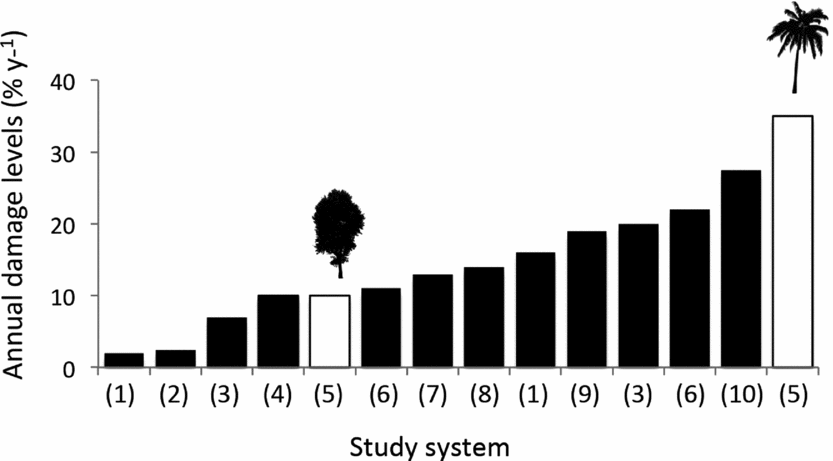
Artificial seedling results show significant evidence for increased mortality of seedlings as a result of litterfall in palm-dominated sites. These observations are congruent with measurements of higher total quantity of macro-litter in sites with high abundance of C. nucifera. Extrapolating to annual levels of severe litterfall damage to artificial seedlings, for purposes of comparison to other studies, we find estimates of damage rates in palm-dominated stands (35.7% y−1) to be higher than average values observed in any other studied system (Figure 1). In contrast, damage in mixed-dicot stands was consistent with estimates of damage in most other sites (Figure 1). Although there are difficulties in extrapolating from several months to a full year, as both of these values were calculated including all originally planted seedlings, of which a large fraction were removed by crabs shortly after planting, and were calculated during the months with the mildest weather patterns, we believe these values to be conservative for both forest types.
Annual levels of damage (% damaged individuals y−1) to artificial seedlings reported in other studies (black bars) from a wide variety of temperate and tropical forests are consistent with those observed in the mixed-dicot, native-species-dominated stands in this study (first white bar), and much lower than those observed in high Cocos nucifera-dominated stands (second white bar). We present average values for each type of system studied from (1) New Zealand (Gilman et al. Reference GILLMAN, WRIGHT and OGDEN2002); (2) New Jersey (McCarthy & Facelli Reference MCCARTHY and FACELLI1990); (3) Hawaii (Drake & Pratt Reference DRAKE and PRATT2001); (4) Panama (Alvarez-Clare & Kitajima Reference ALVAREZ-CLARE and KITAJIMA2009), (5) Line Islands (Young et al. this study), (6) Brazil (Portela & Santos (Reference PORTELA and SANTOS2009), (7) Mack (Reference MACK1998), (8) Márquez et al. (Reference MÁRQUEZ, BIEJO and RAMOS2010), (9) Costa Rica (Clark & Clark Reference CLARK and CLARK1989), (10) Central Amazonia (Scariot Reference SCARIOT2000).

We expect that the high rates of macro-litterfall in palm-dominated stands will translate into similarly negative impacts on real seedlings, and that these effects will fall disproportionately on native dicot species, all of which have much smaller stems and smaller seeds (Young et al. Reference YOUNG, MCCAULEY, GUEVARA and DIRZO2013). Consistent with this expectation, nearly all of moderate and high damage observed on understorey seedlings was caused by C. nucifera litterfall. Seedling survivorship for transplanted experimental seedlings showed that survivorship for P. grandis, but not C. nucifera, was much lower in palm-dominated stands than mixed-dicot stands. While protection from litterfall damage is likely an important effect of caging, particularly for small-seeded native species, it should be noted that protection from herbivores (predominantly land crabs) also likely explains much of the difference in survivorship (Young et al. Reference YOUNG, MCCAULEY, GUEVARA and DIRZO2013).
While other studies have noted the importance of plant community composition in determining physical litterfall damage to understorey plants, the average levels of damage we observed on artificial seedlings exceeds the average of any other system studied using similar methods, and we expect the impacts on seedling composition might be similarly stronger. We suggest that this simple physical force may be a large part of the explanation for the observation that understorey regeneration is much less diverse than the canopy in palm-dominated stands at this site (Young et al. Reference YOUNG, RAAB, MCCAULEY, BRIGGS and DIRZO2010a). Litterfall likely acts in concert with other factors, creating a strong biophysical filter that effectively culls other species from these stands (Young et al. Reference YOUNG, MCCAULEY, DUNBAR and DIRZO2010b, Reference YOUNG, MCCAULEY and DIRZO2011, Reference YOUNG, MCCAULEY, GUEVARA and DIRZO2013). With its extremely remote location, and depauperate flora, Palmyra is certainly an extreme, and atypical tropical system. Yet, we believe the results about the impact of palm litter on seedling establishment from this system may extend to more diverse systems. Cocos nucifera in particular has a pantropical distribution and these litterfall impacts could thus be having large-scale influences on community composition of coastal tropical forests in more diverse continental settings. Other large dominant palms found in more interior sites will likely also have similar impacts on establishment (Peters et al. Reference PETERS, PAUW, SILMAN and TERBORGH2004, Wang & Augspurger Reference WANG and AUGSPURGER2006).
Further research is still needed to explore the effects of litterfall damage from C. nucifera and other large palms specifically on diversity and composition of regeneration. We would expect to see pervasive and systematic changes in characteristics of those species or individuals that persist in C. nucifera-dominated stands (e.g. changes in stem thickness, ability to resprout, root to shoot ratios). Over long time scales we may also expect that species that tend to utilize the same habitats as these large palms may evolve physical or biotic defences when these large palms occur, but this hypothesis has not yet been explored. Comparative work in forests dominated by other types of palm, such as the widespread Sabal-dominated palmettos (López & Dirzo Reference LÓPEZ and DIRZO2007) or the Astrocaryum-dominated forests (Aguirre et al. Reference AGUIRRE, GUEVARA and DIRZO2011) in the Neotropics will help identify if these levels of litterfall damage and their impact on plants are a pervasive way in which palms may change their environment.
ACKNOWLEDGEMENTS
We thank the National Science Foundation, National Geographic Society and US Fish and Wildlife Service for their support of this research. This research was done within the Palmyra Atoll National Wildlife Refuge under a Special Use Permit issued by the US Fish and Wildlife Service. We thank J. Wible, L. Anderegg, A. Briggs, W. Anderegg, G. Carroll, P. DeSalles, Z. Drozdz, C. Hanson, J. McCallen, L. Palumbi, T. Robbins and J. Tam for their assistance in the field. We thank Len Gillman and Markus Eichhorn for their careful reviews of this manuscript.