Seven months after the Broadway premiere of Samuel Beckett's Waiting for Godot closed in June 1956, it appeared on Broadway again with an all-Black cast. This second production had the same producer (Michael Meyerberg), same director (Herbert Berghof), same costume design, and same set design as its predecessor. It opened at a theater just two blocks away from the one that housed the first production. Beckett, who early in his career had translated nineteen pieces about Black culture and history from French to English for Nancy Cunard's Harlem Renaissance–era Negro: An Anthology (1934), expressed deep excitement about the production. He exclaimed in a letter to Cunard that “Godot reopening Broadway November with an ALL NEGRO CAST! That's my best news” (qtd. in Friedman xxii). He was more circumspect but still enthusiastic in a letter to the stage director Alan Schneider, to whom he wrote that he had “no clear picture of the production” but was “very pleased at the thought of the all black production and hope it comes off” (Letter 11, 12). The Village Voice dubbed it “Godot II,” and in almost every way it was an identical re-creation of the first production (Tallmer, “Godot” 7).
Except, of course, for the players. The revival was part of Meyerberg's plan to annually restage the show with different casts. The original Broadway production had an eight-week run that sold out its final ten days, leading Meyerberg to think, remarkably, that the play could be a cash cow (McHarry, “Meyerberg”). The first iteration would feature a Black cast. Drawing on his long history in vaudeville and jazz acts, he described the inspiration behind the revival's casting as rooted in a sense of Black theatrical politics and the show as a response to the situation in which “the Negro has had no theater literature of his own. Marvelous in dance, in music, but always had to play second fiddle in the formal theater. Now for the first time he'll have a chance to appear in a work of classic stature, and represented by the best possible cast. . . . No one will walk away this time and ask: ‘What's it about?’ No one. With this cast, it becomes so clear” (qtd. in Tallmer, “Negro ‘Godot’” 9). Yet when pressed whether this production would therefore be truer to the play than its earlier American incarnations, Meyerberg quickly answered in the negative, simply declaring that it would be “different” (9). Thus, even while audiences would finally get the play, the production itself would not be the play's fulfillment. It would be in its own difference from itself, the production's nonidentity with the play, that its meaning would become “so clear.”
While both right and wrong about the state of Black theater in the first half of the twentieth century, Meyerberg's comments point toward the play's significance as the site of an ongoing encounter between two performance traditions: the European theater of the absurd on the one hand and an Africana absurd on the other. Martin Esslin coined the phrase “theater of the absurd” in 1961 to describe a loose cluster of post–World War II plays that experimented with formal innovations for staging the “sense of the senselessness of the human condition and the inadequacy of the rational approach by the open abandonment of rational devices and discursive thought” (24). For Esslin, this theater of the absurd—including plays by Beckett, Eugene Ionesco, Jean Genet, and others—went even further than other philosophical and dramatic work of the time. While existentialist playwrights such as Jean-Paul Sartre explored similar philosophical questions in their mid-century drama, they did so using conventional theatrical forms with fully imagined characters, carefully constructed plots, and a clear exposition of ideas. The European theater of the absurd, by contrast, saw the rules of plot, character, and dialogue as insufficient to the task of staging the contingency of existence. “The Theatre of the Absurd,” Esslin observed, “has renounced arguing about the absurdity of the human condition; it merely presents it in its being—that is, in terms of concrete stage images” (25).
A different theater of the absurd, one that we get glimpses of in the Black-cast production of Waiting for Godot, appears before and beyond this European tradition. I locate this racial absurd in the tradition that Lewis R. Gordon has described as Africana “philosophies of existence,” which pose “philosophical questions premised upon concerns of freedom, anguish, responsibility, embodied agency, sociality, and liberation” in an African diasporic context that precedes and exceeds postwar European existentialism (10). In this tradition (where “Africana” refers to “African cultures and their hybrid and creolized forms in Europe, North America, Central and South America, and the Caribbean”), the Africana absurd responds to the meaning of meaninglessness and the sense of senselessness as they are shaped by the “historical project of conquest and colonization” and the “subsequent struggles for emancipation that continue to this day” (1).
Or, as Cornel West once suggested, “the first African encounter with the New World was an encounter with a distinctive form of the Absurd” (40). The capital A in West's sentence introduces a philosophical anachronism. The proper noun signals not just an existential condition but the European philosophical tradition that stretches from Søren Kierkegaard to Albert Camus to Beckett. In West's formulation, however, the absurd as a philosophical inquiry and lived experience occurs far in advance of its European enunciation, appearing much earlier, in the European and African arrival in the New World. His capitalized A marks a form of time travel, a philosophical absurd that exists before its formal definition. In this sense, the Black-cast production of Waiting for Godot is less a sequel than a predecessor of the Broadway premiere.
West echoes an earlier proposition made by the novelist Chester Himes. In a similar temporal formulation, Himes described the relationship between the race concept and the absurd. Recalling his time in Paris in the 1950s, he reflected:
Albert Camus once said that racism is absurd. Racism introduces absurdity into the human condition. Not only does racism express the absurdity of the racists, but it generates absurdity in the victims. And the absurdity of the victims intensifies the absurdity of the racists, ad infinitum. If one lives in a country where racism is held valid and practiced in all ways of life, eventually, no matter whether one is a racist or a victim, one comes to feel the absurdity of life. (My Life 1)
Himes too writes about a particular mode of the absurd that begins with the European and African encounter in the New World. Camus appears in this bit of hearsay to lend Himes a vocabulary from Continental philosophy to describe an attitude that both precedes and supersedes it. This Africana absurd describes a philosophic and aesthetic stance toward racial modernity that does not flee from the absurd disorder of racism but commits to new forms of ethics and rebellion in full embrace of its absurdity. While European absurdism confronted the search for meaning in a meaningless postwar world, the Africana absurd responded to the formal meaninglessness—the incoherencies, paradoxes, and arbitrariness—of Western racial logic and most often appears in an aesthetic idiom. This tradition is most fully if fragmentarily articulated across the drama and writings of Lorraine Hansberry, for whom a postwar engagement with existentialism incited both a repudiation and a creative revision of the theater of the absurd.Footnote 1 Absurdism appears, for Himes as for Hansberry, neither as a universal condition nor as a reaction to the horrors of World War II. It appears, rather, as a response to racial modernity from at least the seventeenth century, if not earlier.
How do we make sense of this proleptic encounter described by West and Himes? One of the defining features of the dramatic situation is that any work of dramatic literature gives us a character to imagine while any theatrical production gives us this body, here, before us. The Black-cast ensemble of Waiting for Godot exploited this tension to toggle between the universal and the particular in the absurd, its metaphysical and materialist dimensions, confounding the boundaries between the two. In what follows, I outline this racial theater of the absurd as it surfaces in this production of Waiting for Godot by considering how its metatheatricality and the dynamics of casting located it squarely within the existential and historical situation of Black theater in the Jim Crow era—a theater of collaboration and creativity that was nonetheless overdetermined by segregated spectatorship, that limited opportunities for Black actors, and that deformed representations of African American life. Following a deeper description of the relationship between the Africana absurd and the European absurd, I look first to Vladimir and Estragon and then to Pozzo and Lucky, paying special attention to the theatrical elements of this production—such as casting, stage props, and choreography—that further mark and at times exceed the history of Jim Crow theater. In doing so, we see how this production recasts Beckett's absurdism, metatheatricality, and antihumanism to present, rather than represent, the felt absurdity of racial modernity.Footnote 2
[I]
What does it mean to take the absurd seriously today? The philosophical absurd, especially as advanced by Camus, has largely fallen out of academic fashion. John Foley notes that “the term ‘absurd’ rarely now makes an appearance in academic discourse” (5), and David Carroll, describing it as “dated,” characterizes much of contemporary scholarship when he writes that “its interest today could be considered largely historical” (“Rethinking” 53). Burdened by universalizing claims about the human condition, it appears as a relic of the postwar vogue in existentialism that now comes across as naive after the critiques of structuralism and poststructuralism. It has had a longer shelf life in theater history, where Esslin's influential book provided a heuristic for drama written in the decades after World War II. Translated into twelve languages, The Theatre of the Absurd has gone through three updated editions, most recently in 2004—over forty years after its first edition—and its title continues to name the development of new theatrical conventions in the middle of the twentieth century.
The label has stuck to Beckett's drama in particular, despite efforts to return such works as Waiting for Godot to their historical context. As early as 1969, John Banville sought to disarticulate Beckett's work from metaphysical associations with the absurd. “Now that the Fifties murk has lifted and the labels—Absurdist, Existentialist, whatnot—have fallen into disuse,” he writes, “we can see how firmly [Beckett's] writings are rooted in the solid, the commonplace” (qtd. in Knowlson 21). And scholars have since argued that much of Waiting for Godot speaks directly to Beckett's experience living in France under Nazi occupation (Perloff; Gibson 103–08; Knowlson 344) or the long history of colonialism in Ireland (Roach, “‘All the Dead Voices’”; Knowlson 343). Following Emilie Morin, we can also identify continuities between Beckett's postwar literature and his earlier and overlooked attempts at historical writing and political commentary, restoring a political consciousness to the abstruse icon that he became in the later twentieth century (184–237). A more complex Beckett emerges from this scholarship, one who is interested not solely in the muck (a favorite Beckettian word) of existence but also in what he might have called the muckheap of history.
This project of reclaiming Godot from what Joseph Roach dubs the “metaphysicians of absurdity” provides an opportunity to more deeply historicize the philosophy of the absurd itself, in ways that West and Himes clue us in to (“‘All the Dead Voices’” 84). For example, both Edward Said and Carroll have demonstrated that Camus's fiction and nonfiction, “which had once seemed to be about withstanding or opposing both mortality and Nazism, can now be read as part of the debate about culture and imperialism” (Said 172; see also Carroll, Albert Camus 19–37). While Camus situated the absurd as he outlined it in the preface to The Myth of Sisyphus “amid the French and European disaster” of World War II (Preface [1955] v), Aimé Césaire influentially argued that this disaster was itself nothing other than the “boomerang effect of colonization” (41)—the return to the Continent of the racial classification, social control, and brutality that had been refined across Africa, the Caribbean, and India (36). Around the same time, Hannah Arendt argued that colonialism should be thought of as the “preparatory stage” for the “totalitarian phenomena of the twentieth century” (123). Thus, as Camus responded to the crises of Western modernity laid bare by the Third Reich, Césaire and Arendt made clear what Himes, West, and others would later note: the “European disaster” and the mid-century philosophical response to it were the belated culmination of centuries of colonial and racial violence returned home.
We can trace the same trajectory for the philosophical absurd: even as a disavowed colonialist presence prompts the key texts of the European absurd, an Africana absurd developed in the New World and its Atlantic itineraries well before it arrived in Europe. Like the Black surrealism that Robin D. G. Kelley identifies as both prior to and the condition for French surrealism (157–94), the Africana absurd appears as a minor tradition within a longer diasporic freedom struggle, a stance and a sensibility toward the incoherencies of colonialism and anti-Black racism that seeks new forms by which to represent them (as we will see below in the remarkable staging of Lucky's speech in the revival of Waiting for Godot).
As Himes reminds us, in the postwar decades the Africana absurd offered a resource to Black artists and writers seeking new forms beyond the familiar conventions of the protest novel. Himes believed that the protest novel as a genre had “accomplished as much as it could during the life of Richard Wright” and felt creatively hindered by the expectations from publishers and readers alike for the sentimental narratives of dignity, sociological depictions of Black life, and direct expressions of political protest that James Baldwin also critiqued (qtd. in Miller 117; see Baldwin). Himes became deeply skeptical of literature as a catalyst for revolutionary change, and he maintained in a 1970 interview that “my approach to literature is different. . . . It's just an attempt on my part to illustrate the absurdities of life” (Himes, Interview 89). He titled the second volume of his autobiography My Life of Absurdity (1976), and it describes a stance toward life lived under racist constraints that imagines forms of freedom not through the narrative patterns of the sentimental, the political, or the tragic but through the embrace of that life's absurdities and the exposure of its irrationalities. This stance of absurdity helps define a poetics and an experiment with form in Black fiction that stretches from George Schuyler, Ralph Ellison, Himes, and Ishmael Reed to Paul Beatty and Colson Whitehead, and it finds its fullest expression in dramatic literature and performance. Contra Esslin, we can observe instances of this absurd theater in the performances of nineteenth- and turn-of-the-twentieth-century Black minstrel performers who performed in blackface, such as Sam Lucas, Ida Forsyne, and Bert Williams, and it achieves its greatest theatrical realization in the Black feminist absurd, which stretches from Marita Bonner, Adrienne Kennedy, and Hansberry to Suzan-Lori Parks, Jackie Sibblies Drury, and Antoinette Chinonye Nwandu.
This racial theater of the absurd is a specific instance of the long tradition of the Africana absurd as it takes up and finds momentary expression through the experiments of the European theater of the absurd. Waiting for Godot—written in recently liberated Paris in 1948, staged with a Black cast in the United States in 1957—becomes a switch point or moment of transfer between the European absurd and the Africana absurd. It provided playwrights and actors an idiom through which to experiment not only with specific themes and styles of Black cultures but also with the forms in which colonialism and anti-Black racism represent the world. As Esslin understood it, the European theater of the absurd was significant specifically for its ability to formally present, rather than represent, the senselessness of the modern age, achieving “a unity between its basic assumptions and the form in which these are expressed” (24). As we will see, historical form—not just Beckett's form but the forms of Jim Crow theater—was under examination in the 1957 Black-cast production of Waiting for Godot as the production staged a commentary on Black popular performance idioms such as minstrelsy, entertainment, and serious Black theater.
At the same time, the racial theater of the absurd's critique of the forms and incoherencies of racism retains ongoing philosophic and aesthetic interest. The turn in Beckett scholarship to the concrete and the historical does not supplant the existential and the metaphysical from his plays so much as it provides ever more complex and specific approaches to them. Even for Camus, the absurd was a suspension between the cosmos and history, the metaphysical and the material, the universal and the particular, the sun and the slum. “To correct a natural indifference,” he writes, “I was placed halfway between poverty and the sun. Poverty kept me from thinking all was well under the sun and in history; the sun taught me that history was not everything” (Preface [1958] 6–7). It is this movement between the universal and the particular and the reminder that history is not everything that the cast of the 1957 revival of Waiting for Godot enacts in its performance, correcting the unnatural indifference of a national theatrical tradition.
[II]
Beckett scholars have exhaustively cataloged the metatheatrical elements of Waiting for Godot that give shape to its philosophical mood: the music hall and vaudeville routines between Vladimir and Estragon (the boots that are too small and the shuffling of hats, the slapstick bits and the dropped drawers, the patter and cross talk); the references to the stage, the audience, and the theater itself; the casting of vaudeville performers alongside legitimate stage actors in the premiere productions in France and the United States; and the fact that Vladimir and Estragon exist in a no-place that is also the here and now of the theater in which they find themselves. As the director Herbert Blau notes, “you could take almost any theatrical convention and point to the ways in which the play, in some sense, reflected on the convention” (53). The Black-cast Broadway production was no different, and it extended these metatheatrical elements to the specific existential situation of Black theater in the Jim Crow era.
Recalling Meyerberg's comments that “with this cast” the meaning of Waiting for Godot “becomes so clear,” we see how the interplay of this ensemble extends the play's metatheatricality and reimagines Waiting for Godot as a vehicle for a theater of the racial absurd. The performance theorist Marvin Carlson describes the haunting of all theatrical productions by the association that audiences have with the prior performances of the actors on stage. He likens this “invisible but inevitable ghosting of previous roles” to “the phenomenon of intertextuality in reading” (72, 69), and he notes that the theater's “reliance upon audience memory and association” is conditioned—even encouraged—by paratheatrical matter such as a production's program, which details the actors’ biographies and previous roles (70). Directors of Waiting for Godot have often made strategic use of this phenomenon. The original Broadway production cast the acclaimed vaudevillian Bert Lahr in the part of Estragon and the serious stage actor E. G. Marshall as Vladimir. Such casting drew on the audience's associations of the actors to add metatheatrical layers to the production. Didi and Gogo in this way are less characters than they are theatrical types, and the theater scholar David Bradby recommends that we take them as “two halves of a single theatrical dynamic” that we only get to know “through the pure theatrical categories” of “their movements, gestures, and physical and vocal rhythms” (29).
In the 1957 production, these supposedly “pure theatrical categories” took on concrete shape as the casting centered two distinct positions within Jim Crow–era Black theater: a serious actor who had played classic roles and a comic popular actor rooted in the minstrel tradition. Vladimir was played by Earle Hyman, who had previously appeared in productions of Anna Lucasta (1944), The Merchant of Venice (1953), and Saint Joan (1956). Hyman was a member of the American Shakespeare Theater and the American Negro Theater, the Harlem-based company whose mission was to develop a serious Black drama that would elevate Black theater above the vaudeville stage. Only thirty years old when he appeared as Vladimir, he was already heralded as one of the theater's most significant actors. His biography in the production's program noted his accomplishments while at the same time narrating the difficulty facing Black actors who seek roles on the dramatic stage. Praising him as “one of the theater's most gifted young thespians,” the program apprised audiences that he was “so discouraged a few years ago that he moved into a job in a Manhattan dress factory convinced that he would never have another chance to act.” Even after his celebrated performance in Anna Lucasta, which played for two years in London, he found little opportunity on the stage in New York City, landing “only an occasional TV stint and a role in a short-lived off-Broadway production of ‘All God's Chillun Got Wings’”—parts beholden to caricatured white depictions of Black life. The program continues in this vein, emphasizing the disappointments and defeats that Hyman faced as he struggled to develop a career, nearly giving up on several occasions, “unable to make a living in the only profession he knew” (Program 14).Footnote 3
Estragon, in contrast, was played by the show business veteran Mantan Moreland. Moreland's program biography similarly functions intertextually to locate him within the constraints of Black theater history and the minstrel stage. It narrates his performance debut at age ten “as part of a minstrel sideshow touring with the Hagenbeck-Wallace Circus” (14), celebrates his turn in Jazz Age Broadway revues such as Blackbirds of 1928 and a 1932 revival of Shuffle Along, and boasts of his appearance in over two hundred films, including his prominent role in the Charlie Chan series (16). Even early in his career he stood out from the stage type that confined him by his mastery and transcendence of the conditions of his performance. The film historian Donald Bogle celebrates his “uncanny command of stagecraft” (74), and the Black studies scholar Cedric Robinson describes him as “a brilliant creator of inversion, angling his approach to the textual inventory of film plots in order to suggest alternative realities” (373). These assessments are inadvertently confirmed by a review of Moreland's performance in Waiting for Godot that described Moreland as “a quick, shrewd, fidgety, whimsical comedian” who was “always one jump too far out ahead of the drama” and wondered frankly if the actor grasped Beckett's play too well to fully succeed as Estragon (Tallmer, “Godot” 8). The month he appeared in Waiting for Godot marked his forty-fifth anniversary as a performer, and he was by then a kind of cultural “anachronism,” a residual trace of an increasingly outmoded but nonetheless persistent Black stage figure (Bogle 74; see also Price).
This casting overwrote Waiting for Godot with an Africana absurd that used the play to confront the paradox and nonsense of African American theater in the Jim Crow era. The actors’ different repertoires, biographies, and acting styles informed their appearance on Beckett's country road and, as Carlson suggests, conditioned the audience to draw on its stores of cultural “memory and association” (69). When the curtain rose on Estragon/Moreland wrestling comically with his boot, the audience could not have helped having seen the image of the Black vaudevillian that Moreland perfected on stage and screen. The New York Times complained that the show turned Beckett's play into too much of a minstrel show and that Moreland brought to the stage “all the mournful humors of the traditional Negro vaudeville actor” (Atkinson). Consider the play's opening moments:
Vladimir and Estragon, haunted intertextually by the performance histories of Hyman and Moreland, announce this Black-cast production as an unavoidable presentation of Black theater and its absurd condition in the Jim Crow era. Though they come from two different stage conventions, Vladimir/Hyman and Estragon/Moreland are joined together, unable to fully separate and go their own ways. Seeking a stage for serious Black drama, Vladimir/Hyman encounters a minstrel tradition that he cannot leave behind—not unlike the grinning coin bank that adheres to the narrator in Ellison's Invisible Man and that he cannot shed, even after smashing it (319). We can thus detect both sarcasm and dread in Vladimir's/Hyman's weary response to his companion: “I thought you were gone forever” and “Together again at last! We'll have to celebrate this.” Circumscribed by the very bounds of the stage, they are compelled to appear night after night replaying the same scene, each unable to depart from his own or the other's fixed form.
Once established as part of the presentation of Black theater in the Jim Crow era, the production's lines, gestures, and props oscillate between the absurd's universal and its excluded particular. We can sense this double value, for example, in the boots with which Estragon/Moreland toils. Scholars have long proposed that these boots are not only props used in comic stage business but also indices of philosophical concerns. For Richard Begam, Estragon's boots are an “intransigent reality” that take on “existential resonance” (145), and Ruby Cohn takes them for a “metaphysical symbol” (“World” 56). Uttered as Estragon gives up any likelihood of ever removing them, his “Nothing to be done” doubles as a “cosmic pronouncement” that denies “agency, hope, meaning” (Begam 145). Delivered by an actor like Moreland, such a verdict further evokes the boots’ metonymic associations with the constraining forms of Black theater. Boots were a common prop in early blackface minstrelsy—where dialogue playing on brands of black shoe polish often passed for humor and skits depicting Jim Crow characters as bootblacks were a generic commonplace—and persisted in minstrelsy's half-life into the twentieth century.Footnote 4 Given Moreland's intimacy with traditions of Black theater history, the “cosmic pronouncement” of Estragon's tribulations with his shoe announce not only the absurdity of existence but also the legacy of minstrel deformations that overdetermined the theatrical possibilities for Black actors in the first half of the twentieth century.
More than artifacts of vagabond life, that is, the boots become a haunting marker of the minstrel stage and existential objects that disclose their absurd historicity. When Estragon/Moreland finally succeeds in pulling off his boot, he “peers inside it, feels about inside it, turns it upside down, shakes it, looks on the ground to see if anything has fallen out, finds nothing, feels inside it again, staring sightlessly before him” (Beckett, Waiting 4). Searching for some cause to his pain, he finds only the boot itself, an accoutrement of stage life. There's “nothing to show,” he explains defeatedly to Vladimir/Hyman, no other meaning than the ill-fitting prosthesis that comes to disfigure his theatrical integrity and impair his mobility. For the rest of act 1 he leaves one boot off to “air” his foot out “for a bit,” partially shedding the minstrel costume and giving himself some theatrical room to breathe (4). At the end of the act, Estragon/Moreland leaves both boots at the edge of the stage, hopeful to leave them behind him.
Like actors, stage props carry with them the associations of prior performances and cultural references (Sofer). When Bert Lahr left the stage at the end of act 1 in the earlier, white-cast production, the boots remained visible during intermission on the stage apron, seeming to address themselves directly to the audience. One of the spectators in attendance at that show, the literary critic Normand Berlin, remembered Estragon's boots “left on center stage during intermission, splayed Chaplin style, staring at the audience as though they had become characters, too” (49). It was not only the radical antics of Charlie Chaplin they conjured for Berlin in 1956. He also asks, “[H]ow could ill-fitting boots—in fact, the very idea of boots, piles of boots—not recall Nazi concentration camps where so much waiting was done?” (49). Emblems of the absurd, the boots condense both comedy and horror, both Chaplin and the Holocaust, into one pair of stitched leather. Such absurdity travels. Throughout Beckett's work, Julie Bates argues, boots exemplify his “fascination with the inscribed, embedded history of things as they migrate from person to person and place to place” (54). Transferred from the European theater of the absurd to the theater of the racial absurd, they appear as props inscribed in the Jim Crow stage. Estragon's/Moreland's struggle with his boots presents them not simply as political allegory or as symbolism but also as the metatheatrical unforming of the forms of Black theater itself, as Estragon/Moreland and Vladimir/Hyman engage in an intransigent and existential struggle over their own theatricality.Footnote 5
The play Waiting for Godot insists that it is about nothing but itself yet nonetheless incites a desire for some other meaning, and this production did not reduce it to a particular political interpretation. Rather, it harnessed the play's notorious resistance to interpretation to an Africana philosophical tradition that redeployed its experiment with form and its toggle between the universal and the particular. It is not that Hyman and Moreland play themselves but that the play works simultaneously at the levels of archetype and of character. Didi and Gogo know they exist within a play, and thus by the associations of its casting and the stage life of its props we can see this production as a presentation (rather than a representation) of the historical constraints and creativities—the absurd situation—of Black theater in the first half of the twentieth century. To do so is not to find meaning in the production but to indicate the meaninglessness of the Jim Crow stage, despite and because of the endeavor of Black actors to persist on its boards.
[III]
The dyad of Vladimir/Hyman and Estragon/Moreland is interrupted by a second dyad—the imperious Pozzo and the enslaved Lucky—that imposes itself on their waiting game and shifts the axis of the production's presentation of Black theatrical horizons (fig. 1). Pozzo and Lucky burst onto the stage midway through act 1 and again in act 2, disrupting the recursive musings of Vladimir and Estragon with a violent display of power and subordination that culminates in Lucky's monologue at the end of act 1, when Pozzo commands him to “think!” (Beckett, Waiting 44). As Eric Gans notes, Pozzo and Lucky mark the intrusion of history into the formal world of Vladimir and Estragon, with their references to landed property, the inequality of their relationship, and their different manifestation of the passage of time (8–9).
Geoffrey Holder as Lucky and Rex Ingram as Pozzo in the stage production Waiting for Godot. New York Daily News, 20 Jan. 1957, p. 3. Photo by Louise Mélançon. Billy Rose Theatre Division, New York Public Library for the Performing Arts.

The production's playbill again teaches the audience how to see these characters. Pozzo was played by the stage actor Rex Ingram, who graduated from Northwestern University's medical school in 1919 but achieved great success onstage in Black musicals such as Cabin in the Sky (1940) and St. Louis Woman (1946), as well as in dozens of films. Bogle notes that “Ingram escaped the rigid typing most black actors had to endure” (70), and Ingram described himself in the Waiting for Godot program as a pioneer of “integration without identification” (Program 14), a broadcast policy quietly rolled out in the 1950s by the NBC executive Joseph Baker. Baker was a Black public relations expert who devised the tactic of casting Black actors on television in nonstereotypical parts such as doctors and teachers without fanfare (Forman 129). It was this sub-rosa approach that gave the policy its tellingly incongruous nickname.
The Trinidadian dancer-choreographer Geoffrey Holder played Lucky. At the age of twenty-three, Holder emigrated from Trinidad and immediately became a fixture of the Black theatrical and modernist dance scenes in mid-century New York City. Working in a dance idiom akin to Katherine Dunham's, the young dancer developed his diasporic choreography on Broadway and nightclub stages, as well as in storied laboratories of modern dance such as Jacob's Pillow in Massachusetts. Fusing elements from African and Caribbean dance with Western movement vocabularies, he moved seamlessly between popular culture and high culture, appearing as a featured dance soloist in Harold Arlen's Broadway musical House of Flowers (1954) and in the Metropolitan Opera's productions of Aida (1956) and La Périchole, which ran concurrently with Waiting for Godot. (Holder had fifteen minutes to make it from the Barrymore to the Met each night [“‘Godot’ Star Hops”].)
If Vladimir/Hyman and Estragon/Moreland presented two distinct but entangled positions within African American theater, Pozzo/Ingram and Lucky/Holder embodied a different tension between an American culture industry in a moment of racial liberalism and an Afro-Caribbean folk performance on the threshold of decolonization. As with the casting of Hyman and Moreland, the casting of Holder drew on his emerging reputation as a pioneer of modern Black dance. There is, in fact, precedent to think of Lucky's famous monologue in act 1 as a kind of verbal dance: the first production of the play in the United States cast the renowned choreographer Charles Weidman as Lucky (though apparently stage fright kept him from ever taking the stage [Knowlson 379]), and the first Broadway production cast Alvin Epstein, who studied movement with the French Mime Theater. Holder's casting similarly embraces this impulse, and it is important to remember that before Lucky is commanded to “think!” he is first directed to dance. He advances to the front of the stage and executes a routine described by the unadorned stage directions: “Lucky dances” (Beckett, Waiting 41). Beckett does not provide further instruction for this sequence, though we get hints of its shape from the dialogue that follows it. Pozzo characterizes it as a disheartened and worn-down repudiation of Lucky's past frolics:
For a brief moment, the characters become dance critics, each offering his own interpretation of the piece from his position in and as Black theater history. For the minstrel-derived Estragon/Moreland, Lucky's dance is the thrashing anguish of the ritually sacrificed. For the frustrated serious actor Vladimir/Hyman, it is the obstruction of a career and the constipation of talent. For Pozzo/Ingram (speaking on behalf of Lucky), it is the struggle to be free from the mesh snare of stereotype—the choreography of integration without identification.
But what is it for Lucky/Holder? The dance prefigures and embodies the mental gymnastics that somersault through his “think!” soliloquy. This anticathartic antimonologue interrupts the staccato dialogue of the rest of the play with an onslaught of words and a debasement of thought that evokes horror in its auditors. This speech has been described as a “a catastrophe that sounds suspiciously like the death of a star” (States 41), “a pure paroxysm, an awareness of excess in a moment of total overcoming” (Rabaté 11), “the comic repetition of apparent nonsense” (Cohn, Samuel 217), and “a Master's Oral before three examiners” (Kenner 38).
But reading and hearing Lucky's/Holder's speech in the situation of Jim Crow entertainment, it comes across not only as the deformation of reason that it might have suggested in earlier productions but also as the destruction of minstrel dialect and the minstrel form itself. The stutters, fragments, and failed English Lucky/Holder heaves out become an expulsion of stereotype that makes room for the birth of a new consciousness. We might even hear in his speech something homologous to the patchwork syntax and island rhythm that Edward Kamau Brathwaite calls nation-language, the nonstandard English spoken in the colonial Caribbean that is distinct from dialect, “the language of slaves and laborers” (5). An early review, perfectly repeating the colonial misrecognition of such Caribbean expression, wrote that Lucky/Holder “bursts forth into mumbo-jumbo speech and weird jerky dance after goading” (Review), and the New York Herald Tribune reported that
As Mr. Holder writhes in agony to set the rusty machinery of his “mind” going, as he bashes at his temples, as he triumphantly unlocks the door of his brain only to let loose a cyclonic barrage of unreason, the bitter and mocking image of all human thought processes leaps into paralyzing focus. It also, and I think quite consciously, touches the core of the play. (Terry)
Descriptions such as “writhes,” “bashes,” “leaps,” and “touches” indicate Holder's physicality as he delivers Lucky's speech. Holder presents an opening onto performance that is neither the circumscribed position of Moreland nor the frustrated dead ends of Hyman. While most critics of Beckett's play understand Lucky's monologue as the entropic breakdown of the Cartesian cogito, it becomes something else in Holder's accented delivery: the positive enunciation of a decolonial consciousness on the American stage and another “boomerang effect” of the colonial project (Césaire 41). An attentive review noted a dramaturgical change in this scene from its earlier staging in the white-cast Broadway premiere: Lucky's monologue was “‘dramatically’ broken up with little punctuating moans and utterances from the sidelines”—presumably from Estragon/Moreland and Vladimir/Hyman as they found themselves pulled into the mimetic vortex of Lucky's/Holder's emergent consciousness (Tallmer, “Godot” 8).
Let me push the possible implications of this performance even further. It is significant that Lucky's/Holder's “think!” breaks apart the Jim Crow horizon of Black theater from a position based in Caribbean dance. At the time of the production, Holder was a major presence as a dancer in the New York theater world. In his celebrated solo in House of Flowers three years earlier, he stole the show with his second act “voodoo ballet,” which drew on Caribbean folklore and Haitian spiritual cosmologies. Bringing his own choreography to House of Flowers, he introduced Broadway audiences to the Vodou figure of Baron Samedi, a Haitian deity of life and death who, among other duties, looks after cemeteries. Baron Samedi was an important character in Holder's choreographic repertoire. Holder worked with this figure repeatedly throughout the 1950s on both popular and concert stages, and he returned to it frequently in his work over the next five decades (Bambara; Vogel 142–43, 192).
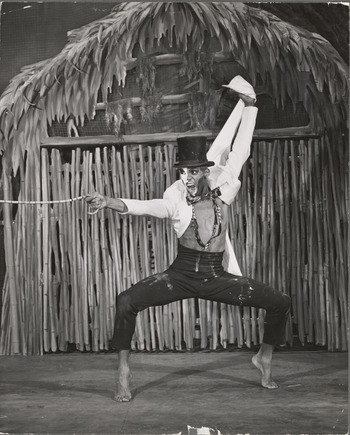
Describing Baron Samedi in 1957, Holder said, “He brings you into the world and he takes you out of it. . . . When he enters a ceremony he becomes king of the clowns, the life of the party, but he is mischievous and when you least expect it he exposes man to himself” (qtd. in McHarry, “Real Voodooists”). As Baron Samedi, Holder presented a striking image: he donned a top hat and tailcoat draped over his bare chest, and he painted his face half white and half black to evoke a skull (fig. 2). Knowing that Holder used his theatrical opportunities to present Caribbean forms to his audiences, it is worth asking: To what extent did he conjure this Vodou figure of existential confrontation—the king of the clowns who “exposes man to himself”—in Waiting for Godot? Reviews of his performance as Lucky praised him, in his “scarlet, scarecrow tail coat” (Durgin), as “macabre and vivid” and deemed his performance “more of a dirge than a vaudeville turn” (Atkinson). As Lucky/Holder dances and then heaves his monologue over the desolate landscape to the pleasure and horror of the audience onstage and off, does he bring Baron Samedi to the Barrymore Theater? Do Lucky's bowler hat and tailcoat transform into the top hat and tails of the Haitian Ghede (as Estragon's boots transform into the props of the blackface minstrel show)? Lest these queries seem too speculative, the methods of performance studies offer critical paradigms—theatrical ghosting (Carlson), Afroalienation acts (Brooks), performance genealogy (Roach, Cities), ephemera as evidence (Muñoz), nonperformance (Moten), the archive and the repertoire (Taylor), and the uncanny stage life of props (Sofer)—that allow us to grasp such elusive elements of performance, even as we find evidence for this proposition in the paratheatrical elements of the production. In addition to hearing Lucky's/Holder's soliloquy as the birth pangs of a new consciousness or even a new form of the human, we might also see it as a spirit possession, a ritual that surfaces Baron Samedi—an inhabitant, like Beckett's tramps, of a mythical realm—within the theater of the absurd as the positive negation of Western reason.
Geoffrey Holder as Baron Samedi in the stage production House of Flowers. 1955. Photo by Arthur Zinn. Billy Rose Theatre Division, New York Public Library for the Performing Arts.

The appearance in Waiting for Godot of Holder-as-Lucky-as-Baron-Samedi brings to the stage other voices and spirits. In the play's second act, Lucky/Holder and Pozzo/Ingram return with no memory of the previous day's events, the former now mute and the latter blind. The ironic spirit of Baron Samedi as keeper of the cemetery evoked in act 1 nevertheless continues to preside over act 2, as the mournful reflections of Vladimir/Hyman and Estragon/Moreland begin to imagine the theater itself as a graveyard:
As they continue to present the formal constraints of the Jim Crow stage, they are haunted by the presence of the dead and invite consideration of the ethical implications of their own performance. Vladimir/Hyman describes the stage as a charnel house, a building for the interment of human bones unearthed while digging new graves in a churchyard cemetery. In other words, it becomes a vault for the excavated remains of past generations—an apt description for the theater itself. Bantering about their own banter, Vladimir/Hyman and Estragon/Moreland cannot ignore the offstage violence that haunts the representational forms of Jim Crow theater, transforming one of the most haunting passages in all of Beckett into a threnody for Black lives—and for forms of Black theater:
For Beckett as for Moreland and Hyman (as for Gogo and Didi), this lyrical duet comments not only on the living's relationship to the dead but also on the theater: voices, stories, scripts. As similes do, these lines carry ambiguous meanings. “Leaves” suggest not only foliage but also the pages of a book, or a playbill. Voices that “make a noise like wings” also encroach on the characters from the wings, the theater's offstage region. In other words, we can understand this exchange both existentially and metatheatrically, simultaneously about past lives and the staging of those lives that is necessary for memory and theatrical tradition. A chorus of indistinct murmuring without lines to recite or characters to embody them, the voices sound stories without form that haunt the Jim Crow stage. These untold stories—those that would stage not stereotypes but the situations and experiences of Black people and their lives—are the negation of the stories that would appear on the earlier stages of Moreland and Hyman. Beckett's stage directions interpose this reverie with instructions for “silence” five times and “long silence” twice in the space of two pages (69–70). In these abundant silences, Vladimir/Hyman and Estragon/Moreland make space on the stage for the fitful rustle of these voices that they themselves, constrained by Jim Crow–era casting practices, were not permitted to perform. This chorus of voices may even, absurdly, include Moreland and Hyman themselves as part of this theatrical unconscious that pushes against the frame of representation. As they make space in their silences for the whisper of past voices, the future they patiently await continually defers its arrival.
A minor but crucial character in this production most poignantly depicts this deferred future—a character who, like Lucky/Holder, seemingly enters from a different dimension. Completing the cast was the ten-year-old Bert Chamberlain as the boy who appears at the end of each act to assure Vladimir/Hyman that Godot will be coming the next day. The program tells us that Chamberlain's “next door neighbor, Mantan Moreland,” suggested him for the part. Moreover, Chamberlain “memorized all his lines before he auditioned for Mr. Meyerberg, who selected him over many candidates from professional drama schools” (Program 18). Less interested in theater than in football and basketball, he hopes to become an Air Force pilot. Such details place the boy / Chamberlain outside the hermetic world of Jim Crow performance. He is an ambassador from the offstage world of the audience who keeps the actors waiting, returning to the board night after night with the promise that Godot will come tomorrow. Vladimir/Hyman, in desperation, implores the boy not to return the next night and behave as though he has never seen him before, a repetition we witness at the end of both acts. In the cosmology of this casting, the boy bears no historical memory, rendering the possibility of Black theater in the Jim Crow era unknown—to the next generation and to itself—and leaving Vladimir's/Hyman's place within it repeatedly deferred, but not without hope: the very fact of Hyman's and the others’ performance in this production of Waiting for Godot creates new concrete stage images and heralds other histories.
[IV]
Meyerberg's plan for annual revivals of Waiting for Godot foundered. Before the Black-cast production opened, Meyerberg had designs to build Beckett's play “into one of the greatest attractions of modern times,” forecasting that “next season we will play 18 weeks, the year after perhaps 24, 26, or 30 weeks, and thereafter for the next ten years I am sure ‘Godot’ can play 26 weeks a year” (Meyerberg). The production instead closed after six performances. It turned out that the pleasures of not getting Waiting for Godot were stronger than Meyerberg anticipated. His conviction that “no one will walk away this time and ask: ‘What's it about?’” failed to come to pass, and the critic for the Harlem-based New York Amsterdam News reported that “after viewing the show, the average playgoer asks on his way out, ‘When you find out what it's all about, won't you please tell me?’” (Slack). The mortal blow, however, was the extravagant cost of reviving the show on Broadway. Though the Barrymore provided free rent, the union expenses for lighting and stagehands increased substantially since, as a revival, it was categorized as a road show (Kempton).Footnote 6 After the production closed, Meyerberg abandoned his ambitions for Godot and moved on to other schemes. The 1957 Black-cast production remains a footnote in the history of Beckett's play, when it is remembered at all.
But in its brief run, it surfaced a deep tradition of the Africana absurd. Through concrete stage images of Black theater history, it took Black performance itself as matter for the racial theater of the absurd, imagining new forms for responding to a disharmonious world, voicing a dissent from the conventions of protest literature, and presenting an experiment with fatigue. Like Beckett's text, this production realized the failures of humanism even as it used Beckett's play to include Blackness in the very universality that it has rendered absurd. And of course, the production provided new opportunities for Black actors to perform roles that were neither minstrel stereotypes nor transcendent classics.
Though audiences in the winter of 1957 may not have gotten it, subsequent playwrights and theater makers did. Lorraine Hansberry directly responded to the production, penning two short plays that revised Beckett's tone and themes: the unpublished queer parody “The Arrival of Mr. Todog” (Godot spelled backward) and the teleplay What Use Are Flowers? (1962). As a switch point between the European absurd and the Africana absurd, Meyerberg's revival inaugurated a line of racial Godots across the twentieth and twenty-first centuries, including the Free Southern Theater's production that toured the United States South in 1964, an interracial production in apartheid-era Cape Town in 1980 directed by Athol Fugard, and Paul Chan's 2007 Waiting for Godot in New Orleans, staged in the wake of Hurricane Katrina.Footnote 7 This string of productions reminds us that the theater of the absurd cannot so readily be shelved as dated or consigned to only historical interest. It instead persists as an ongoing resource for an Africana absurd that is at once materialist and metaphysical. Recognizing this tradition further expands what the theater of the absurd was and can be, and it allows us to see how the Africana absurd—as a felt sensibility and an aesthetic attitude toward the incoherencies of racial ideologies—shaped and continues to shape Black performance history.