Introduction
Cannabis use has been increasing over the past few decades (Gledhill-Hoyt et al. Reference Gledhill-Hoyt, Lee, Strote and Wechsler2000) and age at first use has been decreasing in Western societies (Degenhardt et al. Reference Degenhardt, Lynskey and Hall2000). There are particular concerns about the use of cannabis in adolescence as the brain is still developing (Giedd et al. Reference Giedd, Blumenthal, Jeffries, Castellanos, Liu, Zijdenbos, Pano, Evans and Rapoport1999) and may be vulnerable to the potentially toxic effects of cannabis (Arseneault et al. Reference Arseneault, Cannon, Poulton, Murray, Caspi and Moffitt2002; Cannon et al. Reference Cannon, Harley, Clarke, Arseneault, MacCabe, O'Daly, Murray, McGuffin and Wright2006). Cannabis use has been found to be associated with mental health problems, most notably psychotic disorders (Arseneault et al. Reference Arseneault, Cannon, Witton and Murray2004; Moore et al. Reference Moore, Zammit, Lingford-Hughes, Barnes, Jones, Burke and Lewis2007), although it is a matter of some debate whether the relationship is causal in nature (Macleod et al. Reference Macleod, Davey Smith and Hickman2004, Reference Macleod, Davey Smith and Hickman2006).
Recent studies have shown that childhood trauma is a risk factor for the development of schizophrenia (Read et al. Reference Read, van Os, Morrison and Ross2005; Morgan & Fisher, Reference Morgan and Fisher2007; Bendall et al. Reference Bendall, Jackson, Hulbert and McGorry2008) and psychotic symptoms (Bak et al. Reference Bak, Krabbendam, Janssen, de Graaf, Vollebergh and van Os2005; Kelleher et al. Reference Kelleher, Harley, Lynch, Arseneault, Fitzpatrick and Cannon2008). It has also been shown that childhood trauma increases the risk of substance misuse in adolescence and adulthood (De Bellis, Reference De Bellis2002; Gordon, Reference Gordon2002). Taken together, these strands of evidence point to the possibility that childhood trauma may have a role to play in the association between cannabis use and psychosis (Cougnard et al. Reference Cougnard, Marcelis, Myin-Germeys, De Graaf, Volleburgh, Krabbendam, Leb, Wittchen, Henquiet, Spauwen and van Os2007; Houston et al. Reference Houston, Murphy, Adamson, Stringer and Shevlin2008).
There is increasing interest in the role of interactions (gene–environment, gene–gene and environment–environment) in the aetiology of psychiatric disorders (van Os & Sham, Reference van Os, Sham, Murray, Jones, Susser, van Os and Cannon2003; Moffitt et al. Reference Moffitt, Caspi and Rutter2005; Caspi & Moffitt, Reference Caspi and Moffitt2006; van Os et al. Reference van Os, Rutten and Poulton2008; Clarke et al. Reference Clarke, Tanskanen, Huttunen, Whittaker and Cannon2009). However, there is some debate about the usefulness of such findings and the correct model to use for the investigation of psychiatric outcomes (Risch et al. Reference Risch, Herrell, Lehner, Liang, Eaves, Hoh, Griem, Kovacs, Ott and Merikangas2009; Zammit et al. Reference Zammit, Wiles and Lewis2009). Predictions can be modelled on either additive or multiplicative scales. A multiplicative model assumes that risks multiply in their effect. An additive model assumes that individuals can develop the outcome of interest from either of the risk factors acting alone and tests for positive deviations from additivity (superaddivity) that indicate the presence of synergy. The additive model is considered to be the more meaningful model in psychiatric epidemiology, where diseases usually have complex multifactorial aetiologies (Darroch, Reference Darroch1997; van Os & Sham, Reference van Os, Sham, Murray, Jones, Susser, van Os and Cannon2003; Schwartz & Susser, Reference Schwartz, Susser, Susser, Schwartz, Morabia and Bromet2006).
In this study we aimed to investigate whether the presence of both childhood trauma and early cannabis use increases the risk of experiencing psychotic symptoms in adolescence beyond that expected if each risk factor were working independently. The importance of psychotic symptoms in childhood and adolescence lies in mounting evidence that they are a risk marker for later psychotic illness (Poulton et al. Reference Poulton, Caspi, Moffitt, Cannon, Murray and Harrington2000; Scott et al. Reference Scott, Martin, Welham, Bor, Najman, O'Callaghan, Williams, Aird and McGrath2008).
Method
Participants
The ‘Challenging Times’ study (Lynch et al. Reference Lynch, Mills, Daly and Fitzpatrick2004, Reference Lynch, Mills, Daly and Fitzpatrick2006; Mills et al. Reference Mills, Lynch, Daly and Fitzpatrick2004) was established to investigate the prevalence of psychiatric disorders among Irish adolescents aged 12–15 years in an urban environment. The study was carried out in the geographical catchment area of a Child and Adolescent Mental Health Team in North Dublin with a population of 137 000. Participating schools were selected using a stratified random sampling technique, stratified according to the approximate socio-economic class of the school to approximate to the geographical area population. In brief, 743 pupils in eight mainstream schools (52% of the total school population in that area) were screened for psychiatric symptoms using the Strengths and Difficulties Questionnaire (SDQ), which assesses emotional symptoms, conduct problems, hyperactivity/inattention, peer relationship problems, and prosocial behaviour (Goodman, Reference Goodman1997; Goodman et al. Reference Goodman, Ford, Simmons, Gatward and Meitzer2000). The Children's Depression Inventory (CDI), which assesses cognitive, affective and behavioural signs of depression, was also used (Kovacs, Reference Kovacs1985). After complete description of the study to the subjects, written informed consent was obtained from their parent or guardian. One hundred and forty adolescents scored above threshold on these instruments, indicating high risk of having mental health problems. Adolescents were included in this ‘at-risk’ category if they scored in the clinical range on the CDI and/or if they scored in the clinical range on the SDQ, and/or if they ticked ‘I want to kill myself’ on item 9 of the CDI. Of these 140 adolescents, 117 (83.6%) agreed to attend for full psychiatric interview. A comparison group of 173 adolescents, matched for gender and school, were also invited to attend, of whom 94 (54%) agreed.
Ethical approval for the study was granted by the Medical Ethics Committee of the Mater Misericordiae University Hospital, Dublin, Ireland. The study was supported by the multi-disciplinary Child and Adolescent Mental Health Service covering the geographical area. The protocol ensured that any adolescent who was deemed to be in need of a clinical service could be referred to the appropriate team.
Interview instrument
The interview schedule used in this study was the Schedule for Affective Disorders and Schizophrenia for School-Age Children, Present and Lifetime Versions (K-SADS-PL; Kaufman et al. Reference Kaufman, Brent, Rao and Ryan1996). The K-SADS is a well-validated semi-structured research diagnostic interview for the assessment of all Axis-I psychiatric disorders in children and adolescents. Children and parents were interviewed separately, both answering the same questions about the child. Interviews were conducted by one psychiatrist or two psychologists who were trained in the use of the K-SADS. Inter-rater reliability for the K-SADS was estimated as over 90% in this study (Lynch et al. Reference Lynch, Mills, Daly and Fitzpatrick2006).
Psychotic symptoms
Axis I psychiatric diagnoses according to DSM-IV (APA, 1994) were determined using the K-SADS semi-structured interview with adolescents and parents or guardians. The Psychosis section of the K-SADS asks about the child's experience of hallucinations and delusions not occurring during acute intoxication with a substance. Responses to these questions were recorded on the interview sheet. Three psychiatrists (M.H., F.L. and M.C.) and one psychologist (I.K.) examined these responses and concurred that the symptoms seemed genuine in content.
Measurement of substance misuse
During the interview, in the Substance Misuse section of the K-SADS, both adolescent and parent were asked whether the adolescent had ever used cannabis. If the answer was yes, then frequency of use in the past 6 months and frequency ever were recorded. Cannabis use was defined as ever having used cannabis.
Measurement of childhood trauma
As part of the K-SADS interview the following childhood traumatic experiences were assessed. Interviews were conducted with parents and adolescents separately.
Childhood abuse
Both child physical abuse and child sexual abuse were assessed as part of the K-SADS interview. Adolescents were asked a series of questions in relation to physical or sexual abuse. Parents were asked the same questions appropriately modified. A disclosure of physical or sexual abuse from the parent was taken as evidence of a history of child abuse, regardless of whether it was also disclosed by the child. There were no cases where the parent disputed the occurrence of abuse that had been disclosed by the child.
Domestic violence
Exposure to domestic violence was assessed in the Post-Traumatic Stress Disorder section. Adolescents and their parents were separately asked the same questions. A disclosure of domestic violence from the parent was taken as evidence of violence between parents/step-parents. There were no cases where the parent's report of the occurrence of domestic violence disagreed with that disclosed by the child or vice versa. Childhood trauma was defined as a history of physical abuse, sexual abuse, witnessing domestic violence or any combination of these.
Socio-economic status (SES) and family history
SES of each study participant was determined using parental occupation assessed according to the Irish Social Class Scale (Central Statistics Office, 1996). We divided the sample into two major groups according to social class: the first group contained SES groups 1 and 2 (professional/managerial) and the second group contained SES groups 3–7 (non-manual skilled, skilled manual, semi-skilled manual, unskilled manual, and unemployed). The K-SADS interview includes a routine screening section for family history of psychiatric illness, which was used in the present study. Family psychiatric history included history of affective disorders, anxiety disorders, psychotic and substance use disorders in a first- or second-degree relative.
Statistical analysis
An additive model of interaction assumes that risks add in their effects so that results over and above additivity indicate synergy. However, when examining the interaction of two risk factors, it is important to note that some individuals can develop disease from either one of the two risk factors under study alone; this phenomenon is termed parallelism and it reduces the measure of the exposures' combined effect. An additive model of interaction therefore includes the supperadditive effect of the interaction of two causal partners, and the subadditive effect of parallelism. The details of the analysis are as follows: if we have two risk factors for psychosis A and B, there are four possible exposure states, each carrying a specific risk. Therefore, the risk in those exposed to neither A nor B is R; the risk in those exposed to A only is R(A), the risk in those exposed to B only is R(B), and the risk in those exposed to both is R(AB). On the additive scale, the effect of a risk factor is expressed as a risk difference. We can therefore express the effect associated with A as R(A)−R, with B as R(B)−R and with AB exposure as R(AB)−R. The excess of the combined effect over the sum of the solitary effects of A and B is R(AB)−R(A)−R(B)+R; this represents the statistical additive interaction.
We wanted to examine for additive interaction rather than multiplicative interaction in this study (Darroch, Reference Darroch1997; van Os & Sham, Reference van Os, Sham, Murray, Jones, Susser, van Os and Cannon2003; Cougnard et al. Reference Cougnard, Marcelis, Myin-Germeys, De Graaf, Volleburgh, Krabbendam, Leb, Wittchen, Henquiet, Spauwen and van Os2007). Because of the case-control design of the Challenging Times study, however, it was not possible to estimate the baseline risk of disease and use risk differences in this analysis. Schwartz & Susser (Reference Schwartz, Susser, Susser, Schwartz, Morabia and Bromet2006) have described a method whereby estimates from a multiplicative model can be used to assess interaction on an additive scale. This adaptation allows the use of odds ratios (ORs) instead of risk differences. In this study, we used logistic regression for the initial analyses and translated these to look at interaction on an additive scale using an interaction contrast ratio method (Rothman & Greenland, Reference Rothman and Greenland1998; Schwartz & Susser, Reference Schwartz, Susser, Susser, Schwartz, Morabia and Bromet2006). This ratio is calculated as: R(AB)−R(A)−R(B)+1.
In brief, we stratified our data into four categories: (1) no exposure to cannabis use or childhood trauma [R], (2) exposure to cannabis use only [R(A)], (3) exposure to childhood trauma only [R(B)], and (4) exposure to both cannabis use and childhood trauma [R(AB)]. The outcome measure was self-reported psychotic symptoms. The ORs for groups 2, 3 and 4 were calculated using group 1 as baseline. The ORs were then used in the standard formula for calculating an interaction contrast ratio. The interaction contrast ratio divided by the OR in those exposed to both risk factors can be interpreted as the proportion of disease among those with both risk factors that is attributable to the interaction.
All analyses were carried out using Stata Statistical Software release 9.2 (Stata Corporation, USA).
Results
Of the 211 children in the interviewed sample, 83 (39%) received a DSM-IV Axis I diagnosis following the K-SADS interview. The most common disorders diagnosed were depressive disorders (17.5%, n=37). No participant received a formal diagnosis of a psychotic illness. Fourteen participants (6.6%) reported experiencing psychotic symptoms, primarily auditory and visual hallucinatory experiences.
Substance use
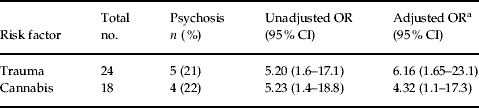
No adolescents in this sample met criteria for a cannabis dependence syndrome. Of the adolescents interviewed, 8.5% (n=18) reported having ever used cannabis. Only five adolescents reported ever having used any illicit substance (ecstasy, ‘poppers’, sniffing deodorant or petrol) other than cannabis and four of these had also used cannabis. Adolescents who had used cannabis were five times more likely to have experienced at least one psychotic symptom (see Table 1).
Risk of psychosis associated with childhood trauma and cannabis use as main effects

OR, Odds ratio; CI, confidence interval.
a Adjusted for gender, age, socio-economic status and family psychiatric history.
Childhood trauma
Childhood trauma was reported in 11.3% of participants interviewed (n=24). Those adolescents who had experienced childhood trauma were almost five times more likely to use cannabis [OR 4.86, 95% confidence interval (CI) 1.63–14.51, p=0.005] than those who had not experienced trauma. Participants who had experienced childhood trauma were also five times more likely to develop psychotic symptoms (OR 5.20, 95% CI 1.58–17.13, p=0.007) compared to those who had not (Table 1).
Examining the relationship between cannabis, childhood trauma and psychotic symptoms
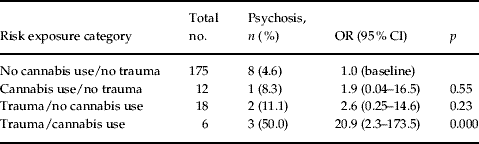
Fig. 1 shows the prevalence of psychotic symptoms in each of the four exposure categories: No trauma or cannabis use; Cannabis use/no trauma; Trauma/no cannabis use; Trauma and cannabis use. Table 2 shows the ORs for each of the four exposure categories. Using these ORs in the formula for additive interaction [R(AB)−R(A)−R(B)+R] gave a value of 17.4 [20.9−1.9−2.6+1]. The statistical additive interaction is positive, indicating that childhood trauma and cannabis use interact on the additive scale. We can estimate from our data that 83% (17.4/20.9) of the occurrence of psychotic symptoms among those exposed to both cannabis use and childhood trauma is attributable to the interaction between these factors.
Percentage of adolescents with psychotic symptoms ( ) in each risk exposure category.

Risk of psychotic symptoms in each exposure category

OR, Odds ratio; CI, confidence interval.
Discussion
In this study we found that both cannabis use and childhood trauma increased the risk for psychotic symptoms in adolescence in main effect analyses. However, when we examined both risk factors under an additive model we found evidence of a greater than additive interaction between childhood trauma and cannabis use, whereby the effect of the joint presence of these two factors increased the likelihood of psychotic symptoms in adolescence to a much greater extent than would be expected if each risk factor were working independently.
Several large prospective studies have examined the association between cannabis use and psychotic illness or psychotic symptoms, mostly in adult populations, controlling for a variety of potential confounding variables (Arseneault et al. Reference Arseneault, Cannon, Witton and Murray2004); however, most have not considered childhood trauma as a potential effect modifier. Two studies reported results adjusted for childhood trauma (physical and/or sexual abuse) in the analysis and found that a significant association between cannabis use and psychotic symptoms remained even after adjustment for these factors (Fergusson et al. Reference Fergusson, Horwood and Ridder2005; Henquet et al. Reference Henquet, Krabbendam, Spauwen, Kaplan, Lieb, Wittchen and van Os2005), suggesting that cannabis is an independent risk factor for psychosis, which is in keeping with our results.
Two recent papers have looked at the possibility of an interaction between childhood trauma and adolescent cannabis use in increasing the likelihood of psychotic symptoms and psychotic illness. Cougnard et al. (Reference Cougnard, Marcelis, Myin-Germeys, De Graaf, Volleburgh, Krabbendam, Leb, Wittchen, Henquiet, Spauwen and van Os2007) re-examined data from two large European population cohort studies (one adult cohort, one cohort aged 14–24 years) and calculated additive interaction between three environmental risk factors for psychosis (cannabis use, childhood trauma and urbanicity) and baseline psychotic experiences in predicting persistence of psychotic experiences. The authors concluded that the level of environmental risk combines synergistically with subclinical psychotic symptoms to cause abnormal persistence of these symptoms. Houston et al. (Reference Houston, Murphy, Adamson, Stringer and Shevlin2008) re-examined data from the National Comorbidity Survey to investigate the interactive effect of childhood sexual abuse and cannabis use in relation to psychotic outcomes. Unlike our study, the authors found no main effect for either risk factor alone, but a significant interaction between the two. Childhood sexual trauma was significantly associated with psychotic symptoms in the subgroup of adolescents who had used cannabis before the age of 16 years.
What are the possible biological mechanisms of an interaction effect?
There are several possible biological, genetic and psychosocial factors that could be involved in the association between cannabis use, trauma and psychotic symptoms. The most parsimonious explanation involves effects on the dopamine neurotransmitter system. First, all effective antipsychotic medications affect dopamine and dopamine sensitization has been proposed as a mechanism explaining psychotic symptoms (Laruelle, Reference Laruelle2000; Kapur et al. Reference Kapur, Mizrahi and Li2005). Second, it has been demonstrated that cannabis affects dopamine release and that the direction of effect depends on the chronicity of use (Verrico et al. Reference Verrico, Jentsch and Roth2003; Luzi et al. Reference Luzi, Morrison, Powell, di Forti and Murray2008; Bossong et al. Reference Bossong, van Berckel, Boelhaard, Zuurman, Schuit, Windhorst, van Gerves, Ramsey, Lammerstsma and Kahn2009). Third, there is evidence from both animal (Plotsky & Meaney, Reference Plotsky and Meaney1993; Ladd, Reference Ladd, Owens and Nemeroff1996; Liu et al. Reference Liu, Caldji, Sharma, Plotzky and Meaney2000; Kalinichev et al. Reference Kalinichev, Easterling, Plotsky and Holtzman2002) and human studies (Heim et al. Reference Heim, Newport, Heit, Graham, Wilcox, Bonsall, Miller and Nemeroff2000; Carpenter et al. Reference Carpenter, Carvalho, Tyrka, Wier, Mello, Anderson, Wilkinson and Price2007) that response to severe stress, such as childhood abuse early in life, can lead to permanent changes in the hypothalamic–pituitary–adrenal (HPA) axis and dopamine systems (for discussion see Read et al. Reference Read, Perry, Moskowitz and Connolly2001).
Limitations and strengths of study
Although the ORs in this study are high, the CIs are wide, reflecting a relatively small sample size when subgroups are compared. The Challenging Times study was designed as a general epidemiological study of mental health in adolescents, not specifically to test the current hypotheses. Although this may have led to less detailed information obtained specifically in relation to cannabis use and psychotic symptoms, it is likely that it minimized interviewer bias. Another limitation was that information on the timing of events (first use of cannabis, first experience of childhood trauma) was limited and relied on retrospective recall. However, recent data suggest that the temporal ordering of childhood trauma and cannabis use does not affect the risk of developing psychosis (Shevlin et al. Reference Shevlin, Murphy, Houston and Adamson2009). Rates of cannabis use were relatively low in this sample. This may be due to under-reporting of substance use, although participants were assured of the confidentiality of their data and collateral information was obtained from at least one parent/guardian. It should also be noted that the measure of sexual abuse used in this study is a conservative one, which may explain the low rates of sexual abuse reported.
The strengths of this study include the use of an epidemiological community-based sample, whereby schools were selected using a randomized stratified sampling method so that the study population is representative of the area population. A well-validated standardized psychiatric interview was used in this study and administered by trained researchers with a clinical background. Information was also obtained from parents/carers so that information on psychiatric symptoms, on environmental risk factors, and on a variety of potential confounding factors was available from two sources.
Conclusions
In this study, we report a greater than additive interaction between childhood trauma and cannabis use in increasing the likelihood of developing psychotic symptoms. Our findings should be replicated in a larger sample of adolescents using a prospective design to clarify the temporal relationship between risk factors and symptoms. Future studies examining links between cannabis use and psychosis should consider the effects of childhood trauma as an important potential effect modifier. The findings reported here may have important practical implications for the prevention of psychosis. Young people with a history of childhood trauma could be conceptualized as an ‘at-risk’ group and could be targeted for psychotherapeutic intervention, if warranted, or psycho-educational interventions concerning risks of substance use, particularly during adolescence.
Acknowledgements
This work was supported by a Clinician Scientist Award to M. Cannon (CSA/2004/1) and a Research and Development Award to C. Fitzpatrick from the Health Research Board (Ireland). L. Arseneault is supported by a Career Scientist Award from the Department of Health (UK). Funding support was also provided to M. Cannon by a NARSAD Grable Independent Investigator award and the Wellcome Trust, UK. We thank C. Mills and I. Daly for their roles in conducting clinical interviews for this study. The original ‘Challenging Times’ study was funded by The Friends of the Children's University Hospital, Temple Street; The American Foundation for Suicide Prevention; Health Service Executive Northern Area and The Mater Hospital College.
Declaration of Interest
None.