INTRODUCTION
In the framework of a monitoring project of non-native species in the coastal waters of Belgium and The Netherlands, several species new to north-west Europe have been found. One of them is an amphipod that has only recently been recorded in Europe, from the Ría de Aveira and the Mondego estuary on the west coast of Portugal (Cunha et al., Reference Cunha, Sorbe and Moreira1999; Pardal et al., Reference Pardal, Marques, Metelo, Lillebø and Flindt2000). Thus far, its further distribution in Europe has not been documented. As it is important to have an overview of the presence and distribution of non-native species not documented in existing European identification works, the new findings are presented in this paper, together with other unpublished European records of this amphipod.
MATERIALS AND METHODS
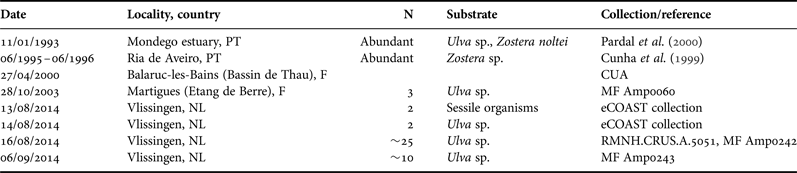
Samples were taken of seaweeds and other sessile organisms from boulders in the littoral zone down to about 20 cm below the low water mark. All organisms were preserved in F-solv or ethanol and identified in the lab. For species unidentifiable with European identification works, additional literature was obtained, particularly that of Nagata (Reference Nagata1965), Bousfield (Reference Bousfield1973), Conlan & Bousfield (Reference Conlan and Bousfield1982) and Kim (Reference Kim2011). For species new to north-western Europe, other records from European coasts based on literature and private collections were investigated. Photos of complete animals were taken with a Canon MP-E 65 macrolens. Appendages were mounted on slides in lactic acid and photographed through a Zeiss standard microscope at a magnification of 100× or 250×. Voucher specimens were deposited in various collections (Table 1).
European records of Ampithoe valida from literature, from eCOAST monitoring carried out by the author (all records from 2014) and from private collections. MF, collection author; CUA, collection by C. d'Udekem d'Acoz; PT, Portugal; NL, The Netherlands; F, France.

RESULTS
Identification
One of the amphipod species collected was identified as Ampithoe valida Smith, 1873. Attempts to identify Ampithoe valida with northern European identification works (Sars, Reference Sars1893; Lincoln, Reference Lincoln1979) resulted in Ampithoe ramondi Audouin, 1826 or Ampithoe rubricata (Montagu, 1808). Clearly, the second gnathopod of the male of Ampithoe valida (Figures 1 & 2) differs significantly from the aforementioned species, which rules those out.
Ampithoe valida, habitus, male. Vlissingen, 16 August 2014. Length = 11 mm, including head and telson.
Ampithoe valida, male second gnathopod, palmar margin with rectangular process. Vlissingen, 16 August 2014.
Identification works treating species from southern Europe (Chevreux & Fage, Reference Chevreux and Fage1925; Krapp-Schickel, Reference Krapp-Schickel1978, Reference Krapp-Schickel and Ruffo1982) mention Ampithoe ferox (Chevreux, Reference Chevreux1902), which has a very similar male second gnathopod. However, whereas for Ampithoe valida a maximum size of 12 mm is given (Bousfield, Reference Bousfield1973), for Ampithoe ferox the largest size found in literature is 6 mm. Furthermore, the propodus of pereiopods 5–7 is straight in Ampithoe valida (Figure 3), while it is slightly widened distally in Ampithoe ferox. Finally, in Ampithoe valida the first gnathopod has a large carpal lobe (Figure 4), which is lacking in Ampithoe ferox.
Ampithoe valida, male seventh pereiopod, distal articles. Vlissingen, 16 August 2014.
Ampithoe valida, male first gnathopod, distal articles. Vlissingen, 16 August 2014.
A second species that closely resembles Ampithoe valida, especially in the second gnathopod of the male, is Ampithoe shimizuensis (Stephensen, Reference Stephensen1944). According to Kim (Reference Kim2011), Ampithoe shimizuensis lacks the carpal lobe on the first gnathopod of the male.
The colour of live specimens of Ampithoe valida varies from dark brown to bright green, often with darker spots. Since similar colours occur in Ampithoe ramondi and Ampithoe rubricata (see Lincoln, Reference Lincoln1979), colour cannot be used to distinguish Ampithoe valida from these native Ampithoe species.
Records
During our monitoring project, we found Ampithoe valida in Vlissingen, close to the port, on the following dates: 13, 14, 16 August and 6 September 2014. Vlissingen is situated at the mouth of the Westerschelde estuary in the Southern Bight of the North Sea (Figure 5). Older records from private collections demonstrate the presence of A. valida on at least two sites along the Mediterranean coast of France (Table 1, Figure 5). At Martigues, it was found close to an industrial area with intensive navigation of cargo ships. The Bassin de Thau is situated about 100 km to the west, near the harbour of Sète. Two records from different water bodies in Portugal were found in literature (Table 1, Figure 5).
Locations in Europe with records of Ampithoe valida. A = Ría de Aveiro (PT), B = Balaruc-les-Bains (F), Ma = Martigues (F), Mo = Mondego estuary (PT), V = Vlissingen (NL).
DISCUSSION
Distribution
Ampithoe valida was described from the Atlantic coast of North America in 1873 and occurs from Chesapeake Bay to New Hampshire, USA (Bousfield, Reference Bousfield1973). It has probably been introduced to the Pacific coast of North America. The first Pacific records date back to 1941, or possibly 1936 (Carlton, Reference Carlton1979). According to Kim (Reference Kim2011), the present distribution of Ampithoe valida also encompasses Japan, China and Korea. Ampithoe shimizuensis Stephensen, Reference Stephensen1944 from Japan is suggested to be a possible synonym of Ampithoe valida by Barnard (Reference Barnard1954, Reference Barnard1965), Nagata (Reference Nagata1965), Conlan & Bousfield (Reference Conlan and Bousfield1982) and Kim & Kim (Reference Kim and Kim1987), but Kim (Reference Kim2011) gives clear distinctions between Ampithoe valida and Ampithoe shimizuensis. As neither species was known from the north-west Pacific before 1944, it is not sure whether Ampithoe valida was introduced to that area or previously overlooked. According to Alonso et al. (Reference Alonso, Tablado, Lopez Gappa and Magaldi1995), Ampithoe valida was recorded for the first time in the southern hemisphere in 1986 from the coast of Río Negro and Chubut in Argentina. Ampithoe valida is now widely distributed in all temperate parts of the northern hemisphere and in the south-west Atlantic.
Ampithoe valida may be more widespread along the Atlantic coast of Europe than currently known. The recorded arrival of the Mediterranean species Ampithoe ferox in the Bassin d'Arcachon (France), as the only Atlantic station after 1970 (Auby, Reference Auby1993), warrants reconfirmation. Ampithoe valida is not mentioned in the identification keys for southern France (Chevreux & Fage, Reference Chevreux and Fage1925; Krapp-Schickel, Reference Krapp-Schickel and Ruffo1982). As Vlissingen has an international port, dispersal to other ports in northern Europe is to be expected or may have occurred already. Low water temperatures pose no problem to its dispersal in Europe, as at the north end of the distributional range of Ampithoe valida on the Atlantic coast of North America average monthly seawater temperatures for February are 1–3°C along the coastline from Portland to Boston (NODC, 2014), lower or equal to the lowest seawater temperatures in most northern European regions.
Pilgrim & Darling (Reference Pilgrim and Darling2010) performed genetic studies on Ampithoe valida from both the Atlantic and Pacific coasts of North America. On the Pacific coast they found three clades, with genetic differences between clades greater than ten times those observed within clades, and as large as the differences between cryptic species described within the amphipod genus Hyalella. This warrants their consideration as a separate species, which may have arrived during separate introduction events. Morphological differences between clades were not found. This makes clear that without genetic studies it is impossible to trace the origin of the populations of Ampithoe valida in different European locations.
Ecology
The genetic studies of Pilgrim & Darling (Reference Pilgrim and Darling2010) also make clear that ecological traits may differ between populations, if these populations represent different species within Ampithoe valida. Therefore, detailed ecological data obtained in one region cannot simply be applied to other regions. Ampithoe valida is most frequently found between green algae of the genus Ulva (Bousfield, Reference Bousfield1973; Alonso et al., Reference Alonso, Tablado, Lopez Gappa and Magaldi1995, Pardal et al., Reference Pardal, Marques, Metelo, Lillebø and Flindt2000; Zheng et al., Reference Zheng, Huang, Huang and Lin2013, Reference Zheng, Huang, Wang and Lin2014; present paper). Pardal et al. (Reference Pardal, Marques, Metelo, Lillebø and Flindt2000) and Zheng et al. (Reference Zheng, Huang, Huang and Lin2013, Reference Zheng, Huang, Wang and Lin2014) found that Ampithoe valida actually consumes green algae. Population development of Ampithoe valida may be favoured by eutrophic situations, which leads to high densities of ephemeral macroalgae. It was found abundantly in an eutrophic situation in the Mondego estuary and after a restoration, which led to a significant decrease in macroalgae, Ampithoe valida densities decreased permanently (Grilo et al., Reference Grilo, Cardoso, Dolbeth and Pardal2009). Although it consumes macroalgae, Ampithoe valida cannot always prevent macroalgal blooms in eutrophic situations (Zheng et al., Reference Zheng, Huang, Wang and Lin2014). The amphipod builds its tubes on algal fronds, which need not be attached to a hard substrate (Conlan & Bousfield, Reference Conlan and Bousfield1982). This means that Ampithoe valida can potentially also colonize habitats lacking anthropogenic hard substrates in the invaded regions.
The genus Ampithoe has only been recorded from The Netherlands once before, on 27 April 1995 in the port of Rotterdam (Paalvast, Reference Paalvast1998). The single specimen, identified as Ampithoe rubricata (Montagu, 1808), is not extant (Paalvast, personal communication). Competition of Ampithoe valida with other species in The Netherlands will probably be limited. Amphipods collected in the same habitat were Monocorophium insidiosum (Crawford, Reference Crawford1937) and Microdeutopus gryllotalpa Costa, Reference Costa1853, which are not restricted to habitats with macroalgae.
In view of the locality at a harbour entrance near Vlissingen where Ampithoe valida was found, and its association with macroalgae, transport in hull fouling of a commercial vessel is the most likely introduction vector. Alternatively, as it is sometimes associated with loose algae, it may have arrived in ballast water tanks.
ACKNOWLEDGEMENTS
The records from Vlissingen presented in this paper were gathered in the course of a monitoring project by eCOAST Marine Research (Middelburg, Netherlands). I am grateful to C. d'Udekem d'Acoz (RBINS, Brussels) for permission to use his data from the Bassin de Thau.