Introduction
Frailty in centenarians has arisen as a frontline topic in the field of frailty studies as it has been recognized as having an important role in determining health outcomes and mortality still at advanced ages (Gu and Feng, Reference Gu and Feng2015; Lau et al., Reference Lau, Kwan and Cheung2016a). The most widely considered frailty definitions include a biological syndrome model comprised of five specific physical criteria – weight loss, exhaustion, weakness, slow walking speed, and low levels of physical activity (Fried et al., Reference Fried2001), frailty as a state produced by accumulated medical burdens (Rockwood et al., Reference Rockwood2005), and a functional approach that emphasises deficits in specific functional abilities (Strawbridge et al., Reference Strawbridge, Shema and Balfour1998). Though these different approaches present conceptual discordances, they all focus primarily on physical and biological aspects.
The association between the frailty phenotype and elderly individuals who are emotionally vulnerable has been an important research topic over the last years due to the known adverse health outcomes linked to both. In 2012, Mezuk et al. (Reference Mezuk, Edwards, Lohman, Choi and Lapane2012) conducted a review of existing studies examining depression and frailty among older adults and revealed a strong support for a bidirectional association. According to their review, both cross-sectional and cohort studies indicate, in overall, that frailty, its components, and functional impairment are risk factors for depression. Subsequent studies have confirmed such comorbidity (Vaughan et al., Reference Vaughan, Corbin and Goveas2015) and reinforced the co-occurrence of frailty and some sort of emotional distress. A recent study on frailty, depression, and anxiety in later life, for instance, revealed that higher depression and anxiety scores were identified in both pre-frail and frail groups when compared to robust elders, suggesting that even at the earliest stages of pre-frailty there is an association with increased symptoms of emotional distress (Mhaolán et al., Reference Mhaoláin2012).
When assessing the extent of diagnostic overlap between frailty and depression in a national representative sample of older adults, Lohman et al. (Reference Lohman, Dumenci and Mezuk2014) found that frailty and depression identify highly overlapping populations, but that such overlap was greatest for the somatic and severely depressed subgroups (about three-quarters of those presenting severe depression were categorized as moderately frail or frail, when compared with 12% of individuals in the low depression class). This finding indicated that the used approaches to operationalize frailty and depression syndromes (frailty criteria developed in the Cardiovascular Health Study, and depression as assessed by the eight-item Center for Epidemiologic Studies Depression Scale – CESD) were poor at discriminating the two conditions in older adults. When further studying the correlation of depression and competing models of frailty (biological syndrome, frailty index, and functional domains) the same authors also found that the correlation of frailty and depression in late life was substantial, but that the associations between the two constructs could not be fully explained by symptom overlap (Lohman et al., Reference Lohman, Dumenci and Mezuk2016). Based on their study findings, authors argued that psychological vulnerability is ought to be an important component of frailty.
A recent systematic review on depression and frailty in later life reported that the depressive syndrome may be difficult to clinically disambiguate from frailty in advanced old age (Vaughan et al., Reference Vaughan, Corbin and Goveas2015), and a newly published study showed that along with variability in depression prevalence among the frailty profiles, i.e. frailty and pre-frailty, there are also specific depressive symptoms for each profile of the syndrome (Nascimento et al., Reference Nascimento, Batistoni and Neri2016). According to Nascimento et al. (Reference Nascimento, Batistoni and Neri2016), pre-frail and frail groups differed to the non-frail group on items from the Geriatric Depression Scale, namely “feel happy,” “feel full of energy,” “feel situation is hopeless,” and “think others are better off”. In addition, their study findings showed that the prevalence of the pre-frailty was influenced by depressive complaints related to “feel happy,” “think others are better off,” and “feel full of energy,” whereas the prevalence of frailty was influenced by “feel full of energy,” “feel life is empty,” “think others are better off,” and “drop activities/interest.” In the pre-frail condition such symptoms indicate lower positive feelings, somatic perception, and interpersonal sensitivity, which in the transition to the frail condition seem to be partially changed as lower positive feelings are replaced by anhedonia. Lau et al. (Reference Lau, Kwan and Cheung2016b) recently explored the interaction effect between frailty and depression in a sample of near-centenarians and centenarians, and found that depression but not WAV (withdrawal-apathy-(lack of) vigor) was associated with a more negative relationship between physical frailty and subjective health. In both studies, explanations of psychosocial nature could be considered, but further studies are needed to better understand the prominence of specific symptoms of depression in distinct frailty profiles within a pathological continuum.
Considering that the comorbidity between physical and mental disorders is particularly common in very advances ages, and that few centenarian studies have explored the frailty concept and its components and consequences (e.g. Kwan et al. Reference Kwan, Lau and Cheung2016), the present study aimed to characterize the frailty phenotype in a sample of centenarians, closely following previous exploratory findings from the Oporto Centenarian Study (Duarte et al., Reference Duarte, Teixeira, Ribeiro and Paúl2014), and add to the current body of knowledge on the relationship between frailty and depressive symptoms in such an advanced age. The study also seeks to explore the most characteristic depressive symptoms of the frailty syndrome, following previous studies on this matter (e.g. Nascimento et al., Reference Nascimento, Batistoni and Neri2016).
Methods
Participants
Data came from two Portuguese studies on centenarians: the Oporto Centenarian Study (PT100) and the Beira Interior Centenarian Study (PT100 Beira Interior). The first is a population-based study comprising a total of 189 centenarians living in Oporto city and its surrounding geographical area, and the second refers to a convenience sample of centenarians (n = 98) living in the interior part of the country with a similar geographical extension around the city of Guarda. Information on these projects and on the methodology used for participant selection and data collection can be found elsewhere (Ribeiro et al., Reference Ribeiro, Araújo, Teixeira, Brandão, Duarte, Paúl and Pachana NA2015).
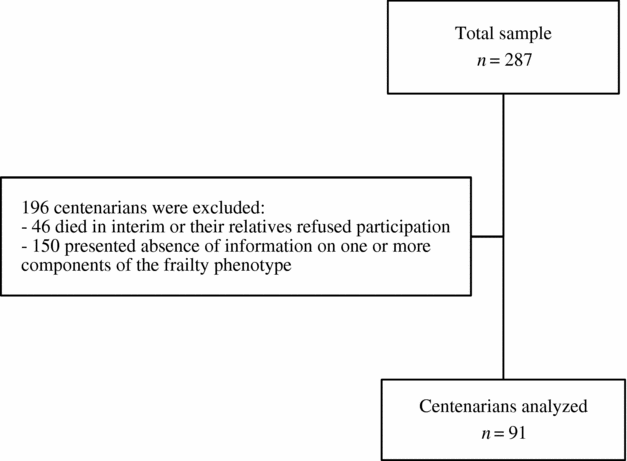
Only participants with no cognitive impairment were eligible for this particular study. Cognition was assessed with a shortened version of the Mini-Mental State Examination (MMSE; Folstein et al., Reference Folstein, Folstein and McHugh1975; Guerreiro et al., Reference Guerreiro, Silva, Botelho, Leitão, Castro-Caldas and Garcia1994). Following the recommendation by Holtsberg et al. (Reference Holtsberg, Poon, Noble and Martin1995), the selected shorter version items included those that were not biased by sensory impairment often prevalent in very old age, resulting in a maximum score of 21 points instead of 30. Considering that reduced cognitive functioning represents a risk to the reliability and validity of self-reports, a sequential data collection strategy was also considered (Ribeiro et al., Reference Ribeiro, Araújo, Teixeira, Brandão, Duarte, Paúl and Pachana NA2015). More specifically, information on the centenarians’ functional and emotional status was only assessed if the individual was not affected by cognitive impairment and was willing to divulge such information. Participants whose components of the frailty phenotype (see variables and measures) could not be determined due to high levels of functional disability (e.g. bedridden cases; dependent on a wheelchair), serious sensorial limitations, tiredness, or other causes were also excluded from the sample (Figure 1). By these means, more than 2/3 of potential participants (n = 196) was excluded and a total of 91 centenarians were analyzed.
Total of participants analyzed and excluded.

The study obtained the approval of the Portuguese Data Protection Authority and signed informed consent was obtained for each participant. The participants’ confidentiality was not breached in accordance with the Declaration of Helsinki.
Variables and measures
Frailty was assessed with the five-component Fried frailty phenotype (2001). Considering the advanced age of the study participants, the metrics were slightly changed following the procedures used in similar studies with very old individuals (Gonzalez-Pichardo et al., Reference Gonzalez-Pichardo2013) and a previous exploratory study with centenarians (Duarte et al., Reference Duarte, Teixeira, Ribeiro and Paúl2014). Weight loss was assessed using one question from The Tilburg Frailty Indicator (Gobbens et al., Reference Gobbens, van Assen, Luijkx, Wijnen-Sponselee and Schols2010): “Have you lost a lot of weight recently without wishing to do so?” (a lot is defined as ≥ 6 kg during last 6 months, or ≥ 3 kg during the last month). Weakness was measured using a dynamometer (grip strength). Grip strength was tested in three consecutive times on both the right and left hands. Analyses use the average peak value across both hands and the last tertile was considered to classify centenarians according to their weakness; by these means, centenarians with < 12.2 kg were considered frail. Exhaustion was assessed by one question of the Geriatric Depression Scale – Short Form: “Do you feel full of energy?.” Slowness was evaluated considering the ability to walk 3 m, using a walking aid, if necessary. This test was performed in previous studies with very old people (Nybo et al., Reference Nybo, Gaist, Jeune, McGue, Vaupel and Christensen2001). Participants who were not able to do the walking test were considered frail. Low physical activity was assessed by the question “Do you practice any of the follow activities (dancing, walking, farmer work, or gardening)?;” the participant was considered frail if he/she could not perform at least one of the activities mentioned above. Regarding to the frailty phenotype, participants with 0/5 criteria were considered as robust, 1–2/5 as pre-frail and ≥ 3/5 as frail.
Depression was measured by the Portuguese abbreviated version of the Geriatric Depression Scale (Greenberg, Reference Greenberg2007; Apóstolo, Reference Apóstolo2011) with a threshold of ≥ 6 indicating depression. Considering that the criteria of exhaustion in the Fried model was determined by a question taken from the same scale (do you feel full of energy), the use of the exhaustion criteria was thought to be a potential confounder in our analysis as it was associated with both the frailty and depression grouping. We therefore omitted the “exhaustion” criterion and our measure of depression consisted solely of the 14 other items of the GDS, following procedures used in previous similar studies (Lau et al., Reference Lau, Kwan and Cheung2016b) and with cut-offs for determining depression remaining the same. The internal consistency of GDS-14 was found to be acceptable (Cronbach's α = 0.738).
Additional information was obtained regarding socio-demographic variables (age, gender, education, marital status, and living arrangements), cognition, functionality, number of current illnesses, and subjective health. The Global Deterioration Scale (GDS) was used to measure the stages of cognitive function (Reisberg et al., Reference Reisberg, Ferris, de Leon and Crook1982). The GDS includes both cognitive and functional aspects of aging and dementia, and it is divided into seven identifiable stages (scores 1–7), which evolve from the mildest to the most severe symptoms considering cognitive and functional impairment, as well as behavioral disturbances. On the basis of GDS scores, participants were divided into two groups: (i) pre-dementia stage (from 1 to 3 score), and (ii) dementia stage, which included individuals in scoring four (mild dementia).
Functional status was assessed with the Physical Health and Activities of Daily Living subscales of the Portuguese version of Duke Older Americans Resources and Services Procedures (OARS; Fillenbaum, Reference Fillenbaum1988; Rodrigues, Reference Rodrigues2008). The scale considers the following activities of daily living: eating, bathing, taking care of own appearance, dressing, getting in, or out of bed, walking and using toilet. The total score was obtained considering the mean score of these seven activities (0 to 14 points) with higher scores indicating better functionality. The number of current medical diseases was assessed with a comprehensive list that included 13 medical diseases: high blood pressure, heart condition, diabetes mellitus, chronic lung disease, problems with stomach or bowels, liver problem, kidneys problems, urinary infections, urinary incontinence, prostate problems (in men), vision or hearing problems, arthritis, and osteoporosis. Finally, self-perception of health was assessed by the question “How do you rate your health status in general?.” The response was categorized into two categories as follows: (1) excellent/very good/good and (2) fair/poor.
In cases of missing data, to calculate total score of scales (e.g. depression), in each item missing data was replaced considering the mean of the information of the item available when at least 50% of the items were completed.
Data analysis
Descriptive statistics were firstly used to characterize the sample, using frequencies (absolute and relative), or mean and standard deviation (SD), according the nature of the variable. The prevalence of frailty and of depression was also obtained by using relative frequencies. The χ2 test or Fisher's exact test was used to compare categorical variables. Student t-test was used to compare numeric variables between groups. Binary logistic regression models, considering depression (zero-without depression and one-with depression) as the dependent variable were used in order to determine the effect of the frailty condition in the depression status, considering a set of socio-demographic and health covariates as potential confounder factors. Finally, distribution of frailty profiles according to the items of the GDS scale was compared using χ 2 test or Fisher's exact test. All analysis were performed in IBM SPSS Statistics 21, considering α = 0.05 as significant level.
Results
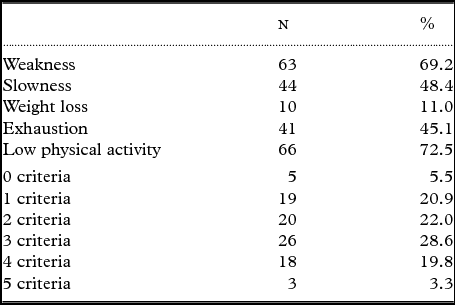
Considering the total sample (n = 91), participants comprised 78 (85.7%) females, and 13 males (14.3%), with an overall mean age of 101.0 years (SD = 1.3 years; range = 100–105). Most were widowed (83.5%; n = 76). As for the educational level, 43.0% (n = 37) never attended school. The overall prevalence of depression as measured by the GDS-14 in the whole sample was 35.2%, with a mean score of 4.5 on the scale (SD = 2.9). Regarding the frailty profile, 5.5% were classified as robust, 42.9% as pre-frail, and 51.6% as frail. Table 1 presents the description of the five criteria that composed the frailty phenotype, including information about the frequency of each criterion separately, and combined. As for those five centenarians considered to be robust, their mean age was 101.1 (SD = 1.4), three were females, four were widowed and one never married. Only one centenarian was illiterate. None had depression.
Description of criteria that composed the frailty phenotype (n = 91)

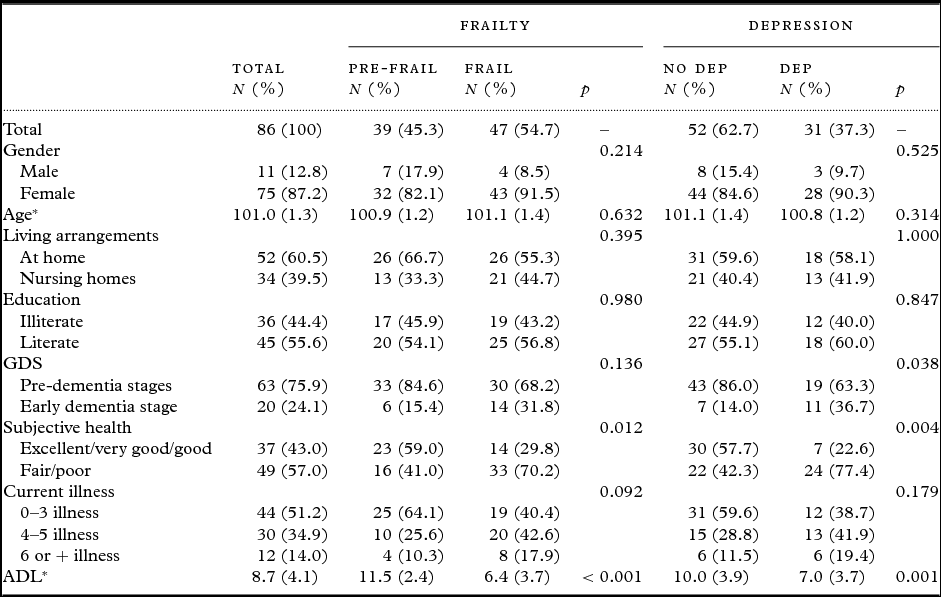
Given the small number of robust centenarians, only pre-frail and frail centenarians are considered in next analysis. A comparison between study variables and frailty profiles and depression is given in Table 2. Differences were observed between pre-frail and frail profiles in what regards subjective health and functionality; in what concerns depression (with/without), differences were observed for the GDS, subjective health, and functionality. In overall, a worse condition was associated with frailty and depression.
Sample characteristics according to frailty profiles (excluding robust cases, n = 86) and according to prevalence of depression

*Mean (SD).
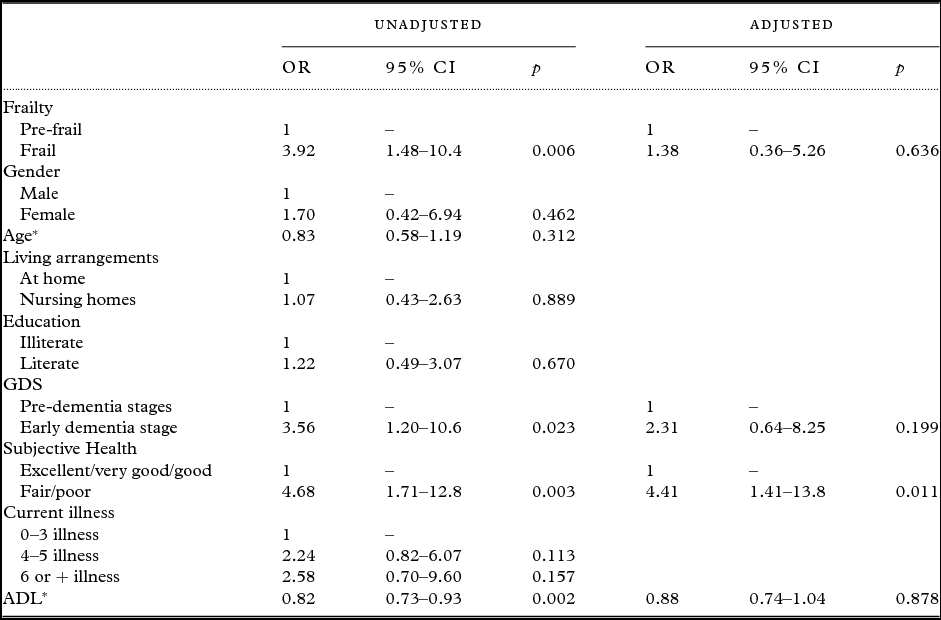
Analyzing univariable models, we verified that frailty condition, cognition, subjective health, and ADL were predictive factors of depression. Frail centenarians presented higher odds of depression comparing with pre-frail centenarians (OR = 3.92, 95% CI 1.48–10.4, p = 0.006). In the same sense, centenarians in an early dementia stage (OR = 3.56, 95% CI 1.20–10.6, p = 0.023) and those who classified their subjective health as fair or poor (OR = 4.68, 95% CI 1.71–12.8, p = 0.003) had higher odds of depression when comparing with respective reference class. Additionally, people with higher score of ADL (i.e. with better functionality) presented lower odds of depression (OR = 0.82, 95% CI 0.73–0.93, p = 0.002). When we consider these variables in a multivariable model, only subjective health remained a significant factor (Table 3).
Univariable and multivariable logistic regression models for depression status (n = 86)

*Mean (SD).
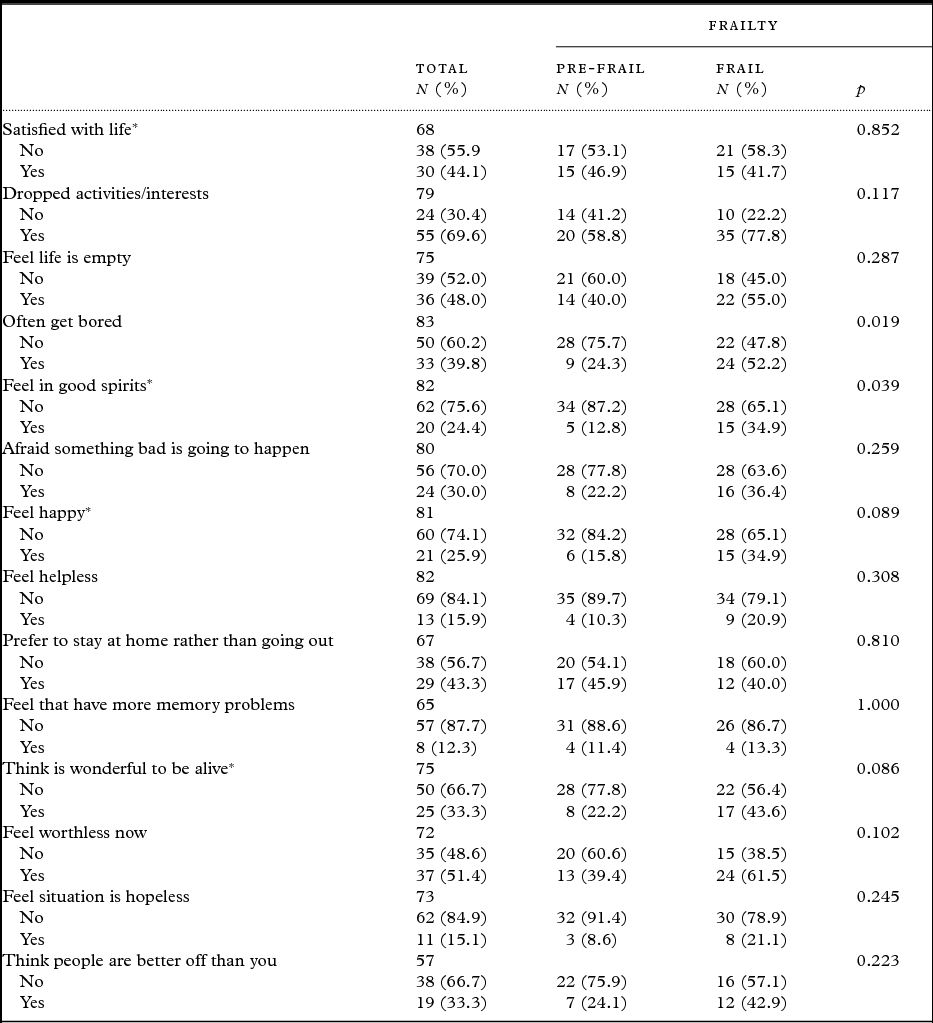
Given the interest in the evaluation of the relationship between GDS and frailty, we analyzed all items that composed the 14-GDS scale according to the frailty condition (pre-frail vs. frail) and results are presented in Table 4. Only GDS-4 (do you often get bored) and GDS-5 (are you in good spirits most of the time) (reverse-scored item) were found to be associated with the frail condition, i.e. frail centenarians presented a significantly higher percentage of positive response for these items.
Geriatric Depression Scale (GDS-14) single-item comparisons by frailty profile

*Reverse-scored item.
Discussion
This paper examined the presence of physical frailty in centenarians and its association with depression. Although the sample under analysis consisted of relatively higher functioning centenarians and rates of frailty could be higher in the group of excluded individuals, the first important finding relates to the fact that most centenarians were found to be frail (51.6%) and pre-frail (42.9%). This reinforces the importance of chronological age for the frail condition, and supports previous findings obtained in the Oporto Centenarian Study, which revealed that 60% of participants were frail and 36% were pre-frail, whereas a minority (4%) was considered robust (Duarte et al., Reference Duarte, Teixeira, Ribeiro and Paúl2014). The prevalence of frailty in older people (65+) has been reported to be high, ranging from 7% to 16.3% in most studies (Rodriguez-Mañas and Fried, Reference Rodriguez-Mañas and Fried2015), and in older samples aged 85+ and living in the community it may reach 28% (Collard et al., Reference Collard, Boter and Schoevers2012). A finding from the world's largest sample of centenarians has recently revealed that they are frailer in average than their younger elderly counterparts (Gu and Fenz, Reference Gu and Feng2015), though there is a substantial heterogeneity within this age group, at least when compared to those below age 90.
As for the prevalence of depression in this study, 35.2% of the total sample was found to be depressed. We found that both pre-frail and frail centenarians experience in a great extent the presence of depression (21.1% and 51.1%, respectively) whereas none of the robust centenarians had signs of clinical depression. Additionally, we found that frail centenarians presented higher odds of depression comparing with pre-frail centenarians. At a first level, this finding may suggest that those who are becoming increasingly frail according to the frailty phenotype may be also fulfilling more criteria for an emotional debilitating condition, echoing findings from previous studies (Mhaláin et al., Reference Mhaoláin2012), and that there's a greater presence of depression in frail individuals when compared to pre-frail individuals (Nascimento et al., Reference Nascimento, Batistoni and Neri2016); second, our findings also suggest that specific depressive symptoms may differentiate frailty profiles. Notably, we found that the frail group differed to the pre-frail group on GDS items 4 – often get bored, and GDS 5 – (not) in good spirits most of the time. Although none of these items are considered to be the cardinal features of geriatric depression, nor considered the most sensitive questions from GDS-4 abbreviated versions (e.g. GDS-4, cf. Baldwin, Reference Baldwin2010), it is well-established that anhedonia may show as boredom, and low mood reflect a feeling of unhappiness with an absence of positive looking toward the future (not in good spirits). In overall, this finding reveals the absence of specific features of the pre-frail condition in this population contrasting what has been identified by Nascimento et al. (Reference Nascimento, Batistoni and Neri2016), but that loss of the capacity to experience joy and pleasure may constitute an important feature for those who are already in an accumulated vulnerability (sustaining Nascimento et al. (Reference Nascimento, Batistoni and Neri2016) findings). Of particular interest, though, is what happens to this last criterion. In a recent study, that had the purpose of examining age differences for specific items and subscales of the GDS-30, Scheetz et al. (Reference Scheetz, Martin and Poon2012) found age-group differences in the overall depression score, in the WAV, mental impairment, and the hopelessness subscale scores, as well as on the item level with significant age group differences on 12 out of the 30 items. In their study, centenarians rated higher on all subscales, but there was no difference in dysphoria; all centenarians reported being in good spirits, (more than any other older age group) despite the fact that they reported more helpless and worthless than those in their 60’s and 80’s. According to authors, it may be that dropping activities and finding life exciting are not as important for this age group as they are for younger-old adults. Nevertheless, in our study, this item was found to be associated with the frail condition, reinforcing that this may be an important characteristic of depression in the presence of the frailty phenotype in very old age. Further attention is to be given to this potentially distinctive aspect in frail centenarians since several studies highlight the specificities of late life depression and the greater likelihood of endorsing WAV symptoms as lack of hope, not wanting to go out, and social withdrawal rather than symptoms related to depressed moods like feeling sad, blue, or helpless. Furthermore, as prominent symptoms of depressive illness, and arguably in those with comorbid frailty, anhedonia, and low mood are probably important clinical markers predicting response to treatment.
Regardless of the observed association between the frail condition and the presence of potential distinct psychological markers of frailty in very old age, of crucial importance in this study is the result obtained in the multivariable model of depression, which revealed that only subjective health remained a significant factor. Although this may have happened because all selected variables were highly correlated, it may also reinforce the importance of subjective health for depression in very advanced ages. Self-reported health refers to a subjective assessment of one's health status tacking as reference the real health problems and its functional counterparts but also the expectations of health condition at a certain age. This means that if centenarians expect to be in better heath and or functionality then they evaluate themselves as being in poor health and this may entail depressive mood. On the other hand, if there is no such mismatch between expectation and health condition, people will probably evaluate their health as good, given age, not leading to depressive mood. Poor self-rated health in community-dwelling near-centenarians and centenarians has been reported to present an important overlap with frailty, disability, and comorbidity (cf. Lau et al., Reference Lau, Kwan and Cheung2016a). This reinforces the need of using a more comprehensive approach to frailty (including psychological and social variables) rather than the phenotype criteria of frailty to fully understand the complex condition of people at this extreme age (Kwan et al., Reference Kwan, Lau and Cheung2016).
Limitations of our study include its cross-sectional design and use of a sample that was cognitively able to fulfill a self-reported structured measure of depression (GDS). This led to an exclusion of potential participants whose number could provide a distinct picture on the number of frail and pre-frail centenarians. Moreover, those centenarians who could be presenting mild to severe dementia and concurrently fulfill three or more frail criteria could possibly also present clinically significant depression, which was not conveniently measured in the present study. By these means, we may have failed to capture a higher number of cases in which the co-occurrence of depression and frailty could be present. One further limitation regards to low number of cases entitled as being non-frail/robust, which did not allow us to further provide comparisons between frail profile groups.
Despite these limitations our study provided important results that corroborate the association between frailty and mental health of the centenarian population. Presently several scholars recommend giving more attention to the psychological aspects of frailty and argue that conceptualizing this syndrome as a pure medical problem may be neglecting the capacities one may have to endure stress and related experiences. Timely identification of specific depressive symptoms in frail individuals may be important in clinical practice and influence outcomes even in such a vulnerable group of older people like centenarians. Future research should continue to examine how the signs and symptoms of depression and frailty interrelate.
Conclusions
Previous studies have shown that late life depression often coexists with frailty and this study makes an effort to unravel the potential specificities of the frailty profile in terms of depressive symptoms in a centenarian population. Along with concluding that frail centenarians present higher odds of depression comparing with pre-frail centenarians, the paper highlights the importance of subjective health for a depressive condition in this population. When examining all individual items of the GDS for possible specificities in the frailty profiles (pre-frail vs. frail), we found that anhedonia (boredom) and low mood (not in good spirits) are distinctive features of those centenarians in a more severe physical condition. These results add to the existing knowledge regarding the potential specificities of depression in very old age in the presence of physical frailty.
Conflict of interests
None.
Description of authors’ roles
O. Ribeiro was responsible for the study conception and design, supervised data collection, and wrote the manuscript; N. Duarte performed the data collection and helped writing the manuscript; L. Teixeira performed the data analysis; C. Paúl critically revised the manuscript for important intellectual content.
Acknowledgments
This work was supported by the Portuguese Foundation for Science and Technology (FCT) [Grant PEst – C/SAU/UI0688/2011]. Authors would like to thank Dr. Rosa Marina Afonso and the PT100 Beira Interior team from University of Beira Interior (Covilhã, Portugal) for their contribution with data from the Beira Interior Centenarian Study.