Introduction
Parkinson's disease (PD) is a debilitating movement disorder affecting more than 60,000 Australians, and is defined by its motor features, including bradykinesia, tremor, rigidity, and postural instability (Hughes, Reference Hughes1992). A great majority of patients with PD are affected by non-motor symptoms that have a great impact on quality of life and psychosocial functioning. Non-motor symptoms relating to degeneration beyond brain dopamine systems may predate the motor features, but often become a problem in the latter stages of disease (Samii, Reference Samii2004). Conversely, a number of motor and non-motor symptoms may directly arise from the long-term dopamine replacement used to alleviate symptoms of the disease. These include motor fluctuations, dyskinesia (Olanow et al., Reference Olanow, Stern and Sethi2009) as well as a range of impulsive and compulsive behaviors (ICBs; Evans, Reference Evans2009).
Dementia complicating PD is well recognized and predicts requirement of residential care. Cognitive decline can deteriorate in a similar fashion to Alzheimer's disease, on average two years prior to clinical diagnosis (Johnson and Galvin, Reference Johnson and Galvin2011), and at least 75% of PD patients fulfill the criteria for dementia ten years after initial diagnosis (Aarsland and Kurz, Reference Aarsland and Kurz2010). Recent evidence has also shown that dementia in PD is predicted by olfactory dysfunction as well as atrophy and cortical hypometabolism of associated brain regions (Baba et al., Reference Baba2012). Early and pronounced deficits in visuospatial ability are found (Muslimovic et al., Reference Muslimovic, Schmand, Speelman and de Haan2007), including patients without a formal dementia diagnosis (Johnson and Galvin, Reference Johnson and Galvin2011). Greater impairments in spatial and visual memory are linked with hallucinations (Ramirez-Ruiz et al., Reference Ramirez-Ruiz, Junque, Marti, Valldeoriola and Tolosa2007).
“Caregiver burden” (CB) refers to the perceived physical, mental, social, and financial impact on the caregivers of chronic patients due to their caregiving experience (Zarit et al., Reference Zarit, Todd and Zarit1986). The effects of CB on the quality of life for both caregiver and care receiver have been documented in studies dealing mostly with dementia, and this may not be generalizable to PD due to its unique spectrum of behavioral disturbances. Moreover, while much of the existing PD literature highlights the relationship between PD motor symptoms and CB (Carter, Reference Carter1997; Aarsland, Reference Aarsland1999), the relationship between CB and non-motor symptoms is not well recognized.
In contrast to the amnestic-predominant phenotype seen in Alzheimer's disease, dementia in PD is the result of multifocal lesions affecting various neurobiological substrates, which result in heterogeneous profiles of cognition with impairments in various subscales (Kim et al., Reference Kim, Cheon, Park, Kim and Jo2009; Liepelt-Scarfone et al., Reference Liepelt-Scarfone2012). This study investigated the impact of cognitive and mental dysfunction on the caregiver–patient relationship. Using a multidimensional cognitive assessment tool, i.e. the Neuropsychiatry Unit Cognitive Assessment Tool (NUCOG; Walterfang, Reference Walterfang2006), we hypothesized that CB would be predicted by specific cognitive deficits that have been previously found to characterize PD, and associated with greater severity of non-motor symptoms such as visual hallucinations. For this study, we developed and used the Parkinson's Disease Caregiver Burden (PDCB) questionnaire (Zhong, Reference Zhong2013), a novel PD-specific instrument that was designed to address the shortcomings of more generic CB tools.
Methods
Patients
Fifty unselected patients with PD (70.2 years ± 8.9, disease duration 7.6 years ± 5.9) with 50 caregivers (64.7 years ±10.8, caregiving duration 5.8 years ± 5.1), who attended three public and private movement disorders clinics between January 2010 and December 2012, gave consent to protocols approved by the Melbourne Health Research Ethics Committee. A caregiver was defined as a spouse, relative, or friend who, through unpaid assistance with at least one activity of daily living, identified as being primarily responsible for the care of the person with PD.
Methods
Demographics were collected. PD severity ratings included Unified Parkinson's Disease Ratings Scale (UPDRS) part III (Goetz et al., Reference Goetz2007) and the Hoehn & Yahr (H&Y) stage scale (Hoehn, Reference Hoehn2001). Cognition was evaluated with the NUCOG, a multidimensional tool scored out of 100 with a cut-off score of 80 to suggest cognitive impairment. It contains five subscales (attention, memory, executive, visuospatial, and language). The NUCOG has been shown to have high face validity to demonstrate significant scoring differences between participants with and without dementia, and to correlate well with the Mini-Mental State Examination (MMSE; Walterfang, Reference Walterfang2006).
The Hospital Anxiety and Depression Scale (HADS) is a self-completed 14-item screening questionnaire on a 4-point scale (Snaith and Zigmond, Reference Snaith and Zigmond1986), and was used to grade the severity of neuropsychiatric symptoms. ICBs were screened with the Questionnaire for Impulsive–Compulsive Disorders in Parkinson's Disease (QUIP; Weintraub, Reference Weintraub2009), and olfaction was assessed with Sniffin’ Sticks (Kobal, Reference Kobal1996), a tool requiring respondents to identify common smells. A score of less than 6 out of 12 demonstrates functional anosmia.
Caregiver demographics were collected, including relationship to the person with PD, how long they had been caring for the patient, and how many hours per day they perceived themselves to be actively giving care. Caregivers were also required to complete the HADS, and the PDCB (Supplement 1; available as supplementary material attached to the electronic version of this paper at www.journals.cambridge.org/jid_IPG), a scale that comprises 20 questions in seven domains with demonstrated reliability and validity (Zhong, Reference Zhong2013).
Data analysis
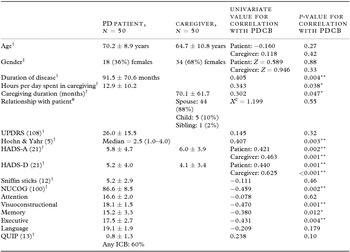
Statistical analysis was performed using SPSS v17 (International Business Machines; Armonk, NY). For all comparisons, variance homogeneity and Gaussianity were tested with the Kolmogorov–Smirnov test. Continuous variables are given in Table 1 as mean values ± SD. The primary statistical tests were two-tailed, and an α level of 0.05 was used. Total scores of PDCB were correlated with patient and caregiver variables using Spearman's correlation. To determine whether the above relationships remained significant after considering potential confounders, analyses were repeated after controlling for the variables that were significantly associated with PDCD scores on univariate analyses. Variables found to be predictive of higher burden were entered into a forward stepwise multiple linear regression model. Variables controlled in the multivariable model were selected by considering their univariate associations with the PDCB score (p < 0.20). The possible explanatory variables used included (1) duration of disease, (2) hours per day spent in giving care, (3) duration of caregiving, (4) H&Y score, (5) caregiver depression and (6) anxiety, (7) patient depression and (8) anxiety, (9) QUIP score, and NUCOG subscale scores for (10) attention, (11) visuoconstructional, and (12) memory.
Summary of patient and caregiver demographic and clinical variables, and their correlation with PDCB scores

Notes: †Spearman's rank correlation coefficient.
‡Two-sample Kolmogorov–Smirnov test.
#Kruskall–Wallis test.
*p < 0.05; **p < 0.01.
Results
Demographics and results for clinical assessments are outlined in Table 1; 64% of the patients and 32% of the caregivers were males. There were significant differences between caregivers and patients with respect to their age (t = 3.715, p = 0.001) and gender (p = 0.014). The caregiver relationship in majority (88%) was spouse, with child: five patients (10%), and sibling: one patient (2%). A high proportion of this sample screened positive for any item on the QUIP score (60%). In all, 36% of the patients and 18% of the caregivers were depressed, and 38% of the patients and 40% of the caregivers were anxious. However, HADS-anxiety (HADS-A) and HADS-depression (HADS-D) scores did not vary significantly between the two populations (t = −0.268, p = 0.79; and t = 1.704, p = 0.095 respectively).
Results of caregiver responses to the PDCB questionnaire are summarized in Supplement 2 (available as supplementary material attached to the electronic version of this paper at www.journals.cambridge.org/jid_IPG). In this questionnaire where higher values indicate greater burden, caregivers scored an average of 33 out of 100 for the PDCB (SD = 28.0, min 0, max 71), which included an average global burden score of 37.4 out of 100 (SD = 27.0, min 0, max 100).
The patient HADS-A score correlated significantly with the caregiver HADS-A score (0.283, p = 0.046), but this was not true for HADS-D scores between the two groups (0.234, p = 0.103). Depression scores in patients did not correlate with anxiety scores in caregivers (0.158, p = 0.273), and vice versa (0.256, p = 0.073).
This study found the PDCB score to correlate significantly with the duration of disease and caregiving, hours per day spent in giving care, H&Y stage score, the visuoconstructional, memory, and executive subscales of NUCOG, and caregiver and patient depression and anxiety scores.
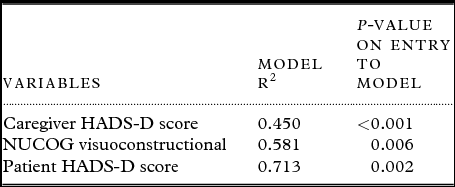
The factors found to be independently associated with PDCB after entering these variables into multiple linear regression analysis included caregiver HADS-D score, NUCOG visuoconstructional score, and patient HADS-D score (Table 2).
Multiple linear regression analysis examining the influence of selected variables on PDCB scores

Discussion
We aimed to examine variables that specifically predict the burden of caring for patients with PD, a highly heterogeneic disorder with a range of motor and non-motor symptoms. Much attention in the past has been focused on the management of motor symptomatology, but there is increasing awareness of the role of non-motor symptoms in the disease burden. The results of this study emphasize the impact of mental health problems in both patients with PD and their caregivers, which is in agreement with other reports (Oh et al., Reference Oh, Lee, Lee and Kim2015) as well as other neurological disease (Denno et al., Reference Denno2013; Qutub et al., Reference Qutub, Lacomis, Albert and Feingold2014; Rosas-Carrasco et al., Reference Rosas-Carrasco, Guerra-Silla Mde, Torres-Arreola Ldel, Garcia-Pena, Escamilla-Jimenez and Gonzalez-Gonzalez2014).
Previous studies have highlighted the importance of mental symptoms experienced by patients with PD, including depression, as having perhaps the greatest impact on burden of care (Thommessen, Reference Thommessen2002). Moreover, the presence of caregivers’ depression has a significant negative effect on CB (Martinez-Martin, Reference Martinez-Martin2007). Our findings also established that patient depression (HADS-D) and patient anxiety (HADS-A) scores correlated with CB; however, the most influential variable in regressional analysis was caregiver depression and not caregiver anxiety. Depression in patients with PD was also independently associated with CB, and has previously been strongly linked with caregiver depression, anxiety, emotional distress, and various measures of CB (Aarsland, Reference Aarsland1999; Schrag, Reference Schrag2006). In this sample, caregiver anxiety (HADS-A) scores were also associated with higher PDCB scores. However, similar to patient anxiety, the relationship has been insufficiently investigated in studies of burden and PD. This link is potentially rectifiable, and cognitive behavioral therapy has shown to decrease anxiety levels in PD caregivers (Secker, Reference Secker2005).
We examined whether significant correlations existed between anxiety and depression scores in patients with PD and their caregivers. Anxiety scores of patients were significantly correlated with anxiety scores of caregivers. However, we found no relationship between depression scores of caregivers and those of patients with PD – this relationship has been found to reach significance in previous studies using different instruments (Aarsland, Reference Aarsland1999; Schrag, Reference Schrag2006). The direction of causality between patient and caregiver depression and anxiety is unclear. It may be that feeling of being unable to manage their role of caregiver leads to a higher incidence of social isolation, anhedonia, and depression in severely burdened caregivers. Alternatively, a depressed caregiver may cope negatively with daily caregiving tasks. Identifying with feelings of “missing out on life” and “being emotionally drained” has previously predicted caregiver depression (Caserta, Reference Caserta1996). Depression experienced by patients with PD could result from CB through the effect of reduced quality of care directed toward the patient (Chou et al., Reference Chou, Jiann-Chyun and Chu2002). Conversely, depressive symptoms in patients with PD may influence caregiver's depression more directly, and increase ratings of burden secondarily. Previous investigations have studied the effects of caregiver anxiety, but not the role of anxiety experienced by the patient. Findings from this sample suggest the importance of assessing CB in caregivers of patients who tend to panic, worry, or feel tense.
With increasing duration of disease, patients with PD not only experience increasing motor disability and place greater physical demands on the caregiver but are also more likely to experience adverse effects on cognitive functions. We found the most important patient variable predicting CB was cognitive impairment in patients with PD. The NUCOG has not been used in prior CB research, although studies using more generic instruments, such as the MMSE, have determined relationships between cognition and burden in the setting of stroke and PD (Thommessen, Reference Thommessen2002). Time demands placed on caregivers, as well as feelings of slowly losing the character or personality of a loved one, may cause the caregiver to experience high emotional and social strain. Cognitive impairment (Thommessen, Reference Thommessen2002), apathy (Leroi, Reference Leroi2012), and psychosis (Williamson et al., Reference Williamson, Simpson and Murray2008) have been found to predict CB.
Visuoconstructional impairment in patients with PD has been previously found to be strongly predictive of future development of dementia (Johnson and Galvin, Reference Johnson and Galvin2011) as well as visual hallucinations (Ramirez-Ruiz et al., Reference Ramirez-Ruiz, Junque, Marti, Valldeoriola and Tolosa2007). In this study, deficits in visuoconstruction as measured by the NUCOG has been found to be specifically relevant in predicting CB rather than other cognitive domains, and this has not been described previously. The role of visuoconstructional impairment in PD relates with studies describing higher burden when caring for patients with hallucinations (Schrag, Reference Schrag2006). Attention should be paid to the caregivers of the patients with advancing severity of hallucinations and psychiatric symptoms.
A higher perceived burden may result from escalating time demands placed on the caregiver as well as the potential accumulation of negative emotions and memories in the caregiver over the course of a chronic disease such as PD. Consistent with this, we and others have found that disease duration, duration of caregiving, hours per day spent in giving care, and H&Y score were significantly associated with higher burden scores (Carter, Reference Carter1997; Aarsland, Reference Aarsland1999). The finding that burden scores correlate significantly with the H&Y score but not with the UPDRS score has been described previously (D’Amelio, Reference D’Amelio2009). The UPDRS score has been previously found to correlate with, but not predict, depressive symptoms (Fernandez, Reference Fernandez2001). This reinforces the notion that in terms of predicting burden, cognitive and psychiatric symptoms are considerations that are likely to outweigh the contribution of motor disability of PD.
Disease duration has been previously identified to be the strongest predictor of depressive symptoms in the caregiver (Fernandez, Reference Fernandez2001). The number of hours per day spent giving care has been associated with reduced perception of caregiver physical and mental health (Chang, Reference Chang2010). Therefore, asking the caregiver for these figures may also be useful in determining the magnitude of perceived burden. In spite of having the time to accept the caregiving role, some caregivers are probably unable to adequately adjust to the progression of patient's disease.
In contrast to previous reports, a number of variables were not found to correlate with the PDCB. These variables included gender, age, nature of the caregiver relationship, and whether the caregiver resided with the patient. Male patient has been associated with increased CB in PD in some studies (Fernandez, Reference Fernandez2001; Happe, Reference Happe2002), but this was not supported by the present sample and other studies (Aarsland, Reference Aarsland1999). Previous studies have also failed to find an association between age and CB (Carter, Reference Carter1997; Schrag, Reference Schrag2006).
Although a recent study has observed a greater burden on the caregivers of patients with PD experiencing ICBs (Leroi, Reference Leroi2012), the QUIP score (or the presence of any ICB) was not correlated with the PDCB scores in the present sample. The QUIP identifies patients with sub-syndromal and syndromal ICBs. This is potentially explained by the smaller sample size (compared with that of Leroi’s, Reference Leroi2012), or perhaps that the ICBs present in this study were milder – and milder forms of compulsive behaviors are not much taxing for caregivers. Anecdotally, some caregivers support mild compulsive behaviors in preference to patient apathy.
Patient's smell has not been studied previously for a relationship with CB. Although olfaction in PD patients predicts brain atrophy and disease progression (Bohnen, Reference Bohnen2010), the power of this relationship did not reflect burden scores in the present study.
The design of the present study may have created certain restrictions. The study required patients with PD and their caregivers to be fluent in spoken and written English, and a number of people from non-English speaking backgrounds were excluded. This research was also cross-sectional in nature, and therefore unable to establish any temporal relationships. The sample size was small and may have prevented detecting small correlations with variables such as impulsive and compulsive behaviors. Finally, since caregivers participated voluntarily, selection bias must be considered.
Conclusions
By improving the evaluation of CB in the settings of PD, clinicians are given the chance to optimize care of the patient as well as the effectiveness of any interventions directed at the caregiver. This study on CB demonstrates the significance of cognitive decline in patients with PD, especially the domain of visuoconstruction. Caregivers of patients experiencing hallucinations or demonstrating evidence of visuospatial impairment should be considered at risk of higher burden. Our findings also suggest that if a clinician's objective is to relieve CB, the mental health of both caregiver and patient is a major, and potentially rectifiable, factor. Caregivers of patients with PD demonstrating more severe functional incapacitation may be at risk of increased burden. In terms of correlating with burden, the H&Y score was a more relevant marker of motor dysfunction compared with the UPDRS.
Conflict of interest declaration
None.
Description of authors’ roles
M. Zhong was involved in the conception and design of the study, participants’ recruitment, data collection, statistical analysis, and the drafting and revision of the manuscript. A. Evans and D. Velakoulis contributed equally to the study and the manuscript. A. Evans was involved in the conception and design of the study, supervision of participants’ recruitment, statistical analysis, and revision of the manuscript. D. Velakoulis was involved in the conception and design of the study, statistical analysis, and assisted with the drafting and revision of the manuscript. R. Peppard was involved in participants’ recruitment and data collection.
Supplementary Material
To view supplementary material for this paper, please visit http://dx.doi.org/10.1017/S1041610215001593.