China's current economic slowdown has led many observers to wonder whether long-standing regional and income inequalities will evolve into more widespread dissatisfaction with governance. Although scholars increasingly recognize that the legitimacy of the Chinese Communist Party (CCP) does not rest solely on delivering material gains, some researchers have questioned the long-term resilience of government support in the face of declining growth rates and pervasive socio-economic disparities.Footnote 1 Our research provides a much needed quantitative analysis of this issue by examining a unique, multi-annual survey dataset of more than 31,000 Chinese respondents, covering both urban and rural areas and implemented in eight waves between 2003 and 2016. Launched at the beginning of the Hu Jintao 胡锦涛–Wen Jiabao 温家宝 administration, our survey is the longest-running independent effort to track citizen approval with all four levels of the Chinese government across time. With data stretching back more than a decade, we are able to monitor and assess changes in public opinion corresponding to major shifts in governmental policies and economic conditions.
Our regression analyses yield two main results, illustrating what we have termed an “income effect” and a “region effect” in satisfaction with governmental performance. First, between 2003 and 2016, we observe that low-income Chinese citizens experienced significantly higher rates of growth in governmental satisfaction than high-income residents. This effect was especially pronounced at the county and township levels. Second, residents living in China's less developed, inland “periphery” regions experienced significantly higher rates of satisfaction increase than residents living in more wealthy coastal regions. This effect was significant for all four levels of government and was especially strong in rural areas. Together, these two findings provide powerful evidence that key populations often considered the most susceptible to instability and dissatisfaction with government – low-income citizens and those living in more remote inland areas – have actually strengthened their relative satisfaction with government vis-à-vis their high income and coastal counterparts. Moreover, these relative satisfaction increases grow successively larger as one moves downwards from the central government towards the local township government, indicating that the long-observed “satisfaction gap” between upper and lower levels of government may finally be starting to close.
Our findings also suggest that Chinese citizens are beginning to respond to the government's recent attempts to rebalance economic growth along regional lines and to establish a basic social safety net for the country's most vulnerable residents. These efforts, which began in earnest under the Hu–Wen administration and will be discussed in further detail below, have had a mixed record of success, and some scholars have justifiably questioned their efficacy in reducing China's level of inequality.Footnote 2 However, our survey results provide evidence that citizen satisfaction does in fact respond to tangible changes in living conditions at the local level. In a second set of regressions, we show that local infrastructure provision and government spending on social assistance programmes are significantly associated with increased satisfaction, while urban–rural income inequality is significantly associated with decreased satisfaction. More importantly, after controlling for these new macro-scale economic variables, the magnitude of the aforementioned “income” and “region” effects declines considerably, suggesting that a large proportion of the observed increases in relative satisfaction among China's poor and inland populations can be explained by real changes in government policy.
Assessing the Sources of CCP Legitimacy
Several studies have used satisfaction and trust in government as proxies for regime legitimacy in China.Footnote 3 However, simply aggregating citizen responses into a single satisfaction variable runs the risk of obscuring the wide variation in regime support across different levels of government. Existing research shows that Chinese citizens tend to “disaggregate” the state, and that although they express high levels of satisfaction with the central government, satisfaction declines at each lower level of government.Footnote 4 The fact that satisfaction declines as the state gets closer to the people is understandable, as it is the local government, especially at the county and township levels, that is responsible for providing most public services yet carries the heaviest financial burden. Although these findings may raise concerns about the quality of local governance, they do not necessarily undermine the ways in which citizens judge the central government or the system as a whole. Many citizens appear to blame problems on poor local policy implementation, rather than either a systemic bias or a lack of will at the centre.Footnote 5 Thus, whereas the central government retains a strong source of legitimacy among virtually all subsets of the population, at the local level the relationship between state and society is more tenuous and subject to variability.
While many factors have the ability to affect individual perceptions of governmental performance, a few recent analyses have pointed to the importance of improved living standards (either real or perceived) in driving regime support. For example, John Knight and Ramani Gunatilaka report that perceived income change over the past five years is positively correlated with political trust.Footnote 6 Bruce Dickson and colleagues also find that county-level spending on healthcare, education and social welfare are all significantly and positively associated with government trust and satisfaction in urban areas.Footnote 7 Moreover, this effect of public goods provision on satisfaction is greater at the local level than at the central level. In a similar study measuring perceived rather than actual flows of public goods, Ethan Michelson finds an association between self-reported improvements in local service provision after China's 2008 stimulus programme and an enhanced opinion of government officials.Footnote 8 Once again, these effects are strongest at the local level.
Other studies have attempted to measure the effects of intra- and inter-regional inequality on generalized government support. Martin Whyte writes that although a majority of Chinese citizens express concern about national income disparities, most feel that these disparities can be attributed to variation in the ability, hard work and education of individuals rather than any kind of broader societal unfairness.Footnote 9 Furthermore, while 72 per cent thought inequality was excessive in China as a whole, fewer than 40 per cent thought it was excessive in their own neighbourhood or workplace. Somewhat surprisingly, poorer rural residents had significantly more optimistic attitudes about inequality than wealthier urbanites; a gap which widened even further in Whyte's follow-up survey five years later.Footnote 10 In short, because rural areas have suffered for so long under government policy, any positive changes in rural incomes tend to be compared favourably against the recent past when nearly all villagers were poor.Footnote 11
The Challenge – Reform Era Inequality
Although China's reform and opening-up policies brought massive increases in economic growth and lifted millions out of poverty, they nevertheless served to exacerbate the problem of income inequality, especially at the regional level. Since the early 1980s, coastal areas have been able to develop their economies very rapidly, while western, north-eastern, and central provinces have not fared so well by comparison. In recent years, these provinces have struggled with very high levels of unemployment, ageing industry and infrastructure, and social welfare bills that are increasingly difficult to meet.Footnote 12
The uneven distribution of foreign trade and FDI has also exacerbated regional inequalities, contributing further to greater wealth concentration in coastal areas. In 2015, Guangdong alone received over 21 per cent of China's FDI, whereas Inner Mongolia received less than 3 per cent.Footnote 13 That same year, the three south-eastern coastal provinces of Guangdong, Fujian and Zhejiang accounted for 60 per cent of total national export value, despite accommodating only 14 per cent of China's population. Guangdong is also home to nearly one-quarter of the foreign-funded enterprises in China, with the three eastern municipalities (Beijing, Shanghai and Tianjin) accounting for a further 20 per cent. By contrast, the western and north-eastern regions together comprise well under 15 per cent of the total.Footnote 14
The Consequences for Local Governance
Regional inequality raises a number of consequences for Chinese governance. By the mid-1990s, continued variation in local development rates stemming from large disparities in revenue generation ability, combined with a decline in the Party's moral authority, led some researchers to argue that there had been a potentially unhealthy rise in the power of the regions.Footnote 15 In 1994, central leaders attempted to reverse this trend by re-centralizing the country's tax system. However, while the central government soon began to claim a larger share of total national revenue, it still required the bulk of public goods and services to be provided at the local level, thus placing local governments in a difficult fiscal position.Footnote 16
These mounting financial pressures forced resource-constrained localities to derive their own sources of funding in order to meet centrally mandated obligations. During the late 1990s, an increasingly large percentage of localities turned to extra-budgetary fees (EBFs) and levies to raise local revenues, a practice which was technically illegal but nonetheless tacitly supported by central authorities.Footnote 17 These fees were especially pervasive in poor, rural areas and contributed greatly to rising discontent in the Chinese countryside. Local financial pressures also led to a general preference for development plans that maximized short-term revenue extraction over longer-term needs, as well as policies that were disinclined to favour distributional and welfare priorities. In effect, the main concern of officials at all levels was to increase revenues rather than to think about the correct role of government.
By the early 2000s, the central government began to realize the untenable nature of this fiscal situation, and in 2002 it consolidated all extra-budgetary fees into a single agriculture tax.Footnote 18 After a few years of local experimentation and pilot projects, the agricultural tax was eliminated completely in January 2006, leaving local governments in rural areas with few direct means of revenue generation.Footnote 19 By the time the agricultural tax was abolished, China's provinces and municipalities accounted for roughly 70 per cent of all subnational-level fiscal revenue, whereas counties and townships (where needs are greatest), accounted for only 30 per cent.Footnote 20 Thus, local governments were forced to rely primarily on financial transfers from above in order to meet their budget obligations, a trend which continues to the present day.
Despite this reliance on fiscal transfers, localities are still required to provide the vast majority of China's public goods and services. While, in theory, the central government should be able to direct the bulk of financial transfers towards poorer and more resource-constrained localities, in reality local service provision continues to vary widely across regions.Footnote 21 As a result, China's fiscal system remains highly regressive, with local governments in poorer areas often having no choice but to eliminate certain public goods and services from their budget.
Thus, despite massive improvements in living standards and household incomes, China's reform era has unleashed a fiscal crisis at the local level, a crisis which disproportionally affects poorer and more remote inland communities. These problems were largely ignored during the Jiang Zemin 江泽民 administration, and it was not until the ascendance of Hu Jintao, and later of Xi Jinping 习近平, that they were first addressed systematically at a national level.
Elite Politics – A Turn towards Egalitarianism?
Our first survey was completed during the spring and summer of 2003. In March of that year, China's leadership transition was officially completed when Hu Jintao was appointed as China's new president, having previously been appointed general secretary. At the same time, Wen Jiabao took office as the country's new premier, accompanied by a largely technocratic cabinet.Footnote 22
From the start of their administration, Hu and Wen portrayed themselves as open, practical and concerned leaders focused on the plight of the poor. To many observers, Jiang Zemin represented the interests of China's economic and coastal elites, a characterization which, during the later years of Jiang's rule, led to increasing concern about inequality and the potential threat this might pose to stability. By contrast, economic policies under Hu and Wen reflected a more populist approach. Before assuming office, both Hu and Wen had spent significant phases of their careers in poorer western provinces, unlike Jiang Zemin, Zhu Rongji 朱镕基 and Li Peng 李鹏, who had worked primarily in the developed metropolis of Shanghai and in the central ministries of Beijing. In completing the transition of power from Jiang to Hu, the implicit message was that the new leadership would show greater concern for those who had been left behind by China's reform programme.Footnote 23
Thus, compared to the Jiang era, both political rhetoric and policy practice became more people-centred. Hu combined populist gestures with attempts to tighten control over state and society in the name of preserving social stability and ensuring continued economic growth. At a speech to the Central Party School in February 2003, Hu proposed a new concept referred to as the “three people's principles” (san min zhuyi 三民主义). This new platform was promulgated more coherently at the sixth plenum of the 16th Party Congress in October 2006, which was remarkable for both its focus on social development and also for putting forward the slogan of building a “harmonious society” (hexie shehui 和谐社会). In introducing his new slogan, Hu did not entirely reject Jiang's previous growth-oriented policies, but rather suggested that they be moderated. By more clearly outlining his goal of “putting people first” (yiren weiben 以人为本), Hu confirmed the need to pay more attention to the negative effects of development and to provide assistance to the groups who had not benefited as much from China's economic reforms, including migrants, the rural poor and laid-off urban workers.
Some of the specific policy measures pursued during the Hu–Wen administration included the improvement of access to healthcare and education for migrants and residents in rural areas, the improvement and extension of the social security system, the moderation of environmental impacts from economic development, and the creation of greater feedback opportunities for disgruntled citizens. In just five years, the percentage of China's population covered by health insurance more than doubled, from 43 per cent in 2006 to 95 per cent in 2011.Footnote 24 Tuition fees for compulsory education were abolished, and by the mid-2000s, 70 per cent of China's villages had explicit rules about the maximum number of corvée (forced) labour days per year.Footnote 25
In a symbolic move, beginning in 2004, the State Council's Document No. 1 was once more dedicated to rural affairs, marking a return to the early years of reform. This move coincided with comments by Hu and other leading rural policymakers that it was time for the cities to support the development of the countryside. In 2003, the government launched the New Rural Cooperative Medical System, followed by the New Rural Social Pension System in 2012. By 2011, the central government's expenditure on rural and agricultural issues had reached nearly three trillion yuan, ten times the expenditure in this area in 2004.Footnote 26 This increased flow of investment was also visible at the local level, with average per capita investments into villages rising from just 350 yuan in 1997 to more than 1,000 yuan in 2008.Footnote 27
During this time, the central government also began to focus on addressing larger, regional-level imbalances in economic development The biggest and most important of these efforts was the “open up the west” (xibu da kaifa 西部大开发) policy, which was launched in late 1999 under Jiang Zemin but not officially confirmed until the tenth National People's Congress in March 2003. The policy covered 12, mostly poor, inland provinces and was designed to stimulate state-led funding for infrastructure projects and also to put political pressure on more developed provinces to shift investment towards China's interior region. Investment in rural infrastructure was especially pronounced, with annual outlays for rural road construction increasing from 36 billion yuan in 2001 to 124 billion yuan in 2004.Footnote 28 Nevertheless, many observers criticized the programme as being insufficient or improperly managed. Most of the projects announced were already scheduled and provinces often sought to simply shift the costs of current projects to the central exchequer. At the time, many analysts also felt that the “open up the west” initiative served purposes that were more political than developmental in nature.Footnote 29
Even so, the “open up the west” campaign sent a powerful message to western provinces, which had been largely neglected during the previous decades of reform, and in 2004, Hu and Wen supplemented this programme with one of their own which was branded “revive the north-east industrial base” (zhenxing dongbei lao gongye jidi 振兴东北老工业基地).Footnote 30 This programme was designed to deal with what had become a major problem area during China's economic reforms, namely the decline in the capacity of many SOEs in the country's former industrial heartland. Then, five years later, the excluded central provinces were finally brought into the fold with the “plan to promote the rise of central China” (cuijin zhongbu diqu jueqi guihua 促进中部地区崛起规划), which was launched in September 2009.Footnote 31 The focus of this most recent programme was to develop clusters around new growth poles and to attract investment both domestically and from abroad.
A small handful of recent studies have attempted to measure the effects of these three large-scale regional development projects. For example, Shenggen Fan, Ravi Kanbur and Xiaobo Zhang together write that overall regional income inequality in China appears to have levelled off and even slightly declined after 2005.Footnote 32 Moreover, since 2009, rural household income per capita has grown faster than urban household income per capita, while real wages in Guizhou and Gansu (two of China's poorest provinces) have increased rapidly since 2003.Footnote 33 However, other studies are careful to note that regional income data in China are often unreliable, and that apparent declines in regional inequality may simply be an artefact of inconsistent accounting measures.Footnote 34 Fan, Kanbur and Zhang also attribute some of the observed drop in regional inequality after 2005 to the 2008 economic slowdown, which disproportionally affected coastal export hubs, and the resultant stimulus package, which emphasized infrastructure development in inland regions.Footnote 35 Thus, while initial assessments of China's regional development projects offer some early signs of encouragement, the longer-term efficacy of these programmes is still largely uncertain.
Data and Methodology
Key advantages of authors’ survey
Although, as outlined above, the ascension of the Hu–Wen administration (and later the Xi–Li administration) unleashed a wide array of profound changes in the Chinese political landscape, both in terms of official Party rhetoric and the direction of tangible capital flows, the reaction of the Chinese public has gone largely unreported.Footnote 36 Part of the reason for this lack of information is the relative scarcity of reliable data. In contrast with the United States and other Western democracies, where multi-year opinion surveys are a tried and trusted tool of political scientists, similar surveys in China tend to be costly, limited and rare. The first nationwide probability sample of Chinese citizens was not published until 1993, and even today the vast majority of surveys are limited to individual cities, townships or villages. Of the national-scale samples that do exist, very few are concerned with directly measuring government satisfaction among the general populace, and as of yet, no studies have attempted to track satisfaction changes in the same locations across multiple years. Thus, in designing our study, we sought to add value to the existing literature on Chinese public opinion by developing strengths in three key methodological areas.
First, our survey maintains a robust sample size comparable to large-scale social surveys in the United States and Europe. The survey also includes separate satisfaction indices for central, provincial, county and township governments, which represents an important distinction since, as mentioned above, prior research shows that Chinese citizens tend to “disaggregate” the state when assessing performance.Footnote 37 Second, the first round of surveys was administered in the spring and summer of 2003, less than a year after Hu and Wen effectively assumed leadership of the Chinese political system. The survey was repeated in 2004, and administered biannually between 2005 and 2011, thus serving as approximate bookends for the Hu and Wen regime. The two most recent surveys were conducted in January 2015 and February 2016 respectively, just a few years after the Xi administration came to power. Finally, while each round of surveys contains several topic-related questions unique to that particular year, the core of the survey has remained unchanged since 2003, allowing the possibility of inter-temporal comparisons.
Together, these three strengths make it possible to measure broad changes in government satisfaction dating from the beginning of the Hu–Wen era through to the current Xi regime, while also offering the potential to examine finer-scale differences in satisfaction changes across a wide range of demographic, socio-economic and geographic groups.
Survey methodology
The main findings and analysis of this study are based on the results of a purposive stratified survey conducted in eight waves between 2003 and 2016. Each wave contains approximately 4,000 respondents, producing a total sample size of N = 31,299. Respondents, aged 16 to 60, were selected from 15 locations across China, with each location chosen to create a reasonably representative national sample in terms of geographical location, average per capita income and population. Seven of the survey locations contained urban-only (city) samples, while the other eight locations contained both urban (cities and towns) and rural (village) samples. Within each of these survey locations, individual respondents were randomly selected through neighbourhood committee lists using the KISH method.Footnote 38 No fewer than 250, 150 and 100 respondents were identified for each city, town, and village sample, respectively.
In terms of socio-economic and demographic variables, our sample was relatively representative of the country as a whole. It was 48 per cent male (compared to the national rate of 51 per cent),Footnote 39 with a median age of 39 years (compared to the national median of 37 years).Footnote 40 Also, 7.7 per cent of our respondents had a college degree (similar to the 7.4 per cent rate among all Chinese adults).Footnote 41 However, our survey had a strong urban bias, with 78 per cent of our responses coming from urban areas (compared to a national urbanization rate of 56 per cent).Footnote 42 This urban bias also resulted in measured household incomes that were significantly higher than corresponding national averages. Therefore, our survey was weighted to correct for imbalances in urban/rural composition, city population size and annual household income.Footnote 43
The main dependent variable of government satisfaction was measured on an ordinal scale of 1–4 (with 4 being the highest). When asked about their satisfaction with government performance, each respondent was presented with the following prompt: “I would like you to give an evaluation of each level of government's work performance and service level” (wo xiang qing nin dui geji zhengfu de gongzuo biaoxian yu fuwu shuiping zuochu pingjia 我想请您对各级政府的工作表现与服务水平做出评价). Then, for each of the four levels of government (central, provincial, county and township), respondents were asked to choose between the following options: “very unsatisfied” (hen bu manyi 很不满意) (coded as 1), “somewhat unsatisfied” (bu tai manyi 不太满意) (coded as 2), “somewhat satisfied” (bijiao manyi 比较满意) (coded as 3), and “very satisfied” (feichang manyi 非常满意) (coded as 4). Respondents who were unsure or who refused to answer the question were coded as missing values.
Because our survey was administered in person, the percentage of respondents who chose not to answer each question was fairly low. For the dependent variable of government satisfaction, the proportion of missing values ranged from 3.2 per cent (at the central level) to 4.3 per cent (at the township level). Among the independent variables, annual household income had the highest percentage of missing values at 3.3 per cent.Footnote 44 When performing the regression analyses, we used listwise deletion, which removes observations for which any data are missing (from either the dependent or independent variables). Listwise deletion has the advantage of simplicity and comparability across analyses, but it runs the risk of biasing the results if the data are not MCAR (missing completely at random).Footnote 45 To test the assumption of MCAR, we used the SPSS Missing Data Module to analyse our survey data. While it is impossible to conclusively prove MCAR (since we do not know what the missing values would have been), the results of our tests showed that our data were generally consistent with the MCAR assumption.
Building a Theoretical Model
In order to assess whether government policies targeting less-advantaged populations have had a positive effect on satisfaction, we test three main hypotheses using a battery of ordered logistic regression models.Footnote 46 The first two models use income–year and region–year interaction terms to determine whether, between 2003 and 2016, satisfaction increased relatively faster among China's targeted “disadvantaged” populations. The third model adds a variety of city-level economic and political control variables, and tests their effects on the significance and magnitude of the coefficients from the first two models.
The income effect
Because low-income individuals were the primary ostensible target of recent policies designed to mitigate inequality resulting from China's rapid economic growth, we hypothesize that, if these initiatives have had their intended effect, government satisfaction should have increased faster among poorer individuals.
Hypothesis 1:
Between 2003 and 2016, low-income individuals experienced a greater average increase in government satisfaction than high-income individuals. As public services are typically implemented by lower levels of government, this “income effect” should be most pronounced at the county and township level.
For ease of analysis and interpretability, we categorized household income as a binary dummy variable, with those above the median income for each survey year classified as zero and those below the median classified as one.Footnote 47
The region effect
In addition to targeting low-income individuals, Hu and Wen, and more recently Xi and Li, also focused their efforts on citizens living in China's geographic periphery. As outlined above, “big push” development campaigns such as the “open up the west” and “revive the north-east” signalled attempts to redistribute financial and political resources along regional lines. Therefore, we hypothesize that, all else being equal, government satisfaction should have increased faster among individuals living in these targeted periphery regions than in the already-developed core.
Hypothesis 2:
Between 2003 and 2016, individuals living in China's “periphery” regions (the west, central and north-east) experienced a greater average increase in government satisfaction than individuals living in China's “core” (coastal) region. As in Hypothesis 1, this “region effect” should be most pronounced at the county and township level.
In categorizing the regional data, we once again used a binary dummy variable approach, with the core classified as zero and the periphery classified as one (Figure 1).Footnote 48
Survey Locations and the Core–Periphery Divide

Adding the macro-scale economic variables
The results of Hypotheses 1 and 2 show whether satisfaction is increasing faster among China's targeted populations, but they do not provide any evidence about why such a change might be taking place. We hypothesize that any observed income or region effects should be explained, at least in part, by recent government policies designed to provide greater support for China's disadvantaged groups. We use three city-level variables as proxies for this government support: the percentage of the local government budget spent on healthcare, welfare and education (a proxy for public service provision), the total area of paved roads per capita (a proxy for infrastructure development), and the ratio of urban disposable income to rural disposable income (a proxy for local-scale inequality). We also control for local GDP per capita and city population. If, after adding these macro-scale economic variables to our pooled logistic regressions, the significance of the income–year and region–year interaction terms declines or vanishes completely, then we can conclude that the income and region effects are being driven, at least in part, by tangible changes in living conditions and local government support. In addition, we expect each of the three main macro-scale economic variables to have a significant effect on satisfaction, with a sign on the coefficient that is consistent with the economic and political theories outlined in the introduction.
Hypothesis 3:
The area of paved roads per capita and the percentage of the local government budget spent on healthcare, welfare and education will have a significantly positive effect on satisfaction, while urban–rural inequality will have a significantly negative effect on satisfaction. Furthermore, once these macro-scale economic variables (along with GDP per capita and population) are added to the regression equations, the significance of the income and region effects observed in Hypotheses 1 and 2 respectively will decline or disappear entirely.
Results
In testing our first two hypotheses, the goal is to determine whether or not satisfaction increased relatively faster among China's targeted “disadvantaged populations” between 2003 and 2016. To do this, we used a pooled regression analysis which combines data from all eight iterations of our survey and controls for the effects of age, education, income and other demographic variables. Because government satisfaction is measured on an ordinal scale of 1–4 (with 4 being the highest), we use an ordered logistic regression with robust standard errors. The independent variables of interest are both interaction terms (income–year and region–year), and the significance of these terms shows whether the core effects of income and region experienced a fundamental shift over time. Furthermore, the sign of the coefficient on each interaction term shows the direction of the fundamental shift, allowing us to conclude whether satisfaction did indeed rise faster among low-income residents and in China's periphery.
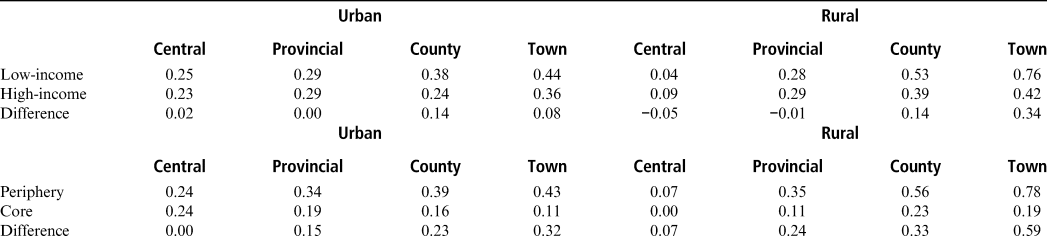
Before presenting the results of the pooled logistic regressions, it is useful to take a look at some descriptive statistics using mean satisfaction data from our survey. Table 1 shows the increase in mean satisfaction between 2003 and 2016 for all four levels of government in both urban and rural areas. The first part of the table shows the difference in mean satisfaction increase between low-income and high-income respondents, while the second part shows the difference between the periphery and core regions. If Hypotheses 1 and 2 are correct, we should expect the bottom “difference” rows to take on positive values, showing that mean satisfaction increased relatively faster among China's targeted populations.
Mean Satisfaction Increase, 2003–2016 (Income and Region Effects)

Source: Authors’ survey data.
Overall, the data show a uniformly positive increase in mean satisfaction towards all levels of government between 2003 and 2016.Footnote 49 However, while mean satisfaction increased across the board, the relative magnitude of those increases differed between low-income and high-income individuals, and also between the core and periphery regions.Footnote 50 For example, in the first part of Table 1, the increase in average satisfaction between 2003 and 2016 appears fairly similar for both low-income and high-income groups for the central and provincial levels of government. However, at the county and township levels, low-income residents exhibited strikingly higher increases in satisfaction than high-income residents. This apparent income effect for county and township governments holds true in both urban and rural areas.
The second part of Table 1 shows an even clearer dichotomy, with mean satisfaction increasing faster in the periphery than in the core. In contrast to the first part, where the income effect appeared limited to the lowest two levels of government, the region effect can be seen at the central and provincial levels as well. However, the relative magnitude of the region effect grows as one gets closer to the local level, suggesting that residents in China's periphery are becoming relatively more satisfied with their county and township governments when compared to their counterparts in the core region.
While the descriptive data in Table 1 support the possibility of both an income and region effect, it is not possible to draw conclusions about statistical significance from descriptive analysis alone. Simply comparing changes within our two variables of interest does not control for the effects of other potentially confounding variables such as age, gender and education. Previous studies show that these variables are often significantly correlated with government satisfaction and so ignoring their effects would bias the results. Therefore, in order to test the significance of the apparent income and region effects shown in Table 1, we present an ordered logistic regression model using pooled data from all eight iterations of our survey.
Pooled Ordered Logistic Regression Models
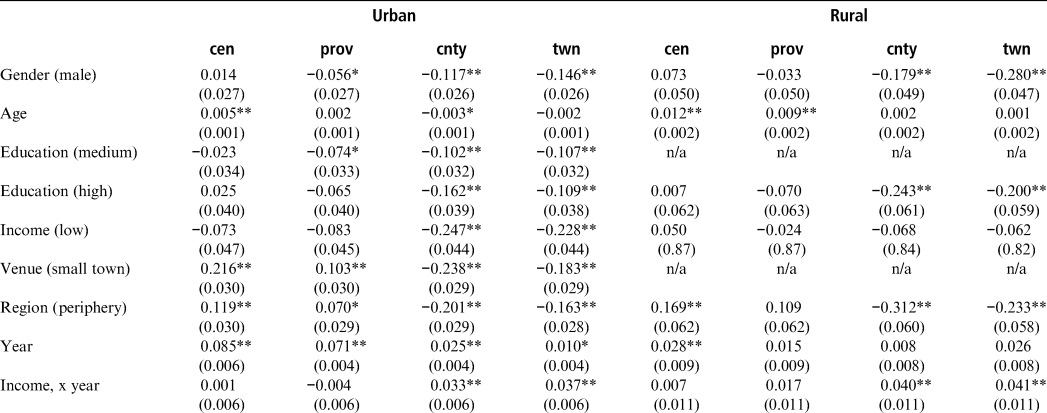
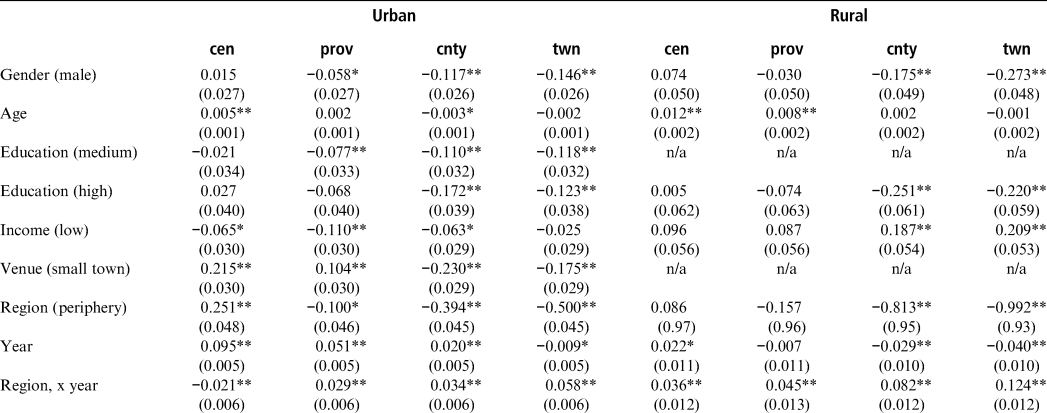
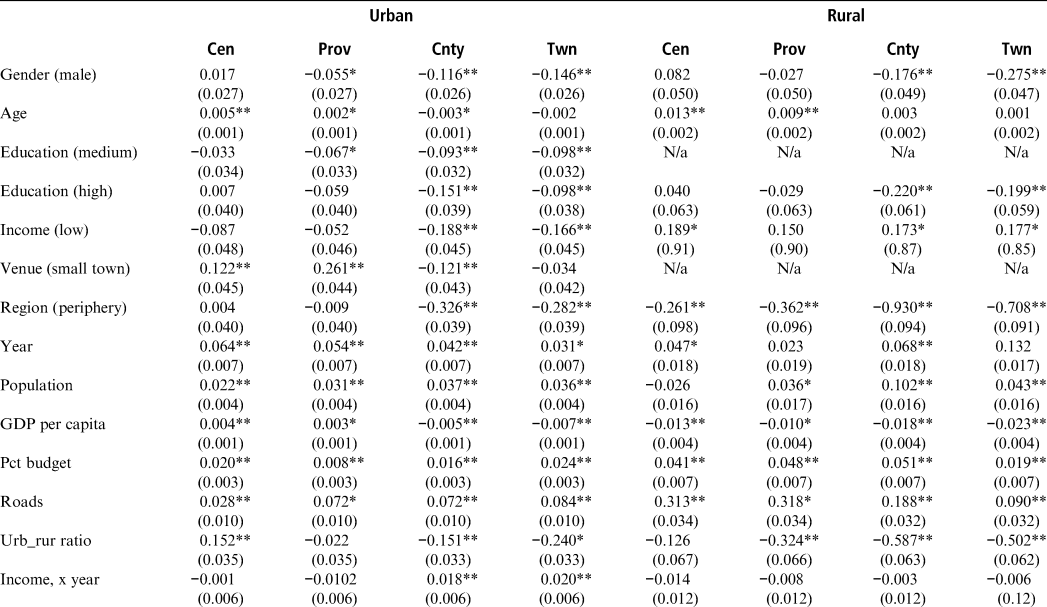
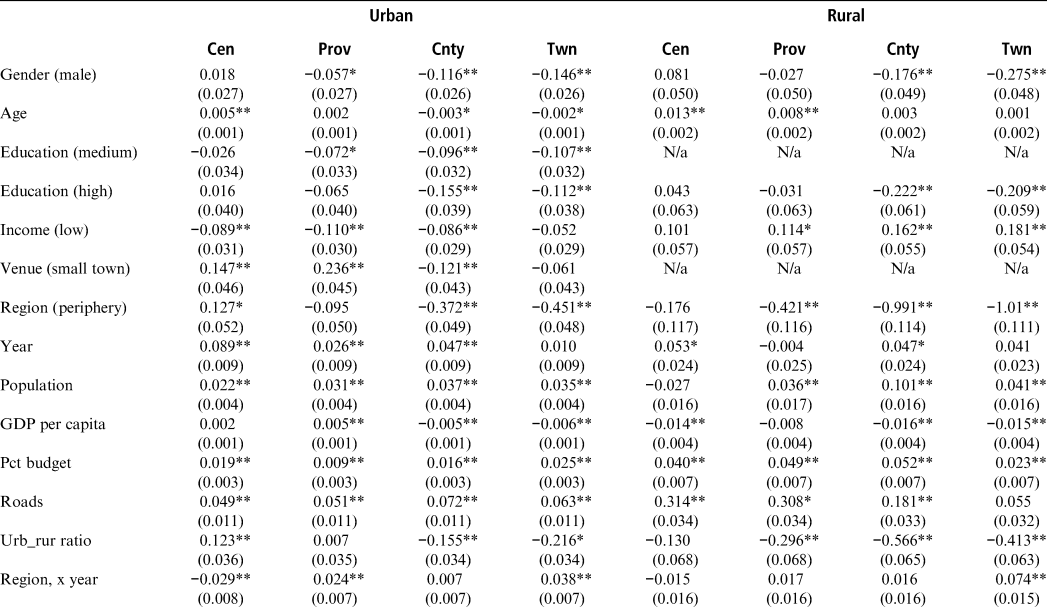
Using government satisfaction as the dependent variable, we performed two sets of pooled, ordered logistic regressions. The first set (Table 2) includes an income–year interaction term to test the significance of the income effect, while the second set (Table 3) includes a region–year interaction term to test the significance of the region effect. Each of the two main sets is composed of eight separate regression models (four levels of government plus urban and rural components for each level). In addition to the highlighted interaction terms, we also controlled for the effects of gender, age, education and survey year. Finally, in urban areas, we added an additional dummy variable to distinguish between respondents living in large cities and smaller towns. The results for both the income and region effects are shown in Tables 2 and 3.
The Income Effect, 2003–2016


Demographic Control Variables
It is worth noting that the expression of the control variables generally matches results shown in prior studies. For example, we find that males are significantly less satisfied with government than females, but only at the subnational level. This supports the findings of Lianjiang Li, who argues that men are more distrustful of local authorities and are more willing to engage in acts of “rightful resistance.”Footnote 51 Also, at the national level, we see that age and government satisfaction show a significant, positive correlation – a result that echoes the work of other researchers.Footnote 52 Finally, we find that satisfaction with county and township government tends to decline with higher levels of education, an oft-reported phenomenon examined in great detail by Whyte.Footnote 53
Sole Effects of Income and Region
While the fate of our two hypotheses is ultimately determined by the sign and significance of the interaction terms shown in the bottom row of Tables 2 and 3, it also worth examining the “sole effects” of income and region respectively. In any regression with two interacting variables, the sole effect of one variable is given as the expression of that variable when the other variable (in this case year) is defined as zero. Thus, Table 2 shows that, in 2003, low-income individuals were relatively less satisfied than high-income individuals at the county and township level in urban areas. Likewise, in 2003, Table 3 shows that residents in China's periphery expressed similar or greater relative levels of support for the central government but were relatively more dissatisfied with county and township governments than core residents.
Analysing the Interaction Terms (Results for Hypotheses 1 and 2)
Broadly speaking, the significance associated with the coefficient of each interaction term shows whether there was a structural change in the relationship between the independent variable and satisfaction over time.
For example, the coefficient on the income–year interaction term shows whether high- and low-income individuals experienced fundamentally different satisfaction trends between 2003 and 2016. Moreover, if the coefficient is significant, the sign of the coefficient indicates the direction of structural change. Therefore, if Hypothesis 1 is correct, we would expect to find a significant, positive coefficient for the income–year interaction term, meaning that satisfaction among low-income individuals increased more rapidly than among high-income individuals.
Indeed, we do see significant, positive coefficients on the income–year interaction terms, but only at the county and local levels. Furthermore, for all four of the county- and local-level results in Table 2, the p-values are less than 0.01, suggesting a highly significant relationship. Thus, we can conclude that there is strong evidence to support Hypothesis 1:
Hypothesis 1 Result:
In both urban and rural areas, average satisfaction with county and local governments increased significantly faster among low-income individuals than among high-income individuals between 2003 and 2016, thus suggesting the presence of an income effect.
For the region effect (Table 3), a similar pattern can be observed. This time, seven out of the eight interaction terms show a significant positive correlation, meaning that government satisfaction increased faster in the periphery than in the core. While all subcategories except “urban central” show a significantly positive interaction coefficient, the magnitude of the coefficients grow larger the closer one gets to the local level. Also, at each level of government, the size of the region effect appears to be relatively larger in rural areas.
Hypothesis 2 Result:
In seven out of the eight regressions, average satisfaction increased significantly faster in China's periphery than in its core between 2003 and 2016, thus suggesting the presence of a region effect. This effect was more pronounced at the local level (county and township) and in rural areas.
Differences between the Hu–Wen and Xi Jinping Administrations
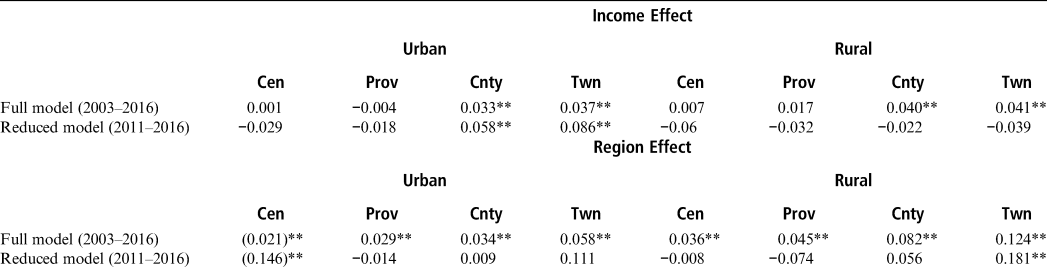
Although many of the redistribution programmes initiated by Hu Jintao and Wen Jiabao continued with Xi Jinping, it is worth examining whether or not the income and region effects noted above continued under the new administration. To test this, we ran the same regressions as in Hypotheses 1 and 2, but removed all observations before 2011. This way, the coefficients on the interaction terms would represent structural changes since the last full year of the Hu–Wen administration (rather than since 2003). Table 4 compares the sign and significance of the interaction terms in the full pooled model to the reduced model only containing observations from 2011 to 2016.
Comparing Interaction Terms between the Full and Reduced Models

Source: Authors’ survey data.
Note: All independent control variables used in the full model are also used in the reduced model. However, to save space, only the coefficients on the interaction terms are displayed.
As shown in Table 4, the results are mixed. The income effect appears to continue and even accelerate under Xi Jinping in urban areas, but it appears to plateau in rural areas. Meanwhile, the region effect appears to level off under Xi Jinping, except at the township level in rural areas where the coefficient remains significant. Although the primary purpose of this paper is to analyse changes since 2003 as a whole, these preliminary results suggest that the income and region effects noted under the Hu–Wen administration are still present but may be diminishing under Xi Jinping.
Hypothesis 3 Results
While the results of Hypotheses 1 and 2 show a correlation between living in poorer, periphery regions and increased satisfaction over time, they do not imply any causal effects. Therefore, in order to determine whether the observed income and region effects are being driven by real changes in government policy and political rhetoric, it is necessary to include other independent variables in the model.
First, in accordance with prior research on local-level satisfaction in China, we control for both city size (population) and wealth (GDP per capita).Footnote 54 We also include the combined percentage of the local government budget spent on healthcare, welfare and education (pct budget). This serves as a proxy for local government provision of public goods and services, and is similar to the method used by Dickson et al.Footnote 55 Next, we use the total area of paved roads per capita to serve as a proxy for infrastructure construction and the spread of regional development projects in China's periphery since the early 2000s. Finally, we include the ratio of urban to rural disposable income to serve as a proxy for local-level inequality. All of these data were collected at the municipal level from annual city statistical yearbooks.
Notably, GDP per capita tends to be negatively associated with satisfaction, especially at the county and township levels. This shows that other factors besides increased local wealth are responsible for driving satisfaction increases in low-income and periphery regions. Also, population size is almost uniformly associated with increased satisfaction, illustrating that citizens living in larger cities tend to be more supportive of government.
Among the three macro-scale variables of particular interest, all appear to exhibit a significant relationship with satisfaction in the direction predicted by Hypothesis 3. The combined percentage of the local budget spent on healthcare, welfare and education is significantly and positively associated with satisfaction in all 16 of the regression models.Footnote 56 Similarly, the area of paved roads per capita is positively associated with satisfaction in all but one of the regression models. By contrast, the ratio of urban-to-rural disposable income tends to be negatively associated with satisfaction, although only at the subnational level. Interestingly, this negative relationship holds true for both rural and urban areas, suggesting that urban–rural inequality has negative impacts on satisfaction even in areas not suffering directly from regional income divides.
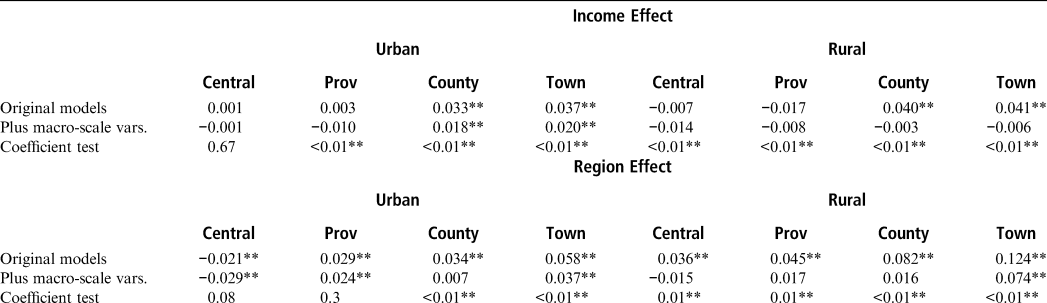
Also, after adding the macro-scale economic variables, the magnitude of the coefficients on the income–year and region–year interaction terms experienced a significant decline in 11 out of the 12 regression models for which the income and region effects were observed. Table 7 compares the value of each interaction term before and after the addition of the new variables, along with a coefficient test to determine whether the second coefficient is significantly more different from the first.
The Income Effect with Additional Macro-Scale Variables, 2003–2016

The Region Effect with Additional Macro-Scale Variables, 2003–2016

Source: Authors’ survey data and Chinese annual city statistical yearbooks.
Comparing the Interaction Term Coefficients before and after the Addition of the New Macro-Scale Economic Variables

Notes: This table presents the coefficients of each interaction term both before and after the addition of the macro-scale economic variables to the model. The bottom rows employ a chi-squared test statistic to test the hypothesis that the original coefficient – the modified coefficient = 0. For each result, significance levels are * chi-2 < 0.05, ** chi-2 < 0.01.
The results shown in Table 7 are important because they suggest that much of the observed significance of the income and region effects can be explained by the addition of the new variables related to local quality of life and government service provisions.
Hypothesis 3 Result:
In both urban and rural regions, satisfaction generally increases with the combined percentage of the local budget spent on healthcare, welfare and education; and also with the area of paved roads per capita. By contrast, satisfaction generally declines with the size of the ratio of urban to rural disposable income. Moreover, in all but one of the 12 sub-regressions in which the income or region effect was observed, the magnitude of the interaction term coefficients declines after the addition of the macro-scale economic variables, signifying that much of the significance of the income and region effects can be explained by local-scale changes in quality of life and government service provisions.
Conclusion
These results suggest that persistent inequality and slowing rates of economic growth have not led to increasing levels of dissatisfaction among the Chinese citizens hit hardest by reforms. In fact, the relatively high satisfaction levels of high-income residents in coastal provinces have remained fairly static since 2003, while lower-income and non-coastal satisfaction levels have risen significantly. This narrowing of the satisfaction gap between advantaged and disadvantaged populations, especially at the county and township levels, has significant implications for the future of Party stability, potential democratization and China's economic development.
Most scenarios envisioning a systemic collapse of the Chinese political system involve either a sharp economic downturn or wide-ranging social unrest triggered by high degrees of embedded inequality.Footnote 57 These scenarios hinge on inequality as a catalyst for social pressure, followed by a response from the ruling elite and the Party. However, our work questions whether China's persistently high levels of inequality have in fact fuelled negative shifts in government satisfaction among China's populace.
Our results also raise further questions about the range of conditions under which satisfaction gaps between different societal groups (and also between upper and lower levels of government) might become politically salient or not. Further research into these questions could produce a much-needed causal analysis to explore potential linkages between observed levels of service provision and inequality in China and bottom-up citizen pressures for political change.Footnote 58 To date, our longitudinal study has shown little evidence of such pressures and has instead demonstrated significant increases in citizen satisfaction with government performance, with the highest increases in satisfaction occurring among the very same populations that many have identified as future potential hotspots for unrest and dissatisfaction. Thus, while it would certainly be premature to declare the Chinese government immune from bottom-up resistance, our data suggest that such resistance is unlikely to be driven by gaps in satisfaction between high- and low-income groups or between residents in core and periphery areas.
Biographical notes
Jesse TURIEL is a doctoral student and researcher at Boston University's department of earth and environment. He focuses on the interplay between air pollution, public opinion and government policies in China. Currently, he is working on a project comparing measured local air quality with perceived local air quality among Chinese citizens.
Edward CUNNINGHAM is the director of China Programs at the Harvard Kennedy School's Ash Center for Democratic Governance and Innovation. He focuses on China's integration into the world economy, primarily through its energy and environmental governance, international trade and investment, and most recently, its philanthropic sector.
Anthony SAICH is the Daewoo professor of international affairs and the director of the Harvard Kennedy School's Ash Center for Democratic Governance and Innovation. Currently, he is working on a project about China–Vietnam cross-boundary water flows, as well as a project on the history of the Chinese Communist Party.
Supplementary material
Supplementary material is available online at https://doi.org/10.1017/S0305741019000377.