Northern Israel served as the battlefield for a war with Hezbollah based in southern Lebanon over the summer of 2006. Western Galilee Hospital (WGH) provided emergency medical care for wartime casualties. Hezbollah deliberately targeted and attacked WGH with Katyusha rockets early in the conflict, one of which made a direct hit on the hospital. The entire hospital population relocated under the cover of darkness to previously prepared bunkers in just over 1 hour, completing the relocation prior to the missile hit on the hospital. These successful changes in hospital functionality warrant consideration in other facilities.
A salient opportunity for improvement addressed in this field report centers around the admission and processing of emotionally traumatized casualties referred to as acute stress disorder (ASD) patients. Many response paradigms indicate that ASD patients will process through the emergency department (ED) essentially alongside or behind physically wounded patients.Reference Meredith, Zazzali and Shields 1 - Reference Hirshberg, Scott and Granchi 3 The experience at WGH made evident that such response expectations met with significant limitations. While the efficacy of the early treatment of ASD patients remains a matter of active study and some criticism, group counseling sessions and light exercise protocols were utilized by WGH staff with positive results.Reference Hick, Hanfling and Burstein 4 An avoidance of sedatives such as benzodiazepines also stood out as different from some conventional treatment protocols currently indicated for such patients.Reference Kosashvili, Aharonson-Daniel and Peleg 5
Psychiatric Services
WGH response plans initially directed that ASD patients present for initial processing alongside physically injured casualties. Staff reported that as seriously injured civilians and soldiers rolled past the ASD casualties on stretchers, the images became more than these emotionally compromised individuals could reasonably tolerate. Several became belligerent as a result and were restrained to restore order in the ED. WGH staff further noted that the physically wounded patients witnessed this behavior and became more upset as a result. It was agreed that such disorder could have escalated to threaten the entire department’s ability to function unless action was taken to address this issue. WGH needed a new plan.
Hospital administration quickly instituted a new protocol for initial processing of ASD patients. Following initial triage by primary responders, ASD casualties were transported to a separate location. This dedicated wing for psychiatric services was staffed primarily by social workers and nursing assistants volunteering from within the local population following the closure of most local businesses. These personnel routinely work with emotionally stressed persons in a variety of circumstances as opposed to emergency clinical staff. One ED physician remained in the stress casualty entrance to affirm the initial triage. This clinician watched for signs of myocardial infarction or other medical emergencies. Remarkably, not a single ASD victim required transfer to the ED owing to a missed diagnosis throughout the conflict. The ED became a calmer and less congested venue without the ASD patients, thus facilitating efficient clinical operation as reported by members of the medical staff.
Therapeutic interventions utilized during the conflict also merit consideration as one of several possible treatment modalities. Ongoing debate within the psychiatric medical community regarding early treatment efficacy indicates mixed results.Reference Hirshberg, Scott and Granchi 3 , Reference Kosashvili, Aharonson-Daniel and Peleg 5 Indeed, numerous studies indicate a negative long-term effect on ASD patients receiving early psychological counseling or debriefing.Reference Hirshberg, Scott and Granchi 3 Supportive psychotherapy sessions conducted at WGH included group discussions focusing more on current emotions as opposed to recounting the recently traumatic events. DSM-IV TR (Diagnostic and Statistical Manual of Mental Disorders, 4th edition, text revision) guidelines indicate that many ASD patients may present with a “numb” expression and diminished physical mobility, as did many of the patients who arrived at WGH.Reference Peleg and Kellermann 6 Dr. Carlos Giloni, the sole psychiatrist staffed at WGH during the war, decided to intervene in this area of immobility.
The clinical contention to encourage physical movement stems from the assertion that immobility allows ASD patients to sit idly and worsen by recounting the horrific events leading to their admission.Reference Tadmor, McManus and Koenig 7 Arriving ASD patients were encouraged by volunteers to stand and walk into the building. This emphasis on physical activity continued with yoga, Tai-Chi, and other light exercise classes. The concern over immobility primarily contributed to the therapeutic decision to avoid sedatives such as benzodiazepines in ASD patient therapy.Reference Tadmor, McManus and Koenig 7 Studies currently indicate mixed results of such therapy, but the current investigation focuses only on the outcomes reported in this particular incident. Quantitative data for these patients were not made available for this report, but interviews with staff including Dr. Giloni indicated positive results.
Emergency Department and Evacuation
The rapid influx of patients and staff into the emergency room required an alternate layout of the department and added personnel numbers to accommodate the response to a mass casualty event.Reference Zilm, Berry and Pietrzak 8 Privacy screens between ED beds were removed to facilitate greater mobility. Equipment staged in the area was limited to those items deemed critical to response efforts to further maximize available floor space. A single direction for traffic was established for movement through the floor space of the department. Patients transferred out of the ED were not readmitted in part to maintain this traffic direction. ED primary receivers awaited patient arrival with their own stretchers staged at the entrance and transferred the victims from ambulance stretchers before entering the hospital. This strategy aided traffic reduction by keeping emergency medical services personnel outside and eliminating the need to turn stretchers around inside.Reference Tadmor, McManus and Koenig 9
WGH disaster planners themselves did not entirely agree on the necessity of construction of the underground facility, but supporters of the initiative found vindication in the form of a successful response to both the war at large and survival following direct attack. Following completion of the bunker, drills began in earnest to maximize the utility of the new addition. Construction of the facility included features that would allow the entire hospital population to physically access the facility in short order. These considerations included multiple access points and protected passages to these entrances. Evacuation protocols were developed in each department and were practiced regularly. As a purposed relocation shelter, the space was forbidden from alternate uses such as storage or facility expansion. Copies of these plans were placed in staff congregation areas such as nursing stations for quick reference if required.
Results
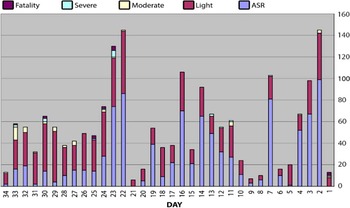
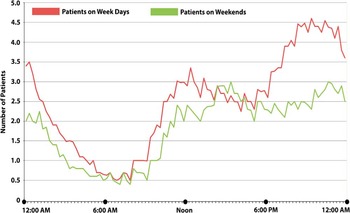
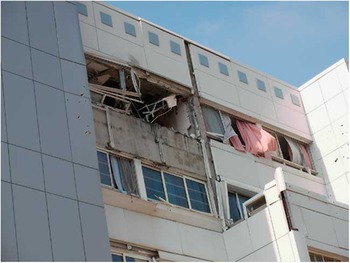
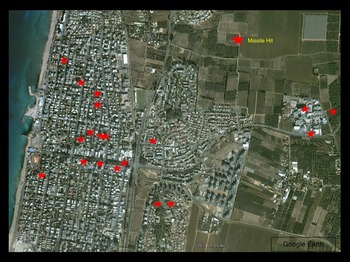
The 1-hour evacuation time stands out as a vital statistic but not the only one of note. The daily distribution of casualties included with this field report indicates the number and severity of patients presenting over each day of the conflict (Figure 1). Times of admission of patients during the war created periods of high and low activity that dictated staffing levels with notable regularity over each day (Figure 2). A photograph (Figure 3) taken shortly after the missile attack displays the exterior structural damage incurred by the hospital. A satellite photo of the Nahariya area (Figure 4) shows where rockets landed in the region. A cluster of 3 rocket hits can be seen in the hospital complex on the right-hand side. Average treatment time of each injury severity category was also recorded with moderately wounded patients requiring the longest average treatment time.
Daily Presentation and Injury Severity of Casualties Treated by Western Galilee Hospital During the 2006 War.

Average Presenting Patient Volume at Western Galilee Hospital Over a 24-Hour Period During the 2006 War.

Damage Sustained by Western Galilee Hospital During the 2006 Second Lebanon War.

Missile Impacts Both Around Western Galilee Hospital (3 Hits to the Right) and in Nahariya Roughly 1 Mile to the West During the 2006 War.

Conclusions
Even a facility with the collective foresight and means to construct a 450-bed underground hospital structure improvised several key aspects of their plan to ensure an effective response. The separation of ASD casualties from physically wounded patients improved treatment for both groups. Physical activity for ASD patients may have improved their treatment further. These patients also largely did not receive sedative agents such as benzodiazepines, which may have contributed to their successful treatment. Aspects of ED functionality and the evacuation protocol met with success by use of more conventional means.
WGH staff and senior administration reported that successful evacuation and ED patient surge responses require realistic and frequent drills to maintain readiness. Staging of stretchers outside the ED with primary receivers maintains traffic direction and reduces congestion. The refusal to retake patients who are moved from the ED also reduces congestion and maintains order. WGH clinicians stressed the importance of maintaining order within the ED as well as associated departments to maintain functionality, particularly over a prolonged period. Hospitals needing to develop evacuation protocols or emergency response procedures for a range of circumstances could consider the effective example of WGH as guidance for their own facilities, especially in conflict zones.