

The European Union-funded Cooperation in Science and Technology (COST) TU1206 Sub-Urban Action has enabled a unique interaction between subsurface specialists and urban planners working in over 20 cities across Europe. The COST Sub-Urban Action enabled the development of a knowledge network between European Geological Surveys and city partners, to improve understanding and use of information relating to the ground beneath our cities within urban planning. The discussions and understanding developed between different specialists working within the Action is actively contributing to transforming the relationship between experts who develop subsurface knowledge, and those who can benefit most from it – urban planners and decision makers.
A key learning point has been that developing this understanding requires an iterative process over a significant period of time (years) between urban planners and subsurface specialists to develop sufficient understanding of what tools and subsurface knowledge are relevant (Bonsor Reference Bonsor2017). Short, focused knowledge exchange visits between specialists in the cities of Glasgow, Rotterdam and Oslo were proven to be a very cost-effective method of developing new knowledge, and quickly identify key similarities and differences between how cities are adapting their planning practices to include the subsurface.
Open public space is becoming increasingly scarce in growing cities, while ambitions to create attractive and liveable cities that stimulate sustainable urban development are high. To realise these ambitions, cities must increasingly deal with the opportunities and the constraints that the subsurface offers to spatial development. In order to create a high-quality living environment and to facilitate sustainable development, it is necessary to adapt a holistic view of the city in which the subsurface plays an important role. Optimal use of the opportunities that the subsurface offers in terms of, for example, space, energy, resources and groundwater, while minimising conflicts between spatial functions, requires a new policy on subsurface usage and integrated above- and below-ground planning.
Urban planners are often not aware of the vast amount of information that is available about the subsurface and subsurface specialists are not aware of how planners would wish to use the information if they had access to it. To develop appropriate tools from this starting point, whereby the urban planner would articulate their needs and the subsurface specialist could then develop appropriate information to meet these requirements is very difficult. In fact, the situation is like an urban planner entering the market place and having no idea what to buy, and the subsurface specialists manning their stalls but not knowing how to capture the planners' attention.
In order to try to understand what underpins this communication gap, two short-term scientific missions (STSMs) were carried out in the city of Oslo, Norway. The week-long visits were targeted at performing comparative studies between the cities of Glasgow, Rotterdam and Oslo on the topic of urban subsurface planning. Each city is currently in the process of adapting its urban planning practice and legislation to better accommodate subsurface issues. The STSMs brought together a range of professionals, including urban planners, legal professionals, engineers, geologists and mapping specialists. Oslo acted as a catalyst for discussion, focused on finding a quick route to drawing out the key similarities, differences and lessons of everyday practice that could be learned.
Oslo, Glasgow and Rotterdam are cities with several common factors, they are roughly the same size, redevelopment of former industrial areas is increasing and they are dealing with challenging ground conditions. Although there are differences between the city planning regimes and how the subsurface is used, it was discovered that the cities' key subsurface challenges have many similarities.
During the discussions between the cities it was clear that a lot can be learnt by comparing subsurface challenges and practises used to overcome them. Practises developed and used in one city can be adapted and used in other cities, and discussions between the cities can help to evolve existing practises.
1. City typologies and planning practice: comparison of current practice in Oslo, Glasgow and Rotterdam
1.1. Oslo
1.1.1. Subsurface use
In order to cope with the expected growth, Oslo will require large investments in communication systems, new dwellings and an integrated land-use and transportation infrastructure. Underground space is already widely used for transportation, storage, extraction of heat and for the foundations of buildings and infrastructure in the city. Oslo also has geological challenges such as deep horizons of marine clays, partly quick clays, thick layers of organic-rich anthropogenic fillings and alum shale containing enhanced levels of radium and uranium, in addition to swelling properties (Municipality of Oslo 2018). There are examples of significant damage to buildings and structures in areas of the city from subsidence, which has been driven by declining groundwater levels in marine sediments as a result of construction works – tunnelling through deep weathered rocks or the development of large subsurface building storage spaces being typical examples of some of the construction works. Already existing structures, such as older tunnels and large pipes, have been proven to impact on groundwater levels (Kveldsvik et al. Reference Kveldsvik, Karlsrud and Løset2003). Reduced infiltration capacity by paved or built areas and the piping of streams also affects groundwater levels in the city.
Due to the rapid growth of the city, underground use is expected to increase. Oslo is a hub within the national transport network, with many road, train and metro tunnels. There is major urban development taking place in the former harbour areas and more development is planned in large former industrial areas within walking distance of the city centre. The city council is currently considering the expansion of the metro system and is also looking at the possibility of introducing light rail. The planned and proposed expansions of the rail network will result in an additional 20km of tunnels beneath Oslo (Municipality of Oslo 2018).
These major developments all make a demand on the subsurface for the provision of infrastructure relating to foundations, ground conditions, groundwater management, water, sewage, heat, electricity, basements and tunnels. They also impact on, and have to negotiate around, existing archaeology, cables/pipes, transport tunnels, plant roots, thermal wells, historic voids and ground conditions. Each planning application is currently dealt with on a case-by-case basis.
1.1.2. Current planning practice
The most important tool for urban planning in Norway is the Norwegian Planning & Building Act (2008). The law was revised in 2008, resulting in quite significant changes. Previously, local municipalities would not only develop municipal master plans themselves, but also carry out most of the detailed planning. Detail plans are now mostly developed by private interests, and approved by municipal authorities (e.g., the city council). Previously, building controls were quite strict throughout the construction process. Responsibility for compliance with regulations are now, to a much greater extent, placed on the developer, while authorities carry out random controls and check reported violations of laws and regulations.
The planning system is designed to encompass underground structures, and regulations describe how planning in more than one level shall be shown on maps. The law opens up the possibility to plan in three-dimensional (3D), but, so far, 3D methods have only been used to illustrate plans and constructions. Methods for producing 3D plans are presently under development.
In September 2015, the local government voted to accept the first generation of a legally binding land-use Master Plan, according to the 2008 law revision. The most significant achievement for the underground is that the Plan proposal contains a demand to consult with infrastructure owners before drilling wells within a shown boundary. This is to protect future major subsurface infrastructure very early in the planning stage.
Particular challenges that affect subsurface planning in Oslo are as follows (Eriksson et al. Reference Eriksson, Borchgrevink, Sæther, Daviknes, Adamou and Andresen2016):
• Buffers between underground constructions are not established.
• Some constructions are not subject to approval (e.g., energy wells).
• For any Master Plan and detail plan that ‘can have significant consequences for environment and society', a ‘planning program' shall be developed requiring an impact assessment. Impact assessment shall also cover consequences of urban development plans on groundwater flow, level and pressure and the potential effects that these changes may have on, for example, road and building stability, growth conditions, archaeology and other cultural heritage.
• Law requirements to maintain groundwater pressure and level are vague.
Through a series of interdisciplinary meetings and workshops, the municipality of Oslo is becoming more and more aware of the needs for subsurface information in the planning process. This awareness is resulting in the development of a series of test products within a limited geographical area in central Oslo. Currently, products such as a depth-to-bedrock map, a 3D model of Quaternary geology, a map of foundation types and a 3D model of subsurface structures have been developed. The future use of the products will be analysed and may result in the implementation of new routines in the local workflows. During the development of maps and 3D models visualising geotechnical and/or geological information, it has been found that 2D maps are the best tool at strategic planning levels; these are most readily understood and accessible in 2D planning maps, as opposed to 3D visualisation. It is essential that the information shown on the maps is easily and immediately understood by urban planners and decision makers, as they generally have a large amount of information to consider (Municipality of Oslo 2018).
It is worth noting that one of the most important results of this exercise has been the increased awareness and knowledge of the subsurface, mainly among those who are participating in the actual work, but also among politicians and other decision makers.
1.2. Glasgow
1.2.1. Subsurface use
The geographical and geological setting of the city, combined with the legacy of mining and heavy industry, gives rise to a range of complex issues relating to the subsurface environment that affect spatial development (Whitbread et al. Reference Whitbread, Dick and Campbell2016). Through collaboration between the British Geological Survey (BGS) and Glasgow City Council (GCC), there is increasing recognition that consideration of the subsurface environment within the city's development and planning processes is needed for sustainable future city development – including the effective remediation and regeneration of vacant and derelict land, hazard mitigation, the management of resources and the development of a sustainable economy (Bonsor Reference Bonsor2017). In the absence of national legislation relating to the subsurface environment, developments in spatial planning policy and in the application of subsurface data are arising through collaboration and partnership within Glasgow. Progress is being achieved through knowledge-exchange initiatives, voluntary agreements and the use of contractual obligations to encourage private contractors to commit to share data in exchange for access to 3D subsurface information provided by BGS.
1.2.2. Current planning practice
Glasgow's statutory Local Development Plan prepared by GCC (2017) is the first in the UK to begin to advocate and formalise an integrated above- and below-ground approach to underpin the urban development design. The purpose of the ‘City Development Plan' is to ensure the efficient use of land and the provision of good infrastructure to improve the social, cultural, economic and environmental health of the city. It sets out a strategy that aims to deliver on the following four key outcomes:
(1) A vibrant place with a growing economy – by providing the right environment for businesses to develop.
(2) A thriving and sustainable place to live and work – by providing opportunities to build new housing, and creating vibrant places and town centres to provide a good quality of life in the long term for the city's growing population.
(3) A connected place to move around and do business in – by improving accessibility for all citizens to employment, shopping and leisure destinations, and providing more sustainable travel options.
(4) A green place – by helping to care for Glasgow's historic and green environments, increasing the city's resilience to climate change and reducing energy use.
In March 2017, a new City Development Plan, setting out a ten-year planning framework for Glasgow, was adopted. The new plan takes into account recent revisions of national planning legislation (Scottish Government 2006), government guidance (Scottish Government 2013, 2014a) and updates to the National Planning Framework and Scottish Planning Policy (Scottish Government 2014b). The proposed plan advocates an integrated or ‘comprehensive' approach to development processes and planning, in which above-ground urban design utilises, to great effect, below-ground opportunities and risk. Geodiversity sites are included in the City Development Plan as nature conservation sites, formalising the city's commitment to further partnership with BGS and other geoscientific experts, and committing the council to the development of subsurface guidance and to develop planning requirements in relation to subsurface infrastructure and environment. It will be the first planning policy for Glasgow to explicitly recognise the environmental and economic value of the subsurface. Following the consultation, review and approval procedure, the proposed measures will ensure that the planning policy for Glasgow reflects the importance of the subsurface environment to the health, wealth and growth of the city Fig. 1).
The development phases of the proposed City Development Plan (http://www.gov.scot/Topics/Built-Environment/planning/Development-Planning/Local-Development).

The revision of supplementary guidance provides a flexible platform for implementing this new, three-dimensional and volumetric approach to the development process at both a site-specific and city-wide spatial scale, taking cognisance of placemaking and urban design principals. Greater understanding is still required between specialists to understand how this can be efficiently developed. It is envisaged that the planning guidance and policy will be developed gradually over the next few years, with growing knowledge of the relevance of subsurface data at different stages of the development process, starting with the strategic overview contained within the City Development Plan and accompanying masterplans, down to site-specific development proposals.
1.3. Rotterdam
1.3.1. Subsurface use
Starting as a dam constructed in 1270 on the Rotte River, Rotterdam has grown into a major international commercial centre. Its strategic location at the Rhine–Meuse–Scheldt delta on the North Sea and at the heart of a massive rail, road, air and inland waterway distribution system extending throughout Europe is the reason that Rotterdam is often called the ‘Gateway to Europe'. After the successful period of post-World War II reconstruction, Rotterdam continued enhancing its status as an international city. On the edges of the city, large residential districts have been built.
The western part of the Netherlands is flat and cultivated, and, today, sedimentation and erosion processes are influenced by man almost everywhere: rivers are contained within dikes and many streams are canalised; swamps, lakes and large parts of an inland sea have been turned into polders below sea level; and in many places dikes strengthen the coastline. Without dikes nearly the whole western part of the country would be flooded. To keep the reclaimed polder areas dry and fit for farming, pumping stations – formerly windmills – extract water continuously and transfer it into bordering water bodies. As a drawback, water extraction leads to the compaction of soft soils and the oxidation of shallow peat layers, resulting in a gradual lowering of the land surface. Cities in this part of the country, including Rotterdam, are developed and planned with these challenging conditions as a starting point. With ground conditions vulnerable for subsidence, many buildings have been constructed using pile foundations, traditionally of wood (van Campenhout et al. Reference van Campenhout, De Vette, Schokker and Van der Meulen2016).
1.3.2. Current planning practice
For the last two to three decades urban planners did not consider the subsurface as an important factor that has to be taken into account whilst planning. The most relevant issues that were considered were archaeology and soil pollution, as these issues were subject to national and international legislation (Municipality of Rotterdam 2015). Other themes such as groundwater, geotechnical conditions and subsurface space were only taken into account at project level and only during the construction phase. During the last five years, attention for all subsurface themes is growing, and it is more and more recognised that the subsurface has to be considered integrally in spatial planning processes. In the Netherlands, spatial planning is governed by a number of different public bodies: national government, provinces or (urban) regions, local authorities (municipalities) and so-called water boards (water authorities; MIE & MEA 2018). The Dutch government produces an overarching spatial plan.
The 12 provinces in the Netherlands make their own ‘structural vision', based on the national governmental plans. Municipalities create their own visions and detailed ‘zoning plans' that need to fit into the national vision.
Water boards are the authorities responsible for (ground) water management. They are responsible for water-related issues, like the maintenance of dikes and dunes, and the discharge of rain- and waste water.
Rotterdam has its own responsibility for the formulation of the Spatial Development Strategy 2030 (Municipality of Rotterdam 2007). The mission of the Rotterdam city council is formulated in the Spatial Development Strategy 2030 and focuses on the following elements:
• Strong economy: creating a strong economy concentrates on the transition from an industrial to a knowledge-based and services economy. In the recently concluded construction of a large new port area (Maasvlakte 2), emphasis is put on innovation in the fields of energy consumption and production, as well as the reduction of CO2 emissions.
• Attractive residential city with a balanced population composition: good housing alone is not enough for an attractive residential city. High-standard public space is an important condition for creating attractive and popular residential environments.
The Rotterdam Climate Change Adaptation Strategy (Municipality of Rotterdam 2013) has been developed with the aim of making Rotterdam climate-proof by 2025:
• By 2025, measures will have been taken to ensure that every city region is minimally affected by climate change, and will receive optimal benefits from climate change adaptation measures in 2025 and onwards.
• Rotterdam will systematically account for the long-term foreseeable climate change in all spatial development of the city, and is resilient to any associated uncertainties.
Open public space at the surface is scarce in Rotterdam. In order to meet the needs that have been formulated in the Spatial Development Strategy 2030, the city has to consider the subsurface as part of the available public space. Rotterdam must deal with the opportunities and the constraints that the subsurface offers to achieve sustainable urban development.
Rotterdam has high ambitions in planning essential functions in the public space: housing, working, transport, recreational activities, green nature and water. City planners translate these aspirations to models in which public space is designed with features: buildings, parks, roads, pipelines, lakes, etc. At present, the subsurface is included for foundations and infrastructure (Municipality of Rotterdam 2015). Furthermore, sectorial input of environmental risks and cultural historical values are gathered. However, most subsurface opportunities need an integrated approach. Examples are strengthening the identity of historic areas by showing their archaeology, re-using quay walls as storage space, and by smart combinations that improve the exploitation of plans and lead to cost savings, e.g., by combining thermal storage with groundwater remediation. Sustainable energy solutions, such as subsurface thermal storage (heat and cold), and the implementation of deep geothermal energy could offer major cost savings and fit seamlessly into the climate objectives of the city. The deeper subsurface also offers possibilities for CO2 storage, while it may provide water retention opportunities at shallower depths. This integrated approach is not embedded in the current planning practice.
2. Bridging the gap between urban planners and subsurface specialists
In order for urban planners to understand the benefits of using the subsurface, it is useful to learn from peers. Oslo, Glasgow and Rotterdam are currently all at similar stages with their development of subsurface information and its use within the spatial planning system. The work going on in these cities provides very useful case studies for other urban areas to emulate and adapt. There are instructive differences between the three cities: Rotterdam and Glasgow are more advanced in terms of available subsurface information than Oslo, due to natural causes and historic city development. Rotterdam and Glasgow have consequently trialled more techniques and tools to include subsurface information in the planning process than Oslo. Much of the experience, examples and tools addressed in this paper originate from Rotterdam and Glasgow. Oslo has, however, undertaken a significant examination of what new subsurface knowledge is required in the future by planners, for new spatial urban development approaches, which increase city resilience and sustainable urban design (Dick Reference Dick2015).
Understanding the gap. It is vital for subsurface specialists and urban planners to be aware of the differences between the two disciplines. Subsurface specialists live in a world of known data, resources and obstacles, whereas urban planners focus more on the future reality and possibilities. In Rotterdam, the initiative to embed the subsurface in the urban development process comes from the ‘public space management' department and the engineering bureau. They traditionally comprise the latter part of the urban development chain, where granting of permits, realisation and maintenance are placed.
Urban planners are challenged to combine existing functions, ambitions of green, grey and blue spaces and places, climate programmes and the political fluctuations in their spatial plans. In Rotterdam, a strong economy and an attractive residential city are important. At the same time, the Rotterdam Climate Change Adaptation Strategy 2030 stimulates sustainability of the urban development. Subsurface issues have, for a long time, not been in the scope of urban planning processes until reaching the construction phase, because the subsurface issues have always been technically resolvable. Subsurface knowledge and management followed the urban development, instead of restricting it. Discussions and knowledge exchange within the framework of the COST Action TU1206 Sub-Urban have shown that this is not a unique situation for Rotterdam, but a general trend in most cities in Europe and beyond (Mielby et al. Reference Mielby, Eriksson, Campbell, de Beer, Bonsor, Le Guern, van der Krogt, Lawrence, Ryżyński, Schokker and Watson2017).
Bridging the gap. To bring in subsurface information and knowledge is not just to incorporate the data; it is about creating awareness of the potential of the subsurface and, thus, bridging the worlds of two different communities. This begins with enhancing awareness of the urban subsurface environment and resources in city development – a process that is in its infancy in several cities and countries (Eriksson et al. Reference Eriksson, Borchgrevink, Sæther, Daviknes, Adamou and Andresen2016; van Campenhout et al. Reference van Campenhout, De Vette, Schokker and Van der Meulen2016; Whitbread et al. Reference Whitbread, Dick and Campbell2016) and lies at the basis for the development of the COST Action TU1206 Sub-Urban.
In our view, there are two main routes to raise awareness that should lead to improved understanding and use of subsurface information in urban development processes: (1) the development of a policy of the subsurface; and (2) the development of subsurface knowledge, and sharing this in the urban development process in an appropriate way, ranging from mapping datasets to initiating collaborative workshops. These two trails should both lead to the same goal: to enable subsurface knowledge to be widely disseminated in order to manage risks and opportunities; and to maximise the economic, social and environmental benefits of the urban subsurface and its services on which cities depend.
2.1. Development of subsurface policy
In the three cities subject to this study, subsurface is treated in line with the ‘first-come-first-served' principle. The subsurface serves more and more as public domain; this is no longer considered a suitable way to manage it. Therefore, in all three cities there is an ambition to somehow regulate the use of the subsurface.
The city of Rotterdam is developing policy for subsurface use. On this journey, Rotterdam has described in general how the city wishes to protect, use, preserve or improve the subsurface environment and/or resources. At this point, Rotterdam is trying to find a way to make this more practical and specific. At the same time, the Dutch government is working on a Draft Vision on the Subsurface on a national scale, mostly focused on nationally important (regional and deeper) subsurface use, such as gas extraction, groundwater resources and geothermal energy (MIE & MEA 2018).
In Scotland, there is no national legislation relating to the subsurface (yet), but a city-scale application of subsurface data is under development. The subsurface is also specifically included in the emerging City Development Plan for Glasgow, which underpins the growing awareness of policy-makers (GCC 2017).
In Norway, national law opens the way for methods to produce 3D plans, which are presently under development. At the same time, the current Planning and Building Act provides a lot of opportunities for the realisation of measures that might obstruct future functions that would be beneficial for the municipal management of the city. In Oslo, the ‘Subsurface Project' has been initiated to face the challenges that the subsurface poses to city development. This project includes investigations for finding ways to regulate and manage the subsurface.
2.1.1. Subsurface in urban development plans
All three cities consider including the use and management of the subsurface in municipal plans. In our opinion, describing the subsurface in different municipal plans may have the following intentions:
• Make inventories of subsurface objects, issues and existing plans in order to prevent the obstruction of future plans by competition for physical space or physical service.
• Acknowledge the subsurface as an integral part of the public space, that can be used to facilitate the ambitions of the local government as an equal part to the above-surface space.
• Produce a guideline on how one wants to protect, (p)reserve, exploit or improve the subsurface, within a framework of sustainability or resilience, etc.
Experience gained in Rotterdam has shown that when ambition is described in a plan, it might not yet be clear whether this ambition will be realised in the above or below surface. If the general (above-surface) plan and a thematic subsurface plan are separate documents, it may lead to unfortunate premature statements, inconsistencies or false expectations.
2.1.2. Spatial integration approach
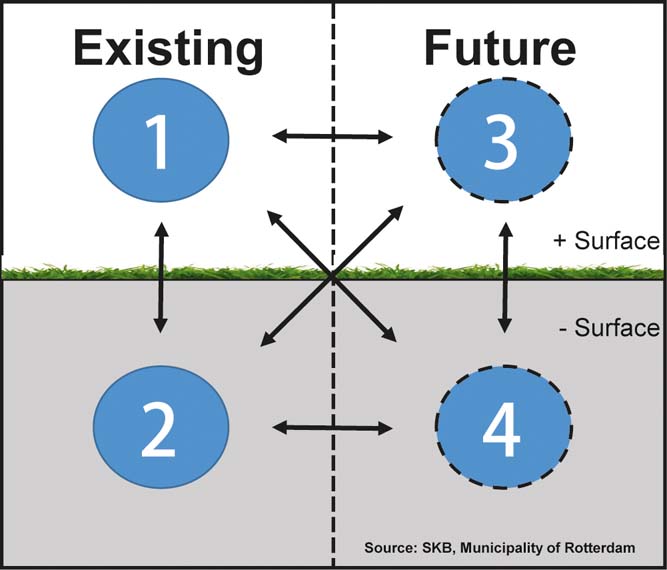
In an ideal future, working-process connections are made between the subsurface and the above-surface level, as well as between the existing and future objects and/or functions. Rotterdam has captured this in a Spatial Integration Approach (Fig. 2), combining surface and subsurface spatial planning.
Spatial integration approach.

All four compartments are related to each other. New functions (3 and 4) in the public space should be considered in the context of the existing functions (1 and 2), both below and above surface level. By following this process, possible conflicts and synergies become explicit, as well as open spaces for future functions. With this knowledge, the development can be assessed in such a way that it leads to the full use of possibilities of the public space as a whole, both above and below surface.
2.2. Providing subsurface information
Providing information is a direct way of communication between subsurface specialists and urban planners. It consists of two parts: (a) the type of information that is transferred; and (b) how this information is communicated. For both parts, communication tools and techniques are crucial to bridge the different worlds of planners and technicians.
2.2.1. Information types
In Rotterdam, data per sector are administered in databases and accessible through geographical information systems (GIS). Urban planners use subsurface data in their working process, but mainly driven by (sectorial) legislation; therefore, the data are not integrated with other subsurface or above-surface disciplines. With the introduction of the ‘Underground-Scan' tool (see Section 2.2.2), Rotterdam has improved the accessibility of this information to be used in maps that present obstacles and opportunities in the subsurface in the form of quality data (within economical areas) using simple ‘traffic light' legends. By using a simple legend that aggregates different information types, jargon is avoided and information becomes understandable for urban planners in the early stage of the planning process. At this stage, opportunities and risks related to the subsurface are best accounted for, giving way to more sustainable and cost-effective urban planning. Similarly, Glasgow is developing a guideline for urban planners, indicating which specialist to talk to in certain events/cases, including subsurface specialists. An integrated consideration and aggregation of available information types are points for attention there.
2.2.2. Communication tools
Temptation maps. In a trial for the creation of a subsurface masterplan, Rotterdam produces digital layered temptation maps, which invite the urban planner to take available subsurface information into account. The maps allow the urban planner to ‘peel off' the available (public) space, layer by layer, eliminating space used for buildings, roads, cables and pipes, trees with their roots, embankments with their buffer zones, subways, etc.
Underground-Scan. The ‘Underground-Scan' is carried out in a workshop environment with both subsurface specialists and urban planners, where basic information is aggregated, analysed and combined with GIS in quality and economical maps (van Campenhout et al. Reference van Campenhout, De Vette, Schokker and Van der Meulen2016). Possibilities for subsurface use are marked on opportunity maps, which answer questions such as ‘what areas in the plan area are less or more suitable for development?' and ‘which area is cheaper to develop than the other?'. Smart combinations can be made between different themes, which give rise to improved plans. The resulting maps are compared with urban planners' ambition maps. Maps are stuck on the wall and the subsurface specialists act as ‘living legends'. A spreadsheet is used where the language of the subsurface specialist is directly confronted with the language of the urban planners. Relationships between below- and above-ground-level topics can be visualised. The dynamic interaction between the urban planners and the subsurface specialists during the workshops has successfully produced improved insight in the spatial cohesion of the main themes above and below ground level.
Public contribution. Glasgow uses charrettes to provide urban plans with all kinds of knowledge and expertise. A charrette is a collaborative session in which a group drafts a solution to a problem. It is a method for consulting all stakeholders and consists of multi-day meetings, involving urban planners, politicians, specialists (subsurface and above ground) and residents. When a charrette is held in an early stage of the planning process, the municipal interests of subsurface opportunities and risks are introduced timely enough to create synergies and cost-effective planning (SubUrban 2017).
Norway also has a well-developed culture for public participation in development matters. It organises public workshops and seminars for professionals to collect input for a large redevelopment area.
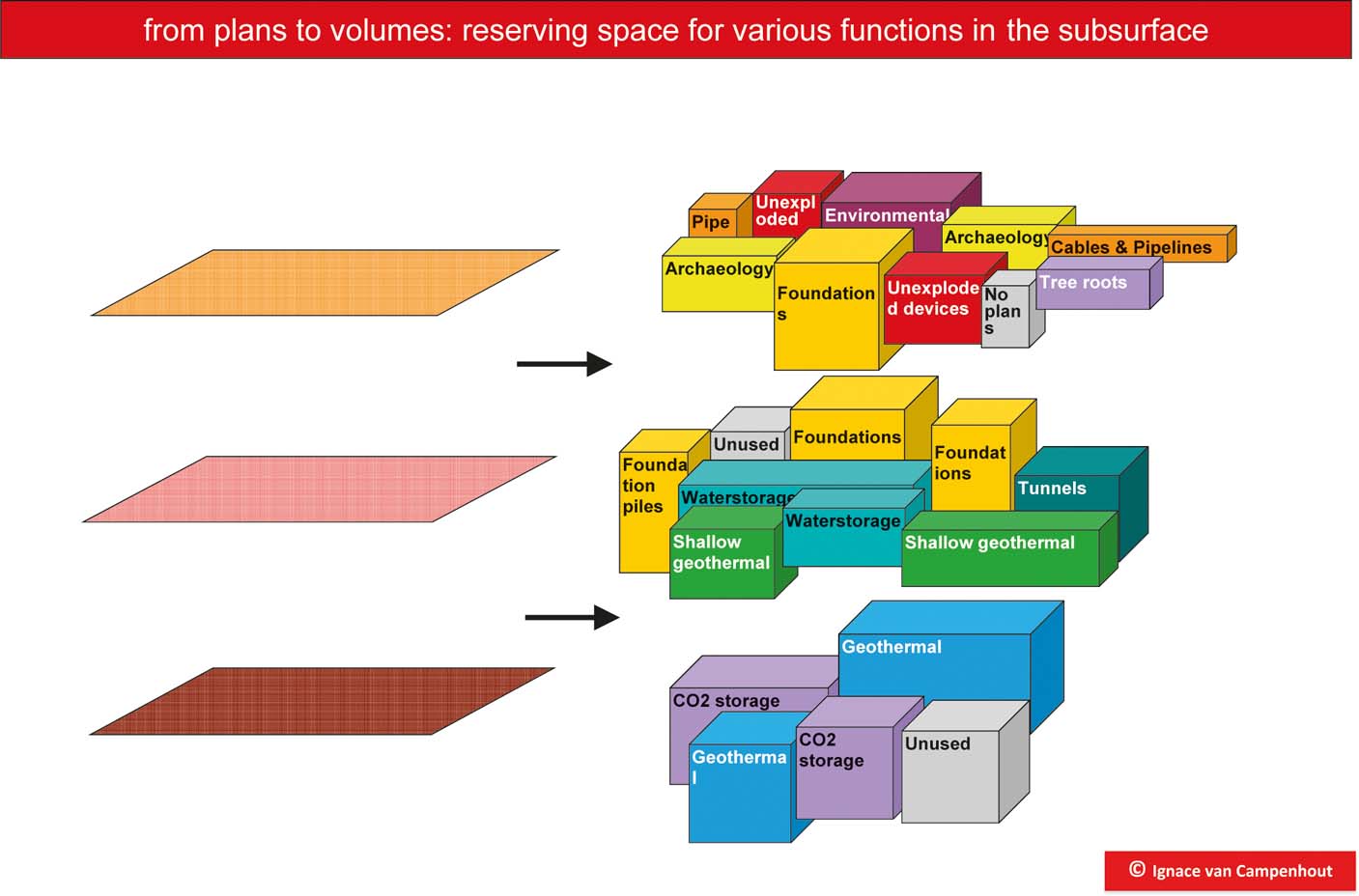
3D modelling. Several 3D modelling software packages are used, which differ in purpose, relevant depth and level of detail. This makes the exchange of information difficult. In Rotterdam, a digital 3D subsurface model of a part of the city is being developed. It connects several 3D modelling software packages and is to be used in an early stage of the urban planning process (van Campenhout et al. Reference van Campenhout, De Vette, Schokker and Van der Meulen2016). Grids are transformed into voxels, providing a block model that is easier to understand and in which it is possible to make reservations for features and characteristics at specific depths, such as those indicated in Figure 3.
3D block model of subsurface functions.

With a user-friendly interface, this is expected to give urban planners insight into how the subsurface is built up and also how certain functions or objects are claiming the same space. Future improvements include scenario development and the assessment of time-dependent processes (4D).
Oslo is currently investigating the need and possible use of a 3D digital model of the subsurface. In selected pilot areas, surveys are conducted on what data are available (type, amount and accuracy), how it can be of value for the model and which technologies can be used. Oslo has also constructed a physical 3D model of the city, based on available digital data, obtained by an orthophoto. A lot of experience and expertise has been developed in upgrading data to prepare it for 3D printing. This might be helpful in communications with urban planners as well as citizens.
Costs and benefits. Glasgow is investigating how to develop a tool to provide insight into the financial impacts of different spatial development solutions on a site, taking account of increased knowledge of the subsurface and the opportunities for greater efficiencies, as well as the de-risking of development that this may bring. Rotterdam is trying to relate costs to subsurface volumes (m3) and subsurface services, e.g., fundamental strength capacity and thermal storage capacity. Appraisal of the subsurface environment and resources by applying costs and benefits to specific functions and volumes is expected to improve the awareness of the subsurface as an invaluable aspect for sustainable and cost-effective urban planning. It is also expected to make it easier for non-subsurface specialists.
2.3. Challenges
Despite the aforementioned tools, increasing awareness and communication between urban planners and subsurface specialists in all three cities is time-consuming. In order to bridge the gap between subsurface specialists and urban planners, and to create more effective integrated planning, key issues need to be overcome.
2.3.1. Policy
No urban planners involved in subsurface policy (yet). Subsurface information should preferably become a regular part of the urban planning policy instead of a separate subsurface policy. Unfortunately, urban developers are not yet fully connected. In the current workflow, subsurface information only comes into the process during the construction phase, at which stage it is too late to change the ‘plan'.
Span of subsurface policy. Sorting out to what extent subsurface policy should become strictly regulated and/or where policy should only result in guidelines, and how this varies depending on the policy area, is a challenge. Another issue concerns determining which professional fields require a more holistic approach, without disrupting currently well-working processes. A selection needs to be made on which policy plans or guidelines are most appropriate to use.
In all three cities considered in this study, there is a tendency to make the (private) developer partly responsible for the (re)development of brown fields, providing green infrastructure and maintenance in adjacent public spaces. When including the subsurface, a wider scope is necessary to capture regional effects and opportunities, because subsurface influences might stretch further than development-site borders and, thus, further than private developers' concerns. Changes in the subsoil remain for a longer period of time than above-soil structures, if not forever. This makes it more important to consider, and at the same time harder to predict, all the consequences.
Interferences. Interferences between subsurface urban resources are often not considered in current policy. For example, energy-well systems are not considered as constraints that require mapping and buffer zones in Norway, resulting in conflicts with development plans.
Integral approach to all subsurface issues. Urban planners use subsurface information, but often in a sectored way, and too late in the planning process. This is a missed opportunity because most of the benefits are obtained through an integral consideration of the subsurface space in the early phases of a spatial planning process. The subsurface specialists need to change their way of working from the traditional sectored manner to an integrated approach.
Oslo has, for example, several guidelines to follow concerning how and when technical information is brought into the process, which is described in a flowchart that is used by urban planners. This flowchart could be adapted to ensure an early and integrated consideration of traditionally sectored information.
2.3.2. Legislation and data management
Regulation and permits. A complete overview of the regulations and permit requirements for activities in the subsurface is lacking in cities. This relates to activities such as digging, laying cables and pipes or other objects, contamination in soil, groundwater extraction and archaeology, in order to assess interconnections.
Ownership. Ownerships of large subsurface structures like tunnels are often not officially registered. In the studied cities, the ‘first-come-first-served' principle is applied. It is a challenge to find a legal way to reserve subsurface space for future functions. Only the prices of above-surface land are regulated and subsurface land is not to be bought, it is to be taken.
Data ownership and maintenance. Reliable data are the basis for interaction between subsurface specialists and urban planners. Even when information is scarce, it should be accompanied by metadata. The maintenance of data is, thus, important and poses challenges related to the allocation of personnel and budgets. Because knowledge and data are sometimes scattered over several local authority departments, it is a challenge to clarify responsibilities for maintenance and to allocate appropriate budgets.
Data availability. During the early phase of a planning process there is often little data available, which means that the aforementioned integral approach has to be based on bits and pieces of information with varying accuracy. As a consequence, the subsurface specialist can only assess and communicate huge uncertainties at this stage.
Scattered subsurface data in different formats is challenging. Obtaining access to classified data is often a time-consuming process. Making subsurface data accessible where it is needed can save time and money in many different processes. In Oslo, obtaining access to some data has even led to court cases. It seems like Rotterdam does not have a lot of restrictions relating to data accessibility. If necessary, access to the objects themselves may be restricted, but not the data about the objects.
Other concerns about data availability are related to the risk of misinterpretations and drawing incorrect conclusions from subsurface data.
2.3.3. Capacity building
Private and public responsibility for subsurface information in the planning process. Different responsibilities between the (private) initiator or contractor and the municipality potentially pose challenges. This is particularly relevant for the determination of the physical consequences of a development involving subsurface aspects (e.g., ground stability or settling rates) and their interrelated effects. If the initiator bears the responsibility for the impact survey, the scope of the survey will often likely only encompass the development area, with the according budget. The effects to the wider surroundings, or on other aspects of the public space, might not be assessed. This means that the municipality needs to build capacity in terms of encompassing the right (technical) expertise, either to provide technical assessments or to make sure that the outsourcing of tasks to, for example, engineering consultants covers the necessary surveys and that tasks are carried out according to the sufficient quality requirements.
Organisation and network. Within cities there are often many different services (sections) involved in subsurface issues. Institutional arrangements are a challenge for the timely inclusion of subsurface information in urban planning processes and for improved communication between subsurface specialists and urban planners.
Training. Knowledge improvement requires training and continuing support and advice from subsurface specialists to urban planners and vice versa. Our study shows that a lack of systematic knowledge provision and training hinders the holistic approach required for sustainable urban planning.
Urban planners do not use data and software in the same manner as subsurface specialists. While urban planners use software mainly for the presentation and visualisation of their work, subsurface specialists use other analytical software to analyse and present an accurate-as-possible representation of reality. The incompatibility and misunderstanding of obtained results may pose challenges.
3. Conclusions and recommendations
One of the most important results from the COST Action study is an increased awareness and knowledge of the subsurface among those who are participating in the actual work, but also among politicians and other decision makers.
The STSMs that were carried out for this comparative study have shown that the provision of subsurface information and communication between urban planners and subsurface specialists is crucial, but difficult.
In order to ‘build bridges' between subsurface specialists and urban planners, a series of challenges will need to be overcome. We have observed that these challenges range from the improvement or realisation of current policy, legislation, regulations, workflows and data management, to organising institutional arrangements and the enhancement of knowledge provision and exchange. Several tools to address these issues have been described in this paper.
Knowledge improvement requires training and continuing support and advice from subsurface specialists to urban planners and vice versa. To foster the development of policy, which reflects the importance of the subsurface, and to enable holistic planning above and below ground requires training and support. Therefore, it is recommended to include subsurface knowledge as part of spatial planners' training and to include spatial planning knowledge as part of the training programme for subsurface specialists.
With regards to policy development, we recommend that the responsibility for subsurface knowledge development and the management of complex interrelations between above- and below-ground functions should be governed by legal authority.
This study has shown that it serves the interests of a city to ensure all impacts of urban development are considered in the 3D space of the urban environment, including the wider surroundings. It is, therefore, recommended to make this wider scope the liability of the municipality, or at least to have a content-related verification. In our opinion, this implies that the municipality needs to have the right expertise, either to provide technical assessments or to make sure that the outsourcing of tasks to, for example, engineering consultants covers the necessary surveys, and that tasks are carried out according to sufficient quality requirements. In other words, public interests do imply public liability.
The research carried out in this study shows that there are multiple intentions for describing the subsurface in different municipal plans. The following actions are recommended:
• Make inventories of subsurface objects, issues and plans in order to prevent obstruction by competition for physical space. It is recommended to include this in a thematic subsurface sub-plan (site scale).
• Acknowledge the subsurface as part of the public space to facilitate ambitions. Inclusion in the regular or ‘holistic' municipal (master) plan is recommended (city scale).
• Produce (spatial) guidance to clarify options, raise awareness and specify the attitude to the subsurface, protecting, (p)reserving, exploiting or improving the subsurface. This distinction can help cities in deciding where to put in the effort(s). This recommended guidance should include a subsurface vision or statement and should be spatially based, incorporating 3D models and/or maps (strategic scale).
4. Acknowledgements
This paper has been produced within the framework and with financial support of the European Union COST Action TU1206 Sub-Urban. The authors wish to acknowledge the support and facilities provided by the Planning and Building Agency of the city of Oslo, and particularly the Subsurface Project for hosting the short-term scientific missions. The constructive comments of two anonymous reviewers are highly appreciated. This paper is published with permission of the Executive Director of the British Geological Survey. BGS/NERC reference: PRP17/054.