Introduction
The extending working lives agenda, encouraging labour force participation beyond traditional retirement ages, brings increasing focus on the types of economic activities that individuals are engaged in from mid-life onwards and also on lifecourse predictors of different types of economic activity (Lundin & Hemmingsson, Reference Lundin and Hemmingsson2013). By their mid-fifties, many individuals have already left the workplace due to early retirement, long-term sickness or disability, unemployment or may remain homemakers, placing expectations on those who remain in the workplace to extend their working lives. Getting people into employment and keeping them in employment is key to the extending working lives agenda (van der Noordt et al. Reference van der Noordt, Ijzelenberg, Droomers and Proper2014).
Labour force participation is characterized by activities encompassing employment covering full-time, part-time and self-employment versus those that characterize work place exit covering unemployment and long-term sickness or disability – often conceptualized as being ‘non-voluntary’ work exits, versus early retirement – often conceptualized as being a ‘voluntary’ work exit. The role of homemaking in later life has been largely overlooked in previous studies (Alavinia & Burdorf, Reference Alavinia and Burdorf2008), and whilst likely to include a group undertaking caring responsibilities, it may also include individuals who have undergone work place exit at some earlier point in the lifecourse for other reasons.
Health is a key predictor for employment (van Rijn et al. Reference van Rijn, Robroek, Brouwer and Burdorf2014), and, in turn, good employment is beneficial for health (van der Noordt et al. Reference van der Noordt, Ijzelenberg, Droomers and Proper2014). The health selection hypothesis posits that individuals in good health are more likely to obtain and stay in employment, whilst individuals with poorer health are more likely to lose their jobs, be or remain unemployed, or receive disability pensions. In terms of lifecourse predictors of moving from labour force participation to exit, a recent systematic review concluded that poorer self-rated health prospectively increased the likelihood for transition to receipt of a disability pension, being unemployed, and early retirement, whilst psychological health problems increased the likelihood for transition to receipt of a disability pension and unemployment but not early retirement (van Rijn et al. Reference van Rijn, Robroek, Brouwer and Burdorf2014).
Whilst psychological health has a strong influence on employment in older age, it is overlooked by a lot of research (Lain, Reference Lain2016). The Black Report (Black, Reference Black2008) identified psychological health as one of the two most important health constraints on employment, the other being musculoskeletal disorders. However, a longitudinal lifecourse approach is important as there are different potential pathways to poorer levels of psychological health among economically inactive older people. On the one hand, older non-working adults may have poorer psychological health because they became inactive – the so-called ‘causation’ explanation (Montgomery et al. Reference Montgomery, Bartley, Cook and Wadsworth1996). Analyses of the US Health and Retirement Study found increased levels of depression among workers on below median incomes who had lost their jobs (Gallo et al. Reference Gallo, Bradley, Dubin, Jones, Falba, Teng and Kasl2006). An alternative perspective, ‘direct health selection’, posits that poorer psychological health leads to inactivity (Montgomery et al. Reference Montgomery, Bartley, Cook and Wadsworth1996). This is likely to include psychological disorders that reflect relatively stable personality traits (Lundin & Hemmingsson, Reference Lundin and Hemmingsson2013), or ‘scarring’ effects, whereby previous psychological problems have long-term negative employment consequences. As psychological ill-health begins early in the lifecourse for many individuals (Insel & Fenton, Reference Insel and Fenton2005; Clark et al. Reference Clark, Rodgers, Caldwell, Power and Stansfeld2007), research into the long-term effects of psychological problems from childhood/early adulthood into older age is needed in order to better understand the processes at play, something that is currently missing from the literature.
Previous evidence relating early-life psychological health to labour force participation and exit is largely limited to studies examining psychological health in late adolescence or early adulthood on unemployment or disability pensions and is often restricted to male populations (Montgomery et al. Reference Montgomery, Bartley, Cook and Wadsworth1996; Lundin & Hemmingsson, Reference Lundin and Hemmingsson2013). Gaps in knowledge remain in relation to the role of externalizing and internalizing problems in childhood; across a broader range of economic activities in later adulthood; and for women. Previous studies have also differed in length of follow-up (van Rijn et al. Reference van Rijn, Robroek, Brouwer and Burdorf2014) and which adulthood time periods were examined. Few studies have taken a lifecourse approach.
A number of lifecourse factors beyond health also influence labour force participation and exit such as educational attainment or cognitive ability, partnership history, and past occupational history and labour demand (Haas et al. Reference Haas, Glymour and Berkman2011; Lundin & Hemmingsson, Reference Lundin and Hemmingsson2013; MacNicol, Reference MacNicol2015). Interestingly, childhood and/or adulthood psychological health have been shown to be prospectively associated with educational attainment, partnership status and past occupational history (Gibb et al. Reference Gibb, Fergusson and Horwood2011; Copeland et al. Reference Copeland, Wolke, Shanahan and Costello2015; Mojtabai et al. Reference Mojtabai, Stuart, Hwang, Eaton, Sampson and Kessler2015; Veldman et al. Reference Veldman, Reijnveld, Ortiz, Verhulst and Bultmann2015), suggesting that these lifecourse factors may explain associations between psychological health and labour force participation and exit in later adulthood. Associations between psychological health and labour force participation and exit may also be confounded by lifecourse socio-economic status, education (own and parent) and childhood adversity (Lorant, Reference Lorant2003; Clark et al. Reference Clark, Caldwell, Power and Stansfeld2010; Stansfeld et al. Reference Stansfeld, Clark, Rodgers, Caldwell and Power2011; Henderson et al. Reference Henderson, Richards, Stansfeld and Hotopf2012).
The existing literature has very little to say about lifecourse predictors of being a homemaker, perhaps because of the previous neglect of women in workforce research. Most studies have not included this type of economic activity in their analyses, despite high numbers of homemakers in the older adult population (DWP, 2014). The implicit assumption is that the inactivity of homemakers is related to male-breadwinner norms among the older population. What has not been examined is whether earlier psychological problems influence inactivity as a homemaker. Consequently, it is harder to reflect upon policies that would positively support increased employment among this group.
It is also important to acknowledge gender as a potential moderator of associations between psychological health and labour force participation and exit: prevalence rates for different types of disorders across childhood and adulthood differ by gender (Green et al. Reference Green, McGinnity, Meltzer, Ford and Goodman2005; McManus et al. Reference McManus, Meltzer, Brugha, Bebbington and Jenkins2009), and there are also gendered patterns of economic activities (Loretto & Vickerstaff, Reference Loretto, Vickerstaff, Tyson and Parry2011).
This paper examines whether childhood and adulthood psychological ill-health are associated with labour force participation and exit at 55 years. We examine whether associations differ by gender; for internalizing versus externalizing problems in childhood; and for early adulthood versus later adulthood psychological distress. We also examine whether the associations observed for childhood psychological health are influenced by adulthood covariates including psychological ill-health, education, number of partnership separations, current partner's labour force activity, number of children, length of time homemaking, and unemployment history.
Method
Sample
Data were from the National Child Development Study, a cohort of 98% of births in England, Scotland and Wales during 1 week in March 1958 (n = 18 558). Information was obtained from parents and teachers at 7, 11 and 16 years and by participant interviews at the ages of 7, 11, 16, 23, 33, 42, 45, 50 and 55 years. Analyses are based on 9137 participants who took part in the 55-year survey: response rate 82.5% of the invited sample (n = 11 070), representing 49.2% of the original cohort population. Ethical approval for the 55-year survey was granted by the Multicentre Research Ethics Committee (MREC) London Central (12/LO/2010).
Measures
Labour force participation and exit at 55 years
Labour force participation or exit was self-reported at 55 years, with participants reporting their main activity as full-time employed (self-employed or employed), part-time employed (self-employed or employed), unemployed, retired, permanently sick (defined as being long-term sick or disabled) or homemaker/other [self-defined as either looking after home/family or something else (including n = 31 temporary sick)]. Cohabiting participants reported their partner’s current labour force participation, using a similar question.
Lifecourse psychological health
Internalizing and externalizing problems were measured at the ages of 7, 11 and 16 years using the teacher-report Bristol Social Adjustment Guides and Rutter Scales (Rutter, Reference Rutter1967, Reference Rutter1970; Elander & Rutter, Reference Elander and Rutter1996). Internalizing problems comprised symptoms including depression, worry and withdrawal; externalizing problems comprised symptoms including hostility, disobedience, aggressiveness and bullying. These scales have demonstrated reliability in this cohort (Clark et al. Reference Clark, Rodgers, Caldwell, Power and Stansfeld2007). Counts of the number of reports of internalizing and the number of reports of externalizing problems across the childhood period (7 years, 11 years and 16 years, inclusive) were derived.
Psychological health at the ages of 23, 33, 42 and 50 years was assessed using the Malaise Inventory (Rodgers et al. Reference Rodgers, Pickles, Power, Collishaw and Maughan1999), which assesses psychological and somatic symptoms. This paper uses the nine-item version, where a score of 4 or higher denotes a high level of distress (Brown et al. Reference Brown, Elliott, Hancock, Shepherd and Dodgeon2010). Counts of the number of reports of malaise across the adulthood period (23, 33, 42 or 50 years), in early adulthood (23 or 33 years) or in later adulthood (42 or 50 years) were derived.
Lifecourse covariates
Social position was assessed using the Registrar General's Social Class measure (I = professional; II = managerial, and technical occupations; IIInm = skilled non-manual occupations; IIIm = manual occupations; IV = partly skilled occupations; v = unskilled occupations) in childhood at age 7 years (for the father) and in adulthood (23 years, 33 years, 42 years, 50 years) (OPCS, 1980). Highest educational qualification was self-reported at 33 years. The number of children the participant had across adulthood was reported at 55 years. A count of times the participant had been unemployed (having no employment and seeking paid work as opposed to undertaking other non-working activities such as homemaking) from 16 years to 42 years was derived from the activity histories available from 1974 to 2009 (Hancock et al. Reference Hancock, Elliott, Johnson and Bukodi2011a ). For further details, see Stansfeld et al. (Reference Stansfeld, Clark, Smuk, Power, Davidson and Rodgers2017). The number of months of homemaking activity reported over this period was also calculated. A count of the number of separations from a cohabiting partnership from 16 years to 42 years was derived from the partnership histories for the period 1974–2008 available for the cohort (Hancock et al. Reference Hancock, Elliott, Johnson and Bukodi2011b ).
Missing data
With over five decades of data collection, missing data needed to be addressed in the datasets. Non-participation at 55 years was significantly predicted by childhood and adulthood psychological health, being male, lower social class and educational qualifications. Within our cohort of participants in the 55-year survey, missing data ranged up to 21.1% for individual variables (not derived count variables). Missing data patterns were explored and ‘missing at random’ (Rubin, Reference Rubin1987) was assumed. We imputed the data using multiple imputation by chained equations in Stata's ICE package (StataCorp, 2015). Interaction terms between gender and the psychological health outcomes were passively imputed. The imputation model was chosen to be congenial (Meng, Reference Meng1994) with the most saturated model of interest and hence included all the lifecourse psychological health and covariates described in the method, along with labour force participation and exit at 55 years. Due to lack of data relating to the partner, partner labour force participation was not imputed reducing the sample size (n = 137), leaving a sample of n = 9010 for imputation. We created 25 imputed datasets, using 100 cycles and checked the convergence of the imputation algorithm.
Statistical analysis
A series of unadjusted and adjusted multinomial regression analyses were conducted to examine associations between the counts of childhood and adulthood psychological ill-health measures and labour force participation and exit at 55 years. These regression analyses compared the relative risks (RRs) for being part-time employed, unemployed, retired, permanently sick and homemaker/other, with the full-time employed as the reference group. Models for childhood psychological ill-health were adjusted for father's social class at 7 years, gender, and marital status at 55 years. Models for adulthood psychological ill-health were adjusted for gender, number of times in manual social class in adulthood, and marital status at 55 years. Interactions of childhood and adulthood psychological ill-health with gender were examined: analyses were stratified by gender if the interaction term was significant (p ⩽ 0.05) and adjusted for gender if not.
We were unable to run causal mediation estimates, as the data are multinomial categorical (Hicks & Tingley, Reference Hicks and Tingley2011). To explore whether the associations for childhood psychological health were influenced by adulthood factors, first, the association of each adulthood factor (number of children in the household; number of months of homemaking; partner's labour force participation or exit; educational qualifications; number of times unemployed; and number of partnership separations) with labour force participation and exit was examined. Second, each adulthood factor was entered individually to examine whether associations of childhood psychological health on labour force participation and exit at 55 years became non-significant (p > 0.05).
Data were analysed with Stata version 14 (StataCorp, 2015).
Results
At 55 years, 81.2% reported labour force participation (61.5% full-time employed or self-employed and 19.7% part-time employed or self-employed), leaving 18.8% who were out of the labour force [2.8% unemployed, 5.2% permanently sick, 3.3% retired and 7.5% homemaker/other (made up of 81.8% homemakers, 4.7% temporary sick and 13.5% other)] (see Table 1).
Descriptives and missing data for people who took part in the age 55 years survey (n = 9010) a

HM, Homemaking.
a Excluding 137 people who were missing data on partner's employment status.
b % Missing at least one of the measures used to derive this variable.
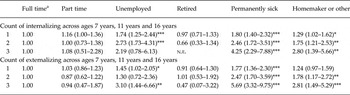
Table 2 shows that after adjustment for gender, father's social class at 7 years, and marital status at 55 years, internalizing problems and externalizing problems in childhood both increased the risk for being unemployed, permanently sick and homemaking/other. Risk for permanent sickness and homemaking/other increased with the count of internalizing problems; one or two reports of internalizing problems in childhood increased risk for unemployment. Risk for permanent sickness increased with the count of externalizing problems; one or three reports of externalizing increased risk of unemployment, and two or three reports of externalizing increased risk for homemaking/other. No gender interactions were observed between the childhood psychological health measures and labour force participation or exit at 55 years.
Associations between childhood psychological health and economic activity at 55 years, adjusted for gender, social class at 7 years and marital status at 55 years ( n = 9010)

Data are given as relative risk ratio (95% confidence interval).
n.e., Not estimated due to low power.
a Reference category.
* p = 0.05, ** p = 0.01, *** p ⩽ 0.01. A gender interaction was explored in each model; none was significant at p < 0.05.
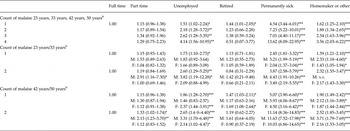
Table 3 shows that after adjustment for gender, adulthood social class, and marital status at 55 years, risk for being unemployed increased with the count of malaise in adulthood, as did risk for permanent sickness and homemaking/other. Risk for being retired was borderline significantly associated with one count of malaise in adulthood [RR 1.44, 95% confidence interval (CI) 1.01–2.05].
Associations between adult psychological health and economic activity at 55 years, adjusted for gender, social class in adulthood and marital status at 55 years (n = 9010) a

Data are given as relative risk ratio (95% confidence interval). Gender-stratified estimates are presented where there is a gender interaction.
n.e., Not estimated due to low power; M, males; F, females.
a Social class is a count of the number of times in manual work for multiple age measures.
b Reference group is 0.
* p = 0.05, ** p = 0.01, *** p ⩽ 0.01.
Comparing the risk for those with malaise in early adulthood (23/33 years) with later adulthood (42/50 years), similar associations were seen for an increase in risk for unemployment and homemaking/other, but the risk was smaller, but still sizeable, for permanent sickness in early adulthood than in later adulthood.
Some gender differences in associations between adulthood psychological health and labour force participation and exit at 55 years were observed (Table 3). Reporting malaise at both 23 years and 33 years increased risk for working part time for men (RR 2.91, 95% CI 1.16–7.30); reporting malaise at both 42 years and 50 years increased risk for working part time for men (RR 2.13, 95% CI 1.23–3.70). Table 3 also shows that men experiencing malaise at both times either in early adulthood or in later adulthood show greater risk of being permanently sick or homemaking/other at 55 years, compared with women but the risks were sizeable for both genders.
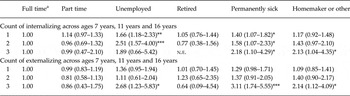
Table 4 shows that many of the associations between childhood psychological ill-health and labour force participation and exit at 55 years were statistically significant after additional adjustment for the count of malaise in adulthood. Internalizing problems in childhood were significantly associated with increased risk for unemployment and permanent sickness. Experiencing three reports of externalizing across childhood was associated with increased risk for being unemployed, being permanently sick and homemaking/other.
Associations between childhood psychological health and economic activity at 55 years, adjusted for gender, social class at 7 years, marital status at 55 years, adulthood social class, with additional adjustment for count of reports of malaise in adulthood ( n = 9010)

Data are given as relative risk ratio (95% confidence interval).
n.e., Not estimated due to low power.
a Reference category.
* p = 0.05, ** p = 0.01, *** p ⩽ 0.01.
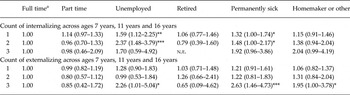
Online Supplementary Table S1 shows that labour force participation and exit were associated with number of children in the household, current partner's labour force participation and exit, number of partnership separations, number of periods of unemployment, educational qualifications and months of homemaking. These adulthood factors were individually added to the childhood psychological health models. Adjustment for these factors hardly changed the estimated coefficients (results not shown), with the exception of the model adjusting for educational qualifications (see Table 5), which influenced some but not all of the associations. Having one or two reports of internalizing in childhood was associated with increased risk for unemployment (RR 1.59, 95% CI 1.12–2.25; RR 2.37, 95% CI 1.48–3.79) and permanent sickness (RR 1.32, 95% CI 1.00–1.74; RR 1.48, 95% CI 1.00–2.17). Having three reports of externalizing in childhood was associated with increased risk for unemployment (RR 2.26, 95% CI 1.01–5.04), permanent sickness (RR 2.63, 95% CI 1.46–4.73) and for homemaking/other (RR 1.95, 95% CI 1.00–3.78).
Adjusted associations between childhood psychological health and economic activity at 55 years, adjusted for gender, social class at 7 years, marital status at 55 years, adulthood social class, count of reports of malaise in adulthood, and further adjusted for educational qualifications at 33 years ( n = 9010)

Data are given as relative risk ratio (95% confidence interval).
n.e., Not estimated due to low power.
a Reference category.
* p = 0.05, ** p = 0.01, *** p ⩽ 0.01.
Discussion
Summary of the evidence
Using prospective data over 55 years, this study found that childhood and adulthood psychological ill-health were both associated with work place exit at 55 years in terms of unemployment, permanent sickness and homemaking/other. Childhood and adulthood psychological ill-health were not associated with early retirement at 55 years.
Adulthood psychological health
This study found robust associations between malaise in adulthood and unemployment, permanent sickness and homemaking/other, confirming that adult mental health is a key predictor of labour force exit (van Rijn et al. Reference van Rijn, Robroek, Brouwer and Burdorf2014). Just one count of malaise in adulthood increased risk for these outcomes, and there was a dose–response relationship between episodes of malaise and the increase in risk. Previous studies have found that poor psychological health predicts unemployment over several months (Kaspersen et al. Reference Kaspersen, Pape, Ose, Gunnell and Bjorngaard2016a ) but also over many years (Kaspersen et al. Reference Kaspersen, Pape, Vie, Ose, Krokstad, Gunnell and Bjørngaard2016b ). We found that malaise at any time in adulthood predicted unemployment many years later, with follow-up encompassing 5–32 years. Adulthood psychological health did not predict early retirement, supporting the conclusion of a recent systematic review (van Rijn et al. Reference van Rijn, Robroek, Brouwer and Burdorf2014).
Previous studies of disability pension receipt, an outcome similar to our measure of permanent sickness, have shown robust associations with mental health in both the short (Overland et al. Reference Overland, Glozier, Henderson, Maeland, Hotopf and Mykletun2008) and the long term (Mykletun et al. Reference Mykletun, Overland, Dahl, Krokstad, Bjerkeset, Glozier, Aarø and Prince2006; Knudsen et al. Reference Knudsen, Øverland, Aakvaag, Harvey, Hotopf and Mykletun2010). A Norwegian study found that individuals in receipt of disability benefit for mental ill-health were awarded this at a significantly younger age (46 years) than those in receipt of disability pension for musculoskeletal disorder (55 years) (Knudsen et al. Reference Knudsen, Øverland, Hotopf and Mykletun2012). We found larger associations between malaise in later adulthood and permanent sickness, probably reflecting the closer time-frame between ill-health and transition to permanent sickness status: this may also reflect stress associated with the period leading up to the transition to permanent sickness status (Overland et al. Reference Overland, Glozier, Henderson, Maeland, Hotopf and Mykletun2008). Previous studies have suggested that recipients of disability benefits have poorer perceived health compared with both the employed and unemployed (Overland et al. Reference Overland, Glozier, Maeland, Aaro and Mykletun2006); our findings may indicate that poorer perceptions of health may be present much further back in the lifecourse and that return-to-work schemes should consider additionally focusing on patients’ perceptions of their health, as suggested by Overland et al. (Reference Overland, Glozier, Maeland, Aaro and Mykletun2006).
Few studies have examined lifecourse predictors of being a homemaker in later adulthood. In this study, participants describing themselves as ‘homemakers/other’ self-defined their main activity as looking after the home/family, being temporarily sick or disabled, or something else. However, the majority of this group were looking after the home/family (>80%). As participants selected which category described their main activity, those describing themselves as homemakers are not able to say they are in full-time or part-time employment, or that they are unemployed. The European Survey on Health and Aging in Europe (SHARE) found that being a homemaker at age 50–64 years was predicted by poorer health, lower education and depression (Alavinia & Burdorf, Reference Alavinia and Burdorf2008). Our findings support the hypothesis that poorer mental health at any stage of adulthood predicts homemaking in later adulthood. Homemaking is predicted by factors that also predict other ‘non-voluntary’ work exits such as permanent sickness and unemployment. It is likely that the roles and activities of individuals who describe themselves as homemakers vary and may include some individuals who are not working for health-related reasons. Psychological ill-health in homemakers may reflect stress associated with caring duties for offspring or older relatives (Stansfeld et al. Reference Stansfeld, Smuk, Onwumere, Clark, Pike, McManus, Harris and Bebbington2014); conversely, homemaking may be a less-stigmatizing label used by some who are vulnerable to psychological distress. Kaspersen et al. (Reference Kaspersen, Pape, Vie, Ose, Krokstad, Gunnell and Bjørngaard2016b ) highlighted the need for policy to focus on the health of out-of-work individuals, including the provision of support, preparing individuals for re-employment. Our findings suggest that the group of out-of-work individuals could be widened to include some homemakers, who may also qualify for re-employment schemes (Kaspersen et al. Reference Kaspersen, Pape, Vie, Ose, Krokstad, Gunnell and Bjørngaard2016b ).
Our findings suggest that men may be more likely to undertake part-time employment at 55 years if they have malaise at both time points in either earlier or later adulthood, although this finding needs replicating in other cohorts. This may reflect an agreement for more flexible working conditions for those who know they experience poor psychological health. Few studies to date have examined part-time work in male populations.
Childhood psychological health
Psychological influences on labour force exit have their origin further back in the lifecourse. Childhood psychological health did not show associations with part-time employment or early retirement but was a significant distal factor for unemployment, permanent sickness and homemaking/other in later adulthood.
Few studies have tracked childhood psychological health onto a range of labour force activities beyond early adulthood (Henderson et al. Reference Henderson, Hotopf and Leon2009). Analyses of the Great Smoky Mountains cohort found that childhood psychiatric disorders predicted inability to keep a job, quitting multiple jobs and being dismissed up to 25 years (Copeland et al. Reference Copeland, Shanahan, Egger, Angold and Costello2014, Reference Copeland, Wolke, Shanahan and Costello2015). Our findings suggest that the effects of childhood psychological problems extend further into the lifecourse. We have not examined further childhood factors, such as childhood adversity, trauma and neglect, which might plausibly account for or precede the effect of childhood psychological health on mid-life labour force participation and exit. Copeland et al. (Reference Copeland, Wolke, Shanahan and Costello2015) found that childhood psychiatric disorder was associated with poorer outcomes in early adulthood, including educational outcomes, and this resulted in a disrupted transition to adulthood probably making an impact on achieving good working conditions and higher status occupations. Due to the categorical multinomial nature of our data, we cannot assess whether education mediates the association between childhood psychological health and labour force activity. Previous studies have demonstrated the importance of education and cognitive ability for labour force exit in early and later adulthood (Henderson et al. Reference Henderson, Richards, Stansfeld and Hotopf2012; Sörberg et al. Reference Sörberg, Lundin, Allebeck, Melin, Falkstedt and Hemmingsson2013). Targeting both childhood psychological health and educational outcomes might be beneficial for the extending working lives agenda. This proactive approach focusing on primary prevention of psychological ill-health and education as a means of reducing risk for labour force exit contrasts with the popular reactive model focusing on better detection and treatment of adult mental health problems in occupational settings (Health & Safety Executive, 2007; Black, Reference Black2008).
One or two counts of internalizing problems increased risk for unemployment and permanent sickness at 55 years. Previous studies have found that multiple episodes of internalizing disorders in childhood are associated with greater risk of long-term psychopathology across the lifecourse (Clark et al. Reference Clark, Rodgers, Caldwell, Power and Stansfeld2007; Colman et al. Reference Colman, Wadsworth, Croudace and Jones2007), indicating one pathway for the effects observed on labour force exit. Reporting externalizing at all three time points in childhood was a significant risk factor for unemployment and permanent sickness at 55 years, confirming previous reports of associations between childhood externalizing problems and poorer health in early adulthood (Odgers et al. Reference Odgers, Caspi, Broadbent, Dickson, Hancox, Harrington, Poulton, Sears, Thomson and Moffitt2007). Having three reports of externalizing reflects lifecourse persistent externalizing problems (Odgers et al. Reference Odgers, Moffitt, Broadbent, Dickson, Hancox, Harrington, Poulton, Sears, Thomson and Caspi2008) and is indicative of clinically relevant, more severe symptomatology and vulnerability: these findings identify a population that could be the focus on interventions in relation to labour force participation. Having one or two reports of externalizing problems is hypothesized not to increase risk as this is normative behaviour in adolescence (Moffitt, Reference Moffitt1993). Childhood psychological health may have a direct influence on labour force exit, but factors such as childhood parenting experiences, personality and coping styles, and inequalities in access to treatment may explain these relationships.
It was not possible to examine the role of potential mediators of the association between psychological health and labour force exit. Possible mediators include educational attainment, partnership history and occupational history (Gibb et al. Reference Gibb, Fergusson and Horwood2011; Haas et al. Reference Haas, Glymour and Berkman2011; Lundin & Hemmingsson, Reference Lundin and Hemmingsson2013; Copeland et al. Reference Copeland, Wolke, Shanahan and Costello2015). Valid statistical methods for examining mediation using multinomial categorical data are not yet available (Richiardi et al. Reference Richiardi, Bellocco and Zugna2013). We have therefore been limited to treating these adulthood factors as covariates, rather than mediators, which may bias our results and conclusions (Richiardi et al. Reference Richiardi, Bellocco and Zugna2013).
Limitations and strengths
This study had several limitations. Labour force participation and exit at 55 years were self-reported, with participants categorizing their main economic activity: such a question may not reflect increasingly diverse multi-occupational patterns in later adulthood. Descriptors of different out-of-work statuses are subjective and may plausibly be influenced by psychological health. The capacity restrictions on current multiple imputation software meant that we had to collapse the categories for homemakers and ‘other’ together for analysis purposes. Further, imputation was restricted to individuals who participated in the 55-year study, meaning that the findings are based on analyses of 50% of the original birth cohort population. This may limit generalizability of the findings and may result in overtly conservative findings, as those with poorer health and greater social disadvantage may be missing from the dataset. We lacked power to explore participants on temporary sick leave. Adulthood psychological health was self-reported using a symptom scale, not a clinical diagnostic measure. We have not accounted for temporal and reciprocal relationships that may exist between psychological health and permanent sickness.
Strengths include: the use of multi-informant data over 55 years; multiple imputation to address missing data; examination of a broad range of labour force participation and exit outcomes not restricted to a working or all-male population; taking a range of adulthood lifecourse factors into account which might influence associations between psychological health and labour force participation at 55 years.
Conclusions
Success of the extending working lives agenda depends on getting people into, and keeping them in, employment (van der Noordt et al. Reference van der Noordt, Ijzelenberg, Droomers and Proper2014). It is notable that psychological problems across the lifecourse, including during childhood, significantly reduce the likelihood of working in older age. It was previously known that psychological problems in older age were associated with an increased likelihood of not working (Black, Reference Black2008). However, until now the long-term impact of childhood mental health on employment in older age was not empirically established. The provision of support for those with mental health problems at different life stages could therefore be a dimension of attempts to extend working lives (on the development of policy interest in mental health and employment, see Irvine, Reference Irvine, Vickerstaff, Phillipson and Wilkie2013). The UK Government's Fuller Working Lives Framework for Action (DWP, 2014), which is aimed at increasing employment among older people, indicates that the government will pilot the provision of increased psychological support for benefit claimants. More generally, the UK government has committed to having a ‘parity of esteem’ between mental and physical health. A key innovation has been the ‘Improving Access to Psychosocial Therapies’ (IAPT) programme, which has increased provision of therapies for those with depressive and anxiety disorders. Evaluations of IAPT suggest that ‘Nationally, of [adult] people that finished a course of treatment in IAPT, 45% recover… and a further 16% show reliable improvement’ (Fonagy & Clark, Reference Fonagy and Clark2015). These results are encouraging, and hopefully modest employment increases among participants found in early evaluations (Clark et al. Reference Clark, Layard, Smithies, Richards, Suckling and Wright2009) could signal sustained improvements in labour market outcomes more generally. However, our study highlights the importance of childhood mental health on employment in older age. The Children and Young People's IAPT has found less obvious success, and there is a need to continue examining how improvements in childhood mental health can be made (Fonagy & Clark, Reference Fonagy and Clark2015). Mental health interventions in schools are mooted as an area where more could be done (Fazel et al. Reference Fazel, Hoagwood, Stephan and Ford2014).
As noted above, a particular focus has thus far been on the benefits of providing therapies for inactive people on benefits (DWP, 2014). However, population ageing means that governments will want to maximize employment among ‘the working age population’ more generally, in order to offset the costs associated with an increased population of older people. This will most likely mean increasing employment among ‘homemakers’ (Altmann, Reference Altmann2015). Historically, there has been little examination of why large numbers of older women are in this category. Our analysis suggests that mental health problems earlier in the lifecourse are significantly associated with being an economically inactive ‘homemaker’ for people in their mid-fifties. If policy is to increase employment among this group, it has to do more to provide and promote mental health services for those with limited connections to the labour market, including homemakers.
Supplementary material
The supplementary material for this article can be found at https://doi.org/10.1017/S0033291717000010
Acknowledgements
This work was funded by the Uncertain Futures: Managing Late Career Transitions and Extended Working Life project by the Economic and Social Research Council (ES/L002949/1) (S.V., C.C., D.L.). S.A.S., E.C., J.H. and C.C. are supported by joint funding from the Economic and Social Research Council and the UK's Medical Research Council, under the Lifelong Health and Wellbeing Cross-Council Programme initiative (ES/L002892/1).
Declaration of Interest
None.