Introduction
Compared to Fasciola hepatica, the experimental production of Paramphistomum daubneyi metacercariae is more difficult. First, 9 or 10 weeks at 20°C are necessary to obtain the first cercarial shedding of this last digenean when Galba truncatula is used as a snail host (Rondelaud et al., Reference Rondelaud, Fousi, Vignoles, Moncef and Dreyfuss2007). Indeed, the cercariae of F. hepatica become progressively free from day 33 post-exposure (p.e.) at 20°C so that a limited number of cercariae are always present within the snail's haemocoel and the first cercarial shedding begins from day 42 p.e. In contrast, the procercariae of P. daubneyi become free from day 25 p.e. and continue their differentiation within the snail so that their number is clearly higher than that of F. hepatica cercariae, thus inducing a delay in larval development and cercarial shedding. Second, the mortality of P. daubneyi-infected snails during week 9 or week 10 (at 20°C) is greater. Finally, the shell height (4 mm) of G. truncatula used for experimental infections only allows a low production of P. daubneyi cercariae (a mean of 95–127 per cercaria-shedding snail) (Rondelaud et al., Reference Rondelaud, Fousi, Vignoles, Moncef and Dreyfuss2007). Under these conditions, more G. truncatula must be used to obtain a given number of metacercariae. Several changes in the method applied by our team for P. daubneyi are thus necessary for enhancing metacercarial production and shortening the time necessary to obtain these larvae.
Numerous factors are already known to have an influence on the success of snail infections with F. hepatica. To increase larval production of this digenean, the quality of the diet used to feed snails was the most important, as the number of cercariae produced was clearly greater in well-fed than in poorly fed G. truncatula (Kendall, Reference Kendall1953; Boray, Reference Boray1969; Ferreira Filipa et al., Reference Ferreira Filipa, Delgado, Seixa Lopes and Sampaio Silva2000). An increase in the number of miracidia for snail exposure also caused a higher cercarial production of F. hepatica for G. truncatula (Kendall, Reference Kendall1949; Kendall & Ollerenshaw, Reference Kendall and Ollerenshaw1963) and Lymnaea viridis (Lee et al., Reference Lee, Cho and Lee1995). As the best prevalence of snail infection with F. hepatica was obtained for 4-mm snails (Gold & Goldberg, Reference Gold and Goldberg1979), G. truncatula larger than 4 mm were little used for experimental infection, even if the size of these snails at exposure allowed a higher production of cercariae. To reduce the time that is necessary to obtain metacercariae, mechanical destruction of the shell, as that reported by Boray (Reference Boray1969), is possible in the case of F. hepatica-infected snails. According to this author, the viability and infectivity of metacercariae coming from these dissected snails were comparable with those obtained by natural emission.
To optimize metacercarial production in the case of P. daubneyi, it was necessary to verify whether several of the factors reported above for F. hepatica might have the same effect on snails infected with P. daubneyi. The objectives of the present study were: (1) to study the capacity of snails larger than 4 mm to sustain an experimental infection up to cercarial shedding, and (2) to determine the number of miracidia that must be used at snail exposure to obtain the highest larval production. Experimental infections of G. truncatula were thus carried out by using 4- to 7-mm high snails at exposure (first experiment) and 2–5 miracidia for each 6-mm snail (second experiment). In both cases, the dynamics of larval production was studied by dissecting snails twice a week and by counting procercariae (free short-tailed cercariae), free cercariae and those that encysted into metacercariae. The infectivity of these last larvae was studied in a third experiment by infecting lambs with metacercariae in relation to the date of encystment.
Materials and methods
Snail infection
The population of G. truncatula was living in a road ditch at Chézeau Chrétien, commune of Migné, department of Indre (central France), on a calcareous soil (46°40′34″N, 1°22′58″E) so that the shell height of adults ranged from 11 to 12 mm. This population was known to be devoid of natural trematode infections, established by the absence of larval forms in a total of 215 adult snails collected from April to September 2006 and dissected under a stereomicroscope. Snails measuring 4, 5, 6 and 7 mm in height were collected from this site between October 2006 and March 2007 according to the experimental protocol given in table 1. To obtain eggs of P. daubneyi, adult worms were collected from the paunch of cattle at the slaughterhouse of Limoges and placed in a saline solution (NaCl 0.9%, glucose 0.45%) for 4 h at 37°C. These eggs were washed several times with spring water and were incubated at 20°C for 20 days in the dark (Ollerenshaw, Reference Ollerenshaw1971).
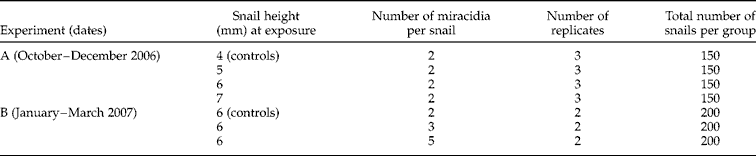
Principal characteristics of Galba truncatula groups used in the present study.
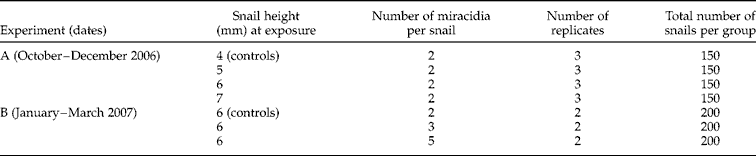
Table 1 gives, for each experiment, the number of groups for each population, the protocol of snail infection, the number of replicates, and the number of snails in each group at snail exposure. In experiment A, two miracidia of P. daubneyi were routinely placed for 4 h in a 35-mm diameter Petri dish containing a single G. truncatula, while each snail from experiment B was exposed to two, three or five miracidia. The use of four miracidia per snail was not performed, due to a lack of 6-mm-high snails in the population at the beginning of experiment B. After exposure, snails were subsequently reared for 70 days according to the method described by Rondelaud et al. (Reference Rondelaud, Fousi, Vignoles, Moncef and Dreyfuss2007). In each Petri dish (diameter, 14 cm), 6, 8 or 10 G. truncatula (the number of snails per dish depended on their shell height at exposure), 150 ml of spring water, several decayed leaves of grass, one or two fragments of live water moss (Fontinalis sp.), and dried leaves of pesticide-free lettuce were added. Water and, if necessary, water moss or lettuce, were changed daily, while Petri dishes were cleaned every 2 weeks. During the first 30 days these dishes were placed in an air-conditioned room under a constant temperature of 24 ± 1°C and a diurnal photoperiod of 12 h with a light intensity of 3000–4000 lx. At day 30 post-exposure (p.e.), surviving snails were placed individually in 35-mm diameter Petri dishes, with 2–3 ml of spring water per dish, a fragment of decayed leaf of grass and a small piece of lettuce. These were placed in the same air-conditioned room as the 14-cm dishes. Water and lettuce were changed daily, and P. daubneyi metacercariae were counted before their removal from dishes and their storage at +4°C. This surveillance was maintained until day 70 p.e.
Twice-weekly samples of five snails each were collected from each group from day 25 up to day 70 p.e. Each snail was dissected under a stereomicroscope to detect and count larval forms of P. daubneyi. Three categories of larvae were considered: (1) white free procercariae; (2) yellowish-brown cercariae that did not encyst within 2 h after dissection; and (3) metacercariae (including those that encysted earlier, just after a cercarial shedding). Individual values recorded for each larval category were averaged and standard deviations were calculated, taking into account the snail group, shell height at snail dissection, and the date of this operation. A one- or two-way analysis of variance (Stat-Itcf, 1988) was used to establish levels of significance. Two other parameters were snail survival at day 30 p.e. and the prevalence of P. daubneyi infection in dissected snails. This last parameter was calculated using the ratio between the number of snails harbouring larval forms and that of dissected snails. These percentages were compared using a χ2 test (Stat-Itcf, 1988).
Lamb infection
The infectivity of P. daubneyi metacercariae was studied using six 3-month-old, weaned limousine male lambs. All lambs were removed from the flock before being permanently reared in the sheepfold during the whole time of the study. A previous screening using Janeckso and Urbanyi's method (Bailenger, Reference Bailenger1973) demonstrated the absence of Paramphistomum infection in these lambs at the onset of the experiment. The first group (controls) was composed of two animals, each infected with a single dose of 100 metacercariae encysted at 60 days p.e. (after a cercarial shedding), while the two lambs of the second group and those of the third group were each infected with 100 larvae encysted at 45 and 35 days p.e., respectively, after snail dissection. All these larvae originated from experiment B (6-mm high snails at exposure, each subjected to three miracidia) and were 1 week old (at 4°C) before lamb infection. They were administered to each lamb via the introduction of a bolus in the oesophagus. Infected lambs were slaughtered 12 weeks after metacercarial infection. The parameter studied was the number of adult worms found in the paunch of each lamb.
Results
Snail infection in experiment A
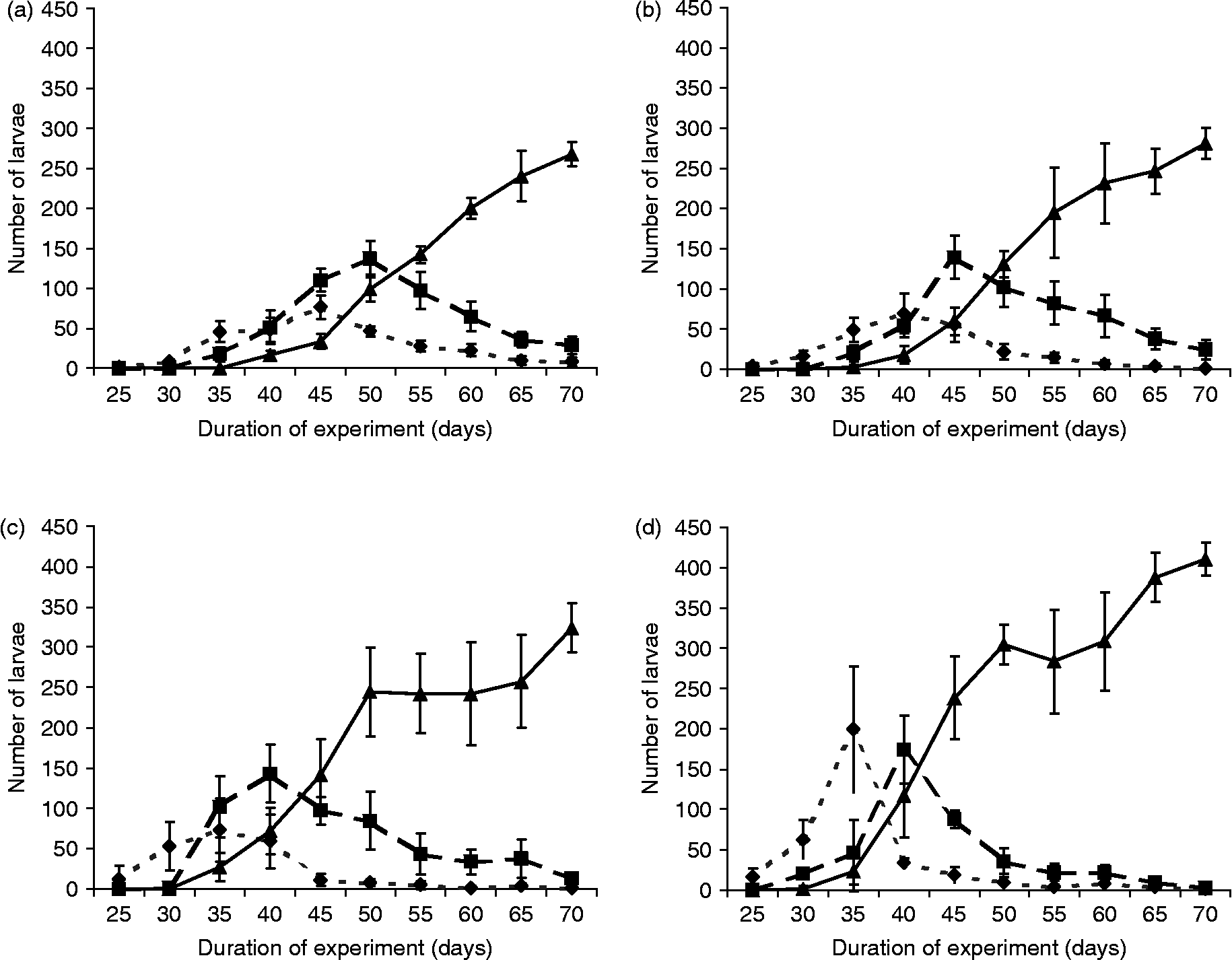
Snail survival at day 30 p.e. ranged from 66.0% in the 4-mm group to 77.6% in the 6-mm snails and only showed insignificant differences. The prevalence of P. daubneyi infection was 76.9% (out of 65 dissected G. truncatula) in the 4-mm group, 65.7% (out of 76) in the 5-mm snails, 52.0% (out of 96) in the 6-mm group, and 41.6% (out of 120) in the 7-mm snails. A significant difference (χ2 = 26.26, P < 0.001) between these last percentages was noted. In the 4-mm group (fig. 1a), the free first procercariae were seen at day 25 p.e. Their number peaked at day 45 and steadily decreased thereafter up to day 70. Non-encysted cercariae appeared at day 35 and their number peaked at day 50, while the first metacercariae were noted at day 40 and increased afterwards in numbers up to day 70 (with a mean of 267 cysts at this date). In the other three groups, several changes in the numbers of these larvae were noted. The peaks of procercariae were found sooner: at day 40 (fig. 1b and c) or at day 35 (fig. 1d), and were clearly higher than that recorded in controls. A similar finding was also noted for non-encysted cercariae, with peaks at day 45 (fig. 1b) or at day 40 (fig. 1c and d). The first metacercariae were noted at day 35 in the 6- and 7-mm snails (instead of day 40 in the other two groups) and the total number recorded at day 70 was clearly higher when snail height at miracidial exposure increased.
Numbers of free procercariae, non-encysted cercariae and metacercariae of Paramphistomum daubneyi in dissected snails from experiment A in relation to the date of snail dissection. Snail shell height at miracidial exposure: (a) 4 mm, (b) 5 mm, (c) 6 mm, and (d) 7 mm. ♦, Procercariae; ■, cercariae; ▲, metacercariae. Mean values are given with their SD.
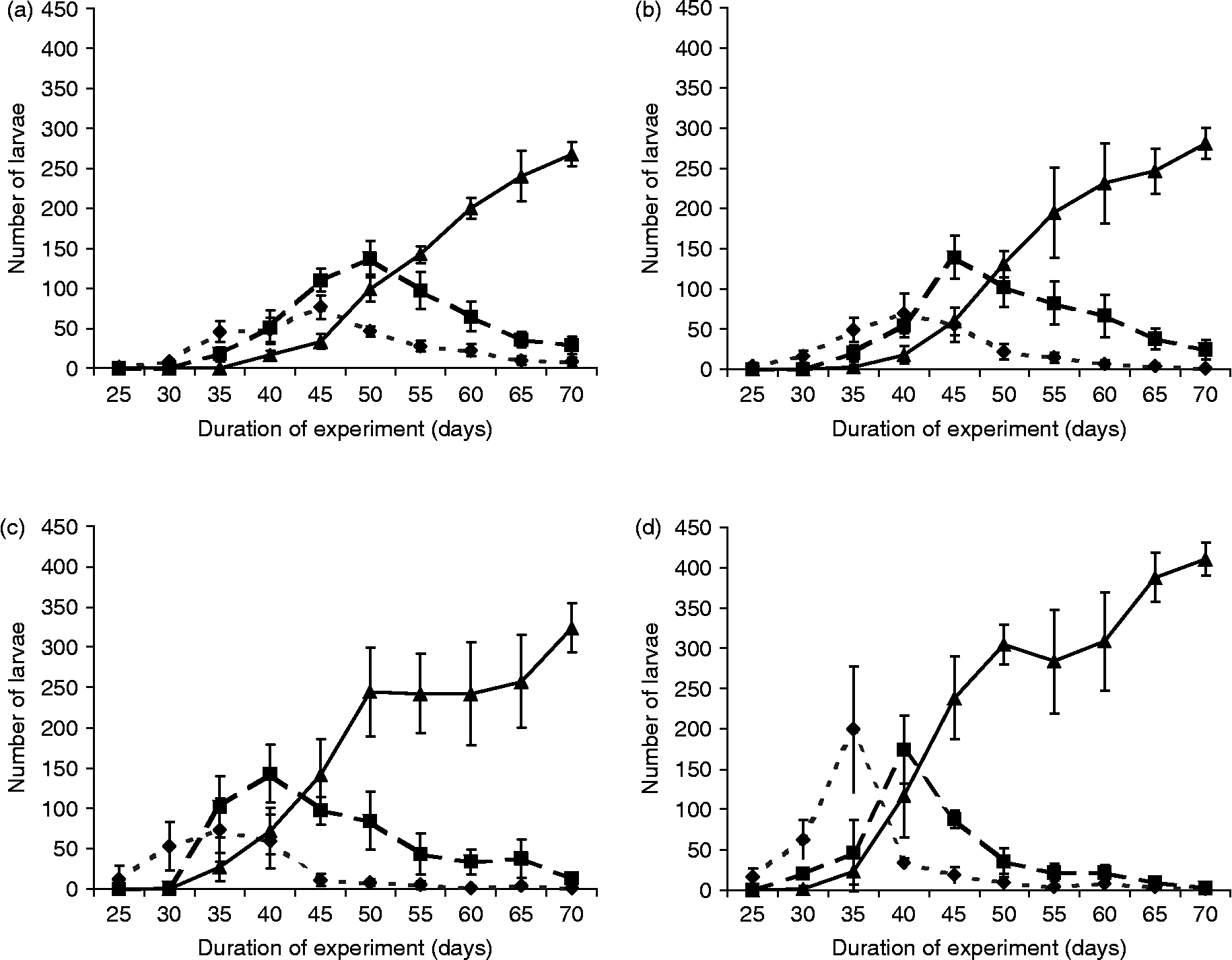
In the case of procercariae, the snail size at miracidial exposure (F = 14.71, P < 0.001), the duration of experiment (F = 6.76, P < 0.05) and the interaction between both factors (F = 14.15, P < 0.001) had significant effects. Similar findings were also found for non-encysted cercariae (snail size: F = 7.54, P < 0.01; duration of experiment: F = 10.87, P < 0.01; interaction between both factors: F = 10.01, P < 0.01). In the case of metacercariae, only the interaction between snail height and the duration of experiment had a significant effect (F = 30.02, P < 0.001), while insignificant effects were found for each factor considered alone. However, at day 70 p.e., the numbers of metacercariae recorded in the 6- and 7-mm snails were significantly higher (F = 36.76, P < 0.001) than those found in the other two groups.
Snail infection in experiment B
Snail survival at day 30 p.e. was 71.0% in the two-miracidium group, 61.5% in the three-miracidium snails and 52.5% in the five-miracidium group; there was a significant difference (χ2 = 16.03, P < 0.001) between these rates. The prevalence of infection was 54.9% (out of 91 dissected G. truncatula) in the two-miracidium group, 66.6% (out of 75) in the three-miracidium snails, and 81.9% (out of 61) in the five-miracidium group. A significant difference (χ2 = 11.91, P < 0.01) was also found between these percentages.
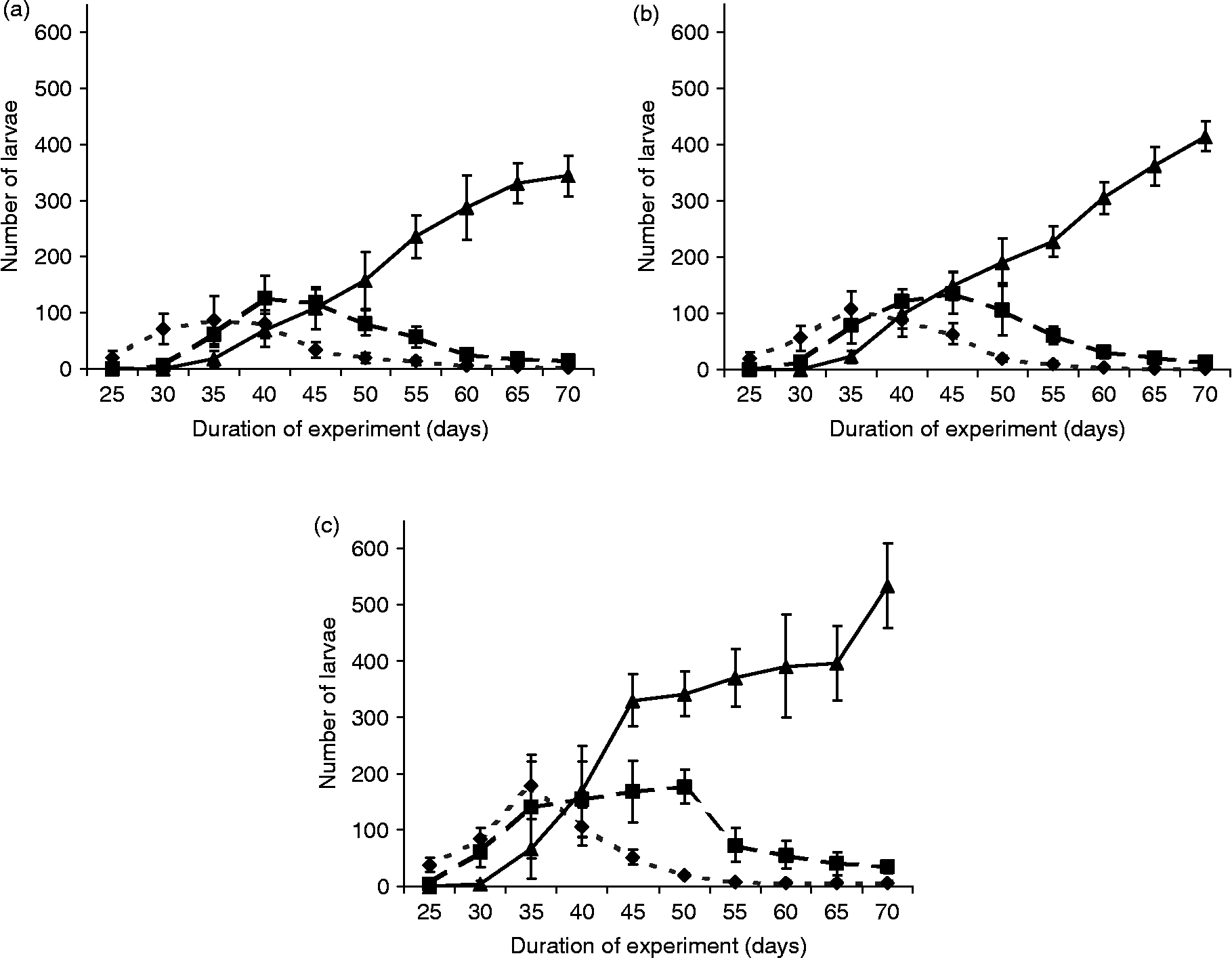
In the two- and three-miracidium infections (fig. 2a and b), the values obtained for the three categories of larvae were close to those found in the 6-mm snails from experiment A. The highest numbers of procercariae were noted at day 35 p.e., while the peaks of non-encysted cercariae were observed at day 40. The first metacercariae were found at day 35 and their numbers steadily increased up to day 70. In contrast, in the five-miracidium group (fig. 2c), several differences were noted. Although the peak of procercariae was always at day 35, the number of non-encysted cercariae increased slightly from day 35 to peak at day 50, while that of metacercariae showed the same slight growth from day 45 to day 65.
Numbers of free procercariae, non-encysted cercariae and metacercariae of Paramphistomum daubneyi in dissected snails from experiment B in relation to the date of snail dissection. (a) Two miracidia per snail; (b) three miracidia per snail; and (c) five miracidia per snail. ♦, Procercariae; ■, cercariae; ▲, metacercariae. Mean values are given with their SD.
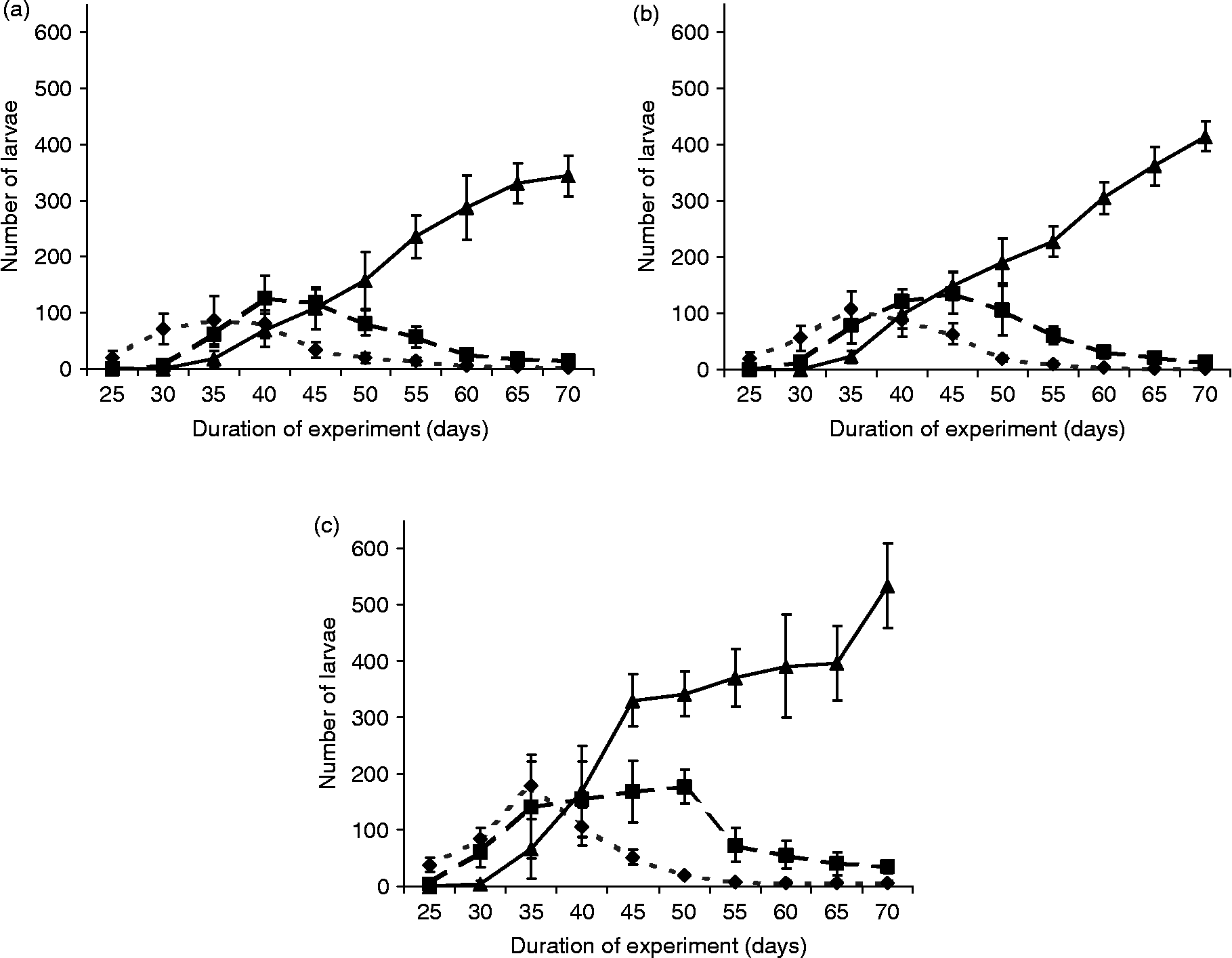
In the case of procercariae, only the number of miracidia (F = 7.54, P < 0.01) and its interaction with the duration of experiment (F = 4.41, P < 0.05) had significant effects. Insignificant effects of both factors were found for non-encysted cercariae. In contrast, in the case of metacercariae, the duration of experiment (F = 66.21, P < 0.001) and its interaction with the number of miracidia (F = 18.92, P < 0.001) had significant effects. At day 70 p.e., the number of metacercariae in the three snail groups significantly increased (F = 17.98, P < 0.001) with the number of miracidia used for snail exposure.
Lamb infection
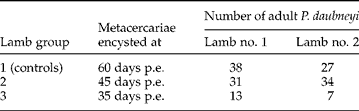
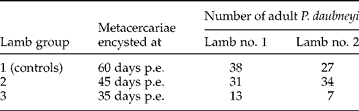
Table 2 gives the numbers of adult worms counted at week 12 post-infection in the paunch of the three lamb groups. The worm burden found in the second group was in the same range of values noted in controls. In contrast, that found in the third group (35-day encysted metacercariae) was clearly lower.
Number of adult worms recovered at week 12 in the paunch of lambs infected with Paramphistomum daubneyi metacercariae.
Discussion
Most results noted in the present study agreed with the reports of several authors when G. truncatula was experimentally infected with F. hepatica. The decrease noted in the prevalence of P. daubneyi infection with increasing height of snails at miracidial exposure (experiment A) has been reported by Gold (Reference Gold1980) for F. hepatica infection. In the same way, the fall of snail survival at day 30 p.e. and the corresponding augmentation of infection rate with the increasing number of miracidia per G. truncatula (experiment B) agreed with the report by Rondelaud & Barthe (Reference Rondelaud and Barthe1982) on snails, each exposed to single-, bi-, or multiple-miracidium infections with F. hepatica. The rising numbers of P. daubneyi metacercariae noted in the first and the second experiments were also found, respectively, by Rondelaud & Barthe (Reference Rondelaud and Barthe1987), Kendall (Reference Kendall1949) and Kendall & Ollerenshaw (Reference Kendall and Ollerenshaw1963) in the model G. truncatula–F. hepatica.
However, two new findings warrant special comments. First, in experiment A, the time necessary for the differentiation of P. daubneyi larvae was clearly shortened (from 5 to 10 days at 24°C) when the snail height at miracidial exposure was increased (from 4 to 7 mm). Even if the time for metacercarial formation did not correspond to the prepatent period (classically, this time began at miracidial exposure and ended at the first cercarial shedding), this finding does not seem to have been reported in the literature on G. truncatula–F. hepatica. To explain this result, the most valid hypothesis was to relate it to the greater body volume of 6- and 7-mm snails at miracidial exposure. As a consequence, the higher quantity of nutrients present in these G. truncatula would permit a quicker differentiation of P. daubneyi larvae and an earlier formation of metacercariae. In support of this assumption, Kendall (Reference Kendall1949) and Kendall & Ollerenshaw (Reference Kendall and Ollerenshaw1963) reported that well-fed G. truncatula produced a higher number of F. hepatica cercariae than starved lymnaeids when the number of miracidia per snail was the same at exposure. In the same way, the low volume of juvenile snails (1-mm high at exposure with F. hepatica) only permitted the differentiation of a few morulae (less than 90 per snail: Vignoles et al., Reference Vignoles, Dreyfuss and Rondelaud2002) and a few cercariae (less than 50: Busson et al., Reference Busson, Busson, Rondelaud and Pestre-Alexandre1982). If the above-mentioned hypothesis is considered valid, it might explain the episodes of cercarial shedding presented by a few snails infected with P. daubneyi before the end of the prepatent period (before day 55 p.e. at 24°C).
Second, in experiment B, the differentiation of cercariae was slower in the five-miracidium snails from day 30 to day 50 p.e. and this process affected the corresponding formation of metacercariae from day 45 to day 65. As this finding was not found in the two- and three-miracidium infections, the slow down of cercarial differentiation in the case of five miracidia per G. truncatula must be interpreted as a consequence of a too high number of miracidia developing in the body of these snails, in spite of their height (6 mm) at exposure. This explanation was supported by the number of empty rediae found at day 70 p.e. in this group: 26–41 per snail (instead of 9–15 rediae and 12–24 in the two- and three-miracidium infections, respectively). Under this condition, the differentiation of P. daubneyi cercariae would take more time in relation to glycogen and fat accumulated by rediae from snail bodies (Graczyk & Fried, Reference Graczyk, Fried and Dalton1999) and would only be achieved if food provided to snails supplies sufficient concentrations of these substances for the differentiation of all cercariae.
Lamb infection with P. daubneyi metacercariae demonstrated similar burdens of adult worms in groups infected with 45- and 60-day encysted larvae. In contrast, a lower burden of worms in the case of 35-day cysts was noted. In our opinion, the most valid explanation is to admit a lack of infectivity for the latter group of metacercariae, in spite of their ability to encyst after snail dissection at day 35. This weakened infectivity of metacercariae might be the consequence of too early encystment, so that corresponding cercariae did not have enough time to complete their reserve materials (glycogen, fat). However, the requirement of a supplementary time (5–10 days) for these 35-day encysted metacercariae to acquire their full infectivity cannot be excluded.
Obtaining P. daubneyi metacercariae from day 45 p.e. (at 24°C) by snail dissection without infectivity loss represents a good way for commercial production of these larvae for the following two reasons. First, these metacercariae were obtained 12–15 days sooner than those that encysted after a cercarial shedding (after day 60 p.e. at 24°C). Second, the use of 4- to 7-mm high G. truncatula for experimental infections with P. daubneyi allowed field-collected snails to be used for a longer period (a total of 4.5–6 months) throughout the year and avoided the need to raise young snails for experimental infections in the lab. These two advantages, coupled with a higher production of these metacercariae in the case of three- to five-miracidium infections, permit a large reduction of the cost price for production of P. daubneyi larvae.