

IntroductionFootnote 1
How can historians contribute to the production of usable and meaningful interpretations of African pasts? This question has permeated the field of African history since its early years. In this article, we respond to Joseph K. Adjaye’s recent call, in this very journal, for a history of Africa that “is not simply an academic enterprise, but (…) also (…) a quest for cultural and national identity, and a tool for responding to contemporary social, political and economic conditions.”Footnote 2 This is not a new call. Esperanza Brizuela-García has demonstrated how, in the semblance of Africanization, questions of relevance and authenticity have been with us since at least as far back as the 1957 London-based Conference in African History and Archaeology and the 1965 International Congress of African Historians held in Dar es Salaam.Footnote 3 In 1976, Terence Ranger famously advocated for a “usable” African past that could be applied to bettering social conditions on the continent.Footnote 4 Half a decade later, A.J. Temu and Bonaventure Swai leveled a Marxian critique at Ranger’s generation of scholars for their lack of attention to the relevance of history for the mass of Africans.Footnote 5 Yet within only a few years, Caroline Neale in turn would argue that not only the liberal historians of the 1960s but also subsequent generation of Marxists had failed to produce truly relevant histories.Footnote 6
As Adjaye’s recent article demonstrates, both questions of what constitute usable and meaningful approaches to the African past and the imperative for producing them remain with us. Yet even if one supports such efforts, the creation of usable African pasts cannot be achieved through theory alone. Rather, theoretical framing must both be applied to fieldwork and be informed by its results. Indeed, methodological innovation and the development of new research tools has been a prime strategy by which Africanists have constructed more accurate and relevant histories of Africa and, in the process, recast the discipline. In this article, we evaluate and reflect on our experience using a pop-up museum as a novel method and tool for leveraging popular conceptions of local pasts for the production of meaningful histories. By assessing the efficacy and results of our fieldwork, we hope to provide one data point of an effort to bring praxis to theory.
Our case study took the form of a multi-day pop-up museum in several sites in the Central Region of Ghana in July 2017. The topic of our experiment was the Fante Confederation of 1868–1871, an episode in Ghanaian history that is the subject of numerous academic studies and which has also at times been harnessed to commemorative state projects, but which seemingly holds little resonance in Fante popular memory. Initially, we hypothesized that the pop-up museum could serve as a tool for understanding the division between these two poles of history and communal memory. We also posited that it might help us to reveal latent memories of the Confederation which had otherwise been submerged within oral tradition. In the event, we discovered that the pop-up museum did not directly surface such memories, although it did provide insight into the values animating our interlocutors’ relationships to the past. In this way, it revealed significant continuities in concerns and anxieties that animated both the nineteenth century actors behind the Confederation and Fante-speakers today. In the aftermath of our experiment, we are now able to apply these values to the construction of more meaningful histories that can serve Fante-speakers in dealing with contemporary issues through historical reference. Ultimately, we also hope that studies such as this one can contribute to the debate surrounding the usability and relevance of academic histories of Africa.
Histories and Memories of the Fante Confederation
We initially proposed to exhibit a pop-up museum in Ghana as a means to examine the palpable disassociation between communal memory of the Fante Confederation on the one hand and official commemoration and history on the other, and to diagnose its causes. Over several years of study, we have documented this divergence as taking the form, on the one hand, of an authoritative narrative featuring a limited cast of elite men and their actions and, on the other hand, a fractured landscape of localized and highly specific traditions. In this section, we will briefly explore the contours and origins of the orthodox history of the Confederation and its official and historical uses. We will draw a contrast to oral tradition in order to demonstrate that in general this orthodox history has not been meaningful to Fante-speakers. This apparent divergence serves as the background to our decision to experiment with the methodology of the pop-up museum in hopes of developing a more relevant and useable history of the Confederation.
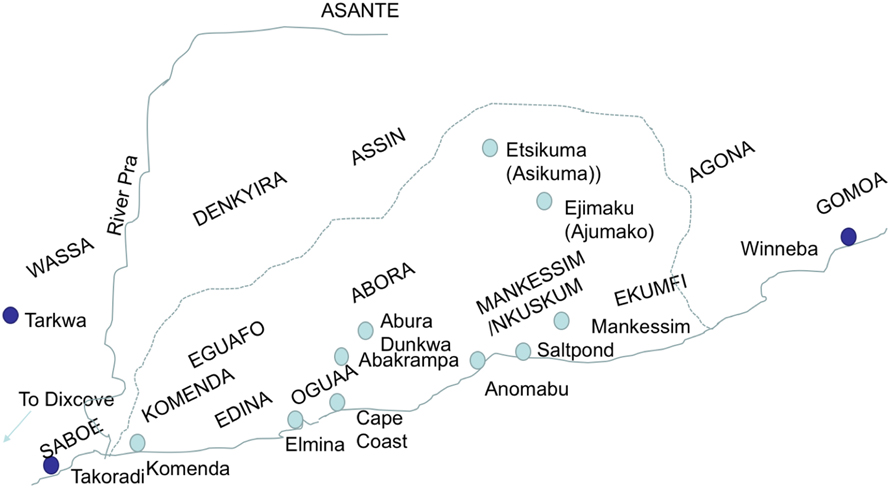
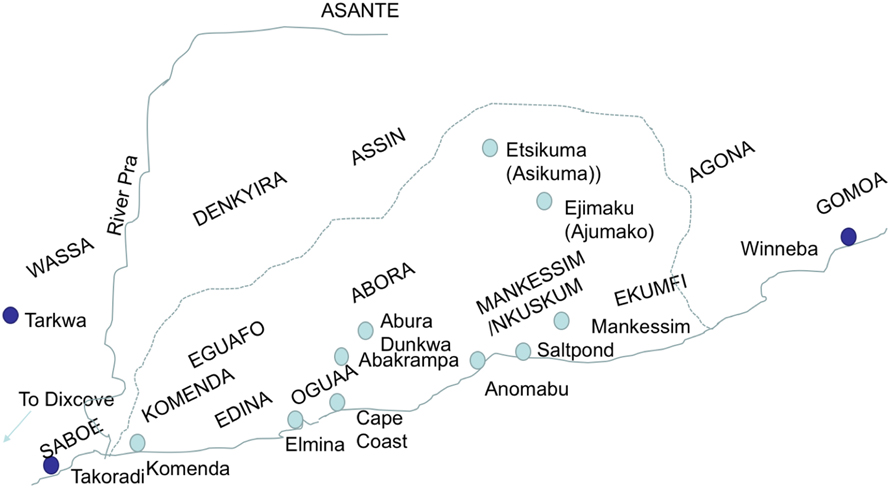
Academic histories of the Fante Confederation of 1868–1873 generally situate it as the culmination of a long era of alliance building and political maturation on the Gold Coast. A patchwork of states based on alliances between Akan matrilineages, antecedent communities, and subsequent immigrants, the Confederation developed in the eighteenth century as a sequence of alliances mediated by a shared shrine, Nananom Mpow, in the state of Mankessim.Footnote 7 In the process, the Fante version of the Akan language and Fante socio-political institutions became increasingly standard and widespread in the region.Footnote 8 Collectively, the Fante polities, faced a particular series of challenges throughout the nineteenth century in the form of the rise of Asante hegemony in the interior and pressure from Europeans along the coast.Footnote 9 These processes culminated in 1867 when the Dutch and British agreed to the exchange of a number of forts in order that each might solidify their control over a unified stretch of territory (see Figure 1).Footnote 10 Because the Dutch were identified as allies of Asante, a number of the states in which these forts were located objected vociferously. The Dutch officials met their protests with force, including the bombardment of the port of Komenda.Footnote 11 The beleaguered polities then reached out to their historical allies in the form of the Confederation, whose leaders met in the town of Mankessim in early 1868. In preparation for a long conflict, the council immediately appointed a crisis management team that included leading stoolholdersFootnote 12 (kings) – Anfo Otoo of Abora, Kwesi Edu of Mankessim, and Otabil of Gomoa – as well as a number of western-educated bureaucrats.Footnote 13 These bureaucrats took the initiative to implement a strategy of modernization allied to the construction of an apparatus of state: hiring constables, collecting taxes, and constructing infrastructure including a much-needed cistern at Anomabo.Footnote 14 They also sought to enforce unity of action across the alliance.
A map of the Fante Confederation, as presented in the Fante Confederation pop-up museum. Produced by Trevor R. Getz, 2017.
Concurrently, if somewhat independently of the council, the asafo companies (patrilineal military sodalities) within the various Fante states and their allies moved to besiege the Dutch at Elmina. Although unsuccessful in a strictly military sense, this effort ultimately forced the Dutch to agree to sell their forts and possession to Britain in 1870.Footnote 15 As the last asafo companies in the field returned to their homes, an alliance-wide meeting was called by the three stoolholders to discuss the future of the Confederation.Footnote 16 Only a relatively small sub-set of states appear to have sent delegates to this meeting, and there is evidence that the kings themselves were in favor of dissolving the crisis administration in favor of returning to a looser affiliation. British officials in the region, as well, expected the Confederation to wind down. Both groups were probably surprised when, instead of dissolving, the bureaucrats rallied the delegates behind a new and thoroughly modern constitution for a formally confederated state, which they completed in November 1871.Footnote 17 Unfortunately for these constitutionalists, the acting British administrator at Cape Coast, Charles Spencer Salmon, was both surprised and personally angered. He seized the messengers who brought him a copy of the constitution, accused the delegates of treason, and immediately began to search for and arrest any and all participants in the convention.Footnote 18 Most of the chiefly officeholders quickly disavowed the constitution and it was never implemented.Footnote 19 In 1873, a war broke out between Britain and Asante in which most Fante states elected to side with the British, and in 1874 a victorious Britain declared the region to be part of the new Gold Coast Colony and Protectorate.
This orthodox narrative of this period in Fante history emerges from a wide historiographic and commemorative literature whose contributions all share several characteristics. First, they are based upon a shared and limited set of sources, comprising, on the one hand, official records produced by colonial officials and, on the other, the writing and papers of the Confederation’s bureaucrats in the form of The African Times newspapers and a limited set of personal papers.Footnote 20 These sources uniformly describe the experiences and work of formally-educated men, whether colonial administrators or the Confederation’s bureaucrats. The two sets of sources differ on their judgement of the Confederation project and the character of its leaders, generally depicted in the official sources as scoundrels and opportunists and in their own writings as patriots.Footnote 21 Yet, perhaps unsurprisingly, they both deal with matters such as modernization and constitutionalism central to those men rather than the concerns of the members of the asafo companies or other elements of Fante-speaking communities. Most of the historians who utilize these sources consequently focus their attention almost exclusively on the constitutional and modernizing projects of the Confederation’s leaders.Footnote 22 Where they turn their focus to stoolholders, it is largely to explore their alliance to the constitutionalists and anxieties about the unity of the alliance. Where they introduce the interests of popular classes, it is generally only to demonstrate or explain their support for the constitutionalists’ project.
As with academic histories, the weight of official commemoration rests heavily on the “educated men” and their modernizing and constitutional project. There are no physical national or regional monuments to the Confederation, but the events of 1867–1871 are verbally and textually invoked in celebrations of Ghanaian independence such as the 2007 Ghana@50 memorial website, which describes the Confederation as a project “to declare the Fante states independent of the British,” focusing particularly on the 1871 constitution. This account is placed on the website directly preceding a brief description of the era of formal colonialism, which in turn is bookended on the other side by independence in 1957. The message is clear: the Confederation was a statal precursor to the modern Ghanaian state.Footnote 23 Another textual commemoration of the Confederation appears in the national junior secondary school social studies curriculum, for which students are required to memorize two lists of the origins of the constitutionalist Confederation and the reason for its demise. The first list largely hinges on the modernizing project, while the second amplifies questions about the loyalties of stoolholders and the dangers of Fante disunity in the face of British opposition.Footnote 24
We can easily speculate as to why both academic historians and the government of the Republic of Ghana would emphasize the constitutionalists, their constitution, and themes of modernization and unity within the orthodox narrative of the Fante Confederation. Taken together, they render the Confederation legible within the spaces of both the nation-state and the historical realm. Perhaps the most influential of the Confederation’s memorialists, the nationalist historian Francis Agbodeka, even proposed the 1871 constitution as a determinant moment in the history of the country. “To those who lived through it,” he wrote, “it was a great force and the event of the century.”Footnote 25
Yet it is clear that, while this account might resonate with historians and with state actors, it holds little appeal to the general public. In more than two dozen interviews conducted in the region in 2013, the majority of interlocutors gave negative responses when asked about their knowledge of the Confederation. Even secondary school graduates frequently only had a vague memory of their lessons, for example stating that “I remember learning about the Fante Confederation in JSS [Junior Secondary School], but I can remember nothing about it.”Footnote 26 In many ways this is not surprising, as historical knowledge gained in the classroom can be quite fleeting, as Roy Rosenzweig and David Thelen have documented in their quantitative and qualitative survey of everyday American relationships to the past.Footnote 27 More remarkable, perhaps, is the near-complete absence of oral traditions explicitly referring to the Confederation, or indeed any reference to the constitutional and modernizing project of 1868–1871, among communally-nominated knowers of the past in Fante communities.
Most Fante-speaking communities possess identifiable professional interpreters of the past in the persons of the akyeame (singl. okyeame), royal orators and state or society linguists.Footnote 28 These are the individuals most frequently consulted by scholars working with oral history.Footnote 29 Family and lineage heads, stoolholders, and asafo company officers are similarly designated repositories of knowledge about the past. UNESCO trained guides at the Cape Coast Castle Museum also offer historical interpretation, although the content they offer is not generally community determined. Taken together, these history-workers might be expected to have developed interpretations of the events and meaning of the Fante Confederation. Yet in extensive and direct interviews, these interlocutors generally expressed little, if any, knowledge of the 1868–1870 conflict, the 1871 constitution, or the modernizing projects of the Fante Confederation. Instead, when asked about these events, they preferenced narratives that were foundational to their specific community origins and, in particular, were embedded in physical sites such as shrines, churches, hills, the ocean, and the castle.Footnote 30 The episodes they describe spanned a period stretching from the fifteenth century to the 1880s, and often touched on themes underpinning the Confederation narrative, in particular struggles with Asante and the British. However, none of them correlated strongly to the orthodox history of the Confederation and scholarly interpretations of the events of 1868–1871. Only gyaasehene Kobina Amonu of Abakrampa, a professional researcher who had worked for the Nkrumah administration and the state broadcaster (Ghana Broadcasting Corporation) and who has personally embarked on a project to write a history of the Fante communities, identified the constitution as an important event in this era, and even he placed it secondary in importance to diplomatic engagements between Fante, Asante, and British.Footnote 31
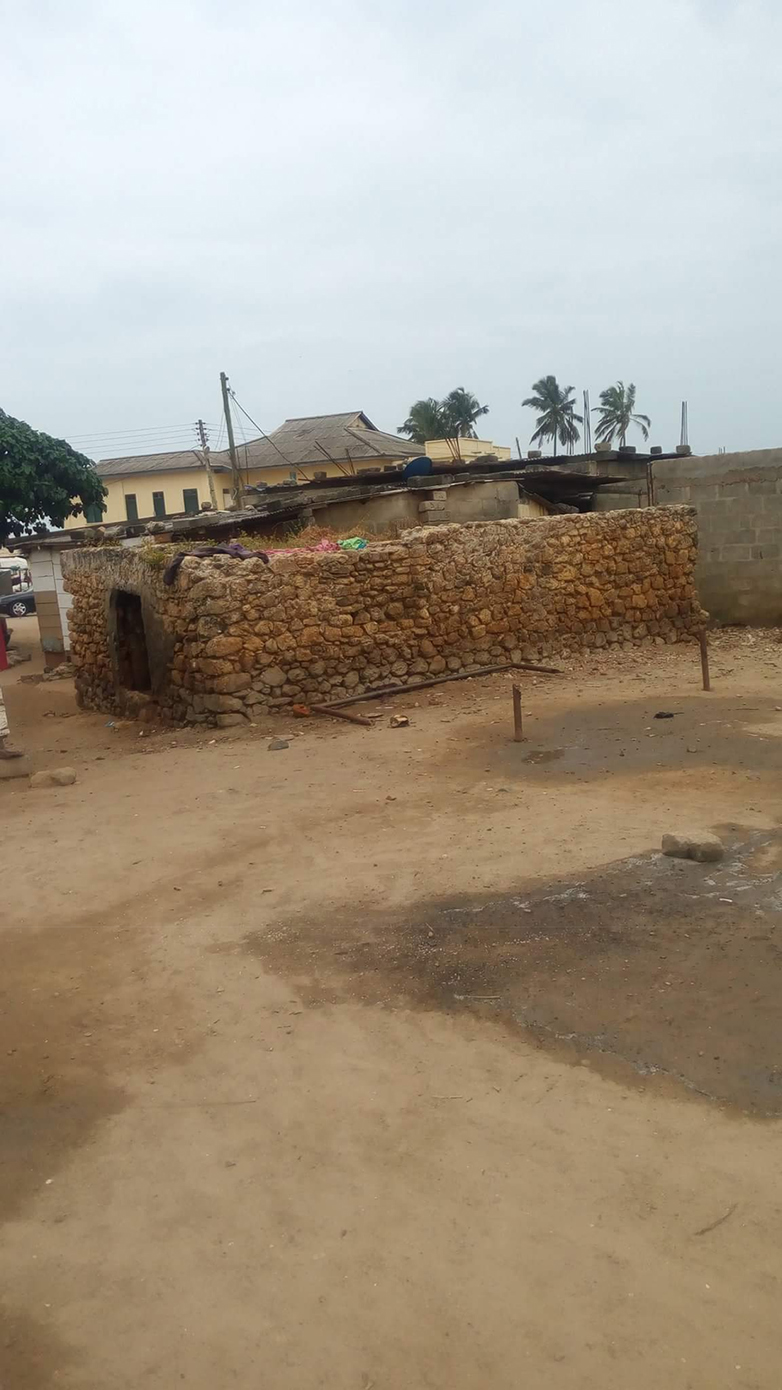
It is possible to hazard some explanations for this divergence between history and official commemoration on the one hand and memory on the other. As we have seen, the crack-down on Confederation supporters in 1871–1872 led many stoolholders to disavow the Confederation, and the need to work with colonial officials after 1874 may have further suppressed memory of the Confederation. Moreover, in a region where physical presence is so central to memorialization, the thin physical record of the Confederation left little mark. A single water cistern at Anomabo (see Figure 2) is the only identified structure associated with the Confederation. Possibly, the shared Fante shrine of Nananom Mpow might have served a function of memorializing the alliance.Footnote 32 However, this shrine is currently unaccessible. The land around it was sold for lumber, a purchase funded partly by a Christian congregation which wished to limit access to the sacred grove.Footnote 33
Remains of the cistern at Anomabo, a civil project of the Fante Confederation. Photograph by Tony Yeboah, 2017.

We additionally conjecture, however, that the problem lies within the historical narratives presented by historians and in curriculum. As Adjaye notes in the piece with which we began this article, historians’ work has not generally been presented in a way that meaningfully engages with contemporary concerns and the uses to which Fante-speakers want to put memory. In order to find ways to bridge this divide, we began in 2017 to look for strategies by which we could gain an understanding what kinds of interpretations of the Confederation might be meaningful to Fante-speakers. Initially, we searched for a tool primarily to diagnose the apparent divergence between history and memory of the Confederation. We also hoped to gain understanding into the modes of commemoration, transmission, or memorialization that might be familiar and accessible to local communities. In search of tools for this kind of work, we turned to the pop-up museum.
The Pop-Up Museum as an Experimental Methodology
Thus, by 2017, we had identified a divergence between history and oral tradition which presented an obstacle to our efforts to construct a more meaningful history of the Fante Confederation. Several questions faced us in this situation. Who are key stakeholders in knowing and interpreting the Confederation? Should historians continue to study and produce interpretations of an event that does not seem to hold interest in the region where it took place? Can and should we work with local partners to construct meaningful and usable histories of the Confederation? What might such histories look like? How might they be rendered useful to key stakeholders while still remaining accurate and authentic to their subjects?
Our pop-up museum exhibit was devised as a tool to address these questions. We posited that a carefully-designed physical exhibit featuring interactive elements might help us to identify the interests and concerns members of the Fante community had with this past. We proposed to present material that could guide “visitors” to the exhibit through the events of 1868–1871 as well as elicit contributions and feedback from them in order to discover how they mapped this history onto their own concerns. We also postulated that such a tool might also serve as a prop or mnemonic device in discussions with okyeame and stoolholders, providing historical context, personal names, and images that might open the door to relevant narratives. Finally, we hypothesized that the pop-up museum might allow local stakeholders to generate and contribute ideas for meaningful commemoration or approaches to curriculum about the Confederation.
Our design was inspired by the traveling Ghanaian art and culture museum designed by Nana Oforiatta Ayim in 2016.Footnote 34 Ayim proposed a free, public museum that would be designed to be familiar and inviting to Ghanaians. Adapting a kiosk similar to those from which everyday goods are sold, she subsequently filled it with photographs and cultural objects, and then dispatched it to ten sites across Ghana. Our design was even simpler than Ayim’s. Constructed from five large posterboard sheets that could be displayed on wooden easels, our museum could be easily and rapidly deployed in a marketplace or palace space. The contents were developed in collaboration with a team of students at Stanford University – several of them Ghanaian citizens and others with expertise in museums, anthropological practice, and education – over the course of several months in Spring 2017. Together, we crafted a core motivating question for the exhibit: “What does the Fante Confederation mean to me, as a Ghanaian, in 2017?” This question was meant to directly engage the process of thinking about meaningful and usable histories of the Confederation.
We also proposed a set of design principles for the project: that the exhibit would incorporate sufficient resources to introduce and contextualize the Confederation story, that it would present debates rather than settled conclusions, that it would be accessible and democratic, and – perhaps most importantly – that it would feature interactive elements. Finally, we settled on a scheme through which participants would be guided through the exhibit rather than moving through it by themselves. The language of the exhibit was largely English, since that is the principal written language of Ghana, but we provided visitors with a Fante translation as well.Footnote 35
The exhibit was intentionally divided into five consecutive parts. The first posterboard panel “What is this museum?” introduced the museum project, the researchers, and the Confederation in a series of short summaries, accompanied by a map and a question-and-answer about “The Fantee Country and its Kings” printed in an 1868 edition of The African Times.Footnote 36 The second and third panels asked respondents to evaluate commonly-presented arguments about the origins and demise of the Confederation. We enriched these arguments by presenting original sources, but we also sought to discover which explanations resonated with the concerns and perspectives of our interlocutors.
The final panels redirected the museum visitor towards questions about power, authority, and commemoration. Panel four, “Whose history is this?” asked visitors four questions. First, it presented the names and brief stories of some of the actors of the Confederation, including not only the formally-educated men who wrote the 1871 constitution and acted as officials for the Confederation, but also chiefly officeholders and leaders of popular institutions such as asafo companies. Participants were asked whether they recognized any of the names and stories or found them meaningful. The second question asked visitors whether they had previously heard of the Confederation, in what context, and what they learned about it. Another question probed whether the Confederation mattered to them, and why or why not. The last question asked visitors’ opinion as to whether people outside of the Central Region and Ghana should learn this story.
The final panel, the culmination of the museum, comprised an interactive poll about whether the Confederation should be memorialized or commemorated. By concluding with this panel, we hoped to learn about participants’ valuations of history, particularly local history, and their thoughts on memorialization. We hoped to gauge our interlocutors’ evaluation of the value of the Fante Confederation as a historical event and its relevance to their contemporary concerns and lives. In retrospect, it would have been useful to have concluded with direct questions about these connections, but this was not anticipated in our design.
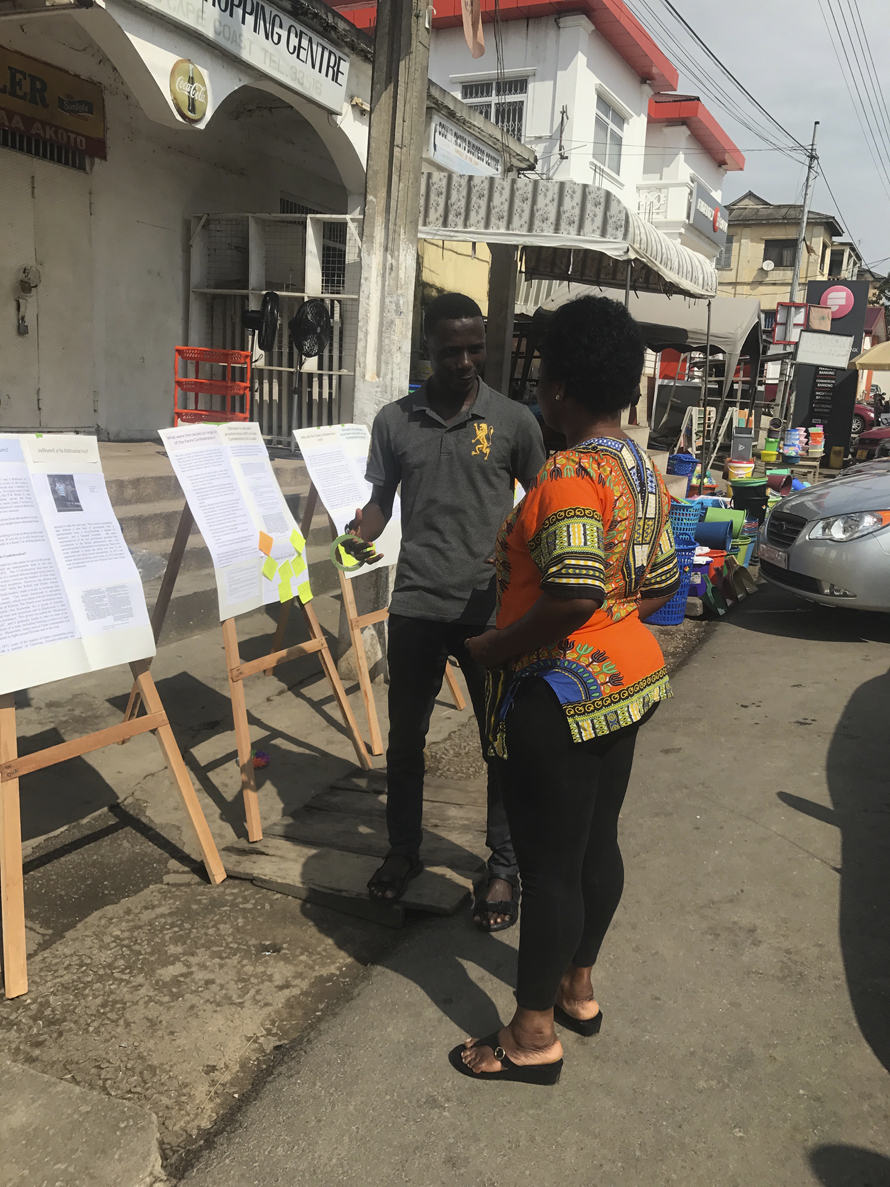
In July 2017, over the course of eight days, we presented the museum in several venues. First, we secured very public sites at central markets in the cities of Cape Coast and Mankessim during market days. Additionally, we brought the museum with us to interviews with stoolholders and state linguists in Saltpond, Mankessim, Anomabo, and Abakrampa. In each case, we guided participants – either scheduled interlocutors or curious members of the public – through the museum as if we were docents (see Figure 3).
Tony Yeboah guides a participant through the museum in Cape Coast. Photo by Lindsay Ehrisman, 2017.

In reviewing the data we collected in this experiment, three particular findings stand out. Perhaps the most glaring discovery was an enduring concern with questions of Fante unity, one of the issues that had animated the Confederation’s founders as well. A plurality of museum patrons, after reading numerous explanations and sources, selected issues of unity as the most compelling explanations for both the origins and the demise of the Confederation. They told us that they believed that the motivations of its originators were “to have one voice in dealing with the British,” “to have a common voice in all matters,” and to “come together as a group.” The Confederation’s founders “didn’t want the Asante to defeat [them]” and “by coming together they would be more powerful, to resist.” Similarly, while many respondents pointed to the British arrest of leaders as the event that terminated the Confederation, numerous respondents suggested that it failed to survive because “the chiefs would not cooperate with each other,” there were “misunderstandings” and “disputes” among the Fante states, and they “preferred to be independent rather than coming together.”Footnote 37
When we presented the museum to stoolholders and okyeame, they too identified unity as an enduring and meaningful concern. This was particularly evident during a two-part interview the Edumadze Odzikro and his court in Mankessim, including omankyeame Kofi Hagan. Hagan, as state linguist, was our primary interlocutor in both segments of the interview. Against the backdrop of a current, protracted struggle among stoolholders for authority in both Mankessim and more broadly in the region, Hagan used the museum exhibit to express the importance of unity among chiefly officeholders. British opposition to the Confederation he claimed, had been aimed at “disintegrating” Fante unity, allowing the colony to be constructed and creating an enduring deficiency in Fante status and power. Hagan explicitly compared this situation to the unified political situation in Asante, stating “That has affected us today. The Asante people, you see, are united. But we are not. So whenever any party wants to come to power [in national politics], they go to Kumasi to seek advice always, because they are always united.”Footnote 38
In Saltpond, omanhene Nana Baa situated the advantages of unity more in cultural terms, as “a memory of what our forefathers did.” “If the formation of the Fante Confederation is brought back,” he concluded, “it will have some usefulness in building community.”Footnote 39 Respondents in public venues also picked up on this theme. Many answered the question “does the Fante Confederation matter to you?” by arguing that commemoration would allow for cultural validation and awareness of individual and communal pasts. They made this argument both in collective terms – “if we learn it, it will help us to know our own past” – and individually – “because it is my history, where my forefathers came from.”Footnote 40
A second enduring theme to emerge from the pop-up museum project was the importance that our interlocutors placed on economic development. Indeed, one respondent specifically connected the two issues, stating as the principal lesson he took away from the museum that “we should have maintained this unity, then there would be more development.”Footnote 41 Development issues were particularly invoked in the context of potential commemoration projects. The vast majority of participants selected a permanent museum as their preferred type of commemorative site, rather than a shrine or monument, and explained that they did so with the hope that it would draw in tourists and provide employment. One participant in Mankessim suggested a future museum “should be a house so more people could be employed there.” Another proposed that it should be located in a rural region “like Abora district, which is under-resourced. It will help us to develop.” Still another called for a museum to be located in the (distinct) Abora neighborhood of Cape Coast “because most things are near the Castle and we need tourists to come to Abora as well.” Yet another suggested the town of Biriwa, because, lacking a museum or tourist site of their own, “they do not have anything there.”Footnote 42
This determination to highlight issues of development related to tourism is not entirely surprising, given the primary examples of historical commemoration evident among members of the Fante community. In the Central Region, tourism is a key industry and almost all tourism is related to history. Cape Coast and Elmina castles are the two pinions of this industry. Cape Coast Castle houses a UNESCO-supported museum on the slave trade and its legacy, and tour guides at both sites produce narratives centering on the heritage and legacy of the past. Moreover, economic development is a logical concern for a region that sees itself as underdeveloped vis a vis both the capital at Accra and the Ashanti Regional capital, Kumase, to the north.
Reflections
As this article has shown, the initial intention of our pop-up museum was to serve as a tool to identify and analyze the various divisions between the history, official commemoration, and contemporary popular memory of the Fante Confederation in and around Cape Coast. Documentary evidence, oral traditions, Ghanaian school curricula, and historical scholarship, all seem to solidify the boundaries between categories of stakeholders and underscore diverging interpretive pathways that have not only informed conflicting, self-serving historical productions over time, but also fail to represent the broader historical perspectives of Fante-speakers outside of elite classes. The pop-up museum thus served as a mechanism for bringing these various sources and interpretations together in one exhibit to engage participants with differing socio-economic backgrounds, knowledge sets, and interests that have otherwise been excluded. In doing so, we sought to collect more broadly representative perspectives in order to create a more relevant and meaningful historical narrative, commemoration, and curriculum about the Fante Confederation to local communities.
Our efforts were, in part, a response to recent calls to action by some of the Ghana’s leading historians. In his recent reflection on fifty years of Ghanaian historiography cited in the introduction to this article, for instance, Joseph Adjaye shed light on the current “crisis” within the discipline of history in Ghana (and across the continent) “at all levels of education.”Footnote 43 According to Adjaye, historians today share the dual responsibility of striving toward “objective analysis and evaluation of the past” while also fostering “historiographical discourse that is truly responsive to local needs.”Footnote 44 Adjaye thus urged historians to search “for distinctly African constructions of history as well as the manifold ways in which African historical production might be made to relate more effectively to local contexts.”Footnote 45 Meeting this task, he insisted, requires further incorporation of African “voices” in historical productions, and new methodologies that reach outside academic and conventional fieldwork frameworks. By using an unconventional methodology, we set out to see whether incorporating local perspectives could in fact enable us to produce a more usable and meaningful history.
Ultimately, our pop-up museum experiment revealed unexpected cohesion and continuity across a diverse range of informants and sources both in different locations and across time. When listened to in chorus, our participants’ voices harmonized in their shared interests and concerns surrounding the dual themes of development and unity. These themes were present in their interpretations of the historical sources included in the exhibit, in their reactions to and ideas about commemoration and curriculum, and in their general understandings of what makes history meaningful and relevant to them today. Echoing the concerns and interests of nineteenth century Fante Confederation actors, museum patrons with little to no prior knowledge of the Fante Confederation and historical specialists alike identified these themes as most important, and tended to emphasize them in their own versions of the Fante Confederation narrative that they either already knew or had developed on their own through the pop-up museum process.
The durability of “development” and “unity” discourses within the Fante Confederation narrative present a serious dilemma to Africanist historians who take seriously Adjaye’s call to write histories that both represent an “objective,” “distinctly African” past and responds to “local needs.” Both terms represent “modern” concepts associated with western imperialism (and neo-imperialism) or nationalist era agendas. Historians are trained to recognize such rhetoric as “products of their time” rather than deeper historical truths. This has certainly been the case in the historiography of the Fante Confederation. The concerns surrounding economic development and unity that repeatedly appear in the written record have been long interpreted either as either adoptions from European ideas and discourses or the imposition of nascent nationalist propaganda, rather than representative of a deeply-rooted (and enduring) Fante identity and worldview.Footnote 46 Indeed, the architects of the Fante Confederation of 1868 made up a minority class of largely Christian, western-educated elites, capitalist-minded merchants, and Fante kings and chiefs who all shared a long history of economic and political interactions with European imperialists along the coast. When these Fante actors wrote and published their economic and political aspirations, they employed a discourse of modernization that bore striking resemblance to their European counterparts. It appears then that the kinds of narratives that “relate more effectively to local contexts,” are precisely those that have been deemed neither “objective” nor “distinctly African.”
Yet, as Rebecca Shumway has recently argued, the imposition or adaptation of European colonialism, capitalism, and Christianity, which tend to be associated with nineteenth century transformations in Africa and have been used to explain the ubiquitous “Eurocentric” views present in the documentary record, have much longer and deeper histories along the Fante coast. Shumway is not the first historian to identify roots and antecedents of the Fante Confederation prior to the nineteenth century. The long history of political and economic concerns that drew Fante actors and states into periodic alliances has been the subject of extensive study over the past four decades.Footnote 47 But Shumway specifically situates the concerns that motivated the Confederation’s founders within a deeper history of engagement with the Atlantic world. According to Shumway, “The Fante and their ancestors were among the first West African populations to engage deeply in the exchange of commercial, political and cultural ideas and practices spanning the Atlantic.”Footnote 48 In addition to their heavy investment in commercial activities, during the eighteenth century “coastal elites also organized a coalition-style government for military defense and the protection of their lucrative middleman role in the commercial traffic between the Asante hinterland and the Europeans on the coast.” “A process which,” Shumway contends, “spread the Fante language and arguably gave rise to a regional Fante identity.” In large part because of their shared economic roles and interests, “the cooperation of a group of coastal chiefs in articulating a unitary political policy agenda in the form of the 1868 Fante Confederation was a recurrence of many earlier episodes in Gold Coast history.”Footnote 49
While Shumway does not use the words “development” or “unity,” her work demonstrates the critical role of economic concerns and unitary politics that lie at the center of Fante history and identity formation-processes long before formal colonialism. Yet although Shumway breaks important ground by tracing historical continuities, rather than change, between the eighteenth and nineteenth centuries, scholars have yet to extend this analytical trajectory into the twentieth and twenty-first centuries. Instead, scholars continue to see the failure of the Fante Confederation as the downfall of Fante political and economic traditions. Ironically, arguing that Fante economic and political institutions were powerful enough to survive through a series of tumultuous historical periods including the Atlantic Slave Trade, but did not survive British colonialism, only reinforces the nineteenth century as a period of change and undermines the importance and durability of Fante aspirations and concerns. A different conclusion, emphasizing continuity rather than transformation, emerges from our pop-up museum fieldwork and demonstrates the durability of core anxieties and concerns extending from the founders of the Confederation to our interlocutors today.
Elsewhere in Africa, scholars have convincingly argued that while colonialism certainly transformed African societies, it did not rupture African communities from their pasts. As David Schoenbrun has argued, “The depth and complexity of African aspirations (…) and the forms of collective action they inspire, often in the face of severe material constraints, exceed the explanatory power of narratives of modernity oriented toward the history of capital, colony, and commerce.”Footnote 50 Such “durable bundles” survived in myriad forms that extend beyond institutional structures. Steven Feierman asserts that even when political structures dissolve, the political discourses that informed those institutions survive, and in fact, “long-term continuities in political language are the outcome of radical social change.”Footnote 51 Such language, Feierman argues, can be creatively revived and utilized at different moments to cope with changing circumstances and needs.
By identifying development and unity as durable bundles that endured through the precolonial, colonial, and post-colonial periods, we can begin to move beyond the apparent divide between histories and memories of the Fante Confederation. Oral traditions about the Confederation have apparently carried less currency in the Ghana’s marketplace of memory than have such well-studied memories as Ewe-speakers’ narratives about their ancestral “homeland” of Notsie. As Sandra Greene has noted, Notsie narratives have great staying power, adapting over time as they were in turn mobilized for family, ethnic, religious, and national goals, and supported by “feedback” loops between histories, official commemoration, and memory.Footnote 52 Seemingly by contrast, in the case of the Fante Confederation we began with what seemed to be a complete disconnect between history and communal memory. By using the pop-up museum, however, we were able to identify continuities that underpin the contemporary concerns of Fante-speakers as well as being motives and values of Confederation’s founders. In the future, we hope to apply these enduring themes to the production of public-facing histories of the Confederation as we work, with local interlocutors and partners, to produce history curriculum and public history installations in this region.
Ultimately, our claims for the utility of the pop-up museum are circumscribed by our own, limited experience. We went into the project hoping that this tool would help us to locate the origins of a perceived divide between history and memory and also unearth new information and narratives about the past that could offer a necessary corrective to elite-centered narratives. We did not, however, uncover information about the experiences and actions of non-elite actors in the late nineteenth century. Nor did we reach conclusions about the origins of the history/memory divergence in narrating the Confederation. Rather, ultimately, the pop-up museum allowed us to evade political constraints and historiographic tenets that had shaped our thinking and to which we were initially responding. By handing over our sources and allowing participants to interpret their own pasts, this tool revealed the aspects of the narrative that are most relevant to Fante-speakers, and forced us to reconsider them as key analytical categories in producing meaningful histories of the Confederation. Hopefully, these findings and those generated by similar projects can in the future inform critical theoretical work around the usability and relevance of constructions of the African past.
Trevor R. Getz is Professor and Chair of History at San Francisco State University and the author or co-author of ten books, including the award-winning Abina and the Important Men (New York: Oxford University Press, 2012). His recently published work includes Slavery and its Legacy in Ghana and the Diaspora (co-edited with Rebecca Shumway) (London: Bloomsbury, 2017) and A Primer for Teaching African History (Durham NC: Duke University Press, 2018). E-mail: tgetz@sfsu.edu
Lindsay Ehrisman is a PhD candidate in African history at the University of Wisconsin-Madison. Her work on gender, intimacy, and well-being in Uganda and Ghana has appeared in the Journal of West African History and the edited volume Strings Attached: AIDS and the Rise of Transnational Connections in Africa (London: Oxford University Press, 2014). E-mail: lehrisman@wisc.edu
Tony Yeboah is a doctoral student in African history at Yale University. His manuscript, “Phoenix Rise: A History of Architectural Reconstruction of Kumase, 1874–1960” has been accepted for publication in an upcoming issue of Journal of West African History. E-mail: tony.yeboah@yale.edu