Introduction
Soldier thistle [Picnomon acarna (L.) Cass.], which originated in the Mediterranean region, is a problematic weed in rainfed farming systems throughout western Iran (Zand et al. Reference Zand, Baghestani, Nezamabadi, Minbashi and Hadizadeh2009). Picnomon acarna is considered to be a problematic weed in Lebanon and in the Victorian Mallee and Wimmera, Australia (Parsons and Cuthbertson Reference Parsons and Cuthbertson2001). It is an annual weed that grows up to 50-cm high, with 10- to 15-mm-long yellow spines on its leaves (Assadi et al. Reference Assadi, Ramak Maassoumi and Khatamsaz1989).
Picnomon acarna is nonpalatable and is resistant to both grazing and soil compaction. These characteristics have increased its density and distribution in the forests and rangelands of western Iran (Mirdavoodi et al. Reference Mirdavoodi, Mohadjer, Amiri and Etemad2013). Picnomon acarna has recently evolved from a weed of neglected areas and rangelands into a noxious weed in rainfed fields throughout the region.
The area under rainfed cropping system in Iran is about 5 million hectares (Ahmadi et al. Reference Ahmadi, Gholizadeh, Badzadh, Hatami, Fazli, Hoseinpour, Kazemian and Rafee2016). The main constraints for crop production in this system are inadequate and variable precipitation during the growing season, high evapotranspiration rate, and low nitrogenous fertilizer use due to water deficits (Hemmat and Eskandari Reference Hemmat and Eskandari2006). Hence, no-till and minimum-tillage systems have been adopted recently by farmers to conserve water (Hemmat and Eskandari Reference Hemmat and Eskandari2004). This change in the cropping system has resulted in increases in both density and diversity of weeds in major crops in the region (Nosratti et al. Reference Nosratti, Sabeti, Chaghamirzaee and Heidari2017b).
Picnomon acarna is capable of reducing the yield of several major rainfed crops, including wheat (Triticum aestivum L.) and chick pea (Cicer arietinum L.). For example, a reduction of 25% in chick pea yield has been reported at a P. acarna density of 16 plants m−2 (unpublished data). The spinous nature of this weed interferes with harvest operations, especially hand harvesting, which is common for chick pea and lentil (Lens culinaris Medik.) crops in the region. In some fields predominated by P. acarna, farmers often abandon the chick pea and lentil crops, as the spines of this weed can seriously injure hands and other body parts. Seeds are the only means of reproduction for P. acarna and are spread mainly by the wind (Parsons and Cuthbertson Reference Parsons and Cuthbertson2001). The seeds are equipped with a 1- to 2-cm-long pappus that enables them to disperse across different areas, including cropping lands, roadsides, channel banks, neglected areas, and pastures. Therefore, one could expect to find this weed in every cultivated area. As a result, factors affecting its germination and emergence have a vital role in its successful establishment in new areas (Baskin and Baskin Reference Baskin and Baskin2004; Benech-Arnold 2000). Seedling emergence is regulated by various factors, including temperature regime, photoperiod, salinity, pH, soil burial depth, and soil moisture (Bouwmeester and Karssen Reference Bouwmeester and Karssen1989; Finch‐Savage and Leubner‐Metzger Reference Finch‐Savage and Leubner‐Metzger2006).
Temperature and light are among the most important environmental factors affecting weed seed germination and thus are key influences on species distribution. These factors, which influence hormone synthesis, along with soil burial depth determine the emergence patterns of weeds in fields (Benvenuti et al. Reference Benvenuti, Macchia and Miele2001). In addition, soil characteristics such as pH, moisture, and salt have a crucial role in affecting the germination behavior of weed seeds present in the soil seedbank. Among these soil factors, water is of high importance, being a basic requirement for seed germination and subsequent seedling growth (Benech-Arnold et al. 2000). The ability of some weed seeds to germinate under high water-stress conditions gives them an advantage over crops in dryland areas, which are commonly exposed to high levels of water-deficit stress (Atia et al. Reference Atia, Smaoui, Barhoumi, Abdelly and Debez2011).
An understanding of the effects of these factors on seed germination and seedling emergence of P. acarna will enable better predictions to be made for its potential to infest new areas. In addition, information on the emergence of P. acarna in response to environmental factors will help in developing best management practices. Therefore, the purpose of this study was to determine the effects of temperature, light, pH, osmotic stress, salt stress, and burial depth on germination and seedling emergence of P. acarna.
Materials and Methods
Seed Collection and Preparation
Mature seeds of P. acarna were collected in September 2016 from 20 chick pea fields located at the Campus of Agriculture and Natural Resources, Razi University, Kermanshah, Iran (34.35°N 47.15°E; elevation 1,318.6 m above sea level). Seeds were randomly collected from approximately 400 individual plants. As seed germination can vary even among populations that have experienced the same environmental conditions, seeds were collected from different plants and from different fields (Mulligan and Bailey Reference Mulligan and Bailey1975). Individual samples were combined and then stored at room temperature (20±2 C) for 3 mo (except for those used in the seed dormancy study) to alleviate seed dormancy before the initiation of experiments (Ebrahimi and Eslami Reference Ebrahimi and Eslami2012). The weight (without pappus) of a single seed was 17.1 mg (Wilson et al. Reference Wilson, Wright, Brain, Clements and Stephens1995).
General Seed Germination Test
To determine seed germination of P. acarna, 30 seeds were evenly placed in 9-cm-diameter petri dishes containing two layers of filter paper (Whatman No. 1, Maidstone, UK) moistened with 9 ml of distilled water or test solution. To reduce evaporation, all petri dishes were tightly sealed with clear Parafilm® and then placed in a germination chamber (JAL TEB, model 200 L) under a fluctuating temperature regime of 20/10 C (16-h high/8-h low) with a 16-h light/8-h dark photoperiod. These conditions were selected based on the results of a preliminary experiment. Fluorescent lamps were used to produce a photosynthetic photon flux density of 150 μmol m−2 s−1 for all experiments. Seeds with a visible protrusion of the radicle were considered to have germinated. Germinated seeds were counted and removed daily for 3 wk.
Dormancy
To determine dormancy in P. acarna seeds, germination was evaluated immediately after seed harvest and at 2, 4, 6, 8, 10, and 12 wk after seed collection. During the trial, seeds were stored at room temperature (20±2 C). All other experimental conditions were the same as described in the general seed germination test.
Effect of Temperature and Light on Seed Germination
Seed germination of P. acarna in response to temperature was evaluated by incubating seeds at constant (5, 10, 15, 20, 25, 30, and 35 C) and fluctuating (10/5, 15/5, 20/10, 25/15 C) (16-h high/8-h low) temperatures and under two light regimes (light/dark and continuous darkness). Petri dishes for the light/dark treatment were placed in sealed transparent polyethylene bags, while petri dishes for the continuous darkness treatment were wrapped in a double layer of aluminum foil. All seed preparation operations for the continuous darkness treatment were done under safe green light.
Effect of Salt and Osmotic Stress on Seed Germination
The effect of salinity on seed germination of P. acarna was determined by using sodium chloride (NaCl) solutions of 0, 2, 4, 8, 16, 32, 64, 128, 256, and 512 mM. To examine the effect of osmotic stress on seed germination, solutions of osmotic potentials of 0, −0.1, −0.2, −0.4, −0.6, −0.8, and −1.0 MPa were prepared using polyethylene glycol 6000 (OHG 85662, Merck Schuchardt, Hohenbrunn, Germany) based on the method described by Michel (Reference Michel1983). Sterilized filter papers were moistened with the relevant solutions, and the germination test was conducted under conditions described for the general seed germination test.
Effect of pH on Seed Germination
Buffer solutions with pH values of 4 to 10 were prepared according to the method described by Chachalis and Reddy (Reference Chachalis and Reddy2000). The pH treatments were applied directly to filter paper in each petri dish using approximately 7-ml aliquots of the treatment solution. The petri dishes were then placed in an incubator set up with the light and temperature conditions described for the general seed germination test.
Effect of Planting Depth on Seedling Emergence
The effect of seed burial depths of 0, 1, 2, 3, 4, 5, 6, 7, 8, 9, and 10 cm on seedling emergence was studied in the greenhouse. Plastic pots (15-cm diameter) were filled with soil (30% sand, 40% silt, 30% clay, with 0.50% total organic matter and a pH of 6.9) and 30 seeds were placed in each pot either on the soil surface or covered with soil to the appropriate depth. All the pots were placed in the greenhouse at 25/18 C with a 12-h photoperiod. Pots were watered as needed to maintain sufficient soil moisture. The seedlings were considered to be emerged when the coleoptile was visible. Emerged seedlings were counted and removed weekly for 28 d or until no further emergence occurred. After this period, the pot soil was examined to determine whether any seedlings failed to reach the soil surface.
Data Analyses
All the experiments were arranged in a completely randomized design with four replications and were repeated. Data were analyzed using the ANOVA procedure in SAS (SAS Institute, Cary, NC, USA). No significant trial by treatment interaction was observed, so the data were pooled across runs and used for further analyses. Regression analysis was conducted on data obtained from salt and osmotic stress and planting-depth experiments using SigmaPlot software (v. 12.0, SyStat Software, Point Richmond, CA, USA). Germination values (%) resulting from different levels of salinity or osmotic potential were fit to the following functional three-parameter exponential model (Chauhan et al. 2006):
 $$G\left( {\rm \,\%\,} \right){\equals}{\raise0.7ex\hbox{${G_{{{\rm max}}} }$} \!\mathord{\left/ {\vphantom {{G_{{{\rm max}}} } {\left[ {1{\plus}(X\,/\,X_{{50}} )^{{G{\rm rate}}} } \right]}}}\right.\kern-\nulldelimiterspace}\!\lower0.7ex\hbox{${\left[ {1{\plus}(X\,/\,X_{{50}} )^{{G{\rm rate}}} } \right]}$}}$$
where G represents the total germination (%) at NaCl concentration or osmotic potential X, G max is the maximum germination (%), X 50 is the NaCl concentration or osmotic potential for 50% inhibition of the maximum germination, and G rate indicates the slope.
The seedling emergence values (%) obtained at different sowing depths were fit to the following two-parameter exponential decay model (Chauhan and Johnson Reference Chauhan and Johnson2008c):
 $$E\left( {\rm \,\%\,} \right){\equals}{\rm }E_{{{\rm max}}} {\times}{\rm }e^{{({\minus}E_{{{\rm rate}}} {\rm }{\times}{\rm }x)}} $$
In this model, E is the ultimate seedling emergence (%) at burial depth x, E max indicates the maximum seedling emergence (%), and E rate is the slope.
In the dormancy, light by temperature, and pH experiments, means were compared using Fisher’s LSD test at P=0.05.
Results and Discussion
Dormancy
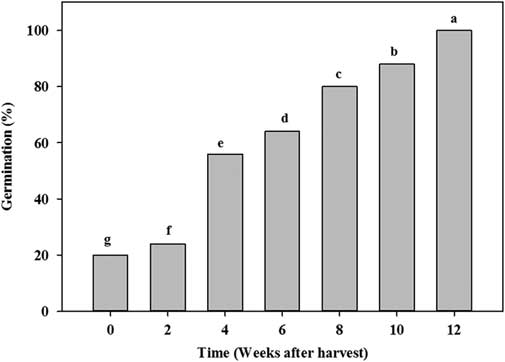
Picnomon acarna seeds had relatively deep dormancy (Figure 1). Based on Baskin and Baskin (Reference Baskin and Baskin2004), intermediate dormancy or relatively deep dormancy could be alleviated by 2 to 3 mo of dry storage. Seed germination increased with time after harvest (Figure 1). Immediately after seed harvest, the germination was 20%. Seed germination increased significantly from 4 wk onward (Figure 1). By 8 wk, germination was 80%, and at 12 wk, 100% germination was achieved.
Germination of Picnomon acarna seeds after harvest when incubated at 20/10C (16-h high/8-h low) with a 16-h light/8-h dark photoperiod. Bars with different letters are significantly different at the P=0.05 level according to Fisher’s LSD test.

The results of this study revealed that freshly harvested seeds of P. acarna are dormant. Seeds of this weed are typically shed in late summer, when soil moisture content is low. Hence, survival of germinated seeds under these conditions is unlikely. The presence of dormancy would prevent germination until mid-autumn, when soil moisture is sufficient for germination. This may explain why P. acarna is well adapted to the rainfed fields of Iran, where summer and early-autumn rainfall is infrequent and insufficient for weed seedling growth (Nosratti et al. Reference Nosratti, Sabeti, Chaghamirzaee and Heidari2017b).
These results provide evidence that that seeds of P. acarna need an after-ripening period (the loss of dormancy under warm and dry conditions) (Baskin and Baskin Reference Baskin and Baskin2004). After-ripening is well known to alleviate physiological dormancy in many other weed species (Baskin and Baskin Reference Baskin and Baskin1987; Taylorson and Brown Reference Taylorson and Brown1977). For instance, it has been reported that physiological dormancy in wild oat (Avena fatua L.) and Asia Minor bluegrass (Polypogon fugax Nees ex Steud.), downy brome (Bromus tectorum L.), and Amaranthus spp. can be broken by after-ripening in dry storage (Baskin and Baskin Reference Baskin and Baskin2004; Christensen et al. Reference Christensen, Meyer and Allen1996; Cristaudo et al. Reference Cristaudo, Gresta, Luciani and Restuccia2007; Wu et al. Reference Wu, Li, Xu and Dong2015).
Light and Temperature
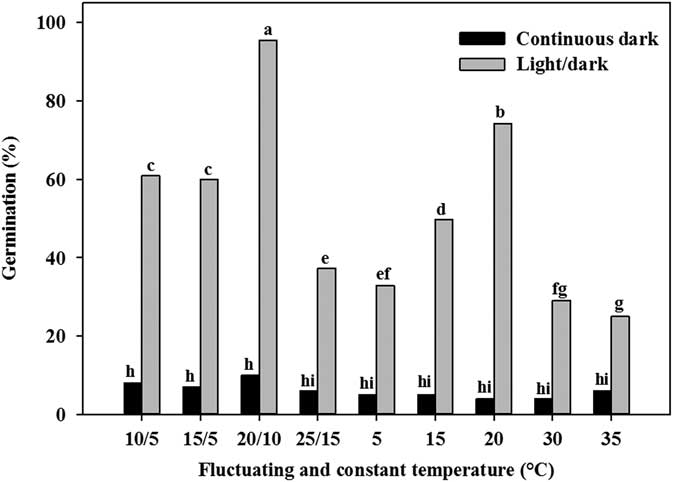
The interaction of light and temperature was not significant for seed germination of P. acarna (Figure 2). Seed germination in the light/dark regime was higher than at 24-h dark. The highest seed germination was observed at 20/10 C under 12-h light/12-h dark conditions.
Effect of constant and fluctuating (16-h high/8-h low) temperatures and light (light/dark [16/8 h] and continuous darkness [24 h]) on seed germination of Picnomon acarna. Bars with different letters are significantly different at the P=0.05 level according to Fisher’s LSD test.

Seed germination of P. acarna was significantly increased by the presence of light at all temperature regimes tested. The results suggest that seeds of P. acarna are positively photoblastic (germination is induced by exposing seeds to white light). Seeds of other weed species, including junglerice [Echinochloa colona (L.) Link] (Chauhan and Johnson Reference Chauhan and Johnson2009), Chinese sprangletop [Dinebra chinensis (L.) P. M. Peterson & N. Snow] (Chauhan and Johnson Reference Chauhan and Johnson2008a), and Iberian starthistle (Centaurea iberica Trevir. ex Spreng.) (Nosratti et al. Reference Nosratti, Abbasi, Bagheri and Bromandan2017a), require light for germination.
It is well demonstrated that positively photoblastic seeds use light to detect an appropriate environment for seed germination and seedling emergence (Batlla and Benech‐Arnold Reference Batlla and Benech‐Arnold2014). The results of this study suggest that seed germination and seedling emergence of P. acarna in the field will be increased when seeds are retained at or near the soil surface. In practice, reduced-tillage or no-till systems would increase the density of P. acarna, as these cropping systems keep most seeds close to the soil surface (Yenish et al. Reference Yenish, Doll and Buhler1992). Therefore, depriving the seeds of light by burial using deep tillage would be an effective measure to control this weed species. Tillage operations conducted at night to prevent the photoinduction of germination may help reduce emergence of P. acarna. Gallagher and Cardina (Reference Gallagher and Cardina1998) reported that conducting tillage during night led to 30% to 55% reduction in the emergence of giant foxtail (Setaria faberi Herrm.), redroot pigweed (Amaranthus retrofexus L.), and smooth pigweed (Amaranthus hybridus L.) when compared with daytime tillage. Furthermore, as seeds of P. acarna require light for germination, they will germinate between the rows of an already emerged crop. By exposing seeds of different weed species to shading by a plant canopy, Górski et al. (Reference Górski, Górska and Nowicki1977) demonstrated that the germination of the positive photoblastic seeds species was inhibited. Therefore, using interrow cultivators to destroy emerged seedlings or planting dense crops to avoid gaps in the crop canopy would be beneficial to control of P. acarna.
Picnomon acarna germinated over a wide range of temperature regimes (Figure 2). Germination occurred at constant temperature regimes from 5 to 35C, with the highest germination at 20 C. Seed germination was reduced with increasing temperature, with the lowest germination (25%) at 35 C (Figure 2). The highest seed germination (95%) was observed at fluctuating temperatures of 20/10 C under light/dark conditions (Figure 2).
Compared with constant-temperature regimes, seed germination of P. acarna was higher at fluctuating-temperature regimes. Such temperature regimes simulate day/night alteration in temperature in temperate areas like Iran. Similar to our results, germination of many other weed species have been reported to be higher at fluctuating temperatures (Chachalis and Reddy Reference Chachalis and Reddy2000; Koger et al. Reference Koger, Reddy and Poston2004; Probert Reference Probert2000; Roy and Lambert Reference Roy and Lambert1997; Wu et al. Reference Wu, Li, Xu and Dong2015).
Picnomon acarna showed an increased ability to germinate at fluctuating temperatures compared with constant temperatures. This may explain why this weed is more abundant in rainfed fields located in cold areas. The fact that P. acarna can germinate across the wide range of 5 to 35 C enables this weed to infest many summer and winter crops like chick pea and wheat, respectively. Based on meteorological data (KMO 2017), a day/night temperature regime of 20/10 C is reflective of conditions in early autumn and spring, which is optimum for germination of P. acarna. Therefore, this weed has great potential to invade wheat and chick pea crops, which are grown in early fall and spring, respectively.
Salt and Osmotic Stress
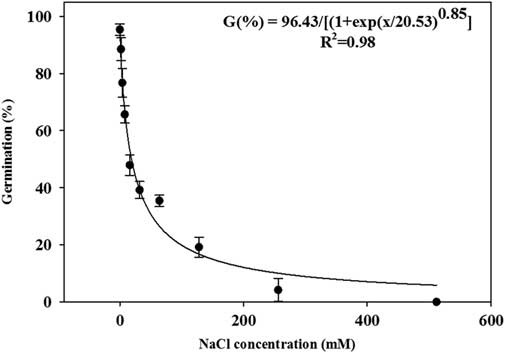
The germination of P. acarna seeds was drastically reduced by NaCl (Figure 3). Seed germination percentage decreased from 95.4% to 4.1% as the NaCl concentration increased from 0 to 256 mM, and germination was completely inhibited at higher concentrations (Figure 3). The NaCl concentration required for 50% inhibition of germination was estimated at 20.53 mM.
Effect of sodium chloride (NaCl) concentration on germination of Picnomon acarna. Vertical bars represent the standard error of mean, and the line represents the three-parameter exponential model (G(%)=G max/[1 + (X/X 50) Grate]) fit to the data.

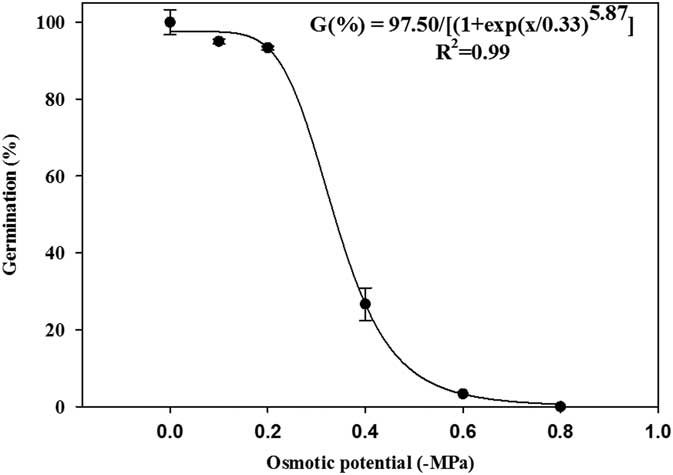
With increasing water stress from 0 to −0.4 MPa (Figure 3), there was a decrease in seed germination, and no germination occurred at an osmotic potential of −0.8 MPa or lower (Figure 4). As estimated using a functional three-parameter sigmoidal model, the osmotic concentration required to reduce seed germination of P. acarna by 50% was −0.33 MPa (Figure 4).
Effect of osmotic potentials (MPa) on germination of Picnomon acarna. Vertical bars represent the standard error of mean, and the line represents the three-parameter exponential model (G(%)=G max/[1 + (X/X 50) Grate]) fit to the data.

Compared with other weed species in Iran, particularly in western parts of Iran (Honarmand et al. Reference Honarmand, Nosratti, Nazari and Heidari2016; Nosratti et al. Reference Nosratti, Sabeti, Chaghamirzaee and Heidari2017b), P. acarna was found to be more sensitive to salt stress. Seeds of P. acarna germinated only at NaCl concentrations lower than 250 mM. Therefore, this plant is well adapted for spread into western parts of Iran, where soil salinity is commonly below this value (Jalali Reference Jalali2005). The osmotic potential results indicate that P. acarna is well suited to germinate in rainfed fields where drought stress is a predominant environmental issue (Nosratti et al. Reference Nosratti, Sabeti, Chaghamirzaee and Heidari2017b), because its seeds can germinate under low osmotic potential.
Similar to our results, Ebrahimi and Eslami (Reference Ebrahimi and Eslami2012) reported that Ceratocarpus arenarius L., another weed species infesting rainfed fields in Iran, could tolerate an osmotic potential of −1.0 MPa. The tolerance of P. acarna to water stress is consistent with its occurrence in rainfed farmland located in arid zones. Increasingly, water deficit is a major environmental issue in Iran. Because germination of P. acarna is tolerant to water stress, its density is expected to increase in Iranian fields.
pH
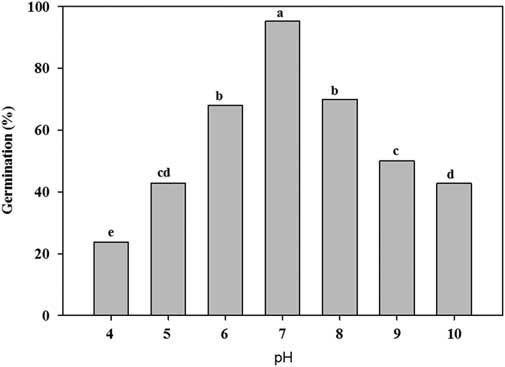
Picnomon acarna seeds germinated over a wide pH range (4 to 10), with the highest (95.2%) and lowest (23.8%) germination rates being recorded at pH 7 and 4, respectively (Figure 5). Seed germination of P. acarna even at a pH of 10 indicates that this weed can invade very alkaline soils (Figure 5). In general, the germination rate was higher at alkaline pH levels compared with acidic pH levels (Figure 5).
Effect of buffered pH solutions on germination of Picnomon acarna. Bars with different letters are significantly different at the P=0.05 level according to Fisher’s LSD test.

The results indicate that this weed species would be more problematic in areas with higher pH values. Most Iranian soils, especially those of rainfed fields located in western parts of Iran, are naturally alkaline (Jalali and Khanlari Reference Jalali and Khanlari2008). Therefore, it is likely that P. acarna will further invade the rainfed farmland of the region. Traditionally, farmers know P. acarna as an alkali-tolerant halophyte that commonly occupies highly alkaline areas.
Seed Burial Depth
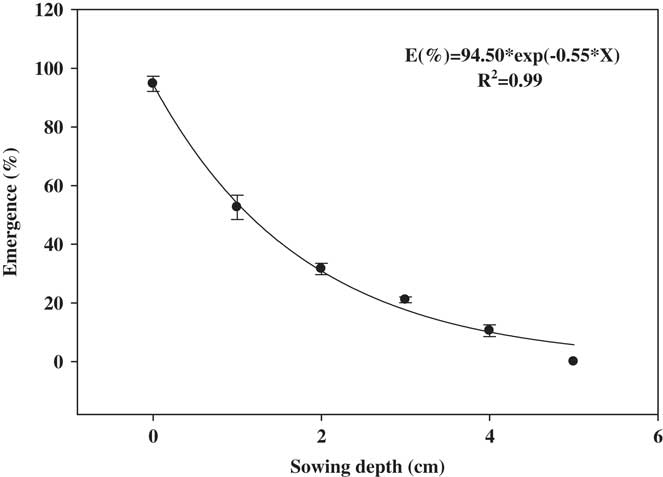
Seedling emergence of P. acarna was drastically reduced with increased burial depth (Figure 6). The highest emergence (94.7%) occurred when seeds were placed on the soil surface, while no seedlings emerged from burial depths of 4 cm or deeper (Figure 6). A burial depth of 0.5 cm inhibited 50% of the maximum emergence.
Seedling emergence of Picnomon acarna in response to burial depth (cm). Vertical bars represent the standard error of mean, and the line represents the two-parameter exponential decay (E(%)=a × e (−bx)) fit to the data.

Higher germination of seeds located close to or on the soil surface is consistent with the positively photoblastic nature of P. acarna seeds (Figure 2). Generally, reduced seedling emergence from greater sowing depth is due to low seed reserves that cannot support seedlings to reach the soil surface (Schutte et al. Reference Schutte, Tomasek, Davis, Andersson, Benoit, Cirujeda, Dekker, Forcella, Gonzalez-Andujar, Graziani, Murdoch, Neve, Rasmussen, Sera, Salonen, Tei, Tørresen and Urbano2014). This has been reported to be more common in small-seeded weed species. Compared with other weed seeds that are sensitive to sowing depths (Boyd and Hughes Reference Boyd and Hughes2011; Chauhan and Johnson Reference Chauhan and Johnson2008b; Nosratti et al. Reference Nosratti, Heidari, Muhammadi and Saeidi2016; Stanton et al. Reference Stanton, Wu and Lemerle2012), seeds of P. acarna are large enough that seedlings can emerge from deeper soil layers. Therefore, it could be concluded that failure of P. acarna seedlings to emerge as soil depth increased is due to its light requirement for seed germination. This conclusion is also supported by non-germinated seeds located at greater soil depths (unpublished data). The results of this experiment clearly suggest that tillage operations that bury seeds below 4-cm depth would be beneficial for P. acarna control. This weed would be more problematic in reduced-tillage cropping systems.
In general, this species is abundant in non-cropland and wastelands where soil is not tilled and seeds occur on the soil surface and are exposed to light, which promotes germination. The adoption of reduced-tillage systems by Iranian farmers, particularly those in rainfed farmlands, has resulted in leaving most seeds of P. acarna on the soil surface, which may explain why this weed is invading rainfed crops.
In conclusion, of the various factors examined in this study, light and osmotic potential were the most important predictors of P. acarna germination in rainfed cropping systems. Light increases germination of P. acarna seed; therefore, minimum tillage, which is popular in rainfed farmlands, will increase P. acarna density. Hence, by depriving the seeds of light using tillage or/and dense-canopy crops, it should be possible to reduce infestations in rainfed areas. In addition, germination of P. acarna under osmotic stress conditions suggests that this weed has great potential to spread into new areas of rainfed systems, which are typically under water-deficit stress. Across Iran, the problem of water-deficit stress is increasing, and P. acarna could become a significant weed in these arid areas, particularly in fields under minimum tillage.
Acknowledgments
We would like to thank Razi University for funding this research. No conflicts of interest have been declared.