I. INTRODUCTION
The increasing demand for reducing weight for aerospace applications has been the motivation for many research programs concerning lightweight alternatives to conventional aerospace materials such as aluminum and titanium alloys. Due to the unique properties such as low density, high specific strength, high specific stiffness, and excellent castability, magnesium alloy is becoming the ideal lightweight structural material applied widely in the field of aerospace. Reference Mordike and Ebert1,Reference Asl, Tari and Khomamizadeh2 Researchers found that adding rare earth elements (RE) is an effective way to improve the mechanical properties of magnesium alloy. Reference Bae, Kim, Kim and Kim3,Reference Mirza, Chen, Li and Zeng4 The main strengthening mechanism of Mg–RE alloy is precipitation hardening which endows the series of alloys with higher mechanical properties than the traditional Mg–Al alloys, e.g., AZ91D or AZ31B. Among those Mg–RE alloys, Mg–Gd–Y alloy is a newly developed magnesium alloy with high mechanical properties both at room and elevated temperature, which demonstrates the potential of its application as the complex-shaped structural material on lunar spacecraft.
To date, literature with regard to the microstructure, heat treatment optimization, and mechanical behavior of the Mg–10Gd–3Y–0.5Zr alloy have been published. Reference Jafari Nodooshan, Liu, Wu, Rao, Zhou, He, Ding and Mahmudi5–Reference Sun, Wu, Wang and Ding8 For the prospective application of the Mg–10Gd–3Y–0.5Zr alloy on lunar vehicle, it is necessary to study the influence of the huge temperature gradient (from −173 to 117 °C at the moon equator) on the mechanical properties of the alloy. Reference Vasavada, Paige and Wood9 Therefore, in the present study, the temperature gradient on the lunar surface was simulated by long time liquid nitrogen soaking (at −196 °C) and high–low temperature cryogenic thermocyclings (from −196 to 200 °C), and then the influence of the treatments on the microstructure, the tensile properties, and the fracture mechanism of the as-cast Mg–10Gd–3Y–0.5Zr alloy at both room and low temperatures was investigated.
II. EXPERIMENTAL
The Mg–10Gd–3Y–0.5Zr alloy was prepared from high-purity magnesium (purity higher than 99.95%) and Mg–25Gd (wt%), Mg–25Y (wt%), and Mg–30Zr (wt%) master alloys in an electric resistance furnace under the mixed atmosphere of CO2 and SF6 with the ratio of 100:1 and the melt poured into a steel mold was preheated to 200–300 °C with a diameter of 100 mm and height of 200 mm. The real chemical composition of the alloy ingot was determined to be Mg–9.86Gd–2.84Y–0.43Zr (wt%) by an inductively coupled plasma analyzer (Plasma-400; Perkin Elmer, Waltham, Massachusetts).
The samples were divided into four categories. The samples in the first category were put away at room temperature without aging and were named as-cast. The samples of the second category were deep cryogenically treated at liquid nitrogen temperature (−196 °C) for 10 days and named cast-10D. The third and last categories of the samples were cryogenic thermocycling treated. The cryogenic thermocycling consisted of a combination of cycles of cryogenic and aging treatment. One cycle involved an 11 h soaking in liquid nitrogen followed by heating to the 200 °C and keeping in 200 °C for 11 h. To do this, after casting, the samples were cooled down to the room temperature, and after the soaking in liquid nitrogen, the samples were warmed up to room temperature before aging. The samples in the third category were cryogenic thermocycling treated for 10 cycles and were named cast-10C. The samples in the last group were cryogenic thermocycling treated for 20 cycles and were named cast-20C. Sample nominations and heat treatment are listed in Table I.
Sample nominations and heat treatment conditions of the tested alloy.

Tensile properties of the four alloys were determined using sheet specimens with the marked dimensions of 15 mm gauge length, 3.6 mm width, and 2 mm thickness on the Zwick/Roell Z020 tensile testing machine (Ulm, Germany) at room temperature and on MTS-SANS CMT5000 (Shenzhen, China) separately at low temperature. The initial strain rate was 1.67 × 10⁻⁵ s−1. Phase composition was characterized by x-ray diffraction (XRD) using Ni-filtered Cu–Kα radiation. The microstructures, chemical compositions analysis, and tensile fracture surfaces of the investigated alloys were observed respectively by using optical microscope (OM, XJL-03; Grand Prosper Sports Goods Factory, Nanjing, China) and scanning electron microscope (SEM, JSM-7600F; JEOL Ltd., Tokyo, Japan) equipped with energy dispersive spectroscopy (EDS).
III. RESULTS
A. Microstructures of the Mg–10Gd–3Y–0.5Zr alloy after cryogenic treatments
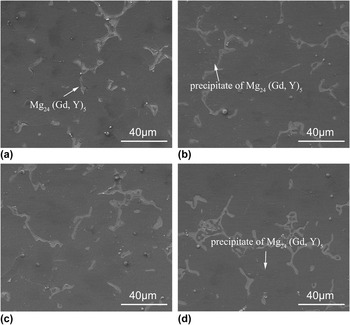
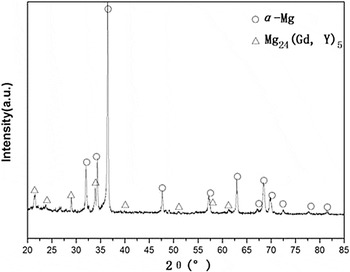
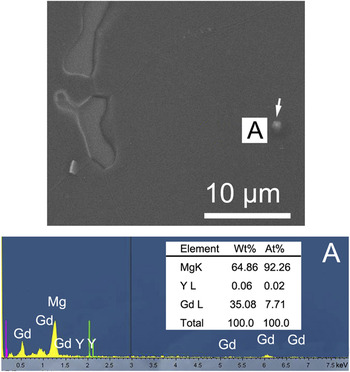
The microstructures of the Mg–10Gd–3Y–0.5Zr alloy with different heat treatments are shown in Fig. 1. As seen in Fig. 1(a), the as-cast Mg–10Gd–3Y–0.5Zr alloy is composed of the equiaxed Mg matrix and eutectic phases segregated at grain boundaries. According to the result of XRD analysis in Fig. 2, the eutectic phase is composed of Mg24(Gd, Y)5 phase. It is reported in Ref. Reference Gao, Wang, Gu, Zhao and Tong10 that the bulk eutectic phase near grain boundaries deteriorate the mechanical properties of the as-cast alloy. After cryogenic treatment for 10 days, some phases in particle shape precipitate from the Mg matrix near the primary eutectic phase and grain boundaries, as can be seen from Fig. 1(b). These particles can also be observed in the samples with cryogenic thermocycling [Figs. 1(c) and 1(d)]. According to the EDS result shown in Fig. 3, the composition of these particles is very similar to the eutectic phase. This demonstrates that the cryogenic treatments cause the precipitation of Mg24(Gd, Y)5 phase near the primary eutectic phase and grain boundaries.
Microstructures of the Mg–10Gd–3Y–0.5Zr alloy with different cryogenic treatments: (a) as-cast, (b) cast-10D, (c) cast-10C, (d) cast-20C.

XRD pattern of the as-cast Mg–10Gd–3Y–0.5Zr alloy.

EDS result of the particles appear after cryogenic treatment.

B. Tensile properties at room temperature
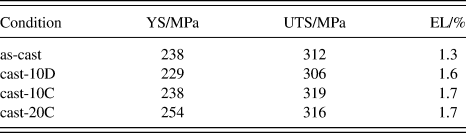
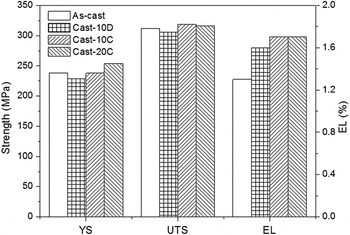
Room temperature tensile properties of the Mg–10Gd–3Y–0.5Zr alloy with different cryogenic treatments are listed in Table II, and Fig. 4 gives the comparison of the room temperature tensile properties among the alloys with different cryogenic treatments. As can be seen in Fig. 4, the yield strength (YS) and ultimate tensile strength (UTS) of the as-cast alloy are 238 and 312 MPa, respectively, and the elongation of the alloy is 1.3%. After 10 days of cryogenic treatment, there is 4% decrease of YS and 2% decrease of UTS in the alloy, while its elongation (EL) increases from 1.3 to 1.6% with an enhancement of 23%. Results show that the YS and UTS of the alloy with the cryogenic treatment almost remain unchanged, while there is an improvement of the ductility caused by the cryogenic treatment.
Tensile properties of the alloy with different cryogenic treatments at room temperature.

Room temperature tensile properties of the alloy with different cryogenic treatments.

After the cryogenic thermocycling, both the YS and UTS show tendency of improvement. The YS of the specimen with 20 cycles of the cryogenic thermocycling increases to 254 MPa which is 7% higher than that at room temperature. The UTS also slightly improves by 2 and 1% after 10 and 20 cycles, respectively. Meanwhile, there is a 31% improvement of the elongation for the specimens after the cryogenic thermocycling. It can be concluded that the cryogenic thermocycling brings slight improvement to the room tensile properties of as-cast Mg–10Gd–3Y–0.5Zr alloy.
C. Tensile properties at low temperature (−196 °C)
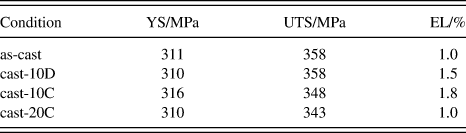
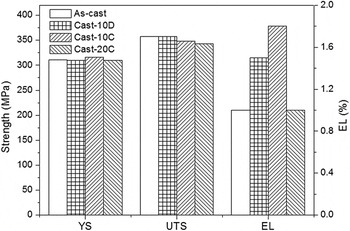
Low temperature (−196 °C) tensile properties of the alloy with different cryogenic treatments are listed in Table III, and the YS and UTS of the as-cast alloy are 311 and 358 MPa, respectively, and the elongation of the alloy is 1.0%. The tensile properties of the as-cast alloy at low temperature show 31% increase in YS and 15% increase in UTS compared with those at room temperature, but the elongation decreases by 23%.
Tensile properties of the alloy with different cryogenic treatments at low temperature.

Figure 5 shows the comparison of low temperature tensile properties among alloy with different cryogenic treatments. For the deep cryogenically treated alloy, the YS and UTS remain unchanged, while the elongation increases from 1.0 to 1.5%. After the cryogenic thermocycling, the YS increases to 316 MPa after 10 cycles and then decreases to 310 MPa after 20 cycles, and the UTS decreases monotonously to 348 MPa after 10 cycles and 343 MPa after 20 cycles which is a 4% decrease. The elongation of the alloy increases to 1.8% after 10 cycles and decreases to 1.0% after 20 cycles. To conclude, the deep cryogenic treatment has almost no influence on the strength, but it can slightly improve the ductility of the alloy at low temperature. The cryogenic thermocycling can improve the YS and elongation of the tested alloy, but it deteriorates the UTS at low temperature. Specimens after 10 cycles have the highest low temperature tensile properties.
Low temperature (−196 °C) tensile properties of the alloy with different cryogenic treatments.

D. Fractography
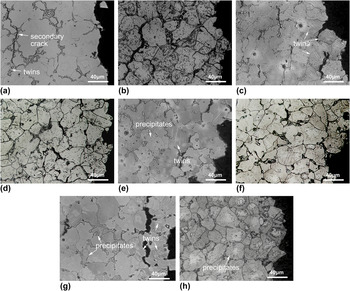
Figure 6 shows the microstructures of the longitudinal section of the tensile fractured specimens of the alloy with different cryogenic treatments tested at both room and low temperatures. Secondary cracks are observed near the fracture surface inside the eutectic Mg24(Gd, Y)5 phase in all specimens tested at both room and low temperature, which indicates that for the alloy with different cryogenic treatment, the weak eutectic phase is where the cracks initiate and propagate. As a main deformation system of magnesium alloy, Reference Wu, Jain, Brown, Stoica, Agnew, Clausen, Fielden and Liaw11–Reference Wang, Beyerlein and Tomé13 twins are also found inside the grains. As seen from Figs. 6(a), 6(c), 6(e), and 6(g), the density of twin of the specimens with both cryogenic treatment and cryogenic thermocycling is obviously higher compared with that of the as-cast alloy. For the specimens with the same cryogenic treatment status, the density of twin in the specimens tested at low temperature is much lower than that tested at room temperature. This is in accordance with the relatively lower elongation of the alloy at low temperature.
Microstructures of longitudinal section of the fractured specimens: (a) as-cast at 25 °C, (b) as-cast at −196 °C, (c) cast-10D at 25 °C, (d) cast-10D at −196 °C, (e) cast-10C at 25 °C, (f) cast-10C at at −196 °C, (g) cast-20C at 25 °C, (h) cast-20C at at −196 °C.

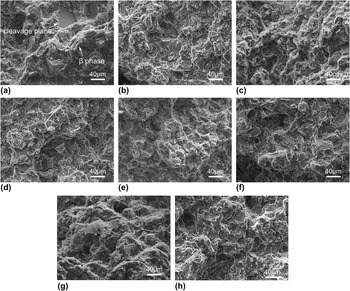
The SEM images of the ruptured surfaces of the alloy with different cryogenic treatments tested at both room temperature and low temperature are shown in Fig. 7. The failure surface is mainly composed of cleavage planes, ruptured eutectic phases, and secondary cracks, which demonstrates that cleavage is the main failure mechanism. As seen from Figs. 7(a), 7(c), 7(e), and 7(g), the proportion of ruptured eutectic phase slightly increases after cryogenic treatment and cryogenic thermocycling. This is due to that the Mg-matrix is strengthened by the precipitated Mg24(Gd, Y)5 phase, which can impede cracks propagation inside the grain. The alloy tested at low temperature shows no obvious changes in fracture characteristics.
SEM images of the ruptured surface of specimens: (a) as-cast at 25 °C, (b) as-cast at −196 °C, (c) cast-10D at 25 °C, (d) cast-10D at −196 °C, (e) cast-10C at 25 °C, (f) cast-10C at at −196 °C, (g) cast-20C at 25 °C, (h) cast-20C at at −196 °C.

IV. DISCUSSION
A. Effect of tensile temperature on tensile behavior
As shown in Tables II and III, the tensile properties of the alloy with different heat treatments at low temperature are much higher than those at room temperature. There is 31% improvement of YS and 15% improvement of UTS. Similar results have been achieved in other commercial magnesium alloys, like AZ91D and AZ31B. Reference Kuang14 The strong temperature sensitivity of the YS can be explained by the Peierls mechanism. At cryogenic temperature, the thermal vibration energy of the atoms decrease greatly with the temperature. This results in a higher activation energy for dislocations to overcome the Peierls barrier and glide on their slip plane, which impedes the deformation of the alloy and increase the YS of the alloy.
Significant decrease of the twin density in the ruptured specimens tested at low temperature is observed in Fig. 6. Due to the impediment to the glide of the dislocation, the stacking faults and dislocations needed by the growth of twin decrease and that leads to a low density of twin at low temperature. The lack of deformation systems also causes a relatively low elongation of the alloy at low temperature compared with that at room temperature.
B. Effect of cryogenic treatment on microstructure and tensile behavior
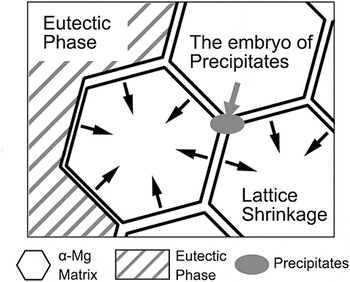
The cryogenic treatment and cryogenic thermocycling cause the precipitation of the Mg24(Gd, Y)5 phases near the primary eutectic phase and grain boundaries as can be seen in Fig. 1. The additional space result from the lattice concentration at low temperature is the main reason for the precipitation. Similar results were achieved in other researches. Reference Liu, Shao, Xu, Yang and Lu15–Reference Amini, Akhbarizadeh and Javadpour18 The schematic diagram of the precipitation progress is shown in Fig. 8.
Sketch of precipitation progress of the Mg24(Gd, Y)5 phase.

The improvement of the elongation after cryogenic treatments related closely to the twin density in the alloy. After cryogenic treatment and cryogenic thermocycling, the density of twin increases obviously. This is related to the precipitation of the particles near the eutectic phase. Similar results were also achieved by Robson et al. Reference Robson, Stanford and Barnett19 During the deformation, twins nucleate near the grain boundaries since the impediment to the dislocation movement at that area promote the nucleation of twins. However, during the growth of twins, according to the Orowan Model, the twinning dislocation will form a dislocation loop around the precipitate particle formed during the cryogenic treatment and additional stress is needed to bypass the particle. Thus, it can impede the growth of twins. The increase of the stress provides driving force for further nucleation of twins, and the density of twins then increases after the cryogenic treatment or cryogenic thermocycling.
The effect of the cryogenic treatment and cryogenic thermocycling on the YS and UTS of the alloy is more complicated. During the cyclic treatment of the alloy, the precipitates can impede the movement of dislocation and improve the YS of the alloy. Meanwhile, the shrinkage of lattice at cryogenic temperature and the expansion of lattice at elevated temperature will cause high stress concentration in local area and promote the formation of entanglement of dislocations which can also perform as the barrier for dislocations to glide and strengthen the alloy. Reference Gu, Zhang, Zhao, Wang, Zhou and Li20–Reference Wang, Liang and Ren22 On the other hand, due to the brittleness of the eutectic phase and low adhesive strength between the eutectic phase and the matrix, the YS and UTS improved after cyclic treatment is limited. Further research can be performed on the strengthening and weakening mechanisms induced by cryogenic treatment to find optimized cryogenic treatment time and temperature.
C. The fracture behavior of the alloy
As can be seen from Fig. 6, many secondary cracks are found inside the remnant eutectic phase near the fracture surface at both room and low temperatures tensile specimens which suggested that the coarse eutectic phases segregated at the grain boundaries are the preferential sites for the crack initiation. Micro-cracks nucleate and propagate inside multiple coarse eutectic phase due to its brittleness and its weak interface with the α-Mg matrix. This leads to the reduction of the effective bearing area of the specimens. The cracks then propagate in a trans-granular way into the α-Mg matrix and finally cause the failure of the alloy. This helps to explain why the fracture surfaces are composed of cleavage planes, remnant eutectic phase and tearing ridges and why the elongation of the as-cast alloy are low at both room temperature and low temperature. Reference Wang, Wu, Liu, Pang, Zhang and Ding23
V. CONCLUSIONS
In the present work, the microstructure and tensile behavior of the as-cast Mg–10Gd–3Y–0.5Zr magnesium alloy with four different cryogenic treatments were investigated. The following conclusions can be drawn:
-
(1) The cryogenic treatment has no obvious influence on the YS and UTS of the alloy at both room and low temperatures, while it improves the elongation of the alloy. The cryogenic thermocycling slightly improves both the room and low temperatures tensile properties, but deteriorate the UTS of the alloy at low temperature. Both cryogenic treatments cause the precipitation of the eutectic phase, which is the main strengthening mechanism.
-
(2) The as-cast alloy and alloy with cryogenic treatments all show excellent low temperature (−196 °C) tensile property which is a 31% improvement of YS and 15% improvement of UTS compared with those at room temperature, which is due to the higher barrier force for dislocations to move at low temperature. The elongation of the alloy slightly decreases at low temperature. This is due to the impediment to the growth of twin at low temperature which causes lack of the deformation system.
-
(3) The eutectic phase is the main area of crack nucleation and propagation in the alloy with different cryogenic treatments. The cryogenic treatments almost have no effect on the fracture mechanism of the alloy.
ACKNOWLEDGMENTS
This work is sponsored by Shanghai Rising-Star Program (No. 14QB1403200), National Natural Science Foundation of China (Nos. 51275295 and 51201102), and Funded by Projects of SAST-SJTU Joint Research Center of Advanced Aerospace Technology (No. USCAST2012-15).