1. Introduction
Mechanistic approaches to the philosophy of science have enjoyed a recent resurgence. This resurgence has been called by some the “New Mechanistic Philosophy” (Skipper and Millstein Reference Skipper and Millstein2005; Darden Reference Darden2008).
In what follows, I examine a feature of mechanisms about which there has been widespread disagreement in the recent literature. Specifically, I address the question of whether (and to what extent) we should conceive of mechanisms as productive of change in a regular way. The goal of this article is to show that, if mechanisms are characterized as productive of fully regular change, on the one hand, then not enough processes will count as mechanisms for them to be interesting or useful. If no appeal to regularity is made at all in their characterization, on the other hand, then mechanisms can no longer be useful for grounding prediction and supporting intervention strategies.
In section 2, I present several of the ongoing characterizations of mechanisms: some appealing to regularity, some not. In section 3, I argue against conceptions of mechanisms appealing to full regularity, claiming that such characterizations lead us to exclude phenomena from counting as mechanisms that mechanists do want to analyze mechanistically. In section 4, I argue against conceptions of mechanisms with no appeal to regularity at all, claiming that such characterizations undermine the supposed pragmatic benefits of the mechanistic approach. In section 5, I conclude that, if the new mechanistic philosophy is to be successful, a stochastic characterization of mechanisms must be adopted.
2. Current Characterizations of Mechanisms
Some current conceptions of mechanisms characterize mechanisms as productive of fully regular change; some do not. I refer to those philosophers who characterize mechanisms as productive of fully regular or invariant change as regularists. Philosophers who do not make any appeal to regularity or invariant change in their characterizations of mechanisms, I call irregularists.
Stuart Glennan, in his discussion of deterministic mechanisms, proposes a clear-cut example of a regularist characterization of mechanism.
Glennan 1: “A mechanism underlying a behavior is a complex system which produces that behavior by the interaction of a number of parts according to direct causal laws” (Reference Glennan1996, 52).
According to this account, the constitutive parts of a mechanism interact in accordance with direct causal laws. Because laws are commonly claimed to be (among other things) exceptionless, counterfactual supporting generalizations, we can understand Glennan's characterization to be fully regularist. If laws underpin the operation of mechanisms and laws always operate in the same fashion, then mechanisms always operate in the same fashion.
In 2002, Glennan revises his characterization.
Glennan 2: “A mechanism for a behavior is a complex system that produces that behavior by the interaction of a number of parts, where the interactions among parts can be characterized by direct, invariant, change relating generalizations” (Reference Glennan2002, S344).
Here, Glennan drops his appeal to laws, replacing it with a reference to “direct, invariant, change.” I discuss the implications of this terminological change below. For now, it suffices to say that both of Glennan's characterizations are fully regularist.
Machamer, Darden, and Craver (Reference Machamer2000) give the following characterization:
MDC: “Mechanisms are entities and activities organized such that they are productive of regular changes from start or set-up to finish or termination conditions” (3).
As is clear from the above characterization, the MDC view is also a regularist position. For MDC, something is a mechanism just in case its entities engage in activities that produce regular changes from start to finish. It should be noted, however, that the MDC characterization (unlike Glennan 1 and 2) may not be a fully regularist position. Machamer et al. write, “Mechanisms are regular in that they work always or for the most part in the same way under the same conditions” (Reference Machamer2000, 3). Due to this somewhat weakened appeal to regularity, MDC might actually qualify as a stochastic account of mechanisms. I say more about this in section 5.
Some proponents of the new mechanistic philosophy, however, make no appeal at all to regularity in their characterizations of mechanisms. Bechtel and Abrahamsen offer an example of a recent irregularist characterization.
B&A: “A mechanism is a structure performing a function in virtue of its components parts, component operations, and their organization. The orchestrated functioning of the mechanism is responsible for one or more phenomena” (Reference Bechtel, Abrahamsen and Stainton2006, 47).
As we can see, Bechtel and Abrahamsen's characterization makes no mention of regularity whatsoever. On this view, something is a mechanism just in case it is a structure performing a function in virtue of its component parts. The performance of this function, on Bechtel and Abrahamsen's view, could be a onetime occurrence. Thus, on Bechtel and Abrahamsen's view, a mechanism need not produce regular behavior at all.
Another philosopher who advocates an irregularist conception of mechanisms is James Bogen. Bogen concludes that “mechanists need not include regularities and invariant generalizations in their account” (Reference Bogen2005, 399). Peter Machamer, influenced by Bogen, also drops his appeal to regularity. Machamer writes, “I think ‘regular’ should be dropped from the definition. Jim Bogen argues forcefully that there might be mechanisms that operate only once in a while or even one that works only once” (Reference Machamer, Darden and Carver2004, 37). For this reason, Machamer should now be considered an irregularist.
It is thereby evident that there are current philosophers of science who support both fully regularist and irregularist conceptions of mechanisms. I argue below that, whichever of these two approaches we take, there seem to be problems.
3. Against Mechanisms as Fully Regular
In this section, I examine some implications for a fully regularist view of mechanisms. I suggest that some serious problems arise. My general point is this: if we envisage mechanisms as productive of fully regular or invariant change, then both (a) some of the same problems arise for mechanisms as there are for purported biological laws and (b) some of the main phenomena targeted by mechanists for mechanistic analysis will fail to qualify as mechanisms.
Let us first examine Glennan 1. Recall that this characterization of mechanisms is as follows: “A mechanism underlying a behavior is a complex system which produces that behavior by the interaction of a number of parts according to direct causal laws” (Glennan Reference Glennan1996, 52). I argue that Glennan 1 is unacceptable. My argument is this:
1. According to Glennan 1, mechanisms produce a given behavior according to direct causal laws.
2. Given 1, mechanisms operating in the biological world must operate in accordance with direct causal laws.
3. Given 1 and 2, there must be direct causal laws operating in and governing our biological world.
4. No such laws exist.
4*. Or if there are such laws of nature, they are not of the sort that fit well with the mechanistic approach.
5. Therefore, we should not accept Glennan 1.
I take 1–3 to be uncontroversial: 1 follows directly from Glennan 1; premise 2 is intuitive, for why would we be mechanists if no mechanisms existed in the world? And premise 3 simply follows from 1 and 2.
Premises 4 and 4* are more controversial. Regarding 4, my reason for accepting it, in part, stems from Beatty's well-known Evolutionary Contingency Thesis (ECT). On Beatty's view, generalizations in biology either amount to statements that are mathematical, physical, or chemical, in which case they are not distinctively about biology at all, or they are distinctively about biology, in which case they are about contingent outcomes of evolution—and are, therefore, not laws. In either case, we are led to the conclusion that there are no laws of biology (Beatty Reference Beatty, Wolters and Lennox1995, 46–47).Footnote 1 Since biological phenomena are paradigmatic targets for mechanistic explanation, and Glennan 1 seems to appeal to biological laws, Beatty's ECT seems to pose a significant threat to Glennan 1.
Encountering the above argument, the proponent of Glennan 1 might offer the following response. The laws appealed to in Glennan 1 are not necessarily meant to be distinctively biological. Maybe they are chemical, mathematical, or physical laws that merely underlie biological phenomena. On this interpretation, Beatty's ECT does not seem to threaten Glennan 1 at all. The problem with this response, however, is that there is good reason to think that even purported chemical, physical, and mathematical laws are contingent (see Cartwright Reference Cartwright1983). In fact, prima facie, it seems that Beatty's argument might run just as strongly against chemical, physical, and mathematical laws as it does against biological laws—only instead of evolutionary contingency, we might speak of cosmological contingency. For whatever the chemical, mathematical, or physical laws might be, they are plausibly tied to whatever way cosmology happens to have gone, a process that might have gone differently, just like evolution. And if generalizations describing laws are taken to be more than accidentally true, then cosmological contingency seems just as much a threat to mathematical, physical, and chemical laws as evolutionary contingency is to biological ones.
Some philosophers, however, do not require laws to be noncontingent (Lewis Reference Lewis1973; Mitchell Reference Mitchell1997, Reference Mitchell2000, Reference Mitchell2002; Cohen and Callender Reference Cohen and Callender2009). My response to this, as indicated by 4*, is that mechanistic approaches do not seem amenable to laws (even contingent ones) for additional reasons. Specifically, laws are typically expressed linguistically or mathematically, and inferences from them are commonly represented as of mathematical or logical derivation. However, mechanisms are typically described in model (schema) form—where text is merely a commentary or explication of these models rather than any kind of mathematical or logical inference from them. On the basis of the above reasons, it seems that, even if safe from Beatty's powerful ECT, Glennan 1's appeal to laws does not fit easily or comfortably in a characterization of mechanisms.
So let us take a look at MDC and Glennan 2. Glennan 2, recall, drops all reference to causal laws—referring instead to “direct, invariant, change relating generalizations” (Glennan Reference Glennan2002, S344). Since the problem with Glennan 1 seems to be its reference to laws, and Glennan 2 makes no such reference, perhaps Glennan 2 is an acceptable regularist characterization of mechanisms. MDC, recall, also characterizes mechanisms as productive of regular change. However, Machamer et al. make a weaker claim than Glennan: suggesting that mechanisms operate “always, or for the most part, in the same way under the same conditions” (Reference Machamer2000, 3). As such, the following argument should only be taken to apply to Machamer et al., to the extent that they do see mechanisms as fully regular. To the extent that they do not, their position seems to fall in line with the stochastic approach briefly sketched in section 5.
My argument is this:
i) Glennan 2 and MDC (to the extent that MDC is fully regularist) require that mechanisms produce behavior in a fully regular way.
ii) Very few phenomena in nature (targeted by mechanists for mechanistic analysis) behave in a fully invariant or fully regular way.
iii) Given i and ii, there are very few mechanisms in nature.
iv) For the new mechanistic approach to be viable, mechanists need there to be vast numbers of mechanisms operating in the natural world.
v) Therefore, the mechanistic approach, as characterized by Glennan 2 and MDC (to the extent that MDC is fully regularist), is not viable.
Premise i, once again, follows directly from MDC and Glennan 2. Premises ii and iv require some defense.
In order to defend ii, it is necessary to distinguish two ways in which a mechanism could fail to be regular or invariant. First, a mechanism might be irregular because (to use Machamer et al.'s terminology), its setup conditions obtain, but the anticipated change—thought to be produced by the mechanism—might sometimes fail to occur. Second, an abstract schema of a mechanism might allow disparate processes to fit as a given mechanism.Footnote 2 In this way, mechanism schemas, with any degree of abstraction, cannot be seen as regular. The reason is this: if more than one distinct causal chain satisfies a mechanism schema, then that schema does not depict a regularly behaving phenomenon. If it turns out that many of the phenomena that new mechanists target for mechanistic explanation fail to be regular in either (or both) of these senses, then there seems to be some reason to accept the above argument and reject fully regularist characterizations of mechanisms.
My examples of paradigmatic phenomena targeted for mechanistic explanation come directly from Machamer et al. They write, “Our goal is to sketch a mechanistic approach for analyzing neurobiology and molecular biology” (Reference Machamer2000, 2). Consider the phenomenon of the release of neurotransmitters and the initiation of electrical activity in postsynaptic neurons. This neurobiological phenomenon has been a recent target for mechanistic explanation (Craver Reference Craver2006, Reference Craver2007). However, as Bogen points out, this operation fails more often than it succeeds (Reference Bogen2005, 400). In other words, sometimes the release of neurotransmitters results in the instantiation of electrical activity in postsynaptic neurons; sometimes, not. In the cases where neurotransmitters get released but no electrical activity in the postsynaptic neurons results, there is a failure of regularity in the proposed mechanism. The purported mechanisms’ setup conditions obtain, but the anticipated behavior fails to result. This is a failure of regularity of the first sort mentioned above. I contend that, since neurobiological phenomena are paradigmatic targets for mechanistic explanation, and such phenomena fail to behave regularly, fully regularist mechanistic approaches cannot target such neurobiological phenomena for mechanistic explanation.
The second area of science targeted for mechanistic analysis by Machamer et al. is molecular biology. Consider the possibility of a protein synthesis mechanism. The mechanism for protein synthesis has been represented by the following mechanism schema: DNA→RNA→protein (Darden Reference Darden2006). As Darden points out, however, there are many different specifications of this schema. Although the rough picture always proceeds in the above three steps, there are many variations as to just how. Darden describes how different DNA sequences can produce different proteins. In bacteria, according to Darden, different RNA polymerases operate than in eukaryotes. Even among bacteria there is variation in how error-prone various different RNA polymerases are (Reference Darden2006). Here, we see an example of the second way that mechanisms can fail to produce regular behavior. Namely, a mechanism schema can be specified by a number of disparate processes. If a mechanism schema can be satisfied by disparate processes, then there fails to be one invariant way in which the mechanism in question operates. If a mechanism does not operate in one invariant fashion, then it clearly does not behave regularly. Since protein synthesis is another paradigmatic target for mechanistic explanation, and it also fails to meet with fully regularist requirements, it seems there is some reason to accept premise ii of the above argument against regularism.
A proponent of the proposed protein synthesis mechanism, however, might respond in the following way. She might agree that the mechanism schema DNA→RNA→protein is sufficiently abstract so as to allow multiple disparate processes to instantiate it. However, she might insist that there is no reason to assume that there is not full regularity at a lower degree of abstraction. Perhaps, in a more detailed lower-level schema, protein synthesis is fully regular and invariant. My response to this is that we are very unlikely to find any degree of abstraction at which protein synthesis operates with complete regularity. It seems to me that any attempt to specify a degree of abstraction at which protein synthesis is fully regular and invariant is going to fail in the first sense (of the two outlined above). Namely, there are too many ways in which the process of protein synthesis can vary at even the lowest degree of abstraction. To go back to the example mentioned above, protein synthesis in bacteria, depicted at the lowest degree of abstraction, is more error prone under conditions of stress. In this sort of example, conditions of stress can cause the use of a different RNA polymerase, which produces messenger RNAs with more errors. If stress conditions can cause variation in the purported protein synthesis mechanism—even at the lowest degree of abstraction—then it fails to meet the regularity demands of fully regularist conceptions of mechanisms.
Now, a few remarks on premise iv of the above argument. What is the matter with a mechanistic view according to which very few natural processes count as mechanisms? I suggest that there is something the matter with such a view. Specifically, it becomes difficult to understand why we should focus on searching for, describing, and modeling mechanisms in neurobiology and molecular biology, if not very many of the systems studied by these sciences qualify as mechanisms. If there are not very many systems that qualify as mechanisms, it makes little sense to build a philosophy of science around them. If the new mechanistic philosophy is an attempt to couch scientific aims and practices as largely having to do with mechanisms, then there had better be a vast number of them in nature. Otherwise, why think of science in primarily mechanistic terms? Upshot: regularists take a mechanistic approach toward a world where, by the light of their own regularism, very few mechanisms exist. This strikes me as sufficient reason to reject regularism.
4. Against Mechanisms as Irregular
In this section, I examine implications of a view of mechanisms according to which they need not be required to be productive of fully regular change at all. I suggest that, although irregularists may be able to avoid problems with full regularity (identified above), they fall prey to other serious problems. My general point is this: if we do not require mechanisms to be productive of regular or invariant change at all, then two serious problems result. First, any singular causal chain seems to be allowed to count as a mechanism, and, second, mechanisms no longer serve to ground prediction and support intervention strategies.
An irregularist characterization of mechanisms, recall, is one in which mechanisms need not be productive of change in any regular fashion at all. On such an account, I suggest, we are obliged to count certain occurrences as mechanisms that we would not want to. My argument for this is:
A. Characterizations of mechanisms with no appeal to regularity whatsoever allow any singular causal chain to qualify as a mechanism.
B. Whatever else a mechanism is, it is not a mere singular causal chain.
C. Therefore, characterizations of mechanisms with no appeal to regularity are unacceptable.
Imagine Bechtel and Abrahamsen, Bogen, and Machamer are correct, and mechanisms need not appeal to regularity at all. On this view, if we follow Machamer et al.'s terminology, all that is required of a mechanism is that it be “entities and activities organized such that they are productive of … changes from start or set-up to finish or termination conditions” (Reference Machamer2000, 3; ellipsis indicates omitted “regular”). What are the sorts of things that, on this characterization, might count as mechanisms?
Take the following example: on June 28, 1914, Archduke Franz Ferdinand was shot and assassinated in Sarajevo. As a direct result, Austria-Hungary declared war against Serbia. This, in turn, directly caused Germany and Italy (countries allied with Austria-Hungary) to declare war on the United Kingdom, France, and the Russian Empire (countries allied with Serbia). As a result, World War I began. This is a clear example of a singular causal chain; it only happened once. However, it apparently qualifies as a mechanism, if we think of mechanism in the above irregularist sense. In other words, we have entities (Franz Ferdinand and the forgoing countries) and activities (assassination and declarations of war) that are productive of change (the start of World War I). What we have, on an irregularist characterization, is apparently a mechanism.
What is so wrong with an account of mechanisms in which single causal chains are allowed to count as mechanisms? I contend there are two main reasons why we should not accept this view. First, on a view of mechanisms where single causal chains are allowed to count as mechanisms, the world is entirely composed of mechanisms. Quite literally, every instance of causation, on the above account, is an instance of a mechanism. If this is indeed the case, then there ceases to be anything interesting about searching for and describing mechanisms. My second reason for rejecting a view of mechanisms wherein single causal chains are allowed to count as mechanisms is that, on such an account, mechanisms cease to be able to ground generalized explanation. Mechanisms can no longer ground our theories about the generalities we see in nature, if single causal chains qualify as mechanisms. I take it that one of the main reasons for accepting a mechanistic approach is that we can explain the generalities we see in nature without appealing to laws. But if a mechanism is just a single causal chain, then there ceases to be any explanatory value in explaining the generalities we see in mechanistic terms. The upshot is this: without some appeal to regularity, mechanistic explanations are allowed to serve as just another way of describing something that happened—even if just once.
Furthermore, I argue that, without some appeal to regularity, mechanistic approaches cease to enjoy their supposed pragmatic benefits. Here, I focus on two such pragmatic benefits: grounding of predictions and constructing of intervention strategies. On a mechanistic approach, what scientists do is identify a puzzling phenomenon, construct a mechanistic model or schema that explains the phenomenon in question, then construct experimental strategies to test the proposed mechanism. I argue that, unless mechanisms are characterized as productive of regular change, the above pragmatic benefits collapse. My argument is as follows:
a) Scientists can only use mechanism schemas to predict experimental outcomes and construct intervention strategies if mechanisms are thought to produce regular behavior.
b) Given a, scientists can only ground predictions and pose interventions on a regularist conception of mechanisms.
c) Therefore, irregularism about mechanisms undermines the pragmatic benefits of the mechanistic approach.
My defense of the first premise (above) rests on the following sorts of considerations: imagine a lab scientist whose job it is to investigate some puzzling phenomenon; call it Z. Say this lab scientist thinks Z is produced by a mechanism schema of the following sort: X→Y→Z. Now, the lab scientist has constructed an experiment in which he can artificially create X→Y, and he wants to see whether Z obtains. Suppose he creates X→Y, but he does not get Z. Can he, on an irregularist conception of mechanisms, conclude that X→Y→Z is not a mechanism? No, for this may have merely been an instance in which the mechanism failed to produce the anticipated behavior. Now, imagine our lab scientist gets Z, but X→Y→Z was merely a singular causal chain, and it would not happen ever again. On an irregularist view, our scientist can still call X→Y→Z a mechanism. But the proposed mechanism, a mere singular causal chain, is powerless to explain any generality. For it only happened once. The result of these considerations is this: scientists can only use mechanisms to ground predictions if mechanisms are seen to behave regularly. If no regularity is required, then there is no reason to suppose any given outcome will occur.
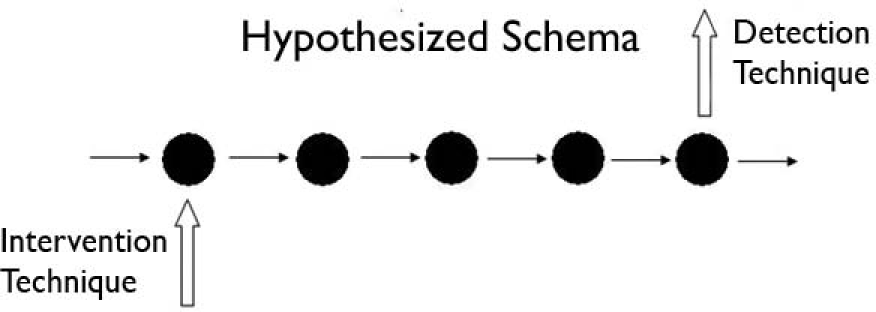
Mechanistic approaches are also supposed to enjoy the pragmatic benefit of allowing straightforward intervention strategies. Take the model for mechanistic intervention strategy shown in figure 1. On this model, we see the proposed mechanistic intervention technique for testing whether intervening on the first circle affects the behavior thought to be produced by the proposed mechanism.
Redrawn, based on figure 4.7a from Craver (Reference Craver2007), 145.

I ask this: Would the setup work, given an irregularist conception of mechanisms? I answer no. Why? Because, on an irregularist characterization (even if the experiment is perfectly set up in accordance with the above technique), the anticipated behavior might appear, or it might not. Unless it is supposed that the first circle would regularly cause the last one, there can be no testing of whether intervening on the first circle plays any causal role. Since this intervention technique only works if it is antecedently supposed that the first circle regularly causes the last, and on an irregularist account of mechanisms no such supposition is available, no such intervention technique is available to the irregularist. For this reason, and the others cited above, I reject irregularist characterizations of mechanisms.
5. Conclusion
In this article, I have argued that neither mechanistic regularism nor irregularism are acceptable positions. In section 2, I outlined current characterizations of mechanisms: some regular, some not. In section 3, I argued that fully regularist conceptions of mechanisms either lead to some of the same problems that there are for purported laws of biology or lead us to exclude paradigmatic targets for mechanistic explanation from qualifying as mechanisms. In section 4, I argued that irregularist characterizations of mechanisms lead us to implausibly accept singular causal chains as mechanisms while undermining the supposed pragmatic benefits of the mechanistic approach.
I propose that the way out of these problems is to adopt a stochastic account of mechanisms. According to a stochastic characterization, mechanisms are neither fully regular nor completely irregular—but are characterized as productive of behavior that is more or less probable.Footnote 3 This approach, prima facie, avoids my argument against regularism: it allows for paradigmatic targets of mechanistic explanation (like the release of neurotransmitters and the initiation of electrical activity in postsynaptic neurons and DNA→RNA→protein) to count as mechanisms. Furthermore, a stochastic account, prima facie, avoids my argument against irregularism: it disallows mere singular causal chains to count as mechanisms while accommodating prediction and intervention. On the basis of these considerations, I conclude that, if the New Mechanistic Philosophy is to be viable, a stochastic characterization of mechanism must be adopted and defended.