Students in capstone seminar courses in political science are often required
to go through the same research and writing process that professional
political scientists go through in producing publishable work. Students
often approach this exercise as the crowning achievement of their
undergraduate careers. However, both students and the professors who work
with them face constraints that may compromise the quality of the final
paper. For example, many students lack direction in the research and writing
process and miss opportunities for periodic critical evaluation and feedback
of their work at each stage of the writing process. In addition, although
capstone classes are generally small (in my case between 18 and 20
students), professors have limited time in which to read and provide
extensive comments on students' drafts. Because students are in the infancy
of their socialization into political science, and because of time
constraints on the part of the professor, students' efforts often result in
papers that fall short of their professor's expectations. Generally, this is
true not because students lack the commitment or desire to produce good
work, but because they: (1) lack a framework that promotes substantive
discussion of complex research questions in basic ways; (2) are unaware of
feedback resources that political scientists tap into when preparing a
transcript for publication; (3) are unaware of the benefits of approaching
the project in cooperative fashion; (4) fail to generate deadlines not
mandated by the professor and thus do most of their substantive thinking and
writing only during that critical last week before the paper is due; and (5)
are fearful (in some cases) of sharing their unfinished work with their
professor and others. Likewise, the absence of periodic critical feedback is
not the result of professor ambivalence, but rather the outcome of
professors who must balance student demands with demands from other classes,
with their own research and publishing objectives, and with other
departmental responsibilities.
One way professors can help remedy those deficits and promote more detailed
feedback is to require students to plan and participate in a mock
professional conference poster session a few weeks before the final draft of
the research paper is due. This activity is productive for the students in
many ways. First, this exercise forces the students to condense their
research paper down to essential arguments and support that can be conveyed
in a few short minutes. Second, it ensures that the evidence and analysis
presented clearly connect to those arguments. Third, it forces the students
to take a critical look at their work to date and identify what issues they
are still struggling with. Fourth, this activity functions as a
catharsis—the research process is often a lonely process for students; this
gives them a chance to discuss that process in a low-pressure situation.
Fifth, it gives students a chance to see how far they have come and to
receive encouragement from their peers and from the professor. Sixth, it
provides students with added incentive to move closer to completion of the
paper sooner than they normally would. And finally, it gives students a
valuable piece of citizen education—the skill of making presentations can be
transferred to both scholarly and non-scholarly settings after graduation.
The outcome, in terms of the practicality of this exercise, is that students
critically evaluate their peers' work and receive critical evaluation in
return which can then be incorporated into the final draft of the paper.
In this paper I describe how I use a mock professional conference poster
session to facilitate critical self-evaluation and to elicit critical peer
feedback that can be used to improve student research papers. This process
includes having students generate the criteria for effective posters,
helping students identify specific components of their papers to include
(and to exclude) in their posters, facilitating student planning of the
logistical components of the poster session, conducting the poster session,
facilitating critical and useful feedback, evaluating the posters, and
integrating feedback into revised drafts of the research paper. I found that
students who participated in the poster session made significant and
substantive revisions to their paper drafts and that these changes
dramatically improved their final papers. As a bonus, students also gained
valuable experience in making presentations and in improving their
presentation skills.
Generating the Criteria and Format of Effective Posters
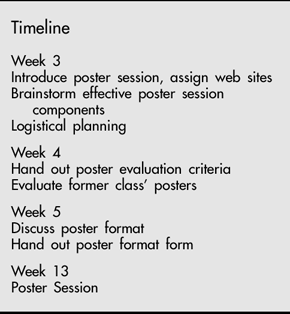
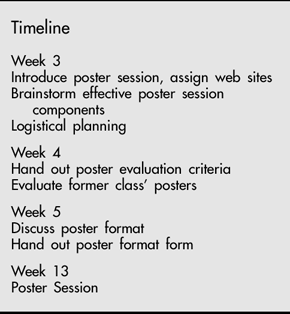
During the third or fourth week of the semester, I introduce the mock
conference poster session to the students. On learning about the poster
requirement many students are initially turned off. Some worry that they
will be graded on the basis of their ability to creatively use glue,
scissors, crayons, glitter, and so on. I reassure them that the primary
purposes of the poster session are to share their research with their
peers (and thereby improve their presentation skills) and to gather
critical feedback that they can use to improve their paper. At the same
time, I stress that going through the process of presenting their work
visually may also encourage them to look at their paper critically in
ways they had not done so before. In fact, I have found that the effort
students devote to presenting their material in effective ways on the
poster often translates into more careful and critical discussions of
that same information when presented in the research paper.
To get the students to identify the criteria of effective posters, I
first assign the students to view a few web sites (list available from
author upon request) that discuss poster presentations. In a follow-up
class, we then brainstorm a list of specific qualities that make an
effective poster. This list often includes components like appearance
(readability, organization, and format) and content (research question
and hypotheses, approach, methodology, discussion of results,
conclusions, and limitations). Then, during a later class period, I
bring several posters from the previous semester into the class. I hang
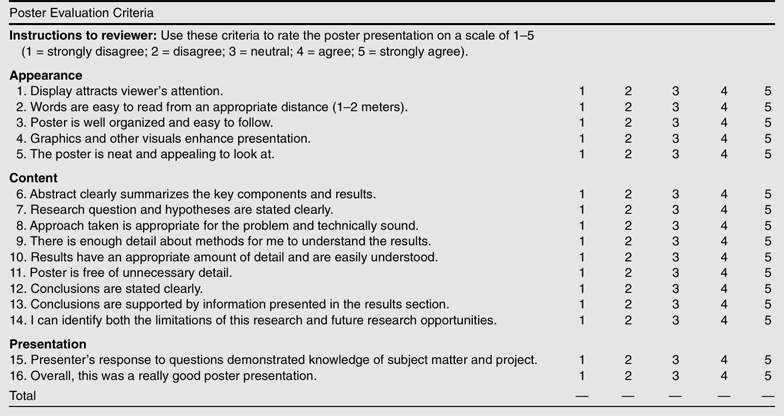
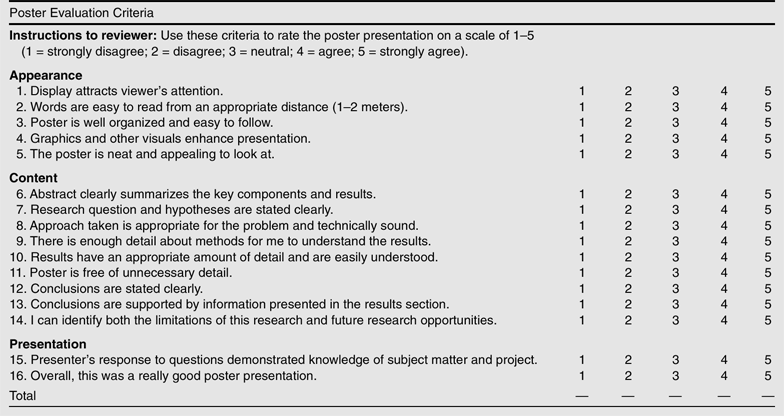
these posters on the walls of the classroom, give students the grading
criteria I use for their poster session, and ask them to evaluate the
posters (table #1) (Although the criteria are my own, I point out how it
reflects the components the students generated previously.) Once the
students have each had a chance to evaluate two or three posters, I
collect the posters, put them up in front of the class, and discuss a
few of them. Using the evaluation criteria I passed out at the beginning
of class, we evaluate each poster's effectiveness in format, presenting
the research question, explaining and justifying methodology, explaining
analysis, presenting findings, outlining conclusions, and discussing
limitations. Following a discussion of the example posters, we develop a
list of essential components and a diagram that outlines the format of
an effective poster. I turn this list into a formal handout, which I
distribute to the students in the following class.
What to Include (and Exclude)
One of the most difficult (and productive) components of the
poster-preparation process is that of evaluating the usefulness and
validity of each of the arguments included in the paper. Despite the
difficulty of this exercise, it can be very productive in terms of
boiling down an argument to its bare essentials. The students are able
(with direction from me and from other students) to see whether the
essential components of their paper (their argument, data, analysis,
theoretical grounding, conclusions, limitations, implications, and so
forth) all fit together and hold up.
Frequently, students find that increased and substantive student-student
and professor-student discussions highlight holes in their research,
analysis, conclusions, etc. In some cases, there may not be time to fill
in those deficits prior to the poster presentation; however, the
discovery provides new direction or pinpoints key areas that the
students can focus on improving in their research paper. Similar to
outcomes of writing a literature review, this part of the process helps
students see not only the research questions more clearly but also the
places they need to go to get the needed information. In addition,
engaging in this process earlier in the semester forces students to
confront their research and deal with more of the problems inherent in
unexamined research. It is important to note that I reassure the
students that the discovery of problems—even if they cannot be fixed
before the poster session—is a productive process. It helps them seek
more specific feedback and suggestions when they present their
poster.
Students take the framework that they have developed through both our
in-class discussion and their investigation of poster presentation web
sites and use it to identify content specific for each quadrant on their
posters.
Planning the Logistical Components of the Poster Session
A few classes after introducing the poster session to the students, I
solicit volunteers to plan each major element of the poster session.
Because the goal is to give the students genuine experience in
presenting at a professional poster session, we recreate as many aspects
of a professional conference as possible. Although one might expect the
students to approach this part of the project with some reservation, I
have found that the planning stage generates excitement and commitment
to the success of the poster session.
One group is assigned room scheduling. I emphasize that they need to
schedule a room that is big enough to allow for attendees to move around
the room and look at all of the displayed posters. This group also needs
to schedule easels to be placed in the room so that the presenters can
display their posters or have appropriate wall space where the posters
can be tacked up.
Another group is assigned to contact publishers. I have a publishers'
table so that both students and attendees can see exemplary research on
the capstone topic. At the end of the conference, we usually raffle off
the books at the publishers' table. In the past it has been somewhat
difficult to get publishers to donate books. The alternative to
approaching publishers is to solicit donations from department funds to
purchase a few relevant books online (Amazon usually has used copies for
a reasonable price). I usually purchase a few books myself and donate
them to the table.
Another group is responsible for planning publicity. This includes
developing, printing, and passing out flyers, as well as developing a
program for the session. When approached, representatives from Pi Sigma
Alpha willingly put their organizational support behind our class
efforts. They help students in charge of publicity get the word out to
other political science classes and to other professors in the
department. In fact, it may be worthwhile to explore the possibility of
having Pi Sigma Alpha and the political science department sponsor the
session and make it a regular requirement of capstone courses.
Another group is responsible for making sure that the room is set up
appropriately (ensuring that scheduled easels or other display methods
are in place on time) and for cleaning up following the poster
session.
Finally, a group is assigned to plan a refreshment table.
Preparing the Students to Give and Ask for Critical and Useful
Feedback
I have found that without specific criteria to frame discussions of the
posters—and more important, the substance of the papers—students often
shy away from both giving and soliciting critical and useful feedback.
To promote that goal, some training is necessary, both for students who
are giving the feedback and for the presenters who must ask for and stay
open to criticism. Before the actual poster session, we review the
evaluation criteria handed out in an earlier class. We then take a
second look at the posters I brought in earlier in the semester. We
identify specific areas around which discussion should take place. I
then model ways in which student presenters could solicit critical
discussion and feedback, had they been presenting that poster. I also
model ways that students as evaluators could ask questions that assess
analytical and evaluative components of the research presented in the
model poster. Finally, I have students generate a list of questions and
discussion points that they are still seeking to deal with in their
research paper. I encourage the presenters to use that list to direct
their discussions with peer evaluators and with other participants in
the mock conference.
Conducting the Poster Session: Logistics
The poster session is held for just one hour. I find that this is enough
time for students to have three or four substantive conversations with
attendees and other participants. I start the session with a brief
welcome to the students and other visitors. I explain the purposes of
the session for presenting students: to present their research, to
gather feedback that can be used to improve their paper, and to gain
experience in making presentations. I play the role of host to
facilitate substantive discussion between participants and attendees.
Although I have provided feedback from the early stages of the research
and writing process, I also make a point of talking with each of my
students. This contact is generally brief and not very critical. My
purpose is simply to offer encouragement rather than critical feedback
which I will give later as I evaluate their posters outside the time
constraints of an hour-long poster session. When the hour is finished, I
formally end the poster session by thanking attendees and students. We
raffle off the books from the publishers table and I collect the peer
evaluations. I now turn to those peer evaluations.
Conducting the Poster Session: Peer Evaluations of the
Posters
The presenters are each required to evaluate three of their peers'
posters by using the evaluation sheet. To ensure that each poster is
evaluated three times, I have each presenter keep three evaluation
sheets by their poster so that students know that once all three have
been filled, they do not need to be evaluated any more. I have groups of
three or four presenters rotate through the evaluation process. This
means leaving their poster for approximately 15 minutes and evaluating
three other posters (where students are present). Although student
evaluators may not be able to evaluate posters with a professor's
critical eye, I find that student involvement in the evaluation
accomplishes several things that contribute to improved capstone papers.
First, it forces presenters to give a clear and short explanation. This
is necessary because the student evaluators usually do not have a great
deal of knowledge about the subject matter. Lack of deep understanding
of the subject matter often means that the student evaluators demand
that the poster be clear, concise, and easily accessible. Second, peer
evaluations provide additional critical feedback through guided
substantive discussion that the author can then integrate into the final
paper. Third, it provides the student evaluators with a chance to
compare their own poster to those of other presenters and to identify
alternative ways of organizing and analyzing information. When grading,
I average the student evaluations and count them as a predetermined
percentage of the student's grade for the poster session.
As noted earlier, I do not evaluate the students' posters during the
poster session. I find that the demands of assessing effectiveness and
grading the poster during the poster session—when there are 18 to 20
posters to evaluate in a period just short of an hour and when I want to
have critical discussions with each of the students presenting
posters—is too tall a task; trying to accomplish all these things at
once makes the poster session less effective. Instead, I collect the
posters following the session and take them back to my office. I can
evaluate them over the next day or two and spend more time on each. I
use the same evaluation form as the students and also write additional
comments or suggestions at the bottom of the form. As with the peer
evaluations, I tailor my comments to improving the quality of the
upcoming capstone paper.
Integrating Feedback into Revised Drafts of the Research
Paper
Following the poster session, I require the students to sit down with the
written evaluations and the questions or discussion points they
generated before the session and draft an outline that summarizes: (1)
the key weaknesses or suggestions they received in the written
evaluations; (2) the sticking points gleaned from discussions they had
with others during the poster session; and (3) other weaknesses or gaps
in the research and writing process that still need to be filled before
the final draft of the paper is turned in. The students take that
outline and draft it into a research progress report. This research
progress report requires students to make sense of where they are in the
research, analysis, and writing process, and to make specific plans to
complete their paper. I encourage students to meet with me during the
process of drafting this memo. Because by this point I have read a draft
of their research paper I am able to give them additional direction in
identifying weak areas in theory, grounding their research in the extant
literature and theory, using empirical data, methodology, analysis, and
conclusions, and in discussing limitations.
Conclusion
This process provides students with a wealth of feedback and socializes
them into the practice of seeking out feedback throughout the writing
and research process. Students also gain valuable experience making
presentations—a necessary skill in scholarly and non-scholarly settings.
As a result of this experience, students are generally much more
comfortable with presenting their final paper to the class because they
have already engaged in critical discussions about their paper during
the poster session. The poster session also makes those later paper
presentations more productive; each student has learned the difference
between anecdotal, substantive, and theoretical discussion and sees the
value of the latter in improving his or her research and writing.
Finally, the quality of the capstone paper increases because students
have followed a process that encourages them to seek critical and
substantive feedback which they can then incorporate into their
paper.