I. INTRODUCTION
Metal matrix composites (MMCs) have attracted attention in many industries for several decades. The research on MMCs is concentrated on improving the properties of the material with the focus being mostly on mechanical properties to expand the area of application and substitute conventional materials. Among MMCs, aluminum matrix composites (AMCs) are mostly preferred for their low density, high strength and toughness, good resistance, and machinability especially in automotive and aerospace applications Reference Chawla and Chawla1,Reference Koli, Agnihotri and Purohit2 like engine blocks Reference Macke, Schultz and Rohatgi3 and airframes. Reference Song, Krauklis, Mauritz and Bandyopadhyay4
Several ceramics such as B4C, Reference Harichandran and Selvakumar5 BN, Reference Wang, Lei, Ruan and Dong6 SiC, Reference Kim, Koss and Gerard7 Al2O3, Reference Saravanan and Senthilvelan8 MgO, Reference Takahashi, Imai, Kan, Hotta and Ogawa9 Si3N4, Reference Sharma, Sharma and Khanduja10 TiB2, Reference Johny James, Venkatesan, Kuppan and Ramanujam11 TiC, Reference Chen, Hua, Xu, Zhang, Qi and Jie12 and graphite Reference Baradeswaran, Vettivel, Perumal, Selvakumar and Issac13 in particulate, whisker, or fiber forms have been researched as reinforcement materials in AMCs. Although using continuous fibers as reinforcement materials is the most effective method in terms of improving the mechanical properties their relatively high prices limit their use as reinforcement. On the other hand, reinforcement materials in their particulate forms are less expensive as compared to their fiber counterparts while giving sufficient improvements in mechanical properties. Together with the type of the reinforcement material appropriate dispersion of the particles in the matrix also plays a vital role in the final product quality. Reference Jayashree, Gowri Shankar, Achutha, Sharma and Raviraj14
B4C being the third hardest material (3800 HV) after diamond and boron nitride has attractive mechanical properties such as high strength, low density, very high hardness, and good chemical stability and is therefore considered as a potential reinforcement material along with SiC and Al2O3. Reference Auradi, Rajesh and Kori15,Reference Sharifi, Karimzadeh and Enayati16 Literature reports that B4C possesses very good bonding characteristics with aluminum alloys compared to the other ceramic reinforcements. Reference Poovazhagan, Kalaichelvan and Sornakumar17 B4C reinforced AMCs have been used as armor material in body protection and as neutron-absorbing material in nuclear industry. Reference Yao and Chen18 Shorowordi et al. found out that the wear rate and friction coefficient of Al–B4C fabricated by stir casting was lower than those of Al–SiC whereas Lee et al. reported that the strength of Al–B4C fabricated by pressureless infiltration is higher than that of Al–SiC. Reference Shorowordi, Haseeb and Celis19,Reference Lee, Sim, Cho and Kwon20 Harichandran et al. investigated the effect of using nano and micron sized B4C particles to produce AMCs by ultrasonic cavitation-assisted solidification process and concluded that increasing the B4C content increases the ultimate tensile strength of the samples. Reference Harichandran and Selvakumar5 Ravi et al. found out that the increase in the ultimate tensile strength due to squeeze casting is greater than the increase (14%) observed by the AA6061–B4C composites obtained by stir casting. Reference Ravi, Balu Naik and Udaya Prakash21
Although there are several methods to prepare AMCs, squeeze casting enables to obtain samples with improved mechanical and microstructural properties by eliminating porosities and shrinkage and providing a fine grained equiaxed structure with small dendrite arm spacing. Reference Skolianos, Kiourtsidis and Xatzifotiou22,Reference Crouch23 Besides, some researchers suggest that this improvement might also be the result of a higher dislocation density in the samples prepared by squeeze casting Reference Masoumi and Hu24 which increases the lattice strains that interact with active dislocations, impeding their motion and resulting in an increase of the yield strength. Reference Zhang, Wu, Liu, Zhang, Pang, Wang and Ding25 In addition to the positive effects of squeeze casting on the mechanical properties of the final products, components manufactured via squeeze casting require less or no post machining processes as compared to conventional casting and have improved strength and ductility. Reference Vijayaram, Sulaiman, Hamouda and Ahmad26,Reference Chen, Liu, Yang, Zhu and Li27 Among several studies investigating the effect of the squeeze pressure on the final characteristics of the AMCs Chen et al. showed that reinforcing AMC with SiC and Ti particles can maintain ductility while increasing the strength of the material. Reference Chen, Liu, Yang, Zhu and Li27 In their study about the stainless steel reinforced AMCs Bhagat et al. Reference Bhagat28 concluded that squeeze casting is a promising method to increase the product quality. Despite its distinctive advantages squeeze casting needs proper control of process parameters such as die, punch, and melt temperatures, and also an appropriate timing for pressure application is necessary to obtain the desired product quality.
This study investigates the effects of the squeeze casting on the machinability, surface roughness, densification, hardness, and mechanical strength of AMC produced with varying B4C contents and squeeze pressures.
II. MATERIAL AND METHODS
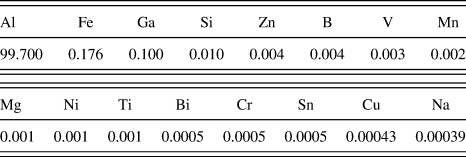
Commercial pure aluminum (Sahinler Metal Co., Istanbul, Turkey) was used as matrix material throughout the experiments. Chemical analysis results of the matrix material ingots as supplied by the manufacturer is given in Table I. The average size of the particulate B4C (Hongwu International Group Ltd., Guangdong China) reinforcement material was about 65 μm. The flux material used for wetting the B4C particles was potassium fluorotitanate (K2TiF6, Hongwu International Group Ltd.)
Reference Hu, Zhao and Li29
with an average particle size of 75 μm. The B4C to K2TiF6 ratio by volume was kept constant as 1:1. Chemical composition (wt%) of matrix material.
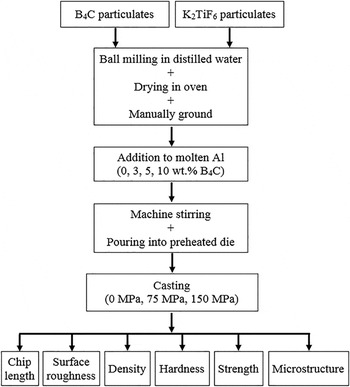
B4C particles were mixed with potassium fluorotitanate and ball milled in the presence of distilled water at 85 rpm using 10 mm alumina balls for 7 h to increase the wettability of boron carbide. Reference Toptan, Kilicarslan and Kerti30 Next, the mixture was dried in an oven at 110 °C for 2 h and further manually ground using an agate mortar and pestle. Then, the mixture is added to pure aluminum melt in appropriate amount at 850 °C and machine stirred at 250 rpm in the furnace for 15 min. The die and punch were preheated to 350 °C. Reference Baskaya31 An in-house produced squeeze casting setup with a stroke of 200 mm was utilized. In case of squeeze casting, the pressure was applied when the temperature of the melt dropped to 730 °C and the selected pressure was applied for 60 s. All the samples with 4 different B4C contents, namely Al–0% B4C, Al–3% B4C, Al–5% B4C, and Al–10% B4C, were gravity cast (designated as 0 MPa from now on) and squeeze cast under 75 and 150 MPa. 7 cylindrical samples of 13 mm diameter and 45 g weight have been prepared for each composition (4 different compositions, namely 0, 3, 5, and 10% B4C) and 3 different pressures (0, 75, and 150 MPa) resulting in a total number of 84 samples. The procedure used to prepare the samples is illustrated step by step in the flowchart (Fig. 1).
Flowchart depicting the preparation and characterization of B4C reinforced AMC samples by squeeze casting.

The samples were used to determine the machinability, surface roughness, density, hardness, mechanical strength, and for microstructural evaluation. First, the head of the samples were removed by a hacksaw and they were mounted on a turning machine. Ceramic tools (Sumitomo DNGA432, Sumitomo Chemical, Osaka, Japan) were used to machine the samples. After an initial cleaning pass the samples were machined at a feeding rate of 0.7 and 2.68 mm/s with a constant turning speed of 860 rpm. The average chip lengths of the samples were evaluated to determine machinability. Next, the samples were tested for their surface roughness using a profilometer (Bruker Dektak XT, Bruker Corporation, Coventry, United Kingdom) over a region of 4 mm. After machining to 10 mm diameter and 60 mm length the samples were weighed and their densities were calculated. After that, Brinell hardness test was applied at three testing points on each sample (21 indentations for each parameter set) using a 2.5 mm diameter hardened steel indenter under 187.5 kgf for 10 s. Then, five samples in each parameter set were prepared according to ASTM E8 standard 32 and tested in a universal testing machine (Zwick/Roell Z010, Zwick, Ulm, Germany) using a 10 kN load cell. Average values and standard deviations of yield and ultimate tensile strengths for each parameter set were obtained. Finally, to evaluate the effects of B4C content and squeeze pressure on the microstructure, the samples were cut and embedded in bakelite, ground and polished (Struers LaboPol-5, Willich, Germany), and etched using Marble’s reagent (10 g CuSO4 in 50 mL HCL/50 mL distilled water). Then the prepared samples were investigated under optical microscope (Clemex LV 150) and in the scanning electron microscope (SEM; Zeiss Supra 55, Carl Zeiss AG, Oberkochen, Germany).
III. RESULTS AND DISCUSSION
Al–B4C composites were produced by squeeze casting using various concentrations of B4C from 0 wt% (control sample) to 10 wt% and using different casting pressures as 0 (gravity cast, control sample), 75 and 150 MPa.
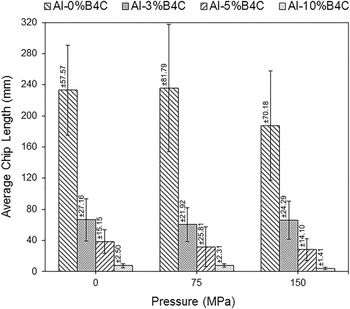
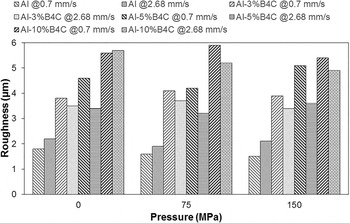
Produced samples were evaluated based on their average chip length (Fig. 2) and surface roughness (Fig. 3) to determine the effects of the different B4C contents and the squeeze pressures on machinability. It was determined that squeeze pressure does not have a profound effect on the chip length of the samples. However, addition of B4C particles has a detrimental effect on the average chip length of the produced samples and the chip length is observed to decrease drastically with increasing amount of B4C addition (Fig. 2). A similar detrimental effect of B4C addition was also observed for surface roughness which worsens with the increasing amount of B4C addition as seen in Fig. 3. These observations were primarily attributed to the brittle nature of the B4C particles. The data obtained by increasing the feed rate revealed that the surface roughness of the pure Al samples increases with the feed rate for all pressures. However, for B4C added samples increasing the feed rate decreases the surface roughness (Fig. 3), in general. This leads to the conclusion that a smaller feed rate needs to be preferred for a smaller surface roughness in case of B4C added samples which is similar to the findings of Ozben et al. Reference Ozben, Kilickap and Cakır33 who state that the surface quality can be improved by decreasing the cutting speed in SiC reinforced AMCs.
Effect of B4C content and squeeze pressure on average chip length of the samples.

Effect of B4C content, squeeze pressure and feed rate on surface roughness of the samples.

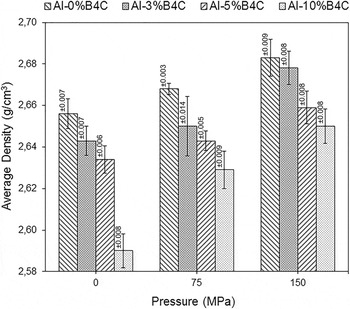
The densities of the obtained samples were also measured and presented in Fig. 4. It was observed that regardless of the composition, application of pressure during squeeze casting has a positive effect on the densification and the density of the samples increase with the amount of pressure applied (Fig. 4). This increase is more pronounced for the samples with B4C addition. On the other hand, for any given squeeze pressure the density is observed to decrease with the amount of B4C added which is thought to be related to the relatively lower density of B4C (2.52 g/cm3) compared to Al (2.70 g/cm3).
Effect of B4C content and squeeze pressure on average density of the samples.

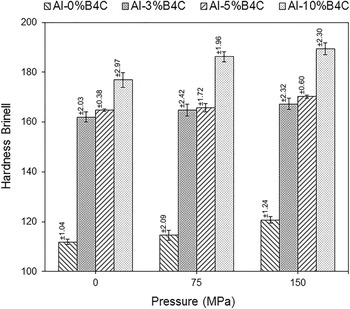
Brinell hardness test was conducted and obtained mean values and standard deviations for each parameter set were presented in Fig. 5 to illustrate the changes in hardness values with respect to the B4C contents and the squeeze pressures. Increasing the applied pressure has a limited effect on the hardness values of the samples for a given amount B4C which is thought to be based on the improved densification of the samples due to the casting pressure. On the other hand, B4C addition significantly improves the hardness of the samples regardless of the casting pressure. Hardness of the Al–3% B4C samples was found to be almost 50% greater as compared to pure Al samples whereas there is only a 10% increase in hardness when the amount of B4C is increased from 3 to 10%. This observation agrees with a similar positive effect of B4C reinforcement on the hardness of AA7075 alloy found in the literature. Reference Baradeswaran and Elaya Perumal34
Effect of B4C content and squeeze pressure on the hardness of the samples.

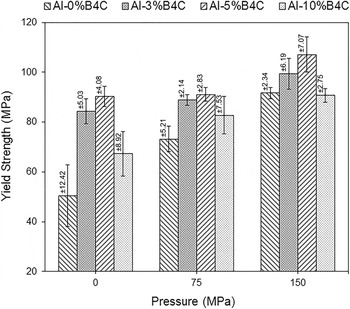
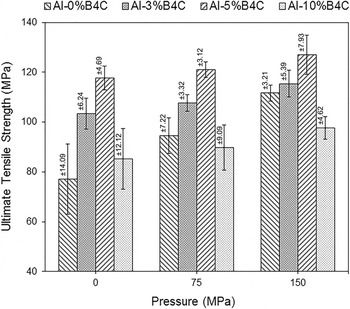
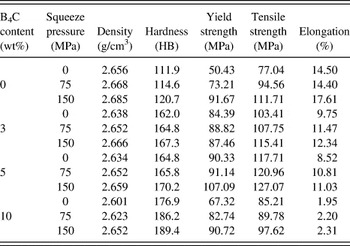
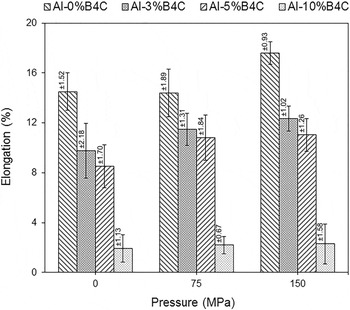
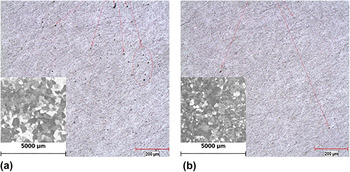
Tensile tests were conducted to obtain the effect of B4C content and varying the squeeze pressure on the yield and ultimate tensile strengths of the samples. Yield and ultimate tensile strengths of the samples with B4C reinforcement were observed to increase with the increase of the B4C content up to 5 wt%, in general (Figs. 6 and 7). This shows that the addition of higher strength B4C particles is a suitable method to enhance the strength of the AMCs up to 5 wt%. Table II summarizes the change in density, hardness, yield strength, tensile strength, and elongation of the samples produced with varying B4C content and squeeze pressure. The increase in yield and ultimate tensile strengths are coupled with a decrease in the elongation of the samples with increasing B4C amount, in general (Fig. 8) which denotes a ductile behavior up to 5 wt% B4C. The increase in the strength values may be attributed to the presence of higher strength B4C reinforcement particles as well as the increased dislocation density close to the matrix and reinforcement interface due to the thermal expansion coefficient mismatch preventing dislocation motion during cooling and in turn increasing the strength. Furthermore, the reinforcement particles may act as nucleation sites for grains enhancing grain refinement (Fig. 9) and thus the overall strength. Reference Oluwatosin Bodunrin, Alaneme and Chown35,Reference Kashyap, Ramachandra, Dutta and Chatterji36 The inverse relation observed between the increasing yield and tensile strengths and the decreasing elongation agrees with the results found in the literature. Reference Yang, Dong, Yu, Wu, Hussain and Wu37,Reference Emamy, Vaziri Yeganeh, Razaghian and Tavighi38
Effect of B4C content and squeeze pressure on the yield strength of the samples.

Effect of B4C content and squeeze pressure on the ultimate tensile strength of the samples.

Change of density, hardness, yield strength, tensile strength and elongation with varying B4C content and squeeze pressure.

Effect of B4C content and squeeze pressure on the elongation of the samples.

Effect of squeeze casting on decreasing porosity (designated by red arrows) and grain refinement (a) pure Al gravity cast without pressure and (b) pure Al squeeze cast under 150 MPa.

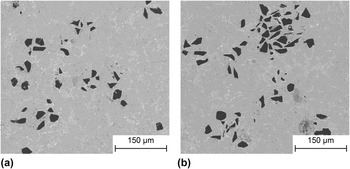
Important to note is the drop both in yield and ultimate tensile strengths of the samples with 10 wt% B4C content (Figs. 6 and 7) contrary to the samples with smaller B4C amounts. Samples reinforced with 10 wt% B4C show a decrease in yield and ultimate tensile strengths which is in close agreement with the findings of Harichandran et al. Reference Harichandran and Selvakumar5 who state that B4C reinforcement beyond 6 wt% has a detrimental effect on the strength of the produced samples. Back-scattered electron (BSE) images taken in SEM showing the particle dispersion of Al–5% B4C and Al–10% B4C samples in the current study under squeeze pressure 75 MPa visualize that the Al–5% B4C sample [Fig. 10(a)] has a more homogenous distribution of the B4C particles without distinguishable cluster formation whereas the particles in the Al–10% B4C sample [Fig. 10(b)] have a less homogeneous distribution with particles forming clusters denoting particle agglomeration. The aforementioned deterioration may possibly be attributed to the agglomeration of the reinforcement particles Reference Harichandran and Selvakumar5,Reference Ezatpour, Sajjadi, Sabzevar and Huang39 which is also supported by the drastic drop in the elongation of the samples with 10 wt% B4C content (Fig. 8) as contrasted to the samples with smaller B4C contents. In general, strengthening a metal decreases its elongation such as in the case of work hardening and alloying. On the other hand, the decrease in the yield and ultimate tensile strengths coupled with a decrease in the elongation in the current study is similar a brittle behavior. Hence, the decrease in the elongation due to the increasing B4C content (Fig. 8) denotes a deterioration in ductile behavior which is in close agreement with the decrease in the chip length due to the increasing B4C content as illustrated in Fig. 2.
SEM (BSE) images of the samples prepared under 75 MPa squeeze pressure showing the dispersion of B4C particles (a) Al–5% B4C and (b) Al–10% B4C.

Evaluation of the microscopy images of samples prepared with and without pressure shows that squeeze casting decreases porosity of the samples [Fig. 9(a)] which is also supported by the increase in the density as illustrated in Fig. 4. Obviously, this decrease in porosity along with the grain refinement after squeeze casting [Fig. 9(b)] also explains the increase in yield (Fig. 6) and ultimate tensile strengths (Fig. 7) of the samples with increasing squeezing pressure.
IV. CONCLUSIONS
-
(1) Increasing the B4C content decreases the average chip length and increases the surface roughness for B4C reinforced AMC.
-
(2) B4C reinforcement decreases the density of the AMC composites while increasing squeeze pressure has a positive effect on the densification of the samples.
-
(3) Increasing B4C amount and squeeze pressure increase the hardness of the samples due to the hardness of the B4C particles and improved densification, respectively.
-
(4) Application of squeeze pressure decreases porosity and results in grain refinement which together result in improved mechanical properties.
-
(5) B4C addition up to 5 wt% increases the yield and tensile strength of the samples while enhancing the elongation before fracture.
-
(6) Mechanical properties of AMC may be improved by addition of B4C reinforcement particles in adequate amounts without resulting in agglomeration and application of squeeze pressure is a suitable method to improve the mechanical properties of AMC.
ACKNOWLEDGMENTS
The authors would like to thank to Mehdi Montakhab, Mustafa Sengor, and Fatih Oz for their assistance in the preparation of the squeeze casting setup.