INTRODUCTION
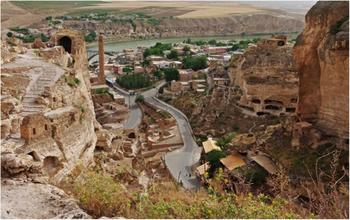
The ancient city of Hasankeyf is situated along the banks of River Tigris in the southeastern part of Turkey in Batman province. Its predominantly Arab and Kurdish population is just over 6,500 people. Hasankeyf is often described as an open-air museum with a history dating back to at least 10,000 years. It was the first capital of Artuqids, and the remains of the four-arch bridge built by them in the mid-twelfth century still stands on the River Tigris. Footnote 1 The Roman, Byzantine, Seljuk, and Ottoman Empires left their marks there. Some of Hasankeyf’s archeological masterpieces are human-made cave dwellings from the Neolithic period; the medieval citadel; the Sultan Süleyman mosque built by the Ayyubids in the fifteenth century; and the tomb of Zeynel Bey, a unique example of Timurid architecture of Iran in Turkey from the Akkoyunlu period. Footnote 2 Due to these characteristics, Turkey’s Ministry of Culture declared Hasankeyf a first-degree protected site in 1978 to be preserved in situ. Nevertheless, the lower levels of the town will soon be flooded by the reservoir waters of the Ilısu dam when the Turkish government finalizes its construction on the River Tigris. Footnote 3 The minister of forestry and water affairs, Veysel Eroğlu, has recently announced that the dam construction is expected to be completed by the end of 2017. Footnote 4 As I will detail later, the only possibility that remains to save Hasankeyf from destruction seems to be the decision that could come from the European Court of Human Rights (ECtHR) in response to a lawsuit filed against Turkey demanding the annulment of the Ilısu dam project (see Figure 1).
A view of Hasankeyf (photo courtesy of Mehmet Masum Süer, May 2010).

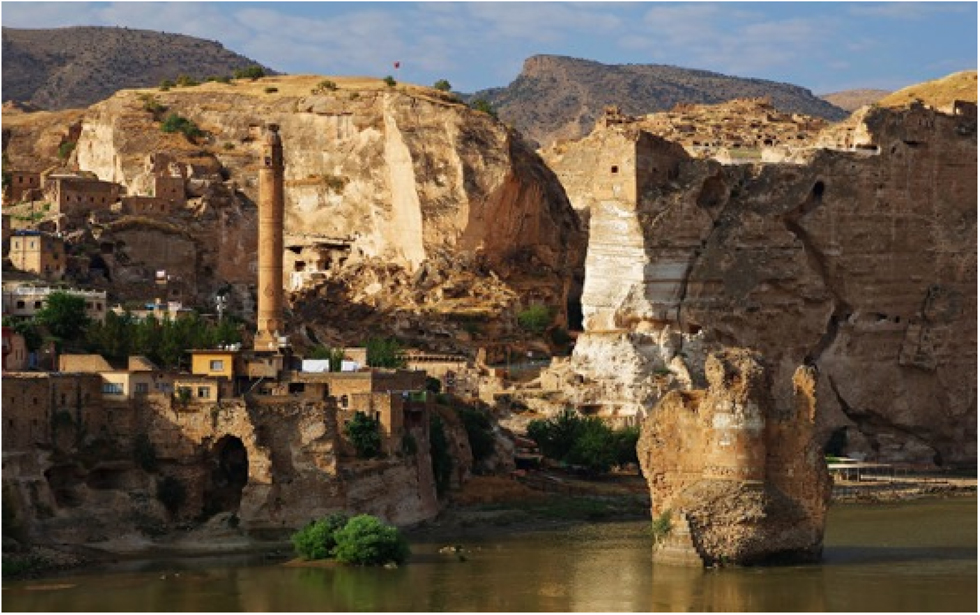
For the government, the Ilısu dam is needed to supply Turkey’s energy needs. Furthermore, as the first dam on the River Tigris, Ilısu is key to the completion of the Southeast Anatolia Project (Güneydoğu Anadolu Projesi [GAP]), one of the most comprehensive regional development programs in the world. Footnote 5 There is also a state-led project to construct a “New Hasankeyf” from scratch about three kilometers away from the ancient city. The government claims that the resettlement of Hasankeyf’s inhabitants will increase their living standards. Moreover, there is a government program to transfer all movable monuments to a cultural park near the new town, in the same way that the Pharaonic temples were relocated following the construction of the Aswan dam in the 1960s. Footnote 6 The upper town that would stay above the water will also be preserved as an archeological park (see Figure 2). According to Veysel Eroğlu, the Ilısu dam will actually save the heritage of Hasankeyf:
Even if it is not our duty, we will try to rescue historical monuments. … We will relocate the ones we can, protect the rest under the water and exhibit their replicas in a cultural park. We will build an outstanding museum for the artifacts found in archaeological excavations … Besides, is it possible to compare old houses with a brand new settlement area? We are conducting a project that will introduce Hasankeyf to the world. The Ilısu Project is an opportunity to save Hasankeyf. Footnote 7
A view of Hasankeyf with Sultan Süleyman mosque (photo courtesy of Mehmet Masum Süer, June 2011).

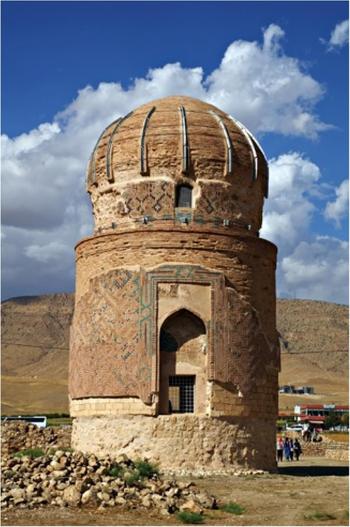
The government’s approach, however, does not take into account that it is impossible to replicate elsewhere Hasankeyf’s living heritage and its unique cultural and historical atmosphere. What is more, once completed, the Ilısu dam is expected to have a functional life of only 30 to 50 years. Footnote 8 The project is unsustainable from an archeological point of view as well. According to Zeynep Ahunbay, even if modern technology offers several methods to move the monuments, they would not have the same topographic relationship to the new site, plus exhibiting them as museum pieces would reduce their integrity and dignity (Figure 3). Footnote 9 Equally important, while the human-made caves engraved into dolomitic limestone will stay above the water, studies show that limestone’s contact with reservoir water will seriously aggravate its deterioration and will possibly lead to a rapid collapse of the caves. Footnote 10 Last but not least, the majority of Hasankeyf’s residents are unwilling to move to the new town, claiming a strong sense of attachment to their cultural heritage. According to a survey conducted with 357 residents by Doğa Derneği (Nature Association) in 2012, only 21 percent of them want to live in New Hasankeyf, while 11 percent are indecisive. Footnote 11 For the 68 percent who want to stay, the major reasons are their love of Hasankeyf and connection to their past, holy places, and graves. In the words of Veysi Ayhan, a local activist born in Hasankeyf, the town is an essential part of its inhabitants’ identity and sense of community:
A human being is his/her past. Our history and the region that we live in are elements that determine our future. Without them, we could neither build our future, nor enjoy our lives. We can’t build a strong social structure, can’t be a healthy community … I mean this is about the right to life. I have lived in Hasankeyf for years. One day you would wake up and boom! All your memories, your past is below the water. You would not really breathe. You would feel like choking. Footnote 12
The Tomb of Zeynel Bey (photo courtesy of Mehmet Masum Süer, September 2013).

Turkey’s determination to build the Ilısu dam met with strong resistance from human rights and heritage activists and non-governmental organizations (NGOs) at regional, national, and international levels. Even though these widespread campaigns have been a major factor in the delays in the dam’s construction, they have been unable to convince the Turkish government to cancel the project so far. At the time of writing, both the construction of the dam and New Hasankeyf are near completion. Zeynel Bey tomb has been moved to its place in New Hasankeyf in May 2017, and preparations are in progress for relocating eight other historic monuments (including Artuqid Hammam and El Rizk, Sultan Süleyman, and Kızlar mosques). Footnote 13 The owners of souvenir shops in the lower town have recently been given a final notice to evacuate their shops and move to New Hasankeyf. Footnote 14
In this article, I explore the limits and possibilities of international human rights law to save Hasankeyf from state-led destruction. To do that, I look at two attempts by activists and NGOs to have the United Nations (UN) and the Council of Europe cancel the Ilısu project on the grounds that destroying Hasankeyf’s cultural heritage would be a breach of Turkey’s obligations under international human rights law. I begin by reviewing the recent debates and developments in international law over the recognition and protection of cultural heritage as human rights. Then I move on to provide a brief historical background to the Ilısu dam. Subsequently, I detail the applications submitted to the UN Committee on Economic, Social and Cultural Rights (CESCR) and the ECtHR to stop the Ilısu dam project and discuss the ways in which they pressured the UN and the Council of Europe to recognize the right to cultural heritage as an aspect of human rights. Overall, I suggest that these cases not only testify to the top-down processes of heritage making and unmaking in Turkey today but also demonstrate the need for more effective and legally enforceable international instruments to prevent the state-led destruction of cultural heritage.
HERITAGE RIGHTS AS HUMAN RIGHTS
Cultural heritage rights—people’s rights to participate in, and benefit from, cultural heritage of their choice—have in recent years become increasingly identified with human rights in the critical heritage literature. Footnote 15 Emphasizing the key role of heritage in the construction, legitimation, and maintenance of individual and group identities, many scholars now frame various heritage inequities—destruction or exploitation of heritage resources, forced evictions from heritage places, exclusion from decision-making processes, and so forth—as human rights abuses. Footnote 16 In their pioneering work investigating the links between heritage and human rights, Helaine Silverman and D. Fairchild Ruggles suggest that heritage constitutes an important aspect of human rights because it closely relates to the recognition of an individual or group’s essential worth. “Freedom of religion, political expression, movement, and freedom from violence, torture, and hunger are human rights of paramount importance and correctly deserving of protection, vigilance, and continued analytical study. But heritage ought to rank with these as an essential component of human rights because the very concept of heritage demands that individual and group identities be respected and protected.” Footnote 17 Scholars investigating cultural property and heritage have long been interested in how particular histories manifested in various objects, places, and traditions serve as crucial identity markers. Footnote 18 Property, in its general and historical sense, has always been about the validation of ownership over things. However, the growth of global capitalism has expanded the scope of property relations to new areas when all sorts of tangible and immaterial things—such as technical know-how, information, cultural artifacts and expressions, and body parts—came to be exposed to ownership claims as “property objects.” Footnote 19 The emergence of new property claims and relations has received increased attention in the related literature over the last two decades. This literature calls for a relational and situational understanding where neither things as properties nor the relations through them can be treated as neutral, given, or static. Footnote 20
In the introduction of the volume Property in Question, Caroline Humphrey and Katherine Verdery provide one such critical account of the notion of property. They call into question the basic assumptions inherent in the classical property theory with regard to “persons,” “things,” and “relations.” Footnote 21 Arguing that classical property theory assumes relationships among already-existing, distinctly separate, and internally uniform entities, they posit instead that things or persons might as well become bounded units as a consequence of property relations, given that “positing certain things as unitary enables the appearance of unity for the persons to whom the things are linked.” Footnote 22
This approach enables us to situate the emergent cultural property claims in their political context. It opens up a possibility to explore how the ownership claims over heritage allow for its use as a political resource to construct and validate collective identities, where the group difference is affirmed through claims to distinct pasts that are materialized in cultural objects, practices, and experiences. Annette Weiner coined the term “inalienable possessions” to define the objects that circulate among generations and, as such, play a key role in the assertion of a group’s cultural distinctiveness. Footnote 23 Drawing from her, Simon Harrison labels symbolic practices such as festivals, rituals, speech acts, and dress styles as “identity symbols” and investigates the various ways in which the ownership claims over them contribute to the creation of a shared sense of belonging and identity. Footnote 24 The significance of heritage in identity construction processes makes it an indispensable component of human rights because it entails one’s personal and collective right to exist. Footnote 25 Moreover, as Janet Blake explains, heritage has a strong human rights dimension due to its insistence on protecting human dignity, and, thus, it should be viewed as an aspect of right to cultural identity that includes the right of everyone to choose cultural identit(ies) alone or together with others; the right of groups to develop and maintain their culture; and the right of individuals to freely take part in the cultural life of their choice. Footnote 26
The relationship between heritage and human rights, however, is not without complexity. As William Logan suggests, one major difficulty lies with the conflict between the collective and individual dimension of heritage rights as a form of human rights, Footnote 27 which adds to the continuing debate over whether the rights of the group or the individual should take precedence when they come into conflict with each other. Footnote 28 The issue is further complicated by the disjuncture between the universality of human rights and cultural, temporal, and geographical specificity of heritage. Footnote 29 Logan cites the Academy of European Law in 2005 to further explain these two linked but contradictory meanings: “[F]irst, as a sub-category of human rights, cultural rights are endowed with universal character … second, cultural rights are clearly related to cultural diversity and cultural diversity is an obvious challenge to the very idea of universal human rights.” Footnote 30
Janette Philp’s discussion on the politicization of Burma’s cultural heritage by the military regime illustrates this uneasy relation between cultural specificity and universality of human rights in heritage contexts. Footnote 31 As she explains, the regime used the concept of “Asian” values in response to criticisms of human rights abuses due to the use of forced labor in the restoration of the Theravada Buddhist monuments. Footnote 32 According to the military regime, the issue should be considered as part of Burmese culture of merit making, which, however, is a violation of Article 4 of the Universal Declaration of Human Rights that prohibits slavery in all forms. Footnote 33
At the practice level, incorporation of human rights frameworks into heritage might also lead to new inequalities and conflicts of ownership. Lynn Meskell discusses the Makuleke Contractual Park in South Africa as a case in point. Footnote 34 Located in the northern sector of Kruger National Park, Makuleke is often hailed as a successful case by anthropologists and activists where the traditional owners obtained the land title, commercial rights, and co-management of the park following a land claim agreement with the South African National Parks Board. Meskell’s research, however, shows that the commercial benefits actually rest with a few local black elites, while only a small number of people from Makuleke are employed in menial jobs or in the luxury lodges located in the park. Furthermore, these privileges have been afforded to Makuleke at the expanse of the rights of other “equally indigenous” neighbors, including the Shangaan and Venda groups, who are excluded from employment or financial benefits.
While heritage rights have been largely overlooked in international law until recently, a change is slowly taking place. At the UN level, the Universal Declaration on Human Rights recognizes the right to freely participate in the cultural life of the community in Article 27, but it gives no specific reference to heritage rights. The same goes for the International Covenant on Civil and Political Rights, which mentions the right to enjoy one’s own culture in Article 27 in relation to minority groups. Footnote 35 Similarly, the International Covenant on Economic, Social and Cultural Rights (ICESCR) does not explicitly refer to the right to heritage but protects the right to take part in cultural life in Article 15. Footnote 36 As I will explain in the next section, however, there has been some improvement in this regard following the adoption of General Comment no. 21 in 2009, which asserts the right to heritage as part of Article 15. Footnote 37
The only UN human rights treaty that explicitly mentions the right to heritage is the 2007 UN Declaration on the Rights of Indigenous Peoples. Footnote 38 In Article 8, Indigenous peoples and individuals have the right not to be subjected to destruction of their culture, while Article 11 recognizes the right to intangible heritage by stating that Indigenous peoples have the right to practice and revitalize their cultural traditions and its manifestations in archeological sites, artifacts, visual and performing arts, ceremonies, and so forth. And, finally, in Article 31, Indigenous peoples have the right to “maintain, control, protect and develop their cultural heritage.”
Several UN heritage treaties have also included references to human rights instruments in recent years. One prominent example is the United Nations Educational, Scientific and Cultural Organization’s (UNESCO) 2003 Convention for the Safeguarding of the Intangible Cultural Heritage, which refers in its preamble to the International Bill of Human Rights. Footnote 39 It further states in Article 2 that the Convention only considers cultural traditions and practices that are compatible with human rights instruments. A similar trend can be observed in UNESCO’s flagship Convention Concerning the Protection of the World Heritage and Natural Heritage (World Heritage Convention), Footnote 40 whose top-down processes have drawn criticism for allowing states to violate local groups’ right to enjoy and maintain control over their heritage. Footnote 41 Its recent “Policy for the Integration of a Sustainable Development Perspective into the Processes of the World Heritage Convention” adopts a human rights-based approach in the “full cycle of World Heritage processes from nomination to management.” Footnote 42
As Meskell states, however, perhaps more important than the recognition of heritage rights as human rights in the international legal framework is the extent to which such recognition is translated into practice. Footnote 43 The state plays a dominant role in the administration and implementation of international law. Given that international law is made by the states, the national level (that is, the state) remains primary to the enactment of any international legal framework. Footnote 44 According to Meskell, this state-led enforcement constitutes a central problem with human rights, given that they are “directly connected to the nation state and thus operate on a state-to-state basis, rather than empowering communities, minorities, or indigenous groups who might propose counter claims.” Footnote 45
The UN legal instruments are technically binding, but they lack enforcement mechanisms for non-conforming actions. Their implementation at the domestic level depends therefore on the willingness of states parties. As such, they may not protect individuals and groups from human rights abuses when it is the states themselves that are practicing them. Turkey provides a case in point. While the country ratified all of the aforementioned UN treaties and voted in favor of the UN Declaration on the Rights of Indigenous Peoples, none of these commitments discouraged the Turkish government from building the Ilısu dam. However, this does not mean that international law, and, particularly, international human rights law, is completely impotent in preventing heritage inequities and injustices. As discussed in the following section, international human rights law is still significant because it provides a way for activists, NGO groups, and individuals to communicate alleged human rights abuses by the states to international legal authorities. Furthermore, although the UN plays a major role in setting worldwide a policy and legal framework on human rights, there are other, fully binding, international human rights instruments that could be evoked against Turkey’s heritage rights violations. The Council of Europe’s European Convention on Human Rights (ECHR) is one example. Footnote 46
HISTORICAL BACKGROUND TO THE ILıSU DAM
The National Water Administration began studies for building the dam in the 1950s, which was incorporated later into the GAP project in the 1980s as one of the 22 dams—and 19 hydroelectric power plants—to be built in the southeast region of Turkey. Footnote 47 The costly armed conflict with the Kurdistan Workers’ Party in the region, however, prevented the Turkish government from financing the project on its own. Footnote 48 A World Bank loan was removed from the table since the organization had decided not to provide funding for the GAP project due to protests from Turkey’s downstream neighbors, Syria and Iraq, on the grounds that the Ilısu dam would reduce the Tigris’s water flow. Footnote 49 In 1996, the project was offered to the private sector as a build-operate-transfer arrangement, and the contract was awarded to an international consortium consisting of Sulzer Hydro and ABB Power Generation, which subcontracted the construction of the Ilısu dam to, among others, Balfour Beatty (United Kingdom), Impregilo (Italy), Skanska (Sweden), Nural, Kiska, and Tekfen (Turkey). Footnote 50 Not willing to carry the risks themselves, these companies applied to secure export credits from national export credit agencies in 1998. Footnote 51
These events aroused considerable international opposition. Arguing that the Ilısu dam would give absolute control of the Tigris’s river water flow to Turkey, Iraq and Syria jointly sent protest letters to the companies involved and to their governmental backers. Footnote 52 Equally important was the pressure from environmental and human rights groups. The London-based Ilısu Dam Campaign, a coalition of NGOs, including the European Rivers Network, Public Eye (formerly the Berne Declaration), the Kurdish Human Rights Project, and Corner House, was particularly effective in targeting European governments, public sympathies, and the companies involved. Footnote 53 Their campaign aimed to stop British involvement in the Ilısu dam project, arguing that the dam was a violation of environmental and human rights because it would result in the massive displacement of local inhabitants and destruction of their cultural heritage. Footnote 54
This international pressure made the export credit agencies request four conditions to be met before giving export credit guarantees: developing a resettlement program conforming to internationally accepted standards; providing provisions for upstream water treatment plants to maintain water quality; ensuring that adequate downstream flows are kept at all times; and producing a detailed plan to preserve as much of Hasankeyf’s archaeological heritage as possible. Footnote 55 When Turkey could not meet these conditions, the credit agencies declined to fund the project, and the consortium came to an end in 2002. Nevertheless, it only took three years for the government to establish a new consortium with Austrian (VA Tech), Swiss (Alstom, Stucky, Colenco and Maggia), German (Ed. Züblin AG), and Turkish (Nurol, Cengiz, Celikler and Temelsu) companies. Footnote 56 The construction of the dam began in 2006, but this consortium also dissolved in 2009 when the export credit agencies pulled their credit from the project for similar reasons. The then German minister of development, Heidemarie Wieczorek-Zeul, explained: “If the protection of people, the environment and cultural heritage cannot be ensured, then the supply and loan guarantee agreements for the dam must be terminated.” Footnote 57 Despite this, the government carried on building the Ilısu dam with financing from various domestic banks.
INTERNATIONAL HUMAN RIGHTS LAW AND THE DESTRUCTION OF HASANKEYF
Hasankeyf before the CESCR
One attempt to stop the Ilısu dam project via invoking Turkey’s obligations under international human rights law was the application made by local and international activists and NGO groups to the CESCR. Turkey ratified the ICESCR in 2003, which requires states parties to submit periodic reports to the CESCR on their implementation of the treaty at the domestic level. The first report submitted by Turkey in 2008 did not explicitly refer to the case of Hasankeyf, yet it highlighted the rescue excavations held before the flooding of various other archeological sites in the region as part of efforts to protect cultural heritage. Footnote 58 The report also mentioned the Ministry of Culture and Tourism’s endeavor to protect cultural and archeological heritage in the prospective dam areas by conducting “documentation and property-saving works.” Footnote 59 In relation to Turkey’s obligations under Article 15—the right to take part in cultural life—the report emphasized that the protection of natural and cultural heritage constitutes an indispensable part of Turkey’s cultural policy. Footnote 60
The ICESCR allows NGOs and other civil society groups to submit written information to the CESCR on states parties’ compliance with human rights obligations. In response to Turkey’s report, a German network of NGOs called CounterCurrent and the Initiative to Keep Hasankeyf Alive, a collation of activists and 86 organizations from the regions to be affected by the Ilısu dam, submitted a report to be considered in the CESCR’s forty-fourth pre-sessional working group. The report concluded that the flooding of Hasankeyf and the surrounding Tigris Valley would constitute a violation of Articles 11, 12, and 15 of the ICESCR:
With regards to the population affected by dam construction in Turkey and specifically by the Ilisu dam project, we have to conclude that the State party has failed to fulfil its obligations under Article 11 of the Covenant, concerning the rights to an adequate standard of living, including adequate food and housing, and to the continuous improvement of living conditions. We also conclude that the State party has failed to fulfil its obligation under Article 12 of the Covenant, concerning the right to the highest attainable standard of health … We also question Turkey’s claim that the protection of the historical, natural and cultural heritage is guaranteed by existing Turkish procedures and conclude that the State party has failed to fulfil its obligations under Article 15 of the Covenant, concerning the right of everyone to take part in cultural life. Footnote 61
Article 15 does not explicitly mention heritage rights. However, the CESCR adopted General Comment no. 21 on Article 15 in its forty-third session in 2009, which recognizes the right to heritage as part of the right to take part in cultural life. Footnote 62 The Comment emphasizes states parties’ obligations to guarantee the right of everyone, individually or in association with others, to access to, and benefit from, their own heritage and that of others. It requests states parties to respect the rights of Indigenous groups and minorities to their culture and heritage and to protect the cultural heritage of all groups in economic development programs.
The report by CounterCurrent and the Initiative to Keep Hasankeyf Alive specifically refers to this content of General Comment no. 21. Footnote 63 It states that the flooding of Hasankeyf and the surrounding Tigris Valley is in direct contradiction with the Turkish government’s claim in its initial report that Turkish law guarantees the protection of cultural heritage. In addition, the report highlights that the destruction of Hasankeyf would constitute a violation of the heritage rights of the local population as protected under Article 15 of the ICESCR, explaining that for the majority of the affected population Hasankeyf should be preserved as part of their right to access their cultural heritage. It specifically argues that the destruction of Hasankeyf would breach Turkey’s obligations to respect and protect cultural heritage at all times; to ensure, and not to intervene in, everyone’s right to access their cultural goods; and to take part freely in decision making with respect to matters affecting their heritage.
The CESCR took this into consideration in its forty-fourth pre-sessional working group, which was held in May 2010. In the list of issues to be taken up in connection with the consideration of Turkey’s report, the Committee asked Turkey to indicate the “policies and measures [it] has undertaken to ensure that the Covenant rights of people affected by large infrastructure construction projects, including the Ilısu Dam, are protected.” Footnote 64 The Turkish government replied in November 2010, explaining that the resettlement action plan for the Ilısu dam, which was prepared in 2005 by the National Water Administration, details “the establishment of the villages and/or districts that were affected by this action plan, the affected population, the number of households, the selection of new residential areas and activities aimed at increasing the living standards and income levels in these new residential areas.” Footnote 65
In March 2011, CounterCurrent, in corporation with the Initiative to Keep Hasankeyf Alive as well as Doğa Derneği and five other local NGOs from the affected region, submitted yet another report to be considered by the CESCR’s forty-sixth session. Footnote 66 This time, the report included seven case studies from across Turkey to demonstrate how the construction of dams and hydroelectric power plants violate Articles 11, 12, and 15 of the ICESCR. With respect to the latter, it argued that the Ilısu dam threatened a “tremendous” cultural heritage and concluded once more that the destruction of Hasankeyf, despite the opposition from local populations and without assessing possible alternatives, would violate the right to take part in cultural life:
While the Turkish government has promised to save Hasankeyf by transposing some of the monuments to an archaeological park, international experts came to the conclusion in 2009 that there was no proof of the feasibility of these plans; according to the International Council on Monuments and Sites Turkey (ICOMOS) most of the monuments even cannot be transposed without causing serious damages. This means that the cultural goods will be submerged and inaccessible if construction is continued. In the affected region and throughout Turkey, there is widespread opposition against the flooding of Hasankeyf due to its cultural significance. The affected population insists that Hasankeyf must be preserved in situ in order to provide access to its cultural heritage. An alternative plan to build five smaller dams instead of the big Ilısu dam which would save Hasankeyf was presented by scientists from the Middle East Technical University in Ankara, but has been ignored by the State authorities. Footnote 67
The issue was also raised during the forty-sixth session when the CESCR requested further explanations as to how the resettlement plan would increase the living standards of the evicted population, what the environmental impacts of the project would be, and what kind of measures were envisaged to protect the cultural heritage of the affected region? Footnote 68 In summing up the government’s view on the issue, Ali Onaner, the former head of the Human Rights Department of the Turkish Ministry of Foreign Affairs, explained that one of the government’s principal aims in the dam’s construction was to promote economic development in the southeastern regions. Footnote 69 Without giving direct answers to the aforementioned inquiries, he instead claimed that “the benefits brought by the energy generated by the dam would enhance the economic, social and cultural rights of many of the inhabitants of the region in question.” Footnote 70
In the concluding observations, the CESCR sided with the NGO groups. It expressed deep concerns over the potential impact of the Ilısu dam on the enjoyment of rights under the ICESCR and urged the government to “take account of a human-rights based approach” in its dam projects. Footnote 71 In its short reply to the concluding observations, however, the government chose not to mention the issue. Footnote 72 Since Turkey has not yet submitted its second periodic report that was due in July 2016, the issue has not been further addressed by the CESCR since then, leaving it entirely in the government’s hands. Moreover, because Turkey did not ratify the Optional Protocol to the ICESCR, which entered into force in 2013, the committee cannot examine complaints from individuals alleging Turkey’s covenant violations. Footnote 73 Yet, even if such communication was possible and if the committee decided that Turkey’s Ilısu project violated the Covenant’s rights, the committee can only give recommendations, without enforcement and binding effect.
Hasankeyf before the ECtHR
Another legal attempt to link the destruction of Hasankeyf to international human rights law is the ongoing lawsuit before the ECtHR, whose judgment was pending as of October 2017. Two things make this attempt noteworthy. First of all, Turkey ratified the ECHR in 1954, and unlike in the case of CESCR, the ECtHR’s judgments are fully binding, and Turkey is obliged to execute them. Second, since the ECHR mentions neither cultural rights nor heritage rights, the lawsuit is notable in its attempt to interpret the Convention with a view to further expand its scope with respect to heritage rights. Özcan Yüksek provides this explanation:
We filed this lawsuit by linking the case of Hasankeyf to human rights. People are not only exposed to physical torture, they may face cultural torture as well. The destruction of a person’s cultural heritage should also be considered a violation of human rights. Footnote 74
While the Convention does not recognize the right to culture or heritage, this does not mean that the question of cultural rights has no weight in the ECtHR’s decisions. The 2011 report of the ECtHR’s Research Division on cultural rights addresses this issue in particular, explaining that the Court’s case law has evolved over time toward a gradual recognition of “substantive rights which may fall under the notion of ‘cultural rights’ in a broad sense,” particularly in the areas of artistic expression, cultural identity, access to culture, linguistic rights, education, historical truth, academic freedom, and cultural and natural heritage. Footnote 75 The report details the Court’s approach to the latter under a special section entitled “Right to the Protection of Cultural and Natural Heritage.” Footnote 76 This section analyzes a series of court decisions concerning property rights enshrined in Article 1 of Protocol no. 1, where the applicants complained of the expropriation of heritage objects or buildings by the state for a public use. Footnote 77 In such cases, the Court recognized cultural heritage as a universal value of humanity. It stressed that protecting cultural heritage and allowing the public to have access to it are legitimate aims of the state when interfering with individual rights. In its Grand Chamber judgment in Kozacıoğlu v. Turkey, for instance, the Court highlighted the importance of the protection of cultural heritage by public authorities:
The Court points out … that the conservation of the cultural heritage and, where appropriate, its sustainable use, have as their aim, in addition to the maintenance of a certain quality of life, the preservation of the historical, cultural and artistic roots of a region and its inhabitants. As such, they are an essential value, the protection and promotion of which are incumbent on the public authorities. Footnote 78
In March 2006, Zeynep Ahunbay (professor of restoration architecture at Istanbul Technical University who conducted excavation and restoration work in Hasankeyf between 1998 and 2000); Oluş Arık (professor of archeology and art history who organized and conducted excavations in Hasankeyf between 1985 and 2003); Metin Ahunbay (retired architect-archeologist who carried out excavation and restoration work in Hasankeyf between 1986 and 1991 and 1998 and 2001); Özcan Yüksek (journalist and ex-editor in chief of a prominent Turkish travel and geography magazine called Atlas); and Murat Cano (lawyer at the Istanbul Bar specializing in cultural heritage law) filed an appeal with the ECtHR against Turkey, Austria, and Germany. Footnote 79 The applicants also requested the Court to prioritize the case to speed up its resolution and to indicate an interim measure to the Turkish government for suspending the construction of the Ilısu dam during the examination of the case.
According to the rules of the ECHR, only individuals who are personally and directly a victim of a violation of the ECHR can lodge a complaint before the ECtHR. The applicants claimed that due to Hasankeyf’s utmost historical and scientific importance, they have the status of victim because, just as the rest of humanity, they would personally suffer from the destruction of Hasankeyf. Footnote 80 In their application, they requested the cancelation of the Ilısu dam project by the ECtHR on the grounds that Hasankeyf constitutes a common heritage of both present and future generations of Europe, and its destruction would breach their right to understand, maintain, and access cultural heritage. Zeynep Ahunbay further explains why they chose to take the issue before the ECtHR:
For instance, Hasankeyf was a very important castle during the Roman Period. This means it is not only part of Islamic culture, but also part of European culture. We formulated our case emphasizing how [Hasankeyf] constitutes heritage of all the European people … When we saw that there was no solution in Turkey, we applied to the ECtHR arguing that both present and future generations have the right to this heritage. They have to see it, understand it, learn from it. It is important to recognize the right to access to cultural heritage. Therefore a project that deprives people of all these should be considered a violation of human rights. Footnote 81
The applicants invoked several articles under the ECHR to justify their position. They argued that the destruction of Hasankeyf would be a violation of the Convention’s Article 1 (obligation to respect human rights) and Article 2 (right to life). While the latter strictly refers to the biological sense of the term—that is, to be alive Footnote 82 —the applicants claimed that Article 2 should have a more inclusive meaning to encapsulate not only the physical, but also the cultural, survival of human beings, guaranteeing the protection of “human values and the need to pass them on to future generations.” Footnote 83 They further claimed that Hasankeyf’s destruction would be a breach of their rights under Article 5 (right to liberty and security), Article 9 (freedom of thought, conscience and religion), and Article 10 (freedom of expression).
In fact, none of these articles give an explicit reference to cultural heritage. Article 5 defines the deprivation of liberty and security of a person strictly in judicial terms, while the other two articles do not mention cultural values, beliefs, or expressions as an aspect of freedom of thought and expression. The applicants argued that the right to heritage should be considered an inherent part of these rights and called for expanding their scope to cover the right to freely share and transmit cultural values and information. Footnote 84 Lastly, drawing on Article 2 of Protocol no.1 (right to education), the applicants argued that the destruction of a piece of archaeological heritage of thousands of years, which should rather be subject to permanent study, would violate both the present and future generations’ right to learn and study cultural heritage. Footnote 85 In the words of Murat Cano,
[o]ur case file is very powerful. While none of the Convention’s Articles directly protect heritage rights, we interpreted them in such a way that heritage rights became part of the right to life, the right to education, the prohibition of discrimination, and so forth … The right to life shouldn’t be understood solely as physical or biological survival. The right to education shouldn’t be restricted to curriculums … Destroying cultural heritage, preventing people from accessing it, all these crimes against cultural heritage are in fact crimes against the humanity. Footnote 86
The ECtHR accepted the case in July 2006 but declined the requests for urgent examination and interim measures. It asked the Turkish government to inform it urgently on the measures taken to protect Hasankeyf. In its very long and detailed reply, the government argued for the inadmissibility of the complaint, stating that because the allegations did not concern the rights defined in the ECtHR, the Court could not examine the subject matter. Footnote 87 The government’s reply also acknowledged the significance of Hasankeyf’s heritage, explaining that US $80 million had been allocated to relocate all movable archeological material to a nearby cultural park. Claiming to have the authority to decide “in such situations where the balance between the preservation of history and the region’s economic enrichment should be considered in favor of wider public good,” the government stated that the public benefits of the Ilısu dam would outweigh the destruction of Hasankeyf because the GAP project, which would bring increased economic prosperity to the region, could not be completed without it. Footnote 88
No verdict came from the ECtHR for nearly a decade, while the construction of the dam continued. In 2015, the applicants resubmitted to the Court their request to prioritize the case, which was accepted this time. Finally, a decision came from the ECtHR in June 2016. It declared the complaints against Austria and Germany inadmissible, stating that the Turkish government was responsible for all of the disputed measures and legal proceedings. Footnote 89 The Court further decided that the applicants’ complaints against Turkey fell within the scope of Article 8 (the right to respect for private and family life) and Article 10 (the right to freedom of expression) in isolation or in combination. Footnote 90 It subsequently gave notice to the Turkish government and invited it to submit written observations on the matter in accordance with Rule no. 54, paragraph 2(b), of the Rules of Court before issuing a final judgment on whether the case of Hasankeyf violates Articles 8 and/or 10. Footnote 91 The government requested extra time to submit its observations to the Court, which was granted until 15 January 2017. Footnote 92 While the Court’s judgment is still pending, according to Murat Cano, there is hope that Hasankeyf may be saved:
The Court’s [July 2016] decision is just wonderful! It is thirty-seven pages long, a common decision of ten judges. I wouldn’t write it differently. It shows the importance of international law; it carries the issue to a universal level … It accepts our arguments, mentions one by one all the relevant Conventions ratified by Turkey, and then asks, what did you do to protect this site and how will you protect it from now on? Footnote 93
CONCLUSION
Examined together, these two attempts to save Hasankeyf demonstrate not only the limits, but also the possibilities, of international human rights law in preventing heritage from being destroyed by state-led action. The irreversible loss of this ancient city could constitute a violation of human rights under the ICESCR and the ECHR. Both the CESCR and the ECtHR have moved toward recognizing heritage rights as part of human rights in recent years. The ECtHR’s acknowledgment of heritage rights in its case law and the CESCR’s adoption of General Comment no. 21, which refers to heritage rights as an aspect of the right to take part in cultural life, are illustrative of this trend. In addition, while the ECtHR does not specifically refer to cultural rights or heritage rights, the fact that it dismissed the inadmissibility claims by the Turkish government and decided to examine the case as a violation of human rights is notable. The same goes for the CESCR that decided to support the claims of the activists and NGO groups and called for Turkey to adopt a rights-based approach in its dam projects.
At the same time, the CESCR’s case shows that this recognition of heritage rights by international human rights frameworks might not always translate into practice. One major obstacle is the lack of enforcement in the UN’s human rights instruments due to their “soft law” character. Yet, as Blake aptly explains, despite its shortcomings, human rights law still constitutes one of the most effective available tools to curtail state dominance in the administration and implementation of international law because it is the only area of international law in which states have accepted fully binding obligations and allowed international regulation to interfere between the state and its citizens. Footnote 94 The ECHR is one example, as it permits citizens to bring before the ECtHR individual rights complaints against their governments, and the judgments are legally binding and enforceable on the governments. Although it was slow in coming, the Court’s decision on Hasankeyf is promising. One need not give up hope.
ACKNOWLEDGMENTS:
The author would like to thank Zeynep Ahunbay, Veysi Ayhan and Murat Cano for their generosity in giving their valuable time for interviews and sharing their thoughts.