

1 INTRODUCTION: AIM AND RATIONALE
The notion of the ‘advanced learner’ is used widely in SLA research, but the term conveys different proficiency levels and experiences with the second language. Most often, the advanced learner is defined as a person who has studied the target language (TL) at school as a foreign language, often in another country than that of the TL, and then continues as a university student. Yet the degree of actual achievement among advanced learners varies. The extent of difference may depend upon his/her study-abroad experiences and on the educational system (for further characteristics, see Bartning, Reference Bartning1997 and Labeau and Myles, Reference Labeau and Myles2009).
However, the ‘advanced learner/L2 user’ can also be defined in contrast to the ‘near-native’ speaker (cf. Abrahamsson and Hyltenstam, Reference Abrahamsson and Hyltenstam2009). The ‘near-native speaker’ is defined by Hyltenstam, Bartning and Fant (2005:7) as someone perceived as a native speaker in everyday conversation, but whose production differs from that of native speakers (NSs) on closer examination. In contrast, the ‘advanced learner’, according to these authors, is someone ‘whose production develops towards that of native speakers, but whose non-native usage is perceivable in normal oral and written interaction.’ In the following the advanced and the near-native speakers will be more thoroughly described but, for the moment, we will use the above mentioned definitions.Footnote 1
The aim of the present study is twofold: first, to find empirical evidence for additional advanced stages in high-level L2 French which are assumed to contain linguistic features typical of high-level proficiency. For this purpose, we take as a point of departure the description of the stages proposed by Bartning and Schlyter (Reference Bartning and Schlyter2004, stages 1–6). These stages have been proposed mainly on the basis of oral productions of students studying French as a foreign language (FFL) from the InterFra corpus (http://www.fraita.su.se/interfra/) and also from the Lund corpus which includes both natural and formal learners. (For studies especially confirming the advanced stages (stages 4–6) of Bartning and Schlyter, see e.g. Housen, Kemps and Pierrard, Reference Housen, Kemps and Pierrard2009 and Agren, Granfeldt and Schlyter, Reference Agren, Granfeldt, Schlyter, Housen, Kuiken and Vedder2012). These stages were proposed essentially on the basis of morphosyntactic criteria. In the present study, we hypothesize that a number of other linguistic criteria, besides the morphosyntactic ones, are necessary in order to account for high-level proficiency, i.e. more advanced stages than those proposed in Bartning and Schlyter (Reference Bartning and Schlyter2004). We have earlier proposed and found that non-targetlike morphosyntactic forms, formulaic sequences and the information structure distribution of preambles (themes) and rhemes are interesting phenomena for highly proficient learners (Bartning, Forsberg and Hancock, Reference Bartning2009, Reference Bartning, Forsberg Lundell and Hancock2012). In this paper we propose three more measures to investigate the most advanced stages. First, perceived nativelikeness is used in order to categorize speakers into different advanced stages. Together with the already investigated measures (see above), lexical richness and fluency are also examined in order to give a fuller description of these new advanced stages. Lexical richness was considered important to add since it may give, together with formulaic sequences, a better understanding of the proficient speaker's growing lexicon. Lexical richness and fluency are, in addition, phenomena that increase incrementally with longer exposure in the TL country, as is the case of many of our speakers.
The second aim of this study is to contribute to the debate on the possibility for adult L2 learners to attain nativelikeness: is it possible to become a nativelike speaker of one's L2?
The study uses 30 learners from the InterFra corpus: 10 learners of French as a foreign language (FFL), and 20 speakers of French as a second language (FSL) who have extensive experience of French in the target language country (length of residence of 5 to 40 years). Thus, these FSL data allow us to focus on highly proficient L2 users at the end state of acquisition. The lack of fine-graded linguistic analyses of such speakers in the SLA literature has recently been highlighted by Hopp (Reference Hopp2010: 902).
In order to differentiate between speakers from different advanced levels and to select possible candidates for the near-native level, a listener test is used as a methodological starting point. This listener test measures the perceived nativelikeness of the L2 speakers (Abrahamsson and Hyltenstam, Reference Abrahamsson and Hyltenstam2009). On the basis of this test, speakers are placed into two main groups, those who pass as natives and those who do not. However, perceived nativelikeness is a subjective criterion, which arguably includes accent and pronunciation, but possibly also other linguistic aspects. Consequently, we think it is interesting to investigate whether speakers who pass or do not pass differ with regard to objective linguistic criteria, besides their perceived nativelikeness. This is why individual spoken productions are then analysed according to the linguistic domains mentioned above. It is hypothesized that a new stage 7 ( = the ‘highly proficient L2 user’ stage) contains speakers who did not pass as natives – but who have more elaborate linguistic resources than speakers from stage 6 (for the placement of speakers at stage 6, see Bartning et al. Reference Bartning, Forsberg and Hancock2009:206–207). Furthermore, a stage 8 ( = the near-natives) would then include speakers who not only have these more elaborate resources but also pass as native speakers (for definition see above).
2 THEORETICAL BACKGROUND
In order to present features of the final stages of L2 French we propose to analyse the following domains: (1) morphosyntax, (2) information structure and complexity, (3) formulaic sequences, (4) lexical richness and (5) fluency. The first three areas have been examined in Bartning et al. (Reference Bartning, Hancock and Hyltenstam2009 and Reference Bartning, Forsberg Lundell and Hancock2012) and they proved to be highly relevant features in high-level proficient users of French L2.
2.1 Previous research on the incidence of nativelikeness
In order to provide a foundation for the discussion of the possibility to attain nativelikeness, we will very briefly outline the different positions taken within research on the notion of nativelikeness.
The literature on the incidence of nativelikeness has recently grown immensely, as evidenced by e.g. Abrahamsson and Hyltenstam (Reference Abrahamsson and Hyltenstam2009: 25), who give a comprehensive overview of the literature examining the Critical Period Hypothesis (CPH, Lenneberg, Reference Lenneberg1967) concentrating on SLA in late learners, i.e. after or during puberty. The CPH posits, on maturational grounds, that it is not possible to acquire a second language at a nativelike level for speakers who start their L2 acquisition after puberty.
Abrahamsson and Hyltenstam's (Reference Abrahamsson and Hyltenstam2009) review (which is very scarcely commented upon here) shows that the possibility for late L2 learners beyond puberty to become nativelike varies enormously from quite high rates of nativelikeness: e.g. Birdsong (e.g. Reference Birdsong1992, French L2, Reference Birdsong2003), Montrul and Slabakova (Reference Montrul and Slabakova2003, Spanish L2), through moderate rates: Birdsong (Reference Birdsong, Bohn and Munro2007, French L2: pronounciation), to low rates: e.g. Coppieters (Reference Coppieters1987, French L2), Ioup et al. (Reference Ioup, Boustagui, Eltigi and Mosette1994, Arabic L2, grammatical judgement) and Abrahamsson and Hyltenstam (Reference Abrahamsson and Hyltenstam2009, Swedish L2).
Finally, in a recent article, Muñoz and Singleton (Reference Muñoz and Singleton2011) also summarize the age related research on L2 ultimate attainment and the Critical Period Hypothesis proposing other causal factors (social and psychological) of nativelike behaviour than biologically related ones.
2.2 Non-targetlike morphosyntactic forms at high levels of proficiency
Interestingly, some studies have shown that nativelikeness of morphosyntax and morphology is possible to acquire by non-native speakers. Hopp (Reference Hopp2010) found nativelike performance on case and subject-verb agreement inflection in his study of very advanced L2 German by L1 Russian, English and Dutch late learners. Lardiere (Reference Lardiere2007) found nativelike performance for subject pronouns in English L2 (nominative case marking) but not for past tense marking and subject–verb agreement. Still other studies report that grammatical features are already acquired, as opposed to discourse features, at these high proficiency levels, e.g. von Stutterheim (Reference von Stutterheim2003).
The non-targetlike moprhosyntactic forms that are one of the measures in this study are well-known features of L2 French morphology and syntax, already present in early/intermediate French SLA (see e.g. Granfeldt, Reference Granfeldt2003, Hawkins and Franceschina, Reference Hawkins, Franceschina, Prévost and Paradis2004, Bartning and Schlyter, Reference Bartning and Schlyter2004 and Housen et al., Reference Housen, Kemps and Pierrard2009).
The following example of such non-targetlike forms illustrates difficulties in morphology (verb inflection) and syntax (subject-verb agreement):
(1) C'était assez rocambolesque parce que bon c'était nous qui *devaient (TL: devions) les accueillir en premier (I:mhm). (Liv, NNS, gr. 3)
(For more examples, see below 5.3)
In Bartning et al. (Reference Bartning, Forsberg and Hancock2009), it was shown that such forms are still present in high-level production after 20 years of residence in France. Thus some of these NTL forms present in advanced learners can still be found in speakers at even higher levels approaching native use in other respects.
For the acquisition of French, a classical case of fossilization/stabilization is shown in some studies of gender that reveal shortcomings in nativelike attainment in late L2 learners whose L1 lacks grammatical gender, e.g. Carroll (Reference Carroll and DeKeyser2005), Fransceschina (Reference Franceschina2005) and Hawkins (Reference Hawkins2004). Hawkins and Franceschina (Reference Hawkins, Franceschina, Prévost and Paradis2004) have argued that unless triggered early (in childhood), the grammatical feature of gender will not be available to the second language learner and furthermore that only those late L2 learners with gender distinctions in their native language will go beyond an arbitrary selection of gender.
Another explanation of the difficulties in inflection at high stages is posited by Lardiere (Reference Lardiere and Archibald2000) who refers to the dissociation between target-like representations of the syntactic features of finiteness and agreement, on the one hand, and non-targetlike inflectional forms, on the other, as a problem of mapping syntactic features to morphological forms (Hopp, Reference Hopp2010: 903).
In our view the non-targetlike morphosyntactic forms are interesting features of late development or stabilisation, stemming from the acquisitional ‘history’ of the dynamic interlanguage system; these NTL- forms are often identical in late acquired and early acquired French interlanguage (Bartning and Hancock, to appear, Hopp, Reference Hopp2010:902–903).
2.3 Information structure – complexity in advanced spoken production
Our next criterion is information structure and complexity. As the ongoing debate concerning complexity indicates (e.g. Norris and Ortega, Reference Norris and Ortega2009), defining complexity in a clear-cut way is a challenge, especially for spoken language. Recent literature shows this search for definitions and sustainable tools for analysis of complexity (see e.g. the special issue of Applied Linguistics by Housen and Kuiken, Reference Housen and Kuiken2009, see also Bulté and Housen, Reference Bulté, Housen, Housen, Kuiken and Vedder2012). Grammatical complexity measures have been based on speech or specific intra-unit features, e.g. the Analysis-of-speech Unit by Foster, Tonkyn and Wigglesworth (Reference Foster, Tonkyn and Wigglesworth2000). More specific indices of grammatical complexity is the number of subordinate clauses in a unit, also categorized as a general measure by researchers such as Robinson, Cadierno and Shirai (Reference Robinson, Cadierno and Shirai2009), see Tonkyn (Reference Tonkyn, Housen, Kuiken, F. and Vedder2012: 223). This measure has been found to distinguish between native and non-native speech by e.g. Van Daele, Housen and Pierrard (Reference Van Daele, Housen, Pierrard, Van Daele, Housen, Kuiken, Pierrard and Vedder2008) and also between planned and unplanned speech (Foster and Skehan Reference Foster and Skehan1996). Studies have also shown an increase in certain types of subordination in longitudinal studies of oral L2 development (Towell, Hawkins and Bazergui, Reference Towell, Hawkins and Bazergui1996, Van Daele et al., Reference Van Daele, Housen, Pierrard, Van Daele, Housen, Kuiken, Pierrard and Vedder2008) and for advanced learners in a combined syntactic and discourse perspective as shown in Lambert, Carroll and von Stutterheim (Reference von Stutterheim2003) and Bartning and Kirchmeyer (Reference Bartning and Kirchmeyer2003).
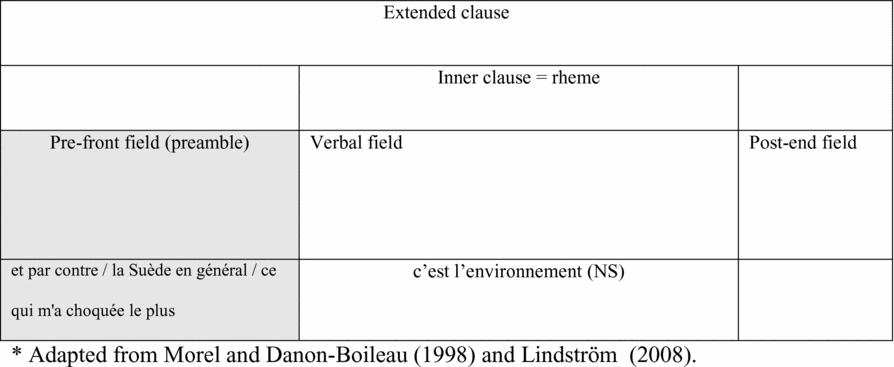
The perspective chosen as a point of departure for indices of complexity in this study was a model of information structure for French proposed by Morel and Danon-Boileau (Reference Morel and Danon-Boileau1998). A characteristic feature of spoken French is a high degree of left-dissociated structures, according to Morel and Danon-Boileau (Reference Morel and Danon-Boileau1998:37). The left-dissociated structures are brought together in a preamble that expresses both thematic and modal aspects of the subsequent rheme, as in the following utterance (rheme in bold): parce que moi je pense que dans le livre le héros il se transforme. In this example, the speaker's perspective and epistemic modality are expressed by moi je pense que. Thematic components would also include dans le livre le héros (cf. Blanche-Benveniste, Reference Blanche-Benveniste1997:120). This model has been applied in SLA research by Conway (Reference Conway2005) and Hancock (Reference Hancock2007). They observed that in very advanced learners (in the interview genre at least) some modal and referential components (adverbs, stressed pronouns) are less frequent than in preambles of native speakers.
Figure 1 below illustrates the topological structure of the extended clause with its preamble and rheme.
The extended clause*.

In Bartning et al. Reference Bartning, Forsberg Lundell and Hancock2012, a combined two level model of analysis of syntactic and discourse complexity was used. The model takes into account both the structural complexity of the utterance (interpreted as the presence of subordination) and discourse complexity in the extended clause (interpreted as the number of words and constituents in the preambles and rhemes) The use of the extended clause as one way to handle the notion of discourse complexity is thus to take into account the dynamic online construction of the utterance, reflected in the division of preambles and rhemes. The preambles in spoken language reflect the search and expression of the thematic parts of an utterance.
In the methodology section, our application of this two-level model in spoken French will be presented.
2.4 Formulaic sequences and advanced SLA
Formulaic language (collocations, idioms, routine formulae, formulaic sequences etc.) in second language learning covers both idiomatic sequences, supposedly acquired without analysis, and learner-idiosyncratic sequences that seem to represent ‘wholes’ for the learner, but that do not always conform to TL use. As for advanced learners, researchers focus on formulaic language viewed as idiomatic word combinations. Little research has been carried out to date about the formulaic language of highly proficient L2 users. A greater number of studies can be found concerning university students who are regarded as ‘advanced’ in a wider sense. As regards spoken production, the few studies that exist have mainly addressed the role of formulaic sequences (FSs) as fluency devices. For instance, Raupach (Reference Raupach, Dechert, Möhle and Raupach1984) found that German L2 learners of French overused certain multiword structures after a stay in France, contending that the subjects were using these FSs as a production strategy, or as ‘safety zones’ (il y a ‘there is’, c'est-à-dire ‘that is’, des choses comme ça ‘things like that’). The fluency aspect of multiword structures has also been investigated by Wood (Reference Wood2006), who concludes that the use of FSs contributes highly to L2 fluency.
In connection with spoken discourse, the only studies known to us that link multiword structures and L2 proficiency are Boers, Eyckmans, Kappel, Stengers and Demecheleer (Reference Boers, Eyckmans, Kappel, Stengers and Demecheleer2006), Forsberg (Reference Forsberg2008) and Stengers, Boers, Housen and Eyckmans (2011), all of whom conclude that the learners’ general proficiency levels seem to coincide with their degree of mastery of FSs: the more proficient the learner, the more the learner will make use of FSs. In addition, Forsberg (Reference Forsberg2008) also shows that not only quantity is in line with proficiency, but also that use of the category Lexical FSs (poser une question ‘ask/pose a question’, mettre en route ‘get going’) is clearly linked to high-level proficiency.
Although the state of the art on FSs in spoken advanced production is, as apparent, quite limited, it can be suggested that certain differences are to be expected between native and non-native speakers. In addition, it should be noted that two studies investigating formulaic language in relation to highly proficient L2 users, Ekberg (Reference Ekberg, Hyltenstam and Lindberg2003) as well as Abrahamsson and Hyltenstam (Reference Abrahamsson and Hyltenstam2009), have found differences (although not in researching spontaneous speech) between native and near-native speakers with regard to different types of formulaic sequences (lexico-grammatical patterns and idioms).
2.5 Lexical richness in advanced L2 production
Read (Reference Read2000) proposed using the term lexical richness as a cover term for different aspects of vocabulary acquisition, including lexical density, lexical diversity, lexical sophistication, and proportion of errors. In the present study the term lexical richness is used in the sense of lexical sophistication, i.e. the use of advanced words. There are also different conceptions of the notion of advanced vocabulary. For the purpose of the present study, we adopt a frequency-based perspective, assuming that the use of low-frequency words indicates an advanced vocabulary (cf. Laufer and Nation, Reference Laufer and Nation1995, Vermeer, Reference Vermeer, Bogaards and Laufer2004, Ovtcharov, Cobb and Halter, Reference Ovtcharov, Cobb and Halter2006).Footnote 2 Lexical richness has rarely been investigated in highly proficient L2 use. Three studies that do focus on advanced French L2 are Treffers-Daller (Reference Treffers-Daller, Richards, Malvern, Meara, Milton and Treffers-Daller2009), Ovtcharov et al. (Reference Ovtcharov, Cobb and Halter2006) and Lindqvist, Bardel and Gudmundsson (Reference Lindqvist, Bardel and Gudmundson2011), but none of them deal with users who have moved to the target language community and resided there for a long time. However, these earlier studies have shown that it is possible to attain a nativelike level of lexical richness by considering the proportion of low-frequency words in oral production (Ovtcharov et al., Reference Ovtcharov, Cobb and Halter2006, Lindqvist et al., Reference Lindqvist, Bardel and Gudmundson2011).
These studies also showed that there were significant differences in vocabulary richness between groups of advanced learners. In the present study lexical richness equals lexical sophistication as stated above for distinguishing proficiency levels. In terms of development of vocabulary knowledge during a stay-abroad period, previous research has often noted that learners make less progress once they have reached an advanced level in the target language. By contrast, lexical development is more notable in the early stages of acquisition.
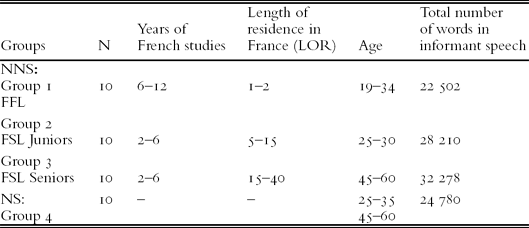
This is interesting in the present context as our groups 2 and 3 (see Table 1) spent a considerable amount of time in the target language environment. They have already been characterized as very advanced learners on the basis of other linguistic criteria. The question is whether it is reasonable to assume that there are differences in lexical richness between the two groups, since earlier studies have shown that the vocabulary of already advanced learners does not develop much during a stay abroad. However, previous studies mainly examined vocabulary size, while the present study focuses on lexical richness. While vocabulary size measures are strictly quantitative, i.e. estimations of the number of words known by the learner, lexical richness also encompasses a qualitative dimension by taking word frequency into account. One would assume that the number of low-frequency words, i.e. advanced vocabulary, will increase with proficiency and also with the amount of time spent abroad (cf. Ife, Vives Boix and Meara, Reference Ife, Vives Boix and Meara2000).
The four groups of informants
2.6 Fluency
Fluency has been defined in different ways. In ordinary language, the word is often used as a synonym of oral proficiency, whereas it has been contrasted to accuracy in the context of communicative language teaching (Chambers, Reference Chambers1997: 536–537). Emphasizing the importance of differentiating fluency from overall language proficiency and from communicative competence, Chambers (Reference Chambers1997: 543) recommends measuring the ‘flow’ or ‘smoothness’ of speech by using temporal variables. The basic characteristics of fluency, such as speed which is reflected by the temporal variables – are also important measures of information processing (Segalowitz, Reference Segalowitz and Riggenbach2000: 201). This could explain the great interest in SLA for this measurement of fluency (see e.g. Dechert and Raupach, Reference Dechert and Raupach1980; Arevart and Nation, Reference Arevart and Nation1991; Towell et al., Reference Towell, Hawkins and Bazergui1996; Skehan, Reference Skehan2009; Housen and Kuiken, Reference Housen and Kuiken2009; Hincks, Reference Hincks2010). Some studies have focused on the cognitive processes underlying fluency (Schmidt, Reference Schmidt1992; Towell et al., Reference Towell, Hawkins and Bazergui1996; Segalowitz, Reference Segalowitz and Riggenbach2000).
In previous studies on fluency, four main types of fluency have been examined (Skehan, Reference Skehan2009: 512–513; Housen and Kuiken, Reference Housen and Kuiken2009: 463, De Jong, Steinel, Florijn, Schoonen and Hulstijn, Reference De Jong, Steinel, Florijn, Schoonen, Hulstijn, Housen, Kuiken and Vedder2012:121): breakdown fluency (pauses), repair fluency (reformulations, repetitions, false starts, etc.), speed of delivery (syllables or words per time unit) and length-of-run measures.
Several studies on fluency in L2 have shown that there is a difference in the speed of verbal production in L1 and L2. Hincks (Reference Hincks2010), for instance, asked engineering students from the Royal Institute of Technology in Stockholm, who were all advanced L2 learners of English, to make an oral presentation on a technical subject first in L2, and then in L1 (Swedish). The speaking rate of these informants, measured in number of syllables pronounced per second, proved to be on average 23% slower in L2 than in L1. This decrease in speaking rate between the L1 and the L2 has also been shown in Towell et al. (Reference Towell, Hawkins and Bazergui1996) who focus on the fluency of advanced English-speaking learners of L2 French.
Having reviewed the relevant literature in the field for the various linguistic domains studied, the research questions will now be presented.
In the following sections we will link the presentation of our five measures discussed above to the concept of perceived nativelikeness and to the discussion of possible additional advanced stages beyond the ones proposed by Bartning and Schlyter (Reference Bartning and Schlyter2004).
3 RESEARCH QUESTIONS
The two research questions of the present study are:
1. Do we find evidence for the existence of two separate highly advanced stages in L2 French after stage 6 of the Bartning and Schlyter (Reference Bartning and Schlyter2004) continuum? That is, are there phenomena other than the perceived nativelikeness that contribute to create a ‘highly-proficient user’ profile (stage 7) and a near-native profile (stage 8)? Does it follow from the perceived nativelikeness criterion that speakers from stage 8 have:
- fewer non-targetlike morphosyntactic forms?
- longer preambles and rhemes?
- more lexical formulaic sequences?
- a significantly higher proportion of low-frequency words?
- longer mean length of runs?
- a higher speaking rate?
2. Is it possible to reach a nativelike spoken proficiency in an L2 as a late learner, i.e. someone who has acquired the L2 after puberty?
4 DATA
The suggested stages will be investigated in a subcorpus (InterFra, www.fraitaklass.su.se/interfra) of 30 advanced L2 speakers from three different groups of Swedish-speaking informants, and will be compared to NSs (see Table 1):
Group 1 (with French as a Foreign Language, FFL) consists of 10 advanced university students with a length of residence (LOR) of 1–2 years in a French-speaking country. They are advanced learners, i.e. university students from the second and third years (BA/MA programme, 19–34 years old) classified as learners of stages 6 already in Bartning and Schlyter (Reference Bartning and Schlyter2004). These learners were residing in Sweden, studying at university at the time of the recordings.
Group 2 (with French as a Second Language, FSL) consists of 10 advanced L2 users, Swedish-speaking young adults 25–30 years old (Juniors), with a LOR of 5–15 years. Most of them work and have a French partner, a few are finishing their French higher education degrees. They were between 18 and 19 when they arrived in France after secondary school.
Group 3 (with French as a Second Language, FSL) consists of 10 Swedish-speaking adults who, after high school, have lived in France for 15–30 years. They are 45–60 years old (Seniors), have French partners and bilingual children and also work in bilingual settings (Swedish-French) as opposed to those in Group 2 who work in entirely French settings. The members of Group 3 came to France at the age of approximately 21–24.
Group 4 contains native speakers from two groups: five ‘Paris NS Juniors’, 25–35 years old, and five ‘Paris NS Seniors’, 45–60 years old. These NSs are parallel to Groups 2 and 3 in age and background.
5 METHODOLOGY
5.1 The listener test
Inspired by the test designed by Abrahamsson and Hyltenstam (Reference Abrahamsson and Hyltenstam2009), 10 NS judges were asked to evaluate the 40 informants of the four groups with respect to nativelikeness. The judges were instructed to listen to extracts of 20–30 seconds from the informants’ interviews made with each informant.
The interviews constitute the main task in the InterFra corpus. The extracts were selected from the middle of the interviews and revealed no information about the origin of the informants. The judges were asked to choose between the following options: (a) this person has French as her/his mother tongue, and she/he comes from the Paris region; (b) this person has French as her/his mother tongue, and she/he does not come from the Paris region; (c) this person does not have French as her/his mother tongue. The judges also had to evaluate the certainty of their answers on a scale from 1–3 and they were not allowed to listen to the extracts again.
The native judges were all from the Paris region. They were between 25 and 40 years old. They had all completed a post-secondary education and worked in the education system, in business or as technicians. Many of them had knowledge of two foreign languages, one even three, but never of Swedish. They were recruited through a French research assistant, who recruited them among her acquaintances based on the criteria given (25–40 years, not linguists, no knowledge of Swedish, and secondary education). In line with Abrahamsson and Hyltenstam (Reference Abrahamsson and Hyltenstam2009), our definition of the ‘PASS’ criterion is a person judged as a native by at least 6 out of 10 native judges.
5.2 Results of the listener test
As mentioned above, the listener test classified the 30 NNS in a ‘PASS-as-a-native’-group (N = 10) and a ‘did NOT PASS as a native group’ (N = 20). All the NSs (Gr 4) passed as natives. Based on these results, a new division in stages was proposed. From here on, the Groups 1, 2, and 3 above constitute the point of departure for the results of the test of perceived nativelikeness. The analysis will henceforth be based on the new division in stages (stages 6, 7 and 8), which, so far, remains hypothetical.
In the following analyses of results, all the non-native speakers who have passed as natives (10 individuals from Groups 2 and 3) were placed at stage 8, the near-natives (cf. for definition, see above and Abrahamsson and Hyltenstam, Reference Abrahamsson and Hyltenstam2009), ( = stage 8 in tables beneath). Based on results from Bartning et al. (Reference Bartning, Hancock and Hyltenstam2009:204–207), we then propose a Stage 7, with 11 individuals (from Groups 2 and 3) called ‘the highly proficient L2 users’ which contains the speakers who did not pass as natives but who have an important length of residence in France and whose productions have proven to be more advanced, i.e. higher number of lexical formulaic sequences and of constituents in the preambles than those of the speakers of stage 6 (all from Group 1). So of the 30 speakers of the cohort of NNS, the stage 6 contains 9 speakers, stage 7 contains 11 speakers, and stage 8 contains 10 speakers as shown in the overview below.
5.3 Method of analysis
5.3.1 Non-targetlike morphosyntactic forms
The selection of the non-targetlike morphosyntactic forms analysed draws on results from our own studies and from overviews of late-acquired features in SLA research (see Bartning, Reference Bartning2009, Labeau and Myles, Reference Labeau and Myles2009). The identification of most of the NTL morphosyntactic forms was not too difficult to make. However, the Tense-Mode-Aspect cases were usually harder to identify since the native speaker norm in these domains is less clear (see Poplack, Reference Poplack, Bybee and Hopper2001 and Bartning, to appear, for the subjunctive, and Howard, Reference Howard2009, for the pluperfect).
The verb phrase:
1. Subject – verb agreement (il y a des cambrioleurs qui *vient [viennent])
2. Tense, Mode, Aspect (TMA): a broad category for simplification patterns or deviant rules in the tense system: e.g. imparfait instead of passé composé in past tense contexts (au bout d'un an je rentrais (for je suis rentrée ) en Suède), passé composé for pluperfect; indicative instead of subjunctive; problems with auxiliaries (avoir ‘have’ instead of être’be’). It has to be added that the TMA-category is of course also semantic (e.g. verbal aspect). Still the label ‘morphosyntactic’ forms is used (Lardiere, Reference Lardiere2007).
The noun phrase:
3. Gender agreement and gender assignment of determiners, e.g. j'ai pas un [une] imagetrès romantique), and gender agreement of adjectives (in different positions: une *petit (petite) fille, la table *vert (verte), une ville *italien (italienne) and of anaphoric pronouns (*il instead of elle) (see Agren, Reference Agren2008, Frenck-Mestre et al., Reference Frenck-Mestre, Foucart, Carrasco and Herschenson2009 for a review of the acquisition of gender in French L2; see also Holmes and Segui, Reference Holmes and Segui2006, S. Carroll, Reference Carroll and DeKeyser2005, Franceschina, Reference Franceschina2005, Granfeldt, Reference Granfeldt2003).
5.3.2 Information structure and complexity in spoken production
As shown in section 2.3 and Figure 1 above the grammaticalization of left dissociated constructions is represented by the topological structure of the extended clause. The components of the preamble are localized in the pre-front field of the extended clause (shaded area in Figure 1). In our analysis, we combine the discursive framework of Morel and Danon-Boileau (Reference Morel and Danon-Boileau1998, cf. preamble and rheme) with a more formalized perspective which is based on the extended clause in French (cf. Hancock, Reference Hancock2007, Lindström, Reference Lindström2008, and Bartning et al., Reference Bartning, Forsberg Lundell and Hancock2012, see Figure 1).
Since elaborate and complex preambles are part of the typical spoken French information structure, we would expect to find a similar pattern in the spoken French of very advanced learners (Hancock, Reference Hancock2007). We could thus expect to find a development towards native information structure concerning the use of preambles in highly advanced speakers of the corpus. Due to space limits, we focus in the present study on a measure of discursive complexity, i.e. the amount of words in the preambles. (For subordination as a measure of syntactic complexity in preambles and rhemes, see Bartning et al., Reference Bartning, Forsberg Lundell and Hancock2012).
5.3.3 Lexical formulaic sequences
The present study makes use of Erman and Warren's (Reference Erman and Warren2000) original categorization of formulaic sequences (prefabs in their terminology) which was slightly modified in Erman, Denke, Fant and Forsberg Lundell (submitted), a model based on the phraseological tradition. For a problematization on the identification of formulaic sequences, see Granger and Pacquot (Reference Granger, Pacquot, Granger and Meunier2008) and Forsberg (Reference Forsberg2010). Formulaic sequences can be classified into Lexical and Qualifier FSs according to our model, but we will only focus on Lexical FSs, since they have turned out to be the most interesting for the study of high level L2 use.
Lexical FSs incorporate at least one content word. They denote actions (such as faire la fête ‘to party’), states (avoir peur ‘to be scared’) and entities (chef d'entreprise ‘company leader’).
The criterion restricted exchangeability (Erman and Warren, Reference Erman and Warren2000) was used for identification. In order for a sequence to qualify as formulaic, an exchange of one of the words for a synonymous word must always result in a change of meaning or a loss of idiomaticity (Erman and Warren, Reference Erman and Warren2000:32). It should be noted that this criterion is based on native speaker use, which is appropriate for the investigation of advanced L2 use and idiomaticity.
The first step in identification is to find the Lexical FSs that meet the restricted exchangeability criterion. This is then complemented by searches on Google.fr. To test the extent to which restricted exchangeability applies to a sequence, an analogous sequence, which has been subject to one of several modifications, e.g. one of the words is exchanged for a synonymous word or one of the words is exchanged for an antonymous word (for example ça marche mal ‘it works bad’ instead of ça marche bien ‘it works well’).
In addition, for a sequence to be considered as formulaic, it has to appear at least twice as frequently on Google as any of the modified versions, in order to provide some sort of measure of nativelike preference.
5.3.4 Lexical richness
The method used to measure lexical richness in French L2 is the Lexical Oral Production Profile (LOPP), which is presented in Lindqvist et al. (Reference Lindqvist, Bardel and Gudmundson2011). It is a frequency-based measure, which is inspired by the Lexical Frequency Profile (Laufer and Nation, Reference Laufer and Nation1995). While the Lexical Frequency Profile is developed for written language, the LOPP method is extended to spoken language. The method consists of dividing a speaker's words into different frequency bands: Band 1, Band 2, Band 3 and Off-list. The frequency bands were created on the basis of the Corpaix corpus (Véronis, http://sites.univ-provence.fr/veronis/data/freq-oral.txt), which contains 1 million words extracted from spoken L1 French. A frequency list based on the corpus is available online. The list contains word forms. For the purpose of creating frequency bands, the list was lemmatized. The lemmatization resulted in 2766 lemmas, which were divided into three frequency bands (Bands 1, 2 and 3), each containing approximately 1000 lemmas. The lexical profile of a text is produced by running the text against the frequency bands. The profile is seen as the proportions of lemmas in the different frequency bands, e.g. Band 1: 95%, Band 2: 2%, Band 3: 1%, Off-list: 2%. The general assumption is that a relatively high proportion of low-frequency words is indicative of a rich vocabulary (cf. Laufer and Nation, Reference Laufer and Nation1995). One would thus expect very advanced L2 users to have a higher proportion of lemmas in Band 3 and Off-list than less advanced learners.
5.3.5 Fluency
The present study focuses on temporal variables of two kinds, and uses the following measures: (a) the speech rate and (b) the mean length of run. These variables are defined as follows: (a) The speech rate is calculated by dividing the number of words by the time needed to produce the speech sample in question (including silent and filled pauses); (b) The second measure, the mean length of run, corresponds to the mean number of words between two silent pauses – a silent pause being defined as exceeding 25 milliseconds (see e.g. Towell et al., Reference Towell, Hawkins and Bazergui1996). In previous studies, the variable (a) has been calculated by taking into account either the number of syllables (see e.g. Towell et al., Reference Towell, Hawkins and Bazergui1996; Hincks Reference Hincks2010) or the number of words (see e.g. Nation, Reference Nation1989; Arevart and Nation, Reference Arevart and Nation1991) per time unit. In the present study, the choice has been made to use the latter type of measure. The reason is that measures using the number of words can be more reliably established than the ones based on the number of syllables. Indeed, reductions in French, for example, due to the unstable ‘e’ in particular, make the calculation of the number of syllables uncertain;Footnote 3 recordings do not always enable a clear-cut distinction between words pronounced with the unstable ‘e’ (e.g. ‘le travail’ [lət{avaj], three syllables), and words pronounced without (‘l'travail’ [lt{avaj], two syllables). Therefore, calculating the number of syllables risks an unreliable interpretation that could jeopardize the validity of the results.
6 RESULTS
In this section, results from the analysis of the linguistic measures for each of the stages 6, 7, 8 and NS will be presented (for the division and criteria for the stages, see section 5.2 above.).
6.1 Non-targetlike morphosyntactic forms
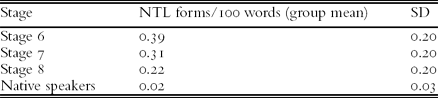
As shown in Bartning et al. (Reference Bartning, Forsberg and Hancock2009), the NNS productions contained non-targetlike morphosyntactic forms, i.e. errors in the verb phrase: subject-verb agreement, verb inflection, in the noun phrase: gender agreement on determiners and adjectives, adjective inflection and, again in the verb phrase: tense/mode/aspect difficulties (concordance of tenses and verb morphology). Table 2 below shows that these grammatical criteria do not differentiate between the three new stages. The non-parametric ANOVA test shows significant differences between the four groups (F 3,36, = 5.97, p = 0.000). Dunn's post-hoc test showed no significant differences in the morphosyntactic NTL forms between the different NNS stages 6, 7 and 8. However, significant differences were shown between all the stages of NNSs (6, 7, 8) as opposed to the NSs in this domain (between 6 and NS (p<0.01), between 7 and NS (p<0.01) and between 8 and NS (p<0.05). It thus seems that morphosyntax is a differentiating criterion between NNS and NS production and that morphosyntax is one of the vulnerable areas of a NNS speaker of French before reaching native use.
Number of non-targetlike morphosyntactic forms per 100 words
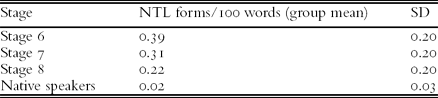
Results concerning the NTL morphosyntactic forms show a clear stabilisation of uses, thus confirming earlier findings in very advanced learners, e.g. Lardiere, Reference Lardiere2007 and Hyltenstam, Reference Hyltenstam and Harris1992.
It is also important to state that there is considerable individual variability, and that some speakers do in fact reach nativelike morphosyntactic use (3 out of 10 at stage 8, i.e. the PASS group).
6.2 Information structure and complexity
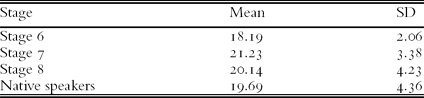
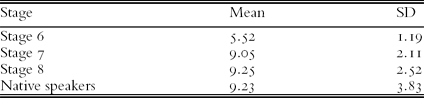
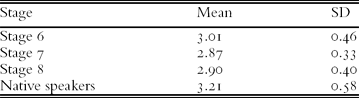
A sample of 800–1500 words was randomly selected from each interview, and preambles were counted with respect to their number of words, here used as a measure of complexity (see Tables 3 and 4 below). The ratio of words in preambles related to the total number of words as shown in Table 3 in percentage, and the mean length of preambles (words/preamble) in Table 4.
Number of words in preambles/total number of words (%)
Mean of number of words/preamble
In Table 3, no clear tendency is discernible, except that the mean value for the speakers of stage 6 (18 %) is lower than those of the other groups (19–21%), although there were no significant differences between the stages according to an ANOVA (F 3,36, = 1,170, p = 0.335). In general, this means that the number of words in the preambles constitutes about a fifth (20 %) of the total number of words, in all groups.
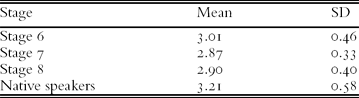
The mean length of preambles (Table 4) shows that the NS group had a higher mean value (3.21) than the NNS groups (3.01, 2.87, and 2.90 respectively). The highest individual mean values were found in the NS group. However, no significant differences between stages were found according to an ANOVA (F 3,36, = 1,359, p = 0.271). Thus there are no quantitative differences between the groups.
As a summary, there were no significant differences between the stages with respect to the total number of words in preambles (Table 3). We also found that NSs had a higher mean length of preambles than all the NNS groups (Table 4). However, the differences between the mean values of the different stages were not statistically significant.
6.3 Formulaic language
Table 5 shows the number of Lexical FSs per level.
Number of lexical FS/100 words
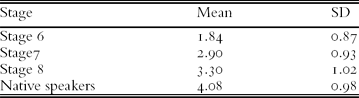
Table 5 indicates a progression in the use of Lexical FSs from stage 6 up to the native speakers. The ANOVA test shows significant differences between the four stages (F 3,36, = 7.05, p = 0.001). The post hoc test (LSD) yields the following differences: between stages 6 and 7 (p = 0.034), between stages 6 and 8 (p = 0.020), between stage 6 and NS (p<0.001), between stage 7 and NS (p = 0.015) and between stage 8 and NS (p = 0.034), but no significant difference between stages 7 and 8 (p = 0.763). This means that there is evidence of stages above stage 6, in that both stage 7 and stage 8 produce significantly more FSs than stage 6. It is also notable that a difference exists between stage 8 and the NSs, suggesting that formulaic sequences are an efficient indicator of nativelikeness. The results should however be interpreted with caution, since few individuals are included.
A linear regression analysis was also carried out in order to examine the increase of Lexical FSs across the stages. Stage (independent variable) (seen as a longitudinal development from stage 6 to NS) significantly predicted an increase in the proportion of formulaic sequences (dependent variable) β = 0.634, t(38) = 4.46, p <0.001 and accounted for 34.4 % of the variance in the proportion of formulaic sequences i.e. R 2 = 0.344.
6.4 Lexical richness
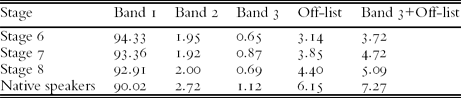
In this section, we report on the results using the LOPP method. Table 6 shows the lexical profiles of the different stages. The numbers refer to the mean proportion of lemmas in the different frequency bands.
Lexical profiles of the different stages (%)
As can be seen in the table, the proportion of high-frequency lemmas (Band 1) is higher at the less advanced stage and then decreases with each subsequent proficiency level. Examining the proportions of low-frequency vocabulary (Band 3+Off-list,), it is obvious that as proficiency increases so does the proportion of advanced vocabulary: The informants who passed as native speakers in the listener test (stage 8) are also those with the highest proportion of low-frequency vocabulary. As expected, the learners at stage 6 have the lowest proportion. An ANOVA test showed that there were significant differences between the four stages (F 3,36, = , 16,86, p<0.001). The post hoc test (LSD) shows that there are significant differences between stage 6 and 7 (p = 0.034), stage 6 and 8 (p = 0.008), stage 6 and NS (p<0.001), stage 7 and NS (p<0.001), and between stage 8 and NS (p<0.001). There is no significant difference between stage 7 and 8 (p = 0.509). The results are thus very similar to those of formulaic sequences, lending support for a stage beyond stage 6, since speakers at both stage 7 and stage 8 produce significantly more non-frequent words than those at stage 6. However, the same lack of difference (as for FSs) between stage 7 and 8 was shown. Yet, since the figures in Table 6 seem to indicate a clear increase along the stages, just as for lexical formulaic sequences, we also carried out a linear regression analysis on the lexical profile data. Stage (independent variable) (seen as a longitudinal development from stage 6 to NS) significantly predicted an increase in the proportion of infrequent words β = 1.41, t(38) = 6.56, p< .001 and accounted for 53.1 % of the variance in the proportion of infrequent words (dependent variable) i.e. R 2 = 0.531. Finally, it should also be noted that the most advanced NNSs did not produce as many non-frequent words as the NS, underlining the difficulty of this domain for NNSs.
In summary, the present study of lexical richness developed in an expected way in the sense that there was an increase in the proportion of low-frequency words at each level of proficiency, although not always significant. In addition, the informants who passed the listener test did not reach the level of the native speakers, as opposed to the most advanced groups in Ovtacharov et al. (Reference Ovtcharov, Cobb and Halter2006) and Lindqvist et al. (Reference Lindqvist, Bardel and Gudmundson2011).
6.5 Fluency
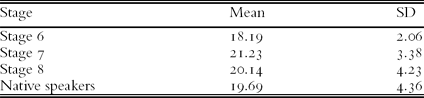
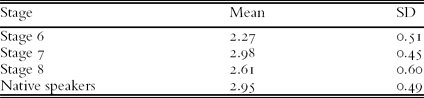
As shown above two measures of fluency have been used: speech rate and mean length of run. Tables 7 and 8 show the results for these measures at the different developmental stages as well as in the NS’ interviews.
Speech rate at the different stages (number of words/seconds)
Mean length of run at the different stages (mean number of words between two silent pauses (silent pause = 25 milliseconds)
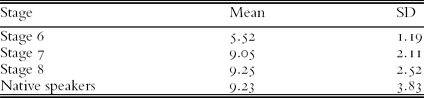
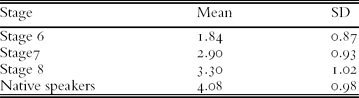
For the speech rate, it can be observed that the speakers at stage 6 have a lower mean rate than the other stages whereas the test participants at stages 7 and 8 show results in the same range as the NSs. However, none of these differences are statistically significant. The situation is different for the mean length of run (as shown in Table 8).
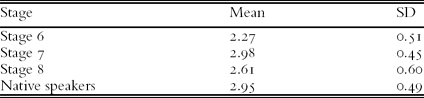
The mean length of run measure yields significant differences between stage 6 compared to the other stages (LSD, stage 6 and 7, p = 0.006, stage 6 and 8, p = 0.004 and stage 6 and NS, p = 0.005) according to an ANOVA (F 3,36, = 4,338, p = 0.01), whereas the differences between the highly proficient L2 users (stage 7), the near-natives (stage 8), and the NSs did not prove significant.
To sum up, the study has not shown the existence of differences in the speed of delivery measured with speech rate. However, as far as the length of run is concerned, the speakers at stage 6 produce shorter runs than those at the other two stages and the NS. On average, the runs of the highly proficient L2 users and of the near-natives seem to have a length comparable to that of the NSs.
In conclusion, the different measures have failed to pinpoint differences regarding fluency between highly proficient L2 users and near-natives. Neither do they distinguish the performances of the highly proficient L2 users on the one hand and the NSs on the other. These results suggest that L2 users at stage 7 and near-natives at stage 8 are as fluent as NSs, and that what distinguishes them from the lower stages is the ability to produce longer runs.
7 DISCUSSION
In the present study, L2 users with varying degrees of exposure to French were divided into three different advanced stages. The first stage, 6, corresponds to the last stage (6) in the Bartning and Schlyter (Reference Bartning and Schlyter2004) model. However, this stage does not suffice, as shown in the results above, for the description of the characteristics found in the advanced productions of our French as a Second Language informants. Thus, stage 7 contains L2 users who have long LORs in France and who were shown, in Bartning et al. (Reference Bartning, Forsberg and Hancock2009), to differ with respect to e.g. formulaic language use compared to stage 6. Stage 8 contains the same type of population of speakers – and productions – as in stage 7, but these speakers were also identified as passing as native speakers in the PASS-as-a-native test, thus near-native speakers based on Abrahamsson and Hyltenstam's (Reference Abrahamsson and Hyltenstam2009) definition.
The aim of the present analysis has been to investigate whether the division in stages, especially between stages 7 and 8 also corresponded to differences with regard to five linguistic criteria, or whether the speakers were merely separated by the ‘pass-as-a native’ criterion. Three measures indicated significant differences between stage 6 and 7, i.e. formulaic sequences, lexical richness and one of the fluency measures. Although the other two measures did not yield significant differences, the differences found are deemed to be important enough to claim that there exists a substantive difference between stage 6 and stage 7. On a more general note, there is a need for stage 7 since the results show that above stage 6, measures other than those we call morphosyntactic in this study are necessary for the description of on-going development.
Furthermore, no measures, except for the pass-criterion, discriminate between individuals in stages 7 and 8, although the formulaic sequence and lexical richness measures point to a clear tendency according to the regression analyses. What are the implications of such a result? Does it make sense to distinguish between stages simply on the basis of the pass-criterion? Are near-native speakers (following Abrahamsson and Hyltenstam's definition, Reference Abrahamsson and Hyltenstam2009: 294, note 1) really that different from ‘advanced’ L2 users? Does the only difference reside in perceived native-likeness and what is actually included in this perception? As the regression analyses carried out suggest a difference with regard to lexical measures between the two stages, other differences than phonological could play a part. It seems quite plausible that the lexicon, which possibly never stops increasing and is incrementally learnt through experience, would be better mastered by speakers who have also received enough input to be able to pass as native speakers. Nevertheless, more informants are needed in order to come to more robust conclusions. All in all, there does not seem to be much support for both a stage 7 and a stage 8, if the pass-criterion alone is not regarded as a sufficient reason for splitting into two stages.
The formulaic sequence measure and the lexical richness measure lend support for a near-native stage, given that a significant difference is found between stage 6 and stage 8. While it seems difficult for L2 learners to attain absolute nativelikeness for these measures, results should be interpreted with caution. Regarding the other measures and the possibilities of attaining a nativelike level, the results are mixed. With respect to fluency and information structure, no differences between NSs and NNSs are found and accordingly, nativelike proficiency seems to be within reach for L2 users. In contrast, with respect to morphosyntactic accuracy, differences are still found. This suggests that at these high levels of L2 proficiency, the last stepping stones would be formulaic sequences, morphosyntax and use of infrequent vocabulary.
8 CONCLUDING REMARKS
Based on the above results, several general points can be made. First of all, it has been made clear that the advanced level needs to be nuanced. Although not many differences between stages 7 and 8 were found, it was apparent that at least one more stage is needed after stage 6. The measures that were successful in defining the highly proficient L2 users-stage (stage 7) were fluency, lexical richness and formulaic sequences. Information structure and morphosyntax, however, did not, in the present study, clearly distinguish between these three L2 stages.
The vast majority of advanced L2 users are probably to be found within the category of highly proficient L2 users, our stage 7. For cognitive, emotional or social reasons, they do not pass as native speakers, but our study suggests that they are otherwise quite similar to near-native speakers. Nevertheless, more participants need to be included in a follow-up study in order to further investigate possible differences between highly proficient L2 users (stage 7) and near-native speakers (stage 8).
Secondly, we concur with Abrahamsson and Hyltenstam (Reference Abrahamsson and Hyltenstam2009) in that it is possible to find speakers who are perceived as native speakers, but when their production is scrutinized in detail – here by means of five different measures – differences remain. Abrahamsson and Hyltenstam (Reference Abrahamsson and Hyltenstam2009) mainly reported on test results, while our findings are based on spontaneous spoken data. Nonetheless, our results are quite similar to theirs. However, it should be noted that although most speakers do not perform in a nativelike manner on all the measures, we have found a few individuals who actually do, and these individual results will be further examined in profile studies in the near future. Finally, it is also worthwhile to point out that 30% of the late learners included in the present study succeeded in passing as native speakers, according to the listener test. This figure deviates from Abrahamsson and Hyltenstam's (Reference Abrahamsson and Hyltenstam2009:274) 19%. This means that a third of the adult learners we investigated have acquired their second language so well that they probably do not encounter linguistic obstacles on a day-to-day basis, which is a very encouraging result for our knowledge base on adult learning. It is highly plausible that some linguistic domains are subject to maturational constraints. This is particularly the case regarding perception, which was investigated through some of Abrahamsson and Hyltenstam's tests. Still, it is important to emphasize that, concerning productive linguistic resources relevant for successful everyday communication, nativelikeness is indeed possible. The differences between the motivational and socio-psychological profiles of the learners included in the present study and those included in Abrahamsson and Hyltenstam (Reference Abrahamsson and Hyltenstam2009) should be taken seriously. In our case, we are dealing mainly with highly motivated, language-interested, high status immigrants with positive affective attitudes towards the host country France, whereas Abrahamsson and Hyltenstam (Reference Abrahamsson and Hyltenstam2009) investigate immigrants in Sweden, most of whom did not come to the host country because of interest in the target language or culture, but rather because of political and economical circumstances. It is possible that the socio-psychological conditions for their L2 acquisition have been less favourable than for our learners. This would explain the higher success rate in our group. Further research should include more participants and continue to look for the factors and contexts which allow late learners to attain nativelikeness.