Contemporary intervention science has shifted from a focus on whether an intervention is effective to an emphasis on explaining how interventions lead to improvements (Kazdin & Nock, Reference Kazdin and Nock2003; Kraemer, Wilson, Fairburn, & Agras, Reference Kraemer, Wilson, Fairburn and Agras2002). By isolating the elements of an intervention that drive its effectiveness, treatments can be modified and enhanced by focusing on these active therapeutic components. Examinations of treatment mechanisms typically involve isolating a specific factor that is conceptualized as changing during treatment, and examining it as a mediator of the link between treatment and outcome.
Although informative, this approach is typically limited to processes unfolding during the active treatment phase, overlooking larger developmental pathways or cascades linking earlier vulnerabilities to later outcomes. This limitation is especially salient with regard to preventive interventions aimed at counteracting risk factors and reinforcing protective factors that mitigate pathways and processes leading to future dysfunction (Coie et al., Reference Coie, Watt, West, Hawkins, Asarnow and Markman1993).
Consistent with the tenets of prevention science, an intervention that effectively reduces a specific factor associated with dysfunction, but fails to alter the pathogenic process underlying dysfunctional development, is of limited utility (Coie et al., Reference Coie, Watt, West, Hawkins, Asarnow and Markman1993). Further, given the complexity of developmental processes over time, interventions that alter a key developmental process may not exert a measurable effect on a particular outcome initially, but may have far-reaching future implications. Innovative approaches, informed by developmental psychology and psychopathology, are necessary to understand how preventive interventions may alter developmental cascades leading to maladjustment.
Consequently, researchers have been urged to incorporate a developmental psychopathology perspective into prevention science (Cicchetti & Hinshaw, Reference Cicchetti and Hinshaw2002; Cox, Mills-Koonce, Propper, & Gariépy, Reference Cox, Mills-Koonce, Propper and Gariépy2010; Masten & Cicchetti, Reference Masten and Cicchetti2010). By elucidating maladaptive developmental processes, factors that may redirect such processes toward more desirable trajectories can be identified. Parenting interventions represent a noteworthy example of strong designs that rely on random assignments and experimental manipulation to interrupt maladaptive developmental sequences. Aspects of the parent–child relationship are particularly meaningful targets. Even a subtle improvement in the quality of the relationship may trigger changes in developmental cascades, leading to better child outcomes (Masten & Cicchetti, Reference Masten and Cicchetti2010). Nonetheless, a recent review of 46 preventive parenting interventions suggests that, despite modest evidence for long-term effects of these interventions, it is unclear how they lead to better child outcomes (Sandler, Schoenfelder, Wolchik, & MacKinnon, Reference Sandler, Schoenfelder, Wolchik and MacKinnon2011).
One way to elucidate how parenting interventions may promote adaptive development is to focus on pathogenic cascades that eventually lead to child maladjustment. Such an approach can be effectively informed by the growing science of relationships and developmental psychology and psychopathology. That science has produced robust evidence about many processes that over time produce maladaptive developmental cascades and increase risk of children's psychopathology (Masten & Cicchetti, Reference Masten and Cicchetti2010, and the Special Issue of Developmental Psychopathology, 2010). Examples include insecure, suboptimal attachment that may lead to deficient emotion regulation, which in turn may lead to a broad range of behavior problems; or the child's coercive and aversive noncompliance that may lead to the parent's adversarial control, which in turn may lead to children's biased social information processing and, in turn, to aggression. In such developmentally informed approach, parenting interventions may be conceptualized as tools that can redirect or disrupt pathogenic cascades that would otherwise unfold. An intervention aims to initiate change in the form of a cascade from the intervention to the mediator to the outcome (Cicchetti & Hinshaw, Reference Cicchetti and Hinshaw2002; Masten & Cicchetti, Reference Masten and Cicchetti2010).
Note that such an approach may also inspire a new strategy to evaluate the effectiveness of parenting interventions. That strategy would entail going beyond main effects (changes in mean levels of certain constructs found for all participants), and beyond simple moderated effects (changes found for certain subsets of participants), although both approaches are, of course, valuable. Instead, or in addition, the focus would be on changes in developmental chains of events or processes that ultimately lead to differential outcomes. A noteworthy example comes from the well-known Family Check-Up (FCU) intervention program for high-risk families with young children (e.g., Sitnick et al., Reference Sitnick, Shaw, Gill, Dishion, Winter and Waller2015). FCU is a brief, annually delivered intervention focused on improving positive parenting skills, with parenting consultants discussing multiple strategies with parents and using videotaped feedback. A recent longitudinal report of the findings from ages 2 to 5 illustrates how FCU altered a developmental process (or cascade) by increasing parent–child positive engagement, which in turn led to a reduction in parent–child coercion, which then led to the child's decrease in oppositional and aggressive behavior problems.
The current study illustrates such process-oriented approach, drawing from a play-based intervention, implemented in a randomized experimental design. We targeted a pathogenic cascade supported by considerable research: it has been widely shown that difficult, angry, hard to manage, unresponsive children elicit more negative, adversarial parenting, and that such negative parenting leads to child maladjustment (Bates, Schermerhorn, & Petersen, Reference Bates, Schermerhorn, Petersen, Zentner and Shiner2012; Bell, Reference Bell1968; Bradley & Corwyn, Reference Bradley and Corwyn2013; Dadds & Salmon, Reference Dadds and Salmon2003; Dishion & Patterson, Reference Dishion, Patterson, Cicchetti and Cohen2006; Lipscomb et al., Reference Lipscomb, Leve, Harold, Neiderhiser, Shaw and Ge2011; Lorber & Egeland, Reference Lorber and Egeland2011; Pardini, Reference Pardini2008; Patterson, DeBaryshe, & Ramsey, Reference Patterson, DeBaryshe and Ramsey1989; Putnam, Sanson, & Rothbart, Reference Putnam, Sanson, Rothbart and Bornstein2002; Reid & Patterson, Reference Reid and Patterson1989; Shaw & Bell, Reference Shaw and Bell1993; Smith et al., Reference Smith, Dishion, Shaw, Wilson, Winter and Patterson2014). This process is particularly likely to unfold in families that experience ecological adversity, such as poverty, stress, or chaos, and such high-risk families are often targeted for preventive interventions.
Recent conceptualizations and empirical studies have revealed that the early parent–child relationship may serve as a powerful moderator, or catalyst, that may either amplify or defuse such parent–child dynamics. Although main effects of the early parent–child relationship may not be found, it can indirectly influence future parent–child processes (Sroufe, Reference Sroufe2005). In our longitudinal nonexperimental work, replicated across several community samples, the parent–infant relationship (insecure vs. secure attachment, as assessed in Strange Situation in infancy) has been found to serve as a significant moderator of the future sequence from the child's difficulty to negative parenting to child maladaptive future outcomes. In insecure relationships, the cascade was likely to unfold. By contrast, in relationships that had been secure, such a cascade was defused and absent (Kochanska, Barry, Stellern, & O'Bleness, Reference Kochanska, Barry, Stellern and O'Bleness2009; Kochanska & Kim, Reference Kochanska and Kim2012).
We apply that model to a randomized experimental design that targeted high-risk mother–toddler dyads. This article represents a preliminary test of an expectation that a play-based intervention, by presumably enhancing the mother–toddler relationship in subtle ways, may significantly alter the causal developmental sequence from child difficulty to maternal adversarial, negative parenting to child maladaptive outcomes, such that the cascade would be weakened or absent in dyads that had been assigned to the intervention condition, compared to those that had not (for whom the maladaptive cascade would be expected to unfold).
Method
Participants
Mothers responded to flyers displayed on community boards and in libraries, pediatric offices, and daycare centers in a Midwestern state. Locations frequented by low-income families (e.g., thrift stores and Head Start locations) were especially targeted. Mothers had to receive/be eligible for aid from a local, state, federal, or faith-based agency (or Earned Income Tax Credit), the child had to be free of major health problems, and the mother had to be able to speak English during sessions. Graduate students were not eligible. A total of 186 mothers and their toddlers (90 girls) were accepted. Mothers signed informed consent prior to the study. All procedures were approved by the institutional review board.
The demographic data are as follows: children's age, M = 30.33 months, SD = 5.40; mothers’ age, M = 27.54 years, SD = 4.87; annual family income, M = $20,385, SD = $13,010; and number of children, M = 2.20, SD = 1.08. In terms of education, 5.4% of mothers did not complete high school, 50% had a high school diploma or GED, 19.4% had an associate degree, and 15.3% had a bachelor's or a technical degree. In terms of marital status, 54.3% were married, 13.4% cohabitated, 30.6% were single or divorced, and 1.6% reported other arrangements. Regarding ethnicity and race, 10.8% were Hispanic, 87.1% not Hispanic, and 2.2% reported “other”; 1.6% were American Indian, 1.6% Asian, 14.5% African American, 72.6% White, 7% more than one race, and 2.7% did not report race. There were no significant differences between the two intervention groups in demographic characteristics. However, there was a trend in terms of race. In the child-oriented play group, there were 79% White and 21% non-White mothers, and in the play-as-usual group, 67% and 33%, respectively, χ2 (1) = 3.20, p < 0.10.
Overview of design
For every mother–child dyad, the study's sequence (~10 months total) included pretest; random assignment to a child-oriented play group, N = 94, or a play-as-usual group, N = 91 (one mother dropped before assignment; training session; play sessions and daily play over 9–10 weeks; Posttest 1; and Posttest 2 (6 months after Posttest 1). The mothers received $700 for their participation (paid in installments, following the completion of consecutive stages of the study). The mothers and children also received small gifts after each session. Children received cards and gifts on their birthdays.
The play-based intervention was rooted in research on child-oriented play and positive interaction, presumed to enhance the quality of the mother–child relationship (Barkley, Reference Barkley1981; Eyberg & Bussing, Reference Eyberg, Bussing, Murrihy, Kidman and Ollendick2010; McMahon & Forehand, Reference McMahon and Forehand2003; Moss et al., Reference Moss, Dubois-Comtois, Cyr, Tarabulsy, St-Laurent and Bernier2011; Webster-Stratton & Reid, Reference Webster-Stratton, Reid, Murrihy, Kidman and Ollendick2011). The dyads were randomized into two groups.Footnote 1 In the child-oriented play group, mothers allowed children to lead the play; responded positively to them; followed their lead; focused positive attention on, offered positive regard to, and reinforced the children; and refrained from any commands, criticism, and any form of negative or punitive influence or control. In the play-as-usual group (active control group), they were asked to play in the usual manner. The dyads were then observed in eight home and laboratory play sessions over approximately 10 weeks, and mothers and children engaged in one-on-one play once a day at home, consistent with the received instructions.
Procedures
Pretest, Posttest 1, Posttest 2
Dyads completed 3-hr sessions in a naturalistically furnished laboratory, with largely parallel scripts that encompassed multiple contexts (e.g., play, snack, and mother busy). The laboratory contained a low shelf with attractive toys, which were off-limits to the child. Mothers were asked to issue the prohibition and prevent children from touching the toys. The entire sessions were videotaped for later behavioral coding. Multiple teams of coders were all blind to group assignments and details of the design. They established reliability using typically approximately 20% of cases. Reliability was followed by multiple realignments to prevent observers’ drift.
Intervention
During the training session, in the child-oriented play group, a staff member taught the mother play techniques drawn from Child's Game using a handout, video produced in our laboratory, featuring racially diverse mothers engaging in each technique. The staff member also modeled each technique. The mother then practiced the techniques and received feedback (McMahon & Forehand, Reference McMahon and Forehand2003). The techniques focused positive attention on the child and/or allowed the child to direct the play as often as possible. Techniques shifting control to the mother, particularly all forms of power-assertive discipline, criticism, or negative influence, were discouraged. In the play-as-usual group, no play techniques were mentioned, and the mother was asked to play with the child as usual.
Following the training session, all dyads took part in eight half-hour laboratory and home play sessions, one every 7–10 days, playing according to the training received. All sessions were videotaped; 95% percent of mothers completed all eight sessions, and 98% completed at least seven. At the outset of a play session, a staff member reviewed briefly the play techniques and elicited questions from the mother. She then observed the entire play session and took notes, and then delivered feedback to the mother. In the child-oriented play group, she reviewed the mother's use of each play technique. The feedback was supportive, positive, and encouraging in tone, but also substantive and pointing out possible room for improvement. In the play-as-usual group, the “rhythm” of the play sessions was parallel, and the feedback consisted of general neutral or pleasant comments about the child or dyad (e.g., “She seemed to enjoy the animals” or “You guys had fun with those trucks”). The groups did not differ in the number of play sessions (child-oriented play, M = 7.73, SD = 1.22; play as usual, M = 7.34, SD = 1.89, ns). Mothers were also asked to play daily at home for 20 min in the same manner (consistent with the group assignment). They kept simple daily diaries provided to them, in which they recorded the daily play (later collected by the staff). That period of the study lasted on average 62.76 days.
Fidelity and integrity
Extensive and rigorous fidelity procedures were deployed (for more information, see Kochanska, Kim, Boldt, & Nordling, Reference Kochanska, Kim, Boldt and Nordling2013). All coders of observational data were blind to the mothers’ group assignments and to all parts of the video records that may have revealed the assignment. For every mother–child dyad, four out of eight play sessions were selected randomly, and for each, blind coders completed a checklist of four key points of the initial instruction and feedback given to the mother by the staff member (thus, the perfect compliance with the protocol meant implementing 16 items (4 coded sessions × 4 items) in the child-oriented play group and 0 items in the play-as-usual group. In the former group, the staff members implemented 14–16 items with 94% of mothers, and 12–13 items with the remaining 6%; in the latter group, compliance was 100%. Regular staff meetings were held to review performance, for consistency with each other and the protocol.
Child difficulty: Pretest
The measures of child difficulty integrated scores from three observational paradigms: child's unresponsiveness to the mother's cues, the child's lack of cooperation with the mother's prohibition, and negative affect expressed in interactions with the mother.
Child unresponsiveness to the mother in naturalistic interactions
The child's responses to maternal cues were coded during naturalistic interactions (62-min total) in seven scripted contexts: introduction to the laboratory room (5 min), mother busy with questionnaires (10 min), a snack (12 min), play (10 min), toy cleanup (10 min), free time (10 min), and gift (5 min). For each context, the coders rated child behavior from 1 (highly unresponsive) to 7 (highly responsive). The code integrated positive attention and orientation toward the mother, sensitivity to her cues, promptness of response, enjoyment of interaction, and cooperation with maternal bids. Intercoder reliability (intraclass correlations [ICCs]) ranged from 0.90 to 0.92. The scores cohered across the contexts (Cronbach α = 0.83) and were averaged into a score of the child's overall responsiveness toward the mother, and reversed such that higher scores indicate more unresponsiveness.
Child lack of cooperation with the mother's prohibition
Dyads were observed in the laboratory for 45 min, in naturalistic interactions that took place in the room with easy access to the off-limit toys that allowed us to observe the prohibition control encounters that involved those toys. Child behavior was coded for each 30-s segment within the earlier identified (by another team) episodes when the child oriented toward the prohibited toys. In the current report, we focus on committed compliance: self-regulated, eager adherence to maternal prohibition, with child complying without the need for maternal sustained control, and indicating a wholehearted endorsement of the prohibition (pointing to the toys, shaking head, and saying “no-no toys” or “don't touch”; Kochanska & Aksan, Reference Kochanska and Aksan1995). The κ value was 0.88. All instances of each behavior were tallied, divided by the number of the 30-s segments, standardized, and reversed, such that higher scores reflected the lack of cooperation with maternal prohibition.
Child negative affect toward the mother
The child's affect was coded in the same seven contexts as their responsiveness (62 min), for every 30-s segment (by another team). The κs ranged from 0.72 to 0.84. We tallied all instances of the child's intense or pervasive (more than 15 s) negative affect (weighed by 3), discrete negative emotions (weighed by 2), and neutral/negative mood, such as signs of fatigue, disengagement, or boredom, negatively “tinged” but not reaching a full expression of a discrete negative emotion (weighted by 1). Those figures were added and divided by the number of coded segments into a score of child negative affect toward the mother (see, e.g., Kochanska, Kim, & Koenig Nordling, Reference Kochanska, Kim and Koenig Nordling2012).
Data aggregation
The scores of child unresponsiveness, lack of cooperation, and negative affect were standardized and averaged to into a score of child difficulty (internally consistent, Cronbach α = 0.77).
Maternal adversarial, negative parenting: Posttest 1
The measure of maternal adversarial, negative parenting integrated the scores from three observational paradigms and a self-report: the mother's observed power-assertive control, observed unresponsiveness to the child, observed negative affect expressed toward the child, and mother-reported unresponsiveness to the child.
Mother observed power-assertive control
The dyad was observed for 45 min in the room with the off-limits toys (e.g., snack, free time, and mother busy). All control encounters involving the prohibition were coded. Coders identified all episodes of control (starting when child attention turned to the toys, until the child reoriented away from them; ICC reliability for this episodic coding were 0.85 to 0.99). Then, another team coded, for every 30-s segment within those episodes, the mother's overall control style. Codes reflecting power assertion included assertive control (matter of fact, firm, decisive control style), and forceful, negative control (negative, angry, threatening, or harsh control style). The κ was 0.86. In addition, for each 30-s segment, mother physical power-assertive strategies were coded: assertive physical control (firmly holding child or taking a toy away), and forceful, negative physical control (handling child roughly or spanking). The κs ranged from 0.78 to 0.86. The instances of each code were tallied, divided by the number of coded segments, and standardized. The two scores for the overall control style were averaged, and the two scores for physical power-assertive strategies were averaged, and finally those two scores were averaged into the mother's observed power-assertive control score.
Mother observed unresponsiveness to the child
Maternal responsiveness was coded in the same seven contexts as the child's. For each context, the coders rated mother responsiveness from 1 (highly unresponsive) to 7 (highly responsive). The code integrated sensitivity–insensitivity to the child's cues and signals, cooperation–interference, or support for the child's autonomy, and acceptance–rejection, or affection and enjoyment of the interaction (Ainsworth, Bell, & Stayton, Reference Ainsworth, Bell, Stayton and Schaffer1971). The reliability among the coders (ICCs) ranged from 0.81 to 0.93. The scores cohered across the contexts (Cronbach α = 0.89 at pretest and α = 0.87 at Posttest 1), and were averaged into the mother's overall responsiveness score toward the child. Scores of maternal responsiveness were reversed, such that higher scores reflect greater unresponsiveness.
Mother negative affect toward the child
Mothers’ affect was coded in the same seven contexts as their responsiveness (62 min), for every 30-s segment. Kappas ranged from 0.62 to 0.85. We then tallied and weighed the instances of the mothers’ intense or pervasive negative affect (weighed by 3), discrete negative emotions (weighed by 2), and neutral/negative mood (weighted by 1). Those figures were added and divided by the number of coded segments into a score of mother negative affect toward the child.
Mother-reported unresponsiveness
Mothers completed the Parenting Inventory (Kochanska, Reference Kochanska1995), a 26-item measure assessing responsiveness to the child's needs (e.g., “I simply must comfort my child at the first sign of distress,” “I often let my child take the lead when we are playing or interacting,” and “I tend to have a hard time understanding what my child wants”). Responses ranged from 1 (not at all true) to 6 (highly true). After reversing 11 items, the Cronbach αs were adequate (α = 0.68 at pretest, α = 0.67 at Posttest 1). The final score was reversed to denote unresponsiveness.
Data aggregation
Scores of observed power assertion, unresponsiveness, negative affect toward the child, and self-reported unresponsiveness were standardized and averaged into a score of maternal adversarial, negative parenting. The Cronbach αs were adequate at 0.66 and 0.70 at pretest and Posttest 1, respectively.
Child outcome: Mother-rated maladjustment: Posttest 2
Mothers completed the Early Childhood Inventory (Gadow & Sprafkin, Reference Gadow and Sprafkin2000), an established, DSM-compatible clinical instrument for children aged 3–5 that produces scores for multiple disorders. We used the symptom severity scoring approach, where most items are rated as 0 = never, 1 = sometimes, 2 = often, or 3 = very often, according to the guidelines. We created a total maladjustment score by summing severity scores for oppositional defiant disorder, conduct disorder, separation anxiety, specific phobia, obsessive–compulsive disorder, general anxiety disorder, depression, social phobia, posttraumatic stress disorder, and attention-deficit/hyperactivity disorder. The Cronbach α (0.71) indicates adequate internal consistency.
The covariate: Child inhibitory control
To control for individual initial differences in child temperament, we used the scores of inhibitory control rated by mothers at pretest (M = 3.99, SD = 1.01; possible range = 1–7) in the Early Childhood Behavior Questionnaire (Putnam, Gartstein, & Rothbart, Reference Putnam, Gartstein and Rothbart2006, α = 0.89). Inhibitory control has been broadly implicated in parent–child interactions and behavior problems.
Results
Overview
First, we conducted preliminary analyses to examine the pattern of associations among the variables for the entire sample, and separately for the child-oriented play and play-as-usual groups. Second, we conducted a traditional comparison of the groups with regard to differences in mean levels of the variables. Third, we implemented our new approach that tested differences in the developmental cascades from child difficulty (pretest) to maternal adversarial, negative parenting (Posttest 1) to child maladjustment (Posttest 2) for the two groups.
Preliminary analyses
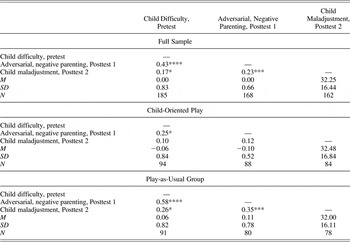
Descriptive data and intercorrelations are in Table 1. Overall, there was evidence of the anticipated and well-established cascade such that child difficulty (pretest) was significantly associated with maternal adversarial, negative parenting (Posttest 1), which was associated with child maladjustment (Posttest 2). Correlations for the two groups (child-oriented play or play as usual), however, suggested differential patterns. Whereas the correlation between child difficulty (pretest) and maternal negative parenting (Posttest 1) was large in magnitude for the play-as-usual group, it was only moderate in the child-oriented play group. Further, the association between maternal negative parenting and child maladjustment was significant and moderate in magnitude for the play-as-usual group, but not significant for the child-oriented play group. Thus, the patterns of associations were consistent with the possibility that group assignment may serve as a moderator of the cascade from child difficulty to maternal adversarial, negative parenting to child maladjustment.
Descriptive data and intercorrelations

*p < .05. ***p < .005. ****p < .001.
Traditional group comparison
We compared the groups to examine mean-level differences. The groups did not differ with regard to child difficulty at pretest, t (183) = –1.03, p = .30, which was expected given the random assignment of participants to the groups. However, despite randomization, the play-as-usual group had higher levels of maternal adversarial, negative parenting relative to child-oriented play group at pretest, t (183) = –2.86, p = .005. Consequently, maternal adversarial parenting at pretest was controlled in all analyses.
Maternal adversarial negative parenting at Posttest 1 was regressed on intervention group (1 = child-oriented play; 0 = play as usual, covarying maternal adversarial parenting at pretest). Child gender and pretest child inhibitory control were also entered as covariates. There were no differences between the groups with regard to mean levels of maternal adversarial, negative parenting at Posttest 1, attributable to the intervention, β = 0.01, t (163) = 0.15, p = .88. Finally, the groups did not differ with regard to child maladjustment at Posttest 2, β = 0.08, t (158) = 1.09, p = .28, controlling for gender and pretest child inhibitory control (no Early Childhood Inventory pretest scores were available, because many children were too young for this instrument).
Conditional process analysis
A conditional process model was tested (Hayes, Reference Hayes2013) using a bootstrap approach to estimate conditional indirect effects of child difficulty (predictor; pretest) on child maladjustment (outcome; Posttest 2) via maternal adversarial, negative parenting (mediator; Posttest 1) for the two groups (moderator; child-oriented play or play as usual). The score analogous to the mediator (maternal adversarial, negative parenting), obtained at pretest, was again included as a covariate in the model. This was a particularly strong control strategy given the robust correlation between the pretest and Posttest 1 scores, r (166) = .80, p < .001. Child gender and pretest child inhibitory control were also included as covariates.
Bootstrapping provides a sampling distribution of indirect effects to provide confidence intervals of estimates; if zero does not fall within the confidence interval, the indirect effect is present. A bootstrapping sampling method is preferential because (a) no assumptions need to be made about the shape of the sampling distribution, (b) power is maximized while minimizing Type I error rate, and (c) no particular formula for the standard error is required (MacKinnon, Lockwood, & Williams, Reference Mackinnon, Lockwood and Williams2004; Preacher, Rucker, & Hayes, Reference Preacher, Rucker and Hayes2007; Shrout & Bolger, Reference Shrout and Bolger2002). Data were analyzed with PROCESS, a computation tool for SPSS (Hayes, Reference Hayes2013). We performed a nonparametric resampling method (bias-corrected bootstrap) with 5,000 resamples drawn to derive the 95% confidence intervals for the conditional indirect effects.
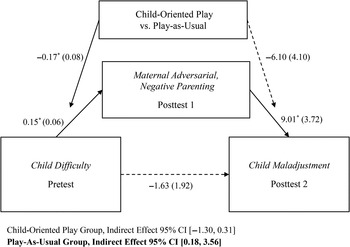
The results of the conditional process models are presented in Figure 1. As discussed by Preacher et al. (Reference Preacher, Rucker and Hayes2007), the conditional indirect effects (i.e., the value of the indirect effect conditioned on one or more values of a moderator) are the parameters of interest in the estimation of a moderated mediation model, and the bootstrap CI for the conditional indirect effects is the preferred inferential method.
Conceptual model including unstandardized parameter estimates of the primary tested paths. *p < .05. The indirect effect from child difficulty to maternal adversarial, negative parenting to child maladjustment was present for the play-as-usual group (in bold). Gender, pretest child inhibitory control, and pretest maternal adversarial, negative parenting were included as covariates in the model (not depicted).

The results were consistent with our expectations. For the child-oriented play group, the conditional indirect effect of child difficulty on child maladjustment via maternal adversarial, negative parenting was absent, as indicated by a bias-corrected bootstrap 95% confidence interval (CI) = (–1.30, 0.31). In contrast, for the play-as-usual group, the conditional indirect effect was present, 95% CI = (0.18, 3.56).
The conditional process analysis was conducted with the 162 mother–child dyads who provided data at all three assessments (pretest, Posttest 1, Posttest 2). Of note, when testing the exact same model using linear interpolation to address missing data, the pattern of results replicated. The conditional indirect effect was absent for the child-oriented play group, 95% CI = (–0.46, 1.29), but present for the play-as-usual group, 95% CI = (0.47, 3.72).
Probing significant interactions
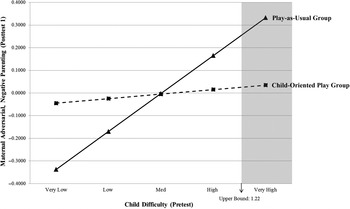
The results of the conditional process analysis revealed a significant interaction between group assignment (child-oriented play vs. play-as-usual) and child difficulty, assessed at pretest, predicting maternal adversarial, negative parenting at Posttest 1 (b = –0.17, SE = 0.08, p = .02; see Figure 1). Accordingly, we probed this significant interaction to better understand how the intervention interrupts the larger cascade. As depicted in Figure 2, the effect of child difficulty on maternal negative parenting was present for the play-as-usual group, 95% CI = (0.08, 0.33), but not for child-oriented play group, 95% CI = (–0.08, 0.13). The intervention appears to exert the greatest impact on the first link in the cascade by weakening the association between child difficulty and maternal adversarial, negative parenting at Posttest 1, controlling for gender, pretest child inhibitory control, and maternal adversarial, negative parenting at pretest.
Child difficulty at pretest interacts with group assignment to predict maternal adversarial, negative parenting at Posttest 1. The simple slope for the effect of child difficulty on maternal negative parenting was significant for the play-as-usual group, 95% confidence interval = (0.08, 0.33), but not the child-oriented play group, 95% confidence interval = (–0.08, 0.13). The shaded area represents the level of child difficulty scores at which there were significant group differences in maternal adversarial, negative parenting. Child gender, child inhibitory control at pretest, and maternal adversarial, negative parenting at pretest were covaried (not depicted); estimates are based on setting covariates to their sample means.

A regions of significance analysis in PROCESS (Hayes, Reference Hayes2013) allowed us to further probe the nature of this interaction, and identify under which conditions the two groups differed in their levels of maternal adversarial parenting at Posttest 1. The Johnson–Neyman technique revealed an upper bound of 1.22. Thus, the two regression lines (i.e., group assignment, child-oriented play vs. play-as-usual, predicting maternal adversarial, negative parenting at Posttest 1) were significantly different for all possible scores exceeding 1.22 for child difficulty. That score was equal to 1.47 SD above the mean level of child difficulty (M = 0.00, SD = 0.83). Thus, when interacting with children high in difficulty, the mothers in the play-as-usual group engaged in significantly more negative, adversarial parenting than did mothers in the child-oriented play group.
To summarize, our findings have three conceptual components. First, the overall cascade from child difficulty to maternal adversarial, negative parenting to child maladjustment (a significant indirect effect) occurred only in the play-as-usual group, as expected in those stressed families, but was defused, or absent, in the child-oriented play group, presumably as a result of the intervention. Second, the “defusion” of the cascade in the child-oriented play group was primarily due to the weakening of the first link (between child difficulty and maternal negative parenting). Third, consistent with traditional conceptualizations of treatment efficacy, focused on group differences at posttreatment, the results indicate that the intervention was effective for reducing maternal adversarial, negative parenting for a subset of mother–child dyads in which children were particularly difficult. Mothers of highly difficult children who were in the play-as-usual group engaged in significantly more adversarial, negative parenting than mothers in the child-oriented play group.
Discussion
This article implements a novel approach to parenting interventions, consistent with a recent growing emphasis on the need for an integration of developmental psychopathology with intervention science (Cicchetti & Hinshaw, Reference Cicchetti and Hinshaw2002; Cox et al., Reference Cox, Mills-Koonce, Propper and Gariépy2010; Masten & Cicchetti, Reference Masten and Cicchetti2010). That approach was rooted in the conceptualization of the mother–child relationship as a critical catalyst that can alter the extensively studied developmental cascade from child difficulty to maternal adversarial, negative parenting to future maladaptive child outcomes. That conceptual model has been supported in several longitudinal community samples (Kochanska et al., Reference Kochanska, Barry, Stellern and O'Bleness2009; Kochanska & Kim, Reference Kochanska and Kim2012). In those earlier studies, early attachment organization significantly moderated such cascade. We now present an initial translational application of that approach to a multimethod, multitrait randomized parenting intervention study.
We examined whether, for mother–toddler dyads, a 2- to 3-month experience of regular engagement in child-oriented play would defuse such maladaptive sequences. By contrast, we expected the maladaptive sequence to unfold over time in the control group (play-as-usual). Consequently, the focus was not on the potential mean-level differences in maternal behavior or child outcomes in the two groups (although those were tested), as traditionally examined, but on “hidden” effects of intervention as presumably enhancing, perhaps in subtle ways that are hard to measure, the quality of the mother–child relationship. We expected that the indirect effect from child difficulty to child maladjustment via maternal negative parenting would be present for the dyads in the play-as-usual (control) condition, but absent, or defused, for the dyads in the child-oriented play condition. We implemented PROCESS, a flexible moderated mediation tool (Hayes, Reference Hayes2013). The pattern of results was fully consistent with expectations.
Note that we are not claiming that the present approach ought to invalidate and replace traditional group analyses of intervention efficacy. We have previously successfully implemented the traditional approach (e.g., Brock, Kochanska, O'Hara, & Grekin, Reference Brock, Kochanska, O'Hara and Grekin2015; Kochanska et al., Reference Kochanska, Kim, Boldt and Nordling2013). Rather, we propose that the method illustrated in the present preliminary report has promise as a developmentally informed approach for identifying potential effects of a parenting intervention on dyadic processes linked to key outcomes. It not only elucidates dynamics of developmental processes that may be effectively altered but also allows for the examination of group differences in key variables within the cascade.
The recent parenting intervention literature includes many well-conducted studies that have produced patterns of results quite similar to ours: failing to find overall main effects between groups but revealing compelling differences in developmental processes that take place under different conditions (e.g., Blair, Reference Blair2002; Cassidy, Woodhouse, Sherman, Stupica, & Lejuez, Reference Cassidy, Woodhouse, Sherman, Stupica and Lejuez2011; Klein Velderman, Bakermans-Kranenburg, Juffer, & van IJzendoorn, Reference Klein Velderman, Bakermans-Kranenburg, Juffer and van IJzendoorn2006). Sitnick et al. (Reference Sitnick, Shaw, Gill, Dishion, Winter and Waller2015) found that treatment group assignment was only linked to child outcomes via certain mechanisms (i.e., positive engagement leading to coercion), but the group main effect was absent in univariate analyses. Thus, intervention effects may be underestimated, especially in the case of preventative parenting interventions; researchers, informed by developmental psychopathology, would be well advised to seek more subtle, or hidden, changes in developmental cascades.
A closer examination of the moderated mediation model points to the intervention exerting its primary influence at the first step of the cascade: from child difficulty to maternal negative parenting. In view of the overall findings that supported the presence of the indirect effect from child difficulty to child maladjustment in the play-as-usual group but not in the child-oriented play group, we believed that a follow-up examination of this specific portion of the cascade was warranted. Thus, we examined the different relations between child difficulty and maternal negative parenting in the two groups, as depicted in Figure 2. The simple slope for the effect of child difficulty on maternal negative parenting was significant for the play-as-usual group, but not for the child-oriented play group, suggesting that the intervention exerts its primary influence on the first link in the cascade.
Further, and consistent with a more traditional approach to conceptualizing intervention effects, group differences favoring the child-oriented play group were detected at Posttest 1, for a subset of the mother–child dyads. This finding was supported by the regions of significance analysis. That analysis revealed that mothers in the play-as-usual group displayed significantly more adversarial, negative parenting at Posttest 1 (controlling for pretest) than did mothers who had been randomly assigned to the child-oriented play group, when dealing with children who posed above-average difficulty. This finding is consistent with meta-analyses reporting that children exhibiting more problematic behavior at baseline (Shelleby & Shaw, Reference Shelleby and Shaw2014) and more distressed families (Nowak & Heinrichs, Reference Nowak and Heinrichs2008) may benefit most from parenting interventions. Attachment researchers have reported similar findings in interventions aimed at enhancing security, with the effects of the intervention found for the most difficult infants (Cassidy et al., Reference Cassidy, Woodhouse, Sherman, Stupica and Lejuez2011). Our results provide an extension of such findings to parental behavior. We suggest that parents of the most challenging and hard to manage children, those who might otherwise likely engage in highly coercive, negative parenting to deal with their difficult children, may benefit most from training in adaptive parenting practices and, more generally, from attempts to enhance their relationship with the child.
In the current study, we have presented a novel approach to examining intervention effects that accounts for group differences in maladaptive developmental cascades. The next step might be to elucidate specific mechanisms that alter developmental cascades (in this case, from child difficulty to maternal negative parenting to child maladjustment). For example, it may be productive to examine the specific ways in which a parenting intervention enhances the quality of the mother–child relationship (e.g., a more positive dyadic affective ambience, more positive mutual perceptions and expectations, improved mutual synchrony and positive reciprocity, and greater attachment security and a closer mother–child bond). Changes in the relationship may be difficult to detect and measure, particularly in prevention research with subclinical groups. This may require the development of more sensitive measures with the capacity to capture relatively subtle relational effects. We believe that such an approach may ultimately inform the science of relationships and developmental psychopathology.
The present study had several limitations that warrant caution when interpreting the findings. First and foremost, admittedly, the children in the two groups did not differ in terms of their overall maladjustment measure at the 6-month follow-up, even though we have demonstrated the hidden, subtle but significant, differences in the developmental process from child difficulty to maternal negative parenting to child maladjustment. Perhaps a period of 6 months was not sufficient for substantial and developmentally meaningful dynamics to unfold. Research in developmental psychopathology has amply demonstrated that qualities of early parent–child relationships often have complex implications for long-term, and not necessarily immediate, adaptation (Sroufe, Reference Sroufe2005). This may be particularly true in case of parenting interventions, which may exert a subtle and hard to detect impact on the relationship, but which may nevertheless alter, or begin to alter, developmental dynamics between the parent and child. In addition, such follow-ups may reveal long-term mean-level gains in maternal and child outcomes. Furthermore, and consistent with the cascade models (Masten & Cicchetti, Reference Masten and Cicchetti2010), child effects may become evident in other domains, which we did not measure (e.g., strengths and competencies, mastery, and cognitive gains).
Second, and related, although the sample included only low-income mothers and thus may be considered at risk, the children were not screened for elevated behavior problems. Consequently, their levels of difficulty and maladjustment were in the relatively typical range. Perhaps the findings would have been amplified with more troubled toddlers, and differences in children's outcomes may have been detected.
Third, the scope of our play-based intervention was relatively narrow. Perhaps effects would have been bolstered by the use of video feedback of the mothers’ and children's actual play, in addition to our verbal feedback and review of the play provided by staff members. Research demonstrates that video feedback interventions are effective for enhancing parenting skills and parental engagement during interactions with children (see review by Fukkink, Reference Fukkink2008). In addition, our intervention focused only on certain aspects of the mother–child interaction. Addressing other risk factors often present in low-income populations (e.g., maternal depression, poor child care resources, single parenthood or unstable/conflictual parent–parent relationships, neighborhood danger, and chaos) in a comprehensive manner may have bolstered the effects of child-oriented play and led to significant main effects of group assignment. Such a comprehensive approach, however, may have obscured the specific mechanisms that account for the intervention's impact.
Fourth, it is important to acknowledge the role of fathers as caregivers. Our study included only mother–child dyads. Although the findings are informative, the picture of potential effects is incomplete, because it does not address dysfunctional father–child dynamics.
Despite those limitations, this study contributes to the continuing rapprochement between developmental psychopathology and prevention and intervention science. It highlights subtle, hidden changes in the process of parenting evolving between the mother and child over time, and elucidates potential points of entry for future relationship-oriented interventions, particularly for parents of difficult, challenging children, who may need help the most.