1 Introduction
Throughout the paper, we assume that n is a positive integer. For a partition
${\lambda }$
 of n, let
$\text {SYT}({\lambda })$
 be the set of standard Young tableaux of shape
${\lambda }$
 . For nonnegative integers k and
$\ell $
 ,
$\mathcal {H}(k,\ell; n)$
 and
$\mathfrak {S}(k,\ell; n)$
 denote the set of partitions in a
$(k,\ell )$
 -hook and the set of standard Young tableaux in a
$(k,\ell )$
 -hook, respectively. Equivalently,

and

Regev [Reference Regev5–Reference Regev7] focused on the combinatorial and asymptotic properties of
$\mathfrak {S}(k,\ell; n)$
 . By studying different values of k and
$\ell $
 , Regev showed that larger hooks lead to more complex behaviours in combinatorial structures. We write
$\mathrm {S}(k,\ell; n)=|\mathfrak {S}(k,\ell; n)|$
 . We list the known numbers
$\mathrm {S}(k,\ell ;n)$
 . When
$\ell =0$
 , Regev [Reference Regev5] showed that

Gouyou-Beauchamps [Reference Gouyou-Beauchamps4] proved that

where
$C_n$
 is the nth Catalan number. When
$\ell =1$
 , Regev [Reference Regev6, Reference Regev7] derived

where
$R_n$
 is the nth Riordan number. Based on the results for
$\mathrm {S}(3,0;n)$
 and
$\mathrm {S}(2,1;n)$
 , Regev conjectured that these identities could be proven combinatorially.
A path is called a Motzkin path of length n if it is a path from
$(0,0)$
 to
$(n,0)$
 that stays weakly above the x-axis and consists of steps
$U=(1,1)$
 ,
$F=(1,0)$
 and
$D=(1,-1)$
 . Let
$\mathcal {M}_n$
 be the set of Motzkin paths of length n and let
$M_n=|\mathcal {M}_n|$
 be the nth Motzkin number. It is known that

so we have
$\mathrm {S}(3,0;n)=M_n$
 . Eu [Reference Eu3] proved this combinatorially.
Theorem 1.1 [Reference Eu3, Theorem 2.1]
There is a bijection between
$\mathfrak {S}(3,0;n)$
 and
$\mathcal {M}_n$
 .
If a Motzkin path is allowed to go below the x-axis, we call it a free Motzkin path. Let
$\mathcal {FM}_n$
 be the set of free Motzkin paths of length n and
$\mathcal {FM}^{D}_n$
 be the set of paths in
$\mathcal {FM}_n$
 whose last nonflat step is a down step if such a step exists. We denote by
$FM_n=|\mathcal {FM}_n|$
 and
$FM^{D}_n=|\mathcal {FM}^{D}_n|$
 . It is easy to check that

so we have
$\mathrm {S}(2,1;n)=FM^D_n$
 . Du and Yu [Reference Du and Yu1] gave the following result.
Theorem 1.2 [Reference Du and Yu1, Theorems 2.1 and 3.3]
There is a bijection between
$\mathfrak {S}(2,1;n)$
 and
$\mathcal {FM}^{D}_n$
 .
Let
$T_{\lambda }$
 be a standard Young tableau of shape
${\lambda }$
 . In [Reference Regev6], Regev introduced a restriction on
$\mathfrak {S}(k,\ell ;n)$
 regarding the parity of
$T_{\lambda }(1,2)$
 , defining

Regev [Reference Regev6, Conjecture 10.1] conjectured that
$\mathrm{S}_\mathrm{odd}(3,0;n)$
 is given by
$\mathrm {S}_{\mathrm {odd}}(3,0;n)=\mathrm {S}(3,0;n-1)-\, \mathrm { S}(3,0; n-3)=M_{n-1}-M_{n-3}$
 . This was proved by Ekhad and Zeilberger [Reference Ekhad and Zeilberger2] and Eu [Reference Eu3, Theorem 3.1] independently. Regev [Reference Regev6, Proposition 9.2] also found
$\mathrm {S}(2,1;n)=1+\mathrm {S}_{\mathrm {odd}}(2,1;n+1)$
 and asked for a combinatorial proof.
In this paper, we classify
$\mathfrak {S}(3,0;n)$
 and
$\mathfrak {S}(2,1;n)$
 according to the value of
$T_{\lambda }(1,2)$
 and extend this classification to other entries
$T_{\lambda }(i,j)$
 for some
$i,j\in \mathbb {N}$
 .
For positive integers i, j and m, let

By convention, we omit the superscript when
$(i,j)=(1,2)$
 , so
$\mathfrak {S}_m(k,\ell ;n)=\mathfrak {S}^{(1,2)}_m(k,\ell ;n)$
 and
$\mathrm { S}_m(k,\ell ;n)=\mathrm {S}^{(1,2)}_m(k,\ell ;n)$
 . Note that
$\mathrm {S}(k,\ell ;n)=\sum _{m\ge 2} \mathrm {S}_m(k,\ell ;n)$
 and
$\mathrm {S}_{\mathrm {odd}}(k,\ell ;n)=\sum _{m\ge 1} \mathrm {S}_{2m+1}(k,\ell ;n)$
 . In particular,
$\mathrm {S}_{\mathrm {odd}}(3,0;n)=\mathrm { S}_3(3,0;n)$
 since
$T_{\lambda } (1,2)\le 4$
 when
${\lambda } \in \mathcal {H}(3,0;n)$
 .
In Section 2, we provide a lattice path interpretation for
$\mathfrak {S}_m(3,0;n)$
 for
${m=2,3,4}$
 . Since the identity
$\mathrm { S}_3(3,0;n)=M_{n-1}-M_{n-3}$
 is already known, we enumerate
$\mathrm {S}_2(3,0;n)$
 and
$\mathrm {S}_4(3,0;n)$
 .
Theorem 1.3. We have
$\mathrm {S}_2(3,0;n)=M_n - M_{n-1}$
 and
$\mathrm {S}_4(3,0;n)=M_{n-3}$
 .
We also provide a lattice path interpretation for
$\mathfrak {S}_m(0,3;n)$
 and enumerate
$\mathrm {S}_m(0,3;n)$
 for small m. In Section 3, we provide a lattice path interpretation for
$\mathfrak {S}_m(2,1;n)$
 for all
$m\ge 2$
 using the bijection of Du and Yu [Reference Du and Yu1]. We compute
$\mathrm {S}_m(2,1;n)$
 as follows.
Theorem 1.4. We have
$\mathrm {S}_2(2,1;n)=FM^{D}_n-FM^{D}_{n-1}-FM^{D}_{n-2}$
 and
$\mathrm {S}_m(2,1;n)=FM^{D}_{n-m+2}-FM^{D}_{n-m}$
 for
$m\ge 3$
 .
From Theorem 1.4, we derive the following result, which gives an alternative proof that
$\mathrm {S}(2,1;n)=1+\mathrm {S}_{\mathrm {odd}}(2,1;n+1)$
 .
Corollary 1.5. We have
$\mathrm {S}_{\mathrm {odd}}(2,1;n)=FM^{D}_{n-1}-1$
 .
Similarly to Section 2, we provide a lattice path interpretation for
$\mathfrak {S}_m(1,2;n)$
 and enumerate
$\mathrm { S}_m(1,2;n)$
 for small m.
2 Classification of
$\mathfrak {S}(3,0;n)$


In this section, we present the classification results for
$\mathfrak {S}(3,0;n)$
 .
2.1 The bijection between
$\mathfrak {S}(3,0;n)$
and
$\mathcal {M}_n$


First, we summarise the bijection established by Eu [Reference Eu3] between
$\mathfrak {S}(3,0;n)$
 and
$\mathcal {M}_n$
 . Given a standard Young tableau T with n entries, the corresponding Yamanouchi word
$W=\chi (T)=w_1 w_2 \cdots w_n$
 is defined by
$w_j=i$
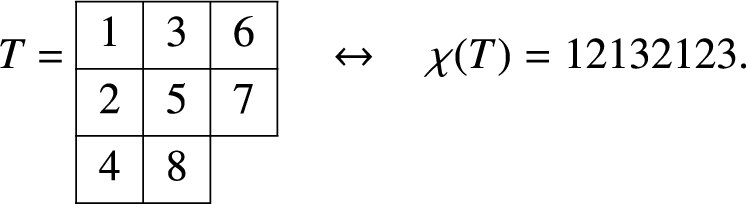
 when the entry of T labelled j is in the ith row. See Figure 1 for an example.
We define
$\mathcal {W}_3(n)=\{\chi (T) \mid T\in \mathfrak {S}(3,0;n)\}$
 , which consists of Yamanouchi words of length n over the alphabet
$\{1, 2, 3\}$
 . The bijection
$\xi $
 between
$\mathcal {W}_3(n)$
 and
$\mathcal {M}_n$
 is described below (we provide only the injective map; see [Reference Eu3, Section 2] for full details).
For a word
$W=w_1 w_2 \cdots w_n \in \mathcal {W}_3(n)$
 , the corresponding Motzkin path
$P=\xi (W)=P_1 P_2 \cdots P_n$
 satisfies the following conditions.
-
(1) If all letters of W are $1$
, then all steps of P are flat steps. -
(2) Otherwise, there exists an index j such that $w_i=1$
for all
$i<j$
and
$w_j=2$
. Let k be the smallest integer such that
$k>j$
and
$w_k=2$
or
$3$
.-
(a) If there is no such k, or if $w_k$
is
$2$
, set
$P_{j-1}=U$
and
$P_{j}=D$
. Create a new word
$W'$
by removing the letters
$w_{j-1}$
and
$w_j$
. -
(b) If $w_k$
is
$3$
, set
$P_{j-1}=U$
,
$P_j=F$
and
$P_k=D$
. Create a new word
$W'$
by removing the letters
$w_{j-1}$
,
$w_j$
and
$w_k$
.
-
-
(3) Repeat steps ( $1$
) and (
$2$
) until W is empty.


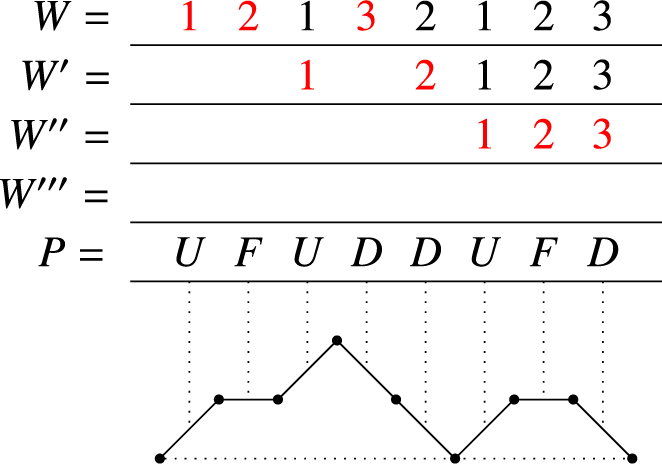
See Figure 2 for an example with
$W=w_1 w_2 w_3 w_4 w_5 w_6 w_7 w_8=12132123 \in \mathcal {W}_3(8)$
 . It follows from
$w_2=2$
 and
$w_4=3$
 that
$P_1=U$
 ,
$P_2=F$
 ,
$P_4=D$
 and
$W'=w_3 w_5 w_6 w_7 w_8 =12123$
 . In addition,
$w_5=2$
 and
$w_7=2$
 imply that
$P_3=U$
 ,
$P_5=D$
 and
$W"=w_6w_7w_8=123$
 . Finally, from
$w_7=2$
 and
$w_8=3$
 , we have
$P_6=U$
 ,
$P_7=F$
 ,
$P_8=D$
 and
$W"'=\emptyset $
 . The resulting path is
$P=\xi (W)=UFUDDUFD$
 .
A standard Young tableau T and the corresponding Yamanouchi word
$\chi (T)$
 .

A Yamanouchi word W and the corresponding Motzkin path
$P=\xi (W)$
 .

Figure 2 Long description
From top to bottom, this figure shows five rows. The first row shows the Yamanouchi word W, equals 1,2,1,3,2,1,2,3 with leftmost 1,2,3 in red. The second row shows W prime, equals 1,2,1,2,3 with leftmost 1,2 in red. The third row shows W double prime, equals 1,2,3 with 1,2,3 in red. The fourth row shows W triple prime, is blank. The fifth row shows the Motzkin path P, equals U,F,U,D,D,U,F,D.
In conclusion,
$\xi \circ \chi $
 is a bijection between
$\mathfrak {S}(3,0;n)$
 and
$\mathcal {M}_n$
 .
2.2 Results on
$\mathfrak {S}_m(3,0;n)$
and
$\mathfrak {S}_m(0,3;n)$


We now provide a path interpretation for
$\mathfrak {S}_m(3,0;n)$
 and
$\mathfrak {S}_m(0,3;n)$
 , and enumerate
$\mathrm {S}_m(3,0;n)$
 and
$\mathrm {S}_m(0,3;n)$
 . For nonnegative integers i and j, let
$\mathcal {M}(i,j;n)$
 be the set of lattice paths from
$(i,j)$
 to
$(n,0)$
 that stay weakly above the x-axis and consist of steps U, F and D. Note that
$\mathcal {M}(i,j;n)=\emptyset $
 when
$i+j>n$
 and
$|\mathcal {M}(i,0;n)|=M_{n-i}$
 for
$i \le n$
 .
Lemma 2.1. For nonnegative integers i and j, the cardinality of
$\mathcal {M}(i,j;n)$
 satisfies:
-
(i) $|\mathcal {M}(i,0;n)|=|\mathcal {M}(i+1,1;n)| + |\mathcal {M}(i+1,0;n)|$
for
$i\le n-1$
; -
(ii) $|\mathcal {M}(i,j;n)|=|\mathcal {M}(i+1,j+1;n)| + |\mathcal {M}(i+1,j;n)| + |\mathcal {M}(i+1,j-1;n)|$
for
$j\ge 1$
and
$i+j \le n-1$
.





Proof. (i) Let
$P=P_1P_2\cdots P_{n-i} \in \mathcal {M}(i,0;n)$
 . Since P never goes below the x-axis,
$P_1$
 must be either U or F. Thus,
$\tilde {P}=P_2\cdots P_{n-i}$
 belongs to
$\mathcal {M}(i+1,1;n)$
 if
$P_1=U$
 and to
$\mathcal {M}(i+1,0;n)$
 if
$P_1=F$
 .
(ii) Let
$P=P_1P_2 \cdots P_{n-i-j} \in \mathcal {M}(i,j;n)$
 . In this case,
$P_1$
 can be U, F or D. The remainder of the proof is analogous to the proof of item (i).
Using Lemma 2.1, we provide an alternative proof of the following proposition.
Proposition 2.2 [Reference Eu3, Proposition 3.2]
For integers i and j with
$0 \le j \le i$
 , the cardinality of
$\mathcal {M}(i,j;n)$
 can be expressed as a linear combination of Motzkin numbers. In particular:
-
(i) $|\mathcal {M}(i,1;n)|=M_{n-i+1}-M_{n-i}$
for
$i\ge 1$
; -
(ii) $|\mathcal {M}(i,2;n)|=M_{n-i+2}-2M_{n-i+1}$
for
$i \ge 2$
.


Proof. By Lemma 2.1(i),

Similarly, it follows from Lemma 2.1 that

Applying Lemma 2.1 repeatedly, we can express
$|\mathcal {M}(i,j;n)|$
 as a linear combination of Motzkin numbers.
Recall that Eu [Reference Eu3, Theorem 3.1] proved
$\mathrm {S}_3(3,0;n)=M_{n-1}-M_{n-3}$
 using the bijection in Section 2.1 and Proposition 2.2. Now, we give Motzkin path interpretations for
$\mathfrak {S}_2(3,0;n)$
 and
$\mathfrak {S}_4(3,0;n)$
 to prove Theorem 1.3.
Theorem 2.3. There is a bijection between the set
$\mathfrak {S}_2(3,0;n)$
 and the set of Motzkin paths of length n that start with
$FF$
 ,
$FU$
 or
$UU$
 . There is a bijection between the set
$\mathfrak {S}_4(3,0;n)$
 and the set of Motzkin paths of length n that start with
$UFD$
 .
Proof. For
$T \in \mathfrak {S}(3,0;n)$
 , let
$W=\chi (T)=w_1w_2\cdots w_n$
 and
$P=\xi (W)=P_1P_2 \cdots P_n$
 . When
$T \in \mathfrak {S}_2(3,0;n)$
 , W satisfies
$w_1=w_2=1$
 . Note that
$P_i$
 is either U or F when
$w_i=1$
 and
$P_1P_2$
 cannot be
$UF$
 according to the construction of
$\xi $
 . Therefore,
$P_1P_2$
 must be one of
$FF$
 ,
$FU$
 or
$UU$
 .
When
$T \in \mathfrak {S}_4(3,0;n)$
 , W satisfies
$w_1=1$
 ,
$w_2=2$
 ,
$w_3=3$
 and
$w_4=1$
 . Hence,
$P_1P_2P_3=UFD$
 according to condition (2b) for
$\xi $
 .
Proof of Theorem 1.3
Applying Proposition 2.2 and Theorem 2.3, we get
$\mathrm { S}_2(3,0;n)=|\mathcal {M}(2,0;n)|+|\mathcal {M}(2,1;n)|+|\mathcal {M}(2,2;n)|=M_{n-2}+(M_{n-1}-M_{n-2})+(M_n-2M_{n-1})=M_n-M_{n-1}$
 . Similarly, we have
$\mathrm {S}_4(3,0;n)=|\mathcal {M}(3,0;n)|=M_{n-3}$
 .
Note that
$\mathfrak {S}(k,\ell ;n)$
 and
$\mathfrak {S}(\ell ,k;n)$
 are in bijection because
${\lambda } \in \mathcal {H}(k,\ell ;n)$
 if and only if
${\lambda }' \in \mathcal {H}(\ell ,k;n)$
 , where
${\lambda }'$
 is the conjugate of
${\lambda }$
 . However,
$\mathfrak {S}_m(k,\ell ;n)$
 and
$\mathfrak {S}_m(\ell ,k;n)$
 are different, in general. From the conjugation of a partition, we observe that
$\mathfrak {S}^{(2,1)}_m(k,\ell ;n)$
 and
$\mathfrak {S}_m(\ell ,k;n)$
 are in bijection. Thus, we consider the set
$\mathfrak {S}^{(2,1)}_m(3,0;n)$
 instead of
$\mathfrak {S}_m(0,3;n)$
 .
Theorem 2.4. For an integer
$m\ge 2$
 , there is a bijection between the set
$\mathfrak {S}^{(2,1)}_m(3,0;n)$
 and the set of Motzkin paths of length n that start with
$F^i U^j D$
 or
$F^i U^j F$
 , where
$i\ge 0$
 ,
$j\ge 1$
 and
$i+j=m-1$
 .
Proof. For
$T \in \mathfrak {S}(3,0;n)$
 , let
$W=\chi (T)=w_1w_2\cdots w_n$
 and
$P=\xi (W)=P_1P_2 \cdots P_n$
 ;
$T \in \mathfrak {S}^{(2,1)}_m(3,0;n)$
 implies that
$w_i=1$
 for
$i=1,2,\ldots ,m-1$
 and
$w_m=2$
 . Similar to the proof of Theorem 2.3,
$w_i=1$
 for
$i=1,2,\ldots ,m-1$
 corresponds to
$P_1P_2\cdots P_{m-1}=F^iU^j$
 for
$i\ge 0$
 ,
$j\ge 1$
 and
$i+j=m-1$
 . In addition,
$w_m=2$
 implies that
$P_m$
 is D or F according to condition (2) for
$\xi $
 .
In Figure 3, we give an example of Theorem 2.4. Using Proposition 2.2 and Theorem 2.4, we derive the following corollary.
A standard Young tableau
$T\in \mathfrak {S}_4^{(2,1)}(3,0;8)$
 ,
$W=\chi (T)$
 and
$P=\xi (W)$
 .

Corollary 2.5. We have
$\mathrm {S}_2(0,3;n)=M_{n-1}$
 ,
$\mathrm {S}_3(0,3;n)=M_{n-1}-M_{n-3}$
 and
$\mathrm {S}_4(0,3;n)=M_{n-1}-M_{n-2}-M_{n-3}$
 .
Proof. Let
$T \in \mathfrak {S}(3,0;n)$
 and
$P=\xi \circ \chi (T)$
 . By Theorem 2.4,
$T \in \mathfrak {S}^{(2,1)}_2(3,0;n)$
 if and only if P starts with
$UD$
 or
$UF$
 . Thus,
$\mathrm { S}_2(0,3;n)=\mathrm {S}^{(2,1)}_2(3,0;n)=|\mathcal {M}(2,1;n)|+|\mathcal {M}(2,0;n)|= M_{n-1}$
 . Similarly,
$\mathrm {S}_3(0,3;n)=|\mathcal {M}(3,2;n)|+2|\mathcal {M}(3,1;n)|+|\mathcal {M}(3,0;n)|= M_{n-1}-M_{n-3}$
 and
$\mathrm {S}_4(0,3;n){\kern-1pt}={\kern-1pt}|\mathcal {M}(4,3;n)|{\kern-1pt}+{\kern-1pt}2|\mathcal {M}(4,2;n)|{\kern-1pt}+{\kern-1pt}2|\mathcal {M}(4,1;n)|{\kern-1pt}+{\kern-1pt}|\mathcal {M}(4,0;n)| = M_{n-1}-M_{n-2}-M_{n-3}$
 .
In a similar manner, we can enumerate
$\mathrm {S}_m(0,3;n)$
 for all positive integers m. However, these numbers do not seem to follow a regular pattern. For example, we computed that
$\mathrm {S}_5(0,3;n)= M_{n-1}-2M_{n-2}-M_{n-3}+2M_{n-4}$
 and
$\mathrm {S}_6(0,3;n)= M_{n-1}-3M_{n-2}+4M_{n-4}-M_{n-6}$
 . We hope that an explicit formula for
$\mathrm {S}_m(0,3;n)$
 can be discovered in future research.
3 Classification of
$\mathfrak {S}(2,1;n)$

In this section, we classify the set
$\mathfrak {S}(2,1;n)$
 .
3.1 The bijection between
$\mathfrak {S}(2,1;n)$
and
$\mathcal {FM}_n^D$


We summarise the bijection between
$\mathfrak {S}(2,1;n)$
 and
$\mathcal {FM}_n^D$
 , as presented in [Reference Du and Yu1, Sections 2 and 3]. Let
${W=w_1 w_2 \cdots w_n}$
 be a word of length n, where
$w_i \in \{0,1,2\}$
 for all
$i=1,2,\ldots ,n$
 , and let
$f_k(W)$
 denote the number of k’s in W for
$k=0,1,2$
 . We call W a tight
$012$
 -word of length n if:
-
(1) $f_0(w_1 w_2 \cdots w_j) \ge f_2(w_1 w_2 \cdots w_j)$
for all
$j=1,2,\ldots ,n$
; and -
(2) for each $j=1,2,\ldots ,n-1$
,
$f_0(w_1 w_2 \cdots w_j)> f_2(w_1 w_2 \cdots w_j)$
whenever
$w_{j+1}=1$
.


We denote by
$\mathfrak {W}_n$
 the set of all tight
$012$
 -words of length n and by
$\mathfrak {W}^{(2)}_n$
 the set of words in
$\mathfrak {W}_n$
 whose last nonzero number is
$2$
 if it exists.
We construct a map
$\phi $
 from
$\mathfrak {S}(2,1;n)$
 to
$\mathfrak {W}^{(2)}_n$
 . For
$T\in \mathfrak {S}(2,1;n)$
 , the corresponding word
$W=\phi (T)\in \mathfrak {W}^{(2)}_n$
 is constructed by the following rules.
-
(1) Let $A=\{a_1,a_2,\ldots ,a_{{\lambda }_1}\}$
be the set of entries in the first row of T and
${B=\{b_1,b_2,\ldots ,b_{n-{\lambda }_1}\}=[n]\setminus A}$
. -
(2) Set $w_{a_i}=0$
for all
$i=1,2,\ldots ,{\lambda }_1$
,
$w_{b_{n-{\lambda }_1}}=2$
and $$ \begin{align*}w_{b_i}= \begin{cases} 2 \quad \text{if } b_{i+1 } \text{ is in row } 2 \text{ of } T, \\ 1 \quad \text{otherwise}. \end{cases} \end{align*} $$


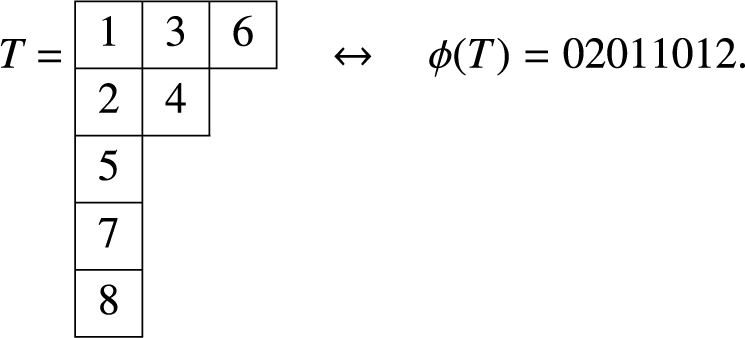
Du and Yu [Reference Du and Yu1] showed that
$\phi $
 is a bijection. Figure 4 illustrates a standard Young tableau
$T\in \mathfrak {S}(2,1;8)$
 and its corresponding tight
$012$
 -word
$\phi (T)\in \mathfrak {W}^{(2)}_8$
 .
Theorem 3.1 [Reference Du and Yu1, Theorem 2.1]
For any positive integer n, the map
$\phi $
 is a bijection between the sets
$\mathfrak {S}(2,1;n)$
 and
$\mathfrak {W}^{(2)}_n$
 such that, if
$T \in \mathfrak {S}(2,1;n)$
 has shape
$({\lambda }_1,{\lambda }_2,1^{n-{\lambda }_1 -{\lambda }_2})$
 , then
$W=\phi (T)\in \mathfrak {W}^{(2)}_n$
 satisfies
$f_0(W)={\lambda }_1$
 ,
$f_2(W)={\lambda }_2$
 and
${f_1(W)=n-{\lambda }_1 - {\lambda }_2}$
 .
Now, we describe the bijection
$\psi $
 between the sets
$\mathfrak {W}_n$
 and
$\mathcal {FM}_n$
 . Note that
$\psi $
 induces a bijection between
$\mathfrak {W}^{(2)}_n$
 and
$\mathcal {FM}^D_n$
 . (We only outline the injective map; for details, see [Reference Du and Yu1, Section 3].)
A standard Young tableau T and the corresponding tight
$012$
 -word
$\phi (T)$
 .

Let
$W=w_1 w_2 \cdots w_n \in \mathfrak {W}_n$
 . The corresponding free Motzkin path
$P=\psi (W)=P_1 P_2 \cdots P_n$
 is constructed by the following steps.
-
(1) If $w_n=0$
, set
$P_n=F$
and create a new word
$W'$
by removing
$w_n$
. -
(2) If $w_n=1$
, let
$w_j$
be the rightmost
$0$
such that
${f_0(w_j \cdots w_n)=f_2(w_j \cdots w_n)+1}$
. In this case, we set
$P_i=D,F,U$
when
$w_i=0,1,2$
, respectively, for
$i=j, j+1,\ldots ,n-1$
and
$P_n=U$
. Create a new word
$W'$
by removing the suffix
$w_j w_{j+1} \cdots w_n$
. -
(3) If $w_n=2$
, let
$w_j$
be the rightmost
$0$
such that
$f_0(w_j \cdots w_n)=f_2(w_j \cdots w_n)$
. In this case, we set
$P_i=U,F,D$
when
$w_i=0,1,2$
, respectively, for
$i=j,j+1,\ldots ,n$
. Similarly, we create a new word
$W'$
by removing the suffix
$w_j w_{j+1} \cdots w_n$
. -
(4) Repeat steps ( $1$
) to (
$3$
) until W is empty.





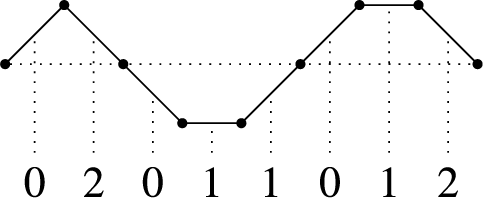
See Figure 5 for an example with
$W=02011012 \in \mathfrak {W}_8$
 . Since
$w_8=2$
 and
$f_0(012)=f_2(012)$
 , we have
$P_6=U$
 ,
$P_7=F$
 ,
$P_8=D$
 and
$W'=02011$
 . Now,
$w_5=1$
 and
$f_0(011)=f_2(011)+1$
 imply that
$P_3=D$
 ,
$P_4=F$
 ,
$P_5=U$
 and
$W"=02$
 . Finally, it follows from
$w_2=2$
 and
$f_0(02)=f_2(02)$
 that
$P_1=U$
 and
$P_2=D$
 .
A tight 012-word W and the corresponding free Motzkin path
$P=\psi (W)$
 .

Thus,
$\psi \circ \phi $
 establishes a bijection between
$\mathfrak {S}(2,1;n)$
 and
$\mathcal {FM}_n^D$
 .
3.2 Results on
$\mathfrak {S}_m(2,1;n)$
and
$\mathfrak {S}_m(1,2;n)$


Now, we give lattice path interpretations for
$\mathfrak {S}_m(2,1;n)$
 and
$\mathfrak {S}_m(1,2;n)$
 . For integers i and j with
$i \ge 0$
 , let
$\mathcal {F}(i,j;n)$
 be the set of paths from
$(i,j)$
 to
$(n,0)$
 consisting of steps U, F and D. Note that
$\mathcal {F}(i,j;n)=\emptyset $
 if
$i+|j|>n$
 and
$|\mathcal {F}(i,0;n)|=FM_{n-i}$
 for
$i \le n$
 .
Lemma 3.2. For integers i and j with
$i\ge 0$
 , the cardinality of
$\mathcal {F}(i,j;n)$
 satisfies

where
$i+|j| \le n-1$
 .
Proof. Let
$P=P_1P_2\cdots P_{n-i-j} \in \mathcal {F}(i,j;n)$
 and
$\tilde {P}=P_2P_3 \cdots P_{n-i-j}$
 . Since
$P_1$
 is either U, F or D, we have
$\tilde {P} \in \mathcal {F}(i+1,j+1;n)$
 if
$P_1=U$
 ,
$\tilde {P} \in \mathcal {F}(i+1,j;n)$
 if
$P_1=F$
 , and
$\tilde {P} \in \mathcal {F}(i+1,j-1;n)$
 if
$P_1=D$
 .
Proposition 3.3. For a nonnegative integer i:
-
(i) $|\mathcal {F}(i,1;n)|+|\mathcal {F}(i,0;n)|+|\mathcal {F}(i,-1;n)|=FM_{n-i+1}$
for
$i \le n-1$
; and -
(ii) $|\mathcal {F}(i,2;n)|+|\mathcal {F}(i,1;n)|+|\mathcal {F}(i,0;n)|+|\mathcal {F}(i,-1;n)|+|\mathcal {F}(i,-2;n)|$
$=FM_{n-i+2}-FM_{n-i+1}-FM_{n-i}$
for
$i \le n-2$
.


Proof. Setting
$j=0$
 in Lemma 3.2 gives

Similarly, setting
$j=1$
 and
$j=-1$
 in Lemma 3.2 gives

Applying item (i), we have
$|\mathcal {F}(i-1,1;n)|+|\mathcal {F}(i-1,-1;n)|=FM_{n-i+2}-FM_{n-i+1}$
 . Therefore,
${|\mathcal {F}(i{\kern-1pt}-{\kern-1pt}1,1;n)|{\kern-1pt}+{\kern-1pt}|\mathcal {F}(i{\kern-1pt}-{\kern-1pt}1,-1;n)|-|\mathcal {F}(i,0;n)|{\kern-1pt}={\kern-1pt}FM_{n-i+2}-FM_{n-i+1}-FM_{n-i}}$
 .
We divide
$\mathcal {F}(i,j;n)$
 into two subsets,
$\mathcal {F}^U(i,j;n)$
 and
$\mathcal {F}^D(i,j;n)$
 . Let
$\mathcal {F}^U(i,j;n)$
 (respectively
$\mathcal {F}^D(i,j;n)$
 ) be the set of paths in
$\mathcal {F}(i,j;n)$
 whose last nonflat step is U (respectively D) if it exists. Note that
$|\mathcal {F}^U(i,j;n)|=|\mathcal {F}^D(i,-j;n)|$
 for integers i, j and n with
$i,n\ge 0$
 .
Corollary 3.4. For nonnegative integers i and n:
-
(i) $|\mathcal {F}^D(i,1;n)|+|\mathcal {F}^D(i,0;n)|+|\mathcal {F}^D(i,-1;n)|=FM^D_{n-i+1}$
for
$i \le n-1$
; and -
(ii) $|\mathcal {F}^D(i,2;n)|+|\mathcal {F}^D(i,1;n)|+|\mathcal {F}^D(i,0;n)|+|\mathcal {F}^D(i,-1;n)|+|\mathcal {F}^D(i,-2;n)|$
$=FM^D_{n-i+2}-FM^D_{n-i+1}-FM^D_{n-i}$
for
$i \le n-2$
.


Proof. It is clear that
$|\mathcal {F}^U(i,1;n)|=|\mathcal {F}^D(i,-1;n)|$
 ,
$|\mathcal {F}^U(i,-1;n)|=|\mathcal {F}^D(i,1;n)|$
 and
$|\mathcal {F}^U(i,0;n)|=|\mathcal {F}^D(i,0;n)|=(FM_{n-i}+1)/2$
 . Therefore,

The proof of item (ii) is almost the same and we omit it.
Now, we give a free Motzkin path interpretation for
$\mathfrak {S}_m(2,1;n)$
 for all
$m \ge 2$
 and prove Theorem 1.4.
Theorem 3.5. There is a bijection between the set
$\mathfrak {S}_2(2,1;n)$
 and the set of paths in
$\mathcal {FM}^D_n$
 that start with
$UU$
 ,
$FU$
 ,
$FF$
 ,
$FD$
 or
$DD$
 . For
$m\ge 3$
 , there is a bijection between the set
$\mathfrak {S}_m(2,1;n)$
 and the set of paths in
$\mathcal {FM}^D_n$
 that start with
$UF^{m-2}U$
 ,
$DF^{m-3}UU$
 ,
$DF^{m-3}UF$
 ,
$DF^{m-3}UD$
 ,
$DF^{m-2}D$
 ,
$UF^{m-3}DU$
 ,
$UF^{m-3}DF$
 or
$UF^{m-3}DD$
 .
Proof. For
$T \in \mathfrak {S}(2,1;n)$
 , let
$w=\phi (T)=w_1w_2\cdots w_n$
 and
$P=\psi (w)=P_1P_2 \cdots P_n$
 . When
$T\in \mathfrak {S}_2(2,1;n)$
 , w satisfies
$w_1=w_2=0$
 . Note that
$0$
 in w corresponds to F at the x-axis, U above the x-axis and D below the x-axis in the corresponding path
$P=\psi (w)$
 . Thus, w satisfies
$w_1=w_2=0$
 if and only if P satisfies
$P_1P_2=UU,FU,FF,FD$
 or
$DD$
 .
Now, consider
$T\in \mathfrak {S}_m(2,1;n)$
 for
$m\ge 3$
 . From the construction of
$\phi $
 , the first m letters of w are
$01^{m-3}20$
 if
$T(2,2)=m+1$
 and
$01^{m-2}0$
 otherwise. Similarly, we note that
$1$
 in w corresponds to F except at the x-axis or U that ends at the x-axis, and
$2$
 in w corresponds to D above the x-axis or U below the x-axis that does not end at the x-axis. When
$w \in \mathfrak {W}_n$
 starts with
$01^{m-2}0$
 , P starts with
$UF^{m-2}U$
 ,
$DF^{m-3}UU$
 ,
$DF^{m-3}UF$
 ,
$DF^{m-3}UD$
 or
$DF^{m-2}D$
 . When
$w \in \mathfrak {W}_n$
 starts with
$01^{m-3}20$
 , the corresponding path P starts with
$UF^{m-3}DU$
 ,
$UF^{m-3}DF$
 or
$UF^{m-3}DD$
 .
For example, when
$T\in \mathfrak {S}_3(2,1;n)$
 in Figure 4, we can check that
$P=\psi \circ \phi (T)$
 starts with
$UDU$
 .
Proof of Theorem 1.4
It follows from Theorem 3.5 and Corollary 3.4 that

Similarly, for
$m\ge 3$
 ,

Similarly to Section 2, we consider the set
$\mathfrak {S}^{(2,1)}_m(2,1;n)$
 instead of
$\mathfrak {S}_m(1,2;n)$
 .
Lemma 3.6. For a positive integer
$m\ge 2$
 , there is a bijection between the set
$\mathfrak {S}^{(1,m)}_m(2,1;n)$
 and the set of paths in
$\mathcal {FM}^D_n$
 which start with
$F^m$
 ,
$F^i U^j$
 or
$F^i D^j$
 with
$i\ge 0$
 ,
$j> 0$
 and
$i+j=m$
 .
Proof. From the construction of
$\phi $
 , a standard Young tableau
$T\in \mathfrak {S}^{(1,m)}_m(2,1;n)$
 if and only if the corresponding tight
$012$
 -word
$w=\phi (T)$
 starts with m consecutive zeros. Recall that, for
$P=\psi (w)$
 ,
$0$
 in w corresponds to F at the x-axis, U above the x-axis and D below the x-axis. Hence, w starts with m consecutive zeros if and only if
$P=\psi (w)$
 starts with
$F^i U^j$
 or
$F^i D^j$
 with
$i>1$
 ,
$j\ge 0$
 and
$i+j=m$
 .
From Lemma 3.6, we get
$\mathrm {S}^{(1,m)}_m(2,1;n)=\sum _{i=-m}^{m} |\mathcal {F}^D(m,i,0)|$
 . We also have the following result using Corollary 3.4.
Corollary 3.7. We have
$\mathrm {S}^{(1,3)}_3(2,1;n)=FM^D_n - 2FM^D_{n-1} -FM^D_{n-2} +2FM^D_{n-3}$
 .
Proof. Putting
$m=3$
 in Lemma 3.6 gives
$\mathrm {S}^{(1,3)}_3(2,1;n)=\sum _{i=-3}^{3} |\mathcal {F}^D(3,i,0)|$
 . We first compute
$\sum _{i=-3}^{3} |\mathcal {F}(3,i,0)|$
 . By Lemma 3.2, it is clear that

for
$i=-2,-1,0,1,2$
 . Summing from
$i=-2$
 to
$2$
 ,

By Proposition 3.3,

Therefore,
$\sum _{i=-3}^{3} |\mathcal {F}(3,i,0)|=FM_n - 2FM_{n-1} -FM_{n-2} +2FM_{n-3}$
 . Similarly to Corollary 3.4,
$\sum _{i=-3}^{3} |\mathcal {F}^D(3,i,0)|=FM^D_n - 2FM^D_{n-1} -FM^D_{n-2} +2FM^D_{n-3}$
 .
Corollary 3.8. We have
$\mathrm {S}_2(1,2;n)=FM^D_{n-1}+FM^D_{n-2}$
 and
$\mathrm {S}_3(1,2;n)=FM^D_{n-1}-2FM^D_{n-3}$
 .
Proof. If
$T\in \mathfrak {S}_2^{(2,1)}(2,1;n)$
 , then
$T(1,2)\neq 2$
 . Therefore, by Theorem 1.4,

If
$T\in \mathfrak {S}_3^{(2,1)}(2,1;n)$
 , then
$T(1,2)=2$
 and
$T(1,3)\neq 3$
 . Therefore,

Similarly, we can enumerate
$\mathrm {S}_m(1,2;n)$
 for
$m\ge 4$
 , but the computation is more complicated. We hope that there is an explicit formula for
$\mathrm {S}_m(1,2;n)$
 for each m.
Acknowledgement
We thank the referees for careful reading and valuable comments.