Introduction
Over recent years, undergraduate medical education has been the subject of much debate and subsequent change. This has lead to expansion of the curriculum in some areas, but at the potential detriment of others, such as ENT surgery. Restructuring of the National Health Service (NHS), including centralisation of specialist services, has compounded the difficulty in giving students access to ENT surgical placements. Despite evidence to suggest that small increases in exposure to ENT surgery can significantly improve clinical ability,Reference Fisher and Pfleiderer1 recent studies have shown that exposure to ENT surgery at an undergraduate level is minimal.Reference Doshi and Carrie2–Reference Chawdhary, Ho and Minhas4
Ear, nose and throat surgery is the fourth largest surgical specialty.5 Within General Practice (GP), ENT complaints make up approximately one in six adult consultationsReference Donnelly, Quraishi and McShane6 and up to half of paediatric consultations.Reference Griffiths7 A 2002 Audit Commission report8 showed a threefold variation in referral rates by general practitioners to ENT surgery services. Unsurprisingly, 75 per cent of general practitioners would like further ENT training.Reference Clamp, Gunasekaran, Pothier and Saunders9 Furthermore, 75 per cent of accident and emergency department doctors felt that their undergraduate ENT experience was insufficient.Reference Sharma, Machen, Clarke and Howard10
Research shows that most medical students do not think their experience of ENT surgery is sufficient to allow an informed career choice.Reference Doshi and Carrie2 Recent changes in clinical training now require earlier career decisions. As postgraduate ENT experience is variable, undergraduate ENT experience may now be the main factor affecting junior doctors’ career decisions.
The objectives of the current study were: (1) to gather UK-wide data on undergraduate ENT surgery experience from medical graduates, (2) to assess postgraduate confidence in ENT surgery, (3) to assess the perceived value of different teaching and learning methodologies and media, and finally (4) to clarify whether graduates considered their undergraduate ENT experiences adequate to make valid career decisions.
Materials and methods
An online-based questionnaire was designed, in consultation with two practising consultant ENT surgeons, using the Survey Monkey online website (Appendix 1). The questionnaire asked 30 questions related to respondents’ undergraduate ENT experience and current opinions. A link to the questionnaire was then circulated anonymously to current Foundation Year One trainees.
To do this, an online search was carried out for NHS trusts around the UK. A total of 163 NHS trusts were identified and asked to take part in the survey, via a telephone conversation. An e-mail with a link to the online survey was subsequently cascaded to all Foundation Year One trainees within participating trusts, starting from 26 July 2010. The questionnaire was accessible online for an eight-week period after this date.
Results were downloaded from the website as an Excel file, and subsequently assessed using Minitab version 15.1 software. Statistical significance was identified using the Mann–Whitney U test; the level of significance was defined as p < 0.05.
Results and analysis
The questionnaire was received by all 155 trusts which following the telephone conversation agreed to take part, with no ‘bounce-backs’. Non-responding trusts were sent a reminder e-mail approximately four weeks after receiving the original e-mail. A total of 92 NHS trusts circulated the e-mail containing the questionnaire link, to a total of 3544 Foundation Year One trainees.
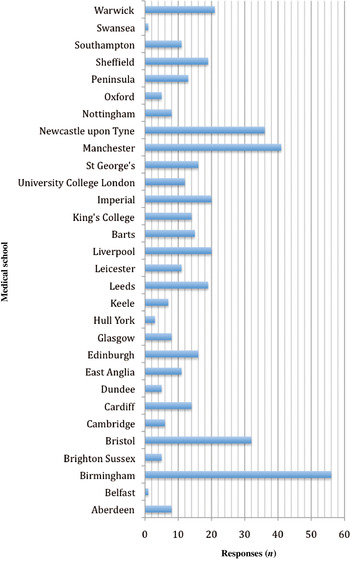
Of the 494 responses received, 444 were eligible for inclusion. Reasons for exclusion comprised graduating outside the UK and prior to 2010. Respondents had variously graduated from 30 UK medical schools (see Figure 1), and were working within 22 foundation schools.
Questionnaire response rates amongst graduates from different UK medical schools.

Undergraduate experience
Respondents’ mean duration of undergraduate ENT experience was 3.4 days pre-clinical teaching plus a further 5.0 days of departmental experience. This experience was combined with another specialty in 24.4 per cent (100/410) of cases. Within our cohort, 15.8 per cent (68/430) reported no formal departmental ENT experience at all, and 51.0 per cent (213/418) had examined less than 10 pairs of ears during their entire undergraduate training. A ‘student selected module’ in ENT surgery had been available to 66.0 per cent (276/418) of respondents but, despite this, 65.8 per cent (250/380) would have liked to have received further undergraduate ENT experience.
Teaching methods
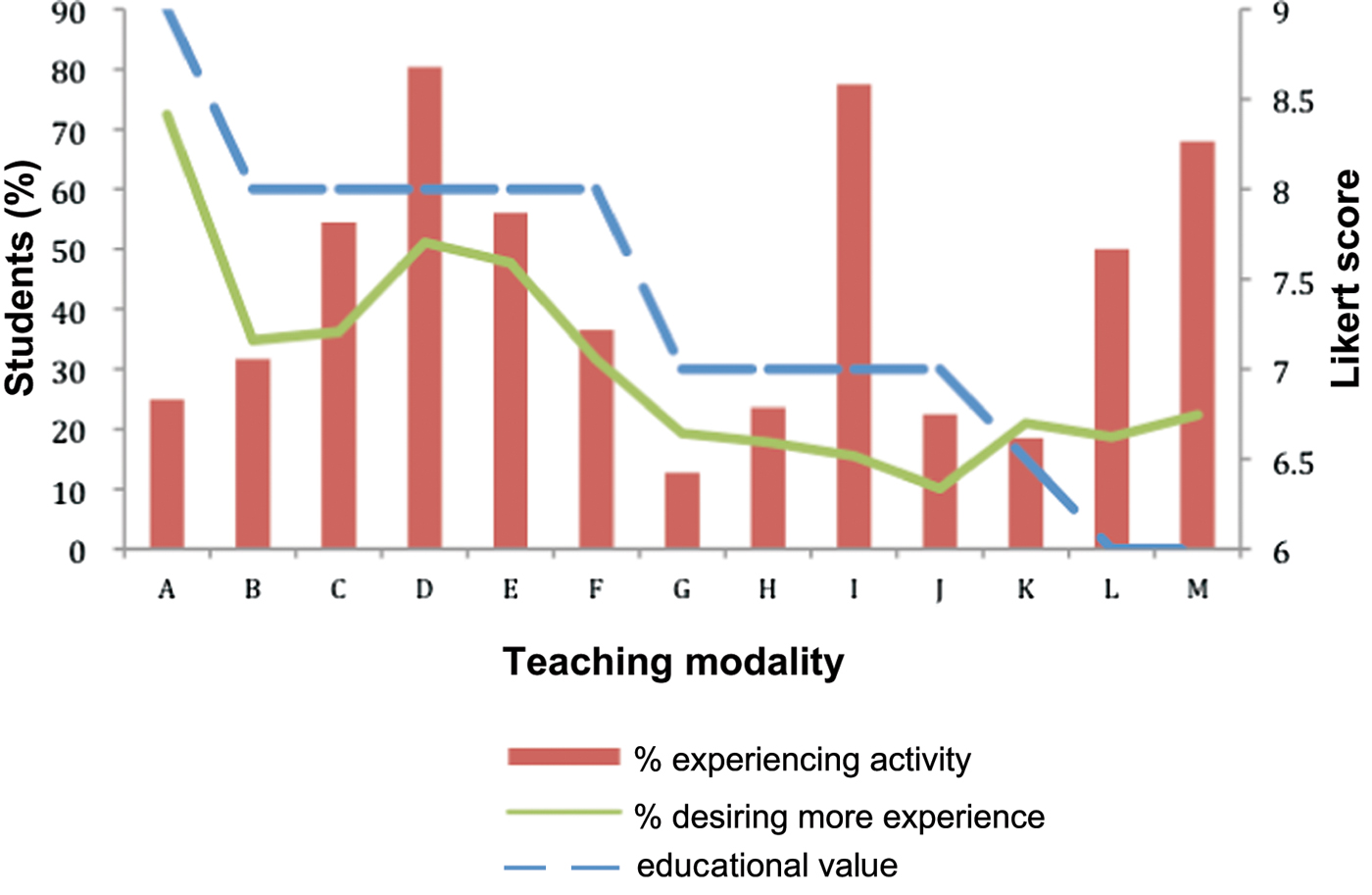
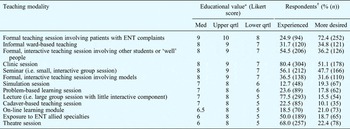
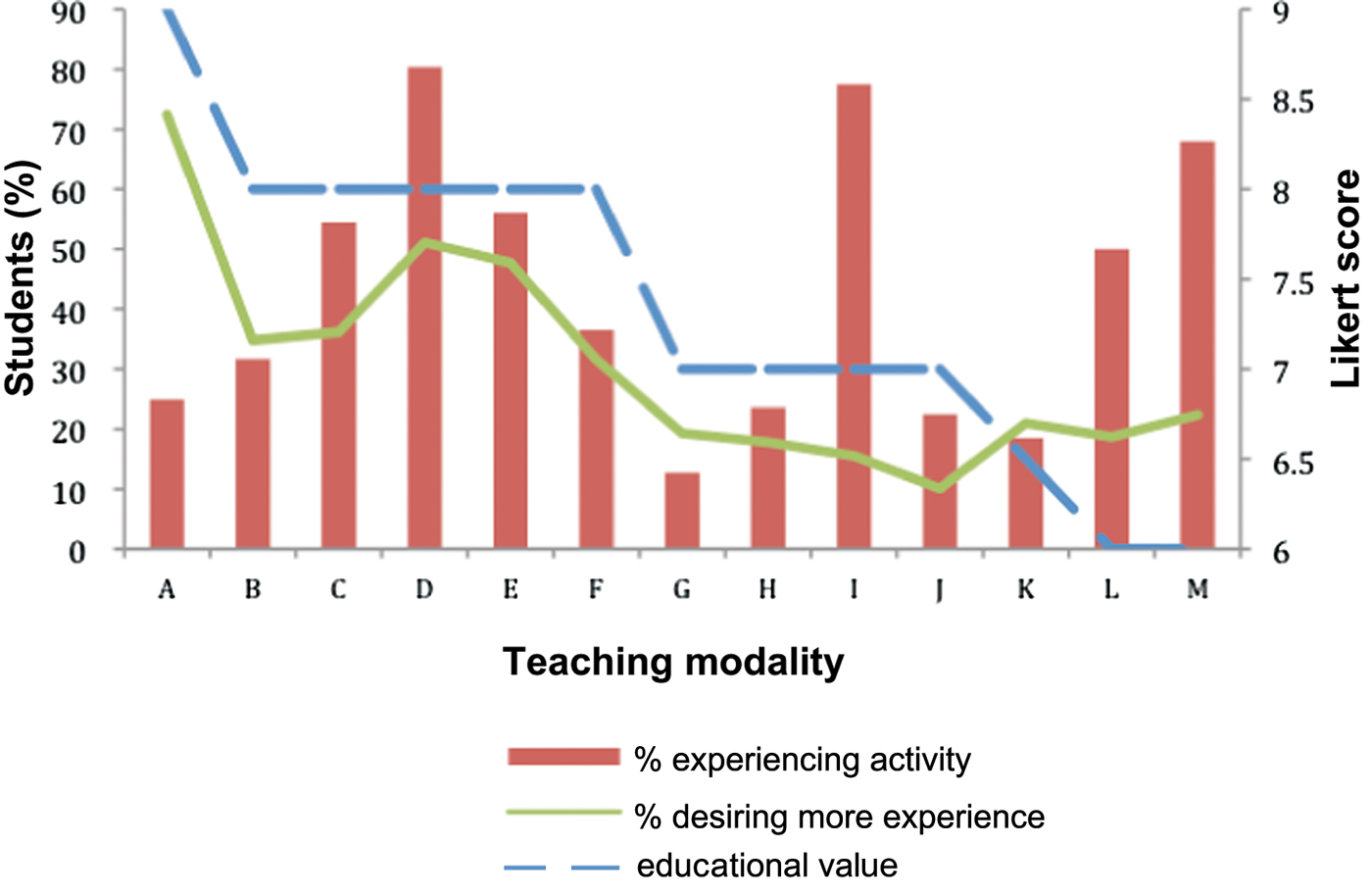
We compared the educational value of various teaching methods, using a Likert scale (1 = least educational value, 10 = most educational value). Variation was noted across teaching modalities (see Table I and Figure 2). While ENT clinics scored consistently highly for both clinical exposure and educational value, a large proportion of the activities with higher perceived educational value were offered less frequently, for example clinical teaching using patients with ENT conditions. In addition, there was a clear desire for more teaching in certain modalities, for example seminars, clinics, and teaching involving real ENT patients.
Proportion of respondents experiencing various undergraduate teaching modalities, and proportion desiring more such experience, together with self-reported educational value of teaching modalities (as median Likert score; 1 = low, 10 = high). A = formal teaching involving patients with ENT complaints; B = informal ward-based teaching; C = formal teaching involving other students or ‘well’ people; D = clinic session; E = seminar; F = formal interactive teaching involving models; G = simulation centre session; H = problem-based learning session; I = lecture; J = cadaver-based teaching session; K = online learning module; L = exposure to ENT allied specialties; M = theatre session
Results for undergraduate teaching modalities

*Assessed by self-reported Likert scoring (1 = low, 10 = high). †Respondents who reported experiencing, or desiring more experience of, each undergraduate teaching modality. Med = median; qrtl = quartile
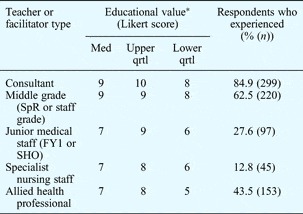
When comparing the type of person delivering teaching or supervision with the reported educational value of that teaching or supervision (see Table II), we observed that senior clinicians scored most highly and were reported to deliver the majority of teaching.
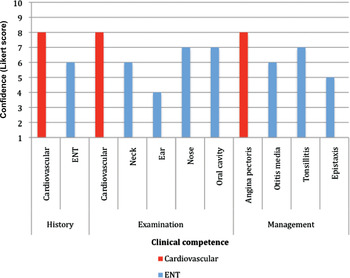
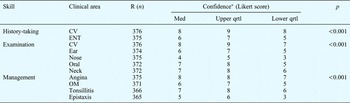
Respondents’ confidence in achieving clinical competencies (rated as median Likert scale scores; 1 = low, 10 = high), for ENT surgery and cardiovascular medicine.

Results for undergraduate teacher or facilitator types

*Assessed by self-reported Likert scoring (1 = low, 10 = high). Med = median; qrtl = quartile; SpR = specialist registrar; FY1 = Foundation Year One trainee; SHO = senior house officer
With respect to assessment, 30.2 per cent (264/378) and 37.9 per cent (234/377) of respondents respectively reported no formal undergraduate assessment of their ENT skills and knowledge.
Clinical confidence
Respondents’ confidence in their clinical competence was compared for ENT and cardiovascular medicine, a subject chosen due to its commonality in undergraduate curricula. A Likert scale was used for scoring (1 = no confidence, 10 = completely confident).
Respondents’ median confidence in history-taking was significant reduced for ENT surgery compared with cardiovascular medicine (p < 0.001). Their median confidence in performing examinations was also significantly reduced for ENT surgery, for all subsets (i.e. ear, nose, oral and neck), compared with cardiovascular medicine (p < 0.001). Finally, respondents’ median confidence in management was significantly lower for all ENT conditions cited (i.e. otitis media, tonsillitis and epistaxis), compared with angina pectoris (p < 0.001) (see Table III and Figure 3).
Respondents' clinical confidence: ENT vs cardiology

*Assessed by self-reported Likert scoring (1 = low, 10 = high). R = respondents; med = median; qrtl = quartile; CV = cardiovascular medicine; ENT = ENT surgery; OM = otitis media
Career choice
Finally, we asked respondents to indicate whether they felt they had received adequate experience and information with which to make an informed choice regarding ENT surgery as a career, using a Likert scale (1 = unable to make an informed choice, 10 = have completely adequate experience and information with which to make an informed choice). Respondents’ median Likert scale score was 5 (range 3–7, n = 363). Only 8.7 per cent (32/367) of respondents stated that they would consider ENT surgery as a career.
Discussion
To our knowledge, this is the first study to use self-reporting, by respondents recently graduated from multiple medical schools and employed in many different trusts, to assess ENT educational exposure, clinical confidence and career aspirations. The technique of self-reporting has previously been shown to be effective in the assessment of ENT experience at local NHS trusts and national medical schools level.Reference Doshi and Carrie2–Reference Chawdhary, Ho and Minhas4
We found that, on average, ENT surgical training made up only 8.4 days of UK undergraduate medical education, and that 15.8 per cent of the UK medical school graduates assessed had had no formal undergraduate experience of ENT surgery in a hospital setting. Many graduates also completed their undergraduate training with no formal assessment of ENT skills or knowledge. Previous studies have identified similar durations of UK undergraduate training in ENT surgery, namely 7.52 and 7.43 days.
This study indicated that new doctors felt significantly less confident in ENT history-taking, examination and management, compared with cardiology clinical competencies. Several large studies have shown that medical students’ self-reporting of their skills and knowledge is representative of their actual skills and knowledge, especially in their final year.Reference Blanch-Hartigan11, Reference Fitzgerald, White and Gruppen12 Therefore, we can assume that new graduates’ self-reporting of their clinical confidence is comparable to their actual ability. In additional, the present study generated useful information by asking respondents to compare their confidence with ENT versus cardiovascular clinical tasks.
In the face of many administrative and training challenges, we acknowledge that it would difficult to change current medical curricula to include a larger proportion of ENT surgery. However, it has been shown that a small undergraduate exposure to ENT surgery results in a large increase in skill and confidence as regards ENT management.Reference Fisher and Pfleiderer1 Our findings indicate that the majority of newly qualified UK doctors would like to have had more ENT experience at an undergraduate level.
Certain educational methods and providers were felt by respondents to provide the most educational value, for example consultant teaching using real ENT patients. The educational methods and providers perceived by respondents to be of greatest educational value were not generally the most commonly utilised ones, with the major exception of clinics. This is in agreement with other studies highlighting a desire for different teaching modalities within ENT surgery.Reference Chawdhary, Ho and Minhas4 We acknowledge that the educational modalities identified by our respondents as ideal may be more challenging to provide, compared with current practice. However, we suggest that prioritising such highly rated teaching modalities could result in an exponential increase in ENT surgical skill and knowledge post-graduation.
General practitioners’ ENT referral rates have been shown to vary, and this may be due to differences in ENT training.8 We propose that a targeted increase in undergraduate appreciation and awareness of simple ENT conditions and their management may also reduce the number of inappropriate general practice referrals.
In agreement with previous findings,Reference Doshi and Carrie2 the majority of our respondents felt they had received inadequate information with which to make a career choice, based on their undergraduate experience of ENT surgery. This may contribute to future problems with ENT surgery workforce planning, due to a lack of suitable applicants.
The current study included graduates from multiple medical schools across the UK, representing a good cross-section of UK medical graduates. We therefore believe that our findings are representative of the general views of UK medical graduates.
We ensured that our results were unbiased by input from non-UK graduates and those graduating before 2010, by the use of screening questions excluding such graduates.
• Although ENT disorders make up a large proportion of general practice, accident and emergency, and surgical workloads, the specialty is under-represented in UK undergraduate curricula
• In this online questionnaire of graduates from 30 UK medical schools, the mean undergraduate ENT exposure was 3.4 days of pre-clinical teaching plus 5.0 days of departmental experience; 15.8 per cent of respondents reported no formal ENT experience
• Most respondents (65.8 per cent) wanted more undergraduate ENT experience
• Respondents were less confident in ENT history-taking, examination and management, compared with cardiology equivalents
We acknowledge that our study design contained inescapable problems regarding recall bias, and that our response rate was relatively low.
However, given that our results are similar to previously published data, and that our final cohort was large enough to allow significance to be achieved in multiple areas, we believe that our findings are relevant and applicable throughout the UK.
Conclusion
This study identified weaknesses in current methods of UK undergraduate ENT surgical training, and highlighted potential repercussions of these weaknesses as regards postgraduate clinical skills and confidence. Thus, work is needed to improve undergraduate ENT education, if future graduates are not to be left with a knowledge gap in a key area of medical practice.
Appendix 1. Online questionnaire made available to cohort
Q1 Are you a FY1 trainee in your first year of training post-graduation?
– Yes
– No
Q2 Did you complete your training in 2010?
– Yes
– No
Q3 Did you graduate from a UK-based university?
– Yes
– No
Q4 Which medical school did you graduate from?
– Aberdeen
– Belfast
– Birmingham
– Brighton Sussex
– Bristol
– Cambridge
– Cardiff
– Dundee
– East Anglia
– Edinburgh
– Glasgow
– Hull York
– Keele
– Leeds
– Leicester
– Liverpool
– London: Barts
– London: King's College
– London: Imperial
– London: University College London
– London: St George's
– Manchester
– Newcastle upon Tyne
– Nottingham
– Oxford
– Peninsula
– Sheffield
– Southampton
– Swansea
– Warwick
5 What is the foundation school you currently work within?
– Coventry & Warwick
– East Anglia
– Leicestershire, Northamptonshire and Rutland
– Mersey
– North Central Thames
– North East Thames
– North West Thames
– North Western
– North Yorkshire & East Coast
– Northern
– Northern Ireland
– Oxford
– Peninsula
– Scotland
– Severn
– South Thames
– Staffordshire
– South Yorkshire
– Trent
– Wales
– Wessex
– West Midlands Central
– West Yorkshire
Q6 What is the NHS trust you currently work within?
– Airedale NHS Foundation Trust
– Aintree University Hospitals NHS Foundation Trust
– Alder Hey Children's NHS Foundation Trust
– Ashford and St Peter's Hospitals NHS Trust
– Barking, Havering and Redbridge University Hospitals NHS Trust
– Barnsley Hospital NHS Foundation Trust
– Bedford Hospital NHS Trust
– Basildon and Thurrock University Hospitals NHS Foundation Trust
– Bradford Teaching Hospitals NHS Foundation Trust
– Brighton and Sussex University Hospitals NHS Trust
– Basingstoke and North Hampshire NHS Foundation Trust
– Barnet and Chase Farm Hospitals NHS Trust
– Birmingham Children's Hospital NHS Foundation Trust
– Barts and The London NHS Trust
– Birmingham Women's NHS Foundation Trust
– Buckinghamshire Hospitals NHS Trust
– Burton Hospitals NHS Foundation Trust
– Blackpool, Fylde and Wyre Hospitals NHS Foundation Trust
– Colchester Hospital University NHS Foundation Trust
– Clatterbridge Centre For Oncology NHS Foundation Trust
– Chesterfield Royal Hospital NHS Foundation Trust
– Central Manchester University Hospitals NHS Foundation Trust
– Cambridgeshire Community Services NHS Trust
– Countess Of Chester Hospital NHS Foundation Trust
– City Hospitals Sunderland NHS Foundation Trust
– County Durham and Darlington NHS Foundation Trust
– Chelsea and Westminster Hospital NHS Foundation Trust
– Calderdale and Huddersfield NHS Foundation Trust
– Cambridge University Hospitals NHS Foundation Trust
– Dorset County Hospital NHS Foundation Trust
– Derby Hospitals NHS Foundation Trust
– Dartford and Gravesham NHS Trust
– Doncaster and Bassetlaw Hospitals NHS Foundation Trust
– Ealing Hospital NHS Trust
– East Lancashire Hospitals NHS Trust
– East Cheshire NHS Trust
– East Sussex Hospitals NHS Trust
– East Kent Hospitals University NHS Foundation Trust
– Epsom and St Helier University Hospitals NHS Trust
– East and North Hertfordshire NHS Trust
– Frimley Park Hospital NHS Foundation Trust
– George Eliot Hospital NHS Trust
– Gloucestershire Hospitals NHS Foundation Trust
– Guy's and St Thomas’ NHS Foundation Trust
– Great Ormond Street Hospital For Children NHS Trust
– Great Western Hospitals NHS Foundation Trust
– Gateshead Health NHS Foundation Trust
– Heatherwood and Wexham Park Hospitals NHS Foundation Trust
– Harrogate and District NHS Foundation Trust
– Hereford Hospitals NHS Trust
– Hull and East Yorkshire Hospitals NHS Trust
– Heart Of England NHS Foundation Trust
– Homerton University Hospital NHS Foundation Trust
– Hinchingbrooke Health Care NHS Trust
– Imperial College Healthcare NHS Trust
– Ipswich Hospital NHS Trust
– James Paget University Hospitals NHS Foundation Trust
– Kingston Hospital NHS Trust
– Kettering General Hospital NHS Foundation Trust
– King's College Hospital NHS Foundation Trust
– Liverpool Heart and Chest NHS Foundation Trust
– Lothian
– Luton and Dunstable Hospital NHS Foundation Trust
– Liverpool Women's NHS Foundation Trust
– Leeds Teaching Hospitals NHS Trust
– Lancashire Teaching Hospitals NHS Foundation Trust
– Mid Cheshire Hospitals NHS Foundation Trust
– Milton Keynes Hospital NHS Foundation Trust
– Mid Staffordshire NHS Foundation Trust
– Maidstone and Tunbridge Wells NHS Trust
– Moorfields Eye Hospital NHS Foundation Trust
– Mayday Healthcare NHS Trust
– Medway NHS Foundation Trust
– Mid Yorkshire Hospitals NHS Trust
– Mid Essex Hospital Services NHS Trust
– Northern Devon Healthcare NHS Trust
– North Middlesex University Hospital NHS Trust
– Newham University Hospital NHS Trust
– Norfolk and Norwich University Hospitals NHS Foundation Trust
– North Cumbria University Hospitals NHS Trust
– Nottingham University Hospitals NHS Trust
– Northampton General Hospital NHS Trust
– Northern Lincolnshire and Goole Hospitals NHS Foundation Trust
– North Tees and Hartlepool NHS Foundation Trust
– Northumbria Healthcare NHS Foundation Trust
– North West London Hospitals NHS Trust
– North Bristol NHS Trust
– Oxford Radcliffe Hospitals NHS Trust
– Poole Hospital NHS Foundation Trust
– Pennine Acute Hospitals NHS Trust
– Papworth Hospital NHS Foundation Trust
– Peterborough and Stamford Hospitals NHS Foundation Trust
– Portsmouth Hospitals NHS Trust
– Plymouth Hospitals NHS Trust
– Queen Victoria Hospital NHS Foundation Trust
– Royal United Hospital Bath NHS Trust
– Royal National Hospital For Rheumatic Diseases NHS Foundation Trust
– Royal National Orthopaedic Hospital NHS Trust
– Royal Cornwall Hospitals NHS Trust
– Royal Surrey County NHS Foundation Trust
– Royal Free Hampstead NHS Trust
– Royal Bolton Hospital NHS Foundation Trust
– Royal Liverpool and Broadgreen University Hospitals NHS Trust
– Royal Devon and Exeter NHS Foundation Trust
– Royal Berkshire NHS Foundation Trust
– Royal Brompton and Harefield NHS Foundation Trust
– Robert Jones and Agnes Hunt Orthopaedic and District Hospital NHS Trust
– St Helens and Knowsley Hospitals NHS Trust
– South Devon Healthcare NHS Foundation Trust
– South Downs Health NHS Trust
– Southend University Hospital NHS Foundation Trust
– South Tyneside NHS Foundation Trust
– Sheffield Children's NHS Foundation Trust
– Scarborough and North East Yorkshire Health Care NHS Trust
– South Tees Hospitals NHS Foundation Trust
– Surrey and Sussex Healthcare NHS Trust
– Stockport NHS Foundation Trust
– Salford Royal NHS Foundation Trust
– Southampton University Hospitals NHS Trust
– Southport and Ormskirk Hospital NHS Trust
– St George's Healthcare NHS Trust
– Salisbury NHS Foundation Trust
– Sheffield Teaching Hospitals NHS Foundation Trust
– South London Healthcare NHS Trust
– South Warwickshire NHS Foundation Trust
– Sherwood Forest Hospitals NHS Foundation Trust
– Shrewsbury and Telford Hospital NHS Trust
– Sandwell and West Birmingham Hospitals NHS Trust
– Taunton and Somerset NHS Foundation Trust
– Christie NHS Foundation Trust
– Hillingdon Hospital NHS Trust
– Rotherham NHS Foundation Trust
– Walton Centre NHS Foundation Trust
– Queen Elizabeth Hospital King's Lynn NHS Trust
– Royal Bournemouth and Christchurch Hospitals NHS Foundation Trust
– Royal Marsden NHS Foundation Trust
– Royal Orthopaedic Hospital NHS Foundation Trust
– Trafford Healthcare NHS Trust
– Royal Wolverhampton Hospitals NHS Trust
– Lewisham Hospital NHS Trust
– Princess Alexandra Hospital NHS Trust
– Newcastle Upon Tyne Hospitals NHS Foundation Trust
– Whittington Hospital NHS Trust
– Dudley Group Of Hospitals NHS Foundation Trust
– Tameside Hospital NHS Foundation Trust
– University Hospitals Bristol NHS Foundation Trust
– University College London Hospitals NHS Foundation Trust
– University Hospital Birmingham NHS Foundation Trust
– University Hospital Of North Staffordshire NHS Trust
– University Hospitals Coventry and Warwickshire NHS Trust
– University Hospital Of South Manchester NHS Foundation Trust
– United Lincolnshire Hospitals NHS Trust
– University Hospitals Of Leicester NHS Trust
– University Hospitals Of Morecambe Bay NHS Trust
– Weston Area Health NHS Trust
– Walsall Hospitals NHS Trust
– Wirral University Teaching Hospital NHS Foundation Trust
– Warrington and Halton Hospitals NHS Foundation Trust
– Wrightington, Wigan and Leigh NHS Foundation Trust
– West Suffolk Hospitals NHS Trust
– Worcestershire Acute Hospitals NHS Trust
– Whipps Cross University Hospital NHS Trust
– Winchester and Eastleigh Healthcare NHS Trust
– Western Sussex Hospitals NHS Trust
– West Middlesex University Hospital NHS Trust
– West Hertfordshire Hospitals NHS Trust
– Yeovil District Hospital NHS Foundation Trust
– York Hospitals NHS Foundation Trust
– Borders
– Fife
– Grampian
– Greater Glasgow and Clyde
– Highland
– Shetland
– Tayside University Hospitals NHS Trust
– Ayrshire and Arran
– Dumfries and Galloway
– Forth Valley
– Lanarkshire
– Orkney
– Western Isles
– Abertawe Bro Morgannwg University NHS Trust
– Velindre NHS Trust
– Cardiff and Vale NHS Trust
– Cwm Taf NHS Trust
– Hywel Dda NHS Trust
– Belfast Health and Social Care Trust
– Northern Health and Social Care Trust
– South Eastern Health and Social Care Trust
– Southern Health and Social Care Trust
– Western Health and Social Care Trust
– Other (please specify)
Q7 What is the length of time you spent in an ENT department as an undergraduate? (Answer rounded up to the nearest day.)
[Supplied answer options ranged from 0 to 30, plus ‘Other (please specify)’.]
Q8 Was this allocated (timetabled) time joint with another speciality?
– Yes
– No
Q9 Excluding time within an ENT department mentioned previously, what is the length of time you spent being taught about ENT as an undergraduate (i.e. lectures, skills sessions etc)? Answer rounded up to the nearest day. (e.g. One morning of lectures and an afternoon of clinical skills would equal one day.)
[Supplied answer options ranged from 0 to 30, plus ‘Other (please specify)’.]
Q10 How many times did you examine a set of ears using an otoscope during your core undergraduate training?
[Supplied answer options ranged from 0 to 10, plus ‘ > 10’.]
Q11 Was there the option of doing an ENT student selected component (SSC)?
– Yes
– No
– Don't know
Q12 Of the types of experience you participated in, please score the educational value of each. (This is its value towards your general medical knowledge for future practice, not specifically its value towards exams.) (1 = no educational value, 10 = fully educationally valuable)
[Supplied answer options ranged from 0 to 10, plus ‘N/A’.]
– Theatre session
– Clinic session
– Seminar (i.e. small, interactive group session)
– Lecture (i.e. large group session with little interactive component)
– Formal interactive teaching session involving models
– Formal interactive teaching session involving examining other students or ‘well’ people
– Formal teaching session involving patients with ENT complaints
– Simulation centre session
– Informal ward-based teaching
– Experience of ENT allied specialties (i.e. speech and language therapy, audiology)
– Online learning modules
– Problem-based learning session
– Cadaver-based teaching session
Q13 Based on the teaching you have received from different grades of staff, please score the educational value of the teaching. (1 = no educational value, 10 = great educational value)
[Supplied answer options ranged from 0 to 10, plus ‘N/A’.]
– Teaching by junior medical staff (FY1/SHO)
– Teaching by senior medical staff (SpR)
– Teaching by senior medical staff (consultant)
– Teaching by specialist nursing staff
– Teaching by allied health professionals (audiologists, speech and language therapists)
Q14 Would you like to have had more experience of ENT surgery as an undergraduate?
– Yes, more would be of benefit
– No, my experience was sufficient
Q15 What further undergraduate experiences do you feel would have been of most benefit to your education, regarding ENT surgery? Please tick as many as you like.
– Theatre session
– Clinic session
– Seminar (i.e. small, interactive group session)
– Lecture (i.e. large group session with little interactive component)
– Formal interactive teaching session involving models
– Formal interactive teaching session involving examining other students or ‘well’ people
– Formal teaching session involving patients with ENT complaints
– Simulation centre session
– Informal ward-based teaching
– Experience of ENT allied specialties (i.e. speech and language therapy, audiology)
– Online learning modules
– Problem-based learning sessions
– Cadaver-based teaching sessions
– Other (please specify)
Q16 Was there any formal assessment of your ENT surgery skills? (e.g. Using an otoscope or examining a neck)
– Yes
– No
Q17 Did you have any formal assessment of your ENT surgery knowledge?
– Yes
– No
Q18 How confident would you be in performing a cardiovascular examination on a patient and eliciting signs if present? (1 = no confidence, 10 = completely confident)
[Supplied answer options ranged from 0 to 10, plus ‘Confident’.]
Q19 How confident would you feel in taking a focussed cardiovascular history from a patient and eliciting the relevant information? (1 = no confidence, 10 = completely confident)
[Supplied answer options ranged from 0 to 10, plus ‘Confident’.]
Q20 You are the FY1 on call one evening and are called to see a patient who the nurses say is having chest pain. You correctly diagnose angina. How confident would you feel in managing this patient? (1 = no confidence, 10 = completely confident)
[Supplied answer options ranged from 0 to 10, plus ‘Confident’.]
Q21 How confident would you feel taking a focussed ENT history from a patient? (e.g. If someone had a discharging or painful ear) (1 = no confidence, 10 = completely confident)
[Supplied answer options ranged from 0 to 10, plus ‘Confident’.]
Q22 How confident would you feel examining a patient's ear, including use of an otoscope? (1 = no confidence, 10 = completely confident)
[Supplied answer options ranged from 0 to 10, plus ‘Confident’.]
Q23 How confident would you feel examining a patient's nose? This is using only basic equipment available. (e.g. If a patient had a suspected broken nose or nosebleed) (1 = no confidence, 10 = completely confident)
[Supplied answer options ranged from 0 to 10, plus ‘Confident’.]
Q24 How confident would you feel examining a patient's mouth and throat? This is using only basic equipment available. (e.g. If a patient had suspected tonsillitis) (1 = no confidence, 10 = completely confident)
[Supplied answer options ranged from 0 to 10, plus ‘Confident’.]
Q25 How confident would you feel examining a patient's neck from an ENT prospective? (e.g. A patient with a thyroid problem, or examining for lymph nodes in the neck) (1 = no confidence, 10 = completely confident)
[Supplied answer options ranged from 0 to 10, plus ‘Confident’.]
Q26 You are the medical house officer on call. You are called to see a patient who is about to be discharged. They are complaining of ear pain and discharge. You ask your SHO to review them as he used to work on ENT. He diagnoses otitis media but is called away and asks you to manage the problem. How confident would you feel managing a patient with otitis media? (1 = no confidence, 10 = completely confident)
[Supplied answer options ranged from 0 to 10, plus ‘Confident’.]
Q27 You are on a GP rotation in F2, sitting in with the practice nurse on your first day. An 8-year-old child comes in with a sore throat. The nurse tells you that she suspects tonsillitis and asks for your advice on management. Assuming the diagnosis is correct, how confident would you feel managing a patient with tonsillitis? (1 = no confidence, 10 = completely confident)
[Supplied answer options ranged from 0 to 10, plus ‘Confident’.]
Q28 You are on rotation in A&E and a patient comes in with a severe, spontaneous nose bleed. There was no trauma, and simple compression of the nose does not prevent the bleeding adequately. How confident would you feel managing a patient with epistaxis? (1 = no confidence, 10 = completely confident)
[Supplied answer options ranged from 0 to 10, plus ‘Confident’.]
Q29 On the scale below, please indicate whether you feel you have adequate experience and information to make an informed choice regarding ENT surgery as a career? (1 = am unable to make an informed choice, 10 = have completely adequate experience and information to make an informed choice)
[Supplied answer options ranged from 0 to 10, plus ‘Ability to make informed decision’.]
Q30 With your current ENT experience and knowledge, would you currently consider ENT as a career option?
– Yes
– No
– Undecided