American cities in the late nineteenth century were a mess: Trash was piled up to 16 feet high in Pittsburgh's yards; household waste and dead dogs littered New Orleans's streets; buzzards patrolled Charleston's market; and the City of St. Louis dumped its waste in the Mississippi River. “Heaps of garbage, rubbish and manure” that “cluttered alleys and streets, putrefied in open dumps, and tainted the watercourses into which refuse was thrown” were real problems for growing American cities.Footnote 1 Accumulating trash released vile odors, hindered travel, and—most importantly—fostered deadly disease outbreaks that killed thousands. When cities were smaller, householders themselves could burn their waste, send it off to farms to be consumed by pigs, or have scavengers collect it. As cities became larger and more concentrated, however, these private means of garbage removal became unworkable, and the issue of garbage became a public problem. How could cities innovate to respond to a growing menace? And would cities be able to develop capacity to collect and dispose of trash?
Garbage was both a technical and political challenge. As a technical problem, garbage required capacity to solve: Cities needed horses, carts, and drivers, while trash disposal required varying levels of expertise and infrastructure. Cities had to be sure that the garbage was picked up by reliable staff, placed into a cart in such a way that it prevented debris flying in the streets, transported to a disposal site, and then done again and again. Even “primitive” forms of disposal (such as dumping) required land, lime, and dump overseers on land or garbage boats, captains, and washing stations in the river. More advanced forms of disposal, like incineration or reduction (in which garbage was burned to create a sellable by-product, e.g., grease), required more specialized engineering knowledge, expensive infrastructure outlays, and workers to build and run the plant. Although sanitary engineers made recommendations about the “best” way to address the garbage problem, many cities ignored them. Instead, sanitary innovations were decided upon by political officials operating in political environments, and in the late nineteenth and early twentieth centuries, many (if not most) governments were corrupt. New policies and programs could disrupt an existing political order, or they could bolster it.Footnote 2 So, what innovations did late nineteenth-century cities adopt? In what ways were they able (or not) to build municipal capacity? And, more broadly, what is the relationship between corruption, innovation, and capacity?
In this article, we show how city corruption influenced municipal decisions about how to innovate as well as whether municipalities could actually develop capacity to carry out a citywide program. Although sanitary experts made recommendations about the best way to collect trash, the logic of corruption—not scientific expertise—determined municipal garbage strategies. Additionally, corruption sometimes promoted innovation and capacity and sometimes hindered it. Corrupt governments with business ties and business capacity were able to marshal these resources to better address the garbage problem. Nonetheless, these cities’ ability to maintain capacity varied. Even though American political development (APD) scholars often study the national government, especially during the Progressive Era and New Deal, we show that innovation and state capacity were vitally important at the local level, too.
Late nineteenth-century cities were miserable places by today's standards. Garbage was one of a number of difficult challenges—along with potable water, sewers, public parks, and paved and lighted streets—that municipal governments faced. Most cities at the time did not have the bureaucratic resources that we know are important to achieve results. Even though scholars often focus on reformers, as many as 70 percent of urban governments in the Gilded Age were corrupt.Footnote 3 Rather than identify development as the shift from local to national control, or from corrupt to reform regime, we studied cities as they were in this time period: ruled in part by formal democratic structures and in part by corrupt, informal systems of governance.
Even though corruption might be expected to undermine attempts to build capacity and successfully collect and dispose of trash, implying a comparison with “clean” government, Jessica Trounstine instead collapses the distinction and shows that both corrupt and reform governments were invested in securing long-term dominance through electoral and administrative entrenchment, “stacking the deck in [their] favor.”Footnote 4 Further, whereas literature on corruption in American government during the late nineteenth and early twentieth centuries often assumes a particular type of corruption (political machines), in this article, we look at different forms of corruption to ask how corruption in particular cities was better or worse for spurring innovation and building municipal capacity to collect waste. We examine different forms of corrupt regimes and the prevailing form of political leadership, and we compare corrupt cities to a shadow case of a reform city.
This article proceeds in four steps. First, we provide an overview of the literature on corruption. Second, we introduce the “garbage problem” faced by American cities in the 1890s, just before a nationwide trend in municipal garbage collection ordinances. Third, we chronicle the efforts of four large, corrupt cities: Pittsburgh, St. Louis, Charleston, and New Orleans. Like other municipalities at the time, all four had informal (corrupt) governing arrangements that ran alongside, or even integrated into, formal democratic structures. Corruption did not preclude adoption of innovative programs, however. In fact, when it benefited the regime, corruption could promote innovation, and when the regime could draw on the capacity of private industry, corruption promoted capacity, too. We identify each city's garbage collection program, paying particular attention to (a) how cities innovated, or the willingness and ability to invest in technologies and practices of the day to meet the growing garbage crisis, and (b) whether these innovations built capacity, which we look at through the longevity and the types of practices instituted in the 1890s. To assess the capacity of each respective garbage collection program, we identify the durability of garbage collection practices as reform regimes emerged in the early decades of the twentieth century. Fourth, we contrast the four corrupt cities with a case of a clean city—Columbus, Ohio—in the discussion.
1. State Capacity and Corruption in Urban Governments
Corruption is most often defined as the “misuse of public power for private gain,” but we favor V. O. Key's definition, “the abuse of control over the power and resources of government for the purpose of personal or party profit,” because it ties power to groups and parties, not just the individuals who are a part of them.Footnote 5 Corruption can be an informal governing system. James C. Scott explains: “Whereas party manifestos, general legislation, and policy declarations are the formal façade of the political structure, corruption stands in sharp contrast to these features as an informal political system in its own right.”Footnote 6 In short, while there are formal democratic governing structures in each of the cities we examine, there are also informal governing structures that follow a different logic in our four corrupt cities. Looking at both the formal and informal rules and procedures in place offers lessons for how corruption may promote or inhibit capacity.Footnote 7 Informal, corrupt governing structures are different in each city we examine. We ask how these different forms of corruption affect a city's ability to innovate and address a public problem, such as garbage, and its capacity to implement collection and disposal programs.
There is a rich and extensive literature on state and local corruption that examines the nation's nineteenth- and twentieth-century political machines. The well-told story is that urban political leaders catered to ethnic immigrants, providing them key social services (especially jobs) and integrating them into politics. In return, these grateful citizens voted for machine politicians.Footnote 8 Progressive Era reforms, New Deal policies, and assimilated immigrants signaled the demise of machines and the beginning of cleaner cities at the start of the twentieth century. Some scholars have criticized this story as an inaccurate representation of power, formal political structures, ethnic and racial politics, and the cleavage between machines and reformers, as well as its timing.Footnote 9
After the heyday of machine-politics studies in the 1960s into the 1970s, urban governments moved from a central part of the study of politics to the periphery. The dominant way to study politics was (and still is) to look at national or even, to a lesser degree, state-level governments. Scholars have given less attention to local governments, even though local governments are the main form of government in the United States, and some of the most well-known theories of contemporary politics like pluralism (e.g., Dahl, Wilson) and later political economy (e.g., Shefter, Peterson, Stone) were developed by studying cities.Footnote 10 For APD scholars, the lack of attention to local governments can be even more puzzling because local governments were both the most common form of American government throughout the nation's history and the most active, accounting for the majority of government expenditures and revenue at the turn of the century.Footnote 11
Recently, some APD scholars have been reconsidering the study of one type of local government, urban, showing how cities contribute to broader patterns of APD as well as showing how the concepts that APD scholars study apply to cities.Footnote 12 There are patterns specific to urban governments, such as the rise of cities in the nineteenth century, and characteristics of geographical representation (e.g., its diluting influence) that are uniquely urban.
Cities are not merely stepping stones to the development of the federal government. Instead, local governments provide the lion's share of services. As Ira Katznelson explains, “cities present a privileged viewpoint from which to ask fundamental questions, and deploy systematic historical and social science research and evidence to answer them.”Footnote 13 In short, cities are both an analytical category and a site of contestation over state capacity in their own right. In this way, municipal governments are ideal for answering our key question about the relationship between corruption, innovation, and capacity. Scholars know the many limitations of corruption on the development, capacity, and even stability of contemporary states, but can corruption foster innovation or state capacity?Footnote 14 If so, when and how?
2. Methodology
We began our study by collecting aggregate data on city sanitation for 114 cities from Charles Chapin's 900-page volume, Municipal Sanitation in the United States, and we analyzed these data. Visiting archives in three regions—the Northeast (Pittsburgh), West (San Francisco), and South (New Orleans)—however, illustrated their limitations. The aggregate data were factually correct but meaningless. For example, technically San Francisco had no municipal collection; nevertheless, the city's householders contracted individually with municipal scavengers to remove waste (as they do to this day with the successor of the same scavenger company). Descriptions of San Francisco paint it as comparatively clean. New Orleans, which technically had municipal collection, did not have public employees the way we had imagined; rather, the city used a system of day labor, paying widows for use of their carts to collect trash (evidence shows that the widows relied on black labor to actually pick up the garbage). Much of the time, garbage was not collected at all, and vivid descriptions suggest that New Orleans was a very foul place, even for the time. In short, the aggregate data do not accurately reflect how garbage was collected, and they cannot tell us why it was collected in that fashion.
We turned instead to the archives of seven cities, where we looked for the annual reports of city offices as well as any ledgers and correspondence available in each city.Footnote 15 We collected thousands of pages of municipal documents, supplementing the original research with newspaper accounts and secondary histories. Perhaps unsurprisingly, there were few competing municipal histories of second-tier cities like the ones we examined. Therefore, when weighing evidence, we placed the most emphasis on original documents, and we drew context and filled in gaps from our secondary sources. On the occasions where there were different accounts, we relied on those sources that could be triangulated with other forms of data (e.g., municipal records that support newspaper stories, or newspaper stories that corroborate secondary histories, or multiple histories drawing on a diverse set of records).Footnote 16
Here, we present detailed data on four cities scattered across the nation: Pittsburgh, Charleston, New Orleans, and St. Louis. All four cities were large, important, regional centers. Like most cities in America, all four experienced significant corruption at some point between 1890 and 1920. For analytical leverage, we contrast these four cities with a shadow case of progressive governance in Columbus. Like all cities, our four corrupt primary cases as well as our reform shadow case had to address the garbage problem.
3. Findings
We have two key findings. First, while scholars in many disciplines have examined why cities choose particular trash strategies and found that city density, regulations, rent seeking, and the actions of neighboring localities play a role,Footnote 17 detailed analysis in our four cities shows that corruption often determined municipal garbage strategies. Corrupt regimes chose garbage collection and disposal strategies that would, first and foremost, benefit themselves. But what benefited a particular corrupt regime varied depending on the type of corruption that dominated a city. In contrast to our progressive city (Columbus), which hired technical experts to design and build trash services, in all four corrupt cities, political actors chose solutions that would bolster their political or economic fortunes. The logic of corruption (what type of regime using what type of corrupt mechanism)—not factors associated with a city or with its garbage—is the single most important factor to explain why municipal governments chose particular garbage strategies. Different forms of corrupt regimes (machine, oligarchy, aristocracy, or ring) used different mechanisms (rigged contracts, boodle, nepotism, or patronage) to yield different forms of trash collection and disposal.
All five cities we studied had democratically elected governments. But the four corrupt cities were ruled by informal regimes, which changed the logic of what they did and why. While reform, democratic regimes were responsive to the electorate (often, however, disenfranchising voters who might foil their efforts), corrupt regimes were responsive to a different set of stakeholders.
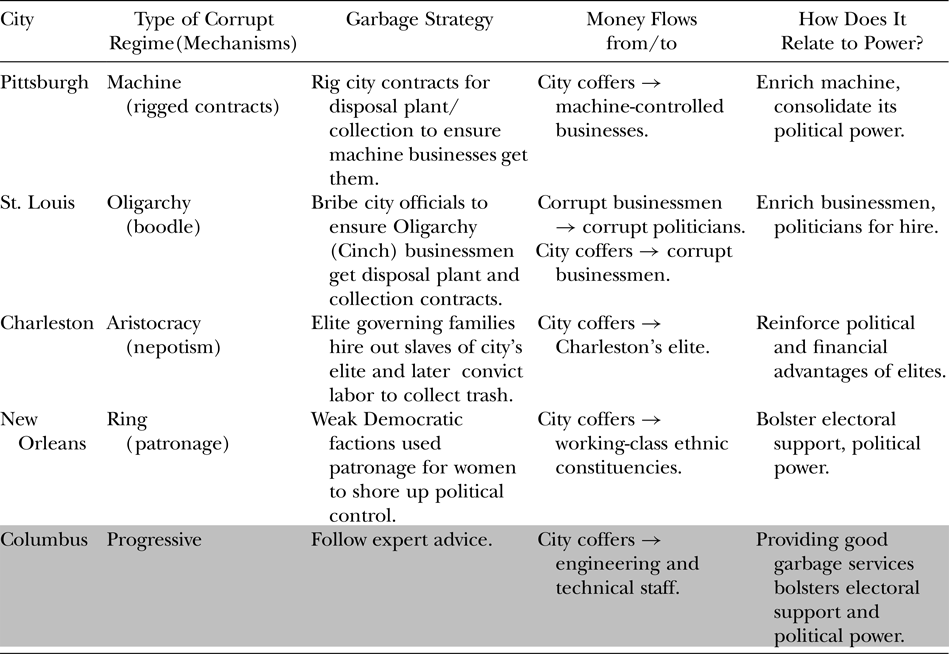
Table 1 summarizes the logic of corruption in the four corrupt cities and one reform city. It shows that Pittsburgh, St. Louis, and Columbus were able to innovate, but only Pittsburgh and Columbus were ultimately successful developing capacity in the long run. Pittsburgh, which was run by a political machine, used rigged contracts to provide trash collection and disposal services. Because the machine controlled city government and owned business entities, the machine rigged contracts to ensure that machine-controlled business entities would get them. Money flowed from city coffers to machine businesses, enhancing the machine's economic standing and consolidating its political power. St. Louis, by contrast, was run by an oligarchy of businessmen. The oligarchy was not integrated into government (like Pittsburgh's machine) and could not directly contract to itself. Instead, the oligarchy relied on extensive bribes as a bridge to elected political officials. Money, in the form of bribes, flowed from businessmen to political officials, and once they were awarded contracts, money flowed from city coffers to businessmen in the form of contracts for services. Businessmen grew wealthier, and political officials were easily replaced.
The Logic of Corruption Determined Municipal Garbage Strategies

Charleston was run by an aristocracy of sorts, and it relied on nepotism. City contracts went to the elite ruling families. Money flowed from city coffers to the city's elite, which reinforced the economic and political advantages of a few of the city's families. New Orleans, by contrast, was run by a ring, disconnected (and hostile) to business interests. The Ring used political patronage to shore up its political fortunes, distributing “jobs” to individuals identified by ward leaders. Money flowed from city coffers to key ethnic constituencies to keep the Ring in power.
Although each of these four cities were ruled by different forms of corrupt regimes, in every case corruption determined whether and how the city would collect and dispose of trash. And, although the cities chose different ways to address the garbage problem, in each case the solution bolstered the economic and political standing of the corrupt regime. By contrast, in our progressive city, Columbus, providing a good service (the logic of good governance through electoral incentives) determined how the city would act, in accordance with expert recommendations.
Our second finding is that although corruption sometimes promoted innovation and capacity, at other times, corruption hindered them. For better or worse, cities ruled by corruption gained the capacity that these informal regimes held.Footnote 18 Sometimes, these informal regimes were capable. Pittsburgh's machine and St. Louis's oligarchy both were composed of businessmen who invested heavily in innovative garbage disposal technology. The ability of these two cities to maintain capacity after reform, however, varied based on whether the corruption had been integrated (Pittsburgh) or not (St. Louis). At other times, corruption relied on informal regimes with few resources, hampering innovation. Charleston's aristocracy chose to stay the course while cities across the country were piloting new garbage programs, and Charleston was soon using antiquated technologies. The New Orleans Ring tried to innovate but utterly and completely failed, because the Ring had limited power and its precarious hold on the city relied on patronage to its supporters. The Ring could not get a disposal plant (as Pittsburgh and St. Louis did) off the ground.
In our study, three cities were able to innovate and develop capacity (one lost capacity, however). Perhaps unsurprisingly, progressive governments—like Columbus—could promote innovation and capacity. But corrupt regimes could promote innovation and capacity, too, when city governments had the incentive and informal regimes had the capacity to adequately provide the services that the formal city government could not. Innovations in garbage collection required investment. Regimes that had relationships with business interests used them as an informal resource (e.g., the Pittsburgh machine's rigged contracts and St. Louis Cinch's boodle) to provide public trash services. Regimes benefited from their relations with business interests, and businessmen in Pittsburgh and St. Louis both were capable of providing innovative trash collection and willing to make the investment. Corruption could incentivize new innovations, and city governments could “borrow” capacity from informal, corrupt regimes.Footnote 19 Nonetheless, the way in which formal and informal arrangements were constituted (integrated, nonintegrated) affected the cities’ ability to maintain capacity once the cities rid themselves of corruption.
But corrupt regimes do not always promote innovation and capacity. In New Orleans, the Ring actually rebuffed offers of help from the business community and civic organizations and chose, instead, to continue with its wholly inadequate sanitation practices, lacking adequate formal and informal resources. In Charleston, the aristocratic form of corruption encouraged city officials to stay the course, and they delayed trying something new for decades.Table 2 summarizes our results: the type of corrupt regime, innovations, and capacity in each of the five cities we examine.
A Summary of Cities, Corruption, Innovations, and Capacity

Our findings offer insight for scholars of APD, showing how corruption can take different forms, how these different forms may affect innovation and capacity, and, ultimately, how different instances of corruption lead to better or worse policy results. Our findings also highlight the relevance of APD to current contemporary corruption studies. By examining nineteenth-century garbage practices, we are able to overcome the large obstacles that often plague contemporary corruption research: an inability to compare across contexts and a lack of data.Footnote 20 There is plenty of evidence in America's own past to uncover broader lessons about the relationships among corruption, innovation, and capacity.Footnote 21
4. The Garbage Problem
Repeated outbreaks of contagious disease propelled the garbage problem onto the governmental agenda in the 1880s. Medical professionals urged cities to develop adequate water supply, sewers, and street cleaning, as well as garbage collection and disposal.Footnote 22 Although the federal government, public health associations, sanitary societies, and civic groups all expressed concern, local—often corrupt—actors ended up taking it on.
There was a brief flirtation with the National Bureau of Health in 1879 after a yellow fever epidemic the year before. Business interests (who already resisted quarantine) decried the bureau as “coercive and restrictive of trade,” and it was disbanded by 1883. The American Public Health Association (APHA), established in 1872, had greater longevity. The APHA did not have designs to control public health through national agencies, recognizing that the federal government's authority was limited to interstate commerce and health of the Army and Navy and could not compete with state police powers.Footnote 23 When the APHA turned its interest to garbage collection, it knew that the collection would take place at the municipal level, so it studied that.Footnote 24
In 1887 the APHA formed a committee on disposal that collected data about U.S. cities and issued its first reports in 1896 and 1897. The committee found that there was no single preferred method, as the best method depended on local conditions such as weather, funding, or political will.Footnote 25 The local refrain was repeated in sanitarians’ studies of garbage collection: The proper method for each city would require “preliminary investigations of conditions in each locality.”Footnote 26 Contrary to their intent, it turns out the condition that mattered most was the type of corruption and capacity of the informal regime.
Municipal Boards of Health were established in cities throughout the nineteenth century, often in response to disease epidemics.Footnote 27 With its busy port and experienced disease outbreaks, New Orleans had a Board of Health as early as 1804 and again in 1853, although it was “in name only.”Footnote 28 Charleston, too, saw an early institution of a Board of Health in 1815 because of its climate and port activity. The abatement of nuisances was historically exercised by towns’ selectmen, and the Board of Health was merely an extension.Footnote 29 As members of Boards of Health sought to use their authority, however, they ran into a lack of capacity to notify, inspect, punish breaches of law, and actually abate the nuisance. Despite the establishment of Boards of Health at the time of the wave of garbage ordinances, they were of limited use in picking up garbage.
Engineers were poised to take the lead by claiming technical expertise, and there was money to be made in innovation, whether it was a reduction plant, a watertight garbage can, or a covered garbage cart.Footnote 30 The first two decades of the twentieth century were an opportunity for “modernizers” to bring their expertise to municipal development.Footnote 31 In fact, there was so much opportunity that this period saw an “incinerator-building craze.”Footnote 32 Not all of these innovations were durable. They might be hastily constructed or soon retired. But the need to destroy waste, especially pertinent in cities in hotter climates, remained. There were also opportunities to profit from the by-products of incineration, which could possibly be used to heat buildings.Footnote 33 Innovative solutions to the garbage problem were available, if cities would invest in them.
Municipal reformers and civic organizations were prevalent in this period, but in our corrupt cities, they were largely pushed out of participation in garbage services. Pittsburgh's Ladies Protective Health Association petitioned for a municipal garbage collection system in 1892.Footnote 34 The city's ruling machine was not receptive to civic groups, however, so individuals and groups combined their oppositional efforts, forming the Civic Club of Allegheny County in 1895.Footnote 35 Charleston's Civic Club, a woman's organization with a keen interest in sanitation, was engaged but marginalized. From the sidelines, it urged the passage of a law that required that garbage cans be covered; organization of Clean-Up Day, a citywide effort to pick up litter and debris; and a program to place public garbage cans on sidewalks.Footnote 36 In New Orleans, the Auxiliary Sanitary Association (ASA) organized in 1879 as a group of “men trained in the severe school of business affairs to execute large undertakings with economy and dispatch.”Footnote 37 The ASA built capacity by purchasing scows for disposing of garbage into the river.Footnote 38 The organization's efforts were mocked by the local newspaper, and the city was reluctant to make use of its proffered services.Footnote 39 St. Louis's Civic League claimed credit for solving the garbage problem in 1909, but the problem persisted for decades. The league had a number of initiatives (like public garbage boxes) but seemed to actually accomplish little.Footnote 40
Progressives—sanitarians, engineers, civic organizations, and reformers—were eager to see improvement in cities, and they were largely responsible for developing the networks that led to a wave of municipal garbage ordinances across the country in the 1890s. In the four corrupt cities that we studied, however, these progressive organizations were just as likely to be on the outs with elected leaders. The data show vividly that although advances in hygiene and sciences offered some best practices, cities chose neither the solution that was most technically advanced nor the one that helped the most people. Instead, the logic of corruption determined the strategies each city adopted and the mechanisms they used. In this context, corruption proved to be an important resource of early American state capacity, motivating city officials to take action and directing the particular policy solutions they chose. However, not every corrupt city was equally successful creating and sustaining programs.
In the narratives that follow, we describe each city's response to the garbage problem, paying particular attention to the type of informal (corrupt) system and the (corrupt) mechanisms used in garbage collection and disposal. Corruption in cities was organized in different ways: Pittsburgh had a machine; St. Louis, an oligarchy of businessmen; Charleston, an aristocracy of sorts; and New Orleans, a ring. These different corrupt governing forms used specific and distinct corrupt mechanisms in garbage collection and disposal for political and financial gain. For example, Pittsburgh's machine employed a rigged contracting procedure to ensure that machine-controlled businesses would win city contracts, while the New Orleans Ring employed patronage, by hiring individuals (often widows) recommended by the city's influential ward bosses. We examine the impact that these informal governing systems had on the city's innovation and capacity to address a growing problem: trash.
5. Pittsburgh's Machine and Rigged Contracts: Innovation and Capacity Building
Like the other four cities we examined, trash was a problem in Pittsburgh. But city leaders had both the incentive and capacity do something about it. Pittsburgh was run by a machine, the perfect public-private partnership fully integrated into government. The machine saw the garbage problem similarly to how it saw street paving and other municipal improvements: as a way to enrich itself. The machine invested heavily in the latest garbage technologies, using a rigged contract to guarantee its investments would pay off. The city of Pittsburgh's capacity to collect and dispose of trash was built on the machine's capacity.
In Pittsburgh, city contracts were under the control of the Magee-Flinn political machine. As city treasurer, Christopher Magee controlled “utility and transportation franchises, the deposit of city funds, and the granting of construction contracts” and “developed a devoted following among the city's construction, banking, and traction magnates.”Footnote 41 In 1880 Magee joined with William Flinn, a street paving contractor and chairman of the Pittsburgh Republican party executive committee. The Magee-Flinn machine ruled Pittsburgh politics and government until the early twentieth century. The machine was entwined with the Pennsylvania Railroad, banks, and local businesses.Footnote 42
The machine's power lay not in patronage or in mass-based loyalty, but in appointment power. Magee and Flinn had been instrumental in changing the city charter in 1887, placing appointment power in city councils. The machine placed “cheap and dependable men” in city council positions, and its power was secured.Footnote 43 The Democratic Pittsburgh Post branded it the “Mageesburgh Charter” and proclaimed that Pittsburgh had been “given over to the boss.” The same Post article cited the Upperman bill, which authorized cities of the Second Class such as Pittsburgh to provide for improvement of streets, lanes, alleys, highways, sewers, and sidewalks, and required “plans” for streets.Footnote 44 For Magee and Flinn, the new charter and the Upperman bill “set the table for a veritable banquet of lucrative public works.”Footnote 45
Flinn was able to personally benefit through his arrangement with E. M. Bigelow, Director of the Department of Public Works, by capturing contracts for his street paving company, Booth & Flinn. This firm was so well entrenched that it was able to get Bigelow to draw up contracts that required that asphalt be sourced from a pitch lake in the Island of Trinidad, Booth & Flinn controlling that very pitch lake.Footnote 46
5.1. Rigged Contracts Bring Innovation in Pittsburgh's Garbage Disposal
City officials saw the garbage problem as another opportunity to consolidate power and enrich themselves. In 1895, the Pennsylvania Legislature passed an act to create Bureaus of Health in cities of the Second Class, empowering them to address conditions that imperiled public health, including garbage, rubbish, dead animals, privy waste, and tainted food. The director of the Department of Public Safety (under which the Bureau of Health was located) was authorized “to enter into a contract or contracts with such parties as may be found necessary, for the removal of all offal, garbage and swill from private premises and for the disposal of the same.”Footnote 47 In 1895, Charles Flinn, William Flinn's brother, was awarded the first contract of $93,890 per year for four years.Footnote 48 As president of the newly created American Reduction Company, Charles invested in an expensive reduction facility—an innovative method to extract reusable products from waste by drying out the garbage, placing the material in extractor tanks, and recovering grease—and Pittsburgh was a real model.Footnote 49 The certainty of obtaining the contract invited investment in the innovative technologies involved in the collection and disposal processes in the reduction process.
At first, officials were pleased: There were few complaints of offensive odors and officials reported satisfactory improvement.Footnote 50 William Flinn ordered materials from Cincinnati, the site of another reduction company.Footnote 51 The reduction plant produced good-quality grease, without excess water or impurities, and netted the company a $921 profit.Footnote 52 Flinn struck up deals with agents in New York City and Washington, DC, to contract for the construction and/or investment of new plants there.Footnote 53 He was even willing to secure the contract with Rochester “if I can get it in an ordinary business way at a fair price, I will be glad to take it.”Footnote 54
5.2. The Machine Develops Short- and Long-Term Capacity
Despite reports of early success, garbage collection was irregular and uneven.Footnote 55 Residents complained about the uncertainty of garbage and rubbish collections. Ashes and dirt not coming under rubbish were stored in unregulated barrels, and their removal depended on the owner or tenant. There was a lack of uniformity and inadequate supply of garbage pails. Filth notices, or orders to get garbage pails, were frequently given, but the department failed to prescribe standard receptacles for garbage. “The results are unfit and impossible to keep clean contrivances.”Footnote 56 Carts were not covered with canvas as required.Footnote 57 The weighing of cart loads was not supervised by a weighmaster, allowing garbage collectors to overcharge the city.Footnote 58 Even worse, the expensive American Reduction Company failed to live up to its promise: The quality of grease was uneven, few workers were employed at the plant, and those that were did not work full-time.Footnote 59 Public health officials reported that the dump did not have enough watchmen, and those employed were not uniformed. Neighboring residents complained of foul odors.Footnote 60 Residents on the hill across the river facing the reduction plant filed suit against the American Reduction Company, but the company, that is, Flinn, won, naturally.Footnote 61 The American Reduction Company continued to pick up city garbage.
After Magee's death in 1901, Flinn ousted the director of the Department of Public Works, Bigelow, in a political dispute. Bigelow rallied disempowered reformers, Democrats, and others to take back the government.Footnote 62 Reformers saw their opportunity. Despite the Pittsburgh councils’ hostility to reform, Mayor George “Guthrie's reform administration (1906–1909) closed 334 brothels, shut down gambling houses and pool rooms, enforced the liquor law, checked bunco games in hotels, stopped systematic grafting by police, and deprived pickpockets and other petty criminals of official protection. Pittsburgh had rarely had either a physician or a sanitarian as superintendent of the Bureau of Health, but Guthrie appointed Dr. James Edwards, who worked diligently to improve sanitary conditions in a number of areas, including housing and milk supply.”Footnote 63
The Guthrie administration reforms ran into the power of the old machine. When the administration sought to prosecute six public officials for tax fraud, the defendants were all acquitted. The mayor then secured the resignation of former the director of public safety, but within days, he secured a new position as mercantile appraiser. The newspaper announced, “Guns of the Flinn and Oliver factions in the Republican party were unmasked today—War has started.”Footnote 64
A 1910 mass meeting authorized a committee representing seventeen civic organizations to draw up a charter. Pittsburghers backed that charter with enthusiastic meetings and 15,000 petitioned to urge the Legislature to pass it unchanged. The Republican state machine cooperated with the reformers. By 1911, Pittsburgh had a nine-man council representing the whole city, in place of its easily corrupted councils with members representing various wards.Footnote 65
In September 1910 the city passed an ordinance raising the debt in order to acquire land for the erection and equipment of a municipal incinerating or refuse disposal plant, $100,000.Footnote 66 It still lacked the capacity to pick up the garbage, however, so in 1912 it awarded the garbage collection contract for the city of Pittsburgh, once again, to the American Reduction Co. for $185,700. Although annexed, Allegheny had its own contract, awarded to the Allegheny Garbage Company.Footnote 67 Despite being controlled by reform regimes, problems remained with garbage collection. City officials passed the blame to residents who failed to comply with instructions.Footnote 68
The American and Allegheny reduction companies continued to be the only available resource to collect and dispose of garbage, and they received garbage contracts through the triumph of the Democratic Party in the 1930s. The city and civic groups began looking into city control of garbage collection and the erection of a city-owned incinerator in 1933, appointing to the waste disposal committee a mixture of academics, medical experts, businessmen, and the sanitary engineer from the American Reduction Company.Footnote 69 Until that incinerator was built, the city needed to rely on the American Reduction Company and had to wrangle with it over company overcharging. American Reduction enjoyed a virtual monopoly over the city's contract until the end of the decade.Footnote 70 By 1940, the city had an incinerator and was ready to dispose of its garbage. But it did not have enough trucks to collect garbage, and the American Reduction Company “rescued” the city by renting out the company's trucks.Footnote 71 By the time the city ran its own trucks, drivers were “lined up for blocks” at the incinerator on overtime pay because of delays in unloading, as the city had purchased the wrong kind of trucks and had to unload “practically by hand.”Footnote 72
Pittsburgh's garbage collection was far from perfect. But the machine undertook public works projects; it invested in innovative technologies (reduction); and it built the city's capacity to provide sanitation. The Democratic regime's protracted efforts to muster resources point to the need to rely on the available capacity of the American Reduction Company, and it continued to receive the garbage collection contract long after regime change and political reform. It provided capacity until the new regime could do it on its own.Footnote 73 In Pittsburgh, corruption incentivized city leaders to innovate. The machine saw sanitary innovations as another way to enrich itself. Because the machine was fully integrated into city government, the machine's capacity to collect and dispose of trash was also the city's capacity.
6. St. Louis's Oligarchy and Boodle: Innovation and Capacity Lost
Whereas Pittsburgh's informal regime was neatly intertwined with formal democratic governance, in St. Louis they were separate. Power lay outside government in the hands of an oligarchy of sorts, wealthy businessmen and financiers known as the “Big Cinch.” These men “looked upon St. Louis as rightfully theirs to manage as they saw fit,”Footnote 74 and they grew rich by bribing local government officials to sell the rights to provide basic necessities such as heat, light, communications, and transportation. Cinch bribes incentivized city leaders to contract for innovative trash services, including a reduction facility. The City of St. Louis gained the capacity of Cinch businessmen, but unlike in Pittsburgh, this capacity was developed and laid entirely outside of government. While Pittsburgh was able to maintain long-term capacity, St. Louis developed the capacity to dispose of trash only to lose it in a fight to rid the city of corruption.
Existing outside and apart from government, the Cinch relied on a powerful conduit, Ed Butler, and a powerful motivator, boodle (or bribes). Butler was an Irish immigrant and blacksmith by training, but he made his fortune as a middleman between business interests and city legislators. Butler organized and systematized an informal system of combines in the Municipal Assembly, which “received and distributed bribes in exchange for the passage of legislation desired by businessmen.”Footnote 75 Members of the Assembly came to see the use of bribes as legitimate. As St. Louis developed, local utilities entrepreneurs and financiers, like Erastus Wells and John Scullin, sought Butler's help.Footnote 76 “‘I am no cheap man,’ he said years afterward, in describing the system that he built up there. ‘I require my fee and I get the results.’”Footnote 77
Butler was a “boodler,” not a boss of a political machine. He had little interest in elected office, and party did not concern him. Instead, he created an informal system of corruption that worked alongside the formal system of government. Because of boodle, the price of doing business in St. Louis was high. In the case of trash collection, it cost the city hundreds of thousands of dollars and eliminated its capacity to provide basic sanitation.
6.1. Boodle and Innovation in Garbage
Like the other three corrupt cities we discuss in depth, late nineteenth-century St. Louis was dirty. But unlike Pittsburgh, Charleston, or New Orleans, power resided purposively outside of government in the hands of a group of local businessmen who used boodle as the key mechanism of corruption for garbage collection and disposal.
In 1875, the City of St. Louis used scavenger dumps for disposing of slops, manure, and garbage in the Mississippi River, which would “take it away.”Footnote 78 Even though various city departments were involved in the administration of garbage, there were numerous complaints about the “sickening smell” pervading the entire neighborhood where the scavenger dump was located, and the city created a floating dump as an alternative.Footnote 79
In the first municipal election under a new charter in 1877, the mayoral-appointed Board of Health awarded Ed Butler's brother-in-law, James Hardy, the garbage collection contract, even though he was the highest bidder by seventeen thousand dollars.Footnote 80 When the St. Louis Post-Dispatch revealed that Butler himself was a silent partner, the House of Delegates voted to stop payment. Not to be outmaneuvered, the board raised the fee to bid on contracts to an amount that Hardy's competitors could not afford, and Hardy got the contract.Footnote 81
Disposal proved an even bigger challenge. Dumping was inexpensive but unsanitary, and the city's health and sanitation officials pushed for better solutions. The health commissioner noted that the existing methods of garbage disposal did not meet “the wants of our increased growth and advanced condition,”Footnote 82 while the harbor commissioner echoed the concern, noting that the garbage problem “demands the serious consideration of the city authorities.”Footnote 83
Serious consideration of garbage did not mean unbiased solutions. Instead, corruption in St. Louis determined how trash would be collected, by contract and benefiting the Cinch. Under Mayor Edward Noonan (1889–1893) and the two following administrations (Walbridge, Ziegenhein), garbage became a financial windfall for Butler and the Cinch. In 1890, the city authorized the mayor and health commissioner of St. Louis to enter into a contract for the sanitary disposal of slop, offal, garbage, and animal matter in the city by the Merz reduction process.Footnote 84 The first garbage disposal contract was awarded to the St. Louis Reduction Company, where the Cinch's John Scullin was president and Ed Butler was one of the contract sureties.
In 1893, the City of St. Louis contracted with Ed Butler for garbage collection “to remove all garbage, dead dogs, cats, rats and fowls from the streets, alleys, roads, courts, private places, private streets, court-yards, market houses, hotels, restaurants, tenement houses, private dwelling houses and public institutions within the limits of the city of St. Louis” twice a week in the fall and winter and three times a week in the warmer spring and summer months.Footnote 85 The contract was for five years at a total cost of $344,000.Footnote 86 The president of the St. Louis Reduction Company, John Scullin, as well as the president of the St. Louis Sanitary Company (the new reduction assignee), J. B. Clement, appeared as Butler's sureties.Footnote 87
The health commissioner praised the St. Louis Sanitary Company for the condition of the city: “Never within the history of the City, as far as remembered, has there been such a perfect condition of sanitary and healthful cleanliness.”Footnote 88 But official praise contrasts sharply with citizen complaints lodged about the irregular collection and messy streets. After detailed examination by the Health Department's sanitary officers, the notoriously corrupt Ziegenhein administration blamed citizens’ noncompliance rather than the contractor for garbage problems.Footnote 89 A report by the health commissioner concluded: “Considering all the circumstances, the removal of garbage by the contractor has been well done.”Footnote 90Garbage, though, was not done all that well, nor were other city franchises operating under similar boodling schemes. In a striking example of the effect boodling had on the city's service provision, during Ziegenhein's administration, the city's streetlights were turned off for two months because of a standstill in bribe negotiations spearheaded by Butler. With no streetlights, residents were “easy prey for men with revolvers and slingshots and crimes were committed nightly in every section of the city. The metropolis of Missouri, a city of one-half million people, was as dark as a country village at night.”Footnote 91 The inability to provide basic services lead to civic unrest, and “hundreds of men marched to the City Hall to demand the passage of the bills. The indignant citizens forced their way upon the floor of the House, after a scene in which revolvers and ropes were displayed.”Footnote 92
Butler's secure footing evaporated under reform mayor Rolla Wells (1901–1909), and garbage collection underwent a turbulent period riddled with corruption scandals and a power struggle between the city government and Butler. Public discontent with garbage collection—long a problem—burst into the open. Citizens put signs in their rotting refuse, which sat uncollected in bins on the street: “15 cents Reward for a Sight of Butler, Dead or Alive.”Footnote 93 Mayor Wells “made a special effort to wrest the business from Butler. For Wells it was a symbolic struggle. He saw himself ‘striking at one of the deep roots of municipal corruption,’ and ‘asserting the rights of the city over the privileges of the feudal political lord.’”Footnote 94 The St. Louis Cinch and Butler were extractive, taking as much as they could (in contrast to Pittsburgh's public-private machine, which had an incentive to develop capacity that it would benefit from).
In 1901, the St. Louis Sanitary Company (which Butler represented) contract was up, and the city had the option of purchasing the reduction plant.Footnote 95 The City Council's Committee on Sanitary Affairs reported, however, “there is not an official in City Hall who has the knowledge or from whom reliable information” on the value of the plant, the cost of operating the plant, and the value of the residual products (e.g., grease or fertilizer) produced can be obtained.Footnote 96
When the Health Commission requested bids for garbage disposal in 1901, the St. Louis Sanitary Company submitted the only proposal at $130,000 a year for three years, twice what it had previously contracted for. Butler was materially invested in the outcome of the contract. The Sanitary Company agreed to pay Butler's Excelsior Hauling $45,000 as well as $17,000 for each of the three years of the contract if it were awarded to the Sanitary Company. Butler went to the homes of two of the physicians on the mayoral-appointed board, saying: “I would like to come to you, Doctor, and make you a present of $2,500 if you will vote for our company to get this contract.”Footnote 97 The Sanitary Company got the contract.
On April 5, 1902, Ed Butler was indicted on bribery charges. He was convicted and sentenced to three years in prison. In 1903, the charges were reversed on a technicality:Footnote 98 The tribunal ruled that garbage removal was not related to public health but to public works. The Board of Health had no right to contract for garbage removal, and therefore, it was not bribery to offer money. Indeed, the mayor signed the ordinance giving the Board of Health power to award garbage removal contracts a few hours after Butler gave the doctor money.Footnote 99 President Teddy Roosevelt called the decision “an outrage” and the judges “recreant to the cause of decent government.”Footnote 100 The Butler trials for bribery garnered a lot of public attention, making visible the ways in which boodlers operated and how corruption was affecting services for citizens.
6.2. Lost Capacity
Corruption in St. Louis not only determined how garbage would be collected, but it also determined the city's capacity for collection and disposal. By contracting to Butler and the Sanitary Company, the city had capacity (albeit weak) to collect and dispose of trash. Mayor Wells tried to disentangle the city from Butler and still retain the capacity to collect and dispose of trash. In the end, when St. Louis chose to rid itself of Butler, it also rid itself of essential capacity.
St. Louis paid an inflated price for Butler's hauling equipment and took over trash collection, using “the city's own forces.”Footnote 101 Although the health commissioner called out the “noticeable improvement,” the “burning question” was what the city would do about disposal.Footnote 102 Mayor Wells, on principle, would not contract with the St. Louis Sanitary Company. The city sent a committee to other large cities to investigate their practices and determined that city-owned incineration would be the best solution. But St. Louis did not have enough time to execute a plan, and it scrambled to figure out what to do when the Sanitary Company's contract was up.
In 1904, the nation's fourth largest city embarked on the “most striking departure from the manner of disposing of a city's garbage ever inaugurated in any city of the West.”Footnote 103 To undermine Butler and the Sanitary Company, Mayor Wells quietly bought Chesley Island in the Mississippi River. St. Louis would load barges with refuse, take them out to Chesley Island, and feed the city's waste to thousands of hogs. The St. Louis Republic was jubilant, with a front page that read: “President of the Board of Public Improvement Finds a Way to Dispose of Refuse at Less than Half the Amount Paid the Butlers, Which Was $356 a Day—May Even Rival Treasure Island—Scheme is Meeting With Success.”Footnote 104 Although the Wells administration improved disposal by removing the source of corruption, it reverted to a mode of disposal referred to—even at the time—as “primitive.”
The hogs were meant to be only temporary until the city made plans for its garbage incinerators, but the animals were employed on and off at least until 1910, as St. Louis lacked the capacity to do better. Despite attempts to contract with other disposal facilities, St. Louis officials reverted back to dumping all garbage on Chesley Island, which was soon “a foot deep with garbage” and “covered with lime.”Footnote 105 St. Louis came full circle as it returned to dumping trash in the Mississippi River, which it had done in the 1870s before Butler became involved.Footnote 106
Corruption in St. Louis was pervasive, and it distributed resources among a wealthy group of individuals. Butler connected elite businessmen to officials willing to sell their position: $250,000 for a railway franchise, $85,000 for a lighting deal, and two $2,500 bribes for a garbage contract worth nearly $200,000.Footnote 107 Cinch businessmen who used Butler's services inflated the cost of contracts and enriched themselves. John Scullin's Sanitary Company doubled the cost of doing business with the City of St. Louis in 1901 and paid Butler's Hauling Company a handsome sum ($45,000 down plus $17,000 a year). In the words of the prosecution at Butler's corruption trial, Butler and the Sanitary Company “throttled the city of St. Louis and robbed it of $195,000 and proceeded to divide the plunder.”Footnote 108 Historians believe that during the Wells (1901–1909) and Kreismann (1909–1913) administrations, good government prevailed.Footnote 109 But the Big Cinch returned again during three-term mayor Henry Kiel's administration (1913–1925).Footnote 110
The residents of St. Louis paid the price: They had increased costs of public services, the city was unable to reinvest money that lined politicians’ pockets into other essential services (like street paving), and ultimately, St. Louis lost the capacity to dispose of trash. The city struggled for decades to redevelop the capacity to dispose of its own trash by reduction. At times, it appeared that St. Louis would have to stop collection entirely, having no place to deposit the trash. Even though Mayor Henry Kiel campaigned on creating a reduction facility, he never delivered.Footnote 111 The St. Louis Post-Dispatch was critical, calling the delay “a legacy from the old House of Delegates, which used to hold up garbage legislation in the interest of the late Ed Butler, who, in this way, used to obtain the contract at his own terms.”Footnote 112 And, in 1930:
the city has gone on, year after year, making these hog-feeding contracts without any real effort to find a permanent solution… Another five-year contract has just been signed. The $80,000 garbage disposal plant built by a former city administration at the foot of Chouteau avenue stands boarded up, although it might be possible… to save part of the original investment… Now people on both sides of the Mississippi River have gone to court. The city stands a chance of finding itself with 70,000 tons of garbage a year and no place to go. St. Louis stands where it stood fifty years ago. There are thousands of dollars tied up in unused trucks… Every summer wooden, open-top wagons reek through the streets. Collection and disposal both are inadequate… The waste alone under the present system ought to pay for any new outlay.Footnote 113
St. Louis's oligarchic Cinch bribed city officials to obtain rights to provide essential services, including garbage. Cinch businessmen built an innovative reduction facility and had the capacity to provide garbage collection and disposal services. However, in an effort to rid the city of corruption, the reform mayor also ironically rid it of capacity to collect and dispose of trash. Well into the 1940s, the city still relied on selling more than half of its garbage to hog farms, and the remainder was ground at the disposal plant and dumped into the Mississippi River.Footnote 114
7. Charleston's Aristocracy and Nepotism: Delayed Innovation and Failed Capacity
Unlike the Pittsburgh machine or St. Louis Cinch, which wasted no time getting rich off the latest garbage innovations, Charleston's aristocracy rested on its laurels, continuing to collect and dispose of trash as it had for decades. When it finally did try novel disposal techniques, it failed miserably. Charleston's aristocratic planter elite enjoyed the profits of the slave-based planter economy, and they ruled the city, dominating elected and appointed positions through nepotism or the “bestowal of patronage by reason of ascriptive relationship rather than merit.”Footnote 115 Charleston's municipal services—including garbage collection practices—mirrored the broader class and racial cleavages.
In the 1850s garbage collection directly benefited the upper classes, and the governing arrangements served their interests. Prominent slave-owning families, including government officials and family members of government officials, rented out their slaves to the city. Superintendents of streets and inspectors for the Street Department during this period came from some of the leading families, such as Chisolm, Pinckney Clement, and Seignious.Footnote 116 Contracts were awarded to family members or those from the inner circle.
The aristocracy's power, which had been built on the subjugation and exploitation of slaves, was disrupted by the Civil War and Reconstruction. During the national wave of garbage ordinances in the 1890s, elite interests worked to reestablish themselves; they held the mayoralty and served in a host of city offices.Footnote 117 The planter elite, along with nonelite whites and German immigrants, banded together to effectively disenfranchise black voters and recreate exploitative regimes by legalizing and using black chain gangs to provide cheap labor for municipal sanitation projects. Rather than incentivizing new ways to address trash, corruption in Charleston kept the city stagnant during a time of great innovation elsewhere. As a result, Charleston delayed innovation and failed to develop capacity.
7.1. Nepotism and Delayed Innovation in Garbage Collection and Disposal
Charleston was one of the busiest ports in the early republic and a very early adopter of municipal garbage collection, with a city scavenger service included in the establishment of the Commissioners of Streets and Lamps in 1806. Charleston's municipal collection did not arise out of early administrative capacity, however. Instead, the city collected garbage to use as fill and build up the land in the marshes, or any area that needed shoring up, such as the Poor House wall.Footnote 118 In fact, rather than treating garbage as a problem, the city considered garbage an opportunity, with scavengers tasked on October 20, 1806, “to procure as much hard, rubbish as possible” to extend the boundaries of the city.Footnote 119
The institution of slavery provided cheap labor to carry out the filling. Two city scavengers were responsible for collecting trash and disposing of it where the Commissioners of Streets and Lamps determined, by “furnish[ing]” “negroes” to do the heavy work.Footnote 120 Slaves were rented out for this work, following a practice of masters “hiring out” their slaves to others that dated back to colonial times.Footnote 121 While hiring out to businesses became a routine part of urban slavery, an 1806 ordinance allowed inexpensive slave labor to be used for municipal governance. In the mid-nineteenth century, the city paid $12 a month for a slave compared to a $1 a day for a white laborer.Footnote 122 Although white workers complained, slave-owning families benefited from the practice and wanted it to continue. Greene et al. estimate that 23 percent of slaves in Charleston were hired out.Footnote 123 Charleston continued to use a city managed scavenger system, which relied on slaves, for decades.
As cities across the nation established municipal garbage collection later in the nineteenth century, Charleston already had a system of collection long in place. Its early start in garbage collection did not mean that its methods were advanced, however. Instead, Charleston failed to innovate at a time when most other cities were trying to better dispose of their trash. Charleston used offal (animal innards), sawdust, and rice chaff as fill, which was a public health issue. The city was a mess. “The foul burthen of the odious scavenger's cart” was dumped in the “low, moist and muddy places of the city, to foment and putrefy till they saturate the air with filthy emanations, pregnant with disease and death.”Footnote 124
During Reconstruction and in its immediate aftermath, Charleston's social and political order—like its municipal trash collection—was tumultuous. Planter elites lost the institutionalized power that had long protected them.Footnote 125 Democrats and Republicans both struggled to create viable coalitions, and each new election brought changes to municipal services. With the election of a Democratic mayor (Johann Wagener, 1871–1873), the city reversed the practice of contracting out and took over direct provision of scavenger services by the Street Department under the supervision of the mayor—an arrangement that would last for decades.Footnote 126 The mayor's Republican successor (George Cunningham, 1873–1877) lowered the city's crippling debt, reorganized the Board of Health, and emphasized the importance of cleanliness.Footnote 127 He also appointed blacks into public service, but the integrated government did not last. By 1877, Charleston had joined the “statewide campaign to return to power the white Democrats.”Footnote 128
As the power of white Democrats increased, the divisions within the Democratic Party of Charleston came to the fore. The aristocratic planter elites, now known as the Broad Street Ring, were composed of “prominent attorneys and businessmen who controlled the city's politics,” and they supported “blue-blood” mayors.Footnote 129 But their control was not complete. They shared a stake in the city's politics with former aristocrats, Tillmanites (populist nativists), and Catholics.Footnote 130
The Broad Street Ring controlled Charleston for three decades (1879–1911)—with the exception of four years when Tillmanite Mayor John Ficken (1891–1895) ruled, and garbage collection over this entire period was characterized by continuity rather than innovation. Under ring-friendly administrations, Charleston's Board of Health was reorganized with representatives from each ward, plus the president of the Medical Society, the physician to the Orphan House, and one practicing physician, amounting to eleven members. Some of the ward representatives were themselves doctors. Their bid to bring the renowned sanitarian Colonel Waring to Charleston to help with the outdated sewage vaults in low-lying lots and attendance at national public health meetings suggests a sincere connection to the national sanitarian movement.Footnote 131 By 1883, the Board of Health assembled a team of sanitary inspectors, who were assigned to visit fifty premises a day and report any uncleanliness or nuisances.Footnote 132
In 1887 the Board of Health reported a satisfactory scavenger service, with thirty carts in operation to haul away garbage, clear drains, and fill in land, as it had done earlier in the century. The scavenger service was likewise useful for clearing brush and debris after storms, cyclones, and earthquakes. While the board was pleased with city ownership of scavenger services, it did suggest that the city could use an incinerator to dispose of garbage.Footnote 133 Charleston's standard method was to dump it in the salt marshes outside areas of human habitation, where the tide would wash it away. The Board of Health regularly urged a modern method of disposal upon the city, specifically suggesting an incinerator called “the Destructor.”Footnote 134
The Broad Street Ring's control was momentarily challenged in the 1891 election, when Tillmanite John F. Ficken was elected. Ficken had garnered the support of Democrats that were united in their desire to weaken the Ring's control over city politics, and he was aligned with overtly racial policies.Footnote 135 Under Ficken, the “Convict Force” was inaugurated, declared unconstitutional, and overturned with the new Constitution of the State of South Carolina, which gave courts the power to sentence convicts to hard labor.Footnote 136 In 1899, the General Assembly passed an act that authorized the use of the county chain gang “in the promotion of the health of a county or community.”Footnote 137 The Convict Force worked to clean the city: grading, leveling and draining, filling up all low places, cleaning roads and shell walks, cutting down dead trees, burning trash, opening ground for laying of pipes, digging ditches, and moving small houses from U.S. government property, among other tasks.Footnote 138 Enforcement of the vagrancy laws provided a ready source of black labor. Blacks made up between 85 and 96 percent of the chain gangs.Footnote 139 The Charleston chief of police reported: “The vagrant law has been rigidly enforced, and the special squad has performed good and efficient service, as the daily additions to the chain gang will show.”Footnote 140
When Broad Street Mayor R. Goodwyn Rhett (1903–1911) assumed office, he made major changes to garbage policy, establishing a Board of Public Works and placing garbage collection under it; purchasing new city carts and new mules; and requiring uniforms for drivers and increasing their wages. Rhett also (controversially) reduced garbage collection to three or four days a week and, in 1907, limited what types of refuse the city would be responsible for removing. Chain gangs, however, were still used for hard labor, and vagrancy laws, which were implemented with “vigor,” were credited with decreasing the number of “idlers and country negroes on the streets.”Footnote 141
7.2. Failed Long-Term Capacity
Despite its early establishment of garbage collection, Charleston was not a clean city. It was ridiculed for its abundance of buzzards, which cruised the marketplace and were known as the city's principal scavengers.Footnote 142 Yet, Charleston's sanitation reflected the informal power structure—the antebellum aristocracy and later the Broad Street Ring—that dominated the city more than earnest advice of sanitary experts.
The aristocracy and Broad Street Ring comprised Charleston's political and administrative class, including health officers, street superintendents, Board of Health members, superintendents of carts, and sanitary inspectors. For example, the Street Department was under T. A. Huguenin, son of a wealthy planter for two decades, and was succeeded, upon his death, by another member of the city's elite, James B. Keckeley.Footnote 143 The superintendent of streets, Capt. J. D. Jervey, was also from aristocratic descent, while the Board of Health consistently throughout the period had representatives from the leading families.Footnote 144 According to one historian: “Eighty percent of the pre–Civil War business executives provided the leadership in postwar Charleston…. A common saying put it that in Boston a man was assessed on the basis of his intellect, in New York on how much money he had, and in Charleston on ‘who was his grandfather.’”Footnote 145
Charleston's elite—which was under no democratic pressure—was content to assign administrative offices to families in the inner circle and to farm out the labor to black workers. When slavery was gone as a source of labor, Charleston modified the system by instituting convict labor to perform hard-labor public works. Police cracked down on petty offenses, thus providing a steady supply of inexpensive workers.
When faced with lapses in garbage collection, city officials in Charleston were quick to redirect the blame at various groups of people: “Colored drivers” were “too careless” in handling the garbage, and the Health Department recommended that carts be covered and that the drivers and collectors “be carefully watched.”Footnote 146 The Rhett administration singled out:
the comparatively large proportion of Negro population living in many sections of the city, huddled together in lanes, rows and lots, as many as 100 to 200 in each such place, often in unfit and dilapidated structures, untenable except by Negroes of the poorest and lowest classes, and in most such cases the land is low, subject to overflows, cess pools, breeding mosquitoes, misery, death. Such sections of the city should surely be visited by the garbage cart daily.Footnote 147
The racialized locus of blame diverted attention from the more systematic problems inherent in Charleston's garbage collection system.
The old guard was finally unseated with the election of Mayor Grace in 1911, who served two nonconsecutive terms: 1911–1915 and 1919–1923. Grace was an Irish Catholic who had the support of working-class Irish and German voters. Grace was an upstart, and his nonconsecutive terms and subsequent loss in 1923 point to an inability to secure power. During his two terms, however, he introduced reforms, and when the old guard won elections against him, it had to act like it, too, was in keeping with the progressivism of the day. One of Grace's first acts was to dismantle the Department of Public Works created by Rhett, claiming it was “too political.”Footnote 148 Grace was derided as a boss and had a reputation as a progressive. Whether political boss or progressive reformer, under Grace, there was significant municipal improvement.
Mayor Grace noted that the practice of disposal by dumping in salt marshes would become untenable as the city grew closer to the marshes, and he considered the use of a high-temperature incineration called the Destructor, but it was cost prohibitive.Footnote 149 The Hyde administration—which took office in between Grace's terms—went ahead and made a contract to erect and operate the Destructor.Footnote 150 The Hyde administration bragged about cooperating with the United States Public Health Service and the “conscientious efforts” of garbage collection personnel.Footnote 151 Nevertheless, the Destructor needed repairs and was not able to incinerate for the nine hours a day it needed to.Footnote 152 Hyde blamed this poor performance on the garbage collectors failing to bring enough garbage to heat the Destructor sufficiently.Footnote 153 To operate adequately, Destructors required a proper study of the local conditions and competent supervisors to operate the facilities.Footnote 154 The Hyde administration may have had the pretense of innovation, but it failed to follow through with adequate operation and maintenance. By the time Grace returned as mayor, he lamented, “I found to my dismay every department functioning on the lowest possible basis.” He pronounced the situation “a municipal disgrace.”Footnote 155 As for the Street Department, “we found things as we left them,” citing four years of neglect and the need to provide needed new equipment.Footnote 156 Grace was not able to recover the situation, however. Under Grace's regime, the Destructor was unusable.Footnote 157
While other cities were finding new ways to address the garbage problem, Charleston's elite continued to do what they had done for decades, exploiting slave and later cheap black labor. When Charleston did try new garbage disposal techniques, finally, in the early twentieth century, the Destructor failed miserably. Unlike Pittsburgh, where the machine had the capacity to provide services to the city, Charleston could not rely on its informal regime to build its capacity. The city failed to develop it through the Destructor.
8. The New Orleans Ring and Patronage: Failed Innovation and Failed Capacity
The New Orleans Ring attempted to create an innovative, modern disposal plant as Pittsburgh and St. Louis had successfully done and as Charleston tried (but failed) to do. But the Ring could never get it off the ground. Instead, New Orleans's capacity for trash collection and disposal remained the same for decades: collection by carts and dumping on land and in the river. Unlike Pittsburgh, St. Louis, or even Charleston, New Orleans was doubly disadvantaged. It was a corrupt city, and its corrupt officials were weak, using patronage to shore up feeble control over a fractured political system.
The Civil War and Reconstruction destabilized New Orleans politics. Fierce competition between Republicans and conservative whites gave way to conflict between factions within the Democratic Party when Reconstruction ended in 1877.Footnote 158 Two coalitions dominated: the reformers, who paired with business and civic leaders to create elite coalitions for change, and the (corrupt) ring, which brought together lower- and working-class residents, especially ethnic Irish, Germans, and later Italians.Footnote 159 City control alternated between business-reform and working-class ring administrations five times between 1880 and 1892. Still, winning office was no guarantee of political power. New Orleans mayors had a difficult time controlling the city's ward leaders and administrative offices because, as historian Brian Ettinger explains, “ward bosses were free to act independently and the Ring lacked the means to enforce discipline.”Footnote 160
Political leaders grappled with how to build electoral coalitions and consolidate power. Ring administrations relied on patronage in trash collection to build political support, aligning policy choices with electoral concerns. The city collected trash through a system of day labor, where it paid individuals with carts and horses based on the number of days they worked. Day labor was ripe for political patronage. City officials could reward particular individuals by putting them on the rolls as trash collectors and paying them for more days of collection. While manipulating trash collection may have helped the Ring politically, it did not improve the sanitary condition of the city. New Orleans, “the filthiest hole in the land,” was incapable of providing basic sanitation.Footnote 161
Unlike St. Louis, New Orleans never developed modern capacity to dispose of trash—even by contract—and residents’ anger over corruption and poor sanitation brought down New Orleans's mayoral administration.
8.1. Patronage and Failed Innovation in Garbage
John Fitzpatrick, de facto leader of the New Orleans Ring, worked his way up the ranks using his position as the administrator of improvements and later commissioner of public works to build support by hiring workers who would remain loyal to the Ring. Fitzpatrick was hostile to the reformers and their elite coalitions, keeping them out of political power and precluding investment in new garbage technology.Footnote 162 New Orleans's Department of Public Works, rather, relied on an antiquated day-labor system of carts, where the city paid cart owners per day and they worked for various public works programs. Although the day-labor system looked very different from civil service today, the system allowed municipal officials in the Crescent City to build and manage support.Footnote 163
Carts were employed to pick up trash and to take it to the garbage wharf, where it was put on barges, towed down river, and dumped. Collection was irregular and in some neighborhoods nonexistent. City reports detail constant breakdowns of the garbage barges. As a result, garbage was left to rot in streets or dumped in sparsely populated locations.
Even though picking up trash was dirty work, all of New Orleans’ cart operators were white and more than half were women.Footnote 164 This fact would be surprising if cart operators were actually expected to do the dirty work of collecting garbage. However, newspaper articles repeatedly reference black drivers, and the sheer number, expense, and demographic makeup of the group suggests that women were not getting their hands dirty.Footnote 165 Women cart operators overwhelmingly were Irish and widowed (by comparison, men were most often German and married). These “widows carts” benefited women connected to New Orleans's ward bosses, especially widows.Footnote 166 Officials in the Department of Public Works responded to requests from ward leaders to add women to and remove women from the rolls. The Eleventh Ward leader wrote “the following are names and addresses of parties of the 11th ward whom I desire will be given a cart each,” while the Tenth Ward leader asked for a cart for Mrs. Mallyn, “a widow and especially deserving and I trust you will help her.”Footnote 167 Handwritten notes from the department indicate that it complied with the requests.Footnote 168
Unlike the difficulties civil-service patronage jobs present to machines, the widows carts allowed the Department of Public Works to actively manage carts, putting widows on the payroll and adjusting the number of days they worked.Footnote 169 Still, the commissioner of public works was hampered in what he could and could not do by the need to maintain political support.
Although Fitzpatrick promised to fix the city's sanitation problems in 1892 when he was elected mayor, garbage carts failed to collect trash for days or weeks at a time, leaving refuse in New Orleans's unforgiving summer sun. The Board of Health reported “so many complaints come in from all directions … the garbage service of this city needs to be completely changed, since it is radically defective.”Footnote 170 Members of the city council, sanitary inspectors, and the president of the State Board of Health met to discuss ways to address the city's garbage problems. The officials discussed the merits of a contract in which the contractor could be held responsible for the “faithful performance” of the work.Footnote 171 The city comptroller advertised bids for collection and disposal by reduction, as in Pittsburgh and St. Louis.
The lowest bid proposed for collection and reduction was still substantially higher than what the city had been paying: $120,000 for the first five years, $134,000 for the second five years, and $150,000 for the third five years. The cost of disposing of trash at the time (albeit totally insufficient) was only $80,000 a year.Footnote 172 Mayor Fitzpatrick accepted the bid of E. G. Schleider of the Southern Chemical and Fertilizing Company to build a reduction plant, “the largest and most complete of its kind in the country,” on August 30, 1893.Footnote 173 But Southern Chemical was a front for the notorious Maurice Hart, who plundered the city's public utilities with contracts for electricity, waterworks, ice, and street paving.Footnote 174
The backlash was swift and severe. The Daily Picayune ran stories critical of Hart, Southern Chemical, and contracting. Reduction burned only garbage (food and animal waste), not rubbish (paper) or ashes, and was most profitable where garbage had high fat content. Residents, for their part, refused to comply with the contractor's requirements to sort trash and to put their garbage in designated boxes.Footnote 175 A grand jury criticized the terms of the garbage contract for being too generous to Hart.
8.2. Failed Capacity
Mayor Fitzpatrick tried to compel residents to comply with sticks rather than carrots, threatening fines of up to $10 or imprisonment for noncompliance. It only made a bad situation worse, with a recalcitrant citizenry refusing to follow the rules. After a few months, the city ended the contract. This experiment failed to produce satisfactory garbage collection or a reduction plant. Investors lost money. The contractor, Southern Chemical, went into receivership.
New Orleans never built capacity to successfully remove or dispose of trash in any way. After its failed experiment, the city reverted back to using day-labor carts and the primitive methods of dumping—which it would continue to do for another twenty-five years.Footnote 176
Fitzpatrick's administration, meanwhile, was plunged into political controversy: Ten members of the city council (nicknamed the “Boodle Council”), the city engineer, and a former tax collector were indicted on charges of corruption. The Citizens Protective Association filed a lawsuit to remove Fitzpatrick from office.Footnote 177 While five members of his administration were convicted, Fitzpatrick was cleared of wrongdoing.Footnote 178 Still, citizens voted overwhelmingly for the reform candidate in the 1896 election, and the Ring was out of power.
Fitzpatrick and the Ring did not give up. Stung by their defeat, members of the Ring created a new Democratic Club, the Choctaws, modeled after Chicago's Iroquois Club. Fitzpatrick and the Choctaw Club had their sights set on the 1898 constitutional convention, where Fitzpatrick pushed successfully to disenfranchise the state's black voters.Footnote 179 As a result, the Choctaws won the election in 1899 and ruled New Orleans as a political machine for five decades.
The machine's Martin Behrman, mayor from 1904 until 1920, was known for his civic advancements and substantial improvements.Footnote 180 The Behrman Administration tried some innovations, shifting from dumping in the river to burying garbage in outlying areas of the city. The result was that “Tidal overflows immediately reincarnated the all too substantial ghosts of last week's cabbage and yesterday's shrimp heads.”Footnote 181 Burning the garbage (in piles, not in an incinerator) led to fumes. Dumps invited “hordes” of rats, mice, flies, mosquitoes, and buzzards.”Footnote 182 The city's Progressive Union “guided entirely by a sense of public duty, and an earnest and commendable desire to assist in removing obstacles and impediments to a clean city,” provided the text for a new garbage ordinance that would prohibit garbage from being put on the sidewalks, and it made Mayor Behrman a director of the union.Footnote 183
Correspondence from the superintendent of public works indicates that the Behrman regime's civic improvements were not improving the garbage situation. Superintendent George Smith reported that the men employed in street cleaning and garbage collection were not beginning their work day promptly and blamed the foreman for his mismanagement.Footnote 184 Smith called attention to carts dumping in inappropriate sites, to no avail.Footnote 185 Smith's correspondence indicates that he tried to maintain the upkeep of carts, and he instituted rules for foremen to keep discipline of workers, to make sure that workers were not intoxicated, to keep up with ordinances, to check in with the office, and to attend to complaints.Footnote 186 Nevertheless, the rules seemed not to take, with Smith finding out that workers were attending baseball games during working hours.Footnote 187 Smith also beseeched the administration to repair the garbage boats. His office maintained the boats, but they showed signs of wear.Footnote 188 In 1918, the Behrman administration oversaw the erection and use of a new incinerator. But by 1926, the garbage situation in New Orleans had still not improved.Footnote 189 Even as late as World War II, as funding for incinerators “dwindled,” New Orleans resorted to dumping on land.Footnote 190
New Orleans, described as “the filthiest hole in the land,” was incapable of providing adequate garbage collection and disposal. Its corrupt regime was unable to sustain the innovation in a reduction plant. The city lacked administrative will and capacity, which resulted in inadequacy even in primitive practices of dumping or burning. The politics in late nineteenth-century New Orleans were no cleaner. The administration relied on threats, bribes, and election fraud. But in the case of garbage, patronage was the dominant form of corruption. City bosses asked for—and received—positions for widows, most often Irish. Rather than incentivizing city leaders to innovate, corruption in New Orleans encouraged patronage for a needy constituency, and, at the same time, failure to provide effective sanitation contributed to the Ring's loss in 1896, the drive to disenfranchise black voters throughout the state of Louisiana, and the inability to adopt modern trash disposal.
9. Discussion
Late nineteenth-century American cities facing a growing garbage problem did not implement the same solutions, and they did not have the same outcomes. We looked in depth at four corrupt cities—Pittsburgh, St. Louis, Charleston, and New Orleans—and in this section, we contrast these experiences with a progressive city, Columbus. In all five cases, garbage was a problem. In all five cases, sanitary experts and health officials advocated for particular solutions. And in all five cases, solutions put into place were imperfect and needed additional reforms. But there were differences in how expert advice was treated, largely ignored in our four corrupt cities but adopted in the comparatively clean Columbus.
Columbus was not a perfect city. Its progressive impulses were stymied by internal political loyalties. In an effort to streamline services in 1901, the director of public safety tried to eliminate the role of sanitary inspectors and shift that work to police patrolmen. The police did not like the extra work, but the sanitary inspectors refused to accept their elimination. They continued to report for work each morning, and then they would leave for employment elsewhere, using their city badges to get free transportation on the street railway.Footnote 191 The Civil Service Commission reinstated them.Footnote 192 Between 1895 and 1908, Columbus resembled other innovating cities in contracting out garbage collection and disposing of it with a crematory. It was reported to be adequate, with a marked improvement in cleanliness.Footnote 193 Columbus was able to call itself progressive by 1908.
With the securing of a reformist Republican regime, Columbus tried to innovate and secure municipal ownership of garbage collection and disposal facilities. When it sought to build a reduction plant, the city rejected the bids it received because they were too high. Unlike our four corrupt cities—in which the logic of corruption determined what they would do—Columbus hired a city engineer to oversee the building of the garbage plant. By late 1909, the plant was up and running. The city had thirty-four “novel garbage wagons” built to spec, designed to eliminate both noise and odor. The garbage wagons took their loads to a 6-acre complex where they dropped their load onto the floor. The garbage was separated, and excess water dripped out of gutters that ran the length of the building. Garbage was then sent through the modern reduction process, producing grease that could be used in making toilet soap and fertilizer.Footnote 194 As with cities throughout the country, conservation of food during World War I led to a reduction of grease by-products, but the operation resumed after the end of the war.Footnote 195 Columbus was singled out for its success, even though it took thirteen years for the progressive regime to secure power.
In the four corrupt cities, by contrast, experts were ignored, and instead, the logic of corruption determined city innovation in the garbage problem and the capacity of the informal regimes determined city capacity to solve it. Compared to good governments, clean governments, all four cities we examined fell short. Corruption is costly: It takes resources that could be invested back into cities and puts them into private hands. Pittsburgh's machine inflated its contract prices while the city endured inadequate water infrastructure. The St. Louis Cinch “bought” transportation and utility franchises worth millions of dollars from corrupt public officials without that money going into the city's coffers to pay for improved streets or water.Footnote 196 Charleston's costly aristocratic style of governance meant it did not invest in innovation and infrastructure for the future. The New Orleans Ring spent thousands of dollars in patronage monthly to cart owners to collect trash, while the city suffered unpaved streets, deficient (and in some places nonexistent) sewerage, and filthy conditions.Footnote 197 Yet, comparing different forms of corruption to one another tells a nuanced story about innovation and capacity. In response to a growing problem, corruption sometimes helped with innovation, and some informal regimes helped with capacity building while other times corruption hindered both.
Pittsburgh's well-oiled political machine contracted garbage collection and disposal to a machine-controlled business. The result may have been inadequate, but Pittsburgh developed both short-term and long-term capacity to collect and dispose of trash. Assimilated into city government and already owning a related business, Pittsburgh's machine sought—and was certain it would receive—the garbage collection and reduction contract. As a result, it had long time horizons, investing in expensive, technologically advanced infrastructure. The machine built the city's sanitation capacity, which was employed even after regime change through democratic elections and reform (although in a cleaner form). It is the only city where capacity built through corruption was durable.
Like Pittsburgh, St. Louis had innovative garbage collection and short-term capacity because of corruption. However, electing a mayor bent on reform meant ridding the city of the notorious corrupt middleman and his extractive form of corruption. With capacity located outside of government and corrupt business interests not welcome to participate, St. Louis lost the capacity to dispose of trash. St. Louis officials purchased (at an inflated price) the middleman's garbage-collecting infrastructure, but they did not have the capacity (knowledge or infrastructure) to dispose of garbage. Even though there was a reduction facility, the city had to resort to dumping in the Mississippi, which was considered primitive and unsanitary even at the time. Well into the 1940s, it continued to feed garbage to hogs and dump the remainder in the river.
Charleston's aristocratic form of corruption engendered a complacency that resisted the wave of innovation (in garbage as well as other areas) happening in other cities. The city's informal aristocracy created one of the nation's first garbage collection programs (to use as filler), but it failed to act when other major cities created new, innovative garbage programs. The city's capacity—once at the forefront—fell woefully behind. When Charleston tried an expensive new disposal mechanism (the Destructor), it did not invest in it properly. The Destructor failed miserably.
New Orleans attempted but failed to innovate. It never built anything more than the most primitive, wholly inadequate capacity. The Ring tried to contract out to build a reduction plant, but when residents revolted, the city reverted to patronage-based carts and dumping. Its garbage collection and disposal programs—whether interpreted as charity for deserving widows or patronage for undeserving cronies—were never adequate. The business community and civic actors volunteered to help the city, but the Ring rebuffed their offers.
10. Conclusion
Why didn't informal, corrupt regimes just take as much as they could from the cities they inhabited? Why invest at all? Mancur Olson famously divided corrupt regimes into “stationary bandits,” who had long time horizons and planned to extract moderate resources for years, and “roving bandits,” who took as much as they could as quickly as possible.Footnote 198 Pittsburgh and Charleston had stationary bandits with long time horizons. They planned to use government resources to enrich themselves over the long run. New Orleans and St. Louis, by contrast, had roving bandits and saw even worse outcomes than the rest. Although St. Louis businessmen held a long time horizon regarding their business interests (and invested accordingly), political officials and Butler operated with short time horizons seeking to take as much as they could as quickly as possible. In New Orleans, officials planned to use government resources quickly to shore up their political power. But how much each government took, and how, is more complicated than just the time horizons.
Understanding the type of corruption endemic to each city—and its garbage services—helps explain why public officials chose particular solutions that, at times, looked very different from progressive Columbus: Pittsburgh's machine pushed to create new garbage collection programs because it already owned a related business (street paving) and chose to enrich itself by contracting collection to a machine-controlled business. St. Louis's Cinch enriched itself by inflating the cost of garbage collection and reduction contracts, which it bribed city officials to get. Charleston was ruled by aristocratic families in a regime of exploitation that cleaned the streets through slave and later convict labor. And the New Orleans Ring operated in a weak and fractured city, where patronage in garbage collection shored up its political support but did not adequately remove waste.
In relying on these informal sources, cities gained the capacity that these informal institutions held.Footnote 199 In Pittsburgh and St. Louis, the independent business contractors were corrupt, but they also had the skills, resources, and infrastructure necessary to put up large and expensive reduction facilities. In Charleston and New Orleans, they did not. Pittsburgh showed the best performance, and perhaps this is because it was a city that had plenty of resources at hand. The inability of Pittsburgh's reform regimes to replace the Magee-Flinn garbage contract, however, suggests that availability of resources is not enough. Later (reform) regimes were unable to muster the public-private resources the way that Pittsburgh's machine could. Even when a reform administration developed the alternative, it needed to carry over the resources of the machine's American Reduction Company until it had its own capacity.
A government requires not just resources but the ability to marshal those resources. As a corrupt regime, Pittsburgh demonstrated that ability. So, too, did Charleston, insofar as it had a long-running garbage collection program. Charleston, however, proved inept at making use of technological innovations of the time. The very aristocratic practice that allowed for longevity also bred complacency, which worked against innovation.
American political development often tells the story of innovation and state capacity by looking at fantastic new developments at the national level, for example, how the railroads forged a new American state. Here, we point to the extraordinary efforts of local, often corrupt, municipal officials in a seemingly mundane policy area: trash. We find that corruption is not just a barrier that local officials must overcome to provide services, but corruption can also foster innovation and capacity when it incentivizes governments to take on novel policy solutions and when the informal regime has capacity of its own to lend to government to achieve policy ends. But not all forms of corruption are equally able to play that role, and most of the corrupt arrangements proved highly debilitating and had a lasting impact on municipal capacity. Understanding the type of corruption and its relationship to formal democratic structures, however, allows scholars to better examine the varied effects of corruption on innovation and capacity.