The United Nations International Strategy for Disaster Reduction (UNISDR) defines disaster as “A serious disruption of the functioning of a community or a society at any scale due to hazardous events interacting with conditions of exposure, vulnerability, and capacity, leading to 1 or more of the following: human, material, economic, and environmental losses and impacts”. 1 In particular, natural disasters are caused by natural phenomena, such as typhoons, floods, earthquakes, etc., having unavoidable characteristics that are difficult for humans to control and can greatly impact an individual’s physical and psychological health, as well as cause economic loss. Reference Brown, Fernandez and Kohn2
A common psychological problem experienced by victims of natural disasters is posttraumatic stress disorder (PTSD). A meta-analysis study reported that 30-40% of primary disaster victims and 5-20% of the indirect ones, such as rescue workers and ordinary citizens, experienced PTSD 1 mo to 3 y after the occurrence of a natural disaster. Reference Neria, Nandi and Galea3 Research conducted on psychological distress experiences of such victims in approximately 160 regions revealed that 18-21% of them experienced severe PTSD. Reference Norris, Friedman and Watson4 Symptoms such as invasive experiences and anxiety have been shown to persist for up to several decades. Reference Briere and D.5,Reference Lazaratou, Paparrigopoulos and Galanos6
PTSD risk factors include demographic aspects such as age, marital status, and income level, disaster-related factors such as injury or illness, property loss, and migration; and psychological issues such as anxiety and depression. Reference Dai, Chen and Lai7–Reference North, Oliver and Pandya10 In particular, trauma has been steadily reported as an important risk factor for PTSD. Reference Brewin, Andrews and Valentine11,Reference Ehlers, Mayou and Bryant12 Risk level and trauma exposure to disasters were found highly related to PTSD, and the severity of mental health problems after the disaster varies depending on the level of trauma exposure, even if they have experienced the same disaster, and the level of threat perceived by individuals. Reference Amstadter, Nugent and Koenen13–Reference Koren, Hemel and Klein15 Therefore, disaster trauma is a concept that includes both physical and psychological trauma, and refers to the trauma caused by exposure to physical injury or life threat in a disaster situation. Reference North, Oliver and Pandya10
After a disaster, the local system is temporarily disrupted due to physical and mental damage, and changes to it are made dynamically. Reference Pfefferbaum and Doughty16,Reference Shultz, Espinel and Geaea17 Therefore, external aid such as rescue, support, treatment, and compensation is required. However, during this process, due to limited resources, tensions and conflicts may arise between the region’s various members, organizations, and institutions. Reference Mort, Convery and Baxter18 Subsequent to a disaster, as mutual support among members decreases, and dependence on external support, competition, and conflicts related to resource imbalances increases, various psychological issues such as tension, fear can take expression. Reference Picou, Marshall and Gill19
This phenomenon is called disaster conflict, and can be defined as a disaster-related crisis between various subjects (neighborhood, residents, damage countermeasures community, etc.), such as disaster prevention and disaster and post-disaster situations. Reference Lim, Tak and Lee20 It is a major obstacle in the process of overcoming several crises that occur after a disaster, securing the right to live, and developing a stable foundation for life. 21 As such, although disaster conflict can have an important effect on the psychological and emotional problems of disaster victims, its direct influence on PTSD has not been sufficiently verified.
Following natural disasters, individuals may face enormous property damage and difficulties in economic activities. Financial loss has an overall impact on the recovery of disaster victims to their daily lives, such as restoration of their living grounds, physical injuries, and treatment of diseases. In fact, a study by Banks (2013) on elderly disaster victims reported that they faced many limitations in preparing for and escaping from disasters that could lead to greater physical and mental damage. Reference Banks22 A meta-analysis showed that physical property loss caused by a catastrophe was a risk factor for PTSD, Reference Dai, Chen and Lai7 and total asset reduction after a disaster increased its risk by 1.59 times, and by 1.71 times when experiencing economic grievances. Reference Lim and Sim23
In summary, trauma, disaster conflict, and economic loss can be the main risk factors for PTSD experienced by disaster victims. Furthermore, efforts to minimize their negative influence are needed to help rapid recovery after a calamity. Resilience has been suggested as a significant protective factor by the existing trauma-related studies. Reference Bensimon24–Reference Streb, Häller and Michael26 It is a power that develops and adapts well despite experiencing adverse situations. Reference Werner and Smith27 With respect to a disaster, it can be defined as an adaptive ability that helps in recovering from negative experiences and disaster shocks. Reference Paton, Jang, Miller and Rivera28
Previous studies have reported that resilience reduces psychological difficulties caused by calamities and supports post-disaster recovery and growth. Reference Banks22,Reference Agaibi and Trauma29–Reference Hooberman, Rosenfeld and Ransmussen31 In a study of 500 university students who experienced trauma, it was identified that PTSD symptoms were reduced when resilience was high. Reference Bensimon24 Resilience has been found to reduce anxiety among victims experiencing international disputes and conflicts and is a protective factor for PTSD. Reference Song, Park and Choi32–Reference Alghamdi34 In addition, it was identified that primary school teachers in Greece still working have a good level of adaptation when resilience is high, even if they are experiencing an economic crisis. Reference Botou, Mylonakou-Keke and Kalouri35 Past studies have verified the negative effect of resilience on the PTSD. However, its moderating effect in the relationship between disaster-related risk factors and PTSD is unclear.
Along with personal resilience, a notable protective factor is community resilience. A natural disaster is not an individual experience, rather a shocking event experienced by a large number of people in a country or region. Disasters induce a crisis of urgency in the community, requiring noticeably more extensive, systematic, and diverse levels of interventions than those needed at an individual level. Reference Oh36 These incidents require an approach different from that needed in cases of personal psychological trauma because they cause changes at a local community level, such as collective characteristics, co-response features, conflict structures, and socio-cultural value alterations. Reference Mort, Convery and Baxter18,Reference McEntire37 In this regard, Erickson (1995) pointed out that, despite receiving adequate individual trauma treatment, people may not be able to recover within the area due to the group trauma experienced. Reference Erikson38 Recent disaster studies have proposed that community along with personal resilience are important. Reference Castleden, McKee and Murray39–Reference Thornley, Ball and Signal41
Community resilience is defined as the ability of societies to perform recovery activities in a manner that mitigates risks, curbs impacts of disasters, minimizes social turmoil, and lessens the effects of future disasters. Reference Bruneau, Chang and Eguchi42 It initiates with the recognition that individuals, families, businesses, and communities as well as the government share responsibility. Furthermore, it includes effective communication between crisis management organizations and the community, preventing disasters and reducing the likelihood of related conflicts. In previous studies, community resilience has been shown to reduce the negative effects of trauma on mental health such as depression, stress, and social vulnerability. Reference Kimhi, Eshel and Leykin43–Reference Chandra, Williams and Plough47 Even if they experience a devastating earthquake, communities connected to pre-existing community infrastructure were found to be adaptive and easier to recover from disasters, but communities with previous difficulties were more exacerbated by disasters. Reference Bruneau, Chang and Eguchi42 In addition, a study of Lebanese refugees showed that resilience is important for refugees suffering from forced displacement and death of their family members in coping with trauma, and community resilience has an important role on their lives in dealing with long-term stress. Reference Doron48 As a result of a study on economic resilience to natural disasters in coastal areas, vulnerability to postdisaster damage could be minimized when community resilience was high, and it was identified that community resilience is an important protective factor for residents suffering from conflict. Reference Faulkner, Brown and Quinn40–Reference Kimhi and Shami50 However, its direct moderation effect in the relationship between disaster-related risk factors and PTSD has not been clearly recognized.
Therefore, this study aimed to identify the moderating effect of personal and community resilience on the effects of disaster trauma, disaster conflict, and economic loss on PTSD.
Methods
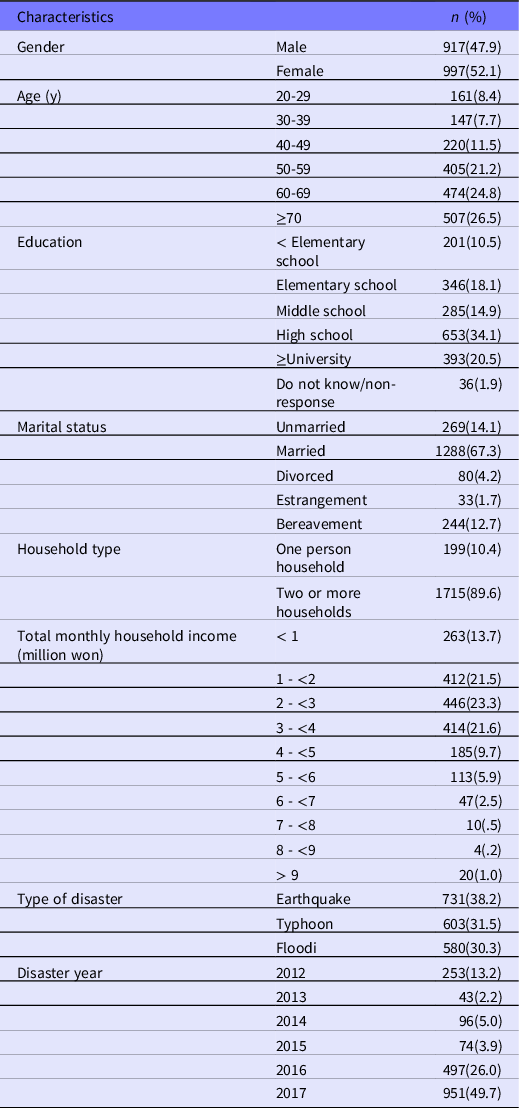
In this study, data from the research conducted by the National Disaster Management Research Institute (NDMRI), Republic of Korea, on the establishment of relief service for disaster victims were used. The subjects had experienced domestic flooding, typhoons, and earthquakes between 2012 and 2017. The areas of disaster occurrence were highest in the order of Gyeongbuk, Ulsan, Incheon, Chungbuk, Jeonnam, etc. The data collection was performed over a period of 3 y, from 2016 to 2018. It was conducted by a professional investigator who personally visited the houses, obtained consent to participate, and surveyed the questionnaire through an individual tablet PC (Computer Assisted Personal Interviewing). Of the 2311 people who participated in the 2018 survey, this study analyzed the data of 1914 individuals aged 20 y or above. The sample included 917 men (47.9%) and 997 women (52.1%); the mean age was 58.76 y, with a standard deviation of 16.56.
Measures
Disaster Trauma
Disaster trauma was measured using the items used in the study by North et al. (2012). Reference North, Oliver and Pandya10 To measure perceived threat, the subjects were asked to respond to the question “Did you feel a threat to life at the time of the above-mentioned disaster?” with a “yes” or a “no”. To examine whether the disaster caused a disease or an injury, the subjects were asked to respond to the question “Did you suffer an injury or from a disease due to the disaster?” with a “yes” or a “no”.
Disaster Conflict
Disaster conflict was examined using 5 items, namely, “neighborhood”, “between residents and damage countermeasures committee”, “between residents and local governments”, “between residents and central governments”, and “between local and central governments”. If a conflict caused by a disaster was experienced, they could be responded with “yes”, otherwise with “no”.
Economic Loss
Economic loss is a measure of the change in total assets by confirming the economic situation of the household. This scale consists of 3 items: the average monthly income of households (work salary, rental income, etc.), their total income assets (real estate, low expenditure, etc.), and household debt (loan, etc.). Each item was examined using a 3-point Likert scale (1 = reduction; 2 = increase; 3 = no change). However, in this study, the alternatives were as follows: “1 = increase”; “2 = unchanged”; and “3 = decrease”. In the case of household debt (loan, etc.), the alternatives were as follows: “1 = decrease”; “2 = unchanged”; and “3 = increase”. Higher scores were indicative of higher economic loss.
PTSD
In this study, the Korean Version of Impact of Event Scale-Revised developed by Horowitz et al. (1979), and validated by Eun et al. (2005), was used to measure PTSD symptoms. Reference Horowitz, Wilner and Alvarez51,Reference Eun, Kwon and Lee52 It consists of 22 items, such as “I remember the disaster even when I was calm”, “I avoided the things that reminded me of the disaster”, and “The intense feelings at the time of the disaster used to come like waves”. Each question was measured using a 5-point Likert scale (1 = no; 5 = very often); the higher the score, the greater the PTSD-related symptoms. An exploratory factor analysis was conducted to confirm the factor structure. Based on the Kaiser-Meyer-Olkin values (.986) and the Bartlett’s sphericity test (P < 0.001), the data were judged to be suitable for factor analysis. The results of the exploratory factor analysis with the maximum likelihood method and direct oblimin showed that a single factor structure was appropriate, and 71.85% of the total variance was explained. In this study, the Cronbach’s α was .982.
Personal Resilience
In this study, the Brief Resilience Scale used by the National Disaster Management Research Institute (2019) was used. 53 It is composed of 6 questions such as “I recover quickly despite facing a stressful event”, “I tend to have a tough time when I suffer a stressful event.”, “I do not take long to recover from a stressful event”, and “If something bad happens, it is difficult to recover and return to my everyday life”. Each item was measured using a 5-point Likert scale (1 = not at all; 5 = very much), and negative questions were reverse-coded for convenient interpretations. Higher scores were indicative of higher resilience. Based on the Kaiser-Meyer-Olkin values (.726) and the Bartlett’s sphericity test (P < 0.001), the data were judged to be suitable for factor analysis. The results of the exploratory factor analysis with the maximum likelihood method and direct oblimin showed that a single factor structure was appropriate, and 64.36% of the total variance was explained. In this study, the Cronbach’s α was .712.
Community Resilience
The Conjoint Community Resiliency Assessment Measure-10 used by the National Disaster Management Research Institute (2019) was used in this study. 53 It comprises 10 questions, including “The residents of my area help each other and are interested in each other”, “The area where I live is well-prepared for an emergency”, “The people of our area will help me if I face a crisis”, “The local residents know what they should do in an emergency”, and “The local residents have faith in each other”. In this study, the first question was found to be less than .5 in communality, so it was removed because it was judged that the explanatory power was low, and a total of 9 questions were used for analysis. Each item was measured using a 5-point Likert scale (1 = not at all; 5 = very much); the higher the score, the higher the level of community resilience. Based on the Kaiser-Meyer-Olkin values (.946) and the Bartlett’s sphericity test (P < 0.001), the data were judged to be suitable for factor analysis. The results of the exploratory factor analysis with the maximum likelihood method and direct oblimin showed that a single factor structure was appropriate, and 58.17% of the total variance was explained. In this study, the Cronbach’s α was .925.
Data Analysis
In this study, the Statistical Package for the Social Sciences version 22.0 and the PROCESS macro version 2.16 were used for data analysis. First, frequency analysis and descriptive statistics were conducted to identify the demographic and social characteristics of disaster victims. Second, Pearson’s correlation analysis was performed to examine the correlation between the major variables. Third, a logistic regression analysis was carried out using Hayes’s (2013) PROCESS macro (Model 1) to verify the moderation effect of personal and community resilience between PTSD and disaster trauma, disaster conflict, and economic loss. Reference Hayes54,Reference Hayes and Rockwood55 To confirm the statistical significance of the moderator variable, the conditional effect of the independent variable was calculated at mean (M) ±1 standard deviation point of the moderator variable, and a simple slope test was used to verify its significance. Reference Aiken, West and Reno56 In addition, the mean centering of all variables was used to minimize the multiple collinearity problems of the control variables and the interaction term.
Results
Descriptive Statistics
As presented in Table 1, of the 1914 respondents, 917 (47.9%) were men and 997 (52.1%) were women. Those in their 70s or above accounted for the highest rate with 507 (26.5%) individuals, while those in their 30s had the lowest rate with 147 (7.7%) individuals. Of all the age groups, 1606 adults aged 40 or older accounted for the highest percentage of middle-aged and older people. In terms of academic background, those having graduated from high school accounted for the highest percentage (34.1%), followed by college or higher (20.5%). In all, 1288 subjects (67.3%) were married, while 269 (14.1%) were unmarried, accounting for 81.4% of the total ratio, 33 (1.7%) individuals were separated. With regard to the type of household, 1-person households accounted for 10.4% (199) of the sample, and 2 or more households accounted for 89.6% (1715). The average monthly household income showed the highest ratio between 2 million (₩) and less than 3 million (₩) (23.3%), and more than half of the survey subjects reported it to be less than 4 million (₩). Earthquakes accounted for 38.2% of the natural disasters, typhoons for 31.5%, and floodings for 30.3%. Disaster year were high in the order of 2017 (49.7%), 2016 (26.0%), and 2012 (13.2%).
Demographic variables (N = 1914)

Correlation Between the Study Variables
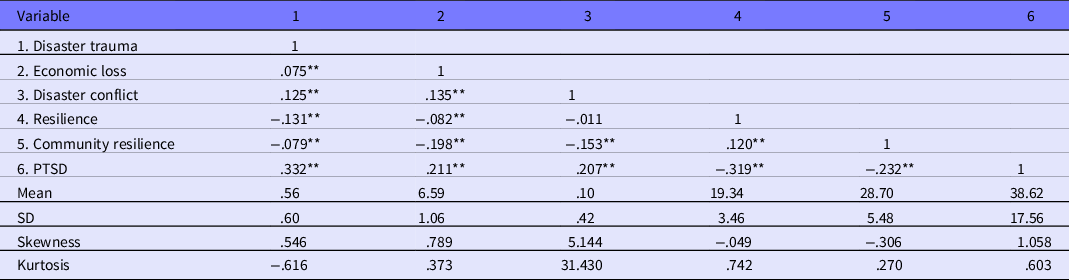
As presented in Table 2, disaster trauma showed a positive correlation with economic loss, disaster conflict, and PTSD, and a negative correlation with personal and community resilience. Economic loss exhibited a positive correlation with disaster conflict and PTSD, however, a negative one with personal and community resilience. Disaster conflict was positively correlated with PTSD and negatively correlated with community resilience. A positive correlation was found between personal and community resilience; moreover, both these variables were negatively correlated with PTSD.
Means, standard deviations, and correlations

*P<.05.
**P<.01.
Moderating Effect of Personal Resilience
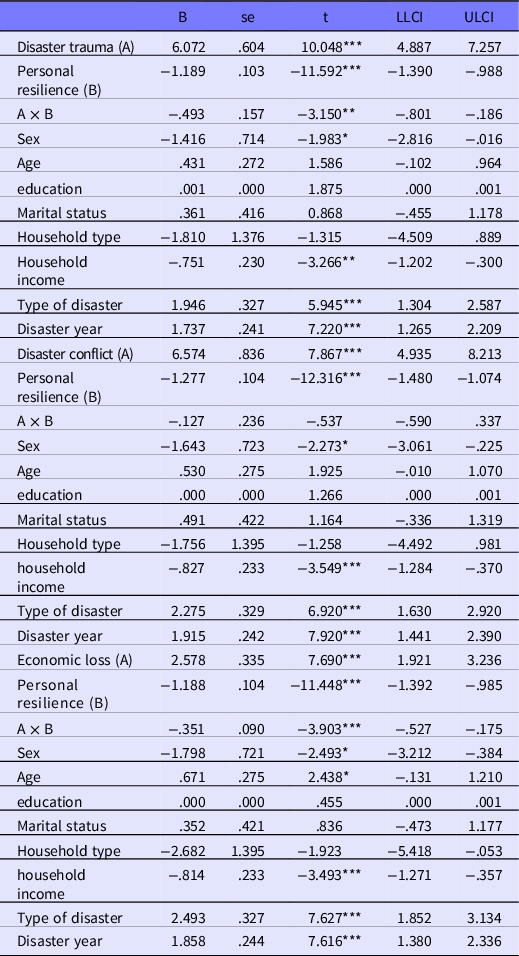
PROCESS (Model 1) was used to verify the moderating effect of personal resilience on the relationship between the effects of disaster damage-related risk factors and PTSD (Table 3). The results revealed that disaster trauma had a positive effect on PTSD (B = 6.072; P < 0.001), while personal resilience had a negative effect on it (B = −1.189; P < 0.001). The interaction between disaster trauma and personal resilience was also found to have an effect on PTSD, indicating that the effect of the former on PTSD depended on the latter (B = −.493; P < 0.01). Additionally, 0.4% of the variance in PTSD was explained. As the interaction term was significant, the value of resilience was set to 3 levels (−1SD, M, +1SD) to verify its conditional effect, and the significance of the simple linear regression was verified. As a result, the moderating effect was found to be statistically significant at all 3 levels.
Moderating effect of personal resilience on the relationship between disaster trauma, disaster conflict, economic loss, and PTSD

Abbreviations: LLCI, lower limit confidence interval; ULCI, upper limit confidence interval.
*P<.05.
**P<.01.
***P<.001.
Economic loss had a positive effect on PTSD (B = 2.578; P < 0.001), while personal resilience had a negative effect on it (B = −1.188; P < 0.001). Moreover, the interaction between economic loss and resilience also had an effect on PTSD, indicating that the former’s effect on it depended on the latter (B = −.351; P < 0.001). Additionally, 0.6% of the variance in PTSD was explained. As the interaction term was significant, the value of personal resilience was set to 3 levels (−1SD, M, +1SD) to validate its conditional effect, and the significance of the simple linear regression was verified. Consequently, the moderating effect was found to be statistically significant at all 3 levels.
Finally, disaster conflict had a positive effect on PTSD (B = 6.574; P < 0.001) and personal resilience had a negative effect on it (B = −1.277; P < 0.001). However, the interaction effect between the 2 was not significant.
Moderating Effect of Community Resilience
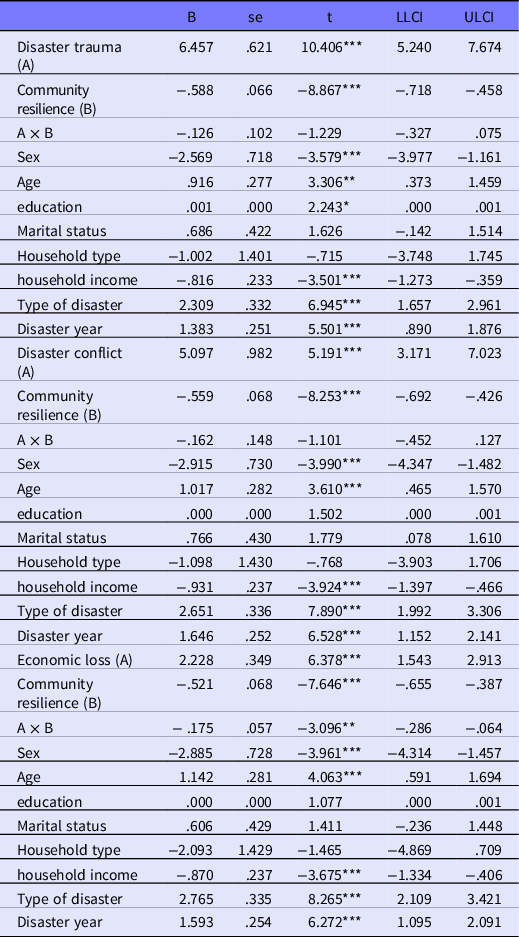
PROCESS (Model 1) was used to verify the moderating effect of community resilience on the association between the effects of disaster damage-related risk factors and PTSD. The verification results are presented in Table 4. The findings revealed that economic loss had a positive effect on PTSD (B = 2.228; P < 0.001), while community resilience had a negative effect on it (B = −.521; P < 0.001). The interaction between the 2 variables was also found to have an effect on PTSD, indicating that the effect of economic loss on the disorder depended on the level of community resilience (B = −.175; P < 0.01). Additionally, 0.4% of the variance in PTSD was explained. As the interaction term was significant, the value of community resilience was set to 3 levels (−1SD, M, +1SD) to validate its conditional effect, and the significance of simple linear regression was verified. Consequently, the moderating effect was found to be statistically significant at all 3 levels.
Moderating effect of community resilience on the relationship between disaster trauma, disaster conflict, economic loss, and PTSD

* P<.05.
** P<.01.
*** P<.001.
Abbreviations: LLCI, lower limit confidence interval; ULCI, upper limit confidence interval.
Disaster trauma had a positive effect on PTSD (B = 6.457; P < 0.001), and community resilience had a negative effect on it (B = −.588; P < 0.001). However, the interaction effect between the 2 was not significant. Finally, disaster conflict had a positive effect on PTSD (B = 5.473; P < 0.001), and community resilience had a negative effect on it (B = −.653; P < 0.001). However, the interaction effect between these 2 variables was also not significant.
Discussion
The purpose of this study was to identify the effects of disaster trauma, disaster conflict, and economic loss on PTSD, and to verify the moderating effect of personal and community resilience on the relationship between the disaster-related risk factors and PTSD.
First, disaster trauma, disaster conflict, and economic loss had a positive effect on PTSD. These results suggest that people who experience these factors caused by a disaster are more likely to develop PTSD. Disaster trauma has consistently been reported as an important risk factor for PTSD, including physical injury and perceived threat. This study’s findings are in line with those of the previous studies on disaster trauma. Reference Brewin, Andrews and Valentine11,Reference Amstadter, Nugent and Koenen13,Reference Thienkrua, Cardozo and Chakkraband14 With respect to a traumatic event, when an individual evaluates it as serious and threatening, the likelihood of developing PTSD may increase. Reference Ehlers and Clark57
Economic loss slows the return to daily life and makes it challenging to secure a stable foundation for the same. Essentially, economic loss is an important variable that can prolong the damage caused by a disaster, and the continuation of which increases the probability of developing PTSD. The results of this study support those of previous studies that economic loss negatively affects PTSD. Reference Dai, Chen and Lai7,Reference Banks22,Reference Lim and Sim23 Disaster conflict refers to a clash between an area’s various members and organizations, where the regional system collapses and changes dynamically subsequent to a disaster. Reference Mort, Convery and Baxter18 It causes the weakening and isolation of community solidarity that leads to greater harm by reducing access to significant disaster-related information and increasing psychological distress. Reference Norris, Friedman and Watson4,Reference Banks22
Second, the moderating effect of personal resilience was significant in the relationships between disaster trauma as well as the impact of economic loss with PTSD. It is suggested that the improvement of personal resilience can reduce psychological difficulties caused by financial problems. On the other hand, personal resilience did not appear to have a moderating effect in the association between disaster conflict and PTSD. These results suggest that resilience acts as a resource for coping with natural disaster situations.
Third, the moderating effect of community resilience was significant only in the impact of economic loss on PTSD. Therefore, it can be an effective coping resource for disaster trauma. It is suggested that it can help in minimizing social confusion and psychological shock caused due to economic loss, by recognizing and trusting each other in the community as well as sharing responsibility in the face of natural disasters.
This study has certain limitations. First, personal resilience may shift depending on life context. Therefore, other variables beyond demographics should be considered to understand current respondent life conditions. However, in this study, such variables were not considered. Future studies need to verify the relationships between variables in consideration variables (eg, medical service, institutional support, environmental and facilities restoration) related to life context. Second, this study is a cross-sectional design study, there is a limit to sufficiently explaining personal developmental change other than demographic variables, and inferring causalities between the variables. Third, disaster trauma and conflict were measured dichotomously (yes/no) that may have resulted in inadequacies in examining the construct accurately. Therefore, future studies should verify the relationships between the variables in consideration of various factors through a longitudinal design, and also develop and use a scale to measure the construct with precision.
Conclusions
Compared with the increasing rate of natural disaster damage every year, there has been a paucity of research to identify risk factors related to PTSD of natural disaster victims, and, perhaps, more focus is needed in this area for future research. As such, it is meaningful in that it identified major risk factors (disaster trauma, disaster conflict, economic loss) for PTSD in victims of natural disasters. Furthermore, as personal and community resilience of disaster victims increases, it confirmed the risks are mitigated, the effects of disasters are suppressed, and social confusion is minimized. In particular, the moderating effect of resilience was found in the impact of economic loss on PTSD. Economic loss continues to inflict mental damage after a disaster; however, there are limitations in reducing it, as financial assistance such as disaster subsidies are often given 1-off. This study suggested that it is necessary to fully use the effects of not only individual, but also community resilience to minimize the psychological impact caused by economic loss.
The results of this study’s findings suggest that personal and community resilience could be used for prevention and therapeutic interventions for disaster victims who experience PTSD. As such, therapy of disaster victims needs to focus on personal and community resilience-based interventions and may include individual therapy (self-regulation ability, optimism, gratitude, etc) and building a community resilience.
Data Availability Statement
The data that support the findings of this study are openly available in [National Disaster Management Research Institute, Republic of Korea] at [https://www.ndmi.go.kr/index.jsp].
Acknowledgments
This research was supported by Establishment of relief service for disaster victims, National Disaster Management Research Institute, Republic of Korea.
Author Contributions
J.-E. Ann designed the study, analyzed the data, wrote the first draft of the manuscript and edited the final version of the paper. M.B. Bae contributed to the design of the study and edited the final version of the study.
Funding
There is no funding for this study.
Declaration of Conflicting Interests
The authors have no relevant financial or nonfinancial interests to disclose.
Ethical Standards
Ethical approval is not required because of using public data.