Introduction
An understanding of disaster medicine and the function of the health care system in a mass-casualty event is vital to a successful disaster response and has been recommended as an integral part of a medical curriculum by the Association of American Medical Colleges (AAMC). 1 Previous studies have shown that while many medical schools incorporate the study of weapons of mass destruction (WMD) and bioterrorism within required courses, the inclusion of training related to disasters from natural events and the health care professional's role in emergency preparedness remain neglected in current medical school curricula.Reference Markenson, DiMaggio and Redlener 2 A report by the AAMC states that focusing on biological aspects of terrorism was inappropriately limiting. 1
The majority of courses related to disasters from natural events and health emergency preparedness responses are based on the assumption that participants are functioning health care providers who have completed their professional training. To ensure preparedness on a national level, health professionals require education focused on the roles of the health care provider in practice.Reference Silenas, Akins, Parrish and Edwards 3 To optimize physicians’ contributions during disasters, medical students need an introduction to their potential roles during a health emergency, as well as an opportunity to learn about the agencies with which they will interface, both professionally and personally. 4
Currently, <20% of medical students believe that they have received adequate education and training for disasters from natural events or radiological dispersal device detonation; <30% consider themselves to be adequately prepared for an influenza pandemic.Reference Kaiser, Barnett, Hsu, Kirsch and James 5 In designing educational programs for integration into medical school curricula, it is necessary to identify core competencies that cut across all health disciplines involved in a subject. Several cross-cutting competencies for disaster training of health care professionals have been identified by means of expert consensus.Reference Hsu, Thomas, Bass, Whynne and Kelen 6
The purpose of this pilot study was to investigate the use of health care provider competencies in medical education and to inform a subsequent, comprehensive study of disaster medicine curricula.
Methods
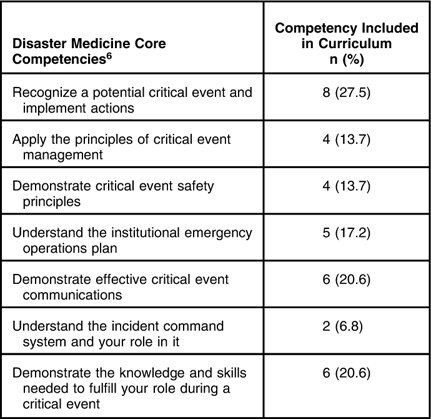
The survey was developed by the authors with the intention of determining which of the disaster core competencies, as described by Hsu et al,Reference Hsu, Thomas, Bass, Whynne and Kelen 6 are included in medical school disaster education (Table 1). The survey included questions regarding the following topics: (1) frequency with which disaster medicine is integrated into the required course work; (2) core competencies of disaster education that are addressed in the curricula; (3) method of teaching (i.e., lectures, group discussions, simulations, web-based); and (4) number of hours per academic year dedicated to disaster medicine.
Disaster Medicine Core Competencies and Their Inclusion in Disaster Education in Participating Medical Schools

An invitation to participate in this study was distributed via e-mail to the education liaison for each of the 115 allopathic medical schools accredited by the AAMC in the US. The survey was administered anonymously through the software SurveyMonkey (SurveyMonkey LLC, Palo Alto, California USA), January through March of 2010. Upon completion of the survey by the participants, the results were compiled and uploaded into a Microsoft Access (Microsoft Corporation, Redmond, Washington USA) database, and description analysis was performed.
This study was reviewed and found to be exempt by the Johns Hopkins University's Institutional Review Board.
Results
A total of 29 (25.2%) of the 115 US allopathic medical schools completed the electronic survey. Surveys were sent to education liaisons as specified by the AAMC, with actual responders remaining anonymous. Of the 29 schools that responded, nine (31.0%) indicated that they incorporate disaster medicine into their curricula, six (20.7%) schools disseminate the information through required courses, and five (17.2%) schools offer disaster medicine through elective courses. Nine (31.0%) schools did not offer disaster medicine curricula at the time of the survey.
Disaster medicine topics that were reported to be included were: principles of triage and pandemic flu/SARS (n = 8, 27.5%); consequences of disasters (n = 7, 24.1%); community and hospital hazards planning (n = 7, 24.1%); public health understanding of the Incident Command System (n = 5, 17.2%); psychological aspects of disaster response (n = 7, 24.1%); ethical issues in disaster response (n = 6, 20.6%); disaster epidemiology such as environmental threats, blast injuries and crush injuries (n = 5, 17.2%); terrorism such as biological, chemical, radiological, and nuclear weapons (n = 7, 24.1%); communicable diseases (n = 5, 17.2%); and biostatistics (n = 3, 10.3%).
The teaching methods reported to be utilized for disaster medicine courses included lectures (n = 8, 27.5%); group discussions (n = 6, 20.6%); live simulations (n=6, 20.6%); distance learning (n=2, 6.8%); and computer simulations and Web-based self learning (n = 1 each, 3.4%). Other teaching methods reported by respondents in an open-ended response text entry included case study reviews, off-site experience with staged incidents, and on-site disaster drills.
Among the respondents, three (10.3%) of the schools incorporated disaster medicine during the first academic year, while four (13.8%), three (10.3%), and five (17.2%) of the schools incorporated disaster medicine topics during the second, third, and fourth academic years, respectively. The average number of hours of disaster medicine topics taught during the first academic year was 3.3 hours (SD = 3). The average number of hours of disaster medicine taught during the second, third, and fourth academic years was 4 (SD = 3), 5.3 (SD = 2), and 6 (SD = 0) hours, respectively. Nine (31.0%) of the responding schools address at least one of the seven listed core competencies within their disaster medicine curricula. Of those who responded, eight (27.5%) address the competency “to recognize a potential critical event and implement actions;” four (13.7%) the competency “to apply the principle of critical event management;” four (13.7%) “to demonstrate critical event safety principles;” five (17.2%) “to understand the institutional emergency operations plan;” six (20.6%) “to demonstrate effective critical event communications;” two (6.8%) “to understand the Incident Command System and your role in it;” and six (20.6%) address the competency “to demonstrate the knowledge and skills needed to fulfill your role during a critical event” (Table 1).
Discussion
While there may be a considerable willingness among health professionals to respond during a disaster, education and training in disaster medicine and public health preparedness are inadequate to meet these challenges.Reference Kaiser, Barnett, Hsu, Kirsch and James 5 Only 17.2% believed that they were receiving adequate education and training for natural disasters and, 26.2% for pandemic influenza.Reference Kaiser, Barnett, Hsu, Kirsch and James 5 Others have also supported the importance of the development and implementation of introductory disaster curricula for medical students.Reference Kaji 8 However, the extent to which disaster medicine training and education is incorporated into medical school education in the United States, to the best of the authors’ knowledge, has not been described previously.
In this pilot survey of the current state of disaster medicine education in US medical school curricula, the percentage of medical schools that incorporate some form of disaster medicine and public health preparedness into their curricula is low. Few of the schools that responded to this survey consider disaster medicine to be a core component of medical education, with only one-fifth disseminating basic disaster medicine knowledge and skills through required courses. Moreover, there is considerable variability in the underpinnings of content being taught, with only one-third of the schools reporting instruction that addresses any previously identified core competencies for disaster medicine and public health preparedness.
It is a societal imperative to prepare all future physicians with the fundamentals to understand and respond, if needed, to the increasing threats from natural and human-caused events. International organizations, such as the Center for Research on the Epidemiology of Disasters, have released statistics that show a growth in magnitude and frequency of disasters from natural events, making it no longer acceptable to address disaster medicine in brief, or not at all. 7 Disaster medicine education should be a formal requirement of medical school education, and should take into consideration suggested core competencies for disaster medicine and public health preparedness. Institutions should review and evaluate the extent to which disaster medicine and public health preparedness is covered within their curricula.
A consensus-based educational framework and competency set for the discipline of disaster medicine and public health preparedness can serve as a blueprint to develop standardized curricula to cultivate expected learning outcomes through selection of relevant context and medical content.Reference Hsu, Thomas, Bass, Whynne and Kelen 6 Although the establishment of these competencies is relatively new, and they have yet to be validated, the number of schools utilizing them in disaster education is strikingly low. For institutions to effectively educate their students in the principles of disaster medicine, the core competencies should be incorporated into an established curriculum, thus ensuring that key information is comprehensively and uniformly conveyed.
Findings from the sparse responses to the section on specific disaster topics covered indicate that disaster epidemiology and biostatistics, as well as understanding of the Incident Command Systems were least covered, even though standardized instructional content on these topics is readily available and accessible through the National Incident Management System (NIMS) training, and the Incident Command System series. Unfortunately, the importance of understanding the essentials of the Incident Command System often is minimized, which may have contributed to the findings by Kaiser et al5 that the vast majority of medical students could not identify to whom they would report in case of a critical event. In contrast, topics that remain popular with the public (i.e., H1N1, avian, and pandemic flu) command the majority of limited allotted teaching time within existing medical school curricula. To ensure that health care systems operate efficiently in the setting of a disaster or mass-casualty event, future physicians must begin to develop an understanding of their role in the context of a local or national response. Familiarity with core competencies would ensure that future physicians possess essential knowledge and skills appropriate for their level of training in such a response. This highlights the necessity for US medical schools to rigorously evaluate the content of their curriculum with the intention of introducing competency-based disaster medicine and public health preparedness education. Focus on such efforts will prepare future physicians for potential roles in disaster health response and make progress toward establishing a more robust supplemental medical workforce.
Limitations
Despite efforts to boost study participation, the survey response rate was low. While this introduces a potential for response bias, it is possible that medical schools with existing disaster medicine curricula were less likely to respond to requests for programmatic information. However, it is more probable that schools without established disaster medicine education within their curricula may have chosen not to respond; this would magnify the extent of the highlighted gap in future physician disaster training and education. Using a Web-based survey tool may have decreased interest in participation or access to the survey, though it is improbable that technology limitations contributed to the response rate.
Overall, the findings from this study support the fact that disaster medicine and public health preparedness may not be a current priority in medical schools in the United States. Future efforts to study the curriculum of disaster medical education should include more extensive tracking of participation and follow-up to ensure an improved response rate. In addition, disaster curricula should be studied using updated competency sets.
Conclusions
The results from this pilot study provide a glimpse into the status of disaster medicine education in medical school curricula and the degree of incorporation of proposed core competencies for disaster training. Only a small percentage of US medical schools currently include disaster medicine in their core curricula, and even fewer medical schools have incorporated or adopted competency-based training within their disaster medicine lecture topics and curricula.
Abbreviations
- AAMC:
-
Association of American Medical Colleges
- ICS:
-
incident command system
- NIMS:
-
National Incident Management System
- SARS:
-
severe acute respiratory syndrome
- WMD:
-
weapons of mass destruction