Introduction
In recent years, the scholarship on international organizations (IOs) has become increasingly interested in studying the process of change that takes place within IOs. In particular, scholars have started asking how, why, and when change occurs (Barnett and Coleman, Reference Barnett and Coleman2005). The research interest in explaining policy change in IOs spans across the rationalist–constructivist spectrum. From a rationalist perspective, policy change in IOs is accounted for either as the result of a deliberate choice made by member states (Koremenos et al., Reference Koremenos, Lipson and Snidal2001), or as information asymmetries and disagreements among principals over the precise goals with which to task IOs (Nielson and Tierney, Reference Nielson and Tierney2003). Indeed, using a principal–agent (PA) framework, these latter factors may enhance the room for ‘agency slack’ within IOs – to shirk tasks or engage in activities that were not expressly mandated by member states or that directly contravene members’ aims (Hawkins et al., Reference Hawkins, Lake, Nielson and Tierney2006). From a constructivist perspective, several scholars have started investigating the endogenous, organization-specific factors that help account for changes. For instance, it has been found that organizational cultures and competition among internal units and departments affect the process of policy change (Willets, Reference Willets2000; Momani, Reference Momani2005; Lipson, Reference Lipson2007; Weaver, Reference Weaver2008; Chwieroth, Reference Chwieroth2010; Park, Reference Park2010; Steffek, Reference Steffek2010).
Interestingly, however, most of these studies offer a limited understanding of the concept of change. Change is largely treated as a dichotomous variable that takes on the values of present/absent. This may be attributed to research questions and designs, with scholars having primarily focused on the triggers of change – and here the debate was often set up in the interest-idea divide – by investigating cases of formal change, such as treaty changes or decisions voted on by state representatives. In doing so, however, existing studies of IOs fall into the trap of an either/or fallacy: they suggest that only two choices are possible, that is, change vs. no change, when more options really exist.
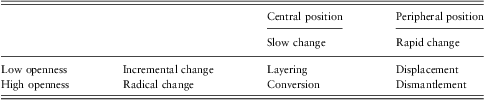
This paper attempts to redress this fallacy by unpacking the dependent variable ‘change’.Footnote 1 That is to say, we contend that in order to explain change in IOs, we cannot simply dichotomize between change and the lack thereof. Rather, change is best conceptualized as made up of two dimensions, that is speed and scope. The combination of the two dimensions leads to a taxonomy with four distinct types of policy change: layering, conversion, displacement, and dismantlement. Although these types are borrowed from historical institutionalism, their meaning and content do not always perfectly coincide with those prevalent in this strand of scholarship – as will be clarified at greater length below. Based on this taxonomy, we suggest a number of hypotheses that help explain why a specific type of change materializes. In particular, we draw from sociological institutionalism, and identify the factors that help to explain the variation in the types of change in the relationship between the IO and its organizational field (DiMaggio and Powell, Reference DiMaggio and Powell1983). As illustrated in Table 1, the position of the organization in the field helps to account for the speed of change (slow vs. rapid), whereas the openness of the organization to the inputs coming from the field helps to explain the scope of change (incremental vs. radical).
Taxonomy of policy change within IOs based on their relationship with the organizational field

In order to itemize our argument, the paper provides empirical illustrations of the changes in the policies of a preeminent international economic organization, that is, the International Monetary Fund (IMF). In particular, we undertake a focused comparison between the policy changes through which the Fund became responsible for financial sector surveillance and poverty reduction. Next to this cross-issue analysis, this study also relies on a longitudinal, within-case comparison. Indeed, both issue areas are characterized by important changes in the organizational fields in the late 1990s following the emerging market crises of the decade. Using this development as a natural experiment, we thus show how the changes within the same organizational field over time altered the configurations of IO–field relationships. These new configurations, in turn, influenced the type of policy change that eventually materialized.
Before proceeding, some clarifications are required concerning the objectives of this paper and its research design and methods. First, the primary purpose of this paper is that of explaining the emergence of different types of change. In doing so, we argue and illustrate that, although member state preferences and bureaucratic culture may help explain why change is initiated in the first place, these same factors alone cannot explain why a specific type of change materializes and another does not.
Second, the dependent variable of this study is the change in the policies that the IMF pursues. Specifically, we investigate what elements have been altered over time in the way the IMF carries out its surveillance functions and engages with the problem of poverty reduction. This is not to suggest that institutional changes are not important. As the empirical sections will show, policy changes often bring about changes in the institutional structure. More narrowly, however, and in order to facilitate the testing of our theoretical claims, the types of change we investigate are those that relate to the policies that the IMF pursues.
Third, it is important to clarify from the outset the modalities through which we discriminate among different levels of policy change. Measuring change is a controversial activity. The assessment of the nature of change can for instance be hindered by one's theoretical viewpoint. Hence, what may be a rapid, radical change from a macro-theoretical perspective can be a slow process of adaptation if one adopts a microanalytical perspective (Capano and Howlett, Reference Capano and Howlett2009: 7). While this paper does not provide definitive answers on how to solve these crucial problems in the measurement of policy change, our study is based on an explicit and parsimonious understanding of different types of policy change that is applied to the empirical analysis. In particular, in order to discriminate between incremental and radical change (i.e. the scope of change), we borrow from Peter Hall's (Reference Hall1993) distinction between first-, second-, and third-order change that refers to changes in the settings, instruments, and goals of a policy, respectively. Whereas first- and second-order changes are here regarded as incremental, third-order changes are regarded as radical. As for the timing of change, the metric used here is that change is slow when there is a temporal mismatch between the adoption of a decision and its actual implementation or between the public recognition of a policy problem and the action taken to solve it. We do not provide a quantitative benchmark against which to assess the slowness/rapidity of change because of the comparative nature of this study. That is to say, the tempo of change is not an absolute but relative variable here that will be ascertained by cross-case comparison.
Finally, some clarifications are needed with regard to the research design used to advance our claims on the importance of organizational fields to the varieties of policy change. While the concept of organizational field is extensively presented in the next sections, it is important to clarify from the outset that organizational fields vary across issue areas and change over time. As a result, the first step of a field analysis usually requires the mapping of the relevant actors and the actor positions in the field (Leander, Reference Leander2010). For the purposes of this study we adopt an inductive approach. This means that the identity and the positions of the actors in the fields under investigation cannot be pre-determined ex ante but are a matter of empirical investigation. In doing so, we relied on both secondary literature, such as scholarly studies and practitioner reports on the issues under investigation, and first-hand material. Archival documents and interviews with IMF staff members were particularly important to identify the relevant actors the organization engaged with in its processes of change.
The arguments in the paper are developed in three steps. After reviewing existing scholarship on policy change in IOs, we clarify the theoretical claims that guide the empirical analysis and illustrate our taxonomy of policy change. The following sections provide the empirical evidence to sustain our arguments, analyzing the IMF's involvement with financial sector surveillance and poverty reduction, respectively. The last section concludes by reflecting on the findings and detailing the implications of our study for the literature on IOs.
IOs and policy change
During the past decade, IO scholars have expanded their research agendas beyond the study of IO creation and influence on member states and world politics by analyzing the causes of policy change. The work of Michael Barnett and Martha Finnemore (Reference Barnett and Finnemore2004, Reference Barnett and Finnemore1999) has been highly influential in this regard. By demonstrating that IOs are agents in their own right because of their ability to define meanings and shape expectations, the authors opened the way for investigating IO pathologies, conflicts, and cleavages that influence their behavior. Following on from these insights, constructivist-oriented scholarship has made pioneering forays into the study of IO change. Borrowing from organizational sociology, the role that bureaucratic culture plays in shaping change has been particularly highlighted (Bebbington et al., Reference Bebbington, Woolcock, Guggenheim and Olson2006; Vetterlein, Reference Vetterlein2007; Weaver, Reference Weaver2008; Chwieroth, Reference Chwieroth2010; Park, Reference Park2010; Steffek, Reference Steffek2010).
While Barnett and Finnemore's work (Reference Barnett and Finnemore2004, Reference Barnett and Finnemore1999) has been particularly influential for constructivist scholars, the turn toward the study of the inner workings of IOs is also evident in rationalist explanations. PA models have shown how organizations change their policies within the parameters set by the PA terms of delegation. That is to say, change is either the result of principals’ decisions to expand/reduce an IO's mandate (Koremenos et al., Reference Koremenos, Lipson and Snidal2001; Elsig, Reference Elsig2011), or of the room of maneuver the IO enjoys under the existing terms of delegation (Cortell and Peterson, Reference Cortell and Peterson2006). In the attempt to bridge the divide between constructivist and PA explanations, a number of scholars have also integrated the logic of a rationalist PA model – focusing on terms of delegation – and the logic of sociological constructivism – focusing on the transformation of bureaucratic culture (Barnett and Coleman, Reference Barnett and Coleman2005; Hawkins et al., Reference Hawkins, Lake, Nielson and Tierney2006; Nielson et al., Reference Nielson, Tierney and Weaver2006; Clegg, Reference Clegg2010; Moschella, Reference Moschella2009).
While both constructivist and rationalist studies have unveiled important factors that help explain the causes of organizational change, the problem of defining and identifying different types of change has gone largely ignored. This is not to say that there are no clues in the literature to answer the question as to what type of change takes place. Rather, explanations based on the ‘bureaucratic culture’ implicitly suggest that this factor is linked to slow-moving changes: culture takes time to be changed (Lipson, Reference Lipson2007; Weaver, Reference Weaver2008). As Catherine Weaver (Reference Weaver2008: 5) puts it studying the World Bank, ‘culture is not immutable. But by its nature, culture changes slowly and incrementally, in a path-dependent fashion often at odds with the direction and pace of change in the organization's environment’. Building on PA explanations, it is possible to extrapolate other hypotheses regarding the type of change. For instance, PA theory seems to suggest that the bigger the discretion accorded to the IO, or the larger the agreement on change among member states, the more profound change will be (Koremenos et al., Reference Koremenos, Lipson and Snidal2001). Nevertheless, these hypotheses are implicitly rather than explicitly theorized and have not been systematically tested. In what follows, we thus start filling in this gap by identifying different types of change and offering an explanation that combines the insights of historical and sociological institutionalism.
Explaining varieties of policy change within IOs: the importance of organizational fields
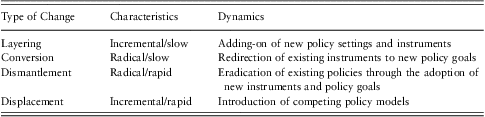
For the purpose of this study, we conceive of change as made up of two dimensions: speed and scope. Their combination gives rise to four different types of change in the policies of an IO. The main characteristics of each type are summarized in Table 2. While we borrow from the HI literature for the labels used to describe different types of change,Footnote 2 our definitions do not always perfectly coincide with those prevalent in this strand of scholarship as the description of each type of change below will illustrate.
Different types of policy change in IO

Layering is the type of change that takes place by adding new institutions rather than dismantling the old. In other words, change by layering entails the addition of new policy settings and instruments on top of existing ones (e.g. Thelen, Reference Thelen2004; Streeck and Thelen, Reference Streeck and Thelen2005). Conversion instead refers to the process of change that takes place when policies are adapted over time by shifting existing instruments and practices to new ends (Thelen, Reference Thelen2003). The two types share the same tempo; both are slow-moving types of change. Indeed, the underlying assumption is that proponents of change face political–institutional barriers that prevent the occurrence of rapid changes through the dismantlement of existing policies outright (Hacker, Reference Hacker2004). Nevertheless, layering and conversion differ in terms of scope. Whereas layering primarily entails a change in the settings and instruments through which existing policies operate, conversion is a more extensive type of change because it involves the redirection of existing policies to new purposes. As Kathleen Thelen (Reference Thelen2003: 226) puts it, conversion entails ‘changes in the role [institutions] perform and/or the functions they serve’.
The third and fourth types of change are those of dismantlement and displacement. It is worth noting that the HI literature has extensively investigated the concept of displacement rather than dismantlement primarily because the latter is often featured in leading institutional theories based on the notion of exogenous/punctuated change. Nevertheless, Mahoney and Thelen (Reference Mahoney and Thelen2010: 16) have recently suggested that displacement can be both abrupt and gradual. We thus build on this insight in order to identify two different types of change.
Specifically, dismantlement refers to a type of change where existing policies are dismissed and replaced with new ones. In other words, in contrast to layering and conversion where the old policies remain in place but are amended through the introduction of new instruments and redirection to new purposes, dismantlement entails the eradication of old policies. When dismantlement takes place, the new policies differ from previous ones in terms of both the instruments used to achieve specific goals and the same goals the policy is expected to pursue.
Similarly to dismantlement, displacement involves the rapid introduction of new institutions and policies, usually as a result of policy failures and accumulation of new knowledge. As Mahoney and Thelen (Reference Mahoney and Thelen2010: 16) put it, ‘the rapid, sudden breakdown of institutions and their replacement with new ones that accompanies revolutions obviously involves displacement’. Although both dismantlement and displacement are examples of rapid change, especially when compared with conversion and layering, they differ in the scope of the change involved. Whereas dismantlement involves the replacement of old policy instruments and goals with new ones, displacement is a more incremental type of change in that new models of doing things are introduced and directly compete with (rather than supplement) established policies. As an increased number of actors defect to the new models, change may eventually take place (Streeck and Thelen, Reference Streeck and Thelen2005: 19–22).
Having identified different types of change, the theoretical framework we suggest in this paper is explicitly devoted to identify the factors that help explain the emergence of each of these. Seen from this perspective, we significantly move beyond the HI literature that has long been criticized for advancing more thick descriptions than theoretical explanations of change (e.g. Gorges, Reference Gorges2001). Furthermore, while historical institutionalism assumes that change is intrinsically incremental, we move beyond this understanding by suggesting a theoretical explanation of both incremental and radical change.Footnote 3 Specifically, our theoretical argument links the relationship of the IO with its organizational field to the emergence of different types of change.
The concept of organizational field is borrowed from DiMaggio and Powell's work, inspired by Bourdieu, where a field is defined as ‘those organizations that, in the aggregate, constitute a recognized area of institutional life’ (DiMaggio and Powell, Reference DiMaggio and Powell1983: 148). A field has three defining characteristics: a specific object around which the field constitutes itself (in our case the specific policy issue); power relations among the participating actors; and emerging norms and rules that become the ‘rules of the game’ over time (see also Dingwerth and Pattberg, Reference Dingwerth and Pattberg2009). This process, which is known as structuration, takes place as a constant struggle over the respective object that is at stake in the field, in our case the respective policy (see Fligstein, Reference Fligstein2008). In this sense, field comes close to ‘regimes’ defined as explicit and implicit norms and rules around which the expectations of relevant actors converge in a given issue area (Krasner, Reference Krasner1983). In contrast to regime theory, however, the field concept is more explicit on the power relationships among the actors within the field.
Applying the concept of organizational field to the study of IOs, our analysis starts from the investigation of the power positioning of the IMF in a particular policy area and moves on to examine how the rules of the game – that is, the content of policies – are (re)shaped through the constant interaction between the organization and the actors in the relevant policy field. As already anticipated, the actors that belong to the field are inductively investigated, so that their identity is not defined ex ante based on the application of a specific theoretical model. This is also the case because organizational fields are not stable but continuously subject to change via the workings of the process of structuration (DiMaggio and Powell, Reference DiMaggio and Powell1983: 148). According to the issue area under investigation, then, relevant actors can include states, other IOs, professional groups, official agencies, and private sector actors.
While the identity of the actors is the subject of empirical investigation, the theoretical expectation that is derived from the application of the concept of organizational field is that micro-level social interactions help explain the emergence of specific (policy) norms (Dingwerth and Pattberg, Reference Dingwerth and Pattberg2009). Extending these insights to the realm of IOs, we thus investigate the process of social interaction between the IO and its fields. In this connection, we argue that the relationship between the organization and its field can be conceptualized as made up of different levels of exchange. That is to say, it is possible to conceptualize the IO, in our case the IMF, as a policy subsystem that is more or less open to external inputs and stimuli (Sabatier, Reference Sabatier1998: 99).
Based on these insights, we advance two theoretical claims in order to explain the different types of change identified above. First, the position of the IO in the field determines the speed through which change materializes. Second, the openness of the organization to its field helps account for the scope of change (see Table 1).
Positioning and speed of change
In order to explain the logic that underpins our first theoretical claim, it is worth recalling that, within each organizational field, all actors assume a position that derives from the resources available and relevant to the field. This ‘position-taking’ is an act of acquiring certain capital that, in turn, affects the actions of an organization (Bourdieu and Wacquant, Reference Bourdieu and Wacquant1992). Position-taking, however, is not solely the result of deliberate action. Rather, positions may derive from past actions and expertise. Furthermore, positions may also derive from historical processes, where some actors gain a first-mover advantage by appearing first in a field and accumulating expertise and organizational resources that are recognized as relevant in the field at a specific point in time (DiMaggio and Powell, Reference DiMaggio and Powell1983). Within IO studies, the existence of differing positions is often implicitly recognized. For instance, IOs are sometimes regarded as being in complementary but not conflicting positions, especially for the governance of the global economic and financial system (Porter, Reference Porter2005; Abbott and Snidal, Reference Abbott and Snidal2010). The co-existence of multiple institutions in a given issue area is also regarded as a crucial factor for accounting for the ability of IOs to perform their functions effectively (Gutner and Thompson, Reference Gutner and Thompson2010: 244).
Building on these insights, by ‘position’ we mean the status granted to an organization in solving a collective problem at a specific point in time based on the capital an actor holds (Bourdieu, Reference Bourdieu1993). Position is a property that derives from past actions and expertise, but it is also intersubjective as it depends on the collective understandings of the actors operating in a field. In particular, we distinguish between central and peripheral positions, according to whether the organization is largely recognized as the preeminent actor in solving the problems of a specific issue area or, in contrast, whether it is a supporting or more marginal actor in its field.
Position is relevant to the purposes of this study because it allows speculation about the speed that change will take. Indeed, the hypothesis is that organizations that occupy a central role in the field will be constrained by existing practices, routines, and expertise. That is to say, IOs face the legacy of the past, including well-developed practices to solve problems, knowledge developed over time, and long-standing experience that set an example of how to act in the future. Existing habits and routines are also ‘a structural obstacle to social change’ (Neumann, Reference Neumann2007; Hopf, Reference Hopf2010: 540). Given these constraints, change is more likely to be slow moving than rapid (see for instance Bebbington et al., Reference Bebbington, Woolcock, Guggenheim and Olson2006).
In contrast, in peripheral organizations, the speed of change is more likely to be rapid because of the lack of constraining factors. That is to say, without the scripts of actions crystallized in routines and habits, organizations will change more rapidly, developing new knowledge and organizational structures. For instance, comparative economic studies on transition economies show that the main obstacle to the creation of new tax systems is the existence of personnel in public administrations schooled in the old ways (Nsouli, Reference Nsouli1999). Furthermore, peripheral organizations are more likely to change their policies rapidly because they can take advantage of the strategies and information developed by organizations that stand at the center of the organizational field.Footnote 4
Of course, this is not to suggest that peripheral organizations do not face obstacles to change. On the contrary, for change to be instantiated into organizational practices, these organizations must tackle internal and external opposition that is often based on adherence to existing mandates. That is to say, change in peripheral organizations requires overcoming resistance to change that derives from the scope of organizational mandate and expertise.
Openness and scope of change
Our second claim is that the scope of change is linked to the interaction between the organization and other actors in its field. Indeed, closed policy subsystems usually constrain change favoring the emergence of incremental rather than radical changes. In the absence of external stimuli, the actors involved in the decision-making process tend to rely on what they know and on the instruments they have experience with. Once a particular degree of institutionalization is reached it becomes difficult to break with the established rules of the game, or as Pierson (Reference Pierson2000) would argue, past choices get locked-in. In this context, professionalism is also important. As Barnett and Finnemore show (Reference Barnett and Finnemore2004: 40), professional training ‘actively seeks to shape the normative orientation and worldviews of those who are trained’. As a result, an organization staffed with trained experts in a particular policy area tends to insulate itself from outside pressure.
In contrast, the expected policy change will be the most radical when the subsystem opens up. For instance, Baumgartner and Jones (Reference Baumgartner and Jones1991) have shown that US civil nuclear policy was significantly altered by the mid-1960s because the policy subsystem made up of government and industry leaders lost control over the policy debate due to the involvement of a number of previously marginalized actors, from state and local governments to financial markets and public opinion. Similar insights can be found in the literature on IOs. For instance, the biggest transformations in IMF policies were introduced in times of economic or financial crises that led the Fund to interact with some of the actors that operate outside the organization, be that NGOs, the community of academic economists, or private sector groups (Broome, Reference Broome2010; Moschella, Reference Moschella2010; Park and Vetterlein, Reference Park and Vetterlein2010).
Combining the insights derived from the position of the IO in its field and the degree of openness, we thus expect different types of change according to whether the IO is a central or peripheral organization in the relevant field and whether its interaction with the actors in the field is low or high (Table 1). Specifically, layering and conversion are the types of change we expect to find in central organizations with closed and open policy subsystems, respectively. Displacement and dismantlement are, instead, the types of change we expect to find in peripheral organizations with closed and open policy subsystems, respectively.
In what follows, we illustrate these four types of change by analyzing the evolution of the policies of the IMF in the issue areas of financial sector surveillance and poverty reduction. As we will see, different types of change come about by the combination of different relationships between the IMF and its fields.
Organizational fields and the configuration of policy change
The IMF and the field of financial sector surveillance
According to Article IV of the Fund's Articles of Agreement, the IMF is mandated to oversee the international monetary system and monitor the economic and financial policies of its member countries. Surveillance is one of the core tasks the IMF performs (Guitiàn, Reference Guitiàn1992); in contrast to poverty reduction, the IMF also occupies a primary position among the international bodies tasked to monitor the economies of countries. Indeed, other IOs carry out surveillance activities, but they do that over a more limited membership and with a more limited mandate (i.e. the Organization for Economic Cooperation and Development, and the Bank for International Settlements). As Schinasi and Edwin Truman (Reference Schinasi and Truman2010: 25) put it, ‘the IMF does not have a monopoly on [surveillance] issues among international organizations, but its mandate and near-universal membership guarantee the IMF the widest scope and respect’. Although today's surveillance covers virtually all aspects of countries’ economic and financial choices, the original core of Fund surveillance was macroeconomics. Over time, however, the scope of surveillance has been significantly expanded, leading the Fund to focus on issues that were previously relegated to the sidelines of its monitoring activity. The incorporation of financial sector issues into the scope of IMF surveillance illustrates this transformation well and to this process we now turn.
Layering
The changes to the Fund's surveillance that led the organization to focus on domestic financial sector policies can be traced back to the period that followed the 1994 Mexican crisis. Although the Fund had already been involved with financial sector surveillance since the 1980s, through the publication of regular reports and analyses, the Mexican crisis provided the catalyst for expanding the scope of that surveillance (Gola and Spadafora, Reference Gola and Spadafora2009: 3). In particular, the crisis offered a conspicuous example of the implications of weak financial systems and of the speed with which financial vulnerabilities spread across the globe.
Given the disruptions caused by the crisis, the reform of global financial architecture, including the activity of the Fund, gained saliency on the international political agenda. In the communiqué released after the June 1995 Halifax summit, for instance, the representatives of the most industrialized economies stressed the need to reform and strengthen the powers of the international financial institutions to ensure that the international community remains able to manage ‘the risks inherent in the growth of private capital flows’ (G7, 1995). Among other measures, the G7 called on the IMF to improve the efficiency of its surveillance by developing an ‘early warning system’, based on ‘benchmarks for the timely publication of key economic and financial data; … a procedure for the regular public identification of countries which comply within these benchmarks’ (G7, 1995).
Although the calls for reform coming from its most powerful members can help explain why the IMF started reforming its surveillance in line with rationalist expectations, explaining the type of change that took place requires expanding our analysis to the relationship of the Fund with its field. Both long-standing experience and routines for surveillance reports and the limited interaction with actors outside the Fund combined to bring about a type of change based on layering.
Indeed, and in spite of the support for reform coming from the G7 countries, the changes to the Fund's surveillance did not materialize quickly as a response to the crisis. For instance, although the Executive Board adopted new operational guidelines for staff involved in surveillance activity, which explicitly mandated the coverage of financial sector issues in surveillance reports (IMF, 1995), until the late 1990s, the analysis of domestic financial sectors was only a marginal component in IMF surveillance reports.Footnote 5 For instance, the 1997 March Review of IMF bilateral surveillance pointed at a limited ability of Article IV mission teams to identify banking problems as one of the major shortcomings of Fund surveillance (IMF, 1997a: 29). In a similar vein, the Independent Evaluation Office (IEO, 2005: 4) noted that, although the Fund ‘acknowledged the need for a sound financial system in order to minimize the risks of liberalization’, its advice to member countries ‘largely remained at the conceptual level and did not lead to operational advice on preconditions, pace, and sequencing until later in the 1990s’.
This slow-moving dynamic can primarily be explained in light of the Fund's central position in the field of international economic surveillance and its dominant surveillance culture, as constructivist scholars would suggest. In particular, the availability of well-established surveillance instruments that reflected the dominant macroeconomic culture of the organization led to a process of adjustment during which financial sector issues were incorporated into Article IV surveillance only ‘gradually’ and selectively (IMF, 1997a: 41; 1997b: 21).
Furthermore, the scope of the changes that were adopted did not entail a radical transformation of the Fund's existing instruments and practices. Rather, change took place incrementally with IMF staff members and Executive Directors grafting new policy instruments on top of existing ones (e.g. Moschella, Reference Moschella2011). For instance, the Fund developed a framework for sound banking and identified a list of indicators to assess the soundness of the banking system. In other words, new instruments were added to the Fund's traditional macroeconomic toolkit for the conduct of surveillance with the aim of expanding the stock of information and analysis on financial market developments and banking sector issues. The Fund's central position in the field of international economic surveillance may once again help explain this distinct type of change in that past experiences and well-established routines in the conduct of surveillance set the parameters within which change could take place. Under these conditions, the coverage of banking and financial sector issues was done only in those circumstances where those issues might have macroeconomic significance (IMF, 1997a: 41).
Conversion
If until late in the 1990s, the major changes to the Fund's surveillance had taken place at the level of the modalities through which surveillance was exercised, more radical changes were adopted, starting at the end of the 1990s when the Fund explicitly redirected its surveillance to the coverage of financial sector issues. To this end, a new surveillance instrument was created, namely the Financial Sector Assessment Program (FSAP). The FSAP was explicitly tailored to the task of monitoring the financial sector policies of member countries.Footnote 6 In other words, IMF surveillance was redirected from the goal of macroeconomic surveillance to the goal of financial sector surveillance.
The conversion in the Fund's policy is associated with an increased interaction between the Fund's subsystem and the field of international economic surveillance. This interaction helped unlock the process of change by freeing it from the constrained process that had characterized the previous round of reform. Indeed, in the aftermath of the Asian crisis, which renewed skepticism about the effectiveness of Fund surveillance,Footnote 7 IOs other than the IMF took the lead in the process of international financial supervision through the launch of the international financial standards initiative. The fact that weaknesses in domestic financial sectors – substantial foreign borrowing by the private sector and a weak and overexposed banking system – significantly contributed to the severity of the Asian crisis and its contagion supported the view according to which global financial stability could be achieved by the world-wide adoption of financial standards modeled upon those of the advanced economies (Walter, Reference Walter2008).
The responsibility to elaborate the financial standards that could help in the prevention of financial instability was distributed among a variety of international bodies, including the Basel Committee on Banking Supervision (BCBS), the Committee on Payment and Settlement Systems (CPSS), the Financial Action Task Force on Money Laundering (FATF), the International Association of Insurance Supervisors (IAIS), the International Organization of Securities Commissions (IOSCO), the Organization for Economic Cooperation and Development (OECD), and the IMF among others. The Financial Stability Board (FSB), in turn, compiled a compendium of existing international prudential standards, from which it identified 12 as priorities to be promoted worldwide.
While the IMF became responsible for developing standards in the areas of monetary and fiscal transparency and on data dissemination, it was also mandated to help in the assessment of compliance with the international financial standards developed by the other standard-setter bodies (Walter, Reference Walter2008). The FSAP can thereby be read as an attempt to respond to the need to collaborate with the other actors operating in the field of international surveillance. As IMF staff recall in one of the IMF's reviews on the standards and codes initiative, the FSAP was initiated ‘in response to calls by the international community […] to facilitate early detection of financial sector vulnerabilities and development needs […] and enhance effective collaboration between the Bank and the Fund’ (IMF, 2003: 8). Indeed, in developing and emerging market countries, FSAPs are conducted jointly with the World Bank. Next to the World Bank, the FSAP was also conceived of as an instrument ‘to continue to strengthen [the Fund's] collaborative efforts and to agree on and adhere to an appropriate division of labor with other international organizations’, including the OECD, and the BCBS (IMF, 2000: 6).
If increasing interaction with the other actors operating in the field contributed to the redirection of IMF surveillance toward financial sector issues, the process of change continued to be constrained by the Fund's macroeconomic expertise and pre-existing surveillance practices. As a result, although change was more radical than that adopted after the Mexican crisis, it was still slow moving. In particular, the recognition of the importance of financial sector issues to macroeconomic stability did not find an outright application in IMF surveillance practices because the Fund's long-standing experience and routines for macroeconomic surveillance slowed down the development of financial sector surveillance. For instance, in order to guide IMF staff members’ approaches to financial sector issues, the organization adopted the so-called ‘macroeconomic relevance test’ (Gola and Spadafora, Reference Gola and Spadafora2009: 45). That is to say, staff members were expected to cover non-core issues such as financial sector issues in their analyses only to ‘the extent to which they actively and directly impinge upon the effective conduct of macroeconomic policy’ (IMF, 1999: 63). As a result, financial sector surveillance was only slowly developed over time. The slow embrace of financial sector surveillance is also evident in the Fund's performance in the run-up to the global financial crisis that burst in 2007. Indeed, in the run-up to the crisis, staff continued to focus on macroeconomic factors such as global imbalances and disorderly dollar decline as the key risks to global stability, underestimating the risks building up in the financial sector (IEO, 2011).
In sum, in the aftermath of the Asian crisis, the Fund's policy subsystem found itself in a position where it was to collaborate with other IOs that exercise economic and financial surveillance. This interaction significantly contributed to the process of change that materialized in the late 1990s. Indeed, whereas in the mid-1990s the Fund layered new modalities and instruments on top of existing ones, in the late 1990s the goal of surveillance was redirected to the coverage of financial sector issues. In spite of the more radical transformation than that which took place in the mid-1990s, the process of change in Fund surveillance continued along the slow path initiated in the mid-1990s, primarily because of the constraints imposed by its prevalent macroeconomic expertise and organizational structure.
The IMF and the field of poverty reduction
According to its Articles of Agreement, the objectives the IMF is expected to pursue are the promotion of international monetary cooperation, balanced growth of international trade, and stability of the exchange rate system. Whereas the promotion and maintenance of high levels of employment and real income explicitly figure in the Fund's mandate, the same does not hold for the objective of poverty reduction and social development. Indeed, the institutional design set up at Bretton Woods in 1944 attributed the primary responsibility for poverty reduction to the World Bank and not the IMF. Hence, in contrast to the Fund's role in financial surveillance, in the field of poverty reduction it occupies a peripheral position. Nevertheless, over time, the Fund has become increasingly involved with this issue, especially in designing its financial assistance programs.
Displacement
Although the first evidence of IMF engagement with poverty and social issues can be traced back to the 1970s, when key research was produced on these issues (IMF, 1976, 1979a, 1979b), IMF involvement with the fight against poverty materialized in the late 1980s. It is in this period that formal policy changes were adopted pushing the organization into the field of poverty reduction. Among the most important changes, the adoption of the Structural Adjustment Facility (SAF) in 1986, followed by the Enhanced SAF (ESAF) 1 year later, certainly stands out.
As has been noted for the case study on surveillance, an important factor behind the Fund's engagement with poverty reduction can be found in the preferences of leading member states – in this case, the United States pushed the Fund to adopt a basic needs approach in the late 1970s (Gerster, Reference Gerster1982). Furthermore, the evolution of the Fund's bureaucratic culture, well exemplified by the Managing Director Michel Camdessus’ call for ‘high-quality growth’,Footnote 8 is another key factor explaining the IMF's involvement with poverty. If state preferences and bureaucratic culture are certainly important in identifying the permissive causes of organizational change, explaining the type of change that unfolded requires engaging with the relationship between the Fund and the relevant organizational field. Indeed, the IMF's embrace of poverty reduction took place quite rapidly. Although incrementally, in line with the expectations associated with the type of change defined here as displacement.
Starting from the mid-1980s, the IMF Fiscal Affairs Department (FAD) produced three successive studies on the distributional impact of Fund programs (see IMF, 1986; Heller et al., Reference Heller, Bovenberg, Catsambas, Chu and Shome1988; Gupta and Nashashibi, Reference Gupta and Nashashibi1990). Since the Fund had virtually no experience with the issue of poverty reduction, the development of new knowledge on these issues was not constrained by old practices and routines as was the case in the area of surveillance in the 1990s. This circumstance favored the rapid accumulation of new knowledge in this area and the emergence of operational guidelines on how to incorporate income distribution in IMF financial assistance programs that came to compete with existing internal practices. The guidelines contained in IMF staff papers provided the basis for the Executive Board's decision making.Footnote 9 In particular, in January 1988, the Executive Board decided to reform the SAF and the ESAF to include policy measures that would enhance income distribution. Furthermore, acting upon the advice of the Development Committee, the IMF embraced the use of social safety nets as a policy tool aimed at mitigating the adverse social impacts of macroeconomic stabilization programs (Development Committee, 1990: 28). This was followed by Camdessus’ calling on staff to include an analysis of social costs in all Fund programs as well as create poverty files for all low-income countries (LICs). The FAD was supposed to take care of these developments and coordinate initiatives in the Fund (Boughton, Reference Boughton2001).
Although the IMF enjoyed greater room for maneuver in the area of poverty reduction than in surveillance due to the absence of constraining old practices and routines, the policy changes that were adopted at the end of the 1990s were more incremental than radical. Indeed, the changes in the SAF and ESAF were confined to a number of policy settings such as the provision for assisting member countries in evaluating the implications of Fund programs for income distribution and poverty and the calls for strengthening the staff's understanding on poverty issues in collaboration with other UN institutions, in particular the World Bank.
This incremental nature of change reflects the limited interaction between the IMF and the relevant organizational field. For instance, although the Fund continued deepening its interest in poverty reduction following the 1988 decisions, also sponsoring a number of seminars and workshops for staff working on countries with adjustment programs in place,Footnote 10 these debates took place behind closed doors, bringing together only high-level economists, mainly from inside the Fund or at least uncritical of it.Footnote 11 Without external stimuli, the established rules and norms of the structurated field prevailed. Indeed, although new knowledge and competing policy models were emerging on the treatment of poverty reduction in Fund-supported programs, these were constantly translated into the Fund's existing understanding of economic growth and macroeconomic stability. That is to say, rather than experimenting with new ideas and policies, IMF staff and Management ultimately relied on past institutional patterns, thereby refraining from adopting significant changes. While engaging with questions of equity, which, if taken seriously, would have implied radical changes to IMF practice, this closed policy subsystem of Fund economists merely discussed the matter in a philosophical way with no practical consequences.
Dismantlement
Whereas until 1998 change had been limited in scope, the situation changed significantly the next year when the IMF promoted poverty reduction as a crucial part of its adjustment programs. That is to say, the scope of change increased with the creation of new instruments and the definition of new policy goals that replaced old policies. Specifically, in 1999, the Fund established the Poverty Reduction and Growth Facility (PRGF) to make poverty reduction more central to its lending and core operations in LICs. The PRGF replaced the SAF/ESAF and changed the operational procedures for LICs for concessional lending. PRGF-supported programs are now based on Poverty Reduction Strategy Papers (PRSPs, instead of Policy Framework Papers under SAF and ESAF) written by the respective government with the participation of civil society and other aid agencies and stakeholders. These PRSPs are considered by the Boards of the Bank and the Fund for concessional lending. In addition to the creation of the PRGF, the Fund also adopted a number of changes in its organizational structure, including the recruitment of social scientists for the first time in its history and the creation of a Poverty and Social Impact Analysis unit (PSIA) within FAD. Furthermore, in contrast to the recent past, the IMF started including social benchmarks in its conditionality. In short, the Fund deepened its involvement with poverty reduction by incorporating this issue into the goals that its programs are expected to pursue.
The speed with which the Fund adopted these changes can still be explained in terms of its peripheral position in the field, which facilitated the emergence of new knowledge also through emulating other IOs. Indeed, the Fund's policy changes joined the PRSP initiative brought forward by the World Bank. After James D. Wolfensohn took office as President of the World Bank in 1995, he started significant reforms mainly in order to address the Bank's growing legitimacy gap emerging in the mid-1990s. Among these reforms was the so-called Comprehensive Development Framework (CDF) adopted in 1996 that provided a framework for significantly changing the Bank's development approach toward a holistic view and thus addressing many critical voices. The PRSP initiative can be seen as the operational vehicle of this framework for LICs. It is solely based on Bank ideas. The Fund joined the initiative when it was already underway.Footnote 12
The more radical type of change as compared with that which emerged in the late 1980s, then, can be attributed to the transformation of the relationship between the Fund's policy subsystem and its field. Indeed, the launch of the PRGF took place against the backdrop of two independent events that reinforced each other: the external review of the ESAF and the East Asian crisis, that in turn increased the Fund's interaction with its field. The ESAF review conducted by Kwesi Botchwey in 1998 was the first of its kind. All reviews of Fund policies before had been internal, prohibiting external actors from getting inside and commenting on Fund operations and politics, and thus in turn potentially influencing its policies. The review was requested by the IMF's Executive Board in 1996 in order to complement an internal study carried out by the Fund's Policy Development and Review Department (PDR) and to address the growing external criticisms leveled at the Fund. It revealed three main points of criticism. First, over the past 20 years, IMF programs had suffered from ownership problems, which had hindered their implementation in developing countries. Second, ESAF programs had not sufficiently focused on the protection of the poor. Third, one of the findings questioned the blurred division of labor between the IOs, criticizing their sometimes opposing recommendations to developing countries, as well as a lack of centralization of aid flows (Botchwey et al., Reference Botchwey, Collier, Gunning and Hamada1998).
The Asian crisis was another important catalyst for the reshaping of the Fund's relationship with its field. Similar to the surveillance case, the crisis triggered external as well as internal critique of the Fund's actions.Footnote 13 As an immediate reaction to the criticism arising, Camdessus stressed the need for a social pillar within the international financial system (see Gupta et al., Reference Gupta, Dicks-Mireaux, Khemani, McDonald and Verhoeven2000). Yet, this criticism brought forward with regard to the Fund's role in the crisis was also reflected in the ESAF review, whose publication coincided with the crisis. In this situation, the findings contained in the ESAF review had a much greater impact. The crisis created a moment where the IMF was placed under strong external performance pressure. While previously critical policy reviews had been shrugged off, this time the power relations in the field had changed and the IMF was in a weak position where it could not simply ignore this criticism. As a consequence, the IMF's policy subsystem opened up and the organization collaborated with the World Bank and quickly joined the PRSP initiative. Instead of clearing the matter up in-house, as on previous occasions, the Fund hired Masood Ahmed, an economist who worked for the Bank as Vice President of PREM, to be responsible for the design of the PRSP based on Wolfensohn's considerations on the CDF. As an expert on the PRSP and an insider of the Bank, he managed to convince the Board to change the name of the Fund's main lending facility for LICs from ESAF to PRGF according to the new initiative (interview with IMF staff 8 April 2004) through his appointment.
The PRSP initiative triggered enormous formal policy changes, which led to a further opening of the Fund's policy subsystem. The PRSP process as such now required IMF staff to engage with civil society and other stakeholders and affected groups in their loan negotiations (interview with IMF staff, March 2004). The organization thus not only underwent major and profound changes, by way of its participation in the PRSP, it also managed to address all three criticisms of the ESAF review, that is, increased country ownership; a focus on poverty and social development; and finally, a coordinated development strategy primarily with the World Bank but also with other aid agencies.
In conclusion, if until the late 1990s the IMF had incorporated poverty in its programs only at the margins, change intensified at the end of that decade. In particular, the increasing interaction of the IMF with its organizational field helped to unlock the process of change. In short, the exogenous stimuli created the conditions for more radical change to happen, leading to new policies dismantling the old.
Conclusion
In recent years, scholars have grown increasingly interested in studying cases of change within IOs. In this paper, we argued that they have not as yet systematically developed and tested hypotheses regarding different types of policy change. We have thus attempted to enrich the research agenda by developing a theoretical framework that contains a number of testable hypotheses to explain the emergence of different types of change, the latter being conceptualized as made up of two dimensions, that is speed and scope. Specifically, we suggested that the dynamics of change are a function of the relationship between the IO and its field of action: change is slower in a central than in a peripheral organization and it is more radical in organizations with strong interactions with their field than in those with closed policy subsystems. We then tested these hypotheses on the IMF, studying the policy changes through which the Fund incorporated financial sector surveillance and poverty reduction in its activities. Although further empirical research is warranted to refine and test our arguments, the findings largely support our initial hypotheses: change in surveillance was slower than change in the field of poverty reduction where the Fund does not occupy a central position. Still, in both cases, the scope of change intensified following the opening of the Fund to the inputs of the actors in its organizational field.
By testing our hypotheses on the workings of a single IO, we found that bureaucratic culture and member state preferences are important determinants of why change takes place. However, they cannot alone explain what type of change in fact occurs once change is set in motion. For instance, converting IMF surveillance goals to financial sector surveillance occurred when the Fund's prevalent culture was still macroeconomic. Likewise, in spite of a supportive state coalition for the Fund's involvement with poverty reduction in the late 1970s or the G7 support for the reform of IMF surveillance in the aftermath of the Mexican crisis, the ensuing policy changes were slow to materialize, although we would have expected otherwise on the basis of the constellation of state interests. In short, our findings suggest that the factors that are usually employed in constructivist/rationalist explanations of organizational change can successfully explain the causes of change but are only partly useful for accounting for the variety of changes we traced in the empirical section. Studying the variety that change can take will therefore require going beyond the ‘gladiatorial posturing typical of the rationalist–constructivist debate’ (Barnett and Coleman, Reference Barnett and Coleman2005: 615) and considering alternative elements that help to account for the different types of change.
Acknowledgement
For their helpful comments, we would like to thank the anonymous reviewers as well as the participants to the workshops “Institutional Dynamics in World Politics: Explaining variation in the scope, pace, and direction of international institutional change” and “Historical Institutionalism in IR” at the Social Science Research Center in Berlin in April 2011 and September 2012, respectively.