Empirical research has provided quite convincing evidence that (a lack of) political trust has strong effects on electoral behaviour. Low levels of political trust indicate that citizens, on average, have a negative perception of the way the political system in their country functions. This dissatisfaction will also have an effect on the way that citizens behave when they have the opportunity to voice their political preferences. A first possibility is that dissatisfied citizens will use the exit option: they will no longer participate at all. There is a positive relationship between political trust and voter turnout;Footnote 2 in the United States, for example, the structural decline in political trust has been invoked as one of the main reasons for the observed drop in voter turnout.Footnote 3 A second option is that dissatisfied voters will voice their discontent by voting for populist or extremist parties. Low levels of political trust have indeed been identified as one of the main motives for voting for extreme right and populist parties.Footnote 4 A third possibility is that, in spite of their distrust, they will opt for loyalty by supporting a mainstream political party. The latter possibility can especially be expected in a system without viable exit or voice options.Footnote 5
Research on the relationship between political trust and voter behaviour has become all the more significant given the widespread concern about the alleged decline in political trust, although it has to be noted that this concern has received only limited support in empirical research.Footnote 6 Similarly, populist parties have gained electoral appeal since the 1980s, which seems to suggest a causal relation between both phenomena.Footnote 7 A distrustful attitude towards the political system as a whole has been identified as a compelling mental framework, allowing us to explain the electoral success of extreme right parties.Footnote 8 Because of these electoral consequences, low levels of political trust could pose a threat to the stability of the party systems in contemporary democracies. For the United States it has been demonstrated that distrust is associated with a propensity to vote for contenders,Footnote 9 and in multiparty systems too, distrust has been linked to an electoral preference for reformist parties.Footnote 10 In a European context, however, few comprehensive studies on this topic exist. Even though the effect of trust on extreme right voting behaviour has been studied extensively,Footnote 11 systematic analyses of the electoral consequences of political distrust remain rather scarce.Footnote 12 In this article we report on the consequences of political distrust for electoral behaviour in Belgium.
The Belgian case offers a number of interesting theoretical perspectives. First of all, extremist and populist parties are well-represented in Belgium. During the 2004 regional elections, the extreme right Vlaams Belang emerged as the second largest party in the Flemish region, with 24.2 per cent of the vote, thus becoming one of the most successful extreme right parties in Europe. During the June 2009 regional elections, the new populist party Lijst Dedecker gained a foothold in the regional Flemish Parliament with 7.6 per cent of the vote. Second, Belgium has a system of compulsory voting, leading to a turnout of 90.4 per cent of all enfranchised voters during the June 2009 elections. This implies that distrusting citizens are deterred from taking the exit option, which has led to some speculation that this might be one of the causes of the high percentage of protest votes in the country.Footnote 13 Third, while the relationship between dissatisfaction and party preference is relatively straightforward in two-party systems, this link can be considered more complex in multiparty systems. The latter are usually associated with coalition governments, which render it much more difficult for voters to identify who exactly is responsible for the state of affairs. In Belgium, coalition governments are formed at the federal and the regional levels, generally between four to six political parties at the federal level and two to four political parties at the regional level. The effective number of parties in Belgium is 8.81. Given the wide array of political parties available, it remains to be ascertained whether Belgian voters can indeed make clear voting decisions based on their level of political trust.
In this article we investigate the relationship between political trust and electoral behaviour in the regional elections that were held simultaneously with the European elections in Belgium on 7 June 2009. The analyses will be based on the results of the PartiRep Belgian National Election Study.Footnote 14 This survey was conducted both in the Dutch and in the French regions of Belgium, in which respect it has to be noted that Belgium has two completely segregated party systems, as the Dutch and the French political parties do not compete in the same territory.Footnote 15
We will first review the literature on the connection between political trust and electoral behaviour before we present the Belgian case in more detail. Then we will discuss the data and methods used and our statistical analysis. We conclude with some observations about the theoretical relevance of our findings.
POLITICAL TRUST AND ELECTORAL BEHAVIOUR
Political trust can be conceptualized as a form of diffuse support that the political system receives from its environment.Footnote 16 Miller and Listhaug define political trust as ‘a summary judgement that the system is responsive and will do what is right even in the absence of constant scrutiny’.Footnote 17 A common distinction made in the political trust literature is between the different objects of political trust: the political authorities, the political regime and the political community.Footnote 18 While it is generally accepted that citizens can and should be rather critical towards specific political leaders, most authors assume that citizens should be able to put trust in the democratic procedures and institutions that are the system level. In this article we will therefore focus on trust in political institutions.
In recent years this topic has attracted renewed attention in the scholarly literature in response to various studies documenting a structural decline in political trust levels, most notably in the United States.Footnote 19 A number of authors have argued that the loss of trust does not remain limited to a more critical attitude towards politicians, but also extends to a loss of trust in basic democratic institutions and procedures.Footnote 20 The dominant view in the scholarly debate is that low levels of political trust should be seen as a major reason for concern. To a certain extent, there are fears that low levels of political trust reflect a general alienation among citizens from the political system, but it can also be assumed that low levels of political trust have direct electoral consequences.
First, a lack of political trust can lead to a decline in voter turnout. If the distrust remains limited to current office holders, this might serve as an incentive to vote as citizens will be motivated to replace current politicians with their challengers. In this way, voting opposition parties into power might in the long run lead to a renewal of trust in the political system among the population.Footnote 21 However, if distrust extends to the basic rules of democracy itself, there is less reason to vote since citizens no longer assume that their vote will make a difference. Especially with regard to the electoral process itself, Alvarez et al. have demonstrated that citizens are less motivated to vote if they do not believe the electoral procedure will be administered in a fair manner.Footnote 22 While it might be true that political distrust will be associated with various non-institutionalized forms of political participation, it is most likely to deter electoral participation.Footnote 23 Low levels of electoral turnout, in turn, might in the long run have a negative effect on the legitimacy of the democratic process.
Second, if distrusting voters choose to vote, they are less likely to vote for the incumbent candidate. In a two-party system, the voice strategy might even cause voters to opt for a third party candidate, even if that candidate does not have the slightest chance of being elected. As Hetherington suggests, ‘as trust decreases, the probability of a vote for the incumbent and the other major party both drop significantly, while support for the third party increases. These results suggest that the distrustful favour candidates who challenge existing political norms.’Footnote 24 While in the literature it is often assumed that two-party systems allow for a clear alternation in power positions, in the eyes of the distrustful the two major parties apparently belong to the same political establishment.
The question remains: what kind of mechanism can we expect in multiparty systems? The presence of coalitions in a multiparty system renders it much more difficult to identify who exactly is responsible for the state of affairs in a political system. It is suggested in some research that this lack of clear and transparent accountability of political parties might provide a breeding ground for populist parties.Footnote 25 Bélanger and Nadeau have identified the effects of political trust in a multiparty system based on Canadian election studies from the 1980s and 1990s.Footnote 26 Their first conclusion is that distrusting voters are more likely not to participate in elections at all. Second, they are more strongly inclined to vote for an anti-system party. Apparently, mainstream opposition parties also become associated with the ‘normal’ functioning of the political system, so voters veer more to anti-system parties that promise a clean break from the ruling political elite. Bélanger and Nadeau explain this as follows: ‘Put differently, distrust would act as a motivating factor drawing people towards new party alternatives and away from traditional old-line parties’.Footnote 27
It is interesting to note, however, that the rise of the Reform Party in Canadian politics did not reduce the effect of trust on turnout. Distrusting citizens in Canada continued to refrain from participation in elections, but when they did choose to vote, they could express their distrust by a vote for the Reform Party, or in some cases also by a vote for the Bloc Québécois. These findings, however, might be tied to the specific Canadian context as the campaign of the Reform Party in 1993 gave voters ample arguments to believe in the plausibility of a structural reform of the Canadian political system. In the European context, it has also been shown that political distrust increases the likelihood of voting for an extremist party.Footnote 28 However, few studies have systematically explored how political distrust affects all possible voting alternatives.
The Belgian case offers an ideal setting to test three hypotheses arising from the current literature. First, there is the question of voter turnout. The most straightforward assumption is that distrusting citizens will not vote at all. The Belgian system of compulsory voting, however, has a prohibitive effect on that exit option.Footnote 29 Together with Australia, Belgium has one of the highest turnout rates of all democratic systems. Furthermore, it has to be borne in mind that all adult Belgians are automatically registered to vote, and therefore the Belgian figures do not allow a direct comparison with those of countries where voters themselves first have to register to vote. While approximately 9 per cent of all eligible voters fail to make it to the polling booth, we do not know whether this is due to circumstantial factors (such as age, reduced mobility, a stay abroad or a prison sentence) or whether this is the result of a deliberate decision not to vote. Previous research has indicated that in a system of compulsory voting alienation from the political system might lead to a deliberate blank or invalid vote.Footnote 30 Although the percentage of voters casting a blank or invalid vote has remained remarkably stable – around 6 per cent – in Belgium,Footnote 31 this might still serve as an exit option in the Belgian electoral system.Footnote 32 Even in a system of compulsory voting, some exit options clearly remain open, but overall their use remains rather limited and stable.
Second, extremist and populist voting has been quite successful in Belgium. Therefore, there is sufficient variance to allow us to assess the impact of political trust on protest voting. Furthermore, Belgium presents an ideal case since the country has two different party systems. According to electoral legislation, Dutch-speaking voters in the Flemish region (Flanders) can only vote for Dutch-language political parties, whereas in the Walloon region (Wallonia) only French-language parties compete.Footnote 33 While extreme right (Vlaams Belang) and populist parties (Lijst Dedecker) are active in the Flemish region, this is not the case in the Walloon region. Depending on where they live and vote, Belgian voters are thus confronted with different options with regard to protest voting, and it remains to be ascertained what impact these different party systems have. The Walloon case is extremely relevant: voters in this region do not have an exit option (since there is a system of compulsory voting) and they do not have a voice option (since there is no viable extremist or populist party in the region), which raises the question of what the consequences of political distrust will be in this specific region.
Given its specific characteristics, Belgium presents an ideal case study to investigate three hypotheses:
H1: In a political system with compulsory voting, political distrust will be positively associated with blank and invalid voting.
H2: Political distrust will positively affect voting for populist or extremist parties.
H3: In the absence of populist or extremist parties, distrust will have no effect on party choice.
These hypotheses will be tested using the results of the PartiRep study that was conducted around the time of the regional elections of June 2009.
THE BELGIAN CASE
As stated above, the Belgian case is somewhat unique because of the two segregated party systems that exist within one country. Belgium is a federal state with a large degree of autonomy for the regions, and all formerly national parties have diverged along linguistic lines.Footnote 34 The traditional party families (Christian democrats, socialists and liberals) are still present in both major regions, but the party in one region acts completely independently from that in the other region. To cite one example: the French-speaking Parti Socialiste has been a coalition member in the federal government, while the Dutch-speaking Socialist Party was in opposition. Dutch- and French-speaking political parties compete in two separated party systems (except for the bilingual region of Brussels). Even though the major political families tend to be analogous in both regions, there are huge differences with regard to extremist and populist parties.
Vlaams Belang
The Vlaams Belang (VB) is one of the most successful extreme right parties in Europe.Footnote 35 The party emerged in 1978 as an offshoot of the Flemish nationalist movement. It soon gained electoral appeal with a party manifesto based on Flemish nationalism and anti-immigrant rhetoric. Racism and xenophobia became a central part of the ideology of the VB.Footnote 36 Other issues that are regularly addressed are law and order, conservative ethics and populism. Consequently, the VB can be labelled as a textbook example of an extreme right political party.Footnote 37
The VB could also be classified as a populist party.Footnote 38 The party depicts ‘the Flemish people’ as a homogeneous and virtuous group of inhabitants of the Flemish region who have common sense, work hard and pay taxes while constantly being betrayed by a corrupt elite. Informed by its populist ideology, the VB claims to favour direct democracy to remove power from the establishment and give it back to the people, mainly with regard to issues such as integration policy or the admission of Turkey to the European Union.
Lijst Dedecker
Lijst Dedecker (LDD) was established by businessman Jean-Marie Dedecker in January 2007. Dedecker was the formal national judo coach of Belgium and he joined the Liberal Party in 1999. However, as he openly criticized his party, he was expelled in 2006. After a short and unsuccessful stay with the Flemish nationalist party, N-VA, he decided to establish his own party: Lijst Dedecker (LDD). Contrary to expectations, LDD managed to pass the electoral threshold of 5 per cent and received 6.4 per cent of the vote in the Flemish region during the 2007 federal elections. This result was confirmed at the 2009 regional elections when the party obtained 7.6 per cent of the vote.
LDD can most accurately be described as a neoliberal populist party.Footnote 39 The main goal of LDD is to put a halt to what the party sees as excessive state intervention, which can be done by reducing government, privatizing government companies, introducing a flat tax rate and by limiting unemployment benefits. In accordance with the principles of neoliberalism, the party also claims that the individual should be left unrestrained and that the government should only provide the most essential services. For instance, in various media appearances the party leader denounced the enforcement of speed limits for cars. The Belgian political system is depicted by Dedecker as corrupt and clientelistic, functioning by means of compromises between party headquarters without the citizens having any say. While criticizing the establishment, Dedecker sees himself as the representative of ordinary citizens who can no longer identify with the highly educated politicians.
Front National
The only extremist party with parliamentary representation in the Walloon region is the Front National (FN). In 1985 the party was established with the intention of cashing in on the success of the French Front National by copying its symbols, labels and style.Footnote 40 Unlike the VB, the FN could not rely on many organizational resources in its early years, and erratic leadership prevented any substantial expansion.Footnote 41 Partly due to internal divisions, the party does not manage to present candidate lists in all electoral districts. The ideological programme of the FN is underdeveloped, but it is clear that an opposition to immigration is the main priority of the party. Similarly to the VB, the FN also insists on harsher punishments for criminals and adheres to conservative values. In line with the populist ideology, the FN wants to organize referendums to give ‘ordinary people’ a voice in political decision-making.
From this overview we can conclude that the supply of populist and extremist parties in Flanders is far larger than that in Wallonia. The VB is known as one of the best organized extreme right parties in Europe.Footnote 42 It currently faces competition from the new populist party, LDD, which focuses more on economic issues. In the Walloon region the extreme right suffers from erratic leadership, weak institutionalization and underdeveloped propaganda machinery. As a result, there are fewer viable options available to it to express its discontent with the political system.
Leftist Challengers
Vlaams Belang, Lijst Dedecker and Front National all clearly belong to the right of the political spectrum, but distrust might also find a voice on the left side of this spectrum. In France, for instance, political distrust was found to be associated with voting for Trotskyist parties.Footnote 43 Although the green parties Groen! (Dutch) and Ecolo (French) can obviously not be seen as traditional mainstream parties, neither can they be considered as anti-system parties.Footnote 44 First of all, in their rhetoric they never use the same kind of populist arguments that the three right-wing contenders routinely do. Second, both green parties were members of the governing coalition in the period 1999–2003. This implies that they are clearly accepted as potential coalition partners by the major parties, which is out of the question for the three right-wing parties under consideration. For the sake of completeness, we should also mention the extreme left Party of Belgian Workers (PVDA in Dutch, PTB in French), which tends to use some populist anti-capitalist rhetoric. However, since this party obtains less than 1 per cent of the vote, it is difficult to analyse the determinants of its electoral potential.
DATA AND METHODS
This analysis is based on the results of the 2009 Belgian Election Study, which was conducted around the time of the regional elections of 7 June 2009.Footnote 45 Together with the elections for the European Parliament, regional elections were held for the parliaments of the autonomous regions in the country. Since Belgium is a federal country these regional parliaments – and their regional governments – have considerable authority, which is why the regional elections can be seen as much more important for politicians and public opinion than the European elections.Footnote 46
A special feature of the PartiRep study is its panel design with two waves of pre-election questions and one wave of post-election questions. This research design allows us to investigate electoral behaviour among the Belgian population in the most reliable manner.Footnote 47 During the first wave (February–May 2009) 2,331 face-to-face interviews were conducted with randomly selected respondents. The response rate was 48.3 per cent. This is slightly lower than average in Belgium, but for ethical reasons potential respondents were informed upfront that participation preferably involved all three waves of the PartiRep study. This informed-consent procedure might have reduced the willingness to participate. Subsequently, 1,845 respondents (79.2 per cent) participated in the second wave of the study, which was conducted in the two weeks preceding the elections on 7 June 2009. Finally, in the weeks following the elections, respondents were contacted again to ascertain whether their responses during the first two waves actually corresponded to their voting behaviour on 7 June. In the current analysis we will limit ourselves to the first two waves of the PartiRep study. More specifically, political trust was measured in the first wave, which means that for most respondents these results were obtained two or three months before the elections, thus ensuring that electoral campaigns had no influence. In the second wave party preference was measured, yielding results that were as close to those of the actual election as possible.Footnote 48
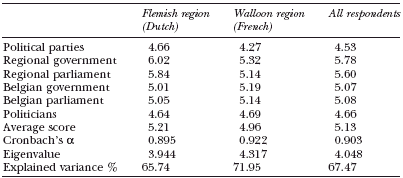
In this survey political trust was operationalized by asking respondents how much trust they had in the following institutions: political parties, regional government (Flemish or Walloon region), regional parliament, Belgian government, Belgian parliament and politicians. For each of these institutions respondents could indicate their trust levels on a scale ranging from 0 to 10. A factor analysis indicated that these six items form a one-dimensional and solid scale, with a Cronbach's alpha of 0.90 (Table 1).
Political Trust in Belgium

Source: PartiRep study 1990, n = 2,247.
Note: Entries are scale averages. Data are weighted by region to correct for slight differences in age and gender distributions.
Table 1 shows that in both regions trust in the regional government and parliament is higher than in the federal institutions, although this difference is more apparent among the Dutch-speaking respondents. This larger gap between regional and federal institutions in the Dutch-speaking respondents also accounts for the slightly weaker internal coherence of the scale for these respondents. It is also worth noting that the average trust level in the Walloon region is lower than it is in Flanders. Despite the success of populist parties in the Flemish region and their virtual non-existence in Wallonia, distrust actually seems to be stronger in the Walloon region.
In general, we can be confident that the PartiRep study is quite representative for the general population. If we compare the results with those of the European Social Survey (ESS),Footnote 49 it is striking that the rank order of the institutions is identical, with parliament receiving the highest trust scores, while there is less trust in politicians and political parties. The comparison with ESS also demonstrates that it makes sense to introduce a distinction between the various institutions. In the 2006 European Social Survey, respondents were simply questioned about their trust in ‘parliament’, without receiving any information about the specific level.
ESS results suggest that political trust was slightly lower in Wallonia than in the Flemish region. The PartiRep figures, however, demonstrate that respondents in Flanders actually have less trust in the federal institutions than respondents in the Walloon region. The higher average score in the Flemish region can be entirely attributed to the higher level of trust that these respondents have in the regional institutions than in the federal institutions. Given the strong one-dimensionality of the political trust scale, it is acceptable to use a simple additive scale, ranging from 0 (no trust at all) to 60 (very high trust in all six institutions).
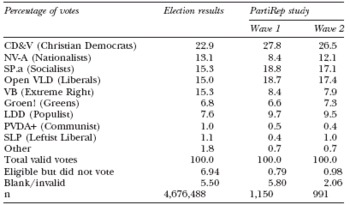
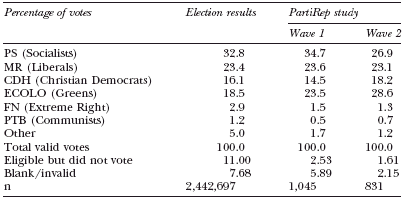
While the question on political trust was only included in the first wave of the PartiRep study, voting intentions were questioned in both the first and second waves of the survey. Tables 2 and 3 present a comparison between the results from both waves and the official election results of 7 June 2009.Footnote 50 As can be observed, the PartiRep results roughly correspond with the election results, with deviations that are common in this kind of research. In the Walloon region, for example, the green party is overrepresented since the specific demographics of the green voters usually imply that these voters are more easily included in this kind of electoral research. Similarly, the extreme right Vlaams Belang is underrepresented. In general, the results of the second wave are more closely in line with the election results than those from the first wave, especially in the Flemish region. Therefore, we will use voting preference as expressed in wave 2 of the PartiRep study as the dependent variable in our analysis.Footnote 51
Election Results of the PartiRep Study (Flemish Region)

Source: PartiRep study 2009 and official election results.
Note: Data are weighted by region to correct for slight differences in age and gender distributions.
Electoral Results of the PartiRep Study (Walloon Region)

Source: PartiRep study 2009 and official election results.
Note: Data are weighted by region to correct for slight differences in age and gender distributions.
Furthermore, the most important socio-demographic control variables were added – age, education level and gender.Footnote 52 These were obtained in the first wave of the PartiRep study. We also added a variable measuring whether voters would participate in elections if this was no longer compulsory. The question was phrased as follows: ‘If voting for parliament were no longer compulsory in Belgium, would you always, most of the time, some of the time or never vote?’ (see Appendix for a description of all variables).
POLITICAL DISTRUST AND THE EXIT OPTION
The most straightforward way of expressing distrust is not to vote at all. As mentioned above, around 9 per cent of the electorate chooses not to vote during elections in Belgium, despite the legal obligation to do so. Information on this group, however, is lacking, as we do not know if they do not vote because they are unable to (for example, due to sickness or reduced mobility) or because they do not want to. Furthermore, survey research fails to assess this phenomenon adequately, as is the case with all kinds of illegal behaviour.
In the PartiRep study only 1.3 per cent of all eligible voters indicated that they had not voted during the previous elections. This low number might be due to selective recruitment (potential respondents do not participate in the survey for the same reason as they do not show up during elections), or by an unwillingness to admit to a form of illegal behaviour in the interview. In any case, the numbers are so low that this group cannot be analysed in a valid manner. This lack of reliable survey data forces us to investigate the occurrence of the exit option in a more indirect manner. First, we will report real-life data on abstention and blank or invalid voting. Second, we will discuss the results of a hypothetical survey question on the possible consequences of the abolition of compulsory voting.
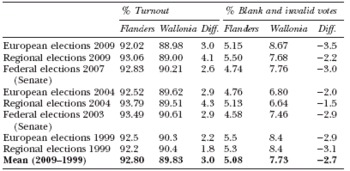
First, the official electoral statistics (Table 4) suggest that turnout and blank or invalid voting has remained stable during the previous decade. A comparison of different forms of elections (European, regional and federal) also suggests that the type of election does not have much of an impact on turnout. What we can observe, however, is that the average turnout is 92.8 per cent in Flanders and 89.8 in the Walloon region – a difference of 3 per cent. While 5.1 per cent of all Flemish voters cast a blank or invalid vote, this is 7.8 per cent in Wallonia; a difference of 2.7 per cent. These percentages show that in the region with the lowest trust levels, turnout is lower and blank or invalid voting is higher, which might serve as a very indirect indication that political distrust is indeed associated with refusal to vote, or blank or invalid voting.
Turnout Figures and Invalid or Blank Voting (1999–2009)

Source: Ministry of the Interior, at http://www.elections.fgov.be/.
Second, including a hypothetical question in the election survey can help us to gain more insight to the exit option. While respondents might not be willing to admit to any actual non-voting behaviour, they might be prepared to express a hypothetical unwillingness to vote if Belgium were to abolish compulsory voting. We asked respondents whether they would abstain from voting if the legal obligation to vote was abolished in Belgium, rendering the exit option more viable.
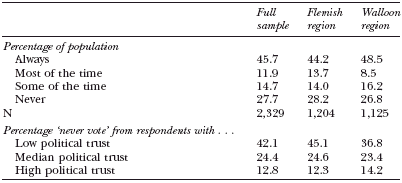
Table 5 shows that turnout would drop by approximately 25 per cent if compulsory voting were abolished. A quarter of all respondents claim they would never bother to vote again if compulsory voting was abandoned. In this regard, there is hardly any difference between the two regions of the country. It can be observed that among the most distrustful part of the population 42 per cent of all respondents indicated that they would not participate in elections any more, while this is just 13 per cent among the most trusting part of the population. Apparently those who feel distrust towards the political system are inclined to follow the exit option, but they refrain from doing so because of the system of compulsory voting in Belgium. The fact that the courts hardly ever prosecute non-voters does not imply that the compulsion no longer has a deterrent effect on would-be non-voters.Footnote 53 These first results therefore already suggest that the legal obligation to vote by itself is sufficient to exclude the exit option for most people.
Willingness to Vote if Compulsory Voting Were Abolished

Source: PartiRep study 2009.
Note: The political trust variable is divided in three equal categories: low political trust 0–29, median political trust 30–35 and high political trust 36–60. Data are weighted by region to correct for slight differences in age and gender distributions.
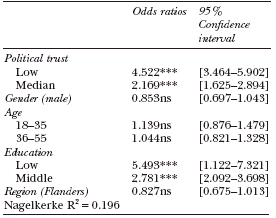
In order to test the independent contribution of political trust to abstention, a logistic regression was performed including several control variables. The results in Table 6 show the likelihood that respondents would abstain if compulsory voting were abolished. Respondents with low levels of political trust are 4.5 times more likely to abstain than respondents with high levels of trust. Furthermore, less-educated respondents are 5.5 times more likely to abstain than higher-educated respondents.
Explaining Likelihood to Abstain

Source: PartiRep study 2009.
Note: Entries are the results of a logistic regression. *** = p < 0.001.
POLITICAL DISTRUST AND VOICE
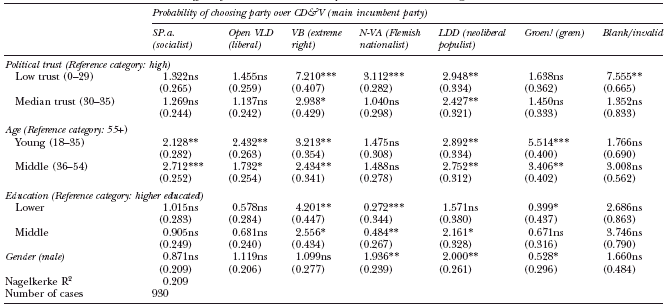
This study's main interest lies in the effect that political trust might have on party choice: will dissatisfied voters voice their grievances by voting for a populist or extremist party? In order to answer this research question, we estimated a multinomial logit model. This analysis is an extension of the binary logit models in multiple-choice settings.Footnote 54 The results of the multinomial logit analysis can be interpreted as the likelihood of choosing one party over another party: values higher than 1 indicate that increases in the independent variables boost the likelihood of choosing one party over the reference category. As reference category we have chosen the main incumbent party, which is the largest party in the coalition government leading the regional government – the Christian democratic party CD&V in the Flemish region and the socialist party PS in the Walloon region. Given that Flanders and Wallonia have different party systems, the analyses will be performed separately for each region. Political trust will be divided into three roughly equal categories in order to ensure that the parameters are estimated correctly.Footnote 55
In the Flemish region (Table 7) political trust has no effect on votes for the different parties that make up the regional government (SP.a. or Open VLD), nor does it have any impact on votes for the Flemish green opposition party (Groen!). In line with our first hypothesis (H1), it is clear that distrust has a very strong effect on the likelihood that voters will cast a blank or invalid vote. However, distrusting voters are just as likely to vote for the Vlaams Belang, which is also the case – although to a lesser extent – for the populist LDD and the nationalist N-VA party, thus confirming hypothesis 2. Furthermore, less-educated voters are more likely to vote for the Vlaams Belang, while the Flemish nationalist N-VA and Groen! attract rather higher-educated voters. Men have a stronger preference for LDD and N-VA than do women.
Effect of Political Trust on Party Choice in the Flemish Region

Source: PartiRep study 2009.
Note: Entries are odds ratios. Standard errors between parentheses. Baseline choice is the Christian democratic party (CD&V), which is the largest party, leading the regional government. Significance: *p < 0.05, **p < 0.01, ***p < 0.001.
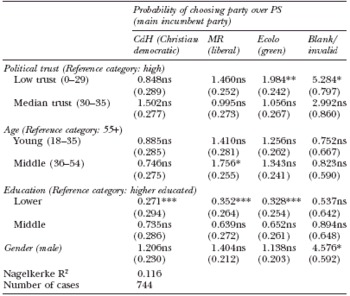
For the Walloon region, the analysis proceeds in exactly the same manner and the results in Table 8 demonstrate the consequences of political trust for party choice in this region. In Wallonia distrusting voters are also more likely to cast a blank or invalid vote, although this effect is not as strong as in Flanders.Footnote 56 Hypothesis 1 is therefore also confirmed for the Walloon case. Political distrust has a positive effect on votes for the green party (Ecolo). Furthermore, it can be observed that the explained variance for the Walloon model (.116) is smaller than for the Flemish model (.209).Footnote 57 In general, the effect of political trust on party preference is rather small in the Walloon region.
Effect of Political Trust on Party Choice in the Walloon Region

Source: PartiRep study 2009.
Note: Entries are odds ratios. Baseline choice is the socialist party (PS), which is the largest party, leading the regional government. Significance: *p < 0.05, **p< 0.01, ***p < 0.001.
Overall, political trust in Wallonia only affects the preference for the green party and blank or invalid voting. Moreover, these effects remain limited compared to the effects in the Flemish sample. The analysis of the Walloon sample thus lends support to hypothesis 3: in party systems where no viable populist party exists, the impact of political trust on party preference remains limited. The voice option is apparently not a viable option in the Walloon party system.
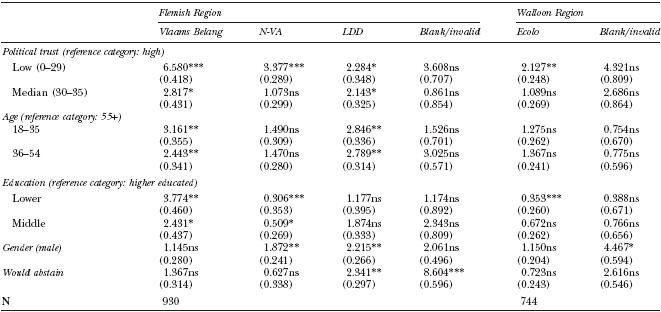
The previous analyses have confirmed hypotheses 2 and 3: trust negatively affects the preference for extreme and populist parties, while the explained variance is lower in the absence of a populist challenger. Hypothesis 1, however, suggests that the relation between trust and invalid voting is influenced by the presence of a system of compulsory voting. The analysis in Tables 7 and 8 indicates that a propensity to vote in an invalid manner is positively associated with political distrust. We can take the analysis a step further by investigating whether this effect remains significant if we take into account the effects of a possible abolition of compulsory voting in Belgium. This is done by examining whether the relationship between political trust and electoral behaviour remains significant when the likelihood of voting after the abolition of compulsory voting is controlled for. For reasons of clarity, we only include the dependent variables that proved to be significant in the earlier analyses (Table 9).Footnote 58
Effects of Political Trust Controlling for Willingness to Vote

Source: PartiRep study 2009.
Note: Entries are odds ratios. Baseline choice is the Christian democratic party (CD&V) for the Flemish region and the Parti Socialiste (PS) for the Walloon region. Significance: *p < 0.05, **p < 0.01, ***p < 0.001.
The analysis confirms that the relation between political trust and a preference for Vlaams Belang, N-VA, LDD or Ecolo is not dependent on the system of compulsory voting. Even when the willingness to vote is controlled for, the relationship between trust and a preference for these parties remains significant. LDD voters are more likely to abstain from voting than N-VA, Vlaams Belang or Ecolo voters, but for that party as well, the effect remains significant. Both in the Flemish and in the Walloon regions, however, it can be observed that the relation between trust and a blank or invalid vote is rendered non-significant when the willingness to vote variable is included. These results clearly suggest that distrustful voters would like to abstain from voting altogether, but that the current system of compulsory voting makes them opt for a blank or invalid vote instead. Even without compulsory voting, however, distrustful voters would still have a preference for Vlaams Belang, N-VA or LDD in the Flemish region of Belgium.
DISCUSSION
In our analysis of the Belgian election study by PartiRep, the effect of political trust on electoral behaviour has been examined in a very specific European context. Belgium has two distinct party systems. While populist and protest parties are well represented in Flanders, these parties are almost non-existent in the Walloon region. This implies that distrusting citizens in the Flemish region have the option of voting for a viable populist or extreme right party; this option is not available for voters in the Walloon region.
The Belgian system of compulsory voting presents a unique case study as to whether dissatisfied voters will refrain from voting. The analysis shows that the system of compulsory voting leaves a blank or invalid vote as the only available exit option, and distrusting voters tend to make use of it. However, if the current system of compulsory voting were abolished, distrusting voters indicate that they would no longer vote at all. This suggests that invalid voting is preferred because electoral abstention is not a viable choice in Belgium. If compulsory voting were abolished, the relation between political trust and invalid voting would be rendered insignificant.
It has to be acknowledged that even in a system of compulsory voting, citizens clearly have sufficient means of voicing their discontent with the main political parties. During the 2009 elections, 9.6 per cent of all Belgian enfranchised voters did not vote. Furthermore, an additional 5.7 per cent of all enfranchised citizens cast a blank or invalid vote. While it is very likely that both groups are at least partially motivated by political distrust, data limitations do not allow us to develop a comprehensive causal model for both these groups based on the current survey data available. Finally, another 13.3 per cent of all enfranchised voters voted for an extremist or populist party, bringing the total of potentially alienated voters to 28.6 per cent of the electorate.
In a system of compulsory voting invalid voting apparently serves as a functional equivalent of abstention. Still, there is a clear difference in the incentive structure. Abstaining is the easiest exit option, as it does not require any effort at all from the citizen. It could therefore be argued that there is a positive incentive to abstain from voting. Invalid voting, however, requires voters to go to the polling station, wait their turn and cast an invalid vote. In practice, only 6 per cent of Belgian voters bother to do so, but it is likely that more than 25 per cent of potential voters would abstain if there were no legal obligation. It is thus safe to assume that the system of compulsory voting boosts turnout levels in Belgium by at least 20 per cent.
Clearly, this confirms hypothesis 1: in a system of compulsory voting low levels of political trust will lead to invalid and blank voting. Hypothesis 2 is partially supported in the Flemish case: even in a multivariate model, low levels of political trust had a strong impact on voter preference for the extreme right Vlaams Belang and the populist LDD. Somewhat surprisingly, there was also a positive relation with a preference for the Flemish nationalist party. This might be due to the populist discourse of this party's leader.
In the Walloon case, on the other hand, political trust had far less of an effect on party preference. Only the green party benefited from sentiments of distrust, but the effect was much weaker than we found in the Flemish case. This thus confirms the hypothesis developed by Hetherington that the effects of political (dis)trust are influenced by the specific political context. If – for various system-related or historical reasons – no reform or protest vote is possible, political distrust does not seem to have a profound effect on electoral behaviour. If the exit option does not exist (for legal reasons) and voice is excluded (for a lack of political opportunities), political distrust can only lead to loyalty. Although levels of political trust are actually lower in the Walloon region, this does not seem to have an impact on party preference. Distrusting voters in the French-speaking part of Belgium are clearly more reluctant to express their discontent. This therefore confirms hypothesis 3: without a supply of populist parties, distrusting voters will remain loyal to the traditional parties.
It is not within the scope of this article to try to explain why there is no viable populist party in the Walloon region. The minority position of Wallonia within the Belgian federation might cause Walloon voters to prefer strong, traditional parties to defend the interests of their region, while these parties have also been quite successful in maintaining their local presence in the communities of the region. The lower success rate of extreme right parties in the Walloon region might be explained by the legacy of the Second World War and that there is greater cultural diversity in the Walloon region than in the Flemish region, despite equal levels of racism and distrust.
The literature generally takes for granted that it is ‘good’ for the long-term stability of a political system if dissatisfied voters can somehow voice their discontent. If the hypothesis of Miller and Listhaug is correct, this implies that voters in the Flemish region effectively have an opportunity to express their discontent.Footnote 59 Voters in the Walloon region, on the other hand, do not seem to have any viable way of expressing their discontent. Theoretically, this confirms the notion developed by Bélanger and Nadeau that the electoral consequences of distrust strongly depend on the opportunities offered by the electoral and the party system. Although the long-term consequences of this lack of voice and exit options still require further investigation, the data currently available do not show any indications that political trust declines more rapidly in the Walloon region, where voters do not have access to a viable option to express their distrust, compared to the Flemish region, where various political parties offer voters ample opportunity to express their discontent.
APPENDIX
Descriptive Statistics