1. Introduction
In an interesting paper, Fong (Reference Fong2020) raises objections to my approach to English modals (and modality in general) which he views as too general and not fully compliant with the postulates of Construction Grammar. In this response paper, I intend to explain in some depth the benefits of my approach, as well as the reasons why Construction Grammar, in particular Cognitive Construction Grammar (Goldberg, Reference Goldberg1995, Reference Goldberg2006, Reference Goldberg2019), needs to be interrogated and adapted as a conceptual framework to explain language learning and processing.
In the first place, it is important to note that Construction Grammar (CxG) is not a monolithic framework (see Goldberg, Reference Goldberg2006: 215), but a family of approaches having in common notions such as construction and usage as the basis for the analysis of linguistic constructions. In this sense, my contribution to the analysis of English modals published in ET should not be read as an outgrowth of traditional CxG, but a proposal ushering a renewed view on what counts as construction in connection with embodied cognition.
2. A paradigmatic shift
The impression one gets after reading Fong's criticisms is that the author, though conversant with CxG, has, at best, got all his facts crossed regarding the gist of my paper. For example, Fong takes me to hold that the modal verb projects a thematic role upon an object. This interpretation rests on a fundamental misconception in CxG, namely that individual modals convey clause-level modality. There is nothing whatever the matter with that. Fong's account here is hard to follow, and does not correspond to anything I have held, which leads us to conclude that the author should have invested more time analyzing the benefits of me positing modal clusters, that is, the combination of a central modal and a full verb (projecting thematic roles), as a means to establish a systematicity in the cognitive analysis of English modals (a description that has remained elusive thus far, as the absence of references in Fong's article reveals), rather than making sweeping generalizations with no solid conceptual basis.
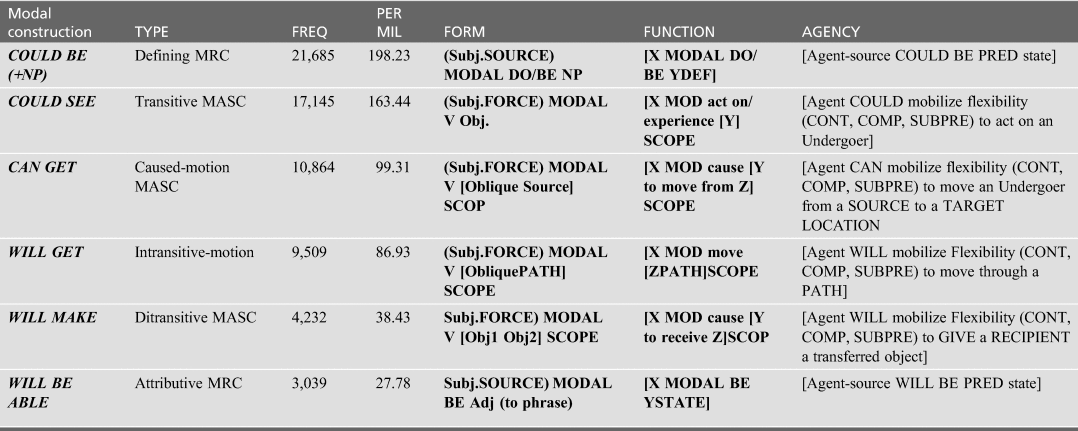
Thus, as I argued, it is the combination of modal clusters with specific argument structure constructions (ASCs) which provides a sense of systematicity in the description of modality in English. As shown in Table 1, the combination of modal clusters and predicate content successfully accounts for syntactical-semantic information, thereby providing a glimpse into patterns of usage in accordance with both motional and stative modality. The main conclusion is that the argument structure is not modal per se, since it only provides a semiotic scaffolding for the assignation of thematic roles associated with the full verb. In addition, it provides valuable information regarding the embodied component of the utterance. So, the false dilemma of whether modal clauses are simple or complex sentences, is downplayed altogether, since the objective is to unveil the cognitive substratum of modality, rather than to continue fruitless discussions on grammatical theory.
The most frequent modal constructions in the Corpus of Contemporary American English (Davies, Reference Davies2008).

Having misinterpreted this simple distinction, Fong goes on (rather undisturbedly) to conflate modality and syntax. Indeed, the notion of force is not associated with the syntax of the modal clause, but the agentive layer encoded in it. Here, it is evident that Fong's affiliation to an outdated definition of construction and constructional meaning, prevents him from understanding the role of the agent conceptualizer as either a source or force of specific modal events. The bad news for old-school grammarians such as Fong is that even Goldberg has moved on, as her new definition of construction reveals. Thus the new version of what counts as construction includes the speaker creativity as an important element in the conceptualization of language:
[C]onstructions are emergent clusters of lossy memory traces that are aligned within our high-(hyper!) dimensional conceptual space on the basis of shared form, function, and contextual dimensions (Goldberg, Reference Goldberg2019: 7).
Crucially, prior to Goldberg's shift to a triadic view of constructions, my ET paper (originally published online in 2018) introduced the view that agency, in addition to form and function, is a requirement for the comprehension of the role of linguistic constructions in the reconstruction of bodily experience through language:
[E]mbodied agency is said to unveil the richness and diversity of form-meaning associations without having to postulate an overwhelmingly complex inventory of constructional specification (Torres-Martínez, Reference Torres–Martínez2019a: 56).
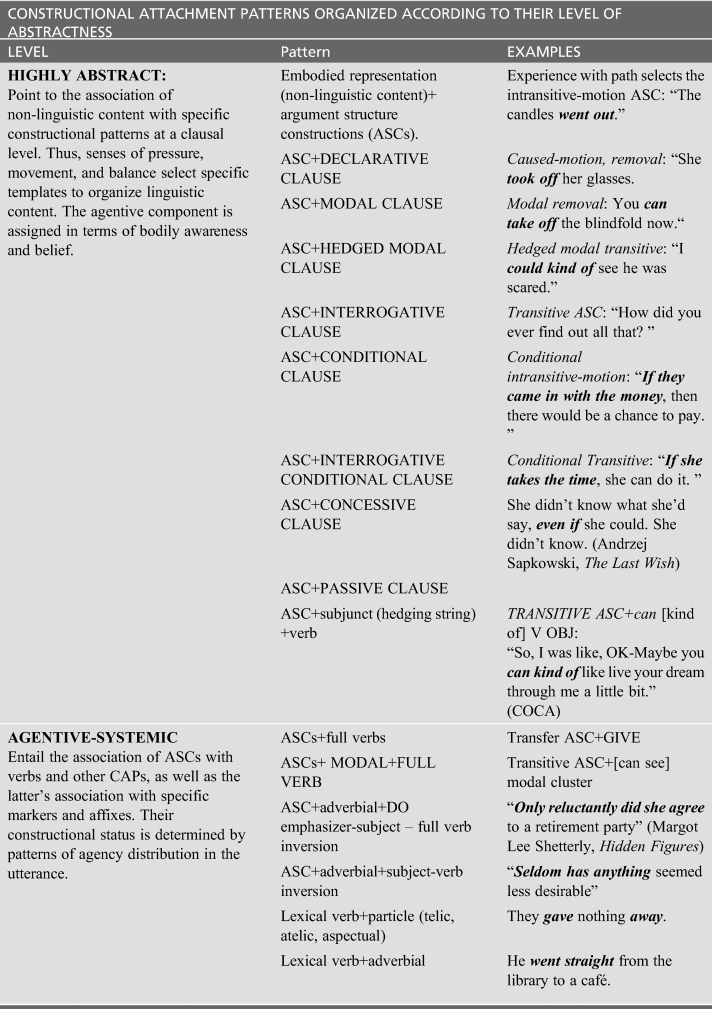
The underlying claim was that language has a strong speaker-meaning component that guides usage in social contexts. This conclusion rid us of the assumption that language is mechanically constructed from within the system (the Saussurean Langue) as a means to talk about the objective world. The positing of modal clusters is thus conditional upon precisely the existence of constructional attachment patterns (CAPS, that is, hypothesis-driven relations among constructions) that account for an embodied perceptually driven type of reality reconstruction (see Table 2).
A partial list of constructional attachment patterns in English.

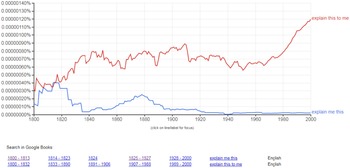
For example, a cursory search in Google Books NGram Viewer (Figure 1) reveals that the decline in the use of the ditransitive construction ‘explain me this’ (see example 1) in favor of the prepositional dative ‘explain this to me’ (both were indeed competing patterns in the 1820's) is not the product of constructional efficiency or competition only (as Goldberg claims), but the result of a combination of agentive selections regulating the activation of mental representations:
(1)
a. “Explain me this if you can?”
(The British Review . . . , Volume 34, 1820)
b. “Explain me this, Lenwood, explain me this”
(St. John Lucas, The First Round, 1920)
Screen grab from the Google Books NGram Viewer featuring the decline of the ditransitive ‘explain me this’ and the increment in usage of the prepositional dative construction ‘explain this to me’

As we can see, CAPS have the potential to provide speakers with a shared sense of event partition both in time and space in the world. The reason is that it is those patterns that have been experienced often enough which have a psychological reality and not those units (constructions) “that are well-suited to linguistic descriptions of language” (Samuel, Reference Samuel2020: 1, pagination added). Therefore, constructional attachment patterns, and not constructions themselves, become activated and further combined as a result of embodied cognitive selections in a context of usage.
In keeping with this characterization, the suggestion was that embodiment allows agents to ‘aim at the world’ in the Husserlian sense, that is, to engage in intentional acts mediated by our perception of the world through different senses. This provides a solid conceptual framework for an alternative definition of constructions as
triads of form, function and agency that arise out of the conjunction of specific constructional attachment patterns, that is, embodied constructional arrangements organizing both high-level (e.g. abstract syntactic patterns) and low-level constructions (e.g. words, morphemes, affixes, etc.) in networks of interconstructional relations motivated by agentive selections.
As we can see, contrary to Fong, the emphasis is not made on levels of constructional abstractedness, but on the various ways CAPs provide speakers with tools to extend their cognition in a social context. These subcomponents are encoded linguistically by means of specific ASCs that act as integrating frames ‘allowing the linguistic representation of complex events as instances of simple clause constructions’ (Mandelblit & Fauconnier, Reference Mandelblit, Fauconnier, Foolen and van der Leek1997: 167). Thus, the function of ASCs is to encode and organize incoming signals that need to be expressed linguistically. This becomes clearer if one brings into discussion the ways how the process of signal recognition in language depends on several particulars, namely ‘what the decider knows, his or her expectations and beliefs, how later information affects the interpretation of the original observations, and the like’ (Wickens, Reference Wickens2002: 4). These particulars are guided by two basic embodied reenactment principles whereby concepts rely on simulations of experience:
1. Exteroceptive signals (coming from the environment) motivate motor reenactment in motional events (including lexical priming).
2. Interoceptive signals (coming from the inner body) motivate emotional reenactment (balance and self-stabilization are often the result of emotionally arousing stimuli) in non-motional events.
Another way of putting it is to say that the type of embodiment described in my ET piece has bearings on language usage beyond motional or spatial sense-encoding. Thus, ‘embodied agency can disambiguate the relation between root semantics and the speaker's stance encoded by the modal in the form of epistemic senses’ (Torres-Martínez, Reference Torres–Martínez2019a: 55).
We can conclude that agency is not defined in terms of movement only, thus, the notion of stative agency is not an ‘oxymoron’ (as Fong misleadingly states), since stasis points to the activation of mental representations not mediated by physical stimulation or producing bodily output. Therefore, the phenomenological level of interoceptive sensations, e.g. ‘feeling one's bladder or stomach full’, and interoceptive feelings, e.g. ‘feeling hungry or thirsty’ (de Vignemont Reference De Vignemont, Tsakiris and Preester2019: 260), can be associated with modal idiom constructions such as [would rather have N]. As we see in example (2), the agent addressee's response requires a specific emotional alignment defined by the agent's awareness of internal organs such as the heart or the stomach.
(2) Who would you rather have on the trip?
So we see that the traditional association of this construction with the category of volition is insufficient to account for the whole host of emotions and agentive relations involved in the use of this specific construction.
As shown in Table 3, different modalities provide agent-conceptualizers with robust perceptual tools for the conceptualization of reality. For example, interoception comprises four main dimensions: 1) interoceptive accuracy (that is, the definition of organ-specific functions), 2) interoceptive sensibility (that is, personal beliefs and perceptions of an agent), 3) interoceptive awareness, i.e. the confidence of a performer in the judgement of the accuracy of a task outcome, and 4) interoceptive emotional evaluation representing ‘subjective appraisal related to sensations and perceptions of interoceptive signals’ (Herbert & Pollatos, Reference Herbert, Pollatos, Tsakiris and De Preester2019: 166). The interplay of interoceptive processing coming from the inner body and proprioception, mainly related with processes of perception of signals coming from the outer world, provides conceptualizers with a sense of bodily ownership and boundary to outside phenomena. The agentive dimension of the process is therefore best understood as a belief-driven sequencing of signals that are projected by the agent onto the environment at different levels of agency distribution. As a result, the combination of CAPs is possible because the constructions used to assemble utterances are learned strings of combinatorically non-conflicting potentialities and not stored symbolic units. The processing advantage of seeing constructions as patterns is evident, since this approach provides the necessary flexibility for the comprehension of language diversity and uniqueness as a tool for communication. Thus, instead of relying on a rigid set of symbols combinable in specific sequences, speakers use learned CAPs to convey meanings that reflect not only community-oriented sensibility, but also a need to project individual meaning through language. We see this in the use of the modal construction [seem to be + V-ing]. As we see in example (3), the conceptualizer utilizes a combination of constructions that reflects the need to pass on epistemic meaning with the addition of temporal information.
(3) The sound seemed to be coming from up the river.
Table 3:Mapping of CAPS in an embodied model.


The embodied component encoded in the utterance is clearly associated with aural perception whereby the reenactment of signals is skewed toward this modality. This involves the identification of the location of the incoming signal in terms of feed-forward prediction errors, which are, however, overridden by visceral influence. The reason is that event reconstruction in modal events requires conceptualizers to couple inner-body awareness before priming exteroceptive reenactment. In other words, speakers require to first create a context for self-stabilization in order to engage in feed forward-processing. Interoceptive processing is thus a requirement for context-sensitive motor-language coupling in utterances involving action verbs. Another reason is that epistemic meanings are balance-oriented, which prompts the creation of mental spaces that privilege belief over evidence. In the case of the sentence in (4), the way to representation takes the conceptualizer through three basic stages, namely 1) the reconstruction of factual experience, 2) the reenactment of this experience, and 3) the modalization of the experience in an epistemic space. Although the perception of a sound coming from a specific location requires the combination of several modalities, the actual perception of the sound primes aural signals over motor and visual ones.
This is most evident in example (4) where an agent-narratee places the focus on an emotional component to encode meaning in an epistemic utterance. Therefore, the semi-auxiliary construction [be about to be +attribute], displays all the characteristics of an event in which the agent mobilizes flexibility through the assignation of accountability to a subject.
(4) He wasn't about to be vulnerable to her.
3. Is the ASC approach to English modals pedagogically compelling?
Fong raises doubts about the possibility of teaching modal constructions from an agentive, clause-based perspective. I agree with Fong that ‘[l]earning of the uses of English modals must entail that learners master both lexical and constructional information of English modals.’ (Fong, Reference Fong2020). However, as discussed, the ASC baseline accomplishes precisely this thanks to its emphasis on CAPs rather than symbolic units.
What is clear is that, if we were to apply the outdated definitions of constructions endorsed by Fong (e.g. Goldberg, Reference Goldberg1995, Reference Goldberg2006), with views to identifying relevant prototypes to be included in the L2 input, we would end up with an overwhelmingly vast network of items with no clear pedagogical implications, since ‘[s]tudies of constructions tend to treat specific examples which are convincing in terms of the concept of “construction” but which do not progress towards a systematic description of a language’ (Hunston & Su, Reference Hunston and Su2017: 4). This ontological gap cannot be filled through recourse to provisional epistemologies justifying the study of a phenomenon that is poorly understood.
The criteria underlying the selection of specific constructions for pedagogical exploitation thus requires the design of a more refined cognitive type of instruction. Furthermore, I would like to argue that the best way to inform cognitive instruction is by the selection of those modal CAPs that display high levels of frequency in specific registers. This requires three levels of conceptualization that complement the insights of both corpus linguistics and CxG:
1. The selection of a pedagogical cognitive theory that links corpus and psycholinguistic research with language instruction.
2. The introduction of constructions as prototypes through ad hoc input.
3. The adoption of a type of instruction that combines both noticing and characterization tasks (see Torres–Martínez Reference Torres–Martínez2014, Reference Torres–Martínez2015). This will facilitate the use of a type of pedagogy that emulates natural language learning.
In the context of Applied Cognitive Construction Grammar (ACCxG, Torres–Martínez, Reference Torres–Martínez2016, Reference Torres–Martínez2017, Reference Torres–Martínez2018b, Reference Torres–Martínez2018c Reference Torres–Martínez2019b, Reference Torres–Martínez2020), this can be accomplished through the introduction of constructional tasks based on Robinson's Cognition Hypothesis (Robinson & Gilabert, Reference Robinson and Gilabert2007) whose focus is on
exploring how tasks could be used to nurture general capacities of awareness, with attention and facility across the task, rather the way an athletics coach might use exercises of different design and under different conditions to promote awareness, strength, mobility, and precision (Bygate, Reference Bygate2016: 6).
Central to this rationale is the notion of task complexity defined as ‘the result of the attentional, memory, reasoning, and other information processing demands imposed by the structure of the task on the language learner’ (Robinson, Reference Robinson2001: 29). According to Robinson the more complex the task, the more accurate is the task outcome. For example, once the main features of modal constructions have been presented to learners, the type and frequency of both Modal ASCs and Modal Referential Constructions can emerge as categories based on similarity relations.
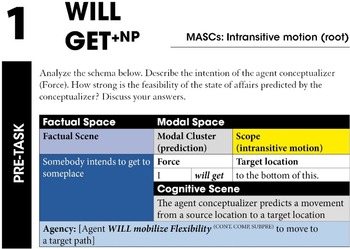
As shown in Figure 2, modal agentive tasks are based on the structure of specific modal clusters (placed at in the upper left or right corner of the handout). Thus, intransitive-motion clusters (will get being the most frequent in the Corpus of Contemporary American English), ditransitive (will/would make) and caused-motion clusters (can/could get) are used as prototypes for the inclusion of other full verbs in which the combination of a modal+perception verb and modal+transitive verb respectively is analyzed.
A sample of a modal task.

In sum, the introduction of modal constructional tasks results from the conjunction of a robust theoretical conceptualization of what count as a construction and the resulting identification of these constructions in large corpora. This is a prerequisite for the design of constructional input that can be seamlessly introduced in ELT classrooms.
4. Conclusion
This response article has explained some of the concepts introduced in Torres–Martínez (Reference Torres–Martínez2019a). At the heart of this rationale is the idea that English central modals are instances of argument structure constructions, and hence, can be disambiguated semantically through an analysis of specific CAPs. As a proof of the theoretical soundness of my approach, the present rationale has been used to explore patterns of agency distribution in languages such as Chinese (see Zhang, Reference Zhang2019), which defuses Fong's unfounded accusations of linguistic relativism associated with my theory.
The theoretical framework laid out also seeks to inform L2 pedagogy by providing a more systematic, and by far more reliable means to understand linguistic constructions. The purpose of this paper (and of my 2019a piece) is to consolidate a specific ontology for the conceptualization of modal constructions leading to the development of an epistemology more in line with L2 pedagogy. An important future direction for a type of cognitive research is, therefore, the validation of the psychological reality of modal constructions as instances of argument structure and the testing of the potential gains of cognitive tasks in the learning of modal constructions in a variety of pedagogical contexts.
 SERGIO TORRES–MARTÍNEZ is professor of cognitive linguistics, semiotics and translation semiotics. Among his main interests are Agentive Cognitive Construction Grammar, Cognitive Semantics, embodiment theory, phenomenology, Wittgenstein's philosophy of language, Peircean semiotics and the cognitive applications of construction grammar (Applied Cognitive Construction Grammar). The main objective of this research is to provide a comprehensive picture of English constructions that can be further connected with L2 instruction. Email: surtr_2000@yahoo.es