I. Introduction
What do you call a person who does research in law at a university? In languages such as German there is one single clear word for it (Rechtswissenschaftler) but in English the picture seems to be more confused: are you an “academic lawyer”, a “legal scholar”, a “legal researcher”, a “legal academic”, or even a “legal scientist”? All of these terms are used more or less frequently,Footnote 1 along with more general terms like “law lecturer” and “law professor”. The preference for a particular term is not only of terminological importance but it indicates a sense of belonging.Footnote 2 For instance, calling yourself an academic lawyer may emphasise the fact that you are primarily a lawyer, affiliating yourself with solicitors, barristers and judges. Conversely, the other terms put more emphasis on the university affiliation, but here there are further differences as well. For instance, someone who researches law from a historical perspective may want to be called a legal scholar, whereas someone who empirically tests hypotheses in law may prefer terms such as legal academic or legal (or social) scientist.Footnote 3
In this article we use a conceptual framework of “law as a practical discipline”, “law as humanities” and “law as social sciences” in order to map legal research. The classification of legal research is of interest for a variety of reasons.Footnote 4 It may determine where law is located within the often complex mix of faculties, schools and other subunits of universities. Such disciplinary barriers can matter, for instance, for whether and how legal scholars collaborate with other academics and practicing lawyers and how future legal scholars are trained and recruited. The question is also important as it can contribute towards an appreciation of the dominant paradigm (if one exists): individual academics may not want to be regarded as outsiders in their scholarly community, and, more tangibly, they may feel induced to pursue the type of research that funding agencies see as “relevant”, “acceptable” or within their scope.Footnote 5
Our article also fills a gap in the literature. While being aware of the extensive previous writing about research methods in law,Footnote 6 the originality of this contribution lies both in the method of analysis and in its discussion of the interplay between “macro” structures and “micro” choices within which researchers operate. More specifically, in Part III, we offer new insights in how at the “macro-level” law fits within the modern university structure, research funding system and the concept of broad disciplines. In particular, we have collected information on the position of all UK law schools within the structure of their respective universities, which has not been done in the previous literature; we also explain the reasons for drawing attention to this data. Part IV on the “micro-level” presents a new way of explaining individual research preferences, introducing and promoting the use of “ternary plots”. We also address the relationship between individual academics and university structures in a comparative context. First, however, the conceptual framework of this article will be explained.
II. Conceptual framework
This article is based on a distinction between three types of legal research: (i) a research tradition which emphasises law as a practical discipline, and approaches which position law as an aspect of (ii) the humanities or (iii) of the social sciences. This is not the only way of classifying legal research,Footnote 7 yet, for the purposes of this article it offers a suitable conceptual framework for mapping legal research.
To clarify, these three categories should be seen as “ideal types” of legal research that can potentially be applied to different legal systems.Footnote 8 Thus, this Part outlines conceptions of how legal research can be pursued, not a description of how this is done in a particular legal or academic system. This rationale also explains the choice of our three categories: as they refer to generic terms (“practical”, “humanities”, “social sciences”); they enable us to map, in the subsequent parts, how far institutions, individuals and legal cultures belong to one or more of those categories.Footnote 9
Law as a practical discipline can refer to research that is valuable for legal practitioners in drafting contracts, advising clients and mediating conflicts. It can also be closely related to the work of the courts. According to Susan Bartie the aim of such research is to examine the “internal puzzles raised by the judge's reasoning process” and to “unveil uniform principles”.Footnote 10 Legal research is then about a comparatively value-free analysis of legal rules, with the effect that law is an applied discipline where legal academics are “academic lawyers” who share the ethics of practicing lawyers.Footnote 11 This can be seen as beneficial since practical research may fulfil an obligation, held jointly with legal practice, to “serve the system of justice” through training future practitioners and addressing important issues for the legal system.Footnote 12 A possible weakness is that such academic lawyers may be “more familiar with legal professionals than with their colleagues from other faculties”, leaving the law school divided between the academic and legal worlds.Footnote 13
Following Peter Birks, practical legal research can be research that “criticises, explains, corrects and directs legal doctrine”.Footnote 14 Yet, doctrinal legal research is not identical to practical legal research. This can be seen in Mark Van Hoecke's taxonomy where he identifies legal doctrine “as a mainly hermeneutic discipline, with also empirical, argumentative, logical and normative elements”.Footnote 15 Some of these elements have a practical dimension but they also go beyond it: for instance, practitioners may have no interest in deep hermeneutical questions but they are of core interest to scholars in humanities, to which we now turn.
Frequent parallels are drawn between law and humanities and it has even been said that “(t)ypically, the discipline of law is regarded as part of the humanities”.Footnote 16 This follows from the view that positive law is composed of legal ought-propositions.Footnote 17 Legal scholars are therefore concerned with the understanding of these stipulations, i.e. the text of the law and its underlying ideas, or, to use Peter Goodrich's words, “the origins of the discipline of legal science are to be sought in a textual past”.Footnote 18 This view relates this approach to legal scholarship to interpretative disciplines such as history, philosophy, theology and literature which are generally recognised as having a primary affiliation with the humanities. In particular, claims are made as to the importance of legal texts:
“(t)he law is not simply a set of forensic or procedural skills. It is a vast body of knowledge, compounded of historical material, modes of textual analysis and various philosophical concerns. It is a formal inquiry into our behavior and ideals that proceeds essentially through language. It is a humanistic study – both as a body of material wrought of words and a set of analytic skills and procedural claims involving linguistic mastery”.Footnote 19
Thus, according to this view, the main commonality of law and disciplines of the humanities is that they have a shared interest in hermeneutics.Footnote 20 It is also possible to contrast law as humanities with the view that law should be primarily a practical discipline. Though both are interested in interpretation, the law-as-humanities scholar approaches the law with the pure aim of understanding, whereas the law as practical-legal-research scholar is interested in how it may be applied in practice.Footnote 21 To illustrate, Austin Sarat supports the turn to humanities to counter what he terms the “value-neutral and technocratic approach” of professional legal education, suggesting that legal scholarship should not be judged by its contribution to law practice and that it may well ignore lawyering except as an object of inquiry.Footnote 22
Turning now to our final category, law as a social science, we find a similar scepticism about merely finding out how to apply the law in practice. Treating law as a social science offers the opportunity to challenge the usefulness of court decisions and pieces of legislation from an external and often empirical perspective.Footnote 23 Reference can also be made to the common Enlightenment origins of legal systems and of social research.Footnote 24 Yet in order to discuss law as a social science more closely, we must look at particular branches of the social sciences and how they relate to legal scholarship.
For example, Richard Posner writes about “economists and economics-minded lawyers, who view law as a social science”,Footnote 25 constructing models of legal rules and evaluating their potential effect on overall social welfare. A view of law as a branch of political science would emphasise the way it exercises power and allocates resources.Footnote 26 Furthermore, legal research may benefit from approaches associated with sociology, and can be engaged with the empirical aspects of the social sciences. For example, such research may challenge legal doctrine by raising the question how and why judges actually decide cases.Footnote 27 A socio-legal scholar may also want to examine the “social origins, social conditions of existence, and social consequences” of legal ideas.Footnote 28 This may extend to quantitative empirical legal research that applies statistical and econometric methods in order to test whether and how legal rules matter in the real world.Footnote 29
Such empirical testing may have the aspiration to transform legal research to a hard social science, aiming to replicate the methods of natural sciences but in respect of social phenomena.Footnote 30 A similar linkage to natural sciences, such as biology, may be suggested if one wanted to construct law as a non-contradictory all-inclusive system of legal rules.Footnote 31 It may even be argued that “like any human or life science we cannot study parts of the law outside their organic context”.Footnote 32 Yet, overall, it is clear that natural scientists and legal scholars do not share the same methods. Thus, for the purposes of this article, we call our final category simply “law as a social science”, being aware that some social scientists may themselves be inspired by the methods of the natural sciences.Footnote 33
III. Macro-level: how does law fit within the university structure?
Published and peer-reviewed legal scholarship typically takes place in universities or other research institutions. Thus, this part examines the legal research environment in the UK. The first section explains that law schools have an ambiguous position within the structure of universities. Subsequently, we provide a comparison with the way how research councils and professional associations have dealt with the classification problem of legal research. Finally, we discuss how such affiliations matter, both in terms of practical consequences and of wider implications regarding the role of disciplines and interdisciplinary collaborations.
A. Mapping law schools within UK universities
There is some degree of pluralism regarding university structures, a matter which is within the control of an individual institution. For example, some institutions have a “flat” structure with a high number of single-discipline schools or departments, whereas others have implemented an intermediate structure of faculties, divisions or colleges. Further distinctions exist according to the precise allocation of responsibilities between the university, the faculty and the school level.Footnote 34
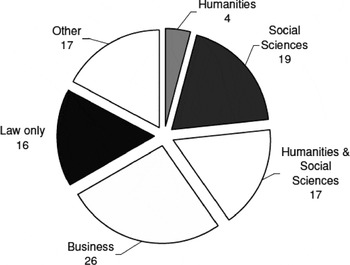
For the purpose of this article, we have examined all 99 UK universities in which academic units for law (schools or departments) are found.Footnote 35 As far as there exists an intermediate level, some universities have a joined faculty of social sciences and humanities (and/or arts), whereas others have separate faculties. There are also some universities with idiosyncratic faculty structures which we classified as “others”.Footnote 36
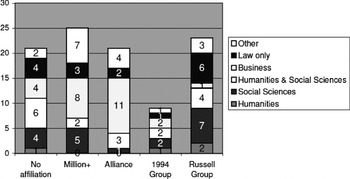
Figure 1 reports our general results. It can be seen that a wide range of models are used, and that rather than a clean division between law as humanities on the one hand, and law as social science on the other, 33% of all institutions either treat law as a unit of its own, potentially reflecting its sui generis character, or have already put humanities and social science together as one faculty, therefore avoiding a need to specify whether law is properly affiliated with humanities or with social science. Interestingly, a number of institutions include law in an academic unit of business or management, or a faculty of business and law (or, vice versa). In this respect it is helpful to distinguish between the approaches of so-called “mission groups”, i.e. the Russell Group, 1994 Group, University Alliance, and Million+.Footnote 37
Position of Law School within Faculty Structure (n = 99)

Figure 2 shows that the allocation of law to business schools is concentrated in the University Alliance and the ex-polytechnic Million+ institutions. The 1994 Group of smaller research-intensive universities is the group that has the highest proportion of law schools belonging to a faculty of social sciences. In the larger and older research-intensive Russell Group institutions law is frequently a faculty or school not belonging to an intermediate unit, and there are also two instances where it belongs to a faculty of humanities.
Position of Law School within Faculty Structure in Different University Groups (n = 99)

What explains these diverse classifications? According to Donald Campbell, writing about disciplinary distinctions in general, the “present organization of content into departments is highly arbitrary, a product in large part of historical accident”.Footnote 38 Thus, it is useful to outline the emergence and development of law schools in UK universities. Traditionally, English lawyers were not trained at university but in an apprenticeship system.Footnote 39 Law was seen as “a practical subject which can only be learnt by practice and not by systematic, scholarly instruction”.Footnote 40
Although from their earliest days Oxford and Cambridge taught some Roman law,Footnote 41 and Oxford established the Vinerian Professorship of Common Law in 1758, it was only in the early 19th century that the significant development of legal education began. This process led to the development of law schools similar to those currently in operation. The first “modern English law school” is said to have been established at University College London (UCL) in 1826, though this was initially not very successful with only three graduates with a degree in English law in 1839.Footnote 42 Thus, despite this innovation, in 1846 a Select Committee of the House of Commons felt the need to inquire into the state of legal education in England and Ireland. Its main recommendation was that:
The universities should teach law and should give degrees in the subject, but the legal education given by them should be ‘comparative and philosophical’ in character, whereas the Inns of Courts and the Law Society should establish a system of professional education.Footnote 43
Thus, at its origins, there was a close link to a field of humanities – philosophy – not legal practice. This is also reflected in the fact that in 1850 the first law school of the University of Oxford was a School of Law and Modern History, which only became a separate “final honour school of Jurisprudence” in 1872.Footnote 44 Still, the 19th century also saw a tendency towards making legal education more relevant for legal practice since Roman law teaching was gradually supplemented and replaced by English law.Footnote 45
In the 18th century, Scottish universities (under the influence of continental European ideas) developed an earlier interest in “scientific” legal thinking.Footnote 46 Yet, in Scotland too, more extensive university-based teaching of law only started in the 19th century. Initially, the approach to teaching was mainly “philosophical”, although the University of Edinburgh began to offer a course in conveyancing in 1825.Footnote 47 In 1864 Edinburgh introduced an LL.B. degree to encourage “academic studies of law”, and it appointed James Lorimer to the vacant chair of public law. Robert Anderson and colleagues describe the situation as follows:
Lorimer believed that law should be a scholarly and liberal study, not just a training for practitioners, and he argued that an expanded legal education could give a broad preparation, as in continental countries, for public service, diplomacy, journals and similar careers. But this idea never caught on in Britain. The LL.B. proved too advanced to attract more than a handful of candidates (…).Footnote 48
Thus, both in England and Scotland we observe a similar tension between legal practice and law as humanities at the very origins of law faculties. The next hundred years saw the emergence of social sciences as an academic field,Footnote 49 as well as the establishment of the “red brick”, “glass plate” and modern universities, sometimes with newer structures going beyond departments and disciplines.Footnote 50 There was also the trend to expand university legal education. This followed a growing demand for lawyers but also demonstrated that the trend to make law a subject that can be studied at university was continuing.Footnote 51
As far as the structural position of law within the university is concerned, however, in the early 1990s most UK universities still had a relatively “flat” structure, with law being a separate faculty and not part of an intermediate unit.Footnote 52 Thus, the integration of law schools into joined faculties has mainly been a development of the last twenty years.Footnote 53 The main reason why universities have moved towards intermediate faculties, combining various schools, has been the desire to save costs, for instance, by way of centralising administrative tasks and building “critical mass”.Footnote 54 From a critical perspective, this has been explained as a trend towards a restructured, corporatised and entrepreneurial university, aiming to contribute to the “knowledge economy”.Footnote 55 There have also been concerns that the humanities have become marginalised because, allegedly, they do not provide clear economic returns to society.Footnote 56
These considerations may be most clearly seen in the universities of Million+ and the University Alliance. They often have a general focus on practical and business-oriented education.Footnote 57 Typically, they also have relatively small law units: thus, there can be a valid case of “critical mass” in combining law and business. This contrasts with the relative conservatism of the universities of the Russell Group where a high proportion of law schools stand as independent academic units with a direct relationship with the university. Yet there is no easy answer to the question why in these and other universities law has become part of a faculty of social sciences or a faculty of humanities or a joined faculty. To some extent, the age of universities may play a role because older universities may have already had a faculty of humanities before social sciences became popular in the 20th century,Footnote 58 but other factors, such as the size, structure and focus of the specific university, are also likely to matter, alongside the research methods employed by legal academics, as considered below.
B. Comparison with external classifications
In addition to universities, organisations such as research councils and professional associations have been faced with the question of how to classify law. Research councils in the UK now cover the complete academic landscape, albeit with a recognition that there may be some issues at the boundaries between two or more councils.Footnote 59 For an individual academic unit the councils are important sources of income and of recognition, and are a distinct source of policy and of funding (i.e. alongside HEFCE and similar agencies in Scotland, Wales and Northern Ireland, which are responsible for the REF (Research Excellence Framework)Footnote 60 and for QR (quality-related) research funding). Law is one of the disciplines that causes difficulty as to which council should fund a given project, with the main councils in question being the Arts & Humanities Research Council (AHRC) and the Economic and Social Research Council (ESRC)Footnote 61. By way of clarification, the councils have stated that:
The AHRC supports research into the content, procedures, theory, philosophy and history of the law. This includes studies of legal systems and legislation in all periods of history and in all parts of the world. ESRC supports socio-legal studies, which are concerned with the social, political and economic influences on and impact of the law and the legal system.Footnote 62
The statement in which this passage appears also considers other borderline disciplines, including area studies, education, linguistics, cultural and media studies, and even history. Nonetheless, it does not explain what the basis of distinction is, such as, the research methods employed, the scope of the research, or other points of differentiation. Looking a little closer, it can be observed that the AHRC includes law in a review panel (Panel A) alongside history, philosophy and religion, while the ESRC includes “Social Legal” in a panel with sociology, political studies and anthropology, to name but a few.Footnote 63
Many disciplines are also represented by a learned society or professional association of some description.Footnote 64 As well as organising conferences, circulating news bulletins and issuing public statements, these organisations are called upon to represent the interests of the discipline, including for the nomination of peer reviewers for the REF. Law, however, has not one but three such associations, as well as a now-defunct Centre for Legal Education (formerly funded by the Higher Education Academy) and an association of Heads of School, CHULS. The three associations are the Society of Legal Scholars, the Association of Law Teachers, and the Socio-Legal Studies Association. The first two are different because the SLS once limited membership to scholars at established universities (thus excluding the former polytechnic institutions), so the ALT catered to the ineligible scholars. However, both organisations now welcome members from all institutions.Footnote 65 The SLSA presents a particularly interesting study for this article. It describes socio-legal research as:
embrac(ing) disciplines and subjects concerned with law as a social institution, with the social effects of law, legal processes, institutions and services and with the influence of social, political and economic factors on the law and legal institutions, (…) covering a range of theoretical perspectives and a wide range of empirical research and methodologies.Footnote 66
It is therefore apparent that, comparing the position of law within university structures with the external classifications of research councils and professional associations, only the latter organisations respond to the ambiguous status of law by purporting to split it into two parts – although what the two parts are is not the same between the councils and the associations, and many scholars join more than one association or apply to both research councils. This may demonstrate that, in principle, it is possible to develop substantive (albeit fairly generic) criteria for such a distinction.Footnote 67 Nonetheless, no UK university has attempted splitting law into two (or three) separate schoolsFootnote 68 while there are examples of law units dividing along other lines in Japan and Canada.Footnote 69 This raises the question about the relevance of the internal university structure for legal research, as there are competing influences on the self-identification of an individual researcher.
C. The influence of university structures on legal research
The trend towards intermediate faculties, combining various schools, has been driven in part by the desire to save costs.Footnote 70 Yet, internal university structures do not only matter in financial terms. In the following we distinguish between more practical and more abstract aspects, while also indicating how problems may be overcome.
First, such structures can have practical consequences for the research that academics pursue. For instance, if in its integration into a faculty of social sciences the law school is re-located within a joined faculty building, this may foster communication with academics from the other schools. There can also be linkages between financial incentives and collaboration across disciplines. For example, if it is assumed that fields such as business studies are better able to generate income than humanities, this may lead to research collaborations on topics such as law & finance, while reducing “the exploration of life's mystery and meaning”Footnote 71. The institutional arrangements of a higher education institution can also affect research more directly. Research training may be provided to doctoral students at a faculty-wide level, something which is fostered by the ESRC funding of doctoral training centres.Footnote 72 Often there are research offices at the faculty level. Here, it is not unrealistic to assume that a faculty research office located in a faculty of social sciences may advise legal academics quite differently on topics such as good research (in terms of RAE/REF) and research grants than a research office located in humanities.
Second, university structures influence the status and self-identification of academics. It has been said that there are different “academic tribes and territories” closely associated with identity and accounting for disciplinary barriers between social sciences and humanities, or more generally hard and soft disciplines and pure and applied ones.Footnote 73 Thus, if law is housed in a faculty of social sciences or a business school, an academic like Gary Watt, who is interested in “the soul or humanity of law”, may understandably say that such a “marriage between law and the humanities (is) something of a forbidden love”.Footnote 74
Of course, the benefits of collaboration between law and other disciplines are often emphasised. Transgressing disciplinary boundaries has been described as a rebellious, or even romantic, activity in the service of a greater truth.Footnote 75 Yet, this is easier said than done. Academic disciplines may be “intellectual silos”,Footnote 76 or tribes employing “devices geared to the exclusion of illegal immigrants”.Footnote 77 This is partly blamed on the way universities are structured: according to Becher, “if interdisciplinary specialisation is required in order to develop an innovation, the organisation of university departments often inhibits it”.Footnote 78
Specifically with respect to law, there is the further complexity of the relationship to legal practice. Thus, from the perspective of the law school, the problem may be that it has “two masters” since, at least, it has to coordinate with professional bodies in terms of teaching as well as the normal internal requirements of a university.Footnote 79 From the perspective of the legal profession it may be seen as a problem that it has to “compete (…) with other disciplines in the university for the attention of legal scholars”.Footnote 80 It has therefore be observed that there are ongoing tensions between university law schools and the legal profession on the respective roles of each, while the quality of the common law may depend on a strong relationship between legal scholars and judges.Footnote 81 There is also the apparent risk of a bifurcation between teaching and research, because taking account what is of interest for legal practice may be more important for the former than for the latter.Footnote 82
To foster collaboration within universities, a possible way forward may be to move away from the focus on monolithic and self-contained disciplines, schools and faculties.Footnote 83 Rather, there may be chains and networks of mutual appreciations,Footnote 84 and a sliding scale of similarities ranging from some shared ground to trade relations to common frontiers.Footnote 85 More specifically, it has been suggested to shift from “disciplines” to “specialisations”. These specialisations would retain the benefit of division of labour, but they could be structured more flexibly, for instance, in being grouped according to theories, methods or subject matter specialities.Footnote 86
In the UK, this is not merely an idea. At various universities there are interdisciplinary centres between law and (other) fields of social sciences or humanities, as well as between law schools and legal practice,Footnote 87 thus, again, showing the ambiguity of law's intellectual position. However, the RAE and REF has relied on a “unit of assessment” approach, which may encourage institutions to design academic units that match REF units,Footnote 88 and law remains a discrete unit of assessment for the forthcoming REF 2014.
IV. Micro-level: identifying preferences of legal academics
Legal research is subject to a range of competing influences. These concern the university structures, research councils and professional associations, discussed in the previous part, as well as other factors, such as the influence of heads of schools and other senior academics in steering early career colleagues in a particular direction. Yet, the individual researcher is not wholly dependent on these structures. It is therefore also necessary to identify more precisely how at the “micro-level” individual legal academics respond to the perspectives of law as a practical discipline, law as humanities, and law as social sciences. The first section of this part outlines previous research on this issue. Subsequently, we suggest that a ternary plot can be a useful conceptual tool to show individual, and often mixed, preferences of legal academics. Finally, we use such a plot to compare (based on literature) the development of UK legal scholarship with that in the US and Germany, also returning to the relationship between the macro- and micro-level (faculty structure compared with the preferences of individual academics), and consider possible future paths for the UK.
A. Studies on the affinity of contemporary legal research
This article is not the first one which tries to identify the predominant approach to current legal research. There are different ways how this question can be approached. To illustrate, three examples (from England, the US and the Netherlands) will be provided.
Based on interviews, Fiona Cownie examined the culture and identity of legal academics at English universities. In her approach she was inspired by Tony Becher's book on academic tribes and territories which explored the linkages between academic cultures (“tribes”) and disciplinary knowledge (“territories”) in twelve academic disciplines.Footnote 89 One chapter of Cownie's book deals with the preferred research methods of legal scholars, distinguishing between black-letter law, socio-legal studies, critical legal studies, and legal feminism.Footnote 90 Her main finding is that about half of the respondents described themselves as black-letter lawyers and the other half as belonging to one of the other approaches. Cownie also reports that many academics mix approaches, and that there is a gradual move away from pure black-letter law.
Furthermore, Cownie finds that the shift of research paradigms is not without problems. The desire to engage with more interdisciplinary work is often challenged by the way lawyers are trained in the British tradition.Footnote 91 With respect to the output of their research, some academics regret that the Research Assessment Exercises (RAEs) have meant that descriptive research, such as publications and textbooks intended for use by legal practitioners, are increasingly regarded as second rank activity.Footnote 92 Overall, Cownie observes that legal academics are somewhere in a no man's land, with minimal contact with academics from other disciplines and with members of the legal profession.Footnote 93
Robert Ellickson took a different approach; his work includes a statistical analysis of US law review articles, for the purpose of examining the use of particular legal methods between 1982 and 1996.Footnote 94 A much wider range of methods were analysed, namely doctrinal, law & economics, critical, postmodern, feminist, empirical, socio-legal, historical, psychological, philosophical and civic republicanism. In order to establish the prevalence of these methods, key words or phrases were used as proxies. Ellickson's main finding was that there has been only little decline in doctrinal analysis, a modest rise in law and economics, and a boom and subsequent bust in critical approaches. He also examined the mainstream journals of the five leading law schools (Chicago, Columbia, Harvard, Stanford, and Yale) but the results were very similar.
Ellickson comments that the stable ratio between doctrinal research on the one hand and law and economics on the other may be regarded as a surprise. There is no denying that law and economics has gained in significance from the 1960s to the early 1980s.Footnote 95 Yet, even in the interdisciplinary climate of US legal scholarship, practical legal research remains a significant player. Thus, the complaint raised by judge Harry Edwards that academics of US elite law schools are intrinsically disdainful of the practice of lawFootnote 96 seems to be an exaggeration.
A quantitative approach is also used by Hervé Tijssen in examining the approaches of 90 Dutch law PhD theses.Footnote 97 In particular, Tijssen was interested in how well the authors justify their research problem, the selected sources and the methods used. With respect to methods, his main criteria are document analysis, historical study, other types of desk research, interviews, questionnaires and experiments. The overall result is that most of the PhD theses explain the research problem but do not justify the sources selected and the methods used in sufficient detail.Footnote 98 Tijssen also shows that a number of interesting distinctions can be drawn. Empirical research is better in justifying its method and sources than what he terms “classical” legal research. Similarly, distinguishing between five fields of study, interdisciplinary theses provide better justifications than theses on private law, public law, criminal law and international law. As far as authors use comparative methods, the choice of countries but not the method of comparative analysis tends to be sufficiently explained.
Cownie, Ellickson and Tijssen use classifications of research methods which are not identical to the three main categories of this article;Footnote 99 yet, overall, they confirm our approach since many of the former classifications can be regarded as sub-categories of our main categories: for instance, law and economics, socio-legal and empirical legal studies are part of law as social science; critical, post-modern or historical approaches would typically belong to law as humanities; and – in the context of a civil law tradition – “classical” legal research incorporates practical and humanities-related aspectsFootnote 100.
However, a problem with these three studies can be observed: legal academics often tend to mix approaches. For instance, it is not uncommon that a legal researcher starts with an historical introduction, then turns to an analysis of the relevant case law and finally engages with socio-political considerations. The following section presents a conceptual tool that allows for this problem to be addressed.
B. Showing preferences with a ternary plot
The Cartesian coordinate system (with X and Y axes) works well when only two variables are of interest. When there are three variables, it is possible to plot them on a three dimensional Cartesian coordinate system; yet, it is difficult to visualise the precise values of the third dimension on a two-dimensional object such as a piece of paper or a computer screen. Thus, when the values of the three variables add up to 100%, a ternary plot (also called a Finetti diagram) is a better tool to show the relationship between the three components.
Ternary plots are relatively common for scientific observations (e.g., the relative presence of three elements in a sample) and they are occasionally also found in other disciplines.Footnote 101 With respect to law, few examples are available, including an article by Ugo Mattei who suggests that legal systems can be plotted on such a diagram in terms of their affinity to representing the rule of traditional, political and professional law,Footnote 102 and a book by Werner Menski where the diagram illustrates the relationship between state, society and ethics.Footnote 103
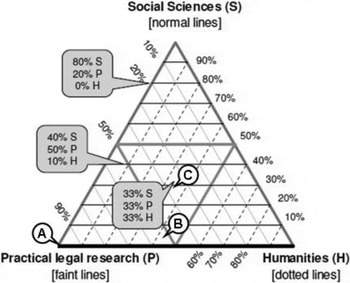
We propose that a ternary plot can be used to show the “balance” between the three approaches we and others have suggested are the main categories of legal research. Figure 3 provides an example of how a ternary plot can visualise how far legal academics are more inclined to practical legal research, law as humanities, or law as social sciences. A corner point represents 100% at the category in question, with the line opposite the point representing 0%. For instance, someone who regards himself as belonging 80% to law as social science and 20% to practical legal research, would be plotted at the cross between the 80% social science line, the 20% practical legal research line, and the 0% humanities line. Someone whose interests are equally split would be at the centre of the triangle. Figure 3 also includes a reverse smaller triangle inside the larger one. The borders of this triangle are the three 50% lines. Thus, being inside this inner triangle shows someone with mixed research methods since none of the three approaches reaches the overall majority.
Ternary Plot Showing Individual Research Preferences

In contemporary UK legal academia most scholars fall within this inner triangle. At its very origins, of course, English law (and, for most parts, Scots law) evolved as a practical discipline outside universities, and as such would fall close to the point A in Figure 3. But this gradually changed in the late 19th and early 20th century.Footnote 104 Here, the dominant paradigm was initially that of “exposition, conceptualisation, systematisation and analysis of existing legal doctrine”.Footnote 105 This moved legal scholarship into the direction of humanities,Footnote 106 for instance closer to point B, though also keeping a practical dimension to legal scholarship and teaching.Footnote 107 But since the early 1960s the social sciences also had an impact on UK legal scholarship. The emergence of sociological, socio-legal and other interdisciplinary forms of legal research has been well documented.Footnote 108 Of course, there has also been resistance:
The centrality of private-law, legal doctrine, courts and cases was strenuously defended for its practical and educational virtues, and for its objectivity, and it was claimed that the development of the social sciences threatened objectivity and law's singular claims to respect.Footnote 109
All this means that today legal scholarship in the UK can be positioned as in-between the three categories, around point C in Figure 3. For example, conceptual research by Christopher McCrudden and William Twining found that “legal research now embraces a pluralism of methodological approaches” and that “(t)oday, academic law is pluralistic, involving a bewildering diversity of subject-matters, perspectives, objectives and methods”.Footnote 110 Empirical research points in the same direction: Becher's work from the mid-1980s distinguished between convergent and divergent academic disciplines. A convergent discipline has a “tightly knit community” whereas a divergent one tolerates “a greater measure of intellectual deviance”. Law was seen as being in the intermediate ground due to the divide between black letter law and more contextual approaches.Footnote 111 Cownie's more recent research,Footnote 112 as well as our own pilot study at a medium-sized law school where none of the three categories of this paper turned out to be dominant,Footnote 113 reaches similar conclusions. As for the future, there are concerns that university legal education and scholarship may be “transformed into an industry preoccupied with economic rationalism, efficiency and the generation of income”.Footnote 114 In addition, it needs to be discussed whether and how foreign models of legal scholarship may have an impact, which we will do in the next section.
C. Comparison with developments in the US and Germany
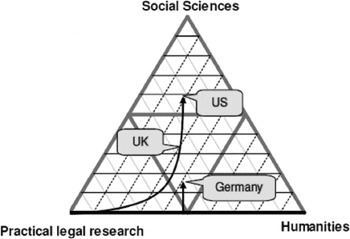
The ternary plot used in this section (Figure 4, below) illustrates how legal thinking has evolved in the UK, the US and Germany. UK developments were considered in the previous section: law started as a practical discipline and moved then closer to other academic fields, first humanities and subsequently the social sciences. Some of these trends can also be found in the US and Germany but there are also important differences.
Illustration of Development of Legal Thinking in Three Countries

The initial historical development of US legal thinking can be regarded as similar to the UK one: starting from an affiliation with legal practice, but subsequently influenced by humanities and social sciences. Yet, throughout the 20th century the US has moved further in the direction of social sciences, with the first main trends being legal realism, law and society, but now predominantly law and economics and empirical legal studies.Footnote 115 These approaches have also had some impact on UK legal scholarship, for instance, through academics spending parts of their careers in the US.Footnote 116 But differences remain: for instance, Susan Bartie contends that today “the main point of distinction is that in America there is a growing band of scholars who proclaim that the discipline can abandon its link with the profession and should boldly shape its interdisciplinary studies to meet broader conceptions of the law”.Footnote 117
Legal thinking in Germany offers a striking contrast. Starting with the reception of Roman law, law was part of university-based teaching and research. However, it was, and still is, also deeply practical, with law professors having had an influence on both law-makers and courts.Footnote 118 Thus, for centuries law was firmly located in-between practical legal research and humanities. To illustrate, Hermann Kantorowicz' famous manifesto on the “Struggle for Legal Science” criticised in vain that the “dogmatic” nature of legal research in Germany was similar to orthodox theology: accepting authority while trying to develop a coherent normative structure.Footnote 119 The emergence of social sciences in the late 19th and 20th century had some impact on legal thinking, in particular in constitutional, administrative and competition law.Footnote 120 Yet, in contrast to the US, changes have been very modest, for instance, in terms of the limited impact of law and economics.Footnote 121
Comparing the UK with the US and Germany, one may wonder how this is related to the “macro-level”, i.e. the structure of universities. It was found above that in the UK, there is a trend to create faculties of humanities and/or social sciences at the intermediate level combining various schools, including law.Footnote 122 Something similar is neither happening in the US, where law schools are separate postgraduate institutions, nor in Germany where only few universities have multi-disciplinary faculties.Footnote 123 Yet in US law schools (but not in German law faculties), interdisciplinary research has become the norm. Thus, it seems that the creation of joined faculties may not matter that much for collaboration across disciplines. Rather, with respect to the US, the fact that US law professors tend to have one or more degrees in disciplines other than law may well have played a role. This is rare in Germany and the UK where, conversely, the academic staff of law schools tends to have more extensive legal qualifications, be it at the professional level or a doctorate in law.Footnote 124
However, there is also an important difference between Anglo-Saxon and continental European universities. In their comparative report on disciplinary barriers between social sciences and humanities, Nicky Le Feuvre and Milka Metso write about Anglo-Saxon universities:
In this model, the universities tend to be organised according to a ‘problem-solving’ logic. There is, in theory at least, quite a lot of room for interdisciplinaity, since the expertise of the academic community and its ability to communicate with a vast range of social actors tends to be evaluated on the basis of their capacity to address and, if possible, solve a certain number of ‘social problems’.Footnote 125
For UK law schools, and legal academics, the question may now be whether to “go American” in moving closer to social sciences, or “go German” in remaining closer to both humanities and legal practice. The Europeanisation of legal education and research may point to the direction of Germany; yet, realistically, legal thinking in most countries is moving in the American direction.Footnote 126 In terms of law's evolution, this may be the final paradigm shift: having started with a practical approach, and having “flirted” with humanities, the social sciences may prove an eventual disciplinary consensus, turning law into a mature science.Footnote 127
However, one also needs to be aware of the implications of such a development. The choice between one of the three approaches can be thought as depending on the nature of one of three threats:Footnote 128 if legal scholars fear that academic legal research becomes irrelevant for lawyers, they may want to return to practical legal studies; if they regard current and past approaches as too sterile, they may favour a shift towards humanities; and if legal research is felt to be not scientific enough, empirical approaches of the social sciences seem to be the way forward. Thus, individual legal researchers face the trilemma that favouring any of the three approaches may lead to accusations of being too impractical, shallow or unscientific.
It is also important to consider that the broad academic traditions of humanities and social sciences have distinctly different ways of thinking and reasoning. For instance, an analysis of textual practices found that humanities scholars tend to emphasise individual variations, whereas social scientists aim for general explanations.Footnote 129 There are also differences in what is regarded as good and original research: whereas humanities tend to value originality in approach and data, social scientists care more about originality in method,Footnote 130 often requiring special skills and training.Footnote 131 Thus, since moving ever closer to social sciences would require adherence to this new and more uniform paradigm, legal academics may well feel that they do not want to give up the current pluralism to the way legal research is and can be conducted.
V. Conclusion
Most UK law schools have identified research as a key part of their mission, recruiting and promoting staff with research performance as a key criterion, and pointing to results of the past RAE (and in future the REF) to demonstrate the success or status of the school. Universities develop research at the level of the permanent academic staff but also through contract research staff and postgraduate research students, and institutional arrangement such as research centres and research support offices.
Yet legal research faces the challenge that its conceptual nature and its position within the context of university disciplines are not entirely clear: should law be thought of as a practical discipline, is it part of humanities, or part of social sciences? In this article we have presented a fresh picture of what legal research is (or could be), distinguishing between “micro” and “macro” aspects, and discussing the relationship between those. At the “micro-level”, the situation of current legal research can be described as mixed since all three types are common in UK academia, and often also within the research of individual academics. Thus, much appears to be left to personal choice. Normatively, this can also be supported by the concept of academic freedomFootnote 132 and the apparent advantages of academic tolerance in allowing, or even encouraging, plurality of methods.Footnote 133
But adding the “macro-level” to the picture complicates the position. Law is a discipline that does not fall squarely in a particular category. This can have profound practical consequences. For instance, a law-as-a-practical-discipline researcher may find it difficult to convince the funding organisations of humanities and social sciences (ie the AHRC and ESRC) that her research is worth pursuing. A law-as-humanities researcher who is based at a faculty of law and business may feel that her type of research is not duly appreciated, for instance, in the making of decisions about promotion and REF submission. And a law-as-social-sciences researcher based at a law school which is not part of a faculty of social sciences may feel that she does not get adequate the support, for instance, for fieldwork or statistical work, and doctoral students with an interest in this approach may choose institutions where training in social science methods is readily available.
Of course, legal researchers can also shift between different types of research. For example, someone whose research is both related to humanities and social sciences may decide strategically whether the AHRC or the ESRC provides more funding and higher success rates for bids on research grants.Footnote 134 Such a researcher may also want to know more precisely which projects conducted by legal academics have received funding in the past. Unfortunately, the current search tools of the research council websites do not provide such information since it is not possible to search according to departmental affiliation. However, it is interesting to see that the Department for Business, Innovation and Skills (BIS) has asked the research councils to develop a new web based “Gateway to Research” that has the aim to provide “ready access to Research Council funded research information and related data”.Footnote 135
Having compared the UK with the US and Germany, we have also seen that the preferences of individual researchers may well diverge from university structures. This section of our article has also shown that law as an academic tradition has been constantly evolving. At the moment, legal research in the UK may still be in a transitional phase, with some trend to move further to a social science model dominant in the US. What is more, the world of universities is changing with higher education and research increasingly becoming globalised and commercialised.Footnote 136 It can be expected that developments in this area will also have an impact on both the “macro” and the “micro” level of legal research, though in which precise direction legal research is to evolve remains to be seen.