Introduction
Background
China is facing the issue of rapid ageing. The number of people aged 60 and above in China has increased from 90 million to 167 million in the past two decades.Footnote 1 At the same time, the statutory retirement ages (SRAs) in China are 60 years for men and 55 or 50 years for women, which are much lower than those in other countries. For instance, the average state retirement ages in Organization for Economic Co-operation and Development countries were above 60 for men and 58 for women in 2010 (Kerkhofs and Lindeboom, Reference Kerkhofs and Lindeboom1997; Yang and Xie, Reference Yang and Xie2014). Against this backdrop, the increase in retired people will impose a huge financial burden on the pension system in China. In 2018, the gap between pension insurance income and expenditure reached 450 billion yuan in China.Footnote 2 Therefore, raising the retirement age has become an urgent issue in the current government work agenda to ease the pension financial burden. To understand fully the possible consequences of delayed retirement policies, we need to consider the health effect of retirement. For example, if retirement has a positive effect on health, then raising retirement ages may increase the health costs as it may negatively affect the health of elderly people.
In this study, we analyse whether retirement has an impact on health in China. Theoretically, the effect of retirement on health is far from obvious (Galama et al., Reference Galama, Kapteyn, Fonseca and Michaud2013; Kuhn et al., Reference Kuhn, Wrzaczek, Prskawetz and Feichtinger2015). According to Grossman's (Reference Grossman1972) health demand model, income and time are both components of gross investments used to increase health stock. Generally, retirees tend to have less income but more leisure time after retirement. However, income and leisure time may lead to different health outcomes. On one hand, decreased income reduces the ability to pay for health investment commodities, such as health care, which may have a negative effect on health (ML Zhang et al., Reference Zhang, Brooks, Ding, Ding, He, Lu and Mano2018). On the other hand, with more leisure time, retirees have lower opportunity costs for medical treatment and more time to improve their lifestyle, such as exercising more and eating a healthier diet, which may have a positive impact on health (Fé and Hollingsworth, Reference Fé and Hollingsworth2016).
A large body of empirical studies also show that the health effect of retirement is mixed. Kerkhofs and Lindeboom (Reference Kerkhofs and Lindeboom1997) were the first to explore the relationship between retirement and health. They employed the Hopkins Symptom Checklist health index to measure health and found that early retirement could improve health in the Netherlands. Similar to the research of Kerkhofs and Lindeboom, a series of subsequent studies also found that retirement has a significant effect on various subjective and objective health indices in some developed countries (Charles, Reference Charles2004; Neuman, Reference Neuman2008; Johnston and Lee, Reference Johnston and Lee2009; Coe and Zamarro, Reference Coe and Zamarro2011; Latif, Reference Latif2011; Hashimoto, Reference Hashimoto2013; Horner, Reference Horner2014; Belloni et al., Reference Belloni, Meschi and Pasini2016; Bloemen et al., Reference Bloemen, Hochguertel and Zweerink2017; Shai, Reference Shai2018). In contrast, some studies also provide evidence that retirement has a negative or non-significant effect on health (Dave et al., Reference Dave, Rashad and Spasojevic2008). The inconsistency of existing conclusions can be attributed to differences in identification strategies, selected samples and health indicators, retirement systems and sociocultural characteristics (van der Heide et al., Reference van der Heide, van Rijn, Robroek, Burdorf and Proper2013; ML Zhang et al., Reference Zhang, Brooks, Ding, Ding, He, Lu and Mano2018).
The estimation of the causal effect between retirement and health is empirically challenging since the retirement decision is not random. Specifically, poor physical and mental health may directly induce retirement, while unobservable and time-varying confounding factors will affect retirement and health simultaneously (Bloemen et al., Reference Bloemen, Hochguertel and Zweerink2017). An approach to address this endogenous problem is to use the SRA as an exogenous variable for retirement and employ instrumental variable regression or regression discontinuity design (RDD) to explore the causal relationship between retirement and health (Insler, Reference Insler2014). In addition, some studies further focus on the mechanisms that explain how retirement leads to different health outcomes. Some of them found that retirement is good for health because retirees tend to have a more active lifestyle, such as reduced smoking and drinking, improved sleep quality and increased physical activities (Insler, Reference Insler2014); in contrast, others found that the health effect of retirement is negative because retirees tend to increase the frequency of smoking (Ayyagari, Reference Ayyagari2016).
The existing studies have provided important references for this study. However, these studies on retirement-health analysis present conflicting results and limit the scope of this subject to developed countries. In view of the large disparities in economic development levels, social security systems and demographic characteristics between developed and developing countries, the impacts of retirement on health vary between different countries. Therefore, this study will contribute to the literature on the effect of retirement on health by providing more evidence from China.
In recent years, studies on retirement and health in China have gradually emerged (Wang and Zang, Reference Wang and Zang2016; Dong and Zang, Reference Dong and Zang2017; Liu and Lang, Reference Liu and Lang2017). Lei et al. (Reference Lei, Tan and Zhao2010) first analysed the effect of retirement on the health of male and female retirees in China. Ye (Reference Ye2018) further explored the role of lifestyles as a mechanism in retirement and health. Similar to Ye's research, Su and Li (Reference Su and Li2019) analysed the change in health effects in retirement after adding lifestyle and time-use variables. In addition, some research also explored the health effect of retirement among a specific group, such as males or urban elderly people (Deng and He, Reference Deng and He2016; Zou et al., Reference Zou, Luan, Peng and Yu2018).
However, studies on this subject in China still have the following limitations. First, most of them only adopt a single indicator or several simple indicators as a measure of health, such as self-reported health or depression symptoms and illness, which do not completely reflect an individual's health status. It is necessary to use multi-dimensional indicators as a measure of health because health is a multi-dimensional concept. Second, the sample range selected by the previous studies is too narrow to estimate accurate results. Most studies limit their sample scope to people with urban household registration or people who only work in companies. However, retirement applies to people with formal occupations in China, such as those who work in government, public institutions, state-owned companies or private companies, regardless of whether they have an urban or rural household registration. Third, some studies define retirement based on ‘processed retirement’ or dropping out of the labour market only, which may not apply to reality in China. On one hand, China's pension system is not perfect. A large number of self-employed people are not subject to SRA, and these individuals continue working as long as their health permits. In addition, a certain percentage of retirees may still work for pay after claiming their pension. On the other hand, some people have never had paid work and did not ‘retire’ from work.
Based on the China Health and Retirement Longitudinal Study (CHARLS) from 2011 to 2015, this study employs SRA as the exogenous variable of retirement and applies RDD to examine the effect of retirement on health in China. In addition, to overcome the limitations of previous studies, we comprehensively investigated the health effect of retirement by using as many health indices as possible. In terms of sample selection, we restrict the sample to civil servants, staff of public institutions and those who participate in employee pension insurance to make the estimation results more accurate. In addition, we also apply different bandwidths to analyse the effect of retirement on the health of retirees of different genders, education levels and occupations. To understand our findings better, we further explore two possible mechanisms (income and lifestyle) between retirement and health in this study. However, the health effect of retirement may not be obvious in the short term, so we also investigated the long-term health effects of retirement using a donut-hole RDD. Finally, we test the robustness of our findings by alternating retirement definition and retirement age.
Institutional setting
The SRA is 60 for males, 55 for female civil servants and 50 for other female workers in China. In principle, employees are required to retire when they reach the SRA, but occasionally they do not. For example, employees are allowed to retire early before they reach the SRA if they are diagnosed with severe diseases and demonstrate that they are too ill to continue working, or if their working conditions are dangerous or harmful to their health. In addition, employees in the private sector may not be retired when they are at SRA given that private companies do not strictly enforce SRA. In addition, the number of self-employed individuals increases rapidly with the development of the economy, and these individuals continue working as long as their health permits regardless of the SRA. As a result, a substantial number of people may not comply with the SRA.
The SRA is associated with the pension system. The rapid ageing caused by birth control policies and the increased life expectancy has placed a heavy economic burden on the sustainability of the pension system in China. China's SRA, the lowest retirement age in the world, also intensifies the situation. The pension systems in China are mainly comprised of three programmes: a social pension insurance system for rural residents and non-working urban residents, an urban employee pension insurance system for enterprise employees, and a government and public institutions pension insurance system for civil servants and staff in public institutions. It is worth noting that some people with rural household registration who working in large companies also participate in urban employee pension insurance. The SRA does not apply to people without formal occupations regardless of whether they live in urban or rural areas, and the pension they receive from the social pension insurance system typically does not meet their basic living costs. Thus, we restrict our samples to people with formal occupations and covered by the latter two pension insurance systems.
The remainder of this study is organised as follows: the following section describes the data, variables and empirical strategies; the next section presents the results and mechanism; this is followed by the discussion section.
Data and methods
Data
The data used in this study are derived from the CHARLS. This dataset randomly selects approximately 17,500 individuals aged 45 and above from 450 villages in 150 counties or districts. This dataset includes rich information on respondents’ demographic characteristics, health care, insurance, retirement and pension status. CHARLS has been conducted nationally since 2011 and repeated every two years. The data we used are from the first three waves of the survey between 2011 and 2015. We restrict the sample to enterprise employees who enjoy urban employee pension insurance, and civil servants and staff in public institutions who enjoy government and public institution pension insurance. All samples in this study were aged between 50 and 70 for males and between 45 and 60 for females. To make the sample size large enough to meet the requirement of RDD, we construct three-wave pooled cross-sectional data from 2011 to 2015. After excluding observations with missing information on the selected variables, the remaining sample size is 7,904, with 4,899 males and 3,005 females.
Assessment of health
The dependent variables of this study are a series of health indices. To comprehensively analyse the health effect of retirement, we include as many subjective and objective indices as possible to measure health. The following health indices were assessed: (a) objective health: (1) Body Mass Index (BMI): a dummy variable indicating whether the respondents are obese (1 = yes, BMI ⩾ 28, 0 = no, BMI < 28);Footnote 3 (2) hypertension: a dummy variable showing whether the respondents have hypertension based on the measurements of their systolic and diastolic pressure (1 = yes, 0 = no); (3) chronic diseases: a dummy variable presenting whether the respondents have at least one of 14 chronic diseases mentioned in the questionnaire (1 = yes, 0 = no); (4) illness last month: a dummy variable indicating whether the respondents were ill in the past month (1 = yes, 0 = no); (b) subjective health: (1) self-reported health: the score ranges from 1 to 5, and the answers are recoded dichotomously into good (1 = excellent or good or fair) and bad (0 = bad or very bad); (2) self-reported memory: it is also assessed on a scale from 1 to 5, and the answered are also recoded dichotomously into good (1 = excellent or good or fair) and bad (0 = bad or very bad); (3) the calculation capacity: a dummy variable indicating whether the respondents can perform five simple calculations (1 = five simple calculations were all right, 0 = otherwise); (4) depression: a dummy variable showing whether the respondents have depression based on the score of the Center for Epidemiologic Studies Depression Scale (CES-D) (1 = depression, CES-D ⩾ 10, 0 = no depression, CES-D < 10); (5) memory: a dummy variable presenting whether the respondents can recall at least one of the ten words immediately (1 = yes, 2 = no).
Assessment of retirement
The core independent variable of focus is whether the respondent has retired. There are three common methods used to define retirement in previous studies: (a) self-reported ‘processed retirement’ (Wang and Zang, Reference Wang and Zang2016; Dong and Zang, Reference Dong and Zang2017); (b) dropped out of the labour market (Lei et al., Reference Lei, Tan and Zhao2010; Coe and Zamarro, Reference Coe and Zamarro2011); and (c) self-reported ‘processed retirement’ and dropped out of the labour market (Eibich, Reference Eibich2015; Liu and Lang, Reference Liu and Lang2017; Ye, Reference Ye2018). However, the first two definitions are not ideal for this study based on two aspects. On one hand, many people may still be employed by other employers or have a temporary contact with their previous employers after processing retirement. As a result, a certain percentage of retirees may still work for pay after claiming their pension (9.56% of participants in our sample continue working after filing for retirement). On the other hand, some people have never had paid work and did not ‘retire’ from work. Therefore, we adopt the last definition because we consider it more applicable to the situation in China that makes the estimation results more precise.
Assessment of demographic and socio-economic variables
We also control for an array of demographic and socio-economic variables, such as age, gender, education, marriage, household registration, occupations and year. Age is measured by subtracting the year of birth from the year of survey. Education is categorised as high (1 = high school and above) and low (0 = middle school and below). Marriage is recoded dichotomously as with a spouse (1 = married or co-habiting) and single (0 = separated or divorced or never married). Household registration is categorised as urban and rural (1 = urban, 0 = rural). Occupations are divided into government employees (1 = civil servants or public institution staff) and enterprise employees (0 = enterprise staff). Year is categorised as the first wave of the data (1 = surveyed in 2011), the second wave of the data (2 = surveyed in 2013) and the third wave of the data (3 = surveyed in 2015).
Assessment of income and lifestyle
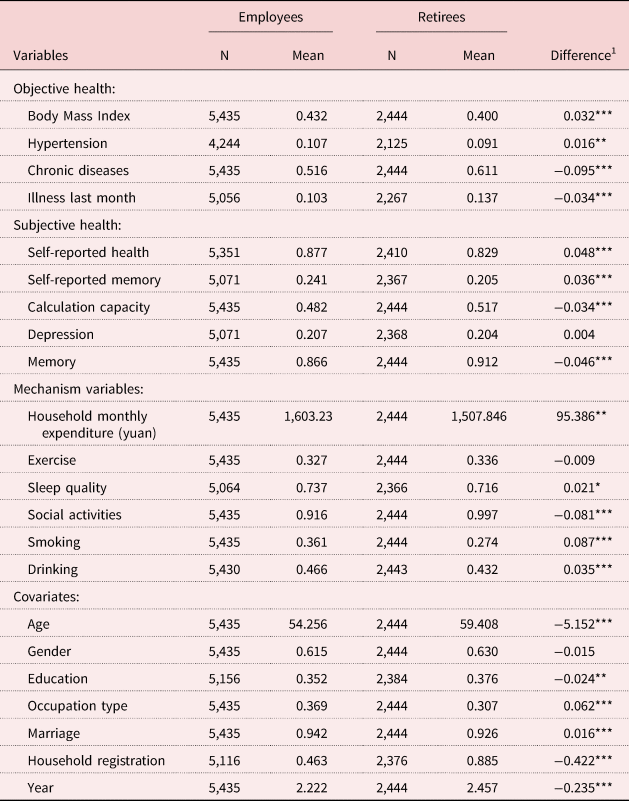
In addition to examining the effect of retirement on health, we also explored the mechanism of this effect. We select income and leisure time as the mediating variables because they are important input factors for health production (Grossman, Reference Grossman1972). In principle, an individual's income may decrease and leisure time may increase after retirement, which may lead to different health outcomes. On one hand, the reduction in income after retirement will reduce people's ability to pay for nutritious food and medical services needed to maintain and improve health. On the other hand, an increase in leisure time will provide individuals with more time for entertainment and physical exercise, and reduce their opportunity costs of medical treatment. Therefore, income and leisure time affect health in different manners. Given that income variables cannot be obtained directly from our data and leisure-time variables are also difficult to measure directly, we finally select the average monthly household expenditure and lifestyle as the proxy variables of income and leisure time, respectively. Lifestyle includes physical exercise (1 = exercising, 0 = no exercising), sleep quality (1 = good sleep quality, 0 = poor sleep quality), social activities (1 = yes, 0 = no), smoking (1 = yes, 0 = no) and drinking (1 = yes, 0 = no). The descriptive statistics of all variables are shown in Table 1.
The difference in variables between employees and retirees

Note: 1. Difference is estimated by chi-square test for dummy variables and by t-test for continuous variables.
Significance levels: Significant at * 10%, ** 5%, *** 1%.
Fuzzy regression discontinuity design
To address the inverse causal relationship between retirement and health, we employ a fuzzy RDD to estimate the effect of retirement on health. As a quasi-experimental design, RDD is ideal to identify the causal effect of treatment, which uses SRA as a source of exogenous variation in retirement status. Another reason we use fuzzy RDD to estimate the effect of retirement on health is that the retirement probability will not increase from 0 to 100 per cent at the SRA. Then, the treatment effect can be estimated as the ratio of the jump in the outcome variable H to the jump in the probability of being retired at the SRA. The formula is as follows:

where α denotes the normalised age, and τ FRD is the local average treatment effect (LATE), indicating the effect of retirement on health around the cutoff point.
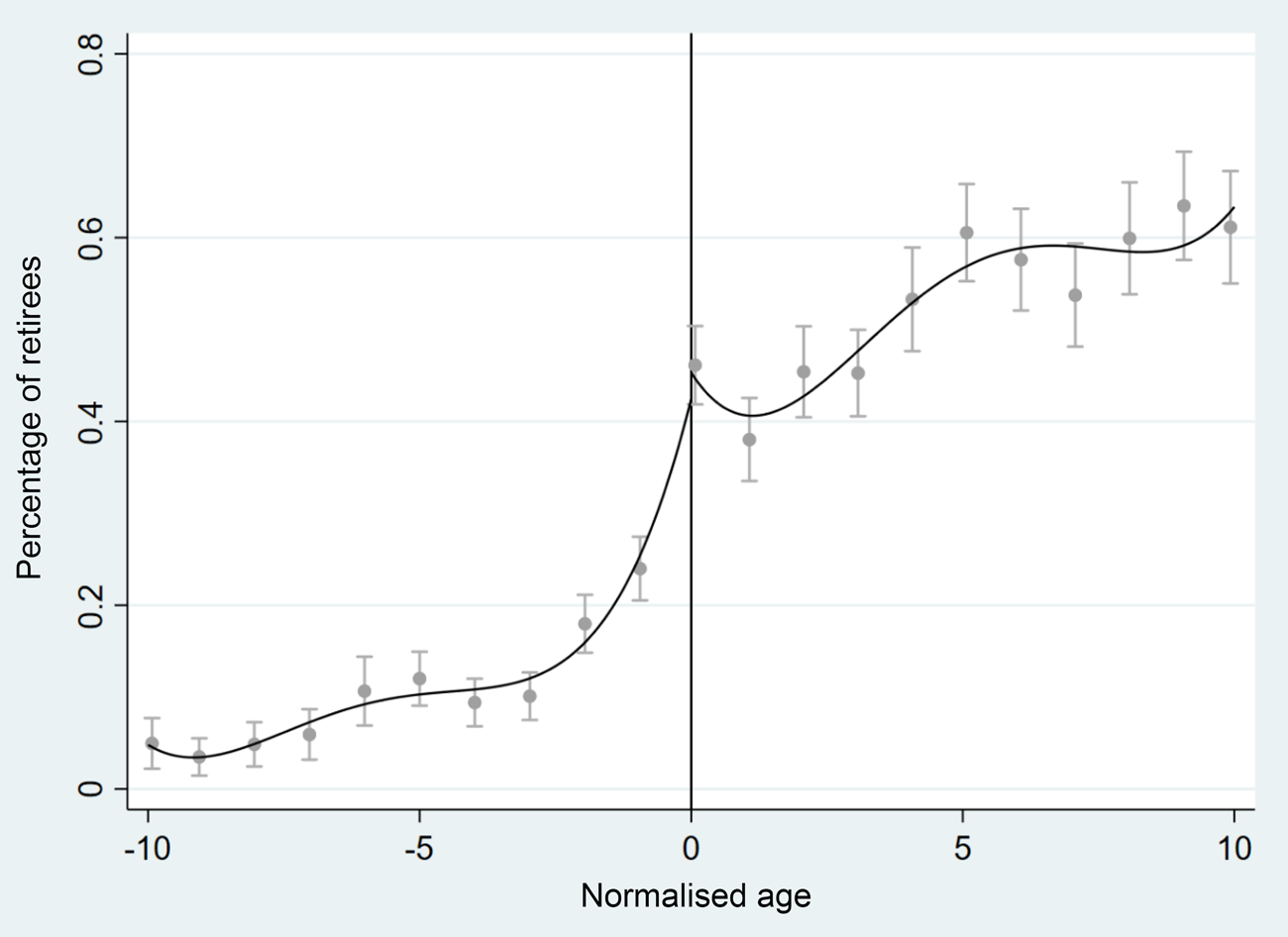
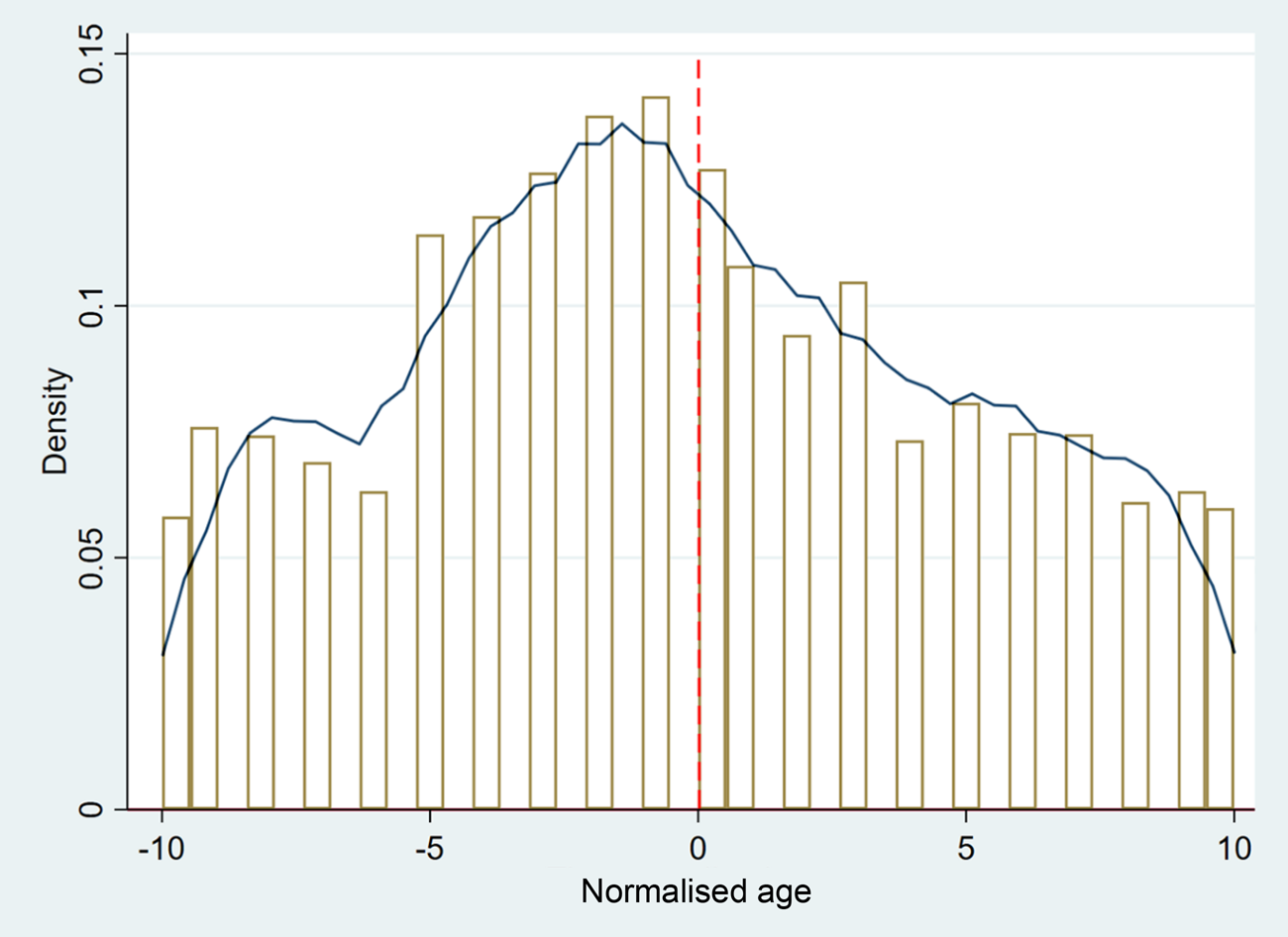
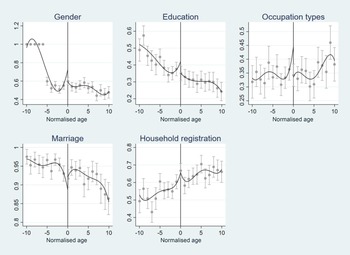
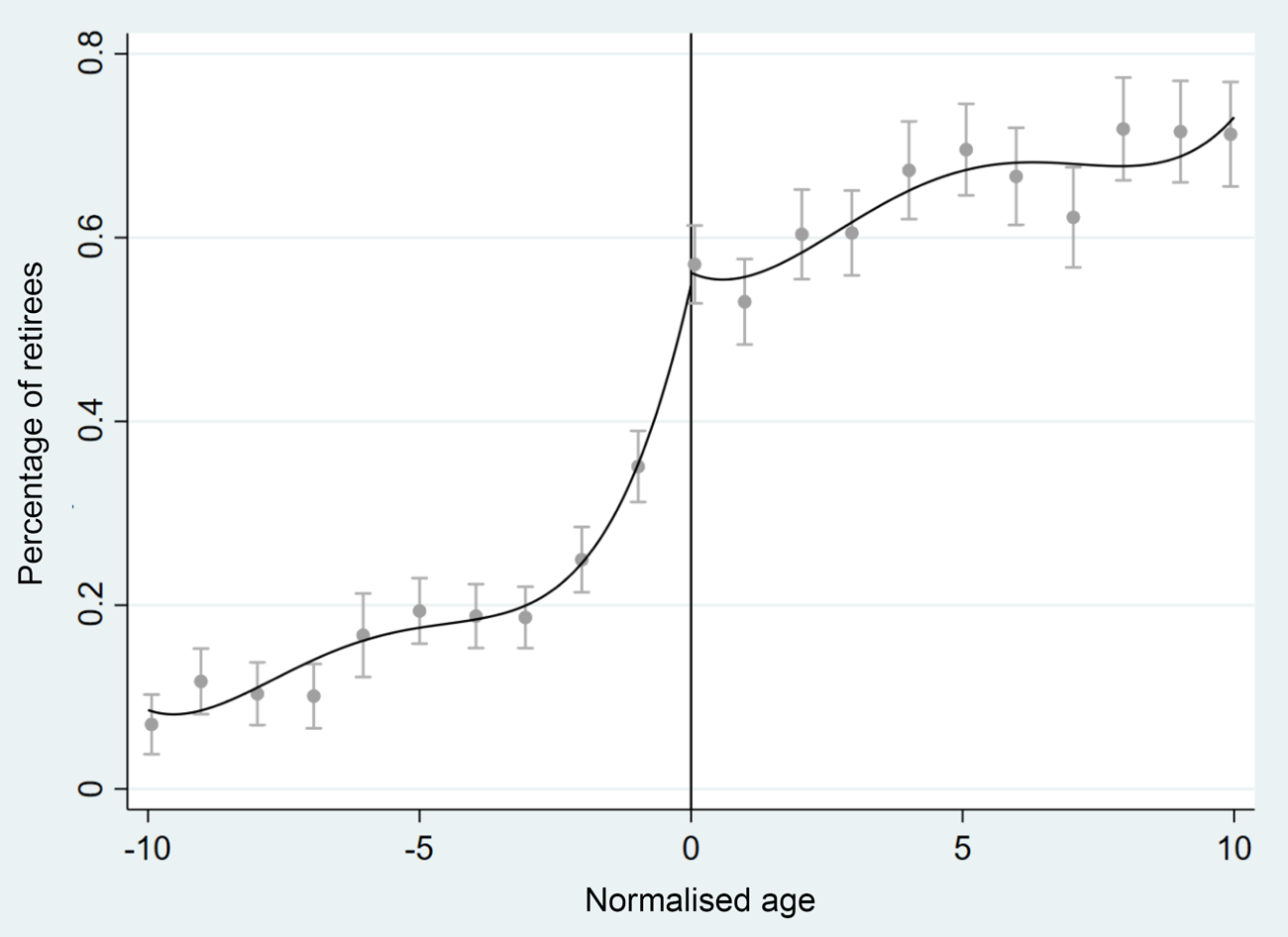
The validity of the RDD relies on two main assumptions. The first assumption requires a discontinuity in the probability of treatment at the cutoff point. Figure 1 verifies this assumption by showing a discontinuity at the SRA where the probability of retirement increases sharply. In Figure 1, the normalised age is the assignment variable for the RDD and is calculated by the actual age minus the corresponding SRA for each gender. In addition, the first assumption also requires the assignment variable to be smooth around the cutoff point, thus ensuring that the sample is randomly allocated (McCrary, Reference McCrary2008). Figure 2 suggests no manipulation of the assignment variable since no discontinuity appears at the cutoff point. The second assumption requires that all other factors driving health status evolve smoothly with respect to the assignment variable (Lee and Lemieux, Reference Lee and Lemieux2010). In other words, if the sample is locally randomised then individuals around the official retirement age should not differ substantially in ‘all other factors’. Figure 3 displays the scatter plots of covariates overlaid with local polynomial smooth plots. The graphs in Figure 3 clearly indicate no significant discontinuity in any of the predetermined covariates at the cutoff point. Overall, the RDD validity checks support our identification strategy and provide no evidence for violations of the key underlying assumptions.
Retirement rate by normalised age.
Note: The 95% confidence intervals are shown.

Density of the assignment variable.

The predetermined covariates by normalised age.
Note: The 95% confidence intervals are shown.

Nonparametric estimation
The LATE parameter τ FRD can be estimated parametrically or nonparametrically. In this study, we employ nonparametric estimation given that it does not require a particular functional form of the assignment variable. The nonparametric estimation uses local linear regressions to estimate the elements of Equation 1. τ FRD is the local average treatment effect that is estimated by Equation 2:

where $\hat{\mu }_{H + }( b )$ is the estimate of $\mathop {\lim }\nolimits_{\varepsilon \downarrow 0} E[ H\vert \alpha = 0 + \varepsilon ]$
 , the health status just above the SRA. In addition, $\hat{\mu }_{H-}( b )$
 , $\hat{\mu }_{R + }( b )$
 and $\hat{\mu }_{R-}( b )$
 are estimates of the corresponding terms in Equation 1. For a given bandwidth, $\hat{\mu }_{H + }( b )$
 is calculated using a triangular kernel-weighted linear regression of H using observations to the right of the age cutoff. The intercept of this local linear regression is $\hat{\mu }_{H + }( b )$
 . The other three terms in Equation 2 are calculated with the same method. The bandwidth b is based on two separated mean squared error (MSE)-optimal bandwidth selectors (below and above the cutoff), which are driven by data. To obtain a robust result between retirement and health, we select different bandwidths to estimate the health effect of retirement and present the results of the optimal bandwidth (b), half of the optimal bandwidth (0.5b) and twice the optimal bandwidth (2b). We also report the usual heteroscedasticity robust standard errors clustered at the individual level to control for the correlation of error terms in the same individual across the three-wave data.
Results
Descriptive statistics
Table 1 shows the descriptive statistics of variables between employees and retirees. With respect to health indices, significant differences in almost all related variables (except depression) exist between the employed and retired groups. Specifically, compared with employees, retirees tend to have a lower prevalence of obesity and hypertension, and better calculation capacity and memory. However, retirees exhibit a poorer status on other health indices such as the prevalence of chronic diseases, illness in the past month, self-reported health and memory, compared with employees. The significant differences in health indices (last column of Table 1) indicate that retirement is associated with a deterioration of physiological health and an improvement in mental health. This finding is potentially attributed to the fact that retirees are older than employees and their physical functions decline with age, whereas their better mental health benefits from healthier lifestyles and no work pressure after retirement. In terms of mechanism variables, retirees tend to have lower monthly expenditures but healthier lifestyles, such as smoking and drinking less. In addition, great differences also exist in covariates, such as age, education, occupation, marriage and household registration between the two groups. However, the differences in health indices between the employed and retired groups cannot be attributed to retirement directly because these results require more rigorous empirical tests. Therefore, we use a fuzzy RDD to explore the causal relationship between retirement and health further.
The effect of retirement on health
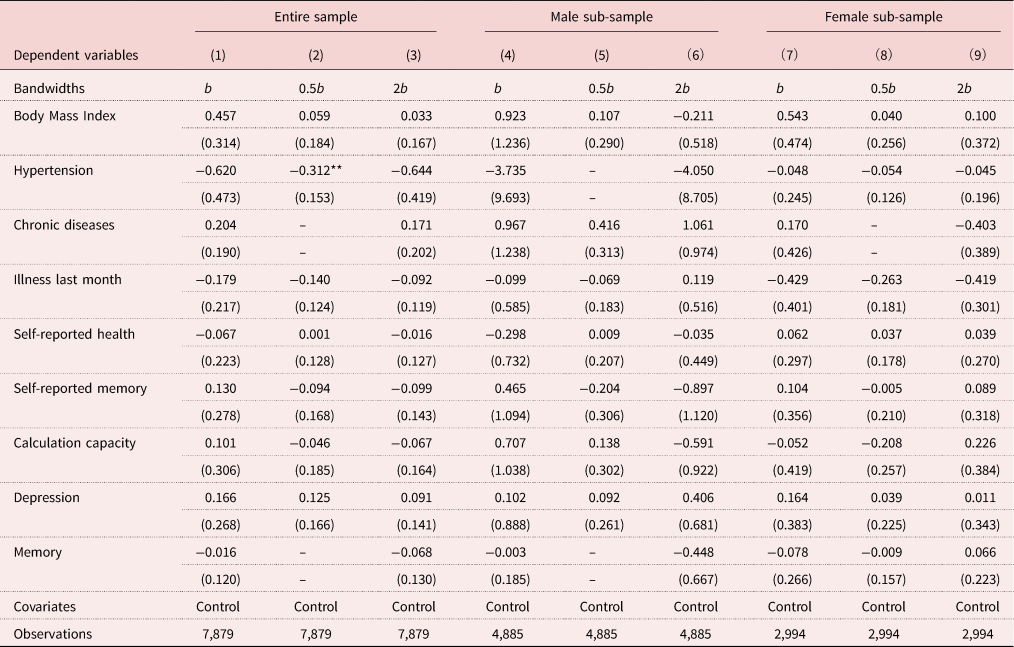
Columns 1–3 of Table 2 report the RDD estimates of the optimal bandwidth (b), half of the optimal bandwidth (0.5b) and twice the optimal bandwidth (2b). As shown in columns 1–3 of Table 2, neither objective nor subjective health indices are significant under the given three bandwidths, indicating that retirement has a non-significant effect on the health of Chinese elderly people as a whole. In addition, due to differences in the SRA and physical functions between males and females, the effect of retirement on health may vary by gender. Therefore, we divide the sample into two groups based on gender to estimate the effect of retirement on male and female health. Columns 4–9 of Table 2 report the impacts of retirement at different bandwidths on the health of males and females. The results are similar to those of the entire sample in that the health effect of retirement is also insignificant in both the male and female groups.
The effect of retirement on health (entire sample and male and female sub-groups)
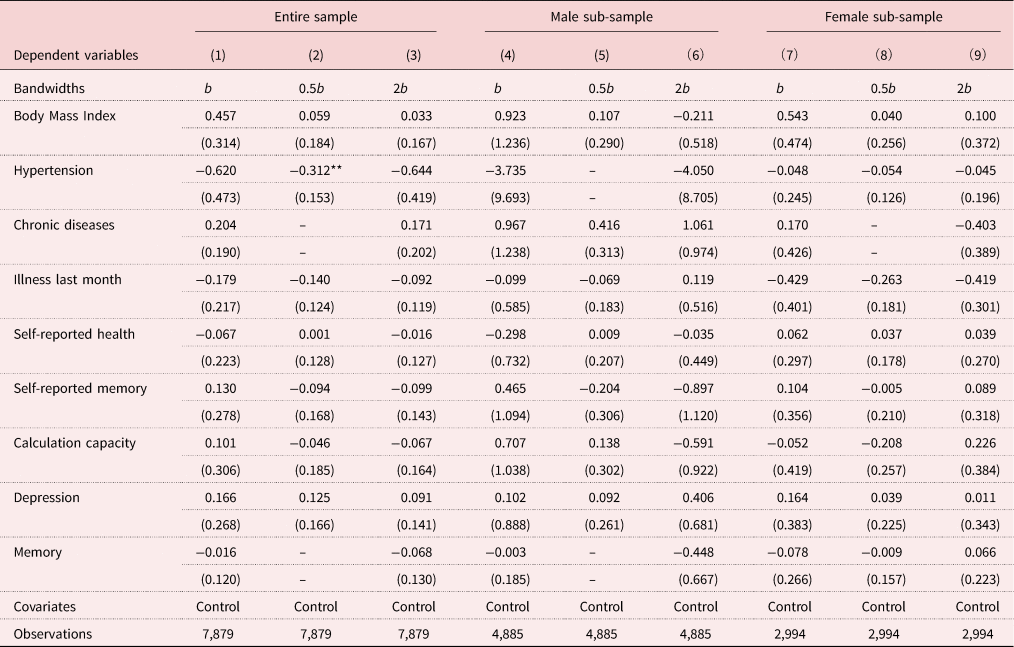
Notes: Standard errors clustered at the individual level are in parentheses. We also control the year variable in all models. Some estimates are missing due to the small sample size, but the number of them is low, so this has little influence on our results.
Significance level: Significant at ** 5%.
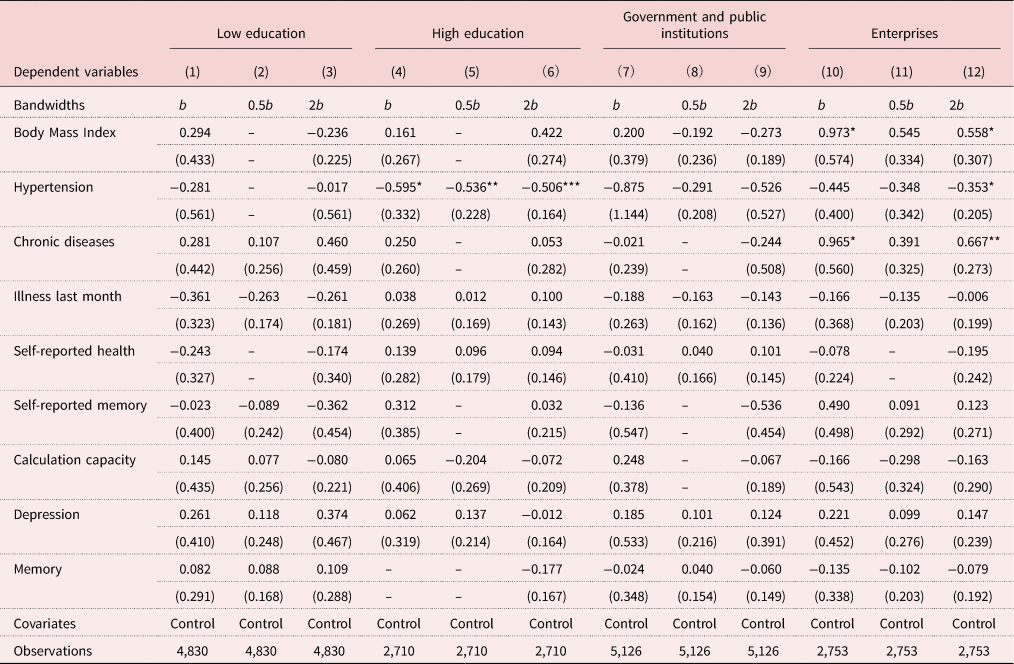
We also explored the problem of whether retirement has different effects on people with different education levels and occupations. Generally, individuals with higher education levels have more health knowledge and pay more attention to their health status. In addition, people working in government and public institutions are typically associated with a better income and working environment in China. Therefore, the health effect of retirement may vary among individuals with different education levels and occupations. Columns 1–6 of Table 3 present the impacts of retirement on the health of people with different education levels, whereas columns 7–12 show the estimated results of people with different occupations. Almost all the results in Table 3 are not significant, indicating that retirement has no impact on the health of Chinese elderly people. Although several coefficients in Table 3 are significant for certain bandwidths and health indices, these coefficients are not significant at all bandwidths. Therefore, the results are also robust across groups with different education levels and occupations.
The health effect of retirement on groups with different education levels and occupations
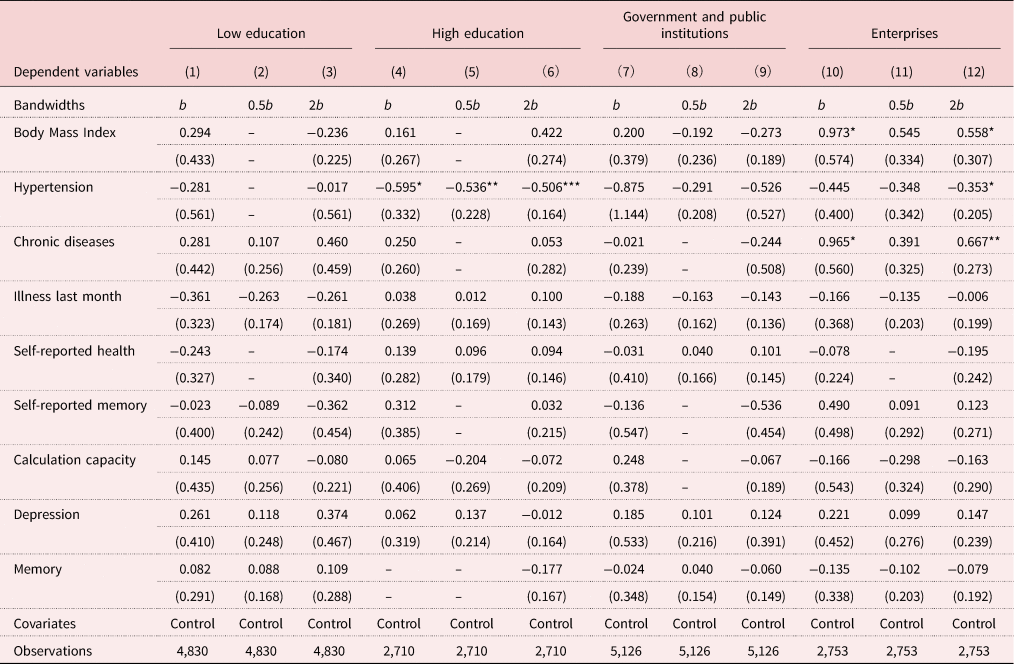
Notes: Standard errors clustered at the individual level are in parentheses. We also control the year variable in all models. Some estimates are missing due to the small sample size, but the number of them is low, so this has little influence on our results.
Significance levels: Significant at * 10%, ** 5%, *** 1%.
The effect of retirement on mechanism variables
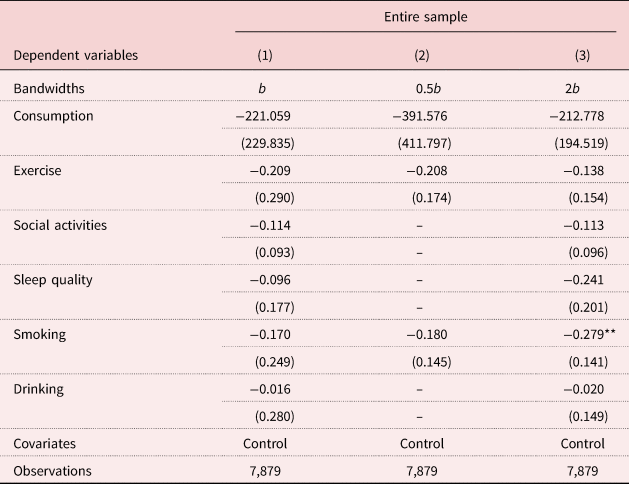
Theoretically, retirement has a mixed impact on health in that the reduction of income after retirement will make nutritional food and health-care services that maintain and improve health less available, and the increase in leisure time after retirement will be beneficial to the investment of health. In the above analysis, we find that retirement has a non-significant effect on the health of Chinese elderly people. It is possible that mechanism variables that have different influence directions on health were hedged. Against this backdrop, we examine further the effect of retirement on income and leisure time to explore the reasons for the above results. As income and leisure time cannot be obtained directly from our data, we use the average household monthly expenditure and five lifestyles as the proxy variables of income and leisure time, respectively. Table 4 shows the effect of retirement on mechanism variables that were estimated using a fuzzy RDD. As noted from the results of Table 4, retirement still has non-significant impacts on average monthly household expenditures and lifestyles among the entire sample. In other words, people's income and lifestyles are not changed significantly before and after retirement, which explains why the health effect is not significant at retirement.
The effect of retirement on mechanism variables for the entire sample
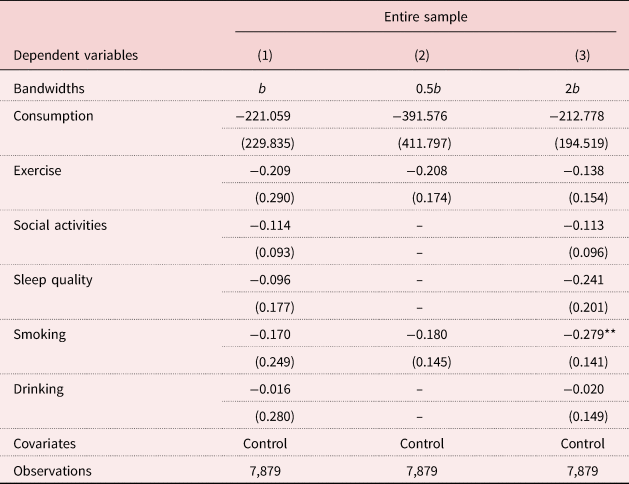
Notes: Standard errors clustered at the individual level are in parentheses. We also control the year variable in all models. Some estimates are missing due to the small sample size, but the number of them is low, so this has little influence on our results.
Significance level: Significant at ** 5%.
Long-term effects of retirement on health
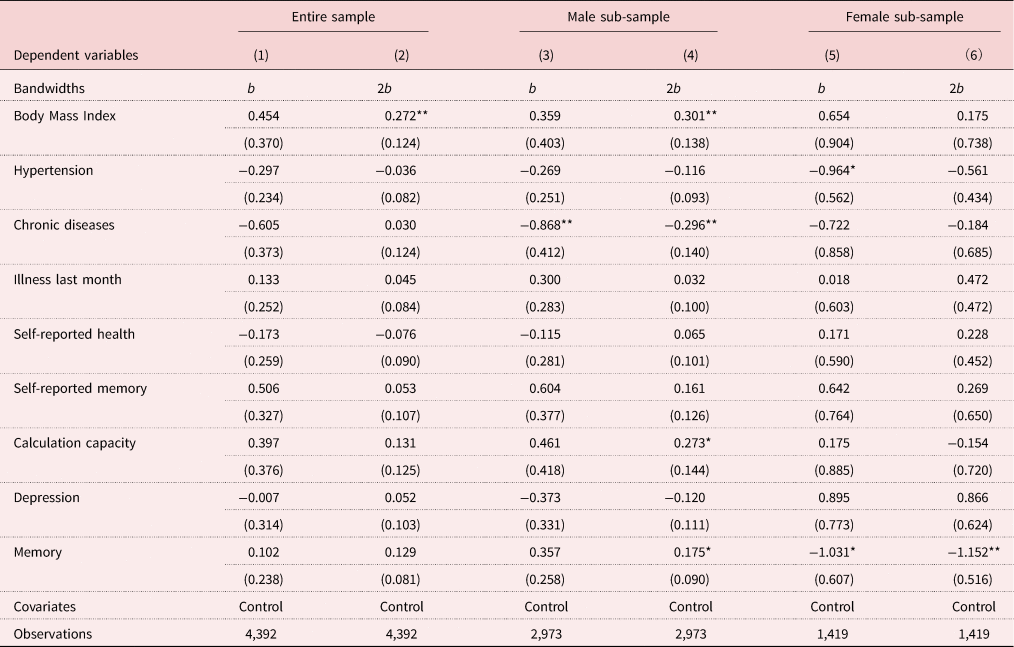
An array of estimates show that retirement has a non-significant effect on health. This result could be attributed to insignificant changes in income and lifestyles before and after retirement. Lifestyles, especially healthy behaviours, are developed over a longer period of time, so they are difficult to change in a short period of time. In addition, income fluctuations within a short period after retirement are relatively small given the steady growth in pension replacement rates and the custom of saving among the Chinese population. However, income and lifestyles may change in the long term after retirement, which subsequently affects health. Against this backdrop, after excluding the samples within three years around the SRA, we estimate the long-term effects of health at retirement by employing a donut-hole RDD with the best bandwidth and a triangular kernel-weighted linear regression (Shigeoka, Reference Shigeoka2014). Table 5 shows the results of the long-term health effects of retirement. Similar to the above results, the impact of retirement on health remains insignificant in the long term. This finding is also robust across different gender groups. Although several coefficients are significant under certain conditions, they are not representative given that they are not significant under most conditions. Overall, retirement has a non-significant impact on the health of Chinese elderly people in both the long and short term.
A donut-hole regression discontinuity design: the long-term effect of retirement on health

Note: Standard errors clustered at the individual level are in parentheses.
Significance levels: Significant at * 10%, ** 5%.
Robustness checks
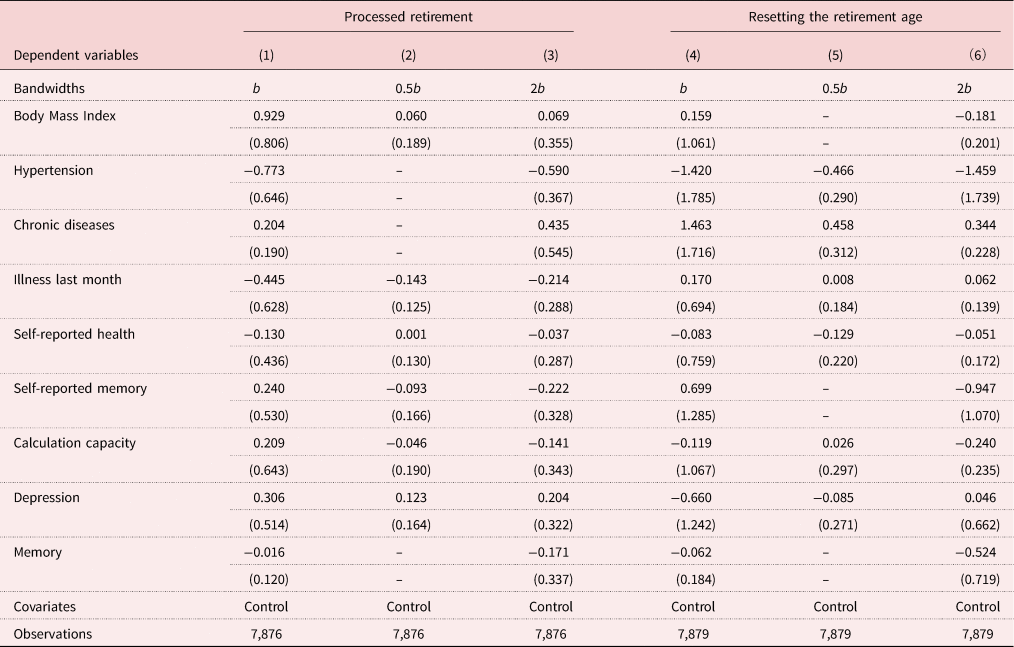
In the above section, we showed that our finding is robust across a series of health indicators as well as different bandwidths, sub-groups and time horizons. In this section, we assess further the robustness of the results with respect to different retirement definitions and retirement ages for the entire sample. First, we directly define retirement based on ‘processed retirement’ without considering whether individuals continue working for pay after retirement. Figure 4 shows a discontinuity at the SRA where the probability of retirement increases sharply under this definition. Columns 1–3 of Table 6 show that the estimated results remain insignificant for all health indices. Second, we also test the robustness of our findings by resetting the retirement age at 55. In principle, female civil servants (including staff of public institutions) are required to retire at 55 in China. However, resetting the retirement age at 55 can be considered a placebo test given that the proportion of female servants (including staff of public institutions) in this study was only approximately 30.18 per cent.Footnote 4 According to columns 4–6 of Table 6, no significant effects of retirement on any of the health indices are noted. Similar results obtained from the two robustness tests further support that retirement has a non-significant effect on Chinese elderly people.
Retirement rate by normalised age (retirement definition based on ‘processed retirement’ only).
Note: The 95% confidence intervals are shown.

The effect of retirement on health (different retirement definitions and retirement ages)

Notes: Standard errors clustered at the individual level are in parentheses. We also control the year variable in all models. Some estimates are missing due to the small sample size, but the number of them is low, so this has little influence on our results.
Discussion and conclusions
This study aims to explore the effect of retirement on the health of Chinese elderly people. The results of this study indicate that retirement has a non-significant effect on health in China, and these results are robust across different health indices, RDD bandwidths, sub-groups, time horizons, retirement definitions and retirement ages. Specifically, retirement has a non-significant effect on both objective (BMI, hypertension, chronic diseases and illness in the last month) and subjective health indices (self-reported health, the calculation capacity, depression and memory). In addition, the health effect of retirement remains insignificant after adjusting model bandwidths. Similar to the results estimated based on the entire sample, retirement has no impact on the health of groups of different genders, education levels and occupations. Results from a donut-hole RDD to explore the long-term health effects of retirement and robustness tests of alternating retirement definition and retirement age further support the finding that retirement has neither short-term nor long-term effects on health.
This finding is contrary to the results of previous studies from developed countries, which have suggested that retirement has significant effects (either positive or negative) on health, and lifestyles and income are the critical mediating mechanisms between retirement and health. The disparities in findings between this study and previous studies can be explained by the differences in social, cultural and economic conditions in China compared with developed countries. A possible explanation for this finding might be that lifestyle is difficult to change in a short period of time because it is rooted in traditional culture and the social environment in China. For example, drinking has become an indispensable aspect of people's social interactions and activities because liquor culture has a long history in China (Jiang, Reference Jiang2011). People tend to drink alcohol in activities related to work before they retire (Hao and Young, Reference Hao and Young2000). After retirement, however, work-related activities decrease, and activities with relatives or friends increase (Lei and Liu, Reference Lei and Liu2018). No significant difference in drinking is noted before and after retirement in China (Liu and Lang, Reference Liu and Lang2017; Su and Li, Reference Su and Li2019). The same is true for physical exercise (ML Zhang et al., Reference Zhang, Brooks, Ding, Ding, He, Lu and Mano2018). Furthermore, as an addictive behaviour, it is also difficult for individuals in both China and developed countries to quit smoking after retirement (Midanik et al., Reference Midanik, Soghikian, Ransom and Tekawa1995; Ye, Reference Ye2018). As a result, the lifestyles of most people will not change significantly after retirement and thus do not have a significant impact on health in China.
Another possible explanation for this finding is that income fluctuation after retirement is not large in China in contrast to developed countries. The pension replacement rate in China ranges from 60 to 80 per cent, which will lead to a reduction in income after retirement, and evidence indicates that the decrease in income after retirement has a negative effect on health (ML Zhang et al., Reference Zhang, Brooks, Ding, Ding, He, Lu and Mano2018). However, China has a tradition of saving since ancient times and has the highest saving rate (greater than 40%) in the world (Y Zhang et al., Reference Zhang, Salm and van Soest2018). The savings can smooth consumption fluctuations after retirement to a degree. Evidence shows that retirement has a non-significant effect on income in China (Liu and Lang, Reference Liu and Lang2017; ML Zhang et al., Reference Zhang, Brooks, Ding, Ding, He, Lu and Mano2018). As a result, in contrast to the conclusions derived from developed countries, the health effect of retirement is not obvious to the Chinese population.
This finding is also contrary to previous studies using data from China. These studies tend to report that retirement has a significant impact on certain health indices of specific groups. The differences in sample selection and retirement definition may contribute to the differences in results. On one hand, some studies limit the scope of analysis samples to individuals with urban household registration (Lei et al., Reference Lei, Tan and Zhao2010; Liu and Lang, Reference Liu and Lang2017) or individuals who work in government and public institutions (Zou et al., Reference Zou, Luan, Peng and Yu2018). At present, some people who work in enterprises and enjoy urban employee pension insurance may also come from rural areas and have agricultural household registration in China. Therefore, limiting samples exclusively to those with urban household registration or those who work in public institutions may lead to bias in the estimation results. On the other hand, some studies define retirement based on ‘processed retirement’ or ‘not working for pay’ only (Wang and Zang, Reference Wang and Zang2016; Dong and Zang, Reference Dong and Zang2017). As noted in the retirement assessment section, these two definitions are not precise. Therefore, different retirement definitions may also cause differences in estimation results.
This study contributes to the literature on the effect of retirement on health by providing more evidence from China. In this study, we provide more comprehensive health indices and more accurate assessments of the effect of health on retirement. Specifically, we adopted as many health indicators as possible (including objective and subjective health indicators) and restricted the sample to civil servants, staff of public institutions and those who participate in employee pension insurance in China. In addition, we also provided the results of different bandwidths of RDD and sub-sample groups and explored the long-term effects of retirement on health. Robustness tests of alternating retirement definition and retirement age also support the main results of this study.
The results of this study have important implications for policy makers on whether and when to raise the retirement age in China. It is well known that ageing is becoming a more serious policy issue in China due to the increase in life expectancy and the decline in birth rate. Demographic changes have imposed a heavy economic burden on the pension system in China. In addition, China has the youngest retirement age in the world. Against this backdrop, raising the retirement age has become an important way to cope with the ageing pressure in China. Our results demonstrate that retirement has a non-significant effect on health across a series of robustness tests. Furthermore, the results show that retirement has no effect on health in the long term. Overall, the findings of this study suggest that increasing the retirement age may effectively reduce the social pension burden and have minimal effects on health in China. The findings of this study may also provide important references for other developing countries facing a rapidly ageing population with the same cultural background as China.
It is important to bear in mind the possible bias that may exist in these results given the limitation of sample size. Generally, the larger the sample size, the more accurate the estimation of the RDD. The reason for the relatively small sample size in this study is that we included more health indices and some indices had a certain number of missing values. Therefore, we need to make a trade-off between the comprehensiveness of health indices and sample size. Furthermore, under the constraint of obtaining comprehensive health indices, we established three waves of pooled cross-sectional data to expand the sample size as much as possible. The findings of this study have been demonstrated to be consistent in an array of robustness tests, indicating that these findings are relatively accurate.
Regarding future research, one interesting direction is to investigate the impact of raising the retirement age on health in China and explore how the health effects vary with education levels and occupations using a larger sample size.
Acknowledgements
The author would like to thank the editor and the two anonymous reviewers for constructive, inspiring and clarifying comments on an earlier draft of this paper.
Financial support
This work was supported by ‘Social Security Rights and Income Distribution Equity’, the Philosophy and Social Science Major Research Project of the Ministry of Education in China (grant number 16JJD840008) and ‘The Fundamental Research Funds for the Central Universities’ (grant number 2020A1017). The funding bodies were not involved in the design of the study, or data collection, analysis, and interpretation or writing the paper.
Conflict of interest
The authors declare no conflicts of interest.
Ethical standards
There are no ethics problems in this study given that the data we used are national public second-hand data.