Introduction
By the end of October in 2010, there were approximately 177 million older people aged 60 years and above, accounting for 13.3% of China's total population.1 These numbers will reach 248 million (17.2%) in 2020 and 400 million (30.0%) in 2050.Reference Cao, Xiang and Dong2 The rapid increase in older people is a challenge to health care providers, because functional change occurs with ageing and this is often associated with increased physical and mental ill health.
Depression is one of the most frequent and disabling mental illnesses and is predicted to be the second leading cause of disability worldwide by 2020.3 In older people, depression is detrimental to both physical and psychological health, leading to physical decline, an increase in chronic illnesses, a decrease in social activities, impairment of quality of life and an increase of costs related to non-mental health problems.Reference Geerlings, Beekman and Deeg4–Reference Unutzer, Patrick and Simon6 It can lead to increased mortality from other diseases such as heart disease, myocardial infarction and cancer.Reference Serby and Yu7 A survey in 60 countries identified depression as having the greatest public health impact.Reference Moussavi, Chatterji, Verdes, Tandon, Patel and Ustun8 Furthermore it is an important cause of suicide in older people.Reference Kaneko, Motohashi, Sasaki and Yamaji9 In Taiwan, many older people who committed suicide were found retrospectively to have had undiagnosed depression.Reference Cheng10
As a major public health problem in older people, depression has attracted much attention across the world. A number of studies in Western countries have focused on prevalence, risk factors and treatment of depression, and intervention programmes to decrease incidence of depression. However, this kind of research is relatively limited in China. Previous studies have shown lower rates of depression in Chinese older people than in their Western counterparts.Reference Chong, Tsang, Chen, Tang, Chen, Yeh, Lee and Lo11 It was explained by the positive family support systems in traditional Chinese context which seemed to militate against depression.Reference Chen, Copeland and Wei12 On the other hand, older Chinese people pay more attention to their physical symptoms and may focus mainly on somatic complaints to the neglect of their psychological symptoms. Some depressive symptoms may be neglected or denied, being regarded as the normal results of ageing. Furthermore, depression has always been a stigmatized mental disorder in China and people often avoid admitting its existence or seeking help.Reference Xu13 However, it is expected that the prevalence of depression of older people in China will increase due to the loss of traditional protective factors, an increase in deleterious factors and an increased awareness of depression as any other health problem.Reference Pan, Franco, Wang, Yu, Ye and Lin14 With depression having serious consequences in older people, recognizing depression early and identifying the vulnerable group to facilitate its prevention and treatment and promoting the well-being of older people is particularly important in the context of the dramatic population changes in China. We report a systematic review of the published literature to establish what is known about the prevalence and related factors of depression in older people in China, in order to provide some indication of health and social care needs to improve older people's quality of life and reduce their mortality.
Search strategy and selection criteria
The following electronic databases were searched: Web of Science, PsycINFO, MEDLINE, PubMed, CINAHL, China Academic Journal and VIP Database for Chinese Technical Periodicals. There was no restriction on publication year. Key subject terms and related words were used as follows: ‘older’ OR ‘elderly’ OR ‘ageing’ OR ‘aged’ AND ‘depression’ AND ‘Chinese’ OR ‘China’ OR ‘Hong Kong’ OR ‘Taiwan’ OR ‘Macau’.
The search identified 757 papers; 722 papers were deemed not relevant after review of title and abstract, as they did not report depression in older people in community settings. Fifteen papers merited further review, but full texts were unobtainable. The remaining 20 papers were retrieved and assessed for eligibility using the following inclusion criteria: primary research reporting prevalence or related factors of depression; the sample age was at least 60 years; sample was drawn from community settings; written either in English or in Chinese. Three papers were duplicate reports of the same study published in different journals, and only the first published paper was included. One paper was excluded because the sample drawn from communities was not reported separately.
Initial screening was undertaken by one researcher (Y.C.) and then checked by two others (A.H. and A.E.W.). One researcher (Y.C.) extracted the following data from the selected papers: study design, setting, study sample, instruments, variables and key findings. Another researcher (A.E.W.) verified the extracted data and made corrections as necessary. A total of seventeen papers were included in the review (n = 11 English language; n = 6 Chinese language).
Results
An overview of selected papers
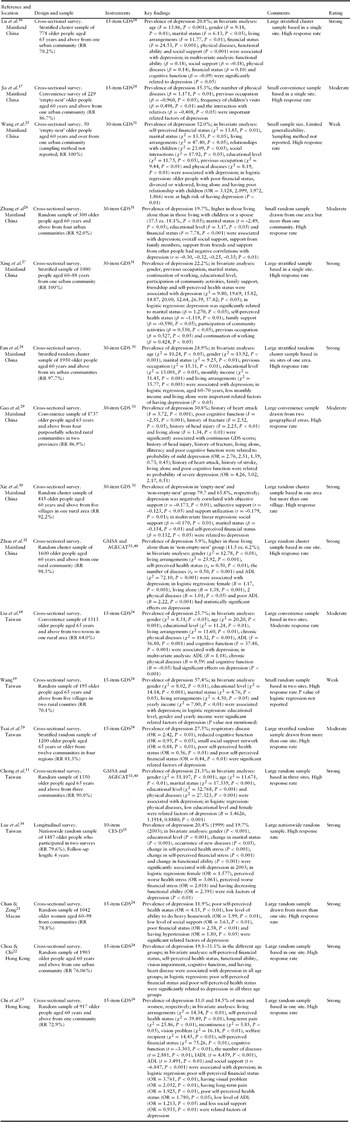
Nine studies were conducted in mainland China, five in Taiwan, two in Hong Kong and one in Macau. Sixteen papers reported cross-sectional surveys and one reported a longitudinal survey. Ten studies recruited samples aged 60 years and above and the other seven studies recruited samples aged 65 years and above. More than half of the studies (n = 9) recruited urban residents, five recruited rural residents, two recruited samples from both urban and rural districts, and the remaining one did not report the study site. All the studies were published since 1997 (1997, n = 1; 2001, n = 3; 2005, n = 4; 2007, n = 2; 2008, n = 1; 2009, n = 3; 2010, n = 3). Table 1 provides details of the 17 selected studies, together with a rating of their quality using the Strobe ChecklistReference Altman, Egger and Gotzsche15 (n = 10, strong quality; n = 5, moderate quality; n = 2, weak quality due to methodological issues).
Summary of included studies regarding depression of older people in China

Instruments for measuring depression
Of the 17 studies, eightReference Lu, Ma and Cao16–Reference Chi, Yip, Chiu, Chou, Chan, Kwan, Conwell and Caine23 used the 15-item Geriatric Depression Scale (GDS),Reference Sheikh and Yesavage24 sixReference Wang, Cui, Ji and Hu25–Reference Xie, Zhang, Peng and Jiao30 used the 30-item GDS,Reference Yesavage, Brink, Rose, Lum, Huang, Adey and Leirer31 twoReference Chong, Tsang, Chen, Tang, Chen, Yeh, Lee and Lo11, Reference Zhou, Chu, Xu, Qin, Chen and Hu32 used the Geriatric Mental State Schedule (GMS)Reference Copeland, Kelleher, Kellett, Gourlay, Gurland, Fleiss and Sharpe33 and the remaining oneReference Lue, Chen and Wu34 used the 10-item Centre for Epidemiological Studies Depression scale (CES-D)Reference Anderson, Malmgren, Carter and Patrick35 to measure depression. The 15-item GDS is the most widely used scale for the detection of depression in older people and comprises 15 items regarding depressive symptoms experienced in the previous 1-week period. Each item is rated on a dichotomous scale of ‘Yes’ or ‘No’ yielding a score range of 0 to 15 with a higher score indicating a higher level of depression. The Chinese version of 15-item GDS has been validatedReference Lee, Chou and Kwong36, Reference Boey37 with a sensitivity of 96.3% and specificity of 87.5%.Reference Woo, Ho, Lau, Yuen, Chiu, Lee and Chi38
The 30-item GDS, which is the original version, has 20 of 30 items indicating the presence of depression when answered positively and the remaining 10 items indicate depression with a negative answer. The score range is 0–30 with a score of 0–10 indicating the normal range, a score between 11 and 20 indicating a mild depression, and a score of 21 or higher indicating the presence of severe depression. The tool has been extensively used in many countries and the Chinese version had good reliability and validity.Reference Chan39 The internal consistency reliability was 0.89 (α), and the test–retest reliability was 0.85 (α). Criterion-related (psychiatrist diagnosis) validity was 0.95, and concurrent validity (with CES-D) was 0.96.Reference Chan39
The 10-item CES-D, which is a short form of the original 20-item version, comprises 10 items assessing depressed effect, somatic retardation and positive effect. Each item is rated on a four-point scale with the score range of 0–30, where a score equal to 10 or higher indicates depression. It has a good reliability and validity comparable to that reported for the original CES-D. Moreover, its operating characteristic is reported as time effective, making it useful with older people.Reference Irwin, Artin and Oxman40 The Chinese version of CES-D has been used in many studies with satisfactory reliability and validity.Reference Boey41, Reference Lee and Chokkanathan42
Different from the three screening scales stated above, the GMS can be used to diagnose older people's depression. It is a semi-structured scale designed to assess psychopathology in older people. Its corresponding computerized diagnostic system, the Automated Geriatric Examination for computer-assisted Taxonomy (AGECAT) was developed later in 1986.Reference Copeland, Dewey and Griffiths-Jones43 The scale has many different versions and the shortened community version (GMSA) is most widely used.Reference Qin, Hu, Xu and Chen44, Reference Qin, Zhou, Xu, Ma, Chen and Hu45 The GMSA comprising 157 items consolidated into eight diagnostic categories (stage I diagnosis): organic mental disorder, schizophrenic disorder, psychotic depressive disorder (major depression), neurotic depressive disorder, hypochondriasis, obsessive-compulsive disorder, phobic disorder, anxiety disorder and the final diagnosis (stage II diagnosis) is generated according to another 25 items with a hierarchical strategy. The AGECAT yields diagnostic categories in a hierarchical sequence; 0 represents normal, 1 and 2 represent sub-clinical cases, and 3, 4 and 5 represent clinical cases.
Prevalence of depression
Among the eight studies which used the 15-item GDS to assess depression, the overall prevalence was 11.0–57.0%. However, different cut-off points were adopted in these studies with the same scale. In two studies,Reference Liu, Wang, Teng, Fuh, Lin, Lin, Chen, Lin, Wang, Yang, Larson, Chou and Liu18, Reference Tsai, Yeh and Tsai20 5 was used as the cut-off point, and 27.5 and 25.7% of the participants were found to have depression, respectively. In the study of Lu et al.,Reference Lu, Ma and Cao16 20.8% of the participants aged 65 years and above reported being depressed using a cut-off point of 6. By using 8 as the cut-off point, the prevalence of depression ranged from 11.0 to 31.1% among different samples with varied gender and age distributions and study location,Reference Jia, Shi, Zhou, Fu and Lv17, Reference Chan and Zeng21–Reference Chi, Yip, Chiu, Chou, Chan, Kwan, Conwell and Caine23 while a significant high rate of depression of 57.4% was found in Wang's studyReference Wang19 where the cut-off point was 7. The prevalence of depression ranged from 19.7 to 73.5% across the six studies which used the 30-item GDS to measure depression. It is noteworthy that the prevalence in two studies,Reference Wang, Cui, Ji and Hu25, Reference Xie, Zhang, Peng and Jiao30 which focused on ‘empty-nest’ older people (i.e. living alone or living with a spouse only), was much higher than that in the other four studies (52.0–79.7% vs. 19.7–30.8%). In addition, Lue et al.Reference Lue, Chen and Wu34 used the 10-item CES-D to explore the incidence of depression among a sample of older people aged 65 years and above, and found that the prevalence of depression was 20.4% in 1999 and decreased to 19.7% in 2003. Of the two studies which used the GMSA-GECAT system to diagnose depression, the prevalence in the study of Chong et al.Reference Chong, Tsang, Chen, Tang, Chen, Yeh, Lee and Lo11 was nearly four times higher than that reported in the study of Zhou et al.Reference Zhou, Chu, Xu, Qin, Chen and Hu32 (21.3 vs. 5.9%). In summary, the prevalence of depression in older people in China varied across the studies included in this review, although comparison across the studies is difficult as the samples, study sites, methodology, measurement tools and criteria for depression were different.
Related factors of depression
Health status
Deteriorating health is a major challenge among older people and can affect their quality of life. The majority of the selected studies addressed health status using several different components: physical diseases, functional ability, cognitive status and self-perceived health status.
Physical diseases
Five studiesReference Chong, Tsang, Chen, Tang, Chen, Yeh, Lee and Lo11, Reference Lu, Ma and Cao16, Reference Liu, Wang, Teng, Fuh, Lin, Lin, Chen, Lin, Wang, Yang, Larson, Chou and Liu18, Reference Wang, Cui, Ji and Hu25, Reference Lue, Chen and Wu34 used the presence of physical diseases or chronic physical diseases as the indicator of physical health status and the results of bivariate analyses showed that there were significant differences in the prevalence of depression between older people with and without physical diseases. Moreover, three of these four studies using multivariate analyses revealed that older people with reported physical diseases were more likely to have depression. In addition, the number of physical diseases was used as the objective health status variable in some studiesReference Jia, Shi, Zhou, Fu and Lv17, Reference Tsai, Yeh and Tsai20, Reference Chi, Yip, Chiu, Chou, Chan, Kwan, Conwell and Caine23, Reference Zhou, Chu, Xu, Qin, Chen and Hu32 and was an important factor related to depression. Depressed older people had more physical diseases compared with non-depressed subjects. Some studiesReference Tsai, Yeh and Tsai20–Reference Chi, Yip, Chiu, Chou, Chan, Kwan, Conwell and Caine23, Reference Gao, Jin and Unverzagt29 investigated the effect of specific diseases upon depression, with participants being asked to indicate whether they had arthritis, heart disease, visual problems, long-term pain, incontinence, diabetes, respiratory diseases, hypertension or other age-related diseases. The listed diseases were different across the studies so that it was difficult to identify particular diseases and their relationship with depression. Nonetheless, having a disease was a significant explanatory factor of the increased likelihood of depression. In summary, regardless of which indicator was used, the presence of physical diseases was significantly related to depression, with those older people having more physical diseases being at higher risk for depressive symptoms.
Functional ability
Functional ability reflects someone's capacity to conduct a variety of tasks in their daily lives, from basic life maintenance to more complicated instrumental self-maintenance.Reference Lawton and Brody46 As one grows older, more health problems arise which may become obstacles to independence, and therefore assessment of older people's functional ability is an appropriate indicator of health status. Eight studiesReference Lu, Ma and Cao16, Reference Liu, Wang, Teng, Fuh, Lin, Lin, Chen, Lin, Wang, Yang, Larson, Chou and Liu18, Reference Tsai, Yeh and Tsai20–Reference Chi, Yip, Chiu, Chou, Chan, Kwan, Conwell and Caine23, Reference Zhou, Chu, Xu, Qin, Chen and Hu32, Reference Lue, Chen and Wu34 investigated the relationship between functional ability and depression using the following instruments or indicators: Physical Self-Maintenance Scale (PSMS), instrumental activities of daily living (IADL) scale, Barthel Index, modified Barthel Index (MBI), activity of daily living (ADL) scale, a researcher-developed questionnaire and a single item of self-rated overall functional ability. Most of the studies addressed two major functional domains: basic activities of daily living (BADL), which chiefly comprise bathing, eating, dressing, toileting, grooming and transferring, and IADL, which chiefly comprise using the telephone, shopping, housekeeping, meal preparation, medication and financial management, and only two studiesReference Tsai, Yeh and Tsai20, Reference Zhou, Chu, Xu, Qin, Chen and Hu32 focused on BADL. Results showed that functional ability was bivariately associated with depression. Older people having limitations in BADL or IADL were more likely to report depressive symptoms. However, the significance of functional ability in the multivariate analyses were inconclusive. In two studies,Reference Tsai, Yeh and Tsai20, Reference Chou and Chi22 functional disability was not statistically related to depression when other variables were controlled, which may be explained by the mediation of other health-related factors. In five other studies, BADL or IADL were independently related factors of depression. Moreover, functional ability was identified as a predictor of depression in the only longitudinal study.Reference Lue, Chen and Wu34 Older people whose functional ability worsened over the 4 years had a higher prevalence of depression. In general, functional ability was significantly related to depression of Chinese older people and those with a higher level of dependence in daily activities were prone to experience depression.
Cognitive status
Cognitive status, which reflects people's mental health, was utilized in some studiesReference Lu, Ma and Cao16, Reference Liu, Wang, Teng, Fuh, Lin, Lin, Chen, Lin, Wang, Yang, Larson, Chou and Liu18, Reference Tsai, Yeh and Tsai20, Reference Chou and Chi22, Reference Chi, Yip, Chiu, Chou, Chan, Kwan, Conwell and Caine23, Reference Gao, Jin and Unverzagt29 as one of the indicators of older people's health status.
Four different measurement tools were used in the selected studies including the Short Portable Mental Status Questionnaire (SPMSQ), Mini-Mental State Examination (MMSE), 100-point Cognitive Abilities Screening Instrument (CASI) and a composite questionnaire which comprises the Community Screening Instrument for Dementia (CSID), CERAD 10-word list learning and recall, IU Story Recall, Animal Fluency test and IU Token test. Results of bivariate analyses in these studies revealed that cognitive status was negatively associated with depression, which means people with poor cognitive function had increased probabilities of depression. Cognitive status was also identified to be an important influencing factor of depression in multivariate analyses in some studies. It seems that poorer cognitive status may result in poorer coping ability and consequent depression and further depression may also cause poorer performance in cognitive tests.Reference Liu, Wang, Teng, Fuh, Lin, Lin, Chen, Lin, Wang, Yang, Larson, Chou and Liu18
Self-perceived health status
Self-perceived health status was found to have a somewhat stronger influence on depression than the objective health indicators. Older people without diseases or having intact functional ability may rate their health poor, which affects their psychological well-being. One question ‘How would you rate your health at the present time?’ was used in some studiesReference Tsai, Yeh and Tsai20–Reference Chi, Yip, Chiu, Chou, Chan, Kwan, Conwell and Caine23, Reference Xing, Tian and Li27, Reference Zhou, Chu, Xu, Qin, Chen and Hu32 to measure participants’ self-perceived health status. Reported perception of health status was found to be an important factor both in the bivariate analyses and multivariate analyses and was identified to be the most important related factor for depression in Chan and Zeng's study.Reference Chan and Zeng21 Older people who perceived their health status as poor were more likely to have depression than those who reported average or good health status. In addition, a causal relationship between self-perceived health status and depression was determined in the study of Lue et al.Reference Lue, Chen and Wu34 with change in perceived health stress being a significant risk factor of depression and the perception of more health stress predicting late-life depression.
In summary, health status measured by the presence of physical diseases, functional ability, cognitive status and self-perceived health status was a major factor associated with depression. Older people who had a poor health status were the vulnerable group regarding depression.
Social support
Social support, which is a natural product of relationships that exhibit certain properties or involve certain types of interactions, is an important and key environmental factor enhancing older people's health, participation and security.Reference Kuhirunyaratn, Pongpanich, Somrongthong, Love and Chapman47, Reference Yeh and Lo48 Its effect on depression was addressed in some of the included studiesReference Lu, Ma and Cao16, Reference Jia, Shi, Zhou, Fu and Lv17, Reference Tsai, Yeh and Tsai20, Reference Chan and Zeng21, Reference Chi, Yip, Chiu, Chou, Chan, Kwan, Conwell and Caine23, Reference Wang, Cui, Ji and Hu25–Reference Xing, Tian and Li27, Reference Xie, Zhang, Peng and Jiao30 using the following instruments: Lubben Social Network Scale (LSNS), Social Support Scale, Perceived Social Support Scale (PSSS), Social Support Rate Scale (SSRS) and researcher-developed questionnaire. Most studies mainly focused on older people's social support networks including family members, friends, neighbours and other sources, and the support level derived from these networks. Results showed that social support was negatively associated with depression. Older people with depressive symptoms reported a smaller social support network, received less support from children, spouses, friends or other providers than non-depressed subjects. Social support was further identified to be an independent related factor of depression in multivariate regression models.
In addition, two studies particularly focused on older people's social interactions. In the study of Wang et al.,Reference Wang, Cui, Ji and Hu25 participants were asked to rate their social interactions, which were categorized as often, neutral and seldom. Those who often interacted with other people and were involved in social activities regularly were found to have a lower prevalence of depression. In the study of Xing et al.,Reference Xing, Tian and Li27 differences in the prevalence of depression were found in the different groups of working status and participation in community activities. Older people who seldom attended community activities and did not continue to do work after retirement were more likely to be depressed. Continuation of working and participation in community activities may provide opportunities for social contact which prevent older people's experiences of depression.
In addition to these aspects, utilization of social support was another important dimension.Reference Xie, Zhang, Peng and Jiao30 It is asserted that someone may refuse to receive support from other people and may not utilize support properly. Results showed that poorer support utilization was significantly correlated with depression and played an important role in the development of depression.
Furthermore, one studyReference Tsai, Yeh and Tsai20 addressed the relationship between depression and satisfaction with social support, which was believed to be more important than actual received support. Results indicated that satisfaction of social support was associated with depression. Older people who were satisfied with emotional support, information support, instrumental support and approval support reported less depressive symptoms.
In summary, social support and its various aspects such as social network, social interaction, support utilization and satisfaction with social support are related factors of depression. Older people who have broader networks, participate in social activities regularly, have a high level of support utilization and those satisfied with received support, reported less depression.
Financial status
Some authorsReference Wang19, Reference Chan and Zeng21, Reference Fan, Hua and Ma28 used monthly or yearly income to evaluate participants’ financial status. The prevalence of depression varied across the different income groups. Older people with a lower income reported higher rates of depression, while those with a higher income reported lower rates. Furthermore, low income was a significant factor related to depression in the logistic regression analysis. In addition, self-perceived financial status is another commonly used indicator. Participants were asked to rate their financial situation according to different categories, such as from ‘adequate’ to ‘inadequate’, from ‘enough to live on’ to ‘not enough to live on’, from ‘affluent’ to ‘poor’, or from ‘low’ to ‘high’.Reference Lu, Ma and Cao16, Reference Tsai, Yeh and Tsai20, Reference Chou and Chi22, Reference Chi, Yip, Chiu, Chou, Chan, Kwan, Conwell and Caine23, Reference Wang, Cui, Ji and Hu25, Reference Zhang, Qian, Miao and Wang26, Reference Xie, Zhang, Peng and Jiao30 Results indicated that self-perceived financial status was significantly related to depression. Older people who perceived poorer financial status were more likely to report depressive symptoms. Self-perceived financial status was further identified to be a risk factor of depression in the study of Lue et al.,Reference Lue, Chen and Wu34 with older people who perceived a worsened financial situation at a 4-year follow-up being 2.018 times more likely to experience depression than those whose financial status had not changed.
Interestingly, some authorsReference Jia, Shi, Zhou, Fu and Lv17, Reference Wang, Cui, Ji and Hu25, Reference Xing, Tian and Li27, Reference Fan, Hua and Ma28 used previous occupations to indicate financial status. In general, older people who had no occupation or were previously a worker, had a higher incidence rate of depression. Undoubtedly different occupations have different related incomes, pensions or welfare provision, which influences people's economic level. Compared with the teacher, doctor and administrator, the ‘worker’ has less yearly income in China and perceives more financial stress, which can affect their psychological well-being.
Similar to study findings in Western countries, financial difficulty, which is reflected either in low actual income or in feelings of financial inadequacy, is a major source of chronic worry, and consequently influences the development of depression in Chinese older people.
Living arrangements
Living arrangements somewhat affect social relationships and social contacts and may have an impact upon older people's psychological health and quality of life.Reference Wang49 Its relationship with depression has attracted much attention in the Chinese context. In one study,Reference Xie, Zhang, Peng and Jiao30 older people were divided into two groups according to different living arrangements, i.e. the ‘empty-nest’ group and the ‘non-empty-nest’ group. The prevalence of depression in the ‘empty-nest’ group was statistically higher than in the ‘non-empty-nest’ group. In more than half of the studies,Reference Lu, Ma and Cao16, Reference Wang19, Reference Chan and Zeng21, Reference Chi, Yip, Chiu, Chou, Chan, Kwan, Conwell and Caine23, Reference Wang, Cui, Ji and Hu25, Reference Zhang, Qian, Miao and Wang26, Reference Fan, Hua and Ma28, Reference Gao, Jin and Unverzagt29, Reference Zhou, Chu, Xu, Qin, Chen and Hu32 living arrangements were further categorized as living alone, living with a spouse, living with children or living with others, which emphasized the effect of living alone on depression. Compared with other types of living arrangements, older people living alone were found to have the highest incidence rate of depression or the most severe depressive symptoms in bivariate analyses across all the studies. Furthermore, living alone was identified to be an independent related factor of depression according to the results of multivariate analyses in four studies.Reference Wang, Cui, Ji and Hu25, Reference Fan, Hua and Ma28, Reference Gao, Jin and Unverzagt29, Reference Zhou, Chu, Xu, Qin, Chen and Hu32 Older people who live alone are likely to lack support and may feel a greater sense of loss, which may induce a high prevalence of depression.
Demographic and related factors
Almost all the studies examined relationships between depression and demographic and other related variables such as age, gender, marital status and educational level. Consistently across the studies,Reference Chong, Tsang, Chen, Tang, Chen, Yeh, Lee and Lo11, Reference Lu, Ma and Cao16, Reference Liu, Wang, Teng, Fuh, Lin, Lin, Chen, Lin, Wang, Yang, Larson, Chou and Liu18–Reference Chan and Zeng21, Reference Wang, Cui, Ji and Hu25–Reference Xie, Zhang, Peng and Jiao30, Reference Zhou, Chu, Xu, Qin, Chen and Hu32, Reference Lue, Chen and Wu34 there appeared to be a relationship between gender, marital status and depression. A higher prevalence of depression was found among females and those currently of unmarried status (never married, widowed, divorced or separated). The gender difference may reflect that women are more likely to detect and report depressive symptoms than men.Reference Chong, Tsang, Chen, Tang, Chen, Yeh, Lee and Lo11 As to marital status, older people who were previously married may experience a relatively higher level of loneliness, which is one of the depressive manifestations.Reference Chong, Tsang, Chen, Tang, Chen, Yeh, Lee and Lo11 Moreover, being a widow, divorced or separated encompasses a previously stressful life event which may impact upon older people's psychological well-being.
Eleven studiesReference Chong, Tsang, Chen, Tang, Chen, Yeh, Lee and Lo11, Reference Liu, Wang, Teng, Fuh, Lin, Lin, Chen, Lin, Wang, Yang, Larson, Chou and Liu18–Reference Chan and Zeng21, Reference Zhang, Qian, Miao and Wang26–Reference Gao, Jin and Unverzagt29, Reference Zhou, Chu, Xu, Qin, Chen and Hu32, Reference Lue, Chen and Wu34 collected educational level data as one of the independent variables. Most studies found that a lower educational level was related to depression. Lack of education may limit the ability to solve problems or identify alternative coping strategies to handle stressors. It may also limit social interactions, resulting in a lower self-esteem. However, in the study of Zhang et al.,Reference Zhang, Qian, Miao and Wang26 older people with a higher educational level had a higher level of depression. They argued that well-educated people have higher life expectations, which resulted in greater disappointment and anxious feelings when they could not attain their expected life.
As to the relationship between age and depression, the results of bivariate analyses were inconsistent. Four studiesReference Chong, Tsang, Chen, Tang, Chen, Yeh, Lee and Lo11, Reference Lu, Ma and Cao16, Reference Liu, Wang, Teng, Fuh, Lin, Lin, Chen, Lin, Wang, Yang, Larson, Chou and Liu18, Reference Gao, Jin and Unverzagt29 found that increasing age was bivariately associated with depression. However, in two studies,Reference Wang, Cui, Ji and Hu25, Reference Fan, Hua and Ma28 the highest prevalence of depression was found in older people aged 60–70 years, and no significant relationship was found between age and depression in another six studies.Reference Wang19, Reference Tsai, Yeh and Tsai20, Reference Chan and Zeng21, Reference Zhang, Qian, Miao and Wang26, Reference Xing, Tian and Li27, Reference Lue, Chen and Wu34 It is noteworthy that the results of multivariate analyses in all the studies except oneReference Fan, Hua and Ma28 did not identify age as an independent related factor of depression. It has been thought that some social-demographic factors were interactive. Higher rates of depression with increasing age may be explained by other factors associated with ageing, such as a higher proportion of women or cognitive impairment, more physical disability and low socioeconomic status.Reference Gao, Jin and Unverzagt29, Reference Lue, Chen and Wu34
Conclusion
The WHO50 has defined health as ‘a state of complete physical, mental and social well-being and not merely the absence of disease or infirmity’ so that the presence of depression in older people is of concern. The prevalence of depression among Chinese older people varied across the studies, reflecting the different samples and different measurement tools and their cut-off points. Most of the selected studies assessed depression using self-report screening instruments such as GDS and CES-D, and only two studies used the diagnostic instrument that is the GMSA-GECAT system. Chong et al.Reference Chong, Tsang, Chen, Tang, Chen, Yeh, Lee and Lo11 asserted that the screening instruments were sensitive to standard criteria for diagnosis of depression but it is easy to over-include somatic symptoms. Therefore, false positives were likely with such instruments, resulting in the over-estimation of the ‘true’ prevalence of depression. In addition, the different study designs and data collection methods may also have contributed to the identification of different related factors of having depression.
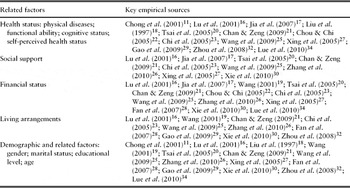
However, the studies included in this review identified some consistent factors related to the increased risk of depression with poor physical health, cognitive impairment and lower levels of functional ability. Moreover, the receipt of social support appeared to alleviate depressive symptoms. Additionally demographic and related factors including financial status, living arrangements, marital status, educational level and gender may affect the incidence of older people's depression. In general, older women who were divorced, separated, widowed or never married, living alone, with a poor financial status and of a lower educational level were prone to having depression (see Table 2). These factors appear to be similar to those found in some Western countries. However, as life circumstances and life experiences are different in different countries and different social contexts, further well-designed studies are needed to identify more culture-specific contributors to depression of older people, especially in vulnerable populations in China, in order to inform the delivery of appropriate social and health care interventions to maximize well-being. Of particular interest will be the impact of the demographic consequences of the ‘single child’ policy and family fragmentation caused by the labour market demand for employee mobility upon older people's lives. This demographic change is also evident in some Western countries where birth rates have fallen and children are relocating with their employment, cutting familial ties.Reference Jacobzone, Cambois, Chaplain and Robine51, Reference Lowenstein, Katz, Prilutzky and Mehlhausen-Hassoen52
Related factors of depression of older people in China

Conflicts of interest
The authors declared no conflicts of interest.